
£6.9 billion in gross gambling yield came from Great Britain's remote casino, betting and bingo sectors during April 2023 to March 2024, according to the UK Gambling Commission's industry statistics. That scale reframes the white-label discussion: you're not just buying a branded website. You're choosing the systems that record customer money, accept wagers and produce evidence when something goes wrong.
Table of Contents
- What a White Label Betting Platform Is
- White Label Turnkey and API Compared
- Business Benefits and Their Limits
- Casino Sportsbook Wallet and Compliance Together
- Payment Rails That Still Need Proof
- Launch Migration and the Security Boundary
- Licence Duty and Vendor Scorecard
What a White Label Betting Platform Is
A white label betting platform is a ready-built operating stack that a business presents under its own brand. It combines the customer-facing site with casino content, sportsbook services, player accounts, a cashier and back-office tools for running the operation.
Consider an operator launching a casino brand with plans to add sports betting. Players see its name, colours and promotions. Behind the interface, the platform connects games, records wallet movements, applies account restrictions and gives staff access to transactions and reports.
The distinction matters because casino and sportsbook aren't interchangeable products. Casino sessions generate game transactions and round results. Sportsbook customers place wagers that may remain open until an event finishes, with settlement, voiding and correction happening later.
The department-store analogy
Think of the platform as a department store. The brand on the door is yours, while the building services support different departments: casino, sportsbook, payments and customer operations.
The analogy has a limit. The trading permission belongs to the licensed entity, which may be the operator or another party under the specific arrangement. Branding a site doesn't establish who holds that permission, and buying technology doesn't transfer it.
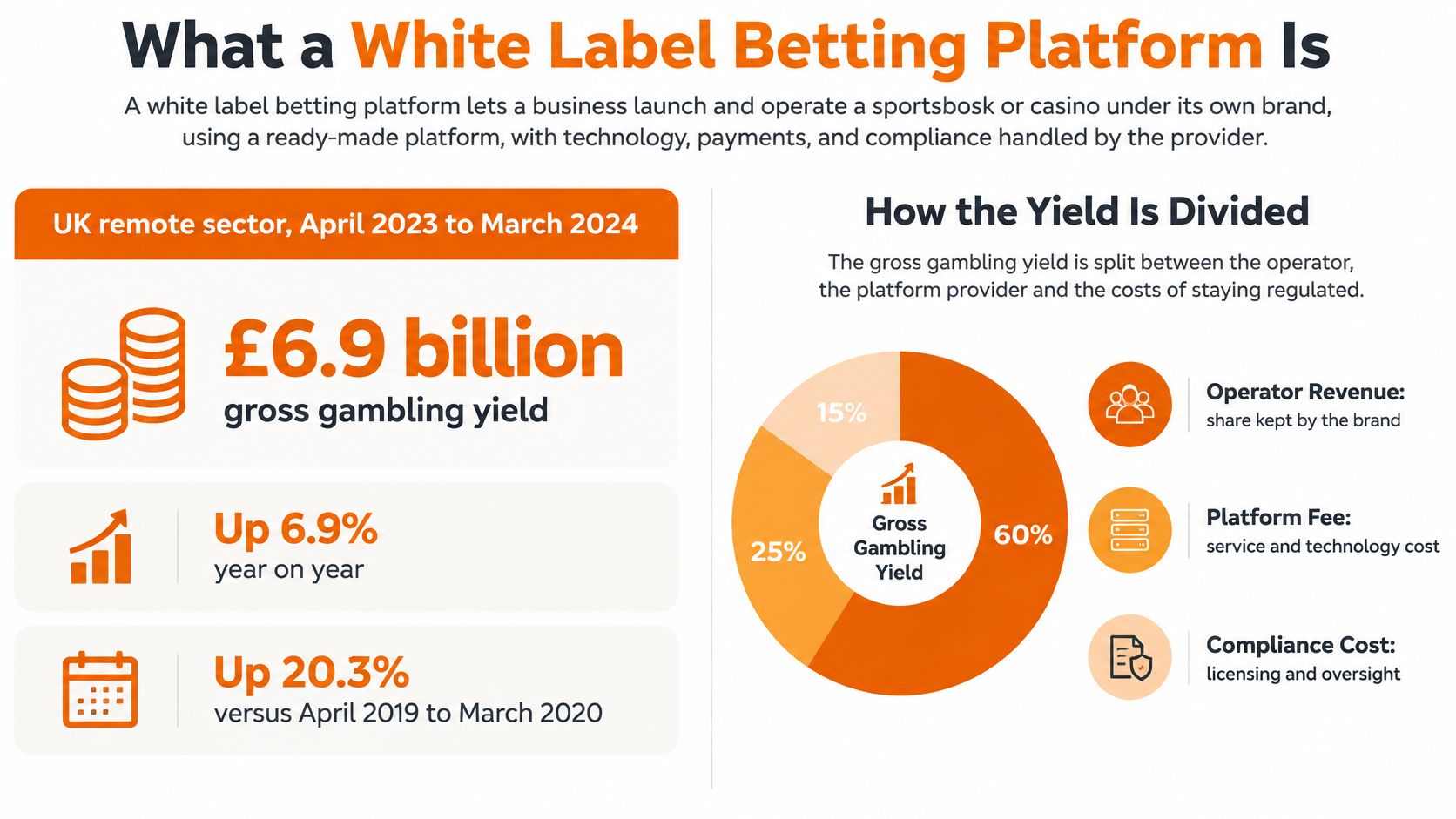
Treat platform fees, operator revenue and compliance expenditure as separate commercial categories. The sector's gambling yield isn't a published allocation between those costs, nor is it the operator's net profit.
What the operator actually buys
A useful platform specification separates the visible product from the operating machinery:
- Customer experience: Registration, navigation, game discovery, bet placement and account access.
- Transaction systems: Wallet debits, winnings, withdrawals, reversals and reconciliation.
- Operational tools: Account reviews, risk settings, customer-support permissions and reporting.
- Integration services: Connections to studios, odds suppliers, payment processors and identity providers.
The central buying decision isn't whether the homepage looks finished. It's whether the delivery model fits your team, the modules account for money consistently, and the licensed operation can demonstrate that its controls work.
White Label Turnkey and API Compared
| Model | What you receive | Typical time to first market | Control you keep | Best when |
|---|---|---|---|---|
| White label | Branded front end, casino aggregation, sportsbook, wallet and back office on a shared platform | Set by licensing readiness, payment approval and configuration acceptance | Brand and player relationship, subject to contract; platform changes require vendor support | A new brand needs both verticals without a large engineering team |
| Turnkey | Integrated modules plus hosting, deployment, monitoring and configured payment and compliance tools | Potentially the shortest route when little is built in house and approvals are ready | Commercial direction and agreed operational settings; less freedom to redesign the stack | The priority is an integrated casino and sportsbook operation |
| API or custom build | Odds, games, payments and identity services assembled into your own product | Set by integration scope, engineering capacity, certification and testing | Greater product and data control, alongside integration responsibility | An existing platform team must extend a stack it already runs |
White label describes the branded delivery arrangement. The supplier provides the underlying product, while the customer operates a distinct brand on it. Before signing, establish contractual ownership of customer records, domains, creative assets and export rights rather than assuming the label guarantees them.
Turnkey describes how much of the operating environment arrives ready to use. Hosting, monitoring, deployment and preconfigured integrations may accompany the software. That reduces assembly work, but it doesn't mean every operational decision or regulated task belongs to the supplier.
Labels aren't a specification
Vendors use white label and turnkey in overlapping ways. A turnkey white-label offer can reasonably describe both a branded product and a managed technical environment, but neither term explains the division of responsibility.
Ask concrete questions instead:
- Hosting: Who operates production infrastructure and authorizes deployments?
- Trading: Who changes margins, suspends markets and approves settlement corrections?
- Product: Who can alter the front end, and how are changes prioritized?
- Operations: Who configures bonuses, permissions and customer restrictions?
Buy the responsibility map, not the delivery label.
API integration is a different starting point. Your team retains an existing product and connects external capabilities to it. Reviewing a sportsbook API means examining authentication, event identifiers, wallet callbacks, settlement messages and failure responses, not just available markets.
For the payment side of that architecture, the payment integration security insights from Disputely are a useful companion resource when preparing technical due-diligence questions. Your acceptance tests should still demonstrate how credentials, retries and transaction records behave inside your own implementation.
Match the model to the team
White label or turnkey suits a first brand when the operator wants an integrated product without staffing every engineering discipline. Either can also support an additional vertical, provided the existing account and money flows remain coherent.
API delivery fits a team that already runs player accounts, a wallet and a customer interface it needs to preserve. Its advantage is control, not freedom from operational work. Judge each option against the casino, sportsbook, wallet and compliance modules it must connect, rather than treating the delivery model as a quality ranking.
Business Benefits and Their Limits
The business case for a white label betting platform should survive a spreadsheet review. Measure the work removed, the remaining dependencies and the operational result, rather than treating a polished demonstration as proof of savings.
Measure what changes
- Time to first market: Start the clock when licence scope and launch requirements are agreed. Track the path to a controlled soft launch, including processor approval, configuration, testing and staff readiness.
- Build cost avoided: Identify the game, odds, cashier and account-system work your team won't perform. Compare that with implementation fees, recurring charges and the internal staff still needed to supervise delivery.
- Cross-product use: Track whether eligible customers can use another vertical without unnecessary account or payment friction. Evaluate this alongside restrictions and responsible-gambling controls, not just promotional uptake.
The casino-led market picture makes a staged launch a reasonable scenario. An operator might begin with casino, then add sportsbook when its trading, support and reporting processes are ready.
In that example, the expansion should add sports markets, odds connections and settlement workflows to the established account structure. It shouldn't require customers to maintain a disconnected balance or staff to reconcile unrelated money systems.
Commercial test: A faster launch is valuable only if the operating costs and dependencies remain acceptable after launch.
Put boundaries around the savings
A shared platform reduces construction work, not every business obligation. Your team still needs to manage acquisition, customer communication, commercial performance and the supplier relationship.
Product freedom also has a price. A feature request may need vendor development, testing and release approval, even when the proposed interface change looks small. Record which settings your staff can change directly and which require a development request.
Before approving the business case, separate fixed fees, volume-linked charges and operator-retained costs. Include compliance staffing, customer support, payment reconciliation, disputes and migration assistance in the comparison. A platform quote isn't a complete operating budget.
Casino Sportsbook Wallet and Compliance Together
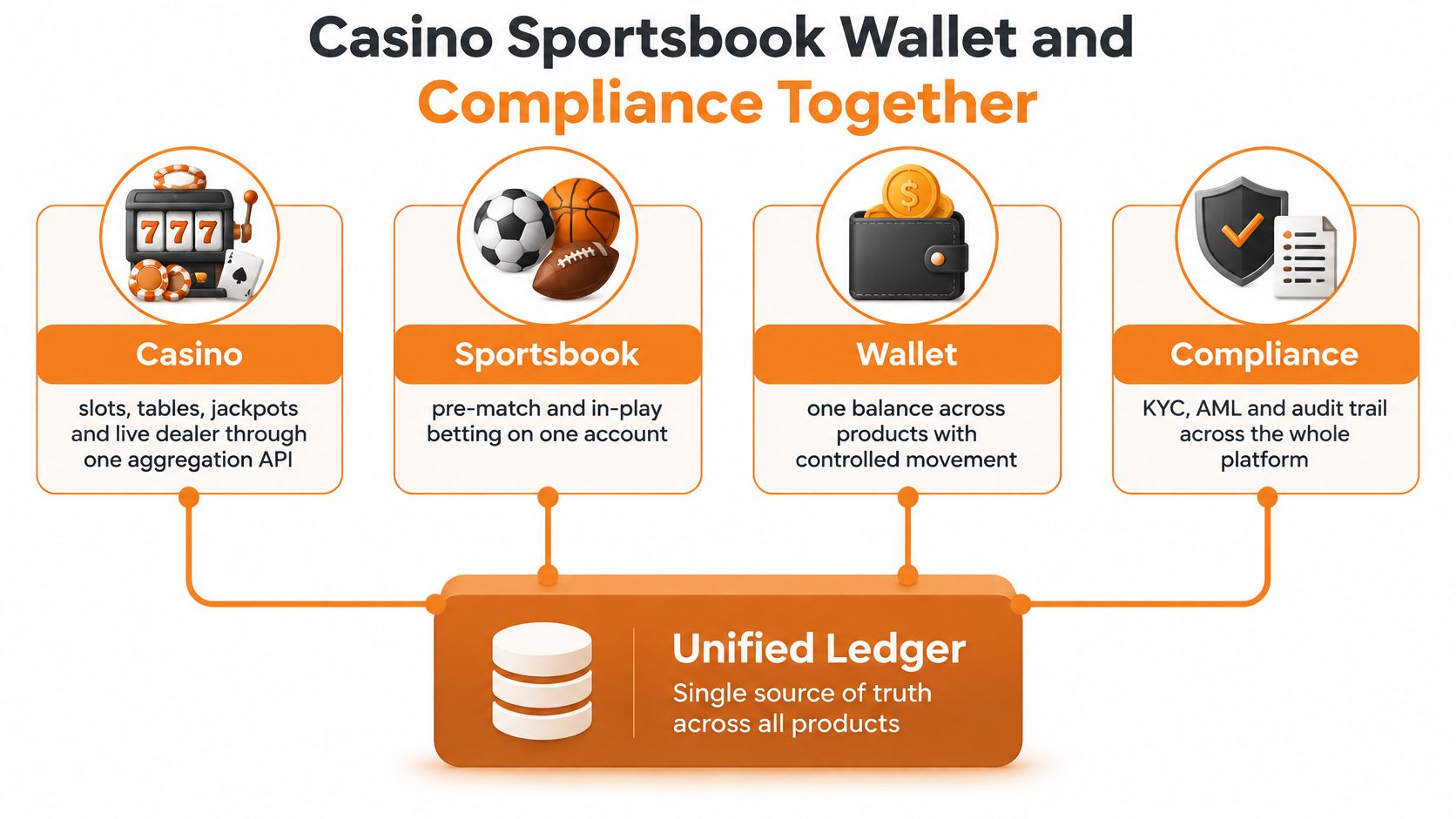
An integrated platform needs casino, sportsbook, wallet and compliance to work against a consistent transaction record. A common login isn't enough. Staff must be able to explain how an action in one product affects the customer's account everywhere else.
The modules behind the interface
Casino covers slots, table games, jackpots and live dealer. An aggregation API can simplify technical access to studios, but content availability, commercial agreements and market permissions still need checking.
The sportsbook handles pre-match and in-play markets, odds, margin settings, wager acceptance and settlement. These functions need an explicit distinction between a displayed price, a requested bet and an accepted wager.
The wallet records available funds, reserved amounts and transaction movements. Bonus funds and liabilities need their own clear treatment so a customer-facing balance doesn't conceal restrictions or unsettled commitments.
Compliance connects identity checks, AML reviews, location restrictions, responsible-gambling controls and reporting to actual customer actions. A restriction must affect the transaction path, not merely appear as a note in an administrator's screen.
Recovery matters as much as availability
The UK remote gambling and software technical standards require recovery from interruptions affecting gambling, including, where appropriate, voiding bets, suspending markets and retaining information needed to restore the pre-failure state.
Translate that requirement into a durable bet lifecycle. Useful states include accepted, rejected, suspended, settled, voided and reversed, with timestamps and recorded reasons for transitions.
Transaction writes should be idempotent: submitting the same instruction again must not create another wager or payment. A retry after a network timeout is normal system behaviour. Paying the same winning bet again isn't.
A practical failure-handling design should preserve:
- Acceptance evidence: The request, quoted odds version, market status and acceptance timestamp.
- Money linkage: The wallet transaction identifier and any reservation, debit or credit.
- Settlement authority: The result source, settlement instruction and correction history.
- Recovery context: The interruption, suspension decision and actions taken by staff.
An odds-feed outage should trigger a circuit breaker that prevents acceptance against stale prices. Settlement should match the provider's result to the platform's event and transaction records before winnings become available.
Say a settlement message arrives, but its acknowledgement is lost. The supplier retries. The platform must recognize the existing instruction and return its status rather than crediting the customer again.
That's especially important when the customer can immediately spend winnings in casino. Sportsbook recovery must preserve the integrity of the whole account, including money already committed elsewhere. Test both duplicate messages and out-of-order corrections before accepting the integration.
Payment Rails That Still Need Proof
| Rail | What it settles | Main exposure | Evidence to retain |
|---|---|---|---|
| Cards | Fiat deposits and withdrawals where supported | Chargebacks and stolen cards | KYC match, authentication result, dispute file |
| Bank transfer and SEPA Instant | Fiat, including near-instant payouts where offered | Name mismatch and fast fraud on instant payouts | IBAN ownership, sanctions screen, payout timestamp |
| Crypto | On-chain deposits and withdrawals | Unproven wallet ownership and source of funds | Wallet screening, transaction hash, travel-rule data where required |
| E-wallets | Transfers from a third-party balance | Shared or borrowed accounts | Provider identity plus the same applicable limits as other rails |
The useful cashier question isn't whether cards and crypto appear on a slide. It's whether each supported method can produce identity evidence, monitoring records, a reconciled transaction and a defensible withdrawal decision.
The Paypers' review of iGaming compliance and payments describes tighter identity expectations in markets including the UK and Germany, action against borrowed documents and payment cards in Brazil, the EU's MiCA framework for crypto-asset service providers, and pressure toward near-instant withdrawals through SEPA Instant. Treat those developments as reasons for jurisdiction-specific review, not as a universal rulebook.
Follow the money beyond authorization
A card authorization doesn't complete the operational story. Staff need to connect the processor reference to the player account, identify subsequent disputes and explain how refunds or withdrawals are handled.
Bank payments need equally clear ownership and reconciliation checks. A fast payout leaves less time to resolve an incorrect beneficiary or suspicious instruction before funds move.
Crypto requires an additional distinction: blockchain confirmation isn't proof of lawful ownership or acceptable source of funds. Retain the transaction hash, screening outcome and the reasoning behind any review. Where conversion occurs, record how the credited amount was established.
For e-wallets, don't assume the provider's account controls remove the operator's need to understand who funded the gaming account. Account sharing and mismatched identities still need an escalation path.
Test the complete withdrawal
A review of payment capabilities should cover the full journey, including failed payouts and reconciliation, rather than stopping at the deposit screen.
Use practical acceptance checks:
- Eligibility: Confirm the rail, currency and provider are permitted for the intended market and business arrangement.
- Consistent restrictions: Apply relevant account-wide deposit limits, affordability controls and self-exclusion regardless of funding method.
- Treasury readiness: Confirm liquidity, settlement finality and refund mechanics before offering the rail.
- Audit export: Retrieve the identity decision, screening result, processor reference and ledger entries together.
A blocked customer must not regain access by switching from fiat to crypto. Likewise, a withdrawal marked complete in the cashier must correspond to an identifiable payment and the correct ledger movement. Time the process in testing, then require staff to export the evidence without manually reconstructing it from unrelated dashboards.
Launch Migration and the Security Boundary
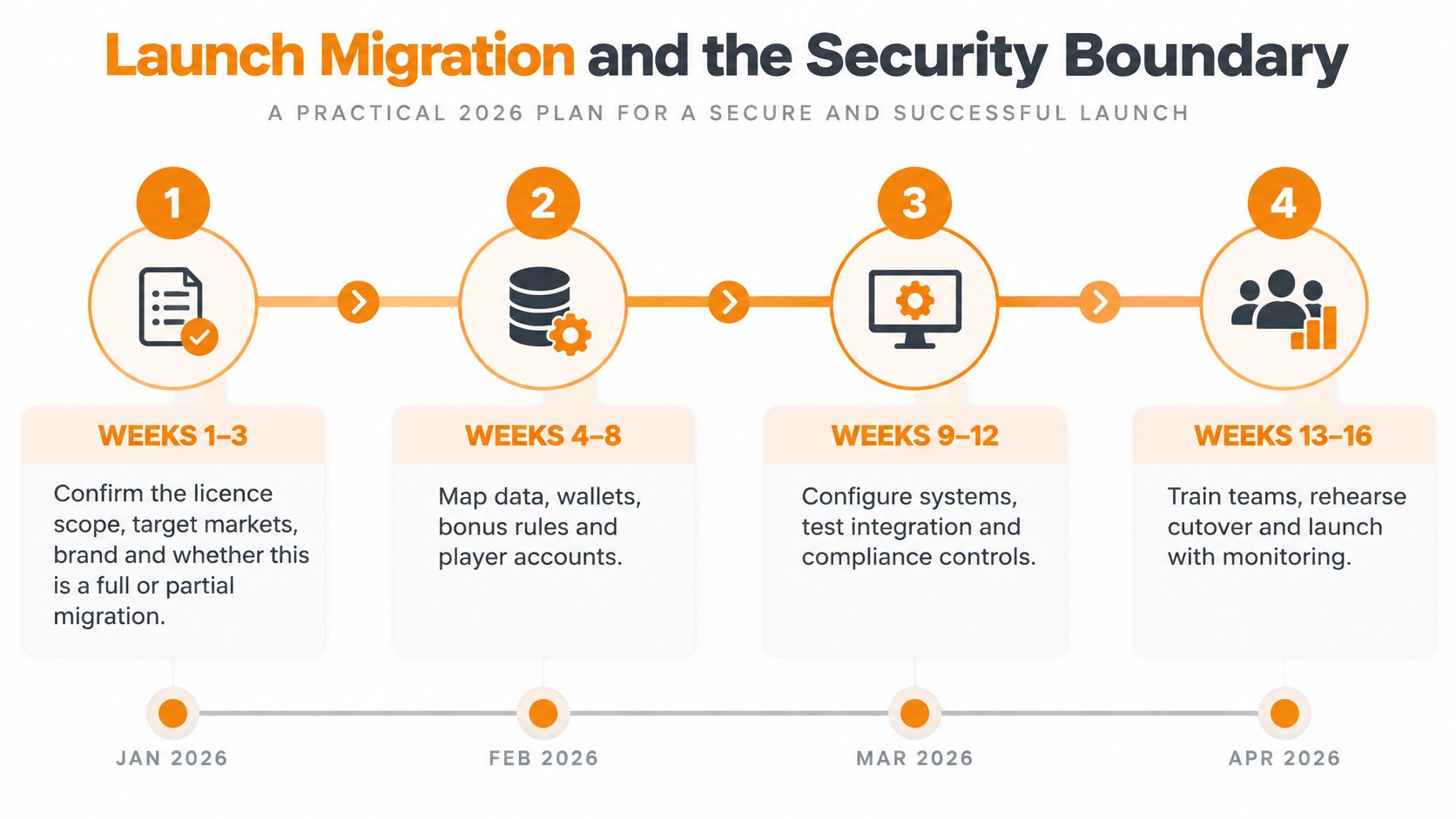
Plan a launch around acceptance gates, not an unsupported calendar promise. A new brand configuration, a new licence application and a migration of historical betting records are different projects, even when they use the same platform.
A launch sequence with clear exit criteria
- Confirm scope and authority. Document target markets, the licensed entity, approved services and whether the project is a new launch or a migration. For migrations, identify balances, bonus obligations, restrictions and open bets that must survive cutover.
- Map and integrate. Connect games, odds, payments and identity services in a segregated test environment. Agree how source records map to player accounts, wallet entries and operational rules.
- Validate controls. Complete applicable certification, configure market restrictions and reports, and approve supplier-security terms. Give support and compliance staff realistic cases rather than demonstration-only accounts.
- Rehearse and release. Run a migration rehearsal, reconcile results, train teams and conduct a controlled soft launch before expanding acquisition.
A new payment corridor, unresolved licence scope or incomplete historical records can delay release. Changing the site's colours generally isn't the critical dependency.
The roadmap is useful as a sequencing illustration, not a commitment to the calendar ranges shown.
Protect the systems that can change the outcome
The UK Gambling Commission's security requirements cover systems handling sensitive customer information, account balances, random numbers and the current state of a gamble, including systems providing direct access to them, and map controls to ISO/IEC 27001:2022.
Treat these components as a connected security boundary. Apply least-privilege access, secure authentication, cryptography, logging, network segregation and separation of development, test and production environments.
Supplier credentials should permit only the actions necessary for that integration. An odds-feed credential must not edit wallet balances. A payment connector must not modify settlement logic.
For a multi-brand environment, require logical tenant isolation with centralized monitoring. An administrator working for one operator shouldn't gain another operator's customer records through a shared support tool.
Cutover gate: Release only when the team can reconcile migrated balances, account for open bets and demonstrate restricted supplier access.
Force an outage during the rehearsal. Staff should identify which migrated wagers remain open, which were settled or voided, and why the closing balances still match. Keep the reconciliation report, credential-test results and release approval together.
Licence Duty and Vendor Scorecard
Outsourcing the platform doesn't outsource regulatory accountability. The UK Gambling Commission's guidance on third-party responsibilities states that responsibility for compliance on white-label sites remains with the licence holder and cannot be transferred, including oversight of social-responsibility and anti-money-laundering obligations.
Use the checklist as an evidence review, not a feature inventory.

A KYC button proves that an interface exists. It doesn't prove that a restricted customer can't deposit, that support follows the escalation procedure or that the licence holder can retrieve the evidence.
Licensing categories also need careful reading. The Malta Gaming Authority's annual-report publication records 28 new gaming-licence applications and 17 new licences issued during 2024. Those are separate measures, not an approval rate, and neither establishes that a particular entity may offer your intended service in your target market.
Assign ownership before scoring vendors
- Control ownership: Name the person responsible for each identity, limit, monitoring and reporting control.
- Regulator response: Identify who receives requests, approves responses and gathers supporting records.
- Data access: Establish how player and transaction exports are requested, delivered and validated.
- Testing: Retain self-exclusion and applicable affordability-control test records.
- Incident handling: Define escalation for a game, processor or affiliate breach.
- Supplier rights: Secure contractual inspection, remediation and exit rights.
Ongoing review needs a repeatable process. Teams can explore vendor monitoring software when organizing supplier records and follow-up tasks, then use vendor-management practices to connect that monitoring to accountable decisions.
Score demonstrated capability
| Criterion | Question to ask | Evidence to see |
|---|---|---|
| Shared ledger | Do casino and sportsbook debit one wallet? | Replay of an interrupted bet with balances matched |
| Control ownership | Who owns each KYC, limit and reporting control? | Named owner for every control |
| Regulator response | Who answers a regulator request, and how fast? | Sample regulator pack produced on request |
| Data export | How quickly can player and transaction data be exported? | Timed export from a test tenant |
| Supplier exit | Can the operator inspect or exit a supplier that breaches local rules? | Contract clause on inspection and exit |
| Tenant isolation | How is each operator tenant isolated? | Written isolation design with central monitoring |
| Timeline | Does the plan include licence scope and payments? | Milestones dated per market and payment rail |
Include us on the shortlist using the same standard: our NexGrate offering is a turnkey white-label casino and sportsbook platform, and our product pages cover Nex AI, Casino, Sportsbook API, Payments, Compliance and Markets. Those categories identify scope to examine, not a substitute for verifying the implementation.
Use the video alongside the written evidence review.
Mark each criterion as demonstrated, documented but untested, or unresolved. Also record who hosts, who configures margins and bonuses, and who can authorize production changes.
Don't let an attractive interface compensate for an unresolved ledger or inaccessible records. The decisive buyer question is practical: if a game, processor or affiliate breaks a rule, whose name is on the response?
We offer a turnkey white-label casino and sportsbook platform for operators launching and scaling their own brands. Visit NexGrate to review the platform scope, then bring your target markets, payment requirements and migration obligations to a discussion grounded in the evidence scorecard.