
You're choosing a stack for a new brand or a migration, and the key question isn't which homepage looks sharper. It's whether your backend can hold together licensing, wallet logic, payments, KYC, fraud controls, reporting, and sportsbook settlement without turning every change into a separate project. That's why a white label gaming solution should be judged like an operating system decision, not a design decision.
For most operators, the pressure comes from the same place. The launch window is tight, compliance is mandatory, and every extra vendor adds another integration point to test, monitor, and reconcile. A serious white-label model exists to compress that complexity into one managed stack, so your team can focus on brand growth without stitching the core infrastructure together from scratch.
Table of Contents
- What a White Label Gaming Solution Actually Is
- Core Modules Every White Label Gaming Stack Should Include
- Benefits and Trade-Offs of Going White Label
- Implementation and Migration Checklist for Operators
- Compliance, Crypto Support, and Multi-Jurisdiction Operations
- KPIs to Track After Launch
- Evaluating a White Label Vendor and What to Ask
What a White Label Gaming Solution Actually Is
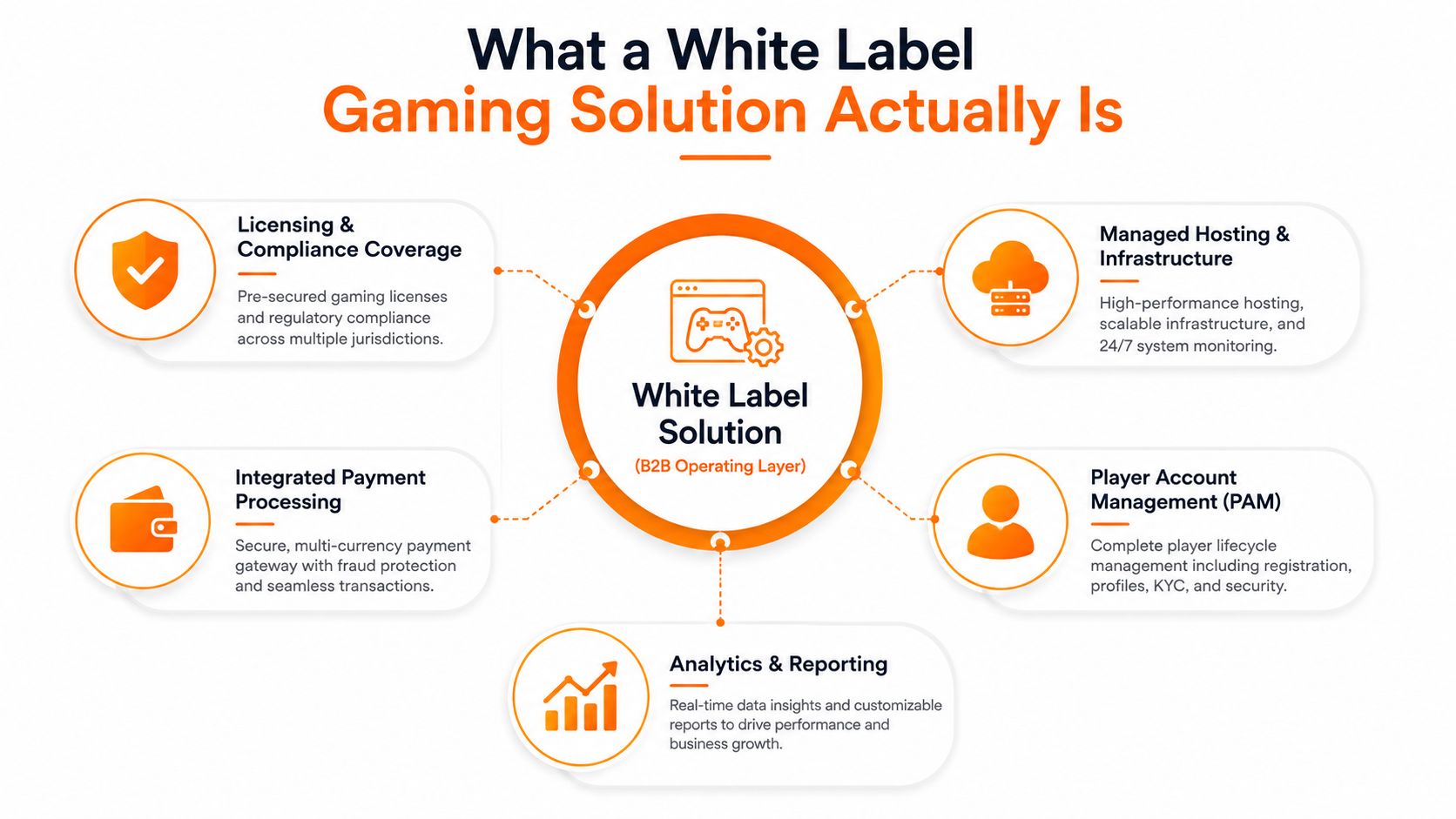
A white label gaming solution is a B2B operating layer that bundles the machinery of gambling operations into a product another company can rebrand and resell. In practice, that means licensing coverage, hosting, payment rails, customer support, KYC/AML workflows, fraud controls, content access, and back-office tooling are delivered as one managed environment, not as a pile of disconnected services. Regulus Partners describes these capabilities as modular components that can be bundled into white-label products for the online gambling market, and that framing is the right one because the operator is buying infrastructure, not a cosmetic shell. Regulus Partners overview of the online gambling B2B market
A team comparing build, buy, and white-label options usually starts with branding. That's the wrong starting point. The more useful question is whether the operator wants to own the whole operating stack, or whether it wants a pre-integrated system that already knows how to handle wallet balances, compliance records, settlement, and reporting in one place.
Practical rule: if the provider's stack can't explain how one wallet, one ledger, and one compliance layer work across casino and sportsbook, it's not a mature white-label architecture.
Modern white-label products have moved beyond simple casino templates. Industry descriptions now treat them as integrated casino-and-sportsbook platforms, with one back office, one wallet, and one compliance layer across multiple verticals. That shift matters because the operator no longer needs to coordinate separate systems for slots, live dealer content, betting markets, and player accounting. White-label casino solutions overview
The structural difference is easy to miss if you're only looking at the front end. A branded site can hide a messy backend for a little while, but it won't hide reconciliation problems, duplicated customer records, or inconsistent compliance logs. That's why platform architecture is the decision point, not the homepage theme.
Core Modules Every White Label Gaming Stack Should Include
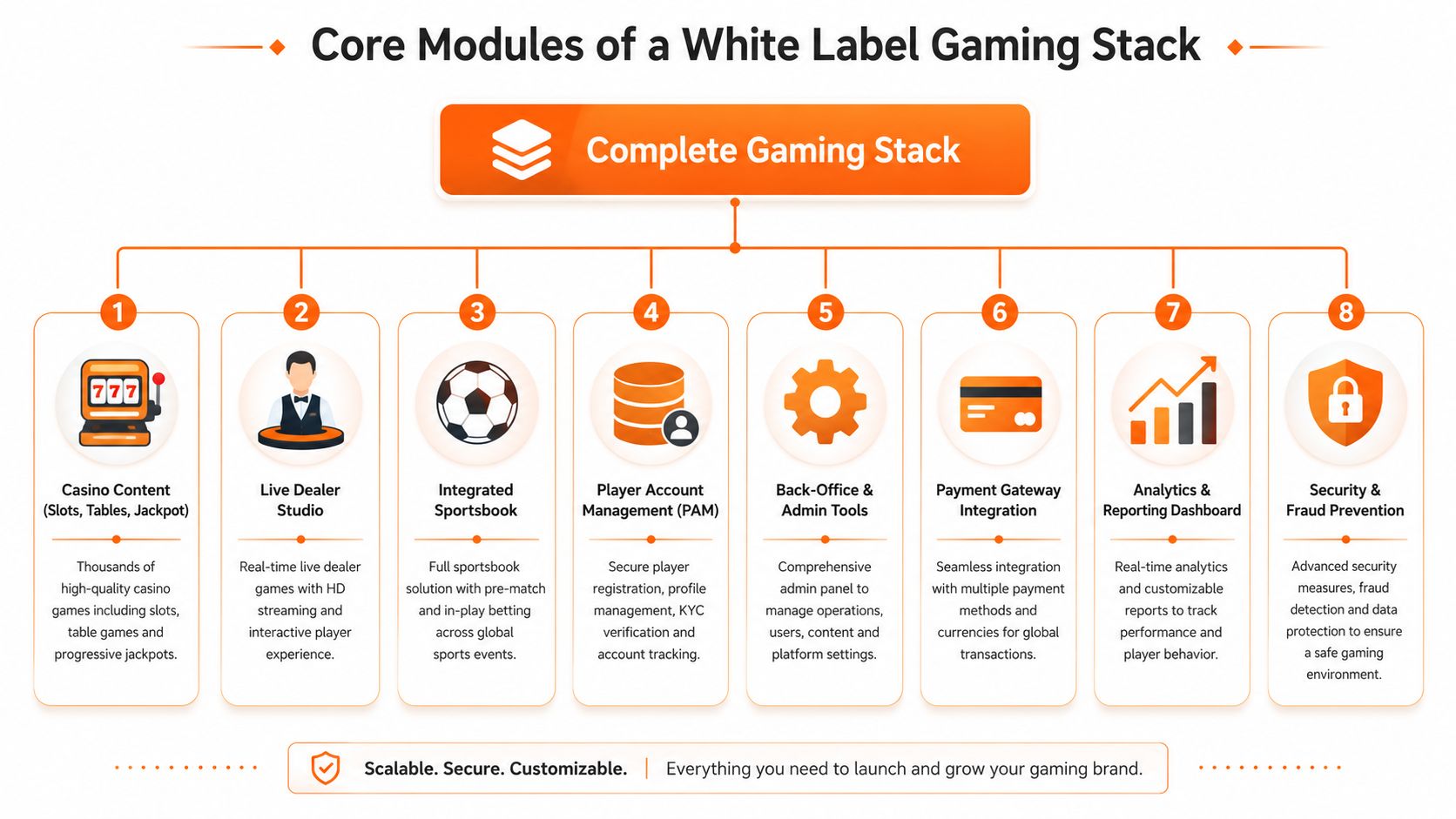
A mature stack starts with the modules that keep money, identity, and game state aligned. PAM, wallets, payment rails, KYC/AML, fraud monitoring, reporting, and provider integrations belong in the same managed environment, because each one affects the others. SoftSwiss describes that bundle as the core of a technically mature white-label setup, and that matches what breaks first when systems are loosely coupled. SoftSwiss knowledge base on white-label solution
Casino content and sportsbook need shared accounting
The casino side needs slots, table games, live dealer feeds, jackpots, and provider aggregation. The sportsbook side needs odds feeds, bet acceptance, settlement logic, and margin management. If those modules run on separate ledgers, every bonus, withdrawal, and adjustment becomes harder to reconcile, especially when a player moves between verticals in the same session.
Single-wallet design keeps balances, bonuses, winnings, and pending settlement inside one accounting frame, which reduces the risk of balance drift between verticals. In a regulated environment, that is not just a convenience. It is what lets finance and compliance teams trace activity without rebuilding the record from scratch.
Back office, payments, and controls must move together
The back office is where operators configure user roles, review risk signals, manage promotions, and track operational issues. Payments and cashier functions sit beside that layer, because deposit and withdrawal rules cannot be tuned properly if the back office is blind to transaction status. A technically mature stack bundles those layers so the operator is not gluing together a payment gateway, a KYC vendor, a risk engine, and an admin panel after launch.
A good vendor does not just show integrations. It shows how those integrations behave when a player deposits, triggers KYC, claims a bonus, bets on sportsbook, and then requests a withdrawal.
The operational advantage is centralized control. Atlaslive describes white-label platforms as including real-time reporting, centralized risk rules, responsible-gaming tools, and managed hosting with DDoS protection and uptime monitoring. That combination lets an operator enforce jurisdiction-specific limits and reporting without rebuilding the backend for every market or every brand. Atlaslive white-label iGaming glossary
A video walkthrough can help non-technical stakeholders see the moving parts more clearly.
Benefits and Trade-Offs of Going White Label
The main benefit is not speed by itself. It's speed with less integration debt. Regulus Partners notes that white-label launches can happen in 1 to 3 months, compared with the much longer timelines tied to building a regulated gambling stack from scratch. That matters because every month spent assembling plumbing is a month not spent learning your market, tuning your funnel, or proving retention. Regulus Partners overview of the online gambling B2B market
What you gain
You get pre-integrated controls for licensing, KYC/AML, risk, and compliance, which is especially useful in multi-jurisdiction operations. You also avoid the overhead of negotiating and integrating every component separately, which is where many first-time projects get stuck. A mature white-label stack can also reduce the chance of inconsistent balances and fragmented compliance records because the ledger, wallet, and reporting layer are already designed to work together. Regulus Partners overview of the online gambling B2B market
What you give up
You cede control to the provider in areas that matter later, not just on day one. Custom UX depth is usually narrower than in a full custom build, and your roadmap can become partly dependent on the provider's priorities. Vendor lock-in is real when the wallet, back office, reporting, and compliance logic are tightly coupled to one stack, because moving away later can mean migrating user data, transaction history, and settlement logic at the same time.
How to think about the economics
The model usually makes the most sense when the operator values launch certainty and operational consolidation more than deep system ownership. That doesn't make it cheap in every sense. It changes the cost profile from heavy upfront engineering to ongoing platform dependency, which is fine if the alternative is delayed launch or a brittle patchwork of services.
Decision rule: if your competitive edge is marketing, distribution, or regional execution, white-label usually fits. If your edge is proprietary product mechanics and deep backend control, you need a harder look at the long-term constraints.
Implementation and Migration Checklist for Operators
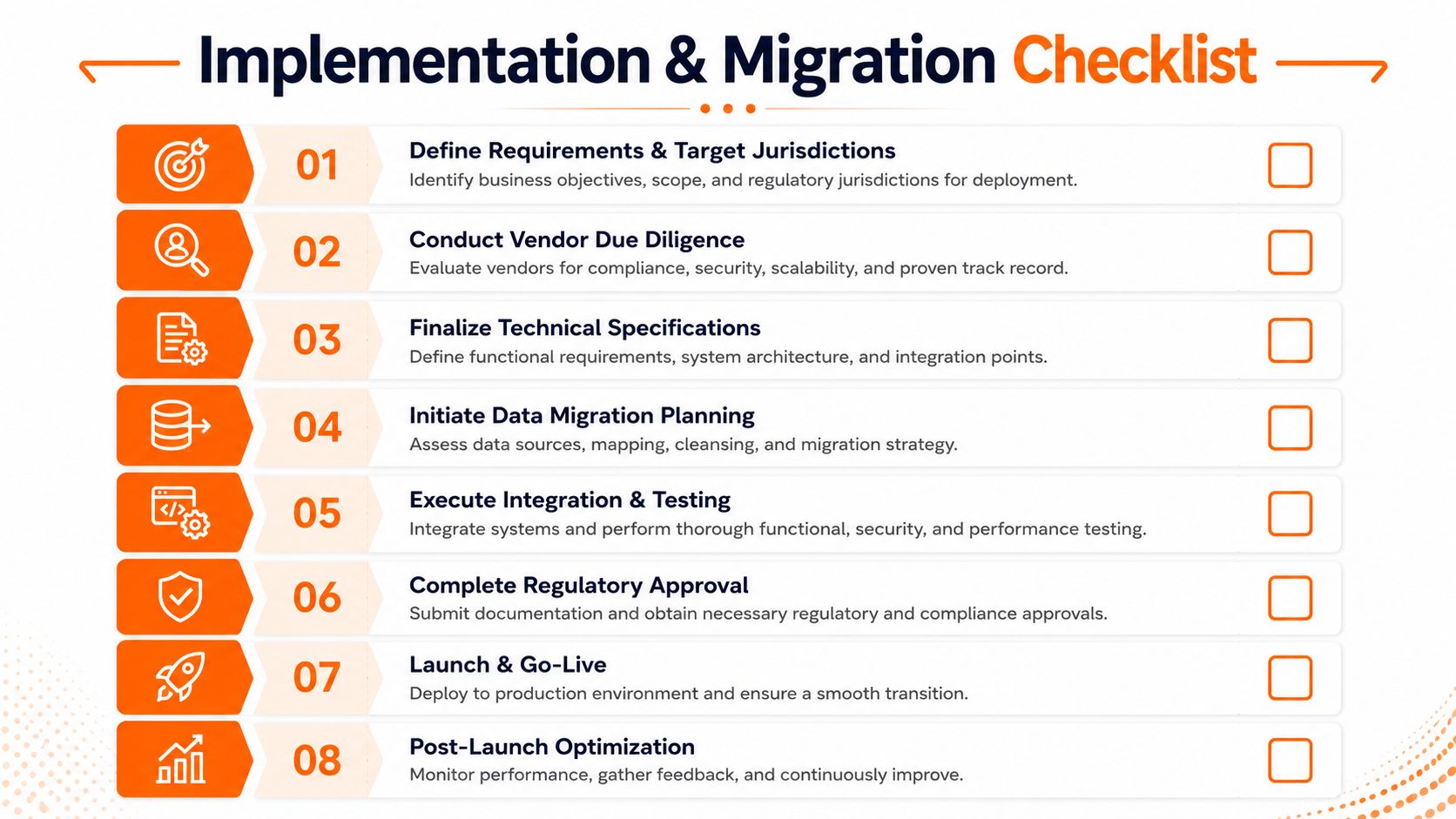
A launch fails most often where the operational handoffs are messy. The safest path is to treat implementation like a controlled sequence, not a single integration sprint. Scope first, then validate the vendor, then test the money flows, then open the doors.
The practical sequence
- Define requirements and target jurisdictions. Decide where you're launching, what verticals you need, and which rules the backend must support from day one.
- Conduct vendor due diligence. Ask for architecture diagrams, compliance scope, hosting details, and proof of how balances and settlements are handled.
- Finalize technical specifications. Lock down wallet behavior, cashier flows, bonus logic, game aggregation, and reporting outputs before custom work starts.
- Plan data migration early. Legacy player records, bonuses, balances, and transaction histories need mapping before cutover, not after.
- Execute integration and testing. Payment providers, KYC flow, content feeds, CRM, and analytics should all go through UAT with realistic player journeys.
- Complete regulatory approval. Make sure the regulator-facing configuration matches the operating model you intend to launch.
- Launch and go live carefully. A soft launch is safer than a hard cutover, especially when payment routing or provider aggregation is new.
- Stabilize after launch. Monitor failed deposits, pending withdrawals, KYC queue times, and content availability before expanding spend.
The migration path is similar, but with one extra burden, parallel run. Existing operators should keep the old backend active long enough to reconcile wallets, confirm transaction integrity, and compare reports across both systems. If you skip that phase, the first unresolved discrepancy becomes a finance issue, then a compliance issue.
The places where projects slip are predictable. Payment provider onboarding drags, content certification takes longer than expected, and regulator reporting needs a closer fit than the original workshop suggested. A good implementation plan assumes those delays are normal and builds slack into the sequence instead of pretending they won't happen.
Compliance, Crypto Support, and Multi-Jurisdiction Operations
A platform that cannot prove compliance becomes expensive fast. The test is whether the backend can keep jurisdiction-specific controls in one operating layer instead of forcing the operator into separate systems for each market. Audit logs, geofencing, responsible-gaming controls, KYC/AML workflows, and standardized reporting are the core of that setup, because they carry the compliance burden inside the platform itself. As noted earlier in the product framing, the stack has to function like an operating system, not a collection of add-ons.
Why compliance architecture matters
The operator needs a backend that shows who did what, when, and under which jurisdictional rule set. That means audit trails must stay stable, access controls must stay clean, and reporting must be exportable in a format finance and compliance can use. When those functions sit in one place, adding a new jurisdiction becomes a configuration task instead of a rebuild.
That same logic is why MGA-aligned accounting matters. The point is not the label, it is the discipline behind it, a single ledger, consistent player records, clear settlement logic, and reporting that can stand up to review. When those pieces live together, the operator can keep the compliance narrative intact from cashier through withdrawal. A backend built around compliance tooling and multi-jurisdiction readiness gives operations and finance the same source of truth instead of two competing versions of the books.
Where crypto fits
Crypto support is not a separate universe. It is a payments choice inside the same cashier and ledger model as cards and bank transfers. When fiat and crypto sit in one platform, the operator keeps accounting, settlement, and player balance logic in one place instead of splitting the flow across disconnected tools.
Crypto-friendly jurisdictions can open additional market opportunities, but they also raise the bar on monitoring and policy design. Volatility handling, custody boundaries, and withdrawal rules have to be set before launch, because the cashier cannot improvise those decisions after player funds start moving.
A platform that can handle both payment types without breaking the ledger is the difference between a usable option and an accounting headache. If crypto is bolted on later, the team usually ends up with two records sets and one reconciliation problem.
KPIs to Track After Launch
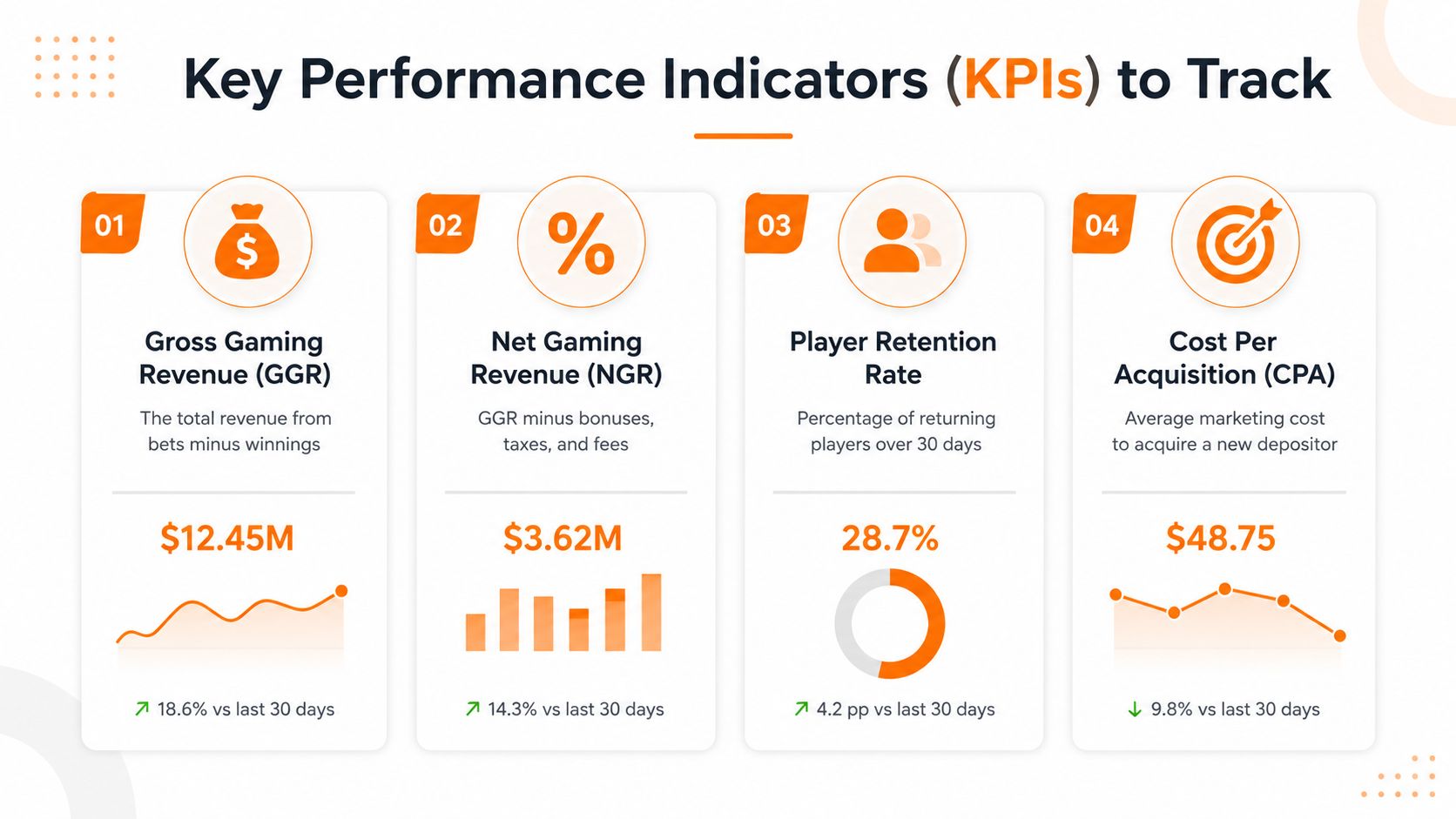
The platform is live only when the numbers are visible and trusted. Post-launch reporting should let finance, operations, and compliance look at the same facts without re-exporting data into side spreadsheets. The first metrics to monitor are GGR, NGR, player conversion, deposit success rate by method, KYC turnaround time, withdrawal time, bonus cost-to-revenue ratio, and uptime.
What each KPI tells you
GGR shows the core gross revenue from player activity before deductions.
NGR shows what remains after bonuses, taxes, and fees.
That distinction matters because marketing can look efficient on a gross basis while still producing weak net returns once promo cost is fully loaded.
Player conversion and activation tell you whether traffic is reaching funded accounts, not just landing on the site. Deposit success rate by method tells you where the cashier is leaking, which is often more useful than a broad payment approval summary. KYC turnaround time and withdrawal time tell you whether friction is creating avoidable abandonment or support load.
If the finance team can't slice reporting by tenant, jurisdiction, and product line, the platform is not ready for MGA-grade accounting, even if the dashboard looks polished.
How operators should use the numbers
- Bonus cost-to-revenue ratio: tune offers, free spins, and retention campaigns when promo spend outpaces the value of the players it brings in.
- Uptime: plan capacity, hosting resilience, and incident response when availability slips during peak periods.
- Withdrawal time: review risk rules and payment routing when cash-out queues build up.
- KYC turnaround time: adjust verification workflows and vendor thresholds when onboarding slows down.
A good reporting layer exports cleanly, filters by tenant, and preserves auditability. That's the difference between a dashboard for management and a record set that can support finance reviews, regulator requests, and internal investigations without cleanup work.
Evaluating a White Label Vendor and What to Ask
Shortlist vendors by asking four questions, not forty. First, can they prove architecture consolidation with one wallet, one back office, and one ledger? Second, can they show compliance depth through audit logs, jurisdictional controls, and reporting that maps to real regulatory work? Third, does the commercial model make sense for your launch horizon, including revenue share, fixed fees, integration cost, contract length, and exit rights? Fourth, is the roadmap credible on crypto support, live content, and marketing tooling?
What a serious answer sounds like
If the provider talks only about front-end branding, keep pushing. A serious platform discussion should include how balances are synchronized, how settlement works across casino and sportsbook, how responsible-gaming controls are enforced, and how reports are exported for review. Those are the questions that expose whether the stack is a true operating system or just a dressed-up site builder.
NexGrate is a useful contextual example because its public positioning lines up with those criteria, casino and sportsbook in one backend, payments including crypto, compliance controls aligned to MGA-style requirements, and a unified operating layer for B2B brands. That kind of packaging is what you want to compare against other vendors, because it tells you whether the platform is built for day-to-day operations or only for launch demos. Compare the platform structure and options
The decision summary
Choose the stack that reduces vendor sprawl, keeps the ledger clean, and gives compliance a system it can govern. If the answer to any of those points is weak, the platform will cost you later even if it looks efficient today.
If you're sizing up a white label gaming solution and want to see what a consolidated casino and sportsbook stack looks like in practice, NexGrate is worth reviewing. It brings together game content, betting, payments, and compliance controls in one operating layer, which is exactly the structure this decision demands. Visit NexGrate to evaluate whether that model fits your launch or migration plan.