
You're looking at a launch plan that seems straightforward. The brand is ready, the marketing concept is clear, and a provider promises games, payments, licensing support, and a functioning casino without a long custom-development project. The difficult questions usually appear later, when a payment is disputed, a regulator requests historical evidence, a market becomes unavailable, or you decide to move away from the platform.
A white label casino solution can be an efficient way to enter iGaming, but it's not merely a ready-made website. It's rented operational infrastructure, and the contract, architecture, compliance controls, and exit terms will shape the value of your business long after launch.
Table of Contents
- The Shift to Rented iGaming Infrastructure
- Core Components of a Turnkey Platform
- Evaluating Launch Timelines and Capital Requirements
- Navigating Compliance and Multi-Jurisdictional Scaling
- Protecting Brand Valuation and Data Portability
- Mapping the Implementation and Go-Live Roadmap
- Final Criteria for Selecting a B2B Provider
The Shift to Rented iGaming Infrastructure
The old assumption was that a new casino brand needed to assemble its own technology stack. That meant commissioning player account management, wallet logic, game integrations, cashier functions, reporting, fraud controls, and administrative tools before the brand could operate. A white label model changes the ownership question. Instead of building every layer, the operator rents an existing stack and concentrates internal resources on positioning, acquisition, customer service, and commercial execution.
That shift reflects a broader B2B market. A 2026 market forecast for white-label casino solutions estimates the category at USD 615.78 million in 2025, rising to USD 667.20 million in 2026 and reaching USD 1,129.76 million by 2032, implying a 9.05% CAGR across the forecast period. The same trajectory represents almost USD 514 million in additional market value between 2025 and 2032.
The commercial logic is clear. Operators want pre-integrated games, payment rails, compliance tooling, and reporting without carrying the full cost of maintaining each component themselves. Providers can standardize those systems across multiple brands, while the operator tests its proposition and builds a customer-facing identity.
What the operator is really renting
A modern platform is closer to a utility than a template. The front end may carry your logo, colors, domain, and promotional language, but the commercial risk sits deeper in the stack. The provider may control the account model, transaction sequencing, game availability, payment relationships, reporting format, and release schedule.
That arrangement works when the operating model matches the provider's assumptions. It becomes restrictive when your brand needs a different wallet structure, market-specific controls, unusual payment flows, or independent data access. The faster launch can therefore create a later dependency.
Practical rule: Treat the platform agreement as an infrastructure and data agreement, not as a website purchase.
The forecasted expansion helps explain why this model remains attractive in regulated markets. Standardized infrastructure can reduce development complexity while supporting expansion across jurisdictions, but only if the provider can apply local controls without forcing every market into the same configuration. Speed matters at launch. Operational independence determines whether the launch becomes a durable business.
Core Components of a Turnkey Platform
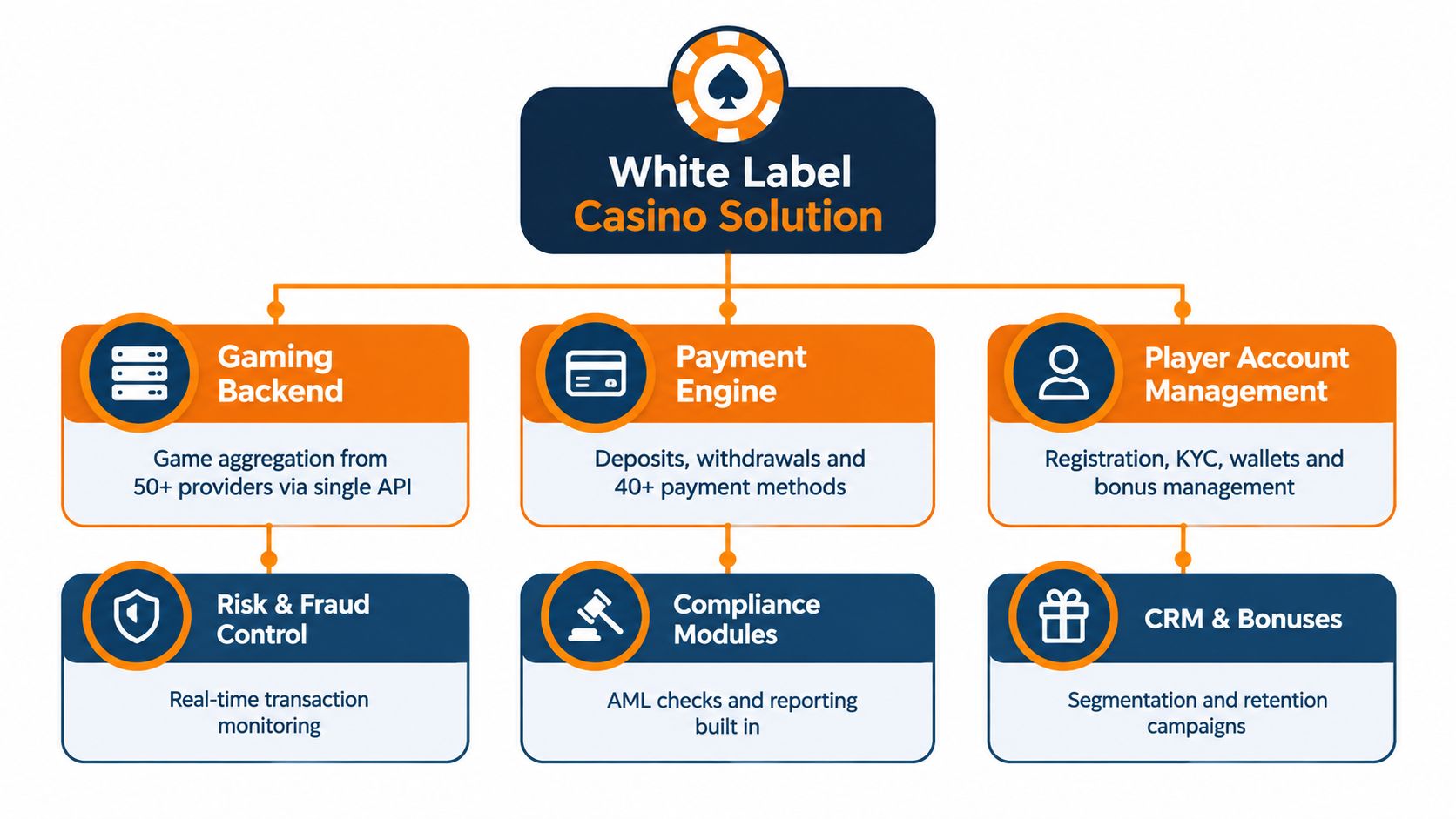
A provider's demo can make a platform look like a polished casino storefront. Operations teams should inspect the systems beneath it. A reliable white label casino solution has distinct layers, clear ownership, and audit trails that show what happened to an account, a payment, a bonus, or a bet.
Start with the player and wallet layers
The Player Account Management layer, or PAM, owns registration, authentication, player profiles, balances, verification status, bonus eligibility, and account restrictions. It should provide a single operational view of the customer rather than scattering identity and activity records across separate tools.
The wallet and transaction engine is equally important. It should record deposits, withdrawals, reversals, wagering movements, adjustments, and settlement events in a consistent ledger. If casino and sportsbook products share the same customer account, the wallet must distinguish product activity while preserving one reliable balance.
A fragmented wallet creates practical problems. Support agents may see one balance while finance sees another. A bonus may be credited in one system but not recognized in the account history. Reconciliation then becomes a manual investigation rather than a controlled process.
Examine content, payments, and control points
The game aggregation layer connects the operator to RNG and live-dealer content through a managed integration. Ask whether game status, round outcomes, errors, and provider identifiers remain visible in the back office. A sportsbook module can sit beside this layer, with pre-match and in-play markets, odds feeds, bet settlement, and margin configuration, but it shouldn't create a second operational identity for the same player.
Payment orchestration coordinates cashier presentation, gateway routing, risk checks, transaction status, and reconciliation. The system should support the payment methods your target markets permit, while showing why a transaction was approved, rejected, delayed, or reversed.
Compliance must operate inside these workflows. Technical guidance on white-label casino architecture identifies PAM, wallet and transaction processing, game aggregation, payment orchestration, compliance, and reporting as separate areas requiring explicit ownership and auditability. It also emphasizes enforcement at login, deposit, withdrawal, and game launch, where access or suspicious activity can be blocked before funds or bets are processed.
A practical inspection list looks like this:
- PAM: Can staff view account status, verification history, restrictions, and support notes in one place?
- Wallet: Does every balance change have an event, reason, timestamp, and reversible audit trail?
- Content: Can the operator disable a game, provider, market, or jurisdiction without waiting for a code release?
- Payments: Are gateway decisions, chargebacks, withdrawals, and reconciliations visible to finance and risk teams?
- Compliance: Do KYC, AML, geofencing, and responsible-gaming rules run at the required event points?
- Reporting: Can operations export regulator-ready records without requesting a custom report from the provider?
The platform is only as strong as its least auditable layer. A beautiful front end won't compensate for unclear transaction ownership or incomplete player history.
Evaluating Launch Timelines and Capital Requirements
The main financial argument for white label is not that it removes cost. It changes where the cost appears. A custom build demands engineering, product management, infrastructure, security, integrations, testing, and compliance implementation before the operator has meaningful market feedback. A rented platform replaces much of that upfront work with setup fees, recurring charges, revenue share, and provider dependency.
Industry commentary from SoftGamings on white-label casino software cites launches beginning in as little as 4 to 8 weeks and typical first-year fixed costs of approximately USD 50,000 to USD 200,000. Those figures are useful for initial planning, but they shouldn't be treated as a complete launch budget. Marketing, staffing, legal work, payment reserves, customer support, local compliance, and acquisition costs can sit outside the provider quote.
Compare the two routes honestly
| Decision area | White label model | Custom or deeper-control model |
|---|---|---|
| Initial deployment | Uses configured infrastructure and existing integrations | Requires platform construction and integration work |
| Capital profile | Lower upfront burden, with recurring commercial commitments | Higher development investment before launch |
| Technical control | Depends on provider permissions and roadmap | Greater control over architecture and releases |
| Compliance setup | Uses provider tooling, subject to license and market scope | Requires direct ownership of implementation and evidence |
| Exit options | Must be negotiated contractually | More direct control over migration assets |
| Best fit | Testing a proposition or entering a defined market | Building differentiated, multi-market infrastructure |
The first question isn't “How quickly can we launch?” It's “What must be live for a controlled launch?” A provider can configure a brand quickly, but payment-provider approval, verification workflows, bonus rules, game testing, customer support procedures, and regulatory review can still determine the critical path.
Model recurring exposure before signing
Request a complete commercial schedule. Separate fixed platform charges from revenue share, payment costs, game fees, support charges, compliance services, withdrawal costs, and migration fees. Also clarify what happens if a provider changes its commercial model or removes a payment route that your acquisition plan depends on.
A low initial quote can become expensive if the provider controls every operational add-on. Conversely, a higher fixed fee may be rational if it includes independent reporting access, flexible integrations, and clearly defined service levels. Evaluate total control and total dependency, not just the launch invoice.
Navigating Compliance and Multi-Jurisdictional Scaling
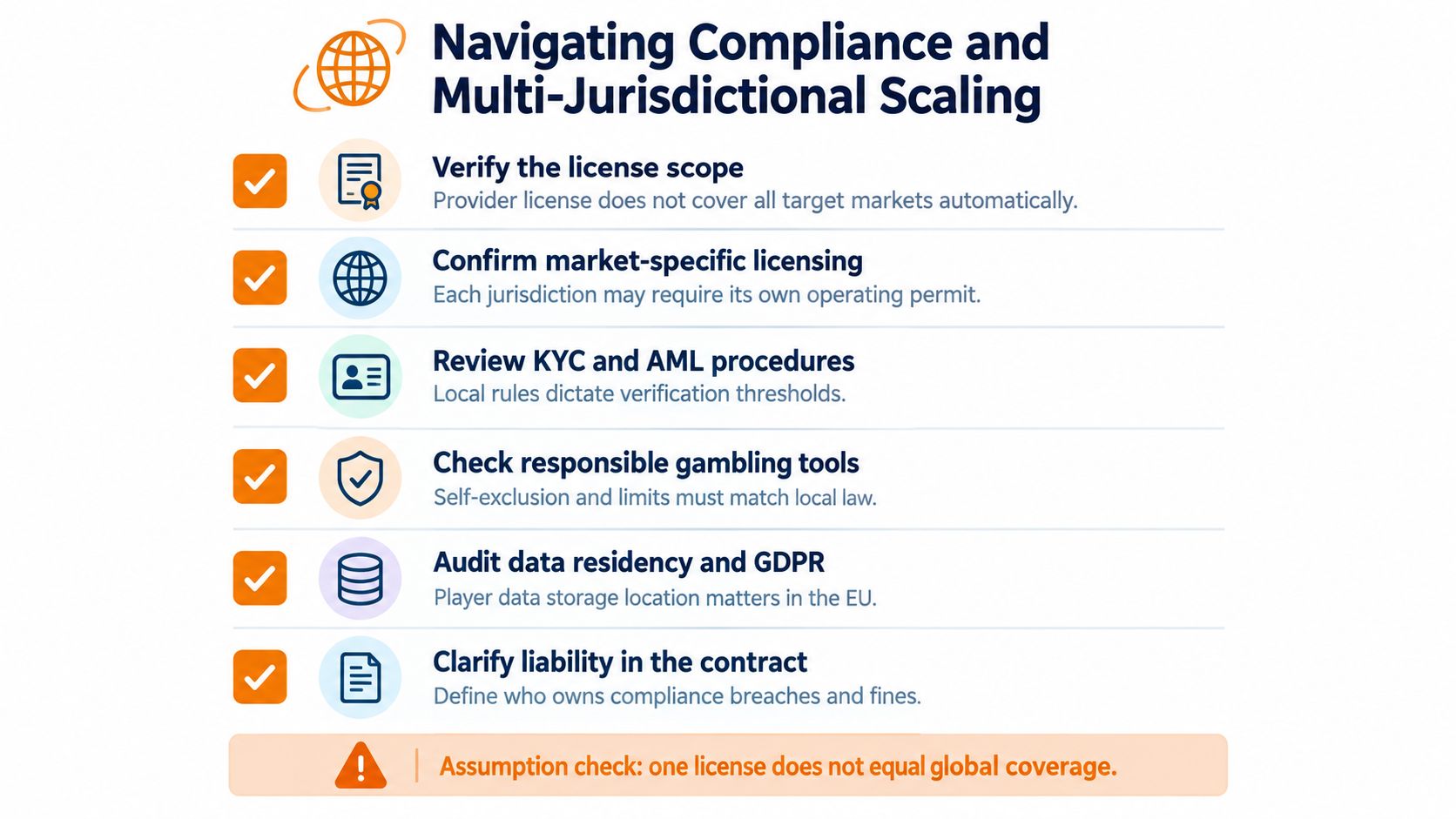
A provider's license isn't a universal permission slip. It may support a particular brand, entity, product, or territory, while your planned expansion requires separate approvals, local controls, or restrictions on marketing and payments.
The operational mistake is to treat compliance as a document collected before launch. In practice, compliance must influence event handling. The platform needs to know where a player is, whether the player has completed the required checks, whether the transaction presents risk, and whether responsible-gaming restrictions apply before the system accepts funds or permits play.
Build evidence into the transaction flow
The American Gaming Association's AML best-practice guidance highlights geolocation checks at the time of patron funding and withdrawal, particularly to prevent transactions from restricted, high-risk, or sanctioned regions. It also addresses customer due diligence and enhanced due diligence for high-risk customers, including politically exposed persons.
That means the platform should connect risk scoring, sanctions screening, location validation, identity checks, and case management to the cashier and account workflow. A spreadsheet assembled after an incident isn't equivalent to a decision log created when the transaction occurred.
Ask the provider to demonstrate:
- Location enforcement: What happens when a player logs in, deposits, withdraws, or launches a game from a restricted location?
- KYC progression: Can the rules require different evidence based on risk, product, jurisdiction, or transaction context?
- AML case handling: Can staff assign, investigate, escalate, and close cases with a durable history?
- Responsible gaming: Can the operator apply limits, self-exclusion, cooling-off, and account restrictions according to local requirements?
- Audit exports: Can compliance teams retrieve account, payment, decision, and communication records in a usable format?
Test the expansion boundary
Before selecting a provider, create a market matrix. For every target jurisdiction, record the required operating permission, available payment methods, data rules, responsible-gaming obligations, game restrictions, and marketing limits. Then map each requirement to a platform control and an accountable owner.
Independent analysis of white-label platform structures notes that operators can be constrained by the provider's license and market permissions, while some jurisdictions require local licensing rather than an umbrella arrangement. That makes multi-market capability a technical and legal question, not a sales-presentation feature.
A platform that launches one market quickly may still be unsuitable for expansion if it can't maintain separate rules, evidence, and reporting for each territory. Choose jurisdictional flexibility before you need it.
Protecting Brand Valuation and Data Portability
The most expensive white-label mistake often happens at the point of departure. The brand may have its name, audience, creative assets, and marketing history, but the provider may hold the player records, transaction ledger, bonus history, segmentation data, game activity, and reporting logic that make the business valuable.
Migration can be difficult for both technical and contractual reasons. Independent guidance on white-label platform exits recommends negotiating explicit export rights, access to a business-intelligence warehouse, and a documented exit route before signing. This is not a legal footnote. It's a condition of preserving buyer confidence and operational continuity.
Define the portable asset
Your agreement should identify the data you can export, the format, the frequency, and the assistance the provider must supply. Include:
- Player identity records: Registration fields, verification status, consent records, account restrictions, and communication preferences.
- Financial history: Deposits, withdrawals, chargebacks, reversals, adjustments, balances, and reconciliation records.
- Gaming activity: Bets, rounds, outcomes, settlements, provider references, and responsible-gaming events.
- CRM history: Segments, campaigns, bonuses, free spins, loyalty status, affiliate attribution, and player communications.
- Compliance evidence: KYC decisions, AML alerts, sanctions results, geolocation decisions, investigations, and audit logs.
- Analytics access: Documented schemas, warehouse access, dashboard definitions, and event dictionaries.
Don't accept “data export available” without a sample export and a migration test. Ask who pays for extraction, how quickly the provider must respond, whether the data is machine-readable, and whether historical records remain available after termination.
Protect the operating environment too
Portability includes more than CSV files. You may need integration documentation, wallet semantics, bonus rules, event definitions, payment mappings, and access to the reports used to manage the business. Without those elements, a new platform can receive player data but still fail to reproduce balances, restrictions, or promotional obligations correctly.
Infrastructure resilience also affects the value of the data you're trying to preserve. Review hosting responsibilities, monitoring, incident response, and DDoS protection for gaming infrastructure as part of the operational contract.
Negotiate notice periods, transition support, read-only access after termination, and a clear timetable for final exports. A provider should be a launch partner, not the only party capable of explaining how your business works.
Mapping the Implementation and Go-Live Roadmap
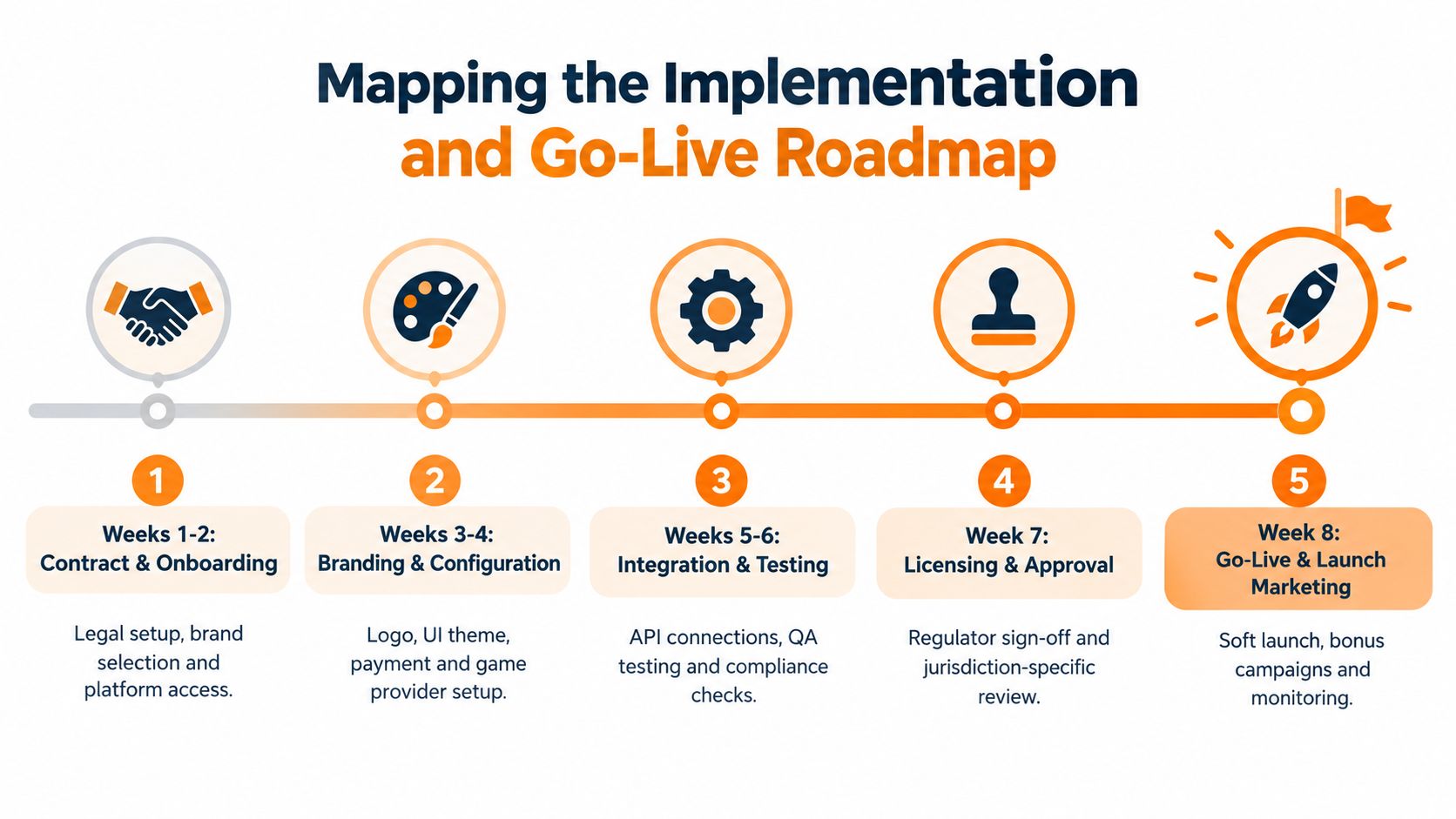
A fast launch still needs controlled sequencing. The project should move from commercial and legal certainty to configuration, integration, testing, approval, and monitored release. Marketing should not set a public launch date before payment, compliance, and settlement paths have passed operational testing.
Sequence the work around dependencies
Contract and onboarding comes first. Confirm the legal entity, license scope, target markets, commercial terms, data rights, support model, and named implementation owners. Request access to the provider's documentation and test environment early.
Branding and configuration follows. Apply the domain, visual identity, language, currency, game catalogue, payment methods, bonus rules, responsible-gaming settings, and customer-support workflows. Treat configuration as a controlled release, not a collection of cosmetic edits.
Integration and testing should cover account creation, KYC decisions, deposits, withdrawals, reversals, game launches, interrupted sessions, bonus wagering, sportsbook settlement where applicable, and reporting. Test failures deliberately. A wallet that works only in the successful payment path isn't ready.
Use a documented white-label casino integration process to assign owners for each API connection, provider approval, and test result. Payment-provider onboarding and market-specific reviews can delay an otherwise complete build, so track them as external dependencies rather than assuming the platform team controls them.
Make the release reversible
Run a soft launch with restricted operational exposure, then monitor payment exceptions, verification queues, game errors, support contacts, suspicious activity, and settlement reconciliation. Keep a written go-live checklist with approval from operations, compliance, finance, customer support, and marketing.
The final gate is not a green front end. It's the ability to explain every important player and money movement, respond to incidents, and pause a risky flow without waiting for an emergency release.
Final Criteria for Selecting a B2B Provider
Choose the provider that gives your operations team evidence, control, and a credible path forward. Front-end polish matters, but it's easy to change compared with wallet behavior, reporting structures, compliance dependencies, and historical data ownership.
Start with a live demonstration of the back office. Don't accept screenshots. Ask the provider to show a player moving from registration through KYC, deposit, bonus activation, gameplay, withdrawal, restriction, and support intervention. Watch whether each action creates a searchable event and whether staff can explain the resulting balance.
Score the platform on operational control
Use these buying criteria:
- Auditability: Every material account, wallet, payment, compliance, and settlement event should have an accountable record.
- Unified operations: Casino, sportsbook, payments, CRM, risk, and customer support should share the necessary identity and wallet context.
- Market adaptability: The platform should apply jurisdiction-specific geofencing, KYC, AML, responsible-gaming, reporting, and payment rules.
- Commercial clarity: Fees, revenue share, reserves, support charges, integrations, and exit costs should be explicit.
- Data independence: Export rights, warehouse access, schemas, historical retention, and transition assistance belong in the contract.
- Service resilience: Review monitoring, incident response, release management, security controls, and escalation routes.
- Expansion fit: Confirm that the provider's licensing model and market permissions match the markets you may enter, not only the first one.
A useful comparison of iGaming software providers should go beyond game count or template variety. Ask how each provider handles an outage, a disputed withdrawal, a regulator's data request, a sanctions alert, and a migration project.
The right decision is rarely the platform with the most features. It's the one that lets you launch efficiently while preserving the records, controls, and commercial negotiating power needed to operate independently later. Buy speed, but contract for control.
NexGrate provides a turnkey white-label platform that brings casino games, sportsbook operations, payments, wallets, compliance controls, reporting, and third-party integrations into one operating environment. If you're evaluating a platform with launch speed and long-term portability in mind, visit NexGrate to discuss the infrastructure and operating model your brand requires.