
Your trading team has connected an odds provider, the frontend displays markets, and the first live event is about to start. Then the problems arrive together. Prices update at different times, one feed uses unfamiliar market identifiers, the payment service follows another authentication model, and the bet slip shows a price that has already moved. The API call works, but the operation doesn't.
That gap defines sportsbook API integration in production. A sportsbook isn't connecting one endpoint to one screen. It's operating a high-frequency system that receives, transforms, stores, distributes, accepts, settles, and audits betting data while several external vendors change state independently.
The difficult work sits in the infrastructure between those providers. Teams that design only for the initial connection usually discover the actual cost during live events, when latency, rate limits, failover behavior, credential controls, and inconsistent schemas become trading and compliance problems.
Table of Contents
- Treating Odds Feeds as High-Frequency Infrastructure
- Architecting for End-to-End Price Freshness
- Securing Credentials and Managing Access Controls
- Normalizing Market Feeds and Mapping Odds
- Preventing Integration Sprawl Across Multiple Vendors
- Stress Testing and Validating Failover Mechanisms
Treating Odds Feeds as High-Frequency Infrastructure
A live football match can change score, incidents, market status, prices, and settlement data within seconds. A sportsbook that treats those changes as occasional REST responses may pass pre-match checks yet fail during the event, when traders and players need the same state at the same time.
Production targets must cover the full latency distribution. A technical integration guide recommends median latency of 50–80 ms, p95 latency under 200 ms, p99 latency up to 500 ms, and p99.9 latency under 2 seconds (sportsbook data integration latency guidance). These thresholds expose problems an average conceals. A healthy median can coexist with a slow tail, and that tail produces stale odds, rejected bets, and conflicting market states.
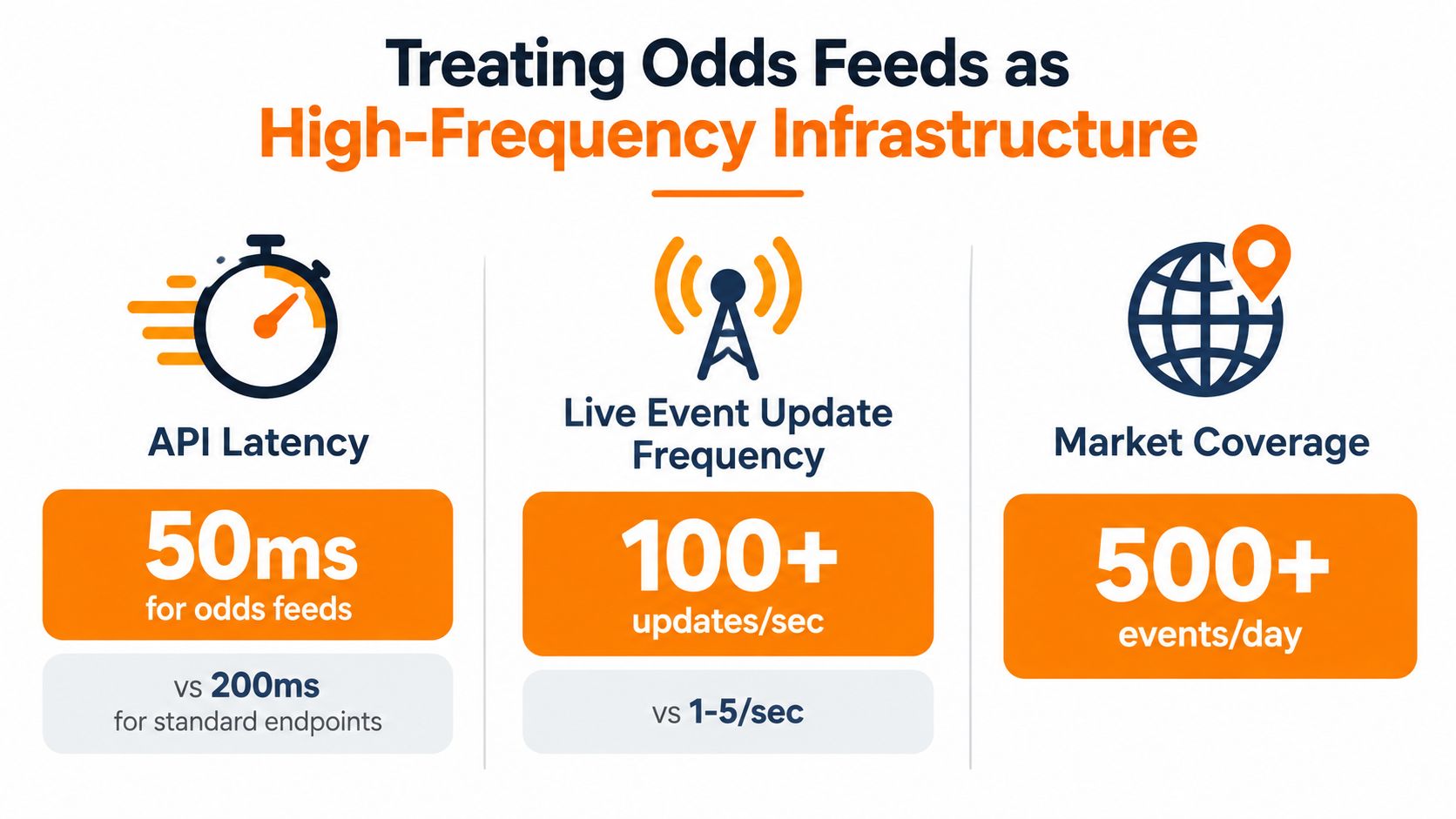
The same guide sets provider availability above 99.9% and data freshness of 1–5 seconds. Availability does not prove that the feed is useful. A reachable provider can still send old event states, so monitor transport health separately from the age of the latest accepted market update.
Size for the event, not the quiet period
Queue capacity directly affects trading control. The integration guidance recommends planning for 3x peak throughput and testing 10x current peak traffic before launch. This capacity absorbs bursts, retries, provider reconnections, market suspensions, and downstream consumers that temporarily process updates more slowly than the feed.
Keep provider receipt independent from normalization, persistence, risk evaluation, and client delivery. A listener that waits for a database write can turn one local slowdown into a delay across every market. Chaining several betting APIs multiplies that risk: each connection adds sockets, retry policies, rate limits, credentials, monitoring, and failure modes that the platform must operate.
Practical rule: Treat odds, scores, and settlement status as event streams with measurable age, not ordinary records retrieved only when a page requests them.
Measure what the player and trader experience
Record timestamps for provider capture, internal receipt, normalization, persistence, risk decision, and delivery. Those markers create a usable latency budget instead of hiding every delay inside one API metric.
Operational dashboards should answer four questions quickly: which provider is late, which market type is accumulating stale updates, whether the queue is growing because the provider or database is slow, and whether a secondary feed is safe to use. Those answers let traders suspend or reroute markets before an infrastructure fault becomes uncontrolled exposure.
Architecting for End-to-End Price Freshness
A player can select a price that has already changed while the API still appears healthy. Provider response time measures only one segment of the path. Production freshness depends on capture time, normalization and storage, and delivery time, plus the wait introduced by REST polling. A quick response to an old request still produces an old price.
With polling every 5 seconds, the platform may wait up to 5 seconds before requesting the next state. Provider refresh, transformation, database work, and frontend delivery add further delay, as explained in this analysis of live odds freshness. A 30-second polling interval can suit low-frequency workflows, but it is unsuitable for in-play trading.
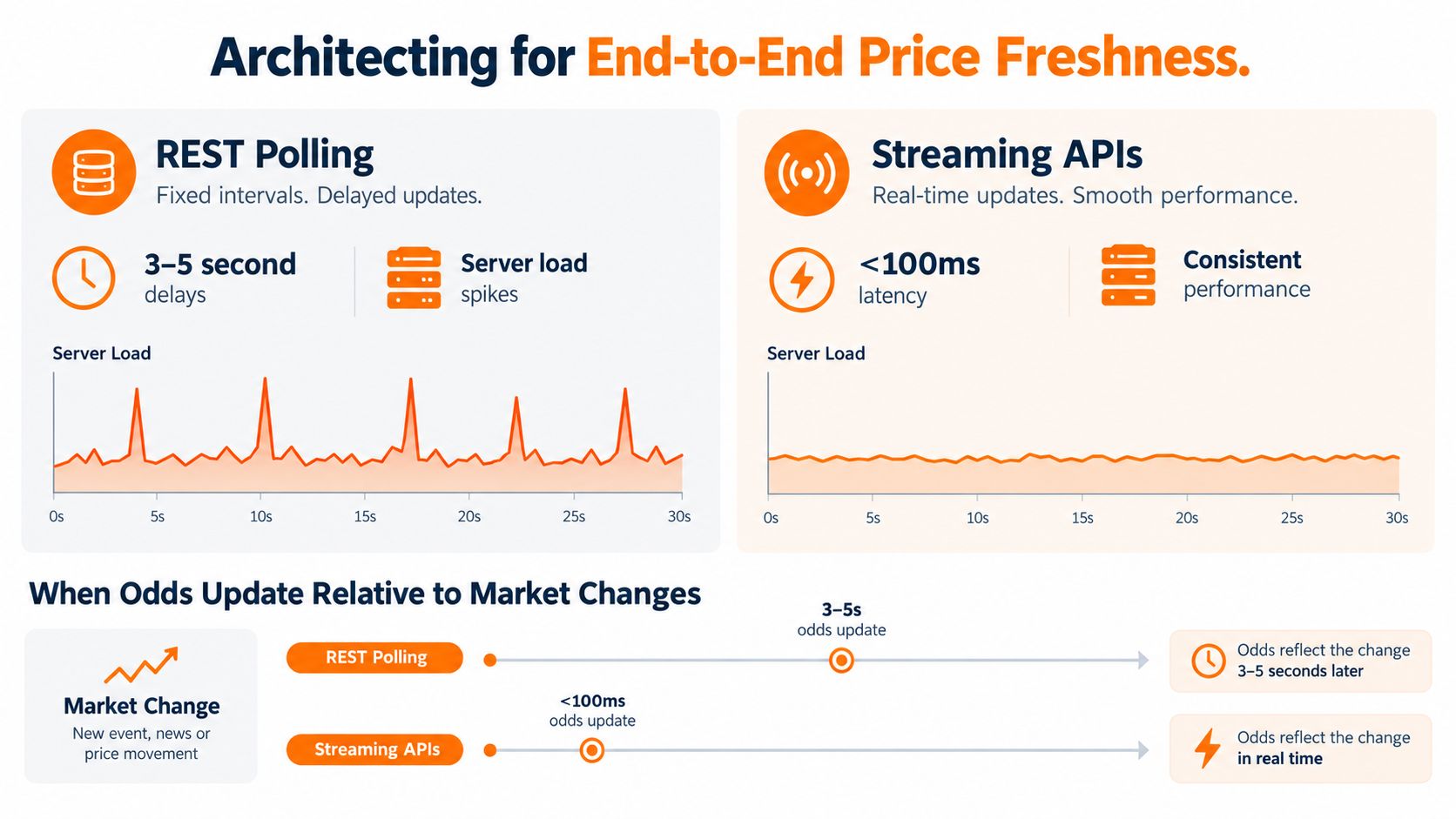
The same analysis describes polling-based odds updates at roughly 30–60 seconds and identifies SSE and WebSocket transports as the preferred architecture for freshness within the sub-second to low-second range. Choose the transport from the market's timing requirements, not from developer familiarity. Chaining several betting APIs also multiplies infrastructure costs, including connections, reconnect handling, queues, observability, and failure recovery.
Use each transport for its proper job
REST fits pre-match catalogues, event discovery, scheduled reconciliation, and batch workflows. It is easy to inspect, retry, cache, and connect to administrative tools. It becomes a poor choice when the platform must detect a market change immediately.
Streaming supports live markets, but it shifts operational responsibility to the integration team. Clients must handle reconnects, sequence gaps, duplicate events, provider heartbeats, backpressure, and orderly shutdowns. Those controls remove the repeated wait created by polling and provide a direct event path, provided the surrounding queues and consumers can keep pace.
A practical ingestion design separates provider receipt from downstream work:
- Capture the provider event immediately. Preserve the provider event identifier, capture timestamp, source, and raw payload.
- Normalize without destroying provenance. Map the message into an internal schema while retaining original values for investigation.
- Persist state and event history. The current market view serves the bet slip, while immutable events support replay and reconciliation.
- Deliver through controlled fan-out. Trading, risk, settlement, analytics, and frontend services should consume one managed internal path instead of maintaining separate provider connections.
- Monitor freshness per event. Alert on age, sequence gaps, rejected messages, and stalled streams, not only on HTTP errors.
Do not let caching disguise stale prices
Caching can protect an upstream service and reduce repeated reads, but it must expose the age of a live price rather than hide it. Cache pre-match data according to its business value. For in-play markets, use event-driven updates and pass freshness metadata to the services deciding whether a bet can be accepted.
The bet slip also needs an explicit re-acceptance flow. If the price or market status changes between selection and placement, explain the change and request confirmation under the operator's rules. Silent substitution creates disputes. Unconditional acceptance creates pricing and risk exposure.
Securing Credentials and Managing Access Controls
A sportsbook API key can expose market data, trading actions, settlement workflows, or wallet operations. Treat every credential as a production control, not a configuration value. Store secrets in a managed vault, keep them out of frontend code and repositories, and grant each service only the permissions its job requires. A trading connector should not share access with a settlement worker.
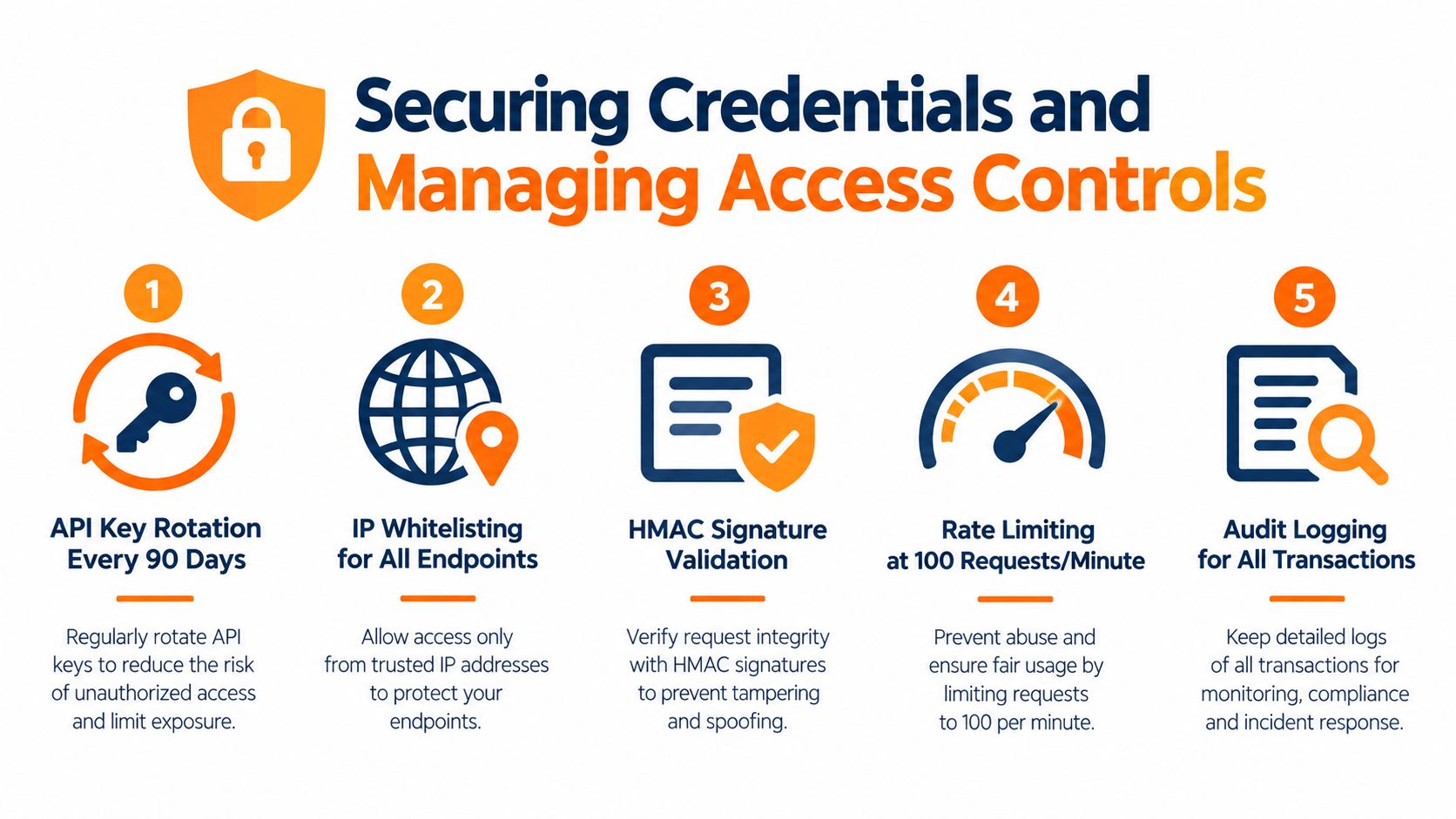
The technical guidance recommends credential rotation every 90 days, primary and backup credentials, audit logging for every credential use, and IP allowlisting where supported (credential security recommendations for sportsbook integrations). Rotation requires a live key-change procedure that supports overlap between credentials, verification, and rollback. Test it before an incident reveals that an inactive backup key has expired or that deployment configuration still references the old secret.
Build an access model that auditors can follow
Use separate identities for ingestion, trading actions, settlement, payments, and administrative tooling where providers support that separation. Log the service identity, requested operation, provider response, correlation identifier, environment, and outcome. Protect these records from alteration, retain enough context for investigation, and connect them to incident response procedures.
IP allowlisting creates a useful network boundary, but it does not replace secret management or request validation. For signed requests, check the signature, timestamp, nonce, and replay behavior. For inbound webhooks, verify authenticity before accepting a settlement or account event into the internal message bus.
Apply rate limits inside your platform as well as in provider contracts. Set controls per provider and operation, then assign different priorities. A rejected analytics request should not delay a market-status update or settlement message.
Security principle: The integration layer should make misuse visible, attributable, and reversible.
Align security with operational risk
Credential controls belong alongside exposure limits, wallet permissions, and deployment approvals. The risk management practices for iGaming teams apply because an API incident can cross operational boundaries quickly. A compromised data key may start with unauthorized extraction, while a trading or wallet credential can affect financial operations.
This walkthrough covers mapping service identities to credential scopes. Use it as a checklist prompt when engineering, trading, and compliance teams review access boundaries.
Review credentials on a schedule, remove unused access, and rehearse emergency revocation through a documented runbook. Auditors generally need evidence that approvals, logs, and deployed configuration match the stated controls, not merely a policy document.
Normalizing Market Feeds and Mapping Odds
Connecting a provider is only the first implementation task. Production complexity appears when one supplier calls a market “moneyline,” another assigns an internal code, and a third models the same selection with different participant, period, or settlement fields. The bet slip needs one stable language, even when upstream systems do not share one.
Build the normalization layer around identity, market meaning, price representation, status, and settlement rules. Mapping display labels alone creates silent errors. A selection may appear correct while its period, line, participant, or settlement behavior remains wrong.
Design a canonical model with an escape hatch
A canonical schema should cover the fields downstream services require:
- Event identity: Provider and internal identifiers, sport, competition, participants, start time, and jurisdictional availability.
- Market identity: Market family, period, line, selection, handicap or total, and source mapping.
- Operational state: Open, suspended, closed, resulted, void, and settlement metadata.
- Price history: Source timestamp, internal receipt timestamp, price version, and the event that caused the update.
- Provenance: Provider, feed type, transformation version, and trace identifier.
Keep an escape hatch for fields the canonical model cannot yet classify. Store unmapped provider data separately instead of forcing a new market into an inaccurate category. The platform retains the original information while the mapping team confirms its business meaning.
Aggregators can offer broad market coverage. The Odds API documents live odds, player props, edge detection, and historical snapshots from 50+ sportsbooks across 26 sports, while another platform advertises 365+ bookmakers across 34 sports (documented sportsbook and market coverage). More coverage means more mapping rules, test cases, and monitoring work.
Control rate limits and data volume
A provider may publish limits such as 2,500 requests every 15 seconds for standard endpoints and 250 streaming connections every 15 seconds for newer connections. The same documentation describes these constraints. Build a connection manager and request scheduler so application services do not call the provider independently.
The same documentation also describes plan volumes of 20,000 data points per day and 200,000 per month on a free plan. Treat those figures as capacity constraints, not permission to poll harder. Use streaming where freshness requires it, deduplicate events before storage, and retain historical snapshots only when trading, analytics, or compliance has a defined reason.
A unified wallet and bet slip should consume normalized events rather than provider-specific payloads. This keeps fiat and crypto account workflows separate from feed implementation while preserving the traceability needed to explain a price, acceptance decision, or settlement result.
Preventing Integration Sprawl Across Multiple Vendors
One provider rarely covers every sport, jurisdiction, uptime requirement, and market type. Adding vendors improves options only when the platform can control the resulting operational load. Every direct connection introduces another authentication model, schema, maintenance calendar, rate-limit policy, retry strategy, and failure mode. In a live betting system, those differences create infrastructure work and latency risk, not just configuration tasks.
The post-contract burden often appears during production operations. Feeds can use different formats and authentication logic, and each direct integration adds another path to monitor, test, secure, and support during live events (multi-provider gateway guidance). A gateway reduces that sprawl by giving product services one controlled interface while isolating vendor-specific behavior.
Put a gateway between vendors and product services
Product services should request a normalized event or market view. They should not need to know whether the source is a REST endpoint, WebSocket stream, or backup supplier. The gateway should own connection state, freshness checks, routing, retries, and provider-specific errors.
| Gateway responsibility | Why it matters |
|---|---|
| Connection management | Keeps reconnects and provider heartbeats out of betting services. |
| Schema translation | Prevents provider identifiers from leaking into the bet slip and wallet. |
| Routing policy | Selects a source by sport, market, jurisdiction, freshness, or health. |
| Circuit breaking | Stops repeated calls to a failing vendor from spreading an outage. |
| Replay and reconciliation | Lets operations rebuild state and investigate discrepancies. |
| Vendor observability | Compares freshness, errors, gaps, and response behavior consistently. |
This architecture does not remove complexity. It puts the complexity at one boundary, where engineers can test it, measure it, and change a supplier without editing the entire platform. The trade-off is another service to operate. That cost is usually easier to control than duplicated vendor logic across betting, wallet, trading, and settlement services.
Make vendor oversight a technical discipline
The same analysis notes that every provider can have distinct integration requirements, maintenance schedules, and performance metrics. Weak documentation or limited test environments can delay development and contribute to downtime. Procurement should involve engineering, trading, security, and compliance before contracts are finalized.
The vendor management practices for sportsbook operations should be part of the integration runbook. Record ownership, escalation paths, change-notice requirements, sandbox availability, schema versioning, service credits, and exit procedures. A provider's technical quality matters, but so does the operator's ability to isolate or replace it without rebuilding product services.
A backup vendor is useful only when the platform can switch to it without creating a second outage.
Avoid combining prices until the business has defined precedence, timestamp tolerance, market equivalence, and dispute handling. The gateway should prefer a trustworthy current event over an attractive price from a delayed source. That policy protects trading decisions and prevents vendor expansion from becoming uncontrolled operational sprawl.
Stress Testing and Validating Failover Mechanisms
A failover design that exists only in a diagram will fail at the first operational surprise. Test it while the primary provider is healthy, then under conditions where the stream remains connected but stale, the API returns errors, messages arrive out of order, or settlement acknowledgements are delayed. Each test should measure detection time, market protection, routing behavior, and recovery.
The infrastructure guidance cited earlier recommends validating queue capacity against projected peak demand. Add production-shaped replay to that exercise, with event sequences that reflect real trading pressure rather than generic requests. Reproduce score changes, suspensions, price movements, cancellations, reconnects, duplicate messages, and settlement events through the complete ingestion path. Replaying these events at peak load exposes hidden costs in queues, retries, storage, observability, and downstream services.
Test the failure modes that affect money
A pre-launch exercise should include:
- Feed interruption: Stop the primary stream and verify detection, market handling, and controlled routing to the backup.
- Stale data: Keep the connection open while freezing event timestamps. The system must detect freshness failure instead of treating transport availability as data validity.
- Schema drift: Send unknown fields, missing fields, and new market variants. Confirm that unsupported messages are quarantined without stopping known markets.
- Queue pressure: Apply the planned load profile and observe lag, memory use, retry behavior, and downstream recovery.
- Settlement mismatch: Delay or duplicate result events, then reconcile bet, wallet, and reporting records.
- Credential failure: Revoke the active credential and prove that rotation or backup access works without uncontrolled retries.
- Regional controls: Confirm that market availability and compliance decisions remain enforced during provider switching.
Test invalid business states as well as transport failures. A provider can return valid JSON for an event that is already suspended, while a reachable backup can provide data too old for in-play use. Define the response for each condition, including whether to suspend markets, reject prices, or require manual trading review.
Roll out in stages
Use a sandbox for contract tests, an isolated environment for replay and load tests, and a limited production release for operational validation. Release by sport, market family, jurisdiction, or traffic cohort. Keep rollback independent of provider connectivity, so a frontend deployment cannot prevent trading from suspending markets.
Monitoring should expose technical and business signals:
- Feed freshness and event age
- Queue depth and consumer lag
- Provider error classes
- Reconnect frequency and sequence gaps
- Price-change rejection and re-acceptance outcomes
- Settlement reconciliation exceptions
- Credential and permission failures
- Wallet and bet-state mismatches
DDoS resilience belongs in the same review. Evaluate DDoS protection and hosting guidance for iGaming platforms alongside provider failover. Public-edge protection does not prevent an internal gateway from collapsing under retries, reconnect storms, or duplicated vendor traffic.
NexGrate provides a casino and sportsbook stack with pre-integrated sportsbook, payments, wallet, compliance, monitoring, and third-party integration components. Teams seeking to reduce custom orchestration can review NexGrate against their latency, failover, and operational-control requirements.