
You're probably here because the sales demos looked simple, the launch timeline sounded short, and now the actual work has started. A white label casino can get you to market quickly, but the hard part isn't picking a theme or turning on a game feed. The hard part is knowing where the provider's convenience becomes your operational risk.
That risk usually shows up in two places most guides barely mention. First, regulatory decoupling risk. If you launch under a provider's licensing structure, what happens if you need to exit, migrate, or respond to a regulatory issue that starts with them, not you? Second, the local payment localization paradox. Plenty of platforms claim global coverage, but operators still lose players when the cashier doesn't reflect how people typically pay in the target market.
The practical side of white label casino integration is less about installation and more about control. Control over payments. Control over compliance evidence. Control over migration paths. Control over what you can extract, replace, or renegotiate when growth changes the original deal.
Table of Contents
- Understanding Key Concepts and Prerequisites
- Planning Your Integration Strategy
- Designing the Technical Architecture
- Implementing Compliance and Payment Flows
- Executing Testing Deployment and Go Live
- Post Launch Operations and Migration Best Practices
- Conclusion and Next Steps
Understanding Key Concepts and Prerequisites
A white label casino integration is a managed launch model where the core platform already exists and the operator brands, configures, and deploys it instead of building the full stack from scratch. That stack usually includes the player account layer, game aggregation, payments, bonus tools, risk controls, back office, and compliance functions in one environment.
According to DSTGaming's 2026 iGaming trends article, operators can launch fully branded online casinos within 1 to 4 weeks, which is 60–80% faster than building a custom platform from scratch. That speed comes from pre-integrated content, payment rails, licensing structures, and operational tooling that are already wired together.
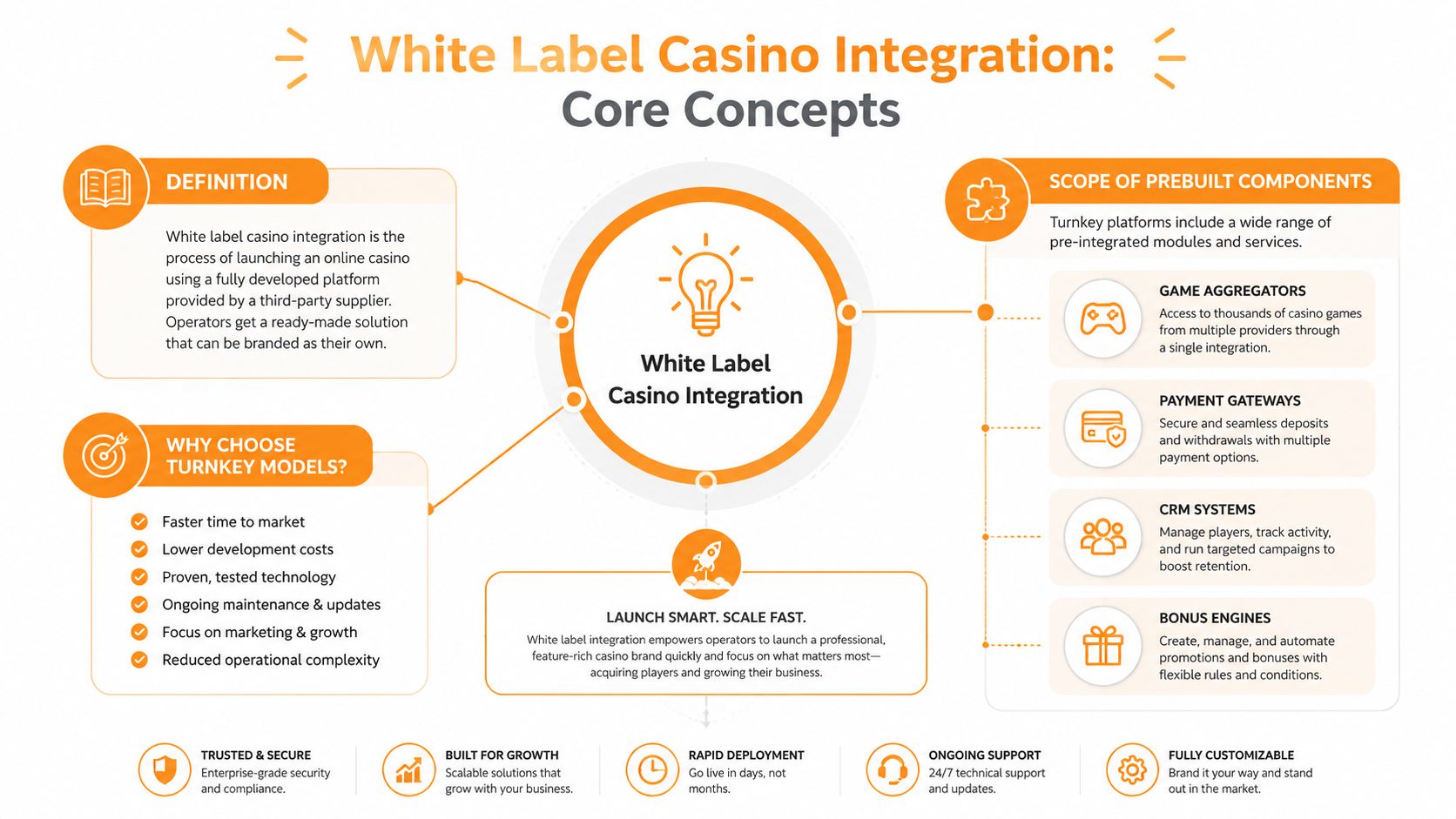
What white label integration actually includes
Most operators underestimate the scope. A real deployment isn't only a front end and a game lobby.
It usually involves:
- Brand layer: Theme, domain setup, lobby structure, localized content, bonus presentation, and CRM triggers.
- Commercial layer: Game catalog access, PSP configuration, affiliate tracking, and reporting permissions.
- Control layer: KYC and AML workflows, fraud rules, audit logs, responsible gaming settings, and geofencing.
- Operational layer: Support tooling, reconciliations, incident handling, and escalation paths between your team and the vendor.
Practical rule: If a provider can't show which components you can configure yourself versus which require their intervention, you're not buying clarity. You're buying dependency.
What to lock down before kickoff
The cleanest launches start with decisions made early, not during QA.
Use this readiness checklist:
- License structure: Know whether you're operating under a master license sublicense or your own path.
- Target market scope: Define where you'll accept players and which countries are excluded.
- Payment strategy: Decide whether your launch depends on cards, banking, crypto, or a mixed cashier.
- Internal ownership: Assign a commercial owner, technical owner, compliance owner, and vendor manager.
- Exit assumptions: Require a written position on data portability, contract exit, and migration support before signature.
A white label launch works best when the operator treats it like a controlled operating model, not a shortcut.
Planning Your Integration Strategy
The planning phase goes wrong when teams start with feature wish lists instead of market mechanics. The better sequence is the reverse. Start with target market, player acquisition model, payment expectations, compliance burden, and only then compare platforms.
The top end of the market is broad. According to AffRoom's white label casino guide, leading solutions aggregate over 30,000 games from 180+ developers and pre-integrate 5–15 payment processors. That sounds impressive, but volume doesn't answer the key question. You need to know which games, which processors, which countries, and who controls activation.
Build the shortlist from business realities
A practical shortlist should compare vendors on fit, not presentation quality. I'd evaluate them against a small matrix first.
| Area | What to check | Why it matters |
|---|---|---|
| Market fit | Supported countries, restricted markets, language handling | A broad platform can still be wrong for your actual launch geography |
| Content quality | Named studios, lobby control, game filtering, live dealer depth | Big libraries are useless if merchandising is weak |
| Payment usability | Local methods, cashier logic, reconciliation access, rollback handling | The cashier decides conversion and support load |
| Compliance model | KYC ownership, audit visibility, reporting access, geofencing controls | You need evidence, not just assurances |
| Vendor operations | SLA behavior, support workflow, deployment ownership | Launch friction usually comes from poor handoffs |
If you're validating market-by-market fit, a region-focused review through NexGrate's market coverage pages is the kind of reference point worth using during comparison, because it forces a concrete question: can this stack really operate where you plan to acquire players?
Questions that expose weak vendors early
Don't ask vendors if they support localization. Ask them what breaks when you need it.
Use questions like these:
- For payments: Which methods are already live in the market I'm entering, and which ones need custom work?
- For content: Can I remove low-performing providers from the lobby without raising a ticket?
- For compliance: Who owns suspicious activity review, and where can my team access the evidence trail?
- For migration: If I leave, what exact data set can I export, in what format, and on what timeline?
A polished demo hides weak operating assumptions. A contract review usually reveals them.
The strongest integration plans don't chase the biggest stack. They choose the stack with the fewest hidden dependencies.
Designing the Technical Architecture
Bad white label architecture decisions usually happen because commercial teams buy the bundle before technical teams map the boundaries. By the time engineering reviews the stack, the vendor has already defined the wallet logic, the payment routing, the reporting model, and half the failure points.
A white label platform should be treated like a system of replaceable layers, even if the vendor sells it as a single product. That means documenting where the platform begins, where third-party services sit, and where your own control must remain visible.
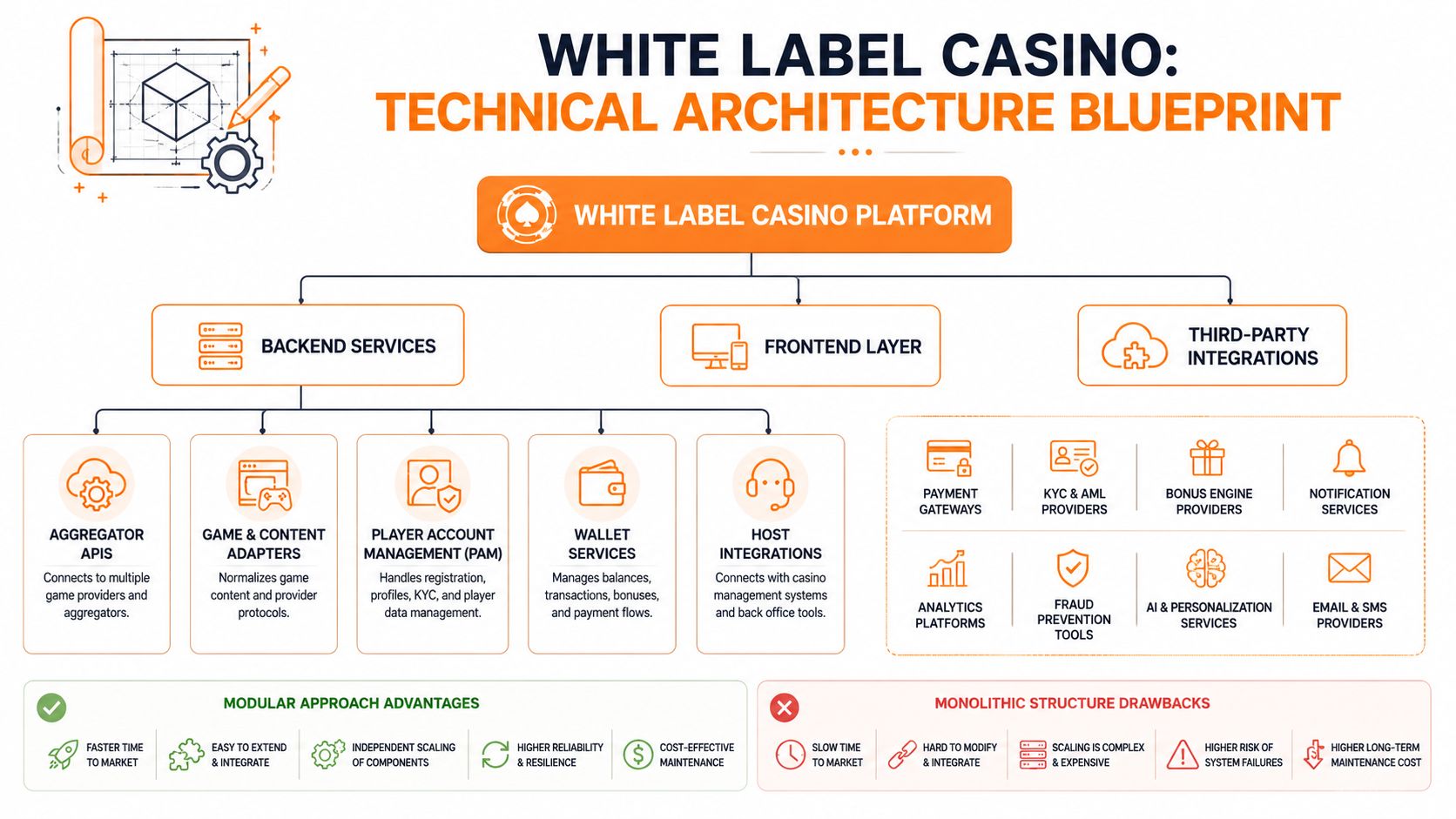
Map the stack before you buy the promise
At minimum, the architecture map should identify these components:
- PAM and identity layer: Registration, login, limits, account state, and profile changes
- Game aggregation layer: Studio access, launch tokens, session handling, and game metadata
- Wallet and transaction engine: Deposits, withdrawals, bonus credits, reversals, and balance sync
- Payment orchestration layer: PSP selection, decline fallback, routing logic, and settlement events
- Compliance layer: KYC decisioning, AML triggers, geofencing, audit logs, and case management
- Marketing layer: Bonuses, CRM segmentation, affiliate attribution, and retention tooling
For a useful benchmark on how vendors package these components, NexGrate's platform overview reflects the kind of unified stack many operators ask for. The important thing isn't that the stack is unified. It's whether each layer is observable and governable.
Where monolithic wallets break operations
One of the biggest failure patterns in white label casino integration is the wallet. According to Jadex Consulting's analysis of white label casino platforms, reliance on monolithic wallet services creates systemic failure risk at scale and limits operator control over payment routing logic.
That issue shows up in ugly ways:
- Deposits and withdrawals share one bottleneck: A fault in one flow can affect the whole cashier.
- Fraud rules are vendor-owned: Your team sees outcomes, not the decision path behind them.
- Fallback routing is constrained: You can't easily redirect traffic between processors when one underperforms.
- Migration gets harder: If balances, bonus logic, and payment events all live in one tightly coupled service, extraction becomes messy.
Don't accept “single wallet” as a feature until the vendor explains failure isolation, routing ownership, and migration support in operational terms.
The safer model is modular orchestration. Even if you keep one player-facing balance, the underlying transaction paths shouldn't all depend on one opaque service.
Implementing Compliance and Payment Flows
Compliance and payments meet in the same place: the cashier. That's why this part of white label casino integration needs operational design, not checklist thinking. If KYC sits too late in the journey, fraud pressure rises. If it sits too early and too bluntly, legitimate players bounce before first deposit.
The goal isn't to make compliance invisible. The goal is to make it predictable, traceable, and aligned with how players transact.
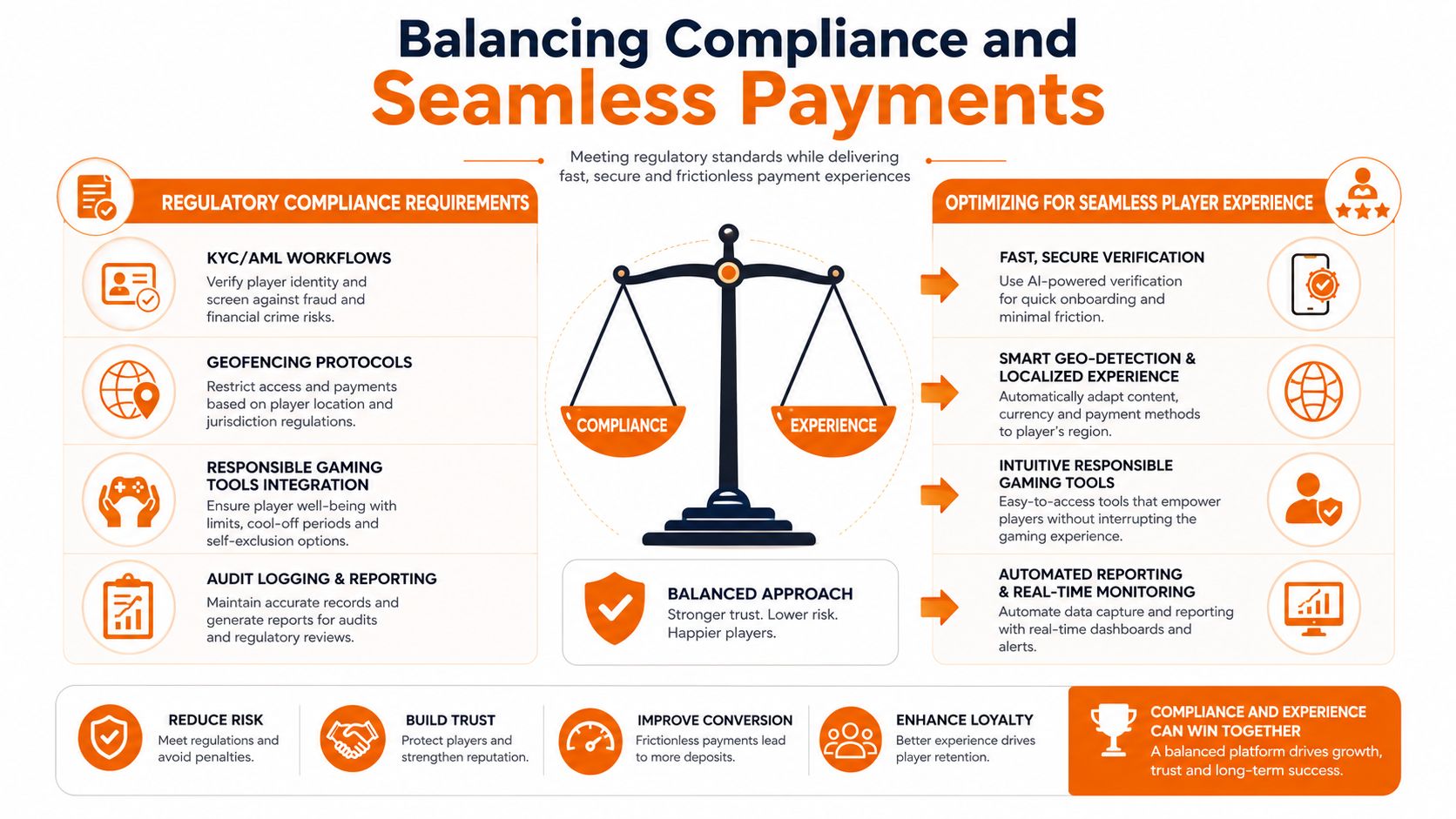
Compliance has to be visible not abstracted away
A common white label mistake is assuming the provider “handles compliance.” They handle tooling. You still carry operator exposure.
Your team should be able to verify:
- KYC workflow states: Pending, approved, rejected, manual review
- AML trigger handling: Who reviews alerts, who clears them, who records rationale
- Geofencing behavior: What happens on login, on deposit, and on gameplay launch
- Audit evidence: Which events are stored, who can export them, and how long they remain accessible
- Responsible gaming controls: Limits, cool-off periods, self-exclusion, and account restrictions
For operators comparing built-in governance capabilities, NexGrate's compliance page shows the sort of controls a modern platform should expose directly rather than bury behind support tickets.
Why local payment coverage decides market viability
The local payment localization paradox becomes evident. A platform may support cards and crypto and still fail in-market because the cashier doesn't match local payment behavior.
According to Start an Online Casino's guide on white label launch steps, 42% of failed white-label launches in emerging markets stemmed from payment stack rigidity, especially the lack of hyper-local methods such as Brazil's PIX or India's UPI.
That number matters because payment failure is often silent. Players don't file a complaint. They abandon.
Use this payment review framework before launch:
| Payment question | What good looks like | What usually fails |
|---|---|---|
| Deposit methods | Methods players already trust in the market | Generic card-only cashier |
| Withdrawal paths | Same-market payout methods with clear status handling | Manual processes and delayed status updates |
| Risk controls | Fraud checks tuned by method and region | One universal rule set |
| Reconciliation | Access to transaction states and exception handling | Vendor-only visibility |
If your provider says “global payments,” ask them to name the local rails already live in your target country. General coverage isn't market readiness.
The operators who get this right treat payment localization as a launch prerequisite, not a later optimization.
Executing Testing Deployment and Go Live
Testing is where rushed white label launches expose every shortcut taken in planning. Teams often try to compress QA because the platform is “already proven.” That's a misunderstanding. The platform may be proven in general. Your exact combination of branding, permissions, market settings, payment flows, and compliance triggers is not.
A controlled go-live needs sequence. Not parallel improvisation.
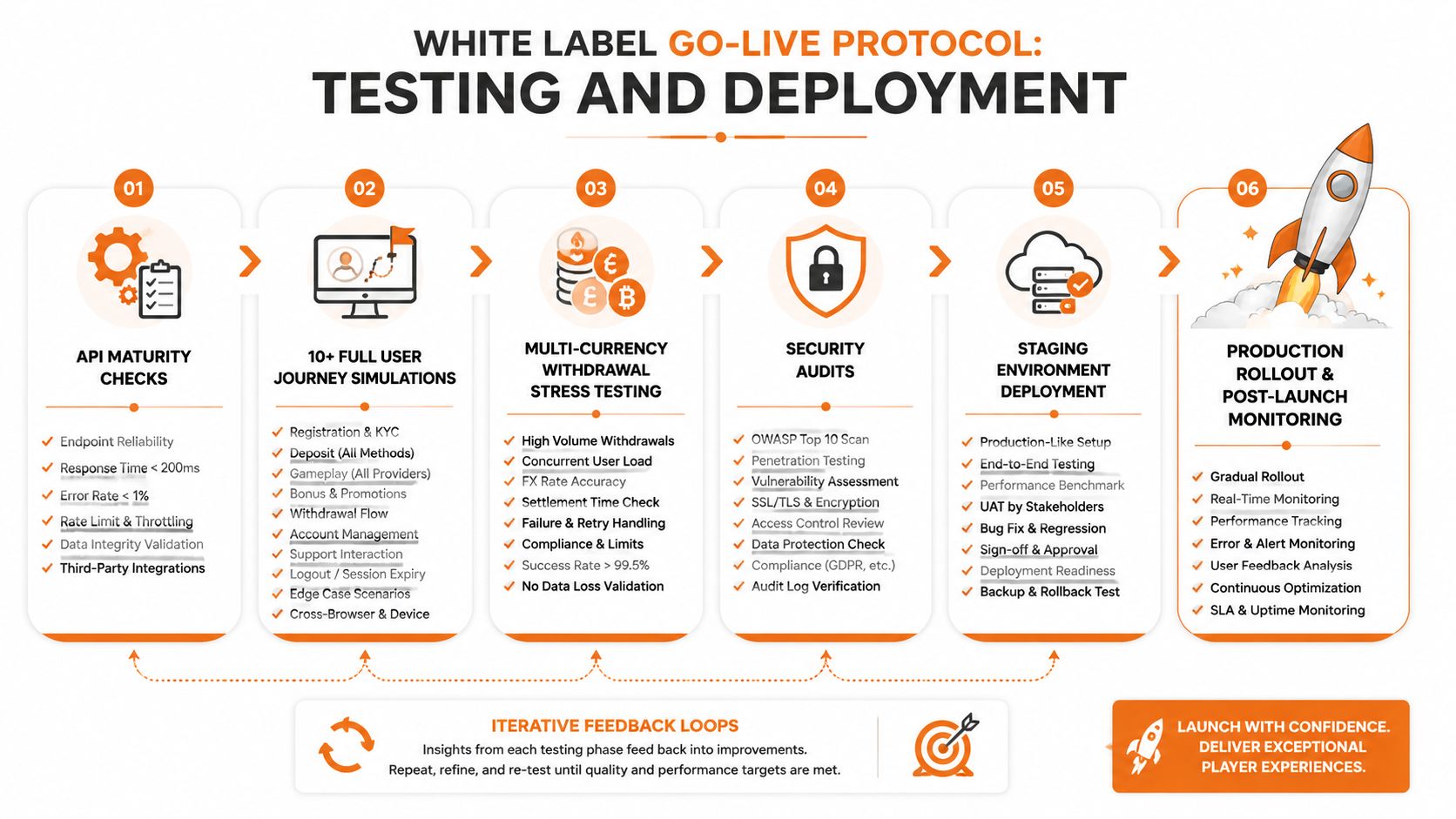
Use a strict sequence not parallel chaos
According to 3UP Gaming's white label integration methodology, the process requires at least 10 full user journey tests, multi-currency withdrawal simulations, and specific stress tests for large-value withdrawals before soft launch.
That sequence matters. I'd run it in this order:
API maturity checks
Confirm stable behavior across account creation, authentication, transaction calls, game launch, and callback handling.Core user journeys
Test registration, verification, deposit, bonus acceptance, gameplay, withdrawal request, document upload, and support escalation.Negative-path tests
Validate duplicate accounts, payment declines, geolocation blocks, limit breaches, and bonus misuse cases.Withdrawal stress scenarios
Test large-value withdrawals, status changes, reversals, and compliance holds in realistic timing sequences.
Here's a useful visual reference for rollout stages:
What a soft launch should prove
A soft launch isn't a marketing event. It's an operational exam.
It should prove:
- Environment parity: Staging and production behave the same where it counts
- Vendor responsiveness: Issues are triaged and fixed inside agreed escalation windows
- Cashier integrity: Deposits, withdrawals, and edge cases reconcile correctly
- Compliance triggers: Reviews, blocks, and logs fire as expected
- Support readiness: Agents know what they can solve and what must go to the vendor
Launch only after you've tested the journeys that lose money or create liability. Login polish can wait. Withdrawal failures can't.
The cleanest launches are usually the least dramatic ones.
Post Launch Operations and Migration Best Practices
Once the brand is live, the job shifts from integration to governance. That's where many operators relax too early. They monitor uptime and deposits, but they don't manage the vendor relationship with enough precision. In a white label setup, weak vendor governance becomes product risk, compliance risk, and eventually migration risk.
The part many operators leave too late is exit design. That's a mistake, especially under sublicensing models.
Run the vendor not just the platform
According to License Gentlemen's analysis of turnkey versus white label casino models, 70% of new iGaming launches relied on sub-licensing in 2025, yet fewer than 15% of contracts include explicit license portability clauses. That gap creates hidden regulatory decoupling risk if the provider's licensing position changes or their master structure becomes unusable for your brand.
Post-launch governance needs teeth.
A strong operator review cycle should cover:
- Contractual control: Rights to player data export, migration support, and domain transition support
- Regulatory separation: Clarity on what compliance evidence belongs to you and how you can access it independently
- Operational transparency: Ticket SLAs, incident reporting, reconciliation ownership, and release approval flow
- Commercial triggers: Revenue share changes, PSP additions, new market requests, and content activation delays
If you can't describe how you'd leave the platform, you don't fully control the platform.
Migration planning starts before the first deposit
Migration from a legacy backend, or away from a current white label provider, is usually less about code than state management. You need to preserve balances, player identity, restrictions, bonus logic, and reporting continuity without creating confusion or compliance gaps.
Use a migration checklist that includes:
| Migration area | What to secure early |
|---|---|
| Player data | Export fields, consent status, verification status, and account restrictions |
| Wallet state | Balance snapshots, pending withdrawals, bonus balances, and rollback rules |
| Session continuity | Re-authentication plan and communication flow |
| Reporting continuity | Historical audit access, transaction records, and case history |
| Parallel operations | Cutover criteria, freeze windows, and rollback authority |
The operators who migrate cleanly usually prepare in two tracks. One track handles data and wallet integrity. The other handles legal and vendor separation. Miss either one and the migration turns into a firefight.
Conclusion and Next Steps
White label casino integration works best when you treat it as an operating model, not a shortcut. The launch speed is real. So is the convenience. But the value only holds if you keep control over the parts that matter most: payments, compliance evidence, wallet behavior, and exit rights.
The common failure pattern is predictable. Teams buy on launch speed, then discover after go-live that the cashier is too generic for the market, the wallet is too coupled to the vendor, compliance visibility is too shallow, or the contract says too little about migration. None of those problems are technical surprises. They're planning failures.
If you're moving now, the first practical steps are straightforward:
- Lock the license structure before branding work starts.
- Pressure-test payment localization before accepting “global” coverage.
- Map the architecture layer by layer, especially wallet and routing ownership.
- Run a strict test sequence with full user journeys and withdrawal stress cases.
- Put portability, data export, and exit support into the contract before signature.
Operators who do those five things usually launch with fewer expensive surprises. They also keep their options open when growth, regulation, or vendor performance changes the original equation.
A good white label setup should help you move faster today without trapping you tomorrow. That's the standard worth holding vendors to.
If you're evaluating platforms for a new launch or planning a migration from a legacy backend, NexGrate is worth a close look. It gives operators a unified white-label stack across casino, sportsbook, payments, compliance, and back-office operations, with the kind of built-in tooling that can reduce integration overhead while keeping the launch process practical.