
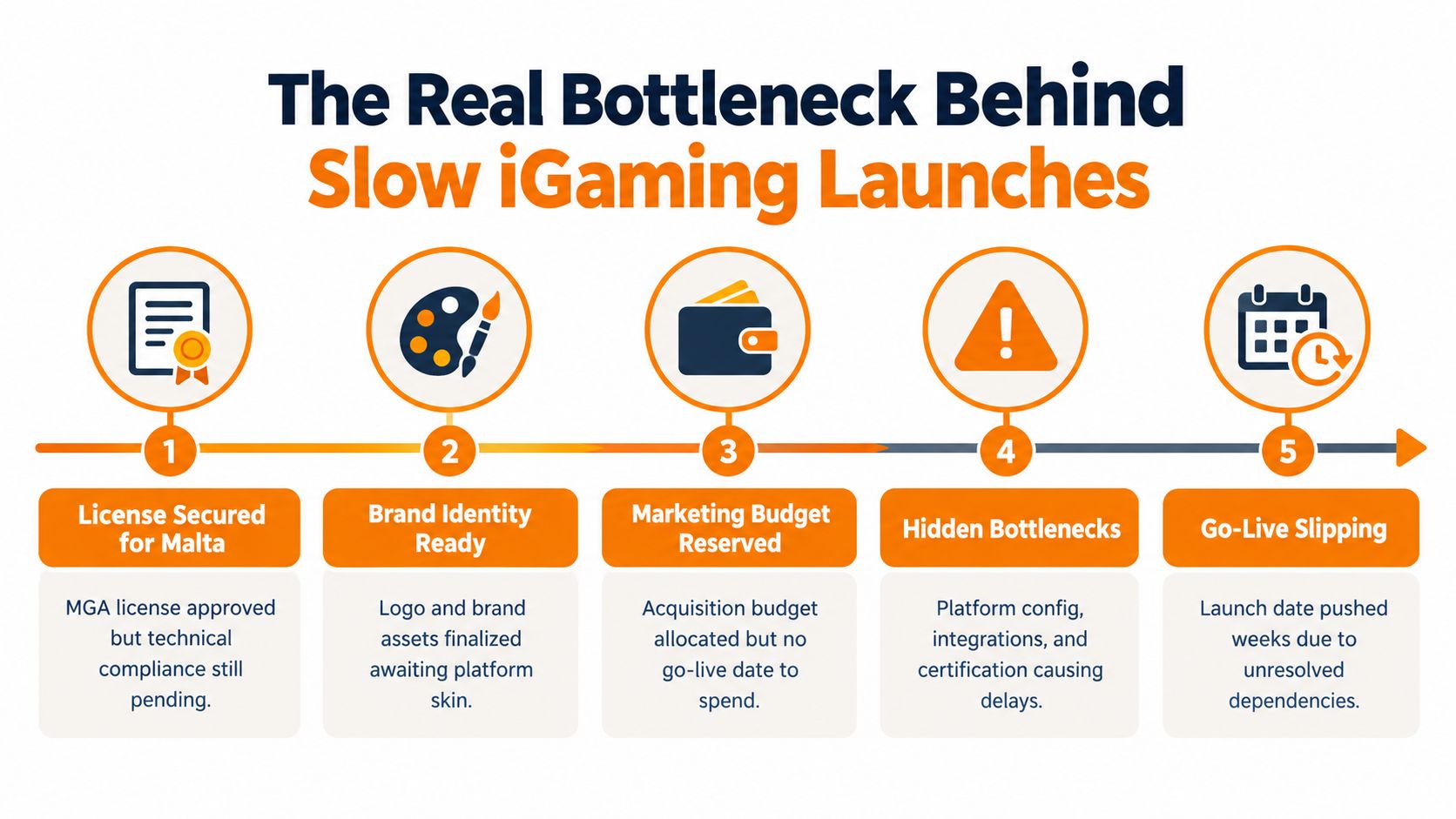
You've secured the Malta licence, approved the brand identity, chosen the target market, and reserved the acquisition budget. Yet the launch date keeps moving. The platform team says the build is nearly ready, while compliance is still waiting for game certifications, payments is negotiating processor terms, and operations can't complete an end-to-end test because the KYC workflow isn't configured.
That situation is common in iGaming because the calendar is usually controlled by coordination, not by core platform coding. Payment service provider negotiations, KYC and AML setup, jurisdictional certification, responsible gambling localization, and multi-vendor testing create dependencies that sit between departments and suppliers. A faster development team won't fix a launch that still relies on sequential approvals.
The practical answer to how to reduce time to market is to treat acceleration as an operations and vendor-consolidation problem first, and an engineering problem second. The strongest launch plans lock prerequisites early, use a platform with existing integration boundaries, run compliance beside development, and automate repeatable release controls without weakening quality.
Table of Contents
- The Bottleneck Behind Slow iGaming Launches Is Coordination, Not Coding
- Pre-Launch Prerequisites Operators Must Lock First
- Turnkey Platforms Versus Custom Builds for Speed
- The Launch Playbook From Scoping to Go-Live
- Cutting Integration Time Across Games, Sportsbook, and Payments
- Automating Releases to Keep New Markets Moving
- Common Launch Mistakes and the Operator Checklist to Avoid Them
The Bottleneck Behind Slow iGaming Launches Is Coordination, Not Coding
An operator can have developers configuring the platform while the launch date remains impossible. The schedule begins earlier, with decisions about suppliers, compliance rules, payment routes, content categories, and market requirements that must work together.
Hidden bottlenecks surface after visible work appears finished. The logo is approved, but the platform skin still lacks final assets. The licence is secured, yet the regulator is waiting for technical documentation. The cashier appears functional, while a payment provider has not approved the merchant account or completed settlement testing. The casino includes the desired games, but some titles still require jurisdiction-specific certification.
Why coordination beats developer headcount
A 1996 Management Science study of new product development found that reducing development cycle time is strategically important, but faster development does not automatically produce an earlier launch when the end-to-end process is misaligned (Management Science research on development cycle time). The same Management Science discussion summarizes software research in which teams achieved lower process and lead times by using a shared Definition of Ready and two shared feedback sessions per sprint. For iGaming, the recommendation is direct: clarify inputs, remove handoff friction, and make suppliers work in parallel instead of asking engineers to work faster.
A regulated launch gives product, compliance, payments, content, customer support, fraud, and operations separate responsibilities. One incomplete requirement can block every team downstream. The programme lead must assign ownership before work starts, then track each dependency through a visible readiness gate.
Practical rule: If two suppliers must complete work one after another, create a shared interface, shared test environment, or consolidated contract that lets them work in parallel.
Manage the launch as a dependency map. Every workstream needs an owner, an entry condition, an exit condition, and a committed date. Vendor consolidation matters because fewer integration boundaries mean fewer approvals, test cycles, and escalation paths. Engineering speed helps only after those operating constraints are controlled.
The following playbook applies that model to readiness gates, turnkey platforms, phased execution, integration design, automated releases, and the launch mistakes that can still cost operators weeks, even with a white-label stack.
Pre-Launch Prerequisites Operators Must Lock First
Don't start platform configuration with an unresolved business case. Every open decision becomes a configuration change, a new integration request, or a compliance review later.
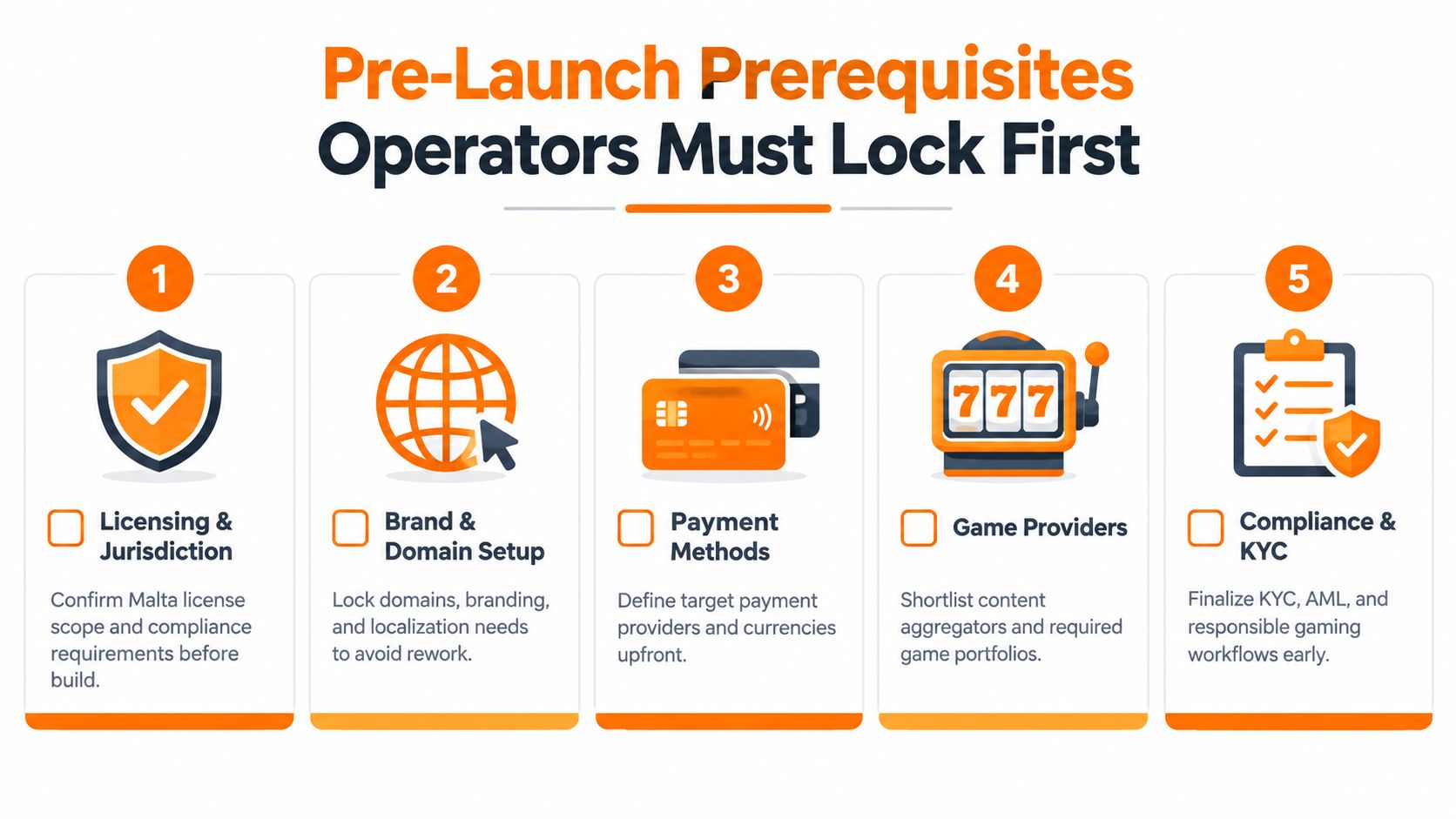
Use a signed readiness pack before the platform owner begins production work:
- Licence and jurisdiction: Confirm the licence scope, permitted game categories, approved provider requirements, advertising restrictions, and reporting obligations for each target market.
- KYC and AML policy: Approve the identity checks, document review process, escalation rules, source-of-funds requirements, sanctions screening, and service-level expectations for manual reviews.
- Payment method matrix: Document deposit and withdrawal methods, currencies, processor jurisdictions, settlement ownership, refund handling, chargeback rules, and fallback routes.
- Brand and localization pack: Freeze the logo, design system, tone of voice, domain decisions, promotional language, translations, customer-support content, and responsible gambling copy.
- Responsible gambling and data controls: Confirm deposit limits, reality checks, self-exclusion feeds, session controls, player protection messaging, retention rules, and data residency requirements.
Make the documents executable
A policy document isn't ready merely because legal has approved it. The platform team needs implementable rules. “Verify high-risk players” must become a defined trigger, an assigned queue, an evidence requirement, and an outcome that the back office can record.
The same standard applies to payments. A spreadsheet listing preferred providers is not a payment method matrix until it states which provider handles each currency and transaction direction, who owns reconciliation, and what happens when a route fails.
Close gates before they become rework
Run a short readiness review with the product lead, compliance officer, payments owner, platform owner, and operations lead. Each person should answer one question: Can my team begin without making assumptions?
If the answer is no, pause downstream work and close the missing decision. Starting development while these artifacts remain open feels productive, but it usually shifts effort into rework. Once the prerequisites are signed off, vendor onboarding, integration scoping, content selection, and compliance dry-runs can proceed in parallel.
Turnkey Platforms Versus Custom Builds for Speed
For a speed-led launch, custom development is usually the wrong default. It gives the operator control over the experience, but it also transfers responsibility for every dependency to the operator: games, sportsbook, wallets, payments, KYC, fraud, responsible gambling, reporting, hosting, monitoring, and supplier change management.
A turnkey platform changes the commercial and operational shape of the project. Instead of negotiating and maintaining separate integration projects, the operator works through a consolidated platform that can provide pre-integrated game content, payment connectors, configurable compliance controls, and a shared back office. NexGrate is one example of this model, combining casino, sportsbook, wallet, payments, KYC and AML workflows, responsible gambling features, reporting, and third-party content integrations in one operating environment.
The trade-off is real. A custom build offers deeper control over user experience, bonus logic, data architecture, and product differentiation. A turnkey stack may constrain unusual UX patterns or advanced promotional mechanics. The decision should therefore follow the commercial priority, not technical preference.
| Vector | Custom Build | Turnkey Platform |
|---|---|---|
| Development effort | The operator owns core platform work and every supporting service. | The operator configures existing modules and focuses on brand-specific changes. |
| Vendor management | Games, payments, KYC, sportsbook, and compliance suppliers require separate relationships. | Multiple capabilities can sit behind one platform relationship and operating model. |
| Integration maintenance | API changes, certification, reconciliation, and regression testing remain the operator's responsibility. | The platform provider manages much of the connector and platform coordination layer. |
| Compliance rework | Regulatory changes may require changes across several independently owned systems. | Configurable controls and centralized reporting reduce the number of places that need adjustment. |
| Differentiation | Maximum control over workflows and front-end behavior. | Faster deployment, with differentiation focused on brand, content, promotions, and selected configuration. |
The relevant comparison isn't “flexible versus inflexible.” It is bespoke control versus coordination load. Operators evaluating custom development should also understand the full delivery scope described in this overview of online casino software development, including the supporting systems that sit outside the player interface.
Speed recommendation: Choose custom architecture only when the product advantage depends on capabilities a turnkey platform cannot provide. Otherwise, vendor consolidation will usually save more calendar time than additional engineering capacity.
The Launch Playbook From Scoping to Go-Live
A launch needs named phases and accountable owners, but the phases shouldn't run as a single queue. Integration and compliance must overlap, while content, payments, and brand configuration move against clear entry criteria.
| Phase | Owner | Duration | Parallel Work Note |
|---|---|---|---|
| Scoping | Product lead | 1–2 weeks | Confirm markets, game mix, bonus rules, and jurisdiction constraints while procurement validates suppliers. |
| Integration | Platform owner | 2–4 weeks | Connect games, sportsbook, payments, KYC, and CRM through the platform hub while compliance prepares evidence. |
| Compliance | Compliance officer | 2–6 weeks | Start RNG certification, RTP audits, responsible gaming documents, and payment approvals before integration is complete. |
| Soft launch | Operations lead | 1–2 weeks | Shape traffic in one licensed market while teams monitor KYC, withdrawals, payments, support, and game behavior. |
| Go-live | Cross-functional launch team | 3–5 days | Stage promotion, complete payment cutover, validate production controls, and maintain incident coverage. |
Scoping
The product lead owns the launch boundary. Define the market, licence scope, game categories, sportsbook requirement, bonus rules, payment coverage, localization, and reporting needs. The most important output is not a feature list. It's a decision about what won't be included in the first release.
A narrow, approved launch scope gives compliance and platform teams a stable target. An expanding scope forces repeated configuration and test cycles.
Integration and compliance
The platform owner should publish an integration map showing every interface, credential, test account, data owner, and acceptance test. The compliance officer should begin evidence collection at the same time, including game certifications, RTP documentation, responsible gaming controls, and payment approvals.
Don't wait for engineering to declare the platform complete before submitting compliance materials. That creates a serial process and leaves the regulator, processor, or certification body controlling the final date.
Soft launch and go-live
The operations lead should use the soft launch to observe real player journeys, not to showcase a marketing campaign. Monitor KYC abandonment, withdrawal queues, payment declines, game loading, bonus fulfillment, support escalation, and responsible gambling triggers.
Go-live should be a controlled operational event. Assign incident ownership, publish escalation paths, verify payment-provider cutover, and schedule staged promotion. A launch team that knows who can stop a release will recover faster than one that treats every issue as an improvised debate.
Cutting Integration Time Across Games, Sportsbook, and Payments
Integration is where iGaming calendars lose weeks. The solution is to reduce the number of custom boundaries, not to build each connection more aggressively.
Use one content boundary
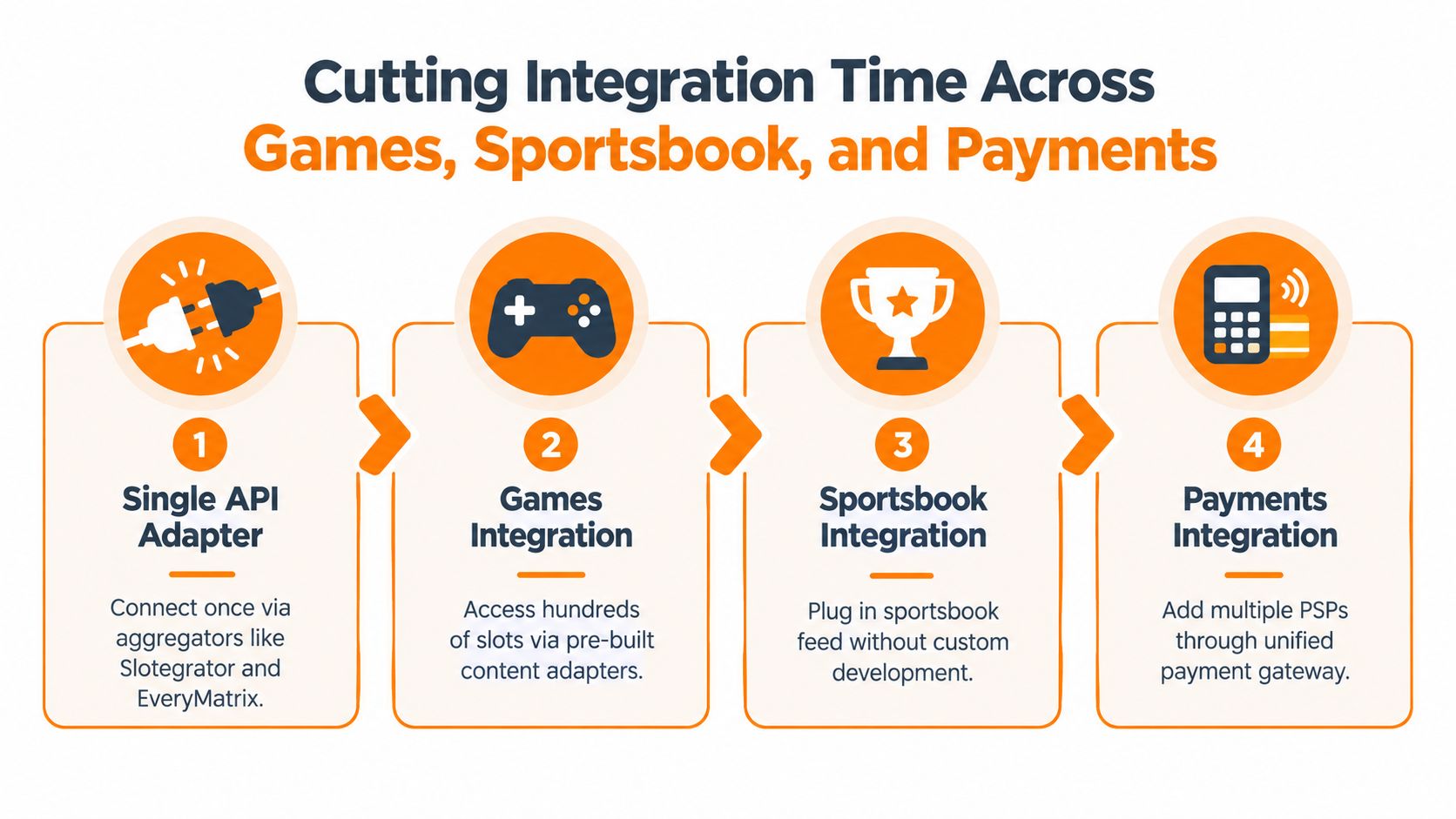
A single API content adapter lets an operator connect to an aggregator rather than manage every studio as an independent engineering project. Services such as Slotegrator, EveryMatrix CasinoEngine, and SoftGamings illustrate the aggregator model, where one integration can expose a broader portfolio through a common feed and wallet pattern.
That structure reduces repetitive work around game launch, metadata, jurisdiction availability, session handling, reporting, and certification evidence. It also gives the platform owner one place to manage changes when a studio adjusts its API or operational requirements.
Treat payments as a product stream
Payment integrations fail when teams treat them as a final cashier task. Select payment providers early, create test credentials, define settlement and reconciliation ownership, and test deposits, withdrawals, refunds, chargebacks, limits, and failure states before the soft launch.
Pre-built connectors for providers such as Stripe, Adyen, Trustly, and regional PSPs can remove repeated connector work and reduce the number of separate certification conversations. Gain comes from avoiding sequential onboarding and reconciliation cycles across markets, not merely from reducing coding effort.
Standardize sportsbook and live casino interfaces
A sportsbook or live casino supplier should attach through a defined wallet, balance, round, settlement, and responsible gambling model. Products from BetConstruct, Pragmatic Play, and Evolution represent integration categories that should be evaluated against those shared interfaces, rather than introduced as isolated custom pipelines.
The platform owner should require each supplier to pass the same acceptance suite. Test authentication, balance updates, bet or round creation, settlement, cancellation, responsible gambling restrictions, reporting, and failure recovery. A common test pack exposes incompatibilities early.
Before adding a supplier, document the critical path. If a provider requires a separate contract, separate wallet, separate certification, and separate reconciliation process, the integration may add more calendar risk than commercial value. This guide to white-label casino integration is relevant when assessing how a consolidated integration layer changes that workload.
The detailed walkthrough below shows the kind of integration architecture operators should examine:
Automating Releases to Keep New Markets Moving
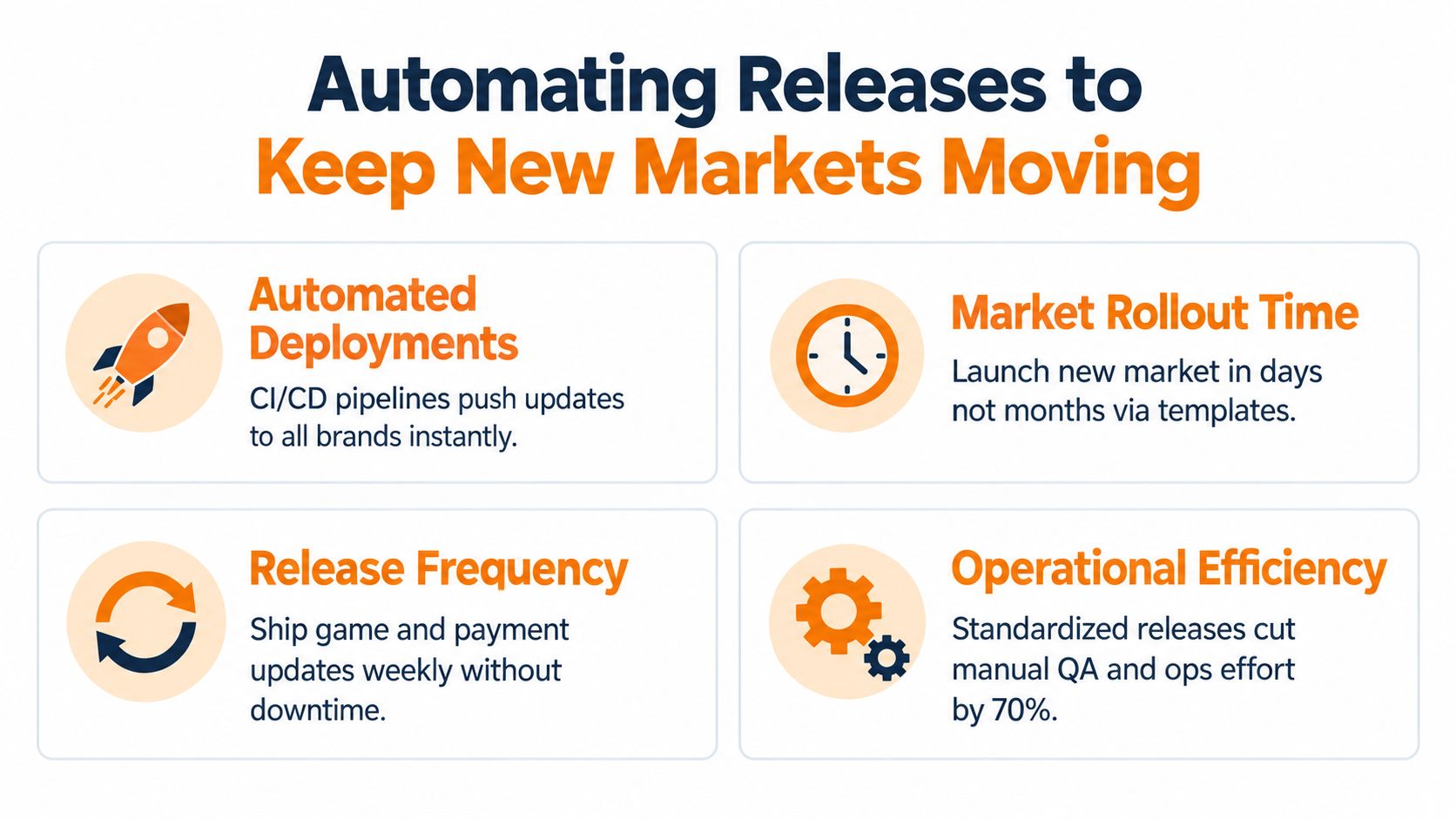
Once the first brand is live, coding speed is rarely the main gate. Integration approvals, compliance evidence, payment configuration, and vendor coordination determine whether a market change reaches production. Build a release system that moves an approved market configuration, game feed, payment route, or compliance update through the same controls every time.
A mature CI/CD pipeline promotes changes from commit to staging to production through defined gates. It should run builds, automated tests, security checks, smoke tests, KYC sample journeys, payment scenarios, responsible gambling boundary checks, and reporting validation. Compliance owners decide which changes require formal approval. The pipeline enforces that decision and records the evidence.
Measure the whole delivery system
DORA metrics stop teams from celebrating deployments that create incidents. Track deployment frequency, lead time for changes, mean time to recovery, and change failure rate. GitLab's DORA metrics documentation describes elite performance as lead times under one hour, on-demand or multiple daily deployments, and change failure rates between 0 and 15%. It also reports that low-performing teams can take one to six months for lead time.
Use those figures as operating context, not as a target to copy blindly. A fast release that breaks withdrawals or responsible gambling controls creates rework and delays the market launch.
Put policy into the pipeline
Use policy-as-code for changes carrying operational or regulatory risk:
- Bonus rules: Block promotion until the compliance owner approves the rule and supporting evidence.
- Payment methods: Block production release until settlement and reconciliation tests pass.
- Game content: Require certification and RTP artifacts before publication.
- Market configuration: Require geofencing, limits, disclosures, and reporting checks before activation. Compliance reporting obligations belong in the pipeline too. Follow this guide to compliance reporting for the reporting requirements that must be reflected in release evidence.
- Emergency changes: Allow controlled overrides only with an incident record and retrospective review.
A practical iGaming example is a market-configuration release that moves from days to hours because validation, approvals, and rollback checks run automatically. The point is not daily deployment for its own sake. Remove manual tickets only after automated quality signals can be trusted.
A 2025/2026 benchmark summary citing PwC research reported that digital product development can reduce time to market by 17%, increase efficiency by 19%, and reduce production costs by 13% (product development and go-to-market benchmarks). The same summary associated continuous delivery with time-to-market reductions of up to 90%. For an operator, the recommendation is direct: create market templates, automate promotion, and measure mean time to market for every subsequent release.
Common Launch Mistakes and the Operator Checklist to Avoid Them
Launch drift usually leaves signals before it becomes visible on the calendar. Scope expands without a new approval, compliance materials remain marked “draft,” QA receives the build late, payment onboarding has no named owner, or a sportsbook contract is still being negotiated while integration has already started.
Use the signal to trigger an action:
- Scope creep: New features keep entering the MVP. Freeze the launch boundary and move additions into a post-launch release plan.
- Late compliance testing: The first regulator-facing review is also the first internal dry-run. Rehearse the evidence pack and player journeys before formal submission.
- Late QA staffing: Testers arrive after integrations are connected. Assign QA during scoping and provide market-specific payment and localization scenarios.
- Payment delay: Processor credentials, settlement rules, or test accounts are still missing near launch. Escalate the payment owner and remove unverified methods from the initial scope.
- Parallel contract risk: Sportsbook or live dealer terms remain unresolved during platform integration. Set a contract deadline or choose an approved alternative.
The standing operator checklist
Keep one checklist as the required launch artifact for every new brand:
- Licence artifacts: Scope, market permissions, provider requirements, and reporting obligations are approved.
- KYC and AML sign-off: Rules, escalation paths, evidence, and manual review ownership are documented.
- Payment matrix: Methods, currencies, processors, settlement, refunds, and chargebacks are approved.
- Brand lock: Domains, assets, copy, translations, and promotional restrictions are final.
- Game portfolio: Providers, titles, certification status, and jurisdiction availability are confirmed.
- Sportsbook scope: Markets, odds, settlement, wallet behavior, and risk ownership are defined.
- Responsible gambling: Limits, reality checks, self-exclusion, and messaging are tested.
- Compliance walkthrough: The team has rehearsed regulator-facing journeys and evidence retrieval.
- Staging certification: Critical player, cashier, KYC, game, and back-office journeys pass in staging.
- Reconciliation test: Deposits, withdrawals, settlements, and reporting match expected records.
- Soft launch controls: Traffic, promotion, support, and rollback conditions are agreed.
- On-call coverage: Named owners can respond to payment, KYC, platform, content, and compliance incidents.
Regulatory readiness can outrank engineering speed. Reporting on European technology launches has described products arriving three to five months later than in the United States, and sometimes nearly a year later, with GDPR and other digital rules cited as blockers (European technology launch and regulatory analysis). The principle applies directly to iGaming: compliance belongs on the critical path from the first scoping meeting.
A similar pattern appears in complex connected-product launches. IoT Analytics reported an average time to market of 41 months in 2023, including 18.5 months from project kickoff to proof of concept and 22.8 months to the first paying customer, illustrating how upstream approval and coordination can dominate technical delivery (IoT launch time-to-market analysis). iGaming operators should take the warning seriously. If the business case, suppliers, compliance rules, and payment model aren't aligned, more developers won't rescue the date.
NexGrate provides a turnkey casino and sportsbook platform that consolidates game content, betting, payments, wallets, KYC and AML workflows, responsible gambling controls, reporting, and third-party integrations. If you're planning a regulated brand launch and want to reduce vendor coordination and integration risk, visit NexGrate to discuss the platform and your launch requirements.