
A game website creator is a platform that delivers a gaming brand's front end, back office, game and betting integrations, payments, and compliance controls as one launchable system. For an iGaming operator, it's the infrastructure for running the business, not just designing its website.
You may already have a brand, a game-provider shortlist, and a launch date. The difficult questions arrive when someone asks who approves withdrawals, where unsettled stakes sit, or how compliance staff will reconstruct a disputed transaction. Those answers matter more than how quickly a vendor can change the lobby colours.
Table of Contents
- What a Game Website Creator Actually Is
- Core Modules Every Game Website Creator Includes
- How a Player Action Moves Through the Stack and Where Controls Sit
- Which Operators Use a Game Website Creator and Why
- Choosing the Build Path
- Shortlist Vendors Against These Checks Before You Sign
What a Game Website Creator Actually Is
Say you're a founder who wants a branded casino live in weeks rather than committing to a year-long development project. A vendor shows you a polished lobby, working games, and an administration dashboard. It looks ready, but you still need to establish what the package includes and what your team must supply.
Think of it as a restaurant franchise in a box. The franchise supplies the kitchen, point-of-sale system, and supplier arrangements together. You choose the identity and offering, but you still need permission to operate, trained staff, and clear responsibilities.
The same distinction applies here. A generic website builder produces pages. An iGaming platform must also coordinate player accounts, money movements, bets, operational decisions, and reporting.

The jobs behind the website
- Player experience: The branded lobby, registration journey, game pages, betting interface, and cashier.
- Staff workspace: Tools for customer support, account reviews, payment approvals, risk investigations, and reporting.
- Operational plumbing: Connections and rules that keep providers, balances, identity checks, and transaction records consistent.
The category grew because operating online gambling required more than publishing content. The history of online gambling records approximately 15 online gambling websites at the end of 1996, increasing to about 200 in 1997. As platforms scaled, accounts, payments, identity checks, and jurisdiction-specific controls became operational necessities.
Don't confuse a bundled platform with a transfer of every obligation. Your contract must identify who runs verification, investigates alerts, handles player complaints, and maintains each integration. Software can support those duties without assuming responsibility for them.
Buying rule: If you only need pages, a website builder may be enough. If you need games, player money, and operational reports, evaluate a game website creator.
Core Modules Every Game Website Creator Includes
Assess the platform through four operating families: player-facing experiences, money, control, and growth and operations. Vendors package these differently, so treat the following as a capability checklist, not a promise that every package includes everything.
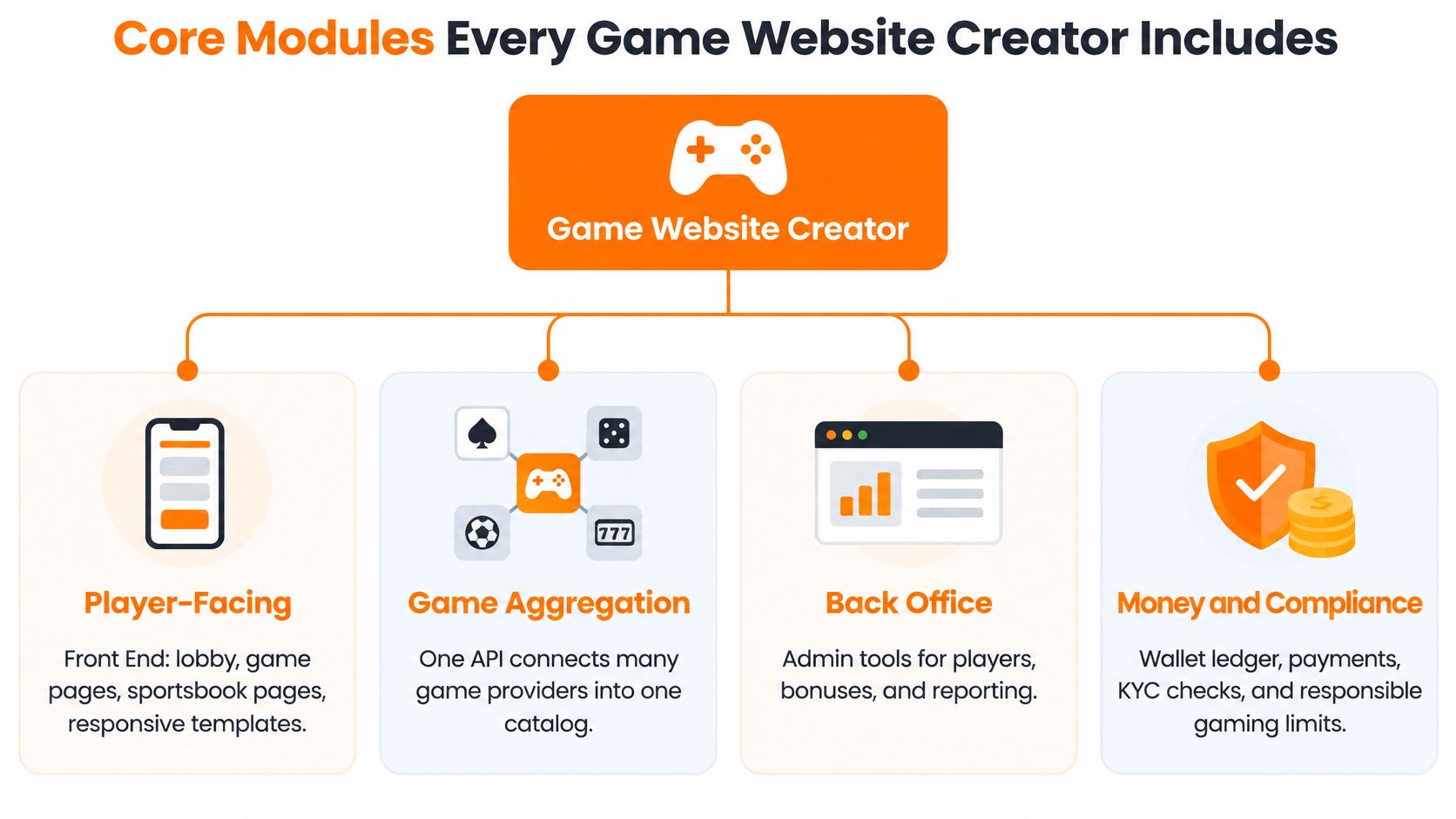
Core modules and what each one does for the operator
| Module | What it covers | What breaks without it |
|---|---|---|
| Front end | Lobby, game pages, sportsbook pages, responsive templates | Players struggle to find or play games on mobile |
| Game aggregation | Single API and prebuilt adapters for random-number-generator games and live casino studios | Every game provider needs custom integration work |
| Sportsbook module | Pre-match and in-play markets, odds feeds, bet settlement, margin settings | No betting product, or settlement handled manually |
| Player wallet and accounts | Balances, know-your-customer and anti-money-laundering workflows, account limits, risk rules | Casino and sportsbook balances can drift apart |
| Cashier and payments | Card and bank processing, multiple currencies, crypto deposits and withdrawals | Uncredited deposits and weak payment coverage in target regions |
| Compliance and reporting | Geofencing, audit logs, responsible gaming tools, regulator reports | Staff assemble licence reporting manually before audits |
| Bonuses and retention | Bonus systems, free spins, loyalty tiers, segmentation, affiliate tracking | Staff cannot reliably administer incentives or attribute retention activity |
| Hosting and operations | Deployment pipelines, monitoring, DDoS protection, uptime management | Service interruptions during peak events such as major sports fixtures |
The back office connects these families. Support staff need account history, payment staff need transaction status, and risk analysts need restrictions that apply wherever the player acts. An attractive dashboard isn't enough if each team sees a different version of the account.
The wallet is the main design decision
For an integrated casino and sportsbook, insist on one authoritative wallet ledger. Separate product balances create transfer states that someone must reconcile, especially when a provider times out or a settlement arrives late. Separate currency balances and bonus sub-balances can still exist within a unified accounting model.
The cashier isn't the wallet. The cashier connects external payment methods; the wallet records what the platform owes the player. When reviewing payment integration capabilities, ask how a processor's pending, successful, failed, and reversed statuses become ledger entries.
Currency support also needs a precise definition. Accepting a deposit currency doesn't automatically mean the platform can hold, wager, settle, and withdraw in that currency.
Your launch scope shouldn't omit the wallet, cashier, required compliance controls, or reporting. Advanced loyalty tiers and detailed segmentation can follow once the core operation works.
Mark every capability in your plan as owned, integrated, or missing. For integrated modules, name both the supplier and the person responsible when the connection fails.
How a Player Action Moves Through the Stack and Where Controls Sit
The front end is the casino floor players see. The wallet ledger is the vault, the authoritative record of money owed, reserved, credited, and withdrawn. A displayed balance is only a view of that record.
Behind the interface, requests pass through an API gateway and an identity and session service. A game aggregator routes casino activity, a sportsbook engine handles betting, and the cashier communicates with payment providers. The back office supports staff decisions, while a reporting store preserves events for investigation and reporting.
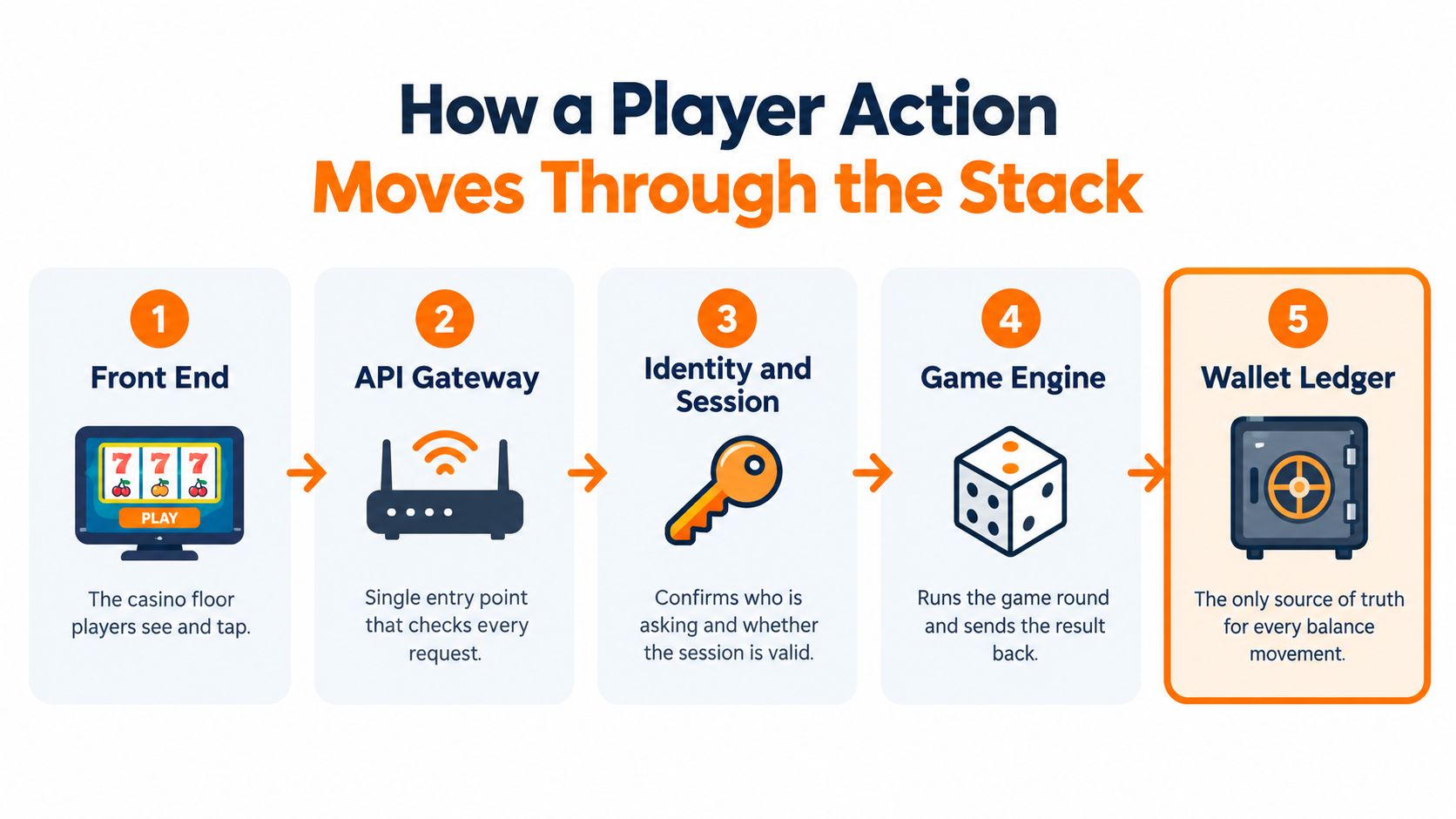
Follow a bet from click to settlement
Consider a player placing a hypothetical sportsbook stake. The happy path is simple, but the platform must preserve correctness when messages arrive late, arrive twice, or don't arrive at all.
- The browser submits the request. It sends the selected market, requested stake, accepted price information, and session token. It asks the server to place a bet; it doesn't debit the player's account itself.
- The gateway checks access. The trusted service validates the token and applies betting-specific rate limits. The betting service also checks whether the account, market, and proposed action are currently permitted.
- The wallet reserves the stake. It checks available funds and creates a reservation using an idempotency key, a unique request identifier. A retry with that identifier must return the existing result rather than reserve the money again.
- The sportsbook handles acceptance and outcome. It confirms or rejects the bet under its market rules. For an accepted bet, settlement follows when the result becomes available, not necessarily during the original browser request.
- The ledger records settlement. The wallet consumes or releases the reservation and posts the appropriate result once. Related events carry a correlation identifier so staff can trace the request across services.
A rejected bet must release any reservation. A timeout needs a defined recovery path: the platform should check the existing transaction state rather than assume failure and create another transaction.
Ask the vendor to demonstrate this with delayed responses and repeated callbacks. A successful bet in a demo proves much less than a correctly recovered bet after an interrupted connection.
Put authorisation on the server
The OWASP REST Security Cheat Sheet recommends HTTPS, endpoint-level access control, and integrity-protected tokens validated for issuer, audience, and expiration. It also says unsecured tokens using an alg value of none must be rejected.
Apply that guidance to every game, wallet, and sportsbook integration as a security boundary. The server must recheck permissions for balance reads, bet placement, settlement, withdrawals, bonus redemption, and administrative actions. Hiding a button doesn't protect the endpoint behind it.
Keep player, operator, payment, and service-to-service scopes separate. A game provider may need to submit an authorised round result, but it shouldn't inherit permission to change identity documents or approve withdrawals.
If the browser could directly change balances, a manipulated client could submit money movements without a valid bet. The browser should display confirmed server state, including an honest pending status when the outcome isn't yet known.
A pending transaction is an operational state to resolve, not an error message to hide.
Centralise identity without centralising every permission
The OWASP Authentication Cheat Sheet recommends protecting non-public resources and applying multi-factor authentication to sensitive or high-value accounts. For a gaming platform, use a shared identity service rather than separate login implementations inside the sportsbook, cashier, and administration console.
Pair short-lived sessions with secure password recovery and deliberate session revocation. Require administrator MFA and step-up re-authentication before sensitive actions such as changing payment details, withdrawing funds, or modifying credentials. Authentication establishes who is asking; authorisation decides whether that identity may perform this action.
Availability needs its own engineering plan. Include DDoS protection and hosting controls in the review, but don't let traffic protection substitute for transaction correctness during outages.
Before acceptance, require these checks:
- Independent protection: Every protected page and API rejects unauthenticated requests on its own.
- Administrative access: Staff accounts require MFA, with roles that restrict financial and account changes.
- Sensitive transactions: Critical actions trigger fresh authentication during an active session, and the audit trail records the decision.
Finish the architecture review with a direct question: Where does the wallet live, and exactly which services and staff roles can write to it?
Which Operators Use a Game Website Creator and Why
Say a team plans to enter a regulated market during a hypothetical launch quarter. Design approves the lobby early, but the payment provider hasn't approved the business and the reporting export doesn't match the intended jurisdiction. The launch delay comes from the cashier and reporting work, not the page templates.
Different operators encounter different versions of that problem. A new brand needs a playable proposition, while an established operator needs continuity and evidence that a migration won't change what it owes players.
Operator profiles, priority modules and main risks
| Operator type | Typical launch goal | Modules to prioritise | Main risk |
|---|---|---|---|
| New casino brand | Live branded lobby with a licensed game library | Front end, game aggregation, cashier | Generic-looking lobby and weak retention tools |
| Sportsbook operator | Integrated betting product with in-play markets | Sportsbook module, shared wallet, settlement | Settlement errors on fast in-play markets |
| Crypto casino founder | Crypto deposits and withdrawals alongside cards | Cashier with crypto, wallet, compliance toolkit | Licence and jurisdiction fit for crypto activity |
| Operator migrating from a legacy backend | Move players and balances without downtime | Wallet and accounts, reporting, identity | Balance mismatches during cutover |
| Multi-brand group | Several brands on one backend and one wallet | Shared wallet, back office, cross-brand risk rules | Fraud rules that miss activity across brands |
| Compliance and operations team | Evidence ready for regulators and audits | Audit logs, regulator reports, geofencing | Reports assembled manually before each submission |
Match the test to the operator
For a new casino brand, start with the front end and aggregation. Confirm that the actual contracted catalogue appears in the intended market, then test payment eligibility before committing to acquisition spend.
A sportsbook operator should prioritise the betting engine and wallet integration. Test rejected prices, suspended markets, voids, and corrected results, not just an accepted pre-match bet. Settlement mistakes can otherwise remain invisible until support receives a complaint.
A crypto casino founder should start with the cashier and compliance toolkit. Define supported networks, confirmation handling, conversion rules, and withdrawal review procedures. Technical support for an asset doesn't establish permission to offer it in the target jurisdiction.
For a legacy migration, prioritise account balances and reporting. Rehearse the cutover with outstanding bets, locked bonuses, pending withdrawals, and account restrictions, then reconcile the opening position against the previous system.
A multi-brand group needs shared account infrastructure and back-office controls, with access boundaries appropriate to each brand and operating entity. A compliance team needs usable audit records and report generation, including evidence of who changed a restriction and why.
Choose the profile closest to your operation, then identify the module that can actually block launch. That bottleneck deserves the earliest proof, even when another feature makes a better sales demonstration.
Choosing the Build Path
Turnkey buys integration speed and bundled controls at the cost of a customisation ceiling. Custom buys control at the cost of engineering, maintenance, and a permanent compliance workload. Neither route removes the operator's responsibility to understand the system.
Turnkey platform versus custom build on the criteria that matter
| Criterion | Turnkey platform | Custom build |
|---|---|---|
| Typical time to first live brand | Configuration and integration-led schedule, subject to approvals | Design, development, integration, and assurance before launch |
| Upfront spend | Licence, setup, revenue-share fees, or a combination specified by the vendor | Full engineering team and build budget |
| Customisation depth | Limited by supported configuration, APIs, and roadmap | Broad control, with build and validation work for each change |
| Compliance coverage | Vendor-supported modules and report templates whose scope needs verification | Your team builds, tests, and evidences each control |
| Ongoing maintenance | Vendor ships contracted updates and patches | Your team patches, upgrades, and runs on-call |
| Lock-in risk | High if wallet records and reports cannot be exported | Supplier dependence may be lower, but your team retains the complexity |
| Best fit | Standard casino or sportsbook launch with a deadline | Proprietary engine or product as the core differentiator |
Treat launch schedules and commercial models as vendor-specific commitments, not category-wide promises. Ask for milestones tied to provider approval, payment onboarding, control testing, and production readiness. A delivery date without those dependencies isn't a useful plan.
What you gain and what you inherit
With turnkey, you avoid implementing every provider connection and staff workflow from scratch. You can operate with a smaller internal engineering scope, but you'll still need people who understand configuration, reconciliation, supplier incidents, and compliance decisions.
- Turnkey advantage: A pre-integrated backend lets your team focus on brand, market configuration, and operational readiness.
- Turnkey limitation: Vendor roadmap, pricing, release cadence, and export capabilities constrain your choices.
- Custom advantage: Proprietary game mechanics, bonus logic, and workflows can shape the architecture from the start.
- Custom burden: Your team owns testing, observability, security patches, incident response, and evidence for every relevant control.
Don't interpret custom as unlimited freedom at no ongoing cost. Changing a bonus rule may require updates to accounting, reporting, customer support tools, and regression tests. The freedom is real, but so is the obligation to maintain those dependencies.
Exit test: Before signing, ask whether another team could reconstruct each player's financial position from the export without using the vendor's dashboard.
Choose according to the differentiator
- Choose turnkey when the product is a standard casino or sportsbook and the priority is a controlled launch with limited custom engineering.
- Choose custom when a proprietary engine or operating model is the actual product, and the team can already run the engineering and compliance workload.
- Consider hybrid when the player experience needs differentiation but established backend capabilities meet the operational requirements.
A hybrid front end still depends on the backend's API coverage. Test whether those APIs support complete account, payment, promotion, and restriction journeys before approving the design.
Shortlist Vendors Against These Checks Before You Sign
A polished demo shows the front of the shop. A scorecard makes you walk behind the counter, where the wallet, the audit trail and the export files really live. Score vendors on money movement and record ownership first; design polish is a later criterion.
Use a vendor scorecard to turn the demonstration into an evidence-based buying decision. Give each criterion an owner from product, engineering, finance, compliance or operations, and require a test result or document before assigning a score. The people who will run the platform day to day belong in that review: the engineer hears whether idempotent requests are real, the finance lead hears whether balances export cleanly, and the compliance lead hears whether the reports match the target jurisdiction.

Vendor scorecard for a game website creator
| Criterion | What to verify | Red flag |
|---|---|---|
| Licence and compliance | Target-jurisdiction controls, regulator exports, audit logs | Compliance claimed without sample reports |
| Integration model | Single API and working adapters for your providers and live studios | Every required provider priced as custom work |
| Wallet and data ownership | Shared casino and sportsbook wallet, exportable balances and history | No export path for player balances |
| Payments coverage | Cards, bank transfers, target currencies, crypto where required | Required crypto capability exists only on the roadmap |
| Security | Administrator MFA, idempotent money requests, penetration test summary | Verbal assurances without documents |
| Front end and accessibility | Branding, responsive layouts, keyboard navigation, contrast support | Branding requires a rebuild |
| Reporting and attribution | Campaign tracking, delayed-conversion reporting, raw exports | Dashboards without exportable records |
| Operations | Written uptime commitment, DDoS protection, deployment process | No contractual service levels |
Check usability and measurement before scoring
Accessibility needs a practical test rather than a template checkbox. Check keyboard navigation, visible focus, colour contrast, alternative text, accessible forms, and a screen-reader pass through the cashier. The Bird & Bird analysis of the European Accessibility Act explains its relevance to in-scope digital products and services; establish the applicable obligations for your service and market rather than assuming every game and interface has identical coverage.
Attribution needs traceable events. Ask which conversion window applies and how the platform prevents duplicate credit between channels. Then trace account creation, verification, deposits, and later activity from each campaign or affiliate click, treating clicks as a measurement signal rather than revenue.
For a turnkey white-label candidate, request a demonstration of the proposed casino, sportsbook, shared wallet, fiat and crypto cashier, compliance tooling, and hosting package. Verify any claimed MGA-style alignment against the permissions you need, since approval depends on the specific market.
Watch the vendor's own walkthrough with the scorecard open, marking each claim that still lacks evidence.
Ask which jurisdictions the reports cover, request a sample audit export, and establish the exit process for player and wallet records. Put incident ownership, subcontractor responsibilities, and uptime commitments into the contract using a documented vendor-management process.
Make the sandbox decide
- Score the evidence. Use a simple low-to-high scale across the scorecard, recording missing evidence separately from failed tests.
- Shortlist viable candidates. Exclude vendors with unresolved financial-record ownership, jurisdiction, or security gaps before comparing design preferences.
- Run a bounded sandbox trial. Complete deposit, bet, settlement, and withdrawal journeys with a real provider's test integration. Repeat them with callbacks delayed, requests retried, and a payment reversed.
Agree the trial period and pass criteria before starting. The right platform produces correct records and recoverable failures under stress; a rehearsed demo proves neither.
NexGrate offers a turnkey white-label casino and sportsbook platform with a shared wallet, payment integrations, back-office tools, compliance controls, and hosting support. Visit NexGrate to discuss your target market and request a walkthrough built around money movement, audit exports, and data ownership before you commit to a launch plan.