“Choose a high-RTP game and keep spinning” isn't a defence against brute force slots attacks. It isn't a winning system either. Operators need to separate game predictability, account compromise, and automated promotion abuse before choosing controls. A CAPTCHA won't repair a predictable generator, and a certified generator won't stop someone withdrawing money through a stolen account.
Start with the attacker's target, then assign an owner and demand evidence. Don't accept a generic assurance that the platform is secure when nobody can explain which attack the control stops.
Table of Contents
- Two Different Threats Behind One Phrase
- Predictable Randomness and the Outcome Pipeline
- Stopping Credential Guessing on Player and Admin Accounts
- Spotting Automated Play Without Punishing Real Players
- Bankroll Maths Behind the Brute Force Myth
- Confirm Controls Before Your Next Launch
Two Different Threats Behind One Phrase
The phrase brute force slots covers at least two problems that differ in kind: exhaustive guessing and outcome prediction. Operationally, you need to distinguish a further category, scripted play and bonus abuse, because its detection and intervention rules differ from both.
Guessing a door code by trying combinations isn't the same as listening to the lock mechanism to work out how it generates codes. The first tests possible inputs. The second uses observations to reduce uncertainty about an internal process.
The distinction matters before anyone starts blocking accounts. An attacker studying game outputs needs a different response from someone testing stolen passwords, while a player exploiting promotion mechanics may already have valid credentials.
The concept map illustrates the underlying distinction.
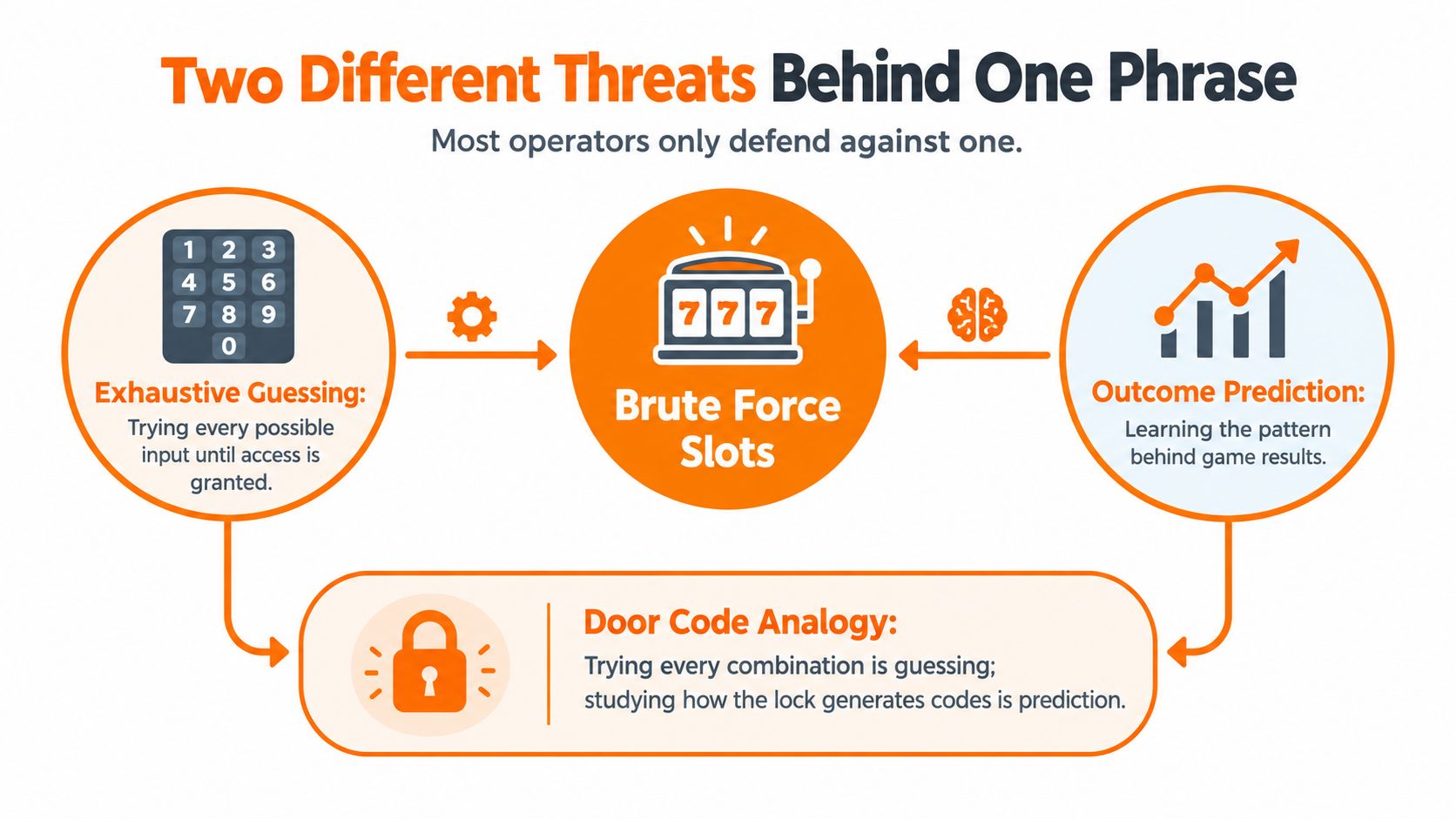
Three threats labelled brute force slots
Treat the following controls as separate workstreams, not interchangeable security features.
| Threat | What is targeted | What the attacker gains | Main control | Owning team |
|---|---|---|---|---|
| Predicting RNG output | Seed, RNG state, scaling logic | Timed wins on game outcomes | Certified RNG, protected seeds, telemetry limits | Platform provider and test house |
| Credential guessing | Player and admin logins | Balance theft, bonus takeover, withdrawals | Login rate limits, lockouts, MFA | Operator security team |
| Scripted play and bonus abuse | Game API and promotion mechanics | Bonus extraction, multi-account farming | Behavioural detection, KYC, human review | Fraud and compliance team |
Assign accountability before investigating individual sessions. The platform provider must answer questions about game implementation and testing. Operator security must own authentication and privileged access. Fraud and compliance must decide whether account behaviour violates promotion terms or requires verification.
Operational rule: Name the target before naming the incident. “Brute force” alone isn't a useful incident classification.
Shared evidence can support all these teams, but shared responsibility mustn't become an excuse for leaving decisions unowned.
Predictable Randomness and the Outcome Pipeline
A slot outcome can be predictable even when its reels look random. The Aristocrat Mark VI case illustrates the threat: attackers reverse-engineered the machine's PRNG by observing outputs and timing, then used their analysis to identify favourable moments to play. The case was prosecuted in the United States. The reported method matters more than the particular machine: attackers used information exposed by the system to infer its internal state. The account of the slot-machine PRNG exploitation
The physical machine is useful context, but the security issue was its internal computation.
A sequence of observations can expose regularities in a system that appears irregular. This is not credential guessing: the attacker is trying to infer how outcomes are generated, not trying passwords until an account opens. Keep those incidents separate. The platform provider and test house own the game implementation and its assessment; operator security owns access to sensitive systems.
Unpredictability is an implementation requirement
A deterministic PRNG can produce output that looks random yet remains predictable if an attacker learns enough about its algorithm, seed, timing, or internal state. Statistical randomness and resistance to prediction aren't interchangeable.
The UK Gambling Commission's remote technical standards require RNG output to be computationally infeasible to predict without complete knowledge of both the algorithm and seed. They also address uniform distribution, non-repeating output streams, independence across RNG instances, and unpredictable seeding or reseeding.
Ask the platform team one direct question: What information about outcome generation can a client observe? Review mobile apps, browser traffic, error responses, support exports, and diagnostic interfaces. The reels are only one visible part of the system.
- Protect seed material. Require cryptographically strong generation and restrict access to seed and reseed paths.
- Separate execution boundaries. Keep RNG services and game logic away from player-controlled devices and exposed diagnostic interfaces.
- Reduce observable state. Remove raw RNG state from routine logs, error messages, and client-facing responses.
- Control diagnostics. Authenticate diagnostic access, apply rate limits, and log who requests sensitive information.
A supplier's explanation of provably fair games can help frame questions about verification. It does not replace implementation review, secure deployment, or the testing obligations that apply in the operator's market.
The video below focuses on slot-machine exploitation, illustrating why observable outputs and timing can matter when attackers analyse a machine's behaviour.
Test the complete outcome pipeline
Testing the RNG alone is not enough. Developers can mishandle scaling, symbol selection, or configuration after the generator produces an output, leaving the full outcome pipeline exposed.
The UK Gambling Commission's testing procedure describes review of RNG documentation, investigation of known algorithmic or hardware weaknesses, source-code review against the documented implementation, and statistical testing of raw and transformed output. It also describes test-house assessment before new games or RNGs go live and submission of game and RNG test results. Do not attribute an annual independent security audit requirement to this procedure. Set audit expectations from the rules that apply in the operator's market, and document the basis for them.
Use the testing procedure to define the evidence you expect from a provider. Request coverage of seed handling, reseeding, symbol or reel mapping, bonus triggers, jackpot selection, and server-side scaling. Ask the test house to state what it assessed and what remained outside scope.
Certification is evidence about an assessed implementation, not permission to change it without review. Track the tested binary, configuration, RNG library, and game mathematics by version. Require release approval when a change could affect that relationship.
| Evidence to retain | Decision it supports |
|---|---|
| Tested build and production artifact identifiers | Whether deployed software matches the assessed implementation |
| Approved game configuration and mathematical model | Whether settings remain within the tested scope |
| RNG version and seed-handling documentation | Whether implementation changes require reassessment |
| Change approvals and test-house correspondence | Whether release decisions have an accountable owner |
Block promotion when material differences remain unexplained. A release manager should not have to guess whether a changed library is harmless based on an informal supplier message.
Monitor for defects after deployment
Production monitoring should surface conditions that warrant investigation, not label an unusual win as fraud. Establish reviewed baselines for outcome distributions. Escalate suspected predictability, synchronization, cycling, or altered scaling to the platform security owner immediately.
Require tamper-evident audit logs, alerts for privileged configuration changes, and a documented escalation route to the provider and test house. Preserve affected build identifiers and relevant records before changing the environment. Keep sensitive generator state out of broadly accessible incident tickets.
A unified wallet, KYC workflow, fraud system, and shared audit-log layer can help investigators connect account activity with game and promotion events across brands. Restrict access to those records. Better correlation should not create a new route to sensitive game data.
A clean payment-security review doesn't establish that game outcomes are unpredictable. Demand evidence for the outcome pipeline itself.
Connect audit findings about access or logging to release governance. Assign an owner and remediation task, then resolve the finding before it becomes a risk in a later deployment.
Stopping Credential Guessing on Player and Admin Accounts
A login attack does not need to manipulate a slot's outcome. It targets access: automated scripts test stolen or guessed credentials, sometimes concentrating attempts on one account and sometimes spreading them across many. If an attacker gets in, they may reach balances, bonus entitlements, personal information, withdrawal functions, or linked payment methods. Slotegrator's iGaming cybersecurity guidance discusses cybersecurity risks in iGaming, but a vendor estimate is not a sound basis for setting your controls.
Separate account guessing from predictable game outcomes and scripted promotion abuse. Each threat needs different evidence and an accountable owner. For login attacks, monitor failures per account, across network sources, and against privileged accounts. Shared identity, wallet, and back-office services on a multi-brand platform need particular scrutiny because a single compromise can reach connected operations.
Starting login defences for casino accounts
Treat these as configuration recommendations, not universal thresholds. Set numerical limits using your own traffic and controlled tests. A copied threshold does not become effective just because another operator uses it.
| Control | Starting setting | What it stops |
|---|---|---|
| Failed-login limit per account | Apply a rolling failure limit, then progressively delay further attempts | Rapid password cycling on one account |
| IP and device throttling | Aggregate failures across accounts and throttle suspicious sources | Password spraying from one source |
| Temporary lockout | Use a temporary restriction with a verified email recovery path | Repeated retries without permanent exclusion |
| CAPTCHA challenge | Trigger after repeated failures or corroborating automation signals | Scripts unable to complete the challenge |
| MFA for admin and cashier actions | Require for back-office roles and withdrawal-detail changes | Reliance on a stolen password alone |
| Breached-password screening | Reject known-compromised passwords and enforce an approved length policy | Reused credentials from other services |
Account limits alone aren't enough. Attackers can distribute attempts across usernames, so review aggregate failures by device and network source as well. Source-only restrictions can disrupt legitimate players sharing a connection. Use both views, and tune them against observed traffic.
Make privileged access harder to misuse than player access. Require MFA for back-office users, restrict and test recovery procedures, and log sensitive cashier changes with the acting identity and outcome. Investigate failures against administrator accounts separately from routine player login activity.
Tune against legitimate failures
Use a risk-management operating model with a named owner for every alert and recovery route. Record login velocity, failed-attempt ratios, location anomalies, device information, and later withdrawal activity. Never store attempted passwords.
- Set the trigger. Document which failure pattern causes a delay, challenge, or temporary restriction.
- Define recovery. Test how a genuine customer regains access without support staff bypassing verification.
- Review false positives. Compare restrictions with successful recoveries and support complaints after traffic spikes.
- Protect administrators. Route privileged-account failures for separate review rather than applying player-account assumptions.
Threshold discipline: A useful limit has an owner, a documented rationale, and a review process. A copied limit has none of those.
Tune settings by brand and access path. Players mistype passwords, promotions change traffic patterns, and administrator accounts warrant a lower tolerance for suspicious activity.
Spotting Automated Play Without Punishing Real Players
Fast play is not proof of an attack, and repeated spins do not predict a slot's outcomes. Treat these as separate risks: scripted play and promotion abuse require behavioural evidence, while attempts to predict randomness belong in the game's outcome controls. Assign the right team to investigate each one.
Apply the requirements of each market through a documented procedure. Do not assume the linked Kenya's 2026 gambling conduct regulations support a particular bot-control measure without checking the regulation's text.
Combine signals before intervening
Send an account for review when independent indicators support concern. Speed alone is weak evidence, especially when a game offers autoplay.
- Timing regularity. Look for unusually consistent intervals between actions, accounting for autoplay and other provider-supported features.
- Account relationships. Check shared device fingerprints, payment methods, and identity details. Test plausible household or shared-device explanations before treating a link as suspicious.
- Promotion behaviour. Examine activity concentrated around bonus triggers and unusual wagering-completion patterns against the promotion's terms.
- Session context. Compare activity with the game's mechanics and the account's prior behaviour. Keep potential gambling harm in view, but do not treat it as evidence of fraud.
A steady spin cadence during a long session could come from permitted autoplay. Check the game settings, provider records, account relationships, and promotion terms before restricting access.
Use behavioural thresholds to trigger review, not to declare guilt. Set cadence and account-linkage triggers using your own traffic. Document the rationale and test each trigger against known legitimate sessions. A universal speed limit is not fraud detection.
Escalate with an evidence trail
Use a defined sequence: flag, step-up verification, human review, customer communication, then restriction where justified. Set a CAPTCHA or request documents only to resolve a specific uncertainty. An unexplained challenge adds friction without strengthening the decision.
Record the observations that triggered review, the applicable terms, the reviewer, the verification result, and the reason for the outcome. If immediate containment is needed, document the risk of waiting and arrange prompt review.
Keep responsible-gambling concerns separate from fraud findings. A player may need support or limits without breaching promotion terms. Investigators should not label prolonged play as criminal behaviour.
Restrict an account only when evidence supports a defined intervention, not because a player crossed an unexplained dashboard threshold.
That standard protects legitimate customers and gives compliance staff a decision they can explain.
Bankroll Maths Behind the Brute Force Myth
Repeated play doesn't create a mathematical edge against a correctly implemented RNG. Changing stake patterns doesn't turn an unfavourable expectation into a winning system.
RTP describes a long-run average, not a session guarantee. Games with the same RTP can produce materially different session experiences because volatility changes the frequency and size of wins.
Expected long-run loss by RTP configuration
The Brute Force slot listing reporting AboutSlots' 2024 figures identifies the RTP configurations below. The loss columns are arithmetic derived from those RTPs: expected loss per $100 equals the amount wagered multiplied by the non-returned proportion, and 1,000 spins at $1 represent $1,000 of total wagering.
| RTP | Expected loss per $100 wagered | Expected loss over 1,000 spins at $1 |
|---|---|---|
| 96.08% | $3.92 | $39.20 |
| 94.10% | $5.90 | $59.00 |
| 92.06% | $7.94 | $79.40 |
| 87.02% | $12.98 | $129.80 |
These are long-sample expectations, not forecasts for an individual session. Total wagering isn't the same as starting bankroll, because a player may wager returned funds again.
Session survival needs more than RTP
A $30 bankroll at $1 per spin can disappear after 30 losing spins, even on a game with an apparently favourable RTP, as illustrated in the discussion of RTP, volatility, and bankroll survival. No universal safe spin count follows from RTP alone.
The relevant question is how stake, bankroll, and the payout distribution interact. Selecting a higher RTP doesn't by itself establish that a player will experience a longer session, and the table doesn't quantify their probability of ruin.
Operators should make those limits clear rather than implying persistence will overcome losses.
- Disclose the active configuration. Show the RTP applicable to the game being offered, alongside meaningful volatility information.
- Explain calculator limits. A stake-to-bankroll tool should distinguish basic affordability arithmetic from a session-survival forecast.
- Support pre-commitment. Offer loss and time limits before play rather than encouraging players to recover losses through more spins.
Don't market high-volume play as a method for forcing a favourable result.
Confirm Controls Before Your Next Launch
Make launch approval depend on evidence someone can retrieve, not assurances someone remembers. Use this sequence for a new brand, a migration, or a material game-platform change.
- Assign the owners. Map each brand and game to accountable contacts for outcome integrity, authentication, and scripted-play investigations.
- Reconcile the deployment. Compare production artifacts and configuration with the versioned test-house evidence.
- Approve authentication settings. Record the rationale for login limits and schedule a review after initial live traffic.
- Exercise the review workflow. Confirm behavioural flags, verification requests, human decisions, and customer communications reach the audit log.
- Run a tabletop drill. Rehearse account compromise on a brand and suspected game predictability elsewhere, recording containment decisions and unresolved dependencies.
A unified wallet and shared audit records can make cross-product investigations easier to coordinate, provided access controls preserve separation of duties. Include infrastructure availability in the rehearsal through an explicit DDoS protection and hosting review, without treating availability controls as a substitute for game or account security.
The readiness test is simple: can you show a regulator the evidence for the game currently in play and explain your most recent suspicious-event decisions?
NexGrate offers a turnkey casino and sportsbook platform with player accounts, wallet management, KYC workflows, fraud controls, and audit logging. Visit NexGrate to discuss your launch architecture and ask how its controls support separate ownership of game integrity, account security, and promotion-abuse investigations.