
A large bet has just landed on your pre-match soccer market. Your trader is checking the team news, the displayed price is still available, and another customer is opening the bet slip. You need to decide whether to move the line, lower the acceptance limit, or stop taking bets while someone checks what changed.
That's the practical problem behind laying the odds. You're not deciding only who's likely to win. You're deciding what promise the business can afford to make, what information supports it, and whether the systems behind the screen can honor it.
Table of Contents
- What Laying the Odds Means on a Live Book
- How Pooled Betting Turned Odds into Prices
- Building Margin Liability and a Usable Price
- Why Odds Format Changes the Bets People Take
- When a Line Should Move or Be Suspended
- Choosing the Stack That Can Lay Those Odds
- A Practical Next Step for Operators
What Laying the Odds Means on a Live Book
The accepted bet matters more than the blinking price. Once your book accepts a wager, the customer has a ticket governed by its accepted terms and your applicable rules. Changing the screen afterward doesn't erase the exposure you've already taken.
From the operator's side, laying the odds means offering a price and accepting the financial obligation attached to the other side of the wager. The bettor chooses a selection. You decide whether to accept that selection at the displayed terms, for the requested stake, within your risk policy.
Separate the decisions before touching the price
In our opening situation, the large bet could mean different things. The customer might know something your feed hasn't reflected, might disagree with your assessment, or might want a substantial position. Treating every large wager as proof that your model is wrong would be as careless as ignoring every large wager.
Keep the desk's jobs separate:
- Set the opening price. Establish the initial view of the event using your model, available information, and trading policy.
- Control the exposure. Decide how much the business can lose if an outcome wins, including related bets elsewhere.
- Respond to change. Determine whether new information or incoming money justifies a different quote.
A stake limit addresses how much you'll accept. A price change addresses the terms you're offering. A suspension addresses whether you should be offering terms at all. They aren't interchangeable controls.
Desk rule: Before changing a line, say what you're correcting: the probability estimate, the exposure, or uncertainty about the event.
Decimal, fractional, and American odds are ways to display a quote. They don't determine who carries the liability or whether your acceptance controls work. A perfectly converted number can still be an unsuitable price.
The operating chain extends beyond the trader's screen. Pooled betting explains how money helped turn odds into market prices; fixed-price trading adds exposure management; customer displays introduce behavioral choices. Integrity checks and settlement infrastructure determine whether the business can support the promises it publishes.
How Pooled Betting Turned Odds into Prices
Think of a race pool as a map of where customers have put their money. Each selection has a share of the stakes, and winning tickets receive a share of the distributable pool. The operator doesn't need to express a private opinion through every payout quote.
The historical connection is Joseph Oller's totalizator, introduced in the 1860s, which recorded stakes before a race and supported pari-mutuel betting, where customers wager against one another rather than directly against a bookmaker, as described in Britannica's history of sports betting. After the operator's commission or pool share, the remaining money is divided among winning tickets.
Follow the money through the pool
The sequence matters. Customers stake on competitors, the system records those stakes, and the distribution of money determines the eventual payout relationship. As more money arrives, the pool changes.
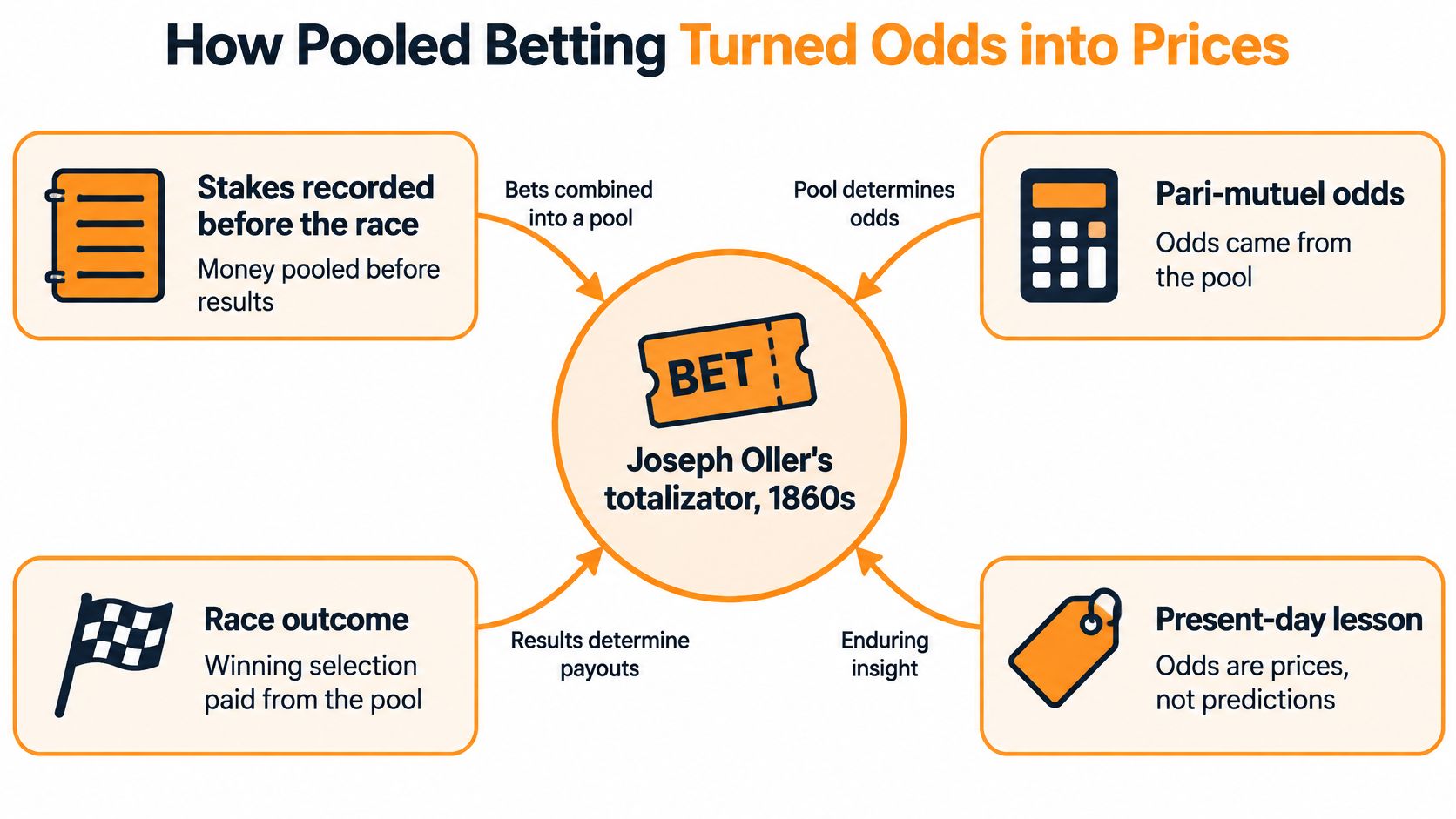
Suppose customers increasingly favor the same runner. Without assigning any numerical odds, you can see the consequence: more winning tickets would share the money available if that runner wins. The payout relationship reflects the crowd's commitments, not just a handicapper's assessment.
Demand isn't the same thing as truth. A concentrated pool tells you where people have wagered. It doesn't establish that their preferred runner will win.
The fixed-price fork
A fixed-odds sportsbook takes a different position. It publishes terms in advance and embeds its pricing margin in those terms. For a fuller distinction between the operator and the betting product, the explanation of what a sportsbook does provides useful context.
The practical difference is commitment. In a pool, additional wagers can change the eventual payout relationship. On a fixed-price book, your next quote can change while previously accepted tickets retain their accepted terms, subject to the applicable rules.
That makes an outdated fixed quote a potential liability. Customers can accept terms that no longer reflect your current assessment while your desk is still updating the market.
The lasting lesson isn't racing trivia. Odds are prices that combine probability, market demand, and operator economics. Read them as forecasts alone and you'll miss why a trader may change an offer without changing their underlying opinion of the teams.
Building Margin Liability and a Usable Price
Start with a soccer match offering home win, draw, and away win. Your model assigns a fair chance to each mutually exclusive result. The trading task is to turn that assessment into an offer the business is willing to accept.
A usable worked example doesn't require invented numerical quotes. Suppose the home side is your favorite, the draw is plausible, and the away win is the least likely result. Your fair assessment would offer the shortest return on the home side and the longest on the away side.
Build the offer, then test the exposure
To add overround, the desk offers returns below the corresponding fair-price returns. Expressed as implied probabilities, the offered outcomes collectively exceed the complete set of fair chances. The margin is embedded in the prices, not added as a surprise deduction after a winning bet settles.
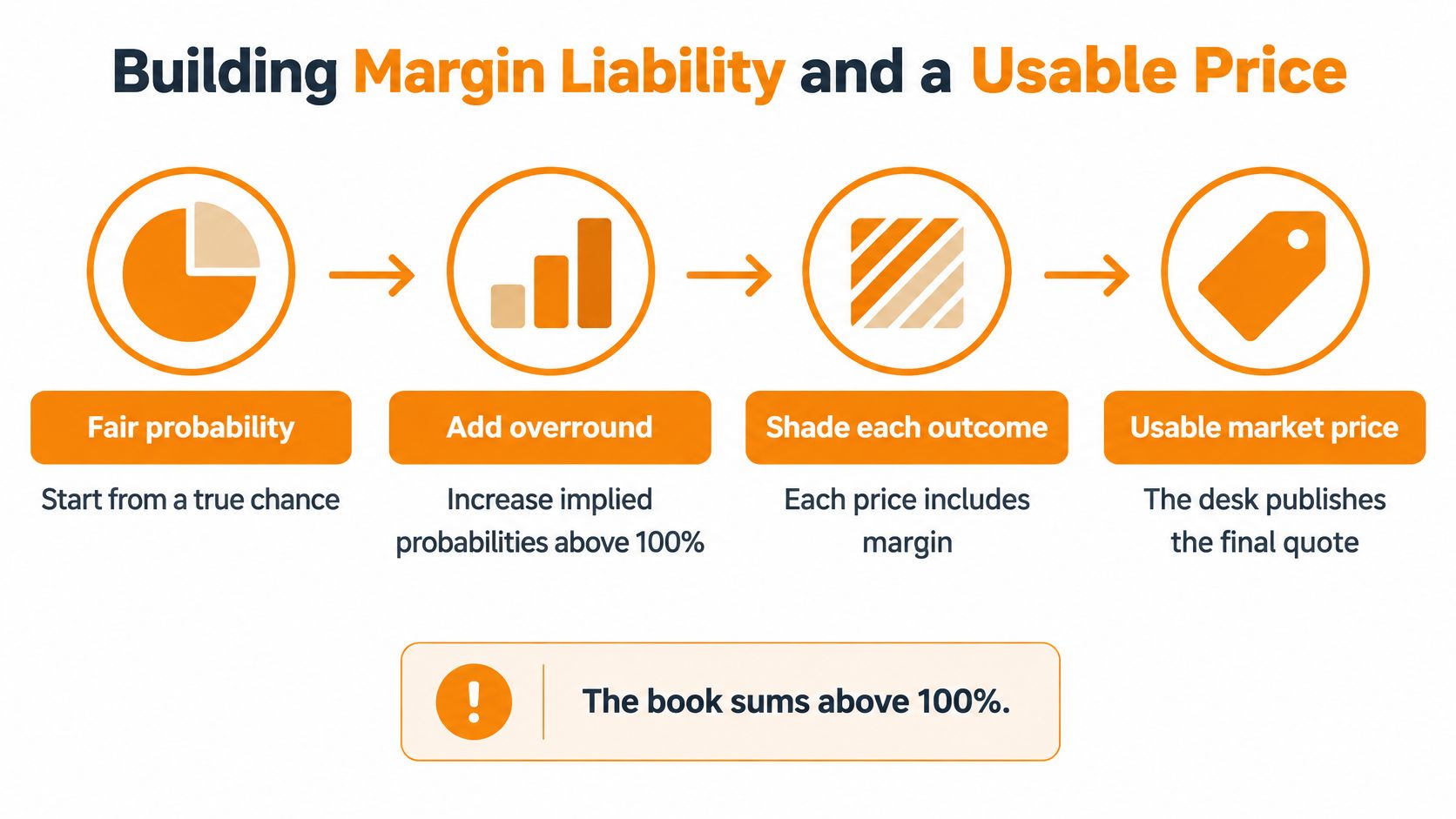
Don't confuse quoted margin with guaranteed profit. Your actual result depends on which bets customers place, the terms you accepted, and what happens on the pitch. A market can look commercially sensible on screen while leaving you heavily exposed to the favorite.
Nor should you assume every outcome needs identical shading. As a trading-policy choice, you might offer a more competitive favorite price while taking more margin elsewhere. That choice should have a documented rationale, rather than becoming an automatic habit that nobody reviews.
Run the acceptance loop
The model may still support your home-win quote after a substantial wager. Your liability policy may not support accepting another substantial stake at that price.
- Open from an approved assessment. Check that the model and event feed refer to the correct fixture, market, and settlement conditions.
- Read early bets as information. Review their timing and concentration before deciding whether they reveal a pricing problem.
- Adjust deliberately. Move the offer manually or automatically, change permitted stakes, or consider a hedge under the desk's policy.
- Stop when you can't refresh reliably. Don't substitute an old quote for a current assessment.
- Settle against a confirmed result. Apply the documented market rules, including exceptions and corrections.
Check related exposure before accepting more. A home victory could coincide with winning player props and accumulators, so reviewing each market in isolation can understate the position.
A practical sportsbook risk-management framework should distinguish pricing authority, liability limits, and escalation ownership. Pre-match and in-play desks can use the same decision sequence, but in-play staff must also account for the changing event state. The essential question remains: can you justify both the quote and the amount you're accepting?
Why Odds Format Changes the Bets People Take
A customer doesn't see your model, exposure report, or trading discussion. They see a price, a possible return, and an invitation to confirm a wager. Treating that display as a cosmetic preference overlooks a meaningful product decision.
A 2025 randomized trial found that participants shown American odds alone selected riskier bets more often than participants shown alternative formats; participants also estimated a same-game parlay with an implied 4% probability as having a 53% chance of winning, while adding implied probability reduced risky selections, according to the Behavioral Insights Team's account of its odds-format experiment.

Clearer arithmetic isn't a complete safeguard
The sensible conclusion is that presentation deserves testing, not that a probability label makes a product safe. A customer can understand that a wager is unlikely to win and still stake more than they can afford to lose.
There's another distinction to protect: price-implied probability isn't a certified true chance. It's derived from the offered terms, which reflect the book's commercial pricing. Calling it the chance of winning can suggest more certainty than the operator has.
A clearer bet slip should help customers understand the commitment, not merely help them complete it faster.
Design a layered explanation
Rather than asking customers to perform conversions, put related information together:
- The offered price. Keep the chosen format consistent between selection, bet slip, and accepted ticket.
- The implied probability. Explain its relationship to the quote and avoid presenting it as a guarantee.
- The margin explanation. State plainly that sportsbook prices include an operator margin.
- The amount at risk. Make the stake that can be lost as legible as the possible return.
- The account record. Give customers an accessible view of settled results and net activity.
Mobile defaults deserve particular attention. If explanations require opening several menus, the primary screen may encourage a decision without supplying the context needed to evaluate it.
Test comprehension as well as completion. Ask whether customers can distinguish total return from profit, identify their potential loss, and explain what the displayed probability means. Those are more useful product questions than whether users recognize the notation.
When a Line Should Move or Be Suspended
An unavailable star player creates an immediate trading question: do you have confirmed information and a usable replacement assessment, or only an alert that someone still needs to verify? Leaving the old offer open while answering that question is a decision, even if nobody explicitly approves it.
Research covering 117,174 odds from 32 bookmakers across 32 markets found initial inertia after elite soccer-player absence announcements followed by delayed adjustment, as discussed in the Economic Inquiry research on bookmaker pricing reactions. For an operator, the important distinction is between time spent checking information and time spent accepting bets at a quote the desk can no longer defend.
Move, pause, or investigate
Move the line when the information is confirmed, material to the market, and supported by a refreshed assessment. Record the reason so the next trader doesn't mistake a news adjustment for a response to liability.
Suspend the market when the event state is uncertain, the feed is late, or the desk can't produce a defensible replacement. A deliberate pause is different from leaving an unattended price available.
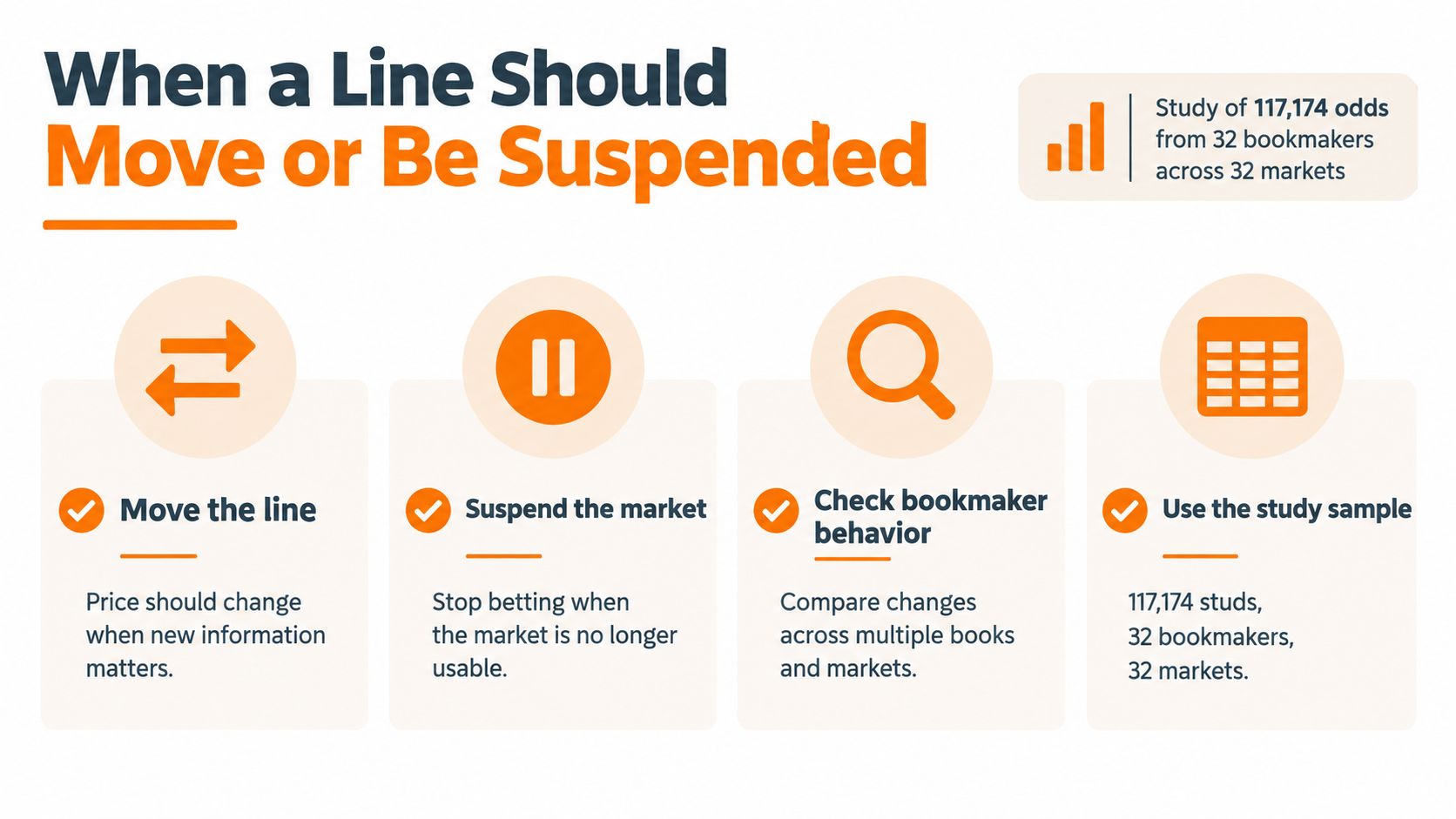
Investigate unusual activity when concentrated betting or unexpected price movement lacks an understood explanation. Thin player-prop and micro-markets warrant explicit escalation rules because the desk needs to know who reviews an anomaly and who can stop acceptance.
An alert isn't proof of manipulation. Likewise, movement elsewhere isn't proof that another bookmaker has better information. Compare the timing, event context, and your own exposure before deciding what the movement means.
Make stale-line handling auditable
The practical control is a record that lets staff reconstruct the decision:
- Information time. Capture when the underlying announcement or event update became available.
- Feed and publication time. Distinguish when your system received an update from when customers saw the revised quote.
- Acceptance time. Preserve the price and market state attached to each accepted ticket.
- Action ownership. Log who moved, suspended, reviewed, and reopened the market.
Set stale-odds alerts against your documented trading policy rather than relying on someone noticing a screen. Automated collection and comparison of line changes can support monitoring, but staff still need a process for reviewing false alarms.
Speed without context isn't sufficient. The goal is a traceable decision about whether the offer remains usable, not an unexplained rush to copy another price.
Choosing the Stack That Can Lay Those Odds
Britain's October–December 2024 operator dataset illustrates the infrastructure challenge: online gross gambling yield rose 21% year over year to £1.54 billion, real-event betting generated £647 million, approximately 42% of that yield, and online activity reached 25.9 billion bets and/or game spins, according to the Gambling Commission's market overview. Those activity totals include casino games, not just sportsbook wagers, and GGY is operator revenue after winnings, not customer stakes or operating profit.
Use that scale as a systems question, not a sales target. Who keeps acceptance, wallet balances, settlement, and reporting consistent when customers are using several products?
What a Book Needs Before It Lays Odds
| Operator job | What must be in place | What stays with the trading team |
|---|---|---|
| Publish markets | Odds feeds, pre-match and in-play support, market mapping | Market selection and approval of trading assumptions |
| Configure offers | Margin settings and controlled price updates | Commercial pricing policy and exceptions |
| Accept wagers | Stake limits, liability checks, acceptance records | Exposure appetite and escalation decisions |
| Settle tickets | Result feeds, settlement rules, correction workflows | Review of disputed or unusual results |
| Maintain balances | Shared wallet, cashier, payment reconciliation | Coordination with finance on unresolved exposure |
| Support compliance | KYC and AML workflows, audit logs, geofencing, reporting | Operational approvals alongside compliance staff |
Building your own stack lets you choose separate feed, risk, wallet, and compliance components. It also leaves your team responsible for their interfaces, failure handling, and reconciliation. An odds update can succeed while another component fails, so testing each vendor independently isn't enough.
A turnkey platform consolidates more of those dependencies. Evaluate that approach through a sports-betting platform selection checklist, with demonstrations based on your acceptance and settlement scenarios rather than a feature tour.
Consolidation doesn't outsource judgment
NexGrate is one B2B white-label option combining casino content and sportsbook operations in a shared backend and player wallet. Its sportsbook includes pre-match and in-play markets, odds feeds, settlement, and margin configuration, alongside KYC and AML workflows, risk and fraud rules, fiat and crypto payments, and compliance tooling oriented to MGA-style reporting, geofencing, and responsible gaming.
Those capabilities can reduce the number of integrations an operator has to coordinate. They don't establish that a proposed launch meets every jurisdiction's requirements, and they don't decide which exposures your business should accept.
Procurement test: Ask the provider to demonstrate a feed interruption, a suspended market, a settlement correction, and the resulting wallet and audit records.
Buyers should also confirm access permissions and exception ownership. A consolidated backend is useful only if staff can identify what happened, take the permitted action, and account for the result.
A Practical Next Step for Operators
Before commissioning another pricing model, write an operating policy that a trader, product manager, and compliance lead can apply to the same test market. Differences in their answers will reveal launch risks that a polished interface can hide.
Keep the first exercise narrow. Choose a sport and market your team understands, then follow a ticket from publication through acceptance, a material news update, suspension, reopening, and settlement. Use the exercise to expose missing decisions, not to prove that the platform works under ideal conditions.
Put decisions into writing
- Document the house view. Define how traders may apply margin by sport and market, who approves exceptions, and when staff review those choices.
- Set acceptance boundaries. Approve stake and liability caps before publication, including the treatment of related markets.
- Approve the customer display. Decide the default odds format, probability explanation, loss disclosure, and account-history presentation.
- Write suspension triggers. Cover unconfirmed team news, feed interruptions, unclear event states, and unusual activity in thin markets.
- Assign reconciliation ownership. Name the staff responsible when tickets, results, wallet entries, or reports don't agree.
Separate human approval from system evidence
The trader must judge whether information is credible and whether the proposed exposure is acceptable. The platform must preserve what was offered, what was accepted, which controls applied, and how the wager was settled.
Don't accept a demonstration that skips exceptions. Ask staff to correct a result, investigate a rejected wager, and retrieve the reason a market reopened. A launch rehearsal should leave an evidence trail that another employee can understand without relying on the original trader's memory.
If your feeds, wallets, and compliance controls still sit in separate projects, review a turnkey sportsbook module against that checklist. Include a combined casino and sportsbook backend where shared balances fit your operating plan, but require the same evidence you'd demand from a custom build.
A price is only laid safely when the book can move it, limit it, explain it, and settle it. Make that your launch acceptance standard.
NexGrate offers a turnkey casino and sportsbook stack with a shared backend and wallet, odds feeds, settlement, and configurable margins. Visit NexGrate to discuss your launch requirements and request a walkthrough built around your pricing, suspension, liability, and settlement checklist.