
You're probably in one of two situations right now. Either you're preparing a new sportsbook launch and trying to avoid a multi-vendor mess, or you're already operating in gaming and you know your current stack won't support the next market, the next regulator, or the next peak event.
That's where most platform evaluations go wrong. Teams spend too much time comparing front-end features and bonus gimmicks, and not enough time on the parts that decide whether the business scales: trading control, wallet architecture, payment coverage, compliance tooling, settlement accuracy, and how many operational workarounds your team will need after launch.
The timing matters. The global sports betting market was valued at USD 191.66 billion in 2025 and is projected to reach USD 385.8 billion by 2033, with an approximate 12.8% CAGR, according to Data Bridge Market Research's global sports betting market outlook. That kind of growth attracts operators, affiliates, suppliers, and regulators at the same time. A weak platform choice gets exposed quickly.
If you're entering a new jurisdiction, expanding your product mix, or evaluating where to place your next budget cycle, this guide is meant to help you make the platform decision the way an operations leader should. It focuses on launch speed, control, operating overhead, and what holds up once real money starts moving across new iGaming markets.
Table of Contents
- Choosing Your Platform in a High-Growth Market
- The Core Dilemma Build, Buy, or Turnkey Solution
- Defining Your Platform Evaluation Criteria
- A Deep Dive Into Sportsbook Engines and Risk Management
- The Unified Platform Advantage Casino, Sports, and Payments
- Your Actionable Vendor Selection Checklist
Choosing Your Platform in a High-Growth Market
The phrase best sports betting platform sounds simple. In practice, it usually means something different for every operator. A startup brand entering one jurisdiction needs speed and low operational drag. An established operator migrating from legacy systems needs continuity, reporting confidence, and cleaner cross-product economics.
The pressure is highest at the start. You're dealing with license requirements, payment routing, content contracts, trading coverage, fraud controls, CRM logic, affiliate tracking, and customer support design at the same time. If the platform underneath those layers is weak, every department creates a workaround. Workarounds become process debt. Process debt becomes margin leakage.
A good selection process starts by asking a harder question than “Which platform has the most features?” Ask which platform will let your team launch, settle, reconcile, report, and expand without rebuilding core workflows six months later.
| Decision area | What operators should optimize for | What usually goes wrong |
|---|---|---|
| Market entry | Fast launch with manageable vendor overhead | Too many integrations too early |
| Compliance | Reporting, controls, auditability | Manual processes hidden behind demos |
| Trading | Reliable feeds, margin control, settlement accuracy | Limited in-play depth and weak tooling |
| Payments | Broad coverage, stable cashier flows, wallet consistency | Fragmented balances and failed reconciliation |
| Operations | One back office, clear ownership, low support friction | Separate systems and duplicated admin work |
The strongest platform decision usually looks conservative on day one and ambitious on day three hundred. It reduces operational complexity first, then expands capability.
That matters more now because the addressable market is large and still expanding, but operators don't monetize growth by being present. They monetize growth by staying stable under pressure. The platform is the first operating decision, not the last procurement step.
The Core Dilemma Build, Buy, or Turnkey Solution
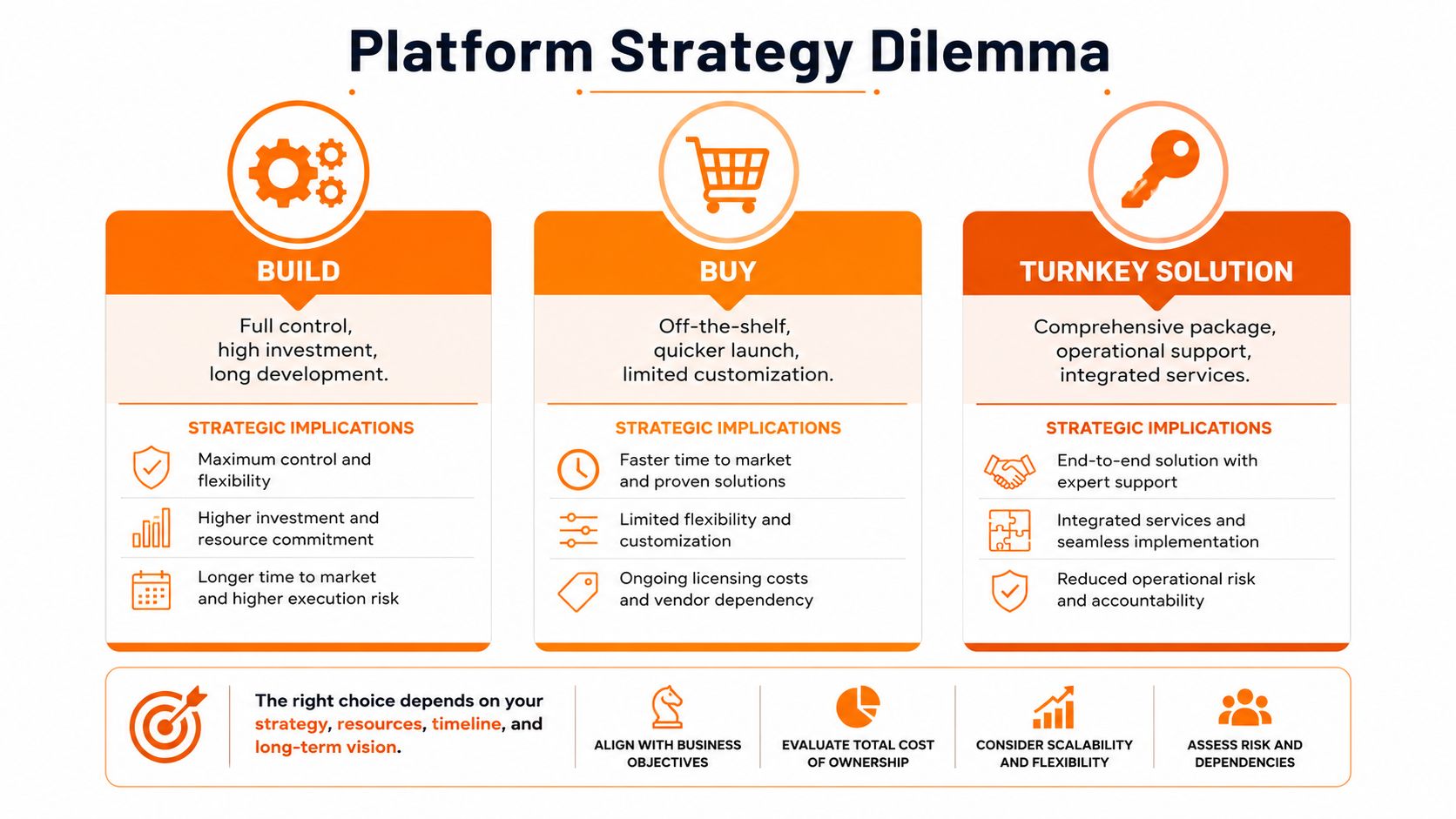
Most operators evaluating the best sports betting platform are really choosing between three models. They can build their own stack, buy and assemble separate components, or adopt a turnkey solution that packages the core operating layers together.
That choice shapes cost structure, launch timing, vendor management, and how much control your team will have in production.
Build
A custom build gives maximum architectural control. You define the wallet logic, trading interfaces, player services, reporting structure, bonus engine behavior, and how each external provider connects.
That sounds attractive until the hidden workload becomes visible. Building a sportsbook-capable platform isn't just front end and APIs. It includes settlement logic, exception handling, player ledger controls, payment orchestration, KYC flows, admin permissions, monitoring, release management, and support tooling. If your team hasn't operated those systems before, custom development can create a polished demo and an unstable business.
Build works best when:
- You already have technical leadership: Internal product and engineering leaders know betting operations, not just software delivery.
- You need unique control: Your market position depends on proprietary workflows or differentiated pricing logic.
- You can support long-term ownership: The budget covers maintenance, not just initial development.
Buy
The buy model means assembling best-of-breed vendors. You might source one sportsbook engine, one casino aggregator, one KYC vendor, one cashier provider, one bonus tool, and one CRM or affiliate layer.
This gives more flexibility than turnkey, but it introduces integration risk. Every integration adds responsibility boundaries. When settlement is delayed, or a bonus misfires after a wallet sync issue, suppliers often point at each other. Your operations team becomes the system integrator, whether you planned for that or not.
Here's the practical trade-off. Buying separate modules can produce a stronger final stack than a generic all-in-one package. But only if your organization is ready to coordinate contracts, roadmaps, incident response, versioning, and data consistency across vendors.
Turnkey solution
Turnkey is usually the right answer for operators who value speed to revenue and predictable operations over absolute technical freedom. The strongest turnkey platforms reduce the amount of custom work required before launch and keep core services aligned under one operating model.
That doesn't mean every turnkey option is equal. Some are rigid white-label shells with shallow controls. Others give real back-office depth, configurable payments, margin settings, third-party integrations, and enough ownership for the operator to run the business properly.
Practical rule: Don't ask whether turnkey is “less powerful” than custom. Ask whether your team can monetize custom complexity faster than a turnkey partner can remove it.
A simple comparison helps.
| Model | Speed to launch | Control | Integration burden | Operational overhead | Best fit |
|---|---|---|---|---|---|
| Build | Slow | High | Internal | High | Mature operators with product and engineering depth |
| Buy | Medium | Medium to high | Shared across many vendors | Medium to high | Operators with integration experience |
| Turnkey | Fast | Medium, sometimes high depending on vendor | Lower | Lower | New launches and expansion plays |
If you're evaluating vendors side by side, it helps to compare sportsbook platform models in one place and map them against your actual operating capacity, not your aspirational org chart.
Defining Your Platform Evaluation Criteria
The fastest way to make a bad platform decision is to let the demo drive the scorecard. Sleek UX matters, but the operator pays for what sits behind it. The right evaluation framework tests whether the platform can carry revenue, risk, and regulatory obligations without constant manual intervention.
Score the operating model before the feature list
A reliable platform has to perform under live trading conditions. According to Software Mind's breakdown of sportsbook platform architecture, a scalable sports betting platform requires a backend stack using Node.js for real-time data streams and Python for odds calculation, deployed on AWS with PostgreSQL, Redis, and WebSockets to maintain transactional integrity, caching, and live odds updates. That detail matters because it tells you what the vendor thinks is essential: speed, consistency, and resilience under peak traffic.
You don't need every supplier to expose its entire codebase. You do need a clear answer on architecture, deployment model, release process, failover design, and how live updates behave under load.
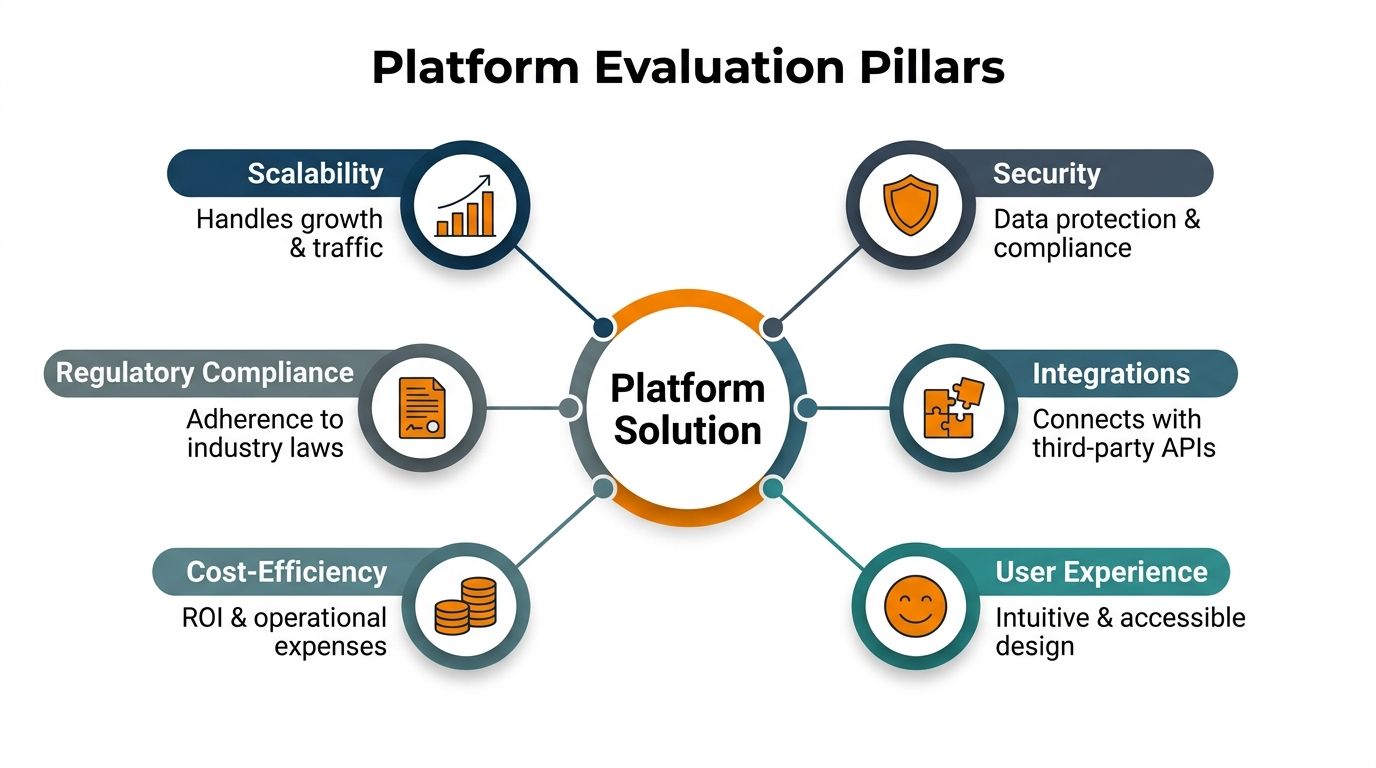
A practical shortlist should test six pillars.
The six pillars that deserve hard questions
Sportsbook engine
This is the commercial heart of the stack. Check market coverage, in-play depth, odds management, settlement controls, margin tools, and how exceptions are handled. If the vendor can't show how traders and operations teams work inside the system, the engine may be thinner than the demo suggests.Unified player wallet
Separate balances across sportsbook, casino, and promotions create support tickets and reconciliation problems. One wallet doesn't just improve the player journey. It gives finance and support teams a single ledger view.Compliance and regulatory tooling
Good compliance support isn't a PDF checklist. It's player verification workflows, AML review capability, geolocation enforcement where relevant, audit logs, role-based permissions, safer gambling controls, and reporting your compliance team can use.
A platform that “supports compliance” but requires spreadsheet exports for routine checks is pushing operating risk back onto your team.
Payments and cashier flexibility
Look past logos on a payments slide. Ask how deposits, withdrawals, reversals, wallet states, chargeback handling, multi-currency support, and crypto flows are managed. Operators don't lose sleep over payment options. They lose sleep over payment exceptions.Content and third-party integrations
A platform should connect cleanly to data feeds, casino studios, CRM tools, affiliate systems, KYC providers, and reporting environments. The question isn't whether integrations exist. It's how much effort your team needs to deploy and maintain them.Scaling and operations
This pillar is often underestimated. Review monitoring, incident response, admin permissions, deployment cadence, support structure, DDoS posture, and data export access. A platform isn't only software. It's an operating environment.
A vendor that performs well across these pillars is usually stronger than one with a longer feature list. If you're mapping suppliers against a shortlist, start with an operator platform evaluation view and then stress test each area through demos, documentation, and live questions.
A Deep Dive Into Sportsbook Engines and Risk Management
A sportsbook can survive weak design in some areas. It can't survive a weak engine. The engine decides what markets you can offer, how quickly odds move, how accurately bets settle, and whether your traders can manage exposure without waiting on supplier intervention.
What separates a usable engine from a profitable one
At the low end, a sportsbook engine is basically a feed wrapper with a bet slip. It offers standard pre-match markets, basic in-play coverage, and limited operator control. That might be enough to launch, but it won't give your trading and risk teams much room to manage margin or react to abnormal patterns.
At the high end, the engine becomes a control system. According to LSports' overview of sportsbook software providers, top-tier providers such as Arena360 combine real-time trading, AI-driven risk management, and advanced analytics across 120+ sports and 15,000+ leagues via a unified API. That kind of breadth matters less as a marketing number and more as a signal that the platform is built for dynamic market creation, broader event coverage, and operator-level control.
The practical question is whether the engine gives your team these levers:
- Pricing control: Can traders adjust margin configuration, market rules, and exposure thresholds without engineering support?
- Market depth: Is in-play limited to headline events, or can the operator support a wider schedule consistently?
- Settlement confidence: How are voids, delays, disputes, and stat corrections handled?
- Latency tolerance: When odds move quickly, does the user interface stay stable and does the admin side stay usable?
Risk controls that operators actually need
Risk management in sportsbook operations isn't just about identifying sharp bettors. It's about controlling operational exposure while still keeping the product competitive.
A strong risk layer usually includes user-level profiling, event-level exposure management, market suspension controls, configurable stake rules, and exception monitoring. The best setups blend automation with trader oversight. Fully manual control is too slow. Fully automated control can overreact and damage the player experience.
If your traders can't see liability clearly and act fast, they'll compensate by being conservative. Conservative trading protects downside, but it also weakens the product.
Many procurement teams miss the point. They ask whether AI exists, not how it's used. AI-driven risk management is only useful when it supports real operating decisions such as flagging suspicious patterns, adjusting exposure logic, or helping prioritize manual review.
The same applies to live betting. Operators need rapid updates, but they also need confidence that the feed, pricing, and settlement chain won't create avoidable disputes. In practice, the best sports betting platform is usually the one that gives your team enough control to stay commercial without losing discipline.
The Unified Platform Advantage Casino, Sports, and Payments
Operators often treat casino, sportsbook, and payments as separate purchasing tracks. That looks reasonable during procurement. It becomes expensive in production.
The U.S. online sports betting market is expected to generate $45.43 billion in revenue in 2024, with a projected 7.47% annual growth rate for 2024 to 2029, according to RG's U.S. sports betting statistics overview. In that environment, operating efficiency matters because competition isn't only about acquisition. It's about how cleanly you can move a player across products, promotions, and payment flows without adding friction.
Where fragmented stacks break down
A fragmented setup usually creates these problems:
- Duplicated player states: Support teams see one profile in sportsbook and another in casino-related tools.
- Bonus friction: Promotions require custom reconciliation between wallets or product silos.
- Reporting inconsistency: Finance and compliance teams spend too much time matching outputs from separate systems.
- Longer issue resolution: When a withdrawal touches multiple vendors, no one owns the full incident.
Operators can tolerate this at very low scale. Once transaction volume rises and support tickets become more varied, the inefficiency becomes visible in every team.
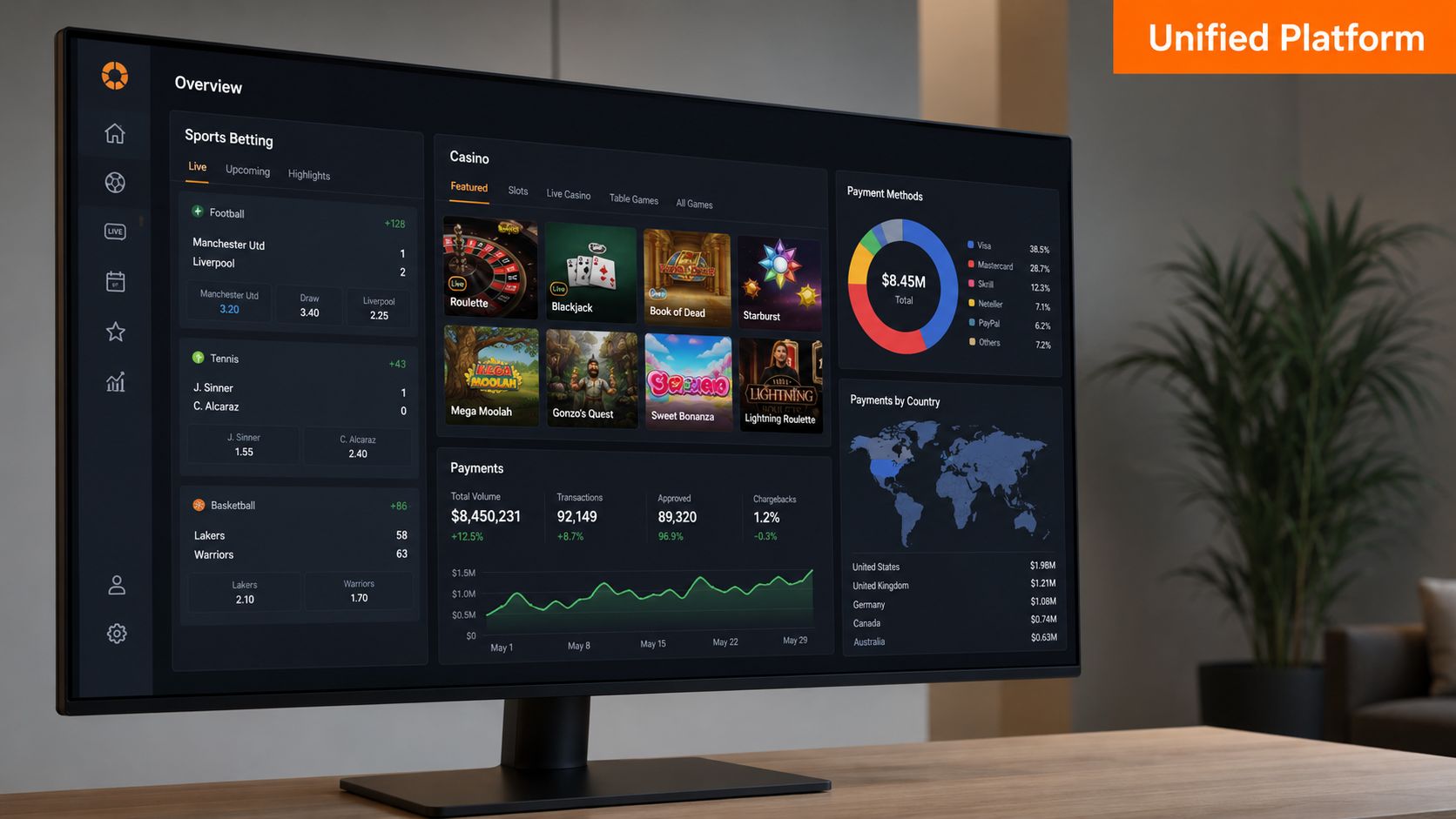
A unified platform fixes that by treating the customer account, wallet, and transaction history as one operating object. That changes day-to-day execution. VIP teams can act faster. Finance gets cleaner reconciliation. CRM teams can segment by real cross-product behavior. Compliance officers review one account history instead of reconstructing a player from multiple systems.
Why the wallet is an operating decision
The wallet is often presented as a UX feature. It's an operational control point.
A unified wallet affects deposit handling, bonus eligibility, cross-sell logic, withdrawal review, and ledger integrity. It also reduces the awkward moments that hurt conversion, like forcing players to move balances manually between sports and casino. That friction doesn't just lower spend. It drives support demand.
The same logic applies to payments. A modern cashier should support fiat methods, multiple currencies, and crypto where the business model and jurisdiction allow it. What matters most is consistency. One transaction layer should apply the same logic for balances, statuses, review queues, and reporting across the full platform.
Operators usually underestimate how much margin gets lost in support overhead, failed withdrawals, and broken bonus logic. Unified architecture reduces those hidden costs.
In practical terms, a unified setup gives management one cleaner answer to a simple question: what happened on this account, across all products, from deposit to settlement to withdrawal? If a platform can't answer that quickly, it isn't unified in the way that matters.
Your Actionable Vendor Selection Checklist
By the time you reach commercial negotiation, most platform choices are already emotionally decided. Someone likes the demo, someone trusts the supplier, someone wants to move fast. That's exactly when discipline matters most.
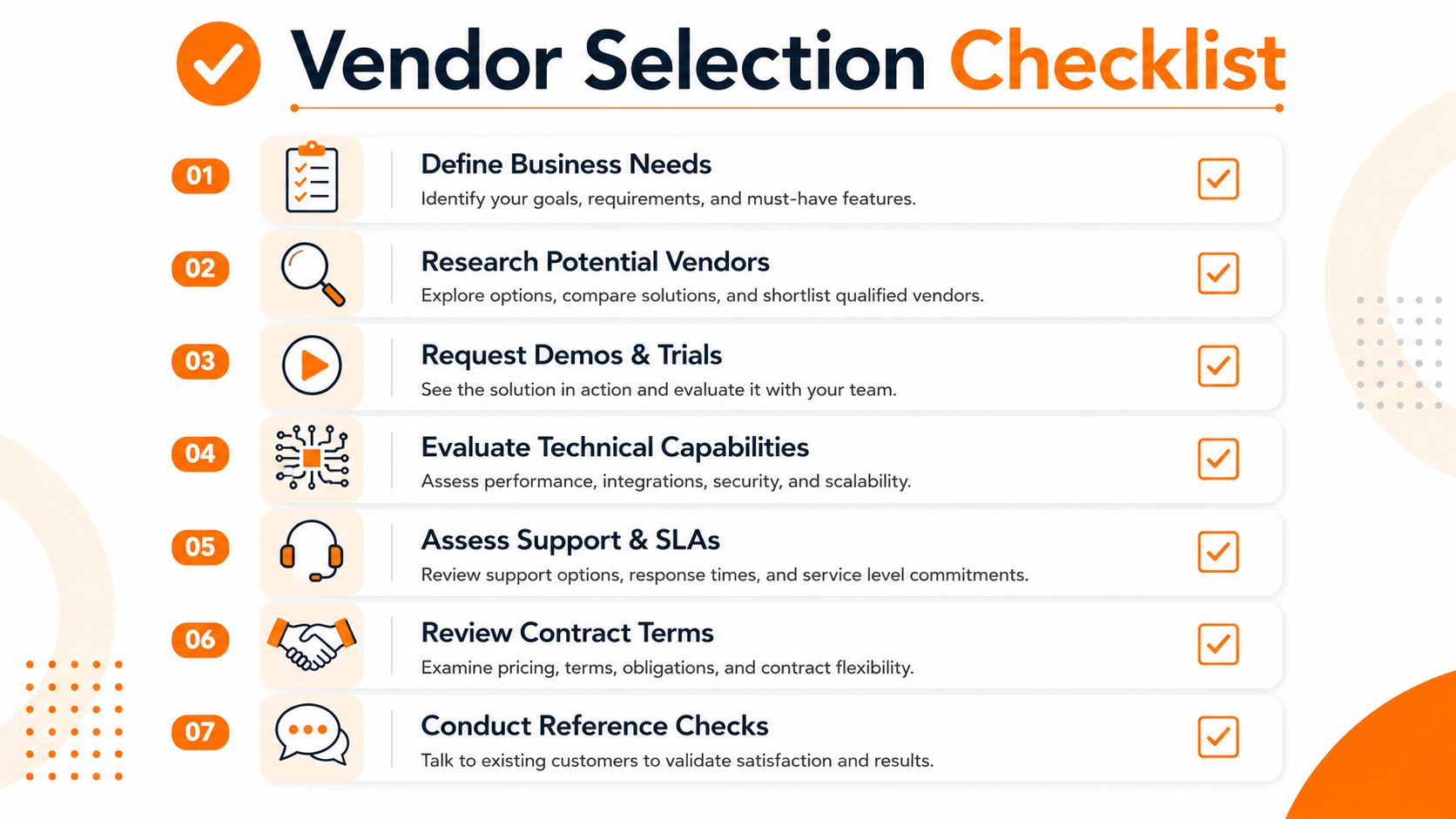
Use a checklist that forces vendors to prove how they operate, not just what they show.
Commercial and technical diligence questions
Take these into calls, demos, and contract review.
Architecture ownership Ask which modules are native, which are third-party, and where the vendor acts as reseller rather than operator-level owner. This tells you where roadmap control and support accountability sit.
Wallet and ledger model
Ask for a walkthrough of deposits, withdrawals, bonus balances, reversals, and transaction history. If the answer is abstract, request a live admin demonstration.Trading and settlement process
Don't stop at market coverage. Ask how bet delays, suspensions, resettlements, disputed outcomes, and feed corrections are handled in the back office.Compliance readiness
Request screenshots or live workflows for KYC review, AML triggers, audit logs, permission controls, and responsible gaming settings. Good compliance capability is visible in process design.Payments operations
Review how the cashier handles statuses, failed payouts, manual review queues, chargeback-related controls, multi-currency support, and crypto transaction logic if relevant to your model.Support and SLA discipline
Clarify escalation routes, issue severity definitions, release communication, and whether support is reactive or operationally involved. A vendor can have a polished sales team and weak post-launch ownership.
Here's a concise scoring view.
| Category | What to verify | Red flag |
|---|---|---|
| Platform core | Native modules, release process, monitoring | Heavy dependence on unseen subcontractors |
| Wallet | Single ledger visibility, clean transaction states | Product-specific balances without clean reconciliation |
| Sportsbook | Trader tools, in-play control, settlement workflows | Beautiful front end and shallow admin depth |
| Compliance | Review tools, logs, access control | Reliance on manual exports for routine work |
| Payments | Withdrawal handling, exceptions, reporting | Many logos, little process clarity |
| Support | Named ownership, escalation, onboarding | Vague promises instead of operating detail |
Niche demand and edge-case readiness
Strong vendors also understand where demand is shifting. Privacy is one example. According to Sports Arbitrage's analysis of no-KYC betting apps, 63% of US bettors in 2025 expressed concern over data privacy, yet only 9 publicly available offshore apps officially operate without ID/SSN verification. Whether or not that model fits your jurisdiction, the takeaway is operationally important: users increasingly care about data handling, and vendors should be able to explain exactly how identity, verification, storage, and review processes work.
Use that broader lens when evaluating edge cases.
Privacy posture
How does the platform support data minimization, role-based access, and clear review workflows without exposing unnecessary user information?Jurisdictional flexibility
Can the system adapt to different verification standards, payment constraints, and reporting requirements without a major rebuild?Expansion readiness
If the first market works, what breaks when you add another brand, another product, or another payment method?Operational transparency
Can the vendor show how incidents are tracked, documented, and resolved? Mature suppliers don't hide the ugly parts of operations.
A vendor that handles edge cases calmly is usually stronger in normal operations too.
The best sports betting platform isn't the one with the most impressive pitch deck. It's the one your compliance lead trusts, your finance team can reconcile, your traders can control, and your support team can live with every day.
If you're evaluating suppliers for a new launch or migration, NexGrate is worth a look for operators who want a turnkey white-label stack that combines sportsbook, casino, payments, back office, and compliance tooling in one environment. It's built for businesses that need faster market entry without taking on the full integration burden of a fragmented platform strategy.