The usual advice is to treat white label poker software as a speed purchase. Pick the shortest setup, rebrand the client, switch on payments, and start buying traffic. That advice optimizes the week you open. It ignores the decade you have to operate.
A poker room is a set of records, not a skin. Balances, identity files, hand histories, liquidity membership, and the compliance data model become the business the day you take a deposit. If those objects live in a schema you cannot export, the cheap launch becomes the expensive exit the moment you add a market, change a processor, or leave the vendor.
Score the platform on three questions before you compare feature decks. What stays portable when the brand enters a new regulated market? Who controls player and game data, and in what format can you take it? How will the vendor prove behavior under real poker traffic, not a scripted demo? Tournaments, bonuses, and cashier buttons do not answer any of those.
Table of Contents
- Why Platform Choice Locks In Your Poker Business
- Core Components Every Platform Must Deliver
- Comparing Deployment and Integration Models
- Verifying Randomness and Load Performance Before Signing
- Compliance Portability Across Jurisdictions
- Data Governance and Vendor Risk Due Diligence
- Pricing Models, Launch Timelines and Migration Planning
- Choosing the Right Platform for Your Launch Scenario
Why Platform Choice Locks In Your Poker Business
Speed is a real constraint. A branded room can be taking play while a ground-up build is still arguing about service boundaries. Use speed to test demand. Do not use it as the only buying rule if the brand is meant to last.
What locks the business is the layer under the client. Player balances, KYC files, AML alerts, self-exclusion flags, rake history, and tournament results sit in the provider's schema. Shared liquidity is a contract plus a technical identity, not a switch you carry to the next vendor. A new market can force new geofencing, new reports, and a fresh approval of an engine you already paid for. The logo moving does not move any of that.
Practical rule: If you cannot export the wallet, the identity file, and the hand history in a format another platform can load, you rent the poker business. You do not own it.
Put the same three demands on every vendor before the demo.
- Portability: Which objects travel into a new regulated market, and which must be rebuilt or recertified?
- Control: Who is controller of player data and raw hand histories, and what does a full export contain?
- Proof: Which load and randomness artifacts will they attach to the contract, tied to the build you will run?
A feature checklist tells you the software can deal cards. It does not tell you whether you can leave.
Core Components Every Platform Must Deliver
Judge the platform by what each layer guarantees and what you can verify: the engine's rules and randomness hooks, tournament state handling, wallet settlement and idempotency, identity gates, and back-office event logs. A polished client cannot compensate for gaps in those controls.
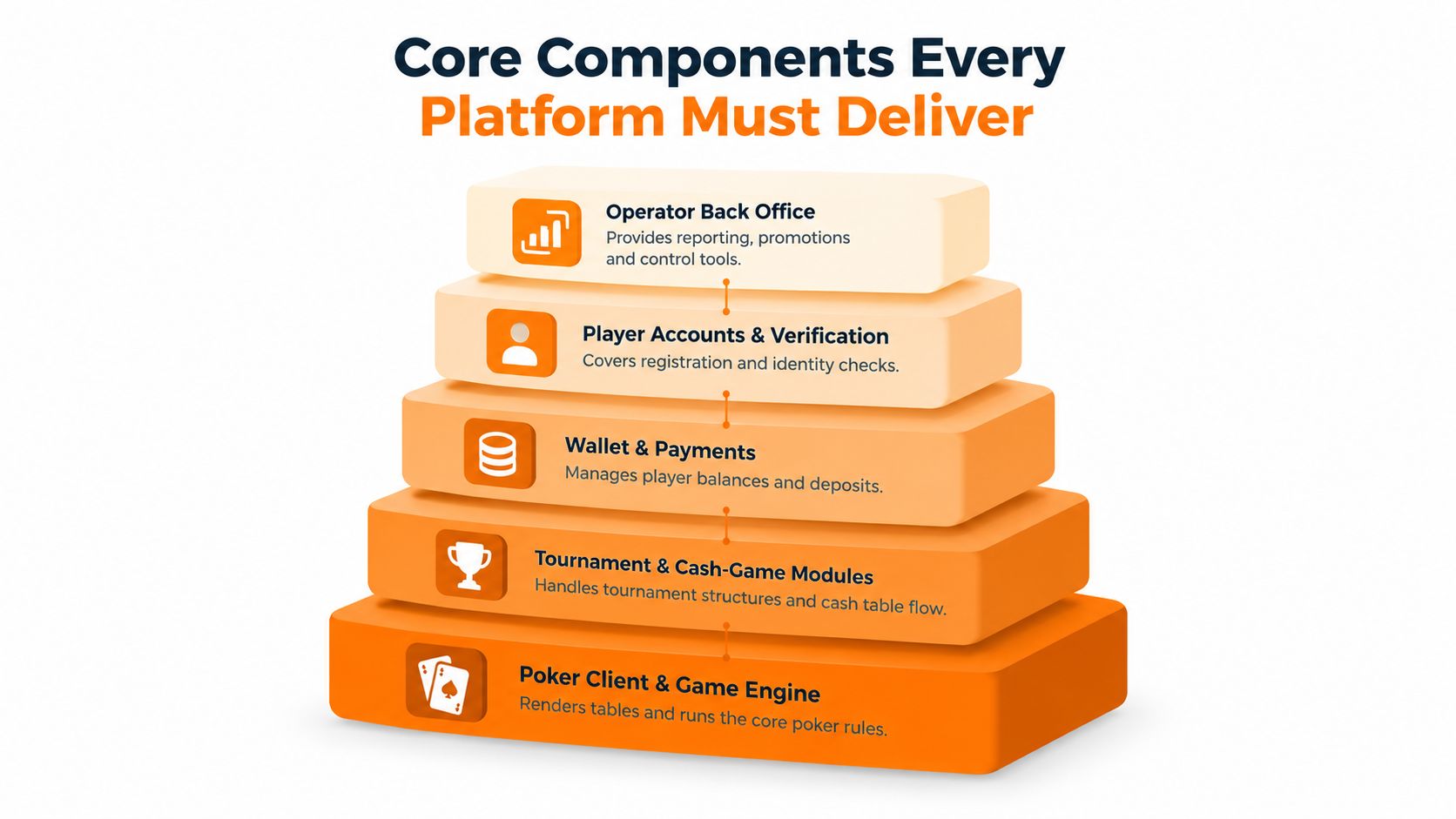
What each layer actually owns
Poker client and game engine. The client displays the table; the engine enforces blinds, betting rounds, side pots, and showdowns. Ask the vendor for the rules configuration and the hooks available for randomness testing. Confirm that test results can be tied to the exact build and game variants you intend to launch.
Tournament and cash-game modules. These modules manage game state across registrations, late entries, re-entries, pauses, disconnections, and payouts. Test what happens when a player loses connection during a hand or a tournament pauses during a table move. Get written confirmation of which formats and recovery cases the platform supports. Short-deck and mixed games need their own rules checks and randomness review.
Wallet and payments. The wallet records balances, rake, bonuses, deposits, and withdrawals. Require an immutable transaction reference and idempotent settlement, so a retried request cannot credit or debit an account twice. Test reversals and reconciliation between the poker ledger and any shared casino or sportsbook wallet before launch.
Player accounts and verification. Registration, identity checks, geolocation, and session controls determine who can enter a game and when. Verify that the platform blocks play until required checks pass, and that status changes, failed checks, and self-exclusion are recorded and reflected across relevant products.
Operator back office. Risk controls, reports, bonus tools, and admin actions rely on accurate event records. Ask to see a player-level audit trail covering hands, wallet movements, account changes, and staff actions. Check that you can export the underlying events, not just summary reports.
Shared liquidity is access to a pool governed by its eligibility rules, game formats, and operating terms. Confirm which player and hand-history records you can retrieve if that arrangement ends. A dependable table is only one part of the platform; the controls and records around it determine whether you can operate and move the business later.
Comparing Deployment and Integration Models
There are three ways to buy this, and they fail in different places.
Full-stack turnkey means the provider runs the game, the wallet, the back office, and the hosting. You brand the client and buy the traffic. Modular means you assemble a poker engine, a wallet, and compliance tools through APIs, and you own every seam. Hybrid means you keep your own wallet or identity system and license the poker client.
A walkthrough of how these stacks get assembled is worth ten minutes before you score the grid.
| Deployment Model | Who Controls the Wallet and Player Data | Typical Launch Speed | Migration Exposure Later |
|---|---|---|---|
| Full-stack turnkey | Provider holds wallet, identity, and hand history | Fastest, often weeks once licensing is settled | Highest if exports and the pool are locked to that vendor |
| Modular API build | Operator holds the wallet and can split vendors | Slowest, because every seam is yours to integrate | Lowest when contracts require open exports |
| Hybrid client plus own wallet | Operator keeps balances and identity; vendor runs the tables | Middle, gated by reconciliation work | Medium: tables move easier than a shared pool |
Where each model breaks
Turnkey breaks when the brand is the product. Custom rakeback, cross-product bonuses, and odd tournament structures hit a configuration ceiling, and you wait on someone else's roadmap. You also inherit their liquidity rules. That is acceptable for a first room, a small team, and one market. It is a poor fit if you already run a casino wallet and refuse a second balance.
Modular breaks on staffing, not on code. Three vendors means three change windows, three incident bridges, and a compliance story you stitch together. A five-person studio will drown. A team that already runs payments can live with it, especially when you want to swap a KYC vendor without touching the cards.
Hybrid breaks in the ledger. The client believes a stack is one number. Your wallet believes another. Disconnects, retries, and bonus chips create a break file every night. Choose hybrid only if finance already settles another real-time product and will own that file.
Match the model to team size and market count. One market and no engineering bench points to turnkey. Several regulated markets plus an existing wallet points to hybrid or modular. Ignore any slide whose only argument is a go-live date.
Verifying Randomness and Load Performance Before Signing
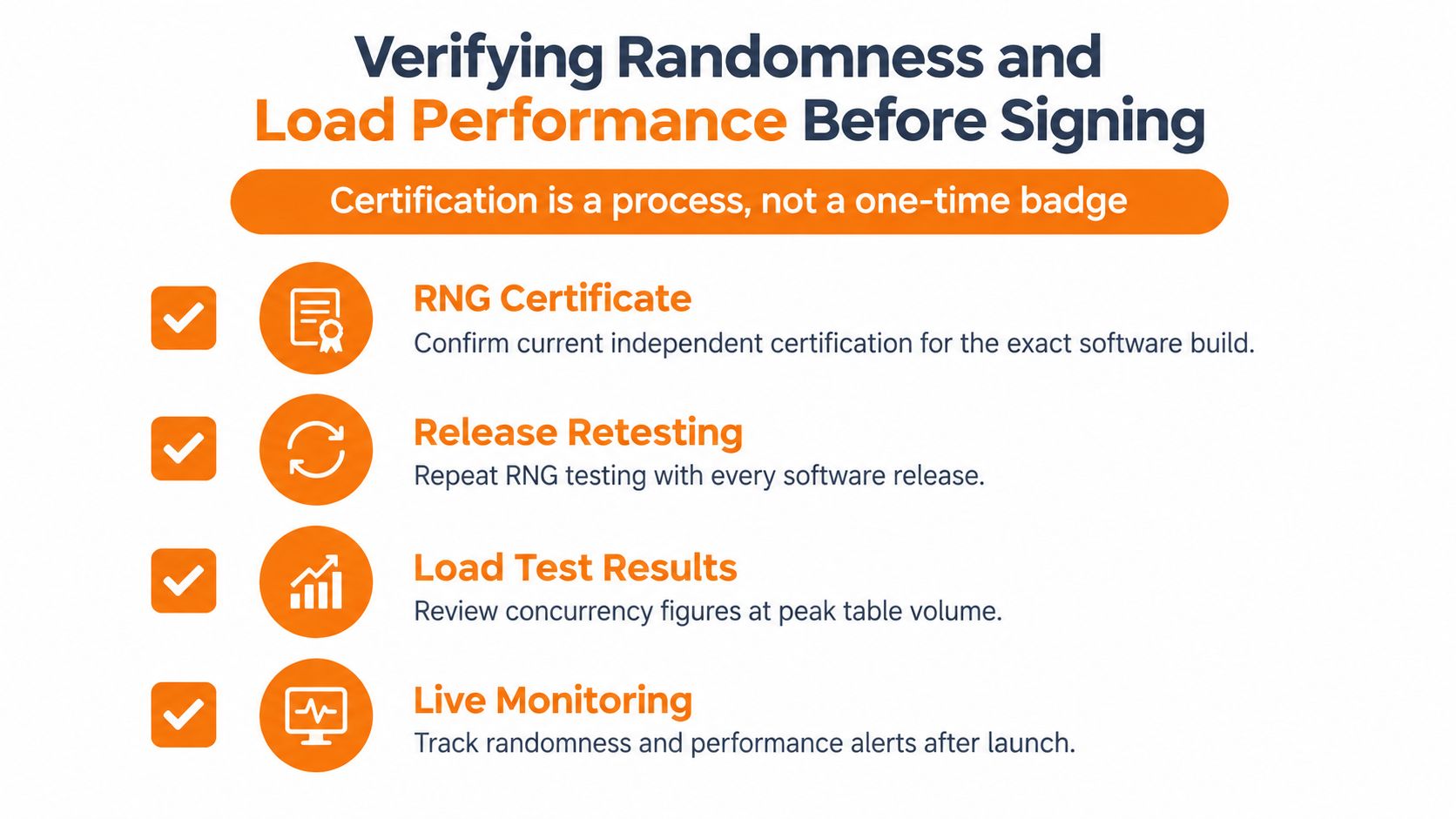
The cheapest launch can become the most expensive migration if you cannot carry game records, test evidence, or player-facing outcomes to another provider. Treat RNG approval as a release gate, then confirm how the system monitors outcomes after launch. A certification logo alone does not answer either question.
GLI-19 sets requirements for interactive gaming systems, including RNG quality and testing. Ask the vendor for the applicable lab report and the procedures used to monitor the game and RNG after deployment. A “provably fair” claim is not a substitute for certification, testing evidence, or ongoing controls. The limits of that claim are explained in this guide to provably fair games.
Evidence to demand
- Current certificate: Request the lab documentation for the exact build you will operate, not a different product or an outdated release.
- Version and seeding: Get the RNG version, seeding method, and change-control records for releases after testing.
- Reproducible hand records: Confirm you can retrieve records tying each hand or tournament event to its outcome, and export them in a usable format if you leave the vendor.
Load, not table count
A table limit does not show how the platform behaves under pressure. Poker systems coordinate sessions, table state, turn timers, hand histories, balances, rake, registrations, and reconnects. Ask the vendor to demonstrate how these services perform together during a load test, including what happens when a dependent service slows or fails.
Request the test dossier and the conditions behind each result. The vendor should report:
- Concurrency: Peak authenticated users, active tables, and hands or state transitions processed per second.
- Latency and recovery: p95 and p99 action-to-confirmation times, reconnect success, settlement delays, and recovery time after a node failure.
- Bursts: Results for tournament starts, withdrawal spikes, clients connecting from multiple regions, and degraded payment or identity services.
- Separate workload figures: Lobby reads and gameplay writes reported separately, so aggregate request rates cannot conceal table-state delays.
- Money safety: How the system scales, prevents duplicate settlement on retries, retains event logs, and handles interrupted transactions.
Put these requirements in the RFP. Also ask whether you can retain and export the test evidence, hand records, and operational data if you migrate. If the vendor will not provide the dossier, do not accept its uptime claim as proof of performance.
Compliance Portability Across Jurisdictions
A vendor's master licence does not cover your operator obligations. The vendor's approvals may support your technical submission, but the operator remains responsible for meeting each market's rules. Treat compliance portability as a contract and migration requirement, not a launch-day checkbox.
U.S. online poker is offered in New Jersey, Nevada, Delaware, Michigan, and Pennsylvania. Shared liquidity among states is possible only through specific interstate agreements, each with its own rules and conditions. Monitoring, reporting, player-fund handling, self-exclusion, deposit and loss limits, and system certification are set by individual state regulators, not by a single federal standard. The state-by-state requirements are outlined in this overview of U.S. online poker regulation.

What usually ports, and what does not
The core game engine, base wallet logic, reporting templates, and admin roles may be reusable. Keep the tested randomness component stable, but confirm what each regulator requires for approval and ongoing evidence.
Market-specific work often includes player segregation, geolocation, KYC and AML thresholds, responsible-gaming limits, permissions for shared liquidity, and regulator reporting feeds. Require a market-entry matrix that marks the wallet, poker client, identity checks, AML rules, geofencing, reporting, and liquidity as reusable, local, or subject to recertification. If the vendor cannot complete that matrix, treat its single-codebase claim as unproven. Confirm how each control must be evidenced in a jurisdiction-specific compliance review.
A low-cost launch can leave you paying later to recertify systems, migrate player records, and renegotiate liquidity arrangements. Get the vendor to scope those costs before signing.
Data Governance and Vendor Risk Due Diligence
Buying white label poker software is a security decision, not a feature bundle. You concentrate identity, payments, betting patterns, and KYC in one ecosystem. That cuts build risk. It also means a vendor breach is your breach, and every other brand on that vendor.
A 2026 industry analysis reported that a 2025 cyberattack on an iGaming CRM provider exposed player names, addresses, transaction histories, betting patterns, and KYC documents across its client base. The same analysis notes overlapping GDPR, CCPA, PIPEDA, and licence duties, and points to supervision models, including Portugal's, that expect direct access to transaction and game-event data, traceability, and certified monitoring. The incident write-up is in iGaming data protection challenges. One supplier incident became a multi-operator incident.
Data minimization, purpose limitation, encryption, retention, auditability, and residency belong on the procurement scorecard. They are not an appendix for the security team after signature.
Questions that belong in the contract
- Hands and profiles: Who controls raw hand histories and player profiling data?
- Export: Can you pull that data in a usable format without a paid extraction project?
- Isolation: Are tenant environments separated from other skins, and from casino or sportsbook datasets?
- Notice: Who tells regulators and players after a breach, and on what clock?
- Admin trail: How are privileged actions logged, and can your team read that log?
Ask for the artifacts, not the policy PDF alone. You want a data-flow diagram, an incident-response SLA, evidence of dataset segregation, and a written exit plan. The operating habit behind that ask is covered in vendor management practice. The contract is where the habit becomes enforceable.
Outsourcing the platform can lower development risk while it raises third-party risk. Price both, or you have priced only half the decision.
Pricing Models, Launch Timelines and Migration Planning
Commercial shape decides who feels pain when volume moves. There is no neutral fee.
Setup plus a recurring platform fee is the predictable shape. You pay to enter and you pay to stay. The vendor has less stake in your rake, so response times and change windows have to be contractual.
Revenue share keeps cash in the business at launch and becomes open-ended as gross gaming revenue grows. It fits an unproven room. It punishes a room that is already busy if the share never steps down. Confirm whether the base is gross or net before you model it.
Per-transaction or per-player charges track cashier and KYC activity. They punish high-churn acquisition. Model them against the signup quality you realistically expect, not against a best month.
A launch you can actually run
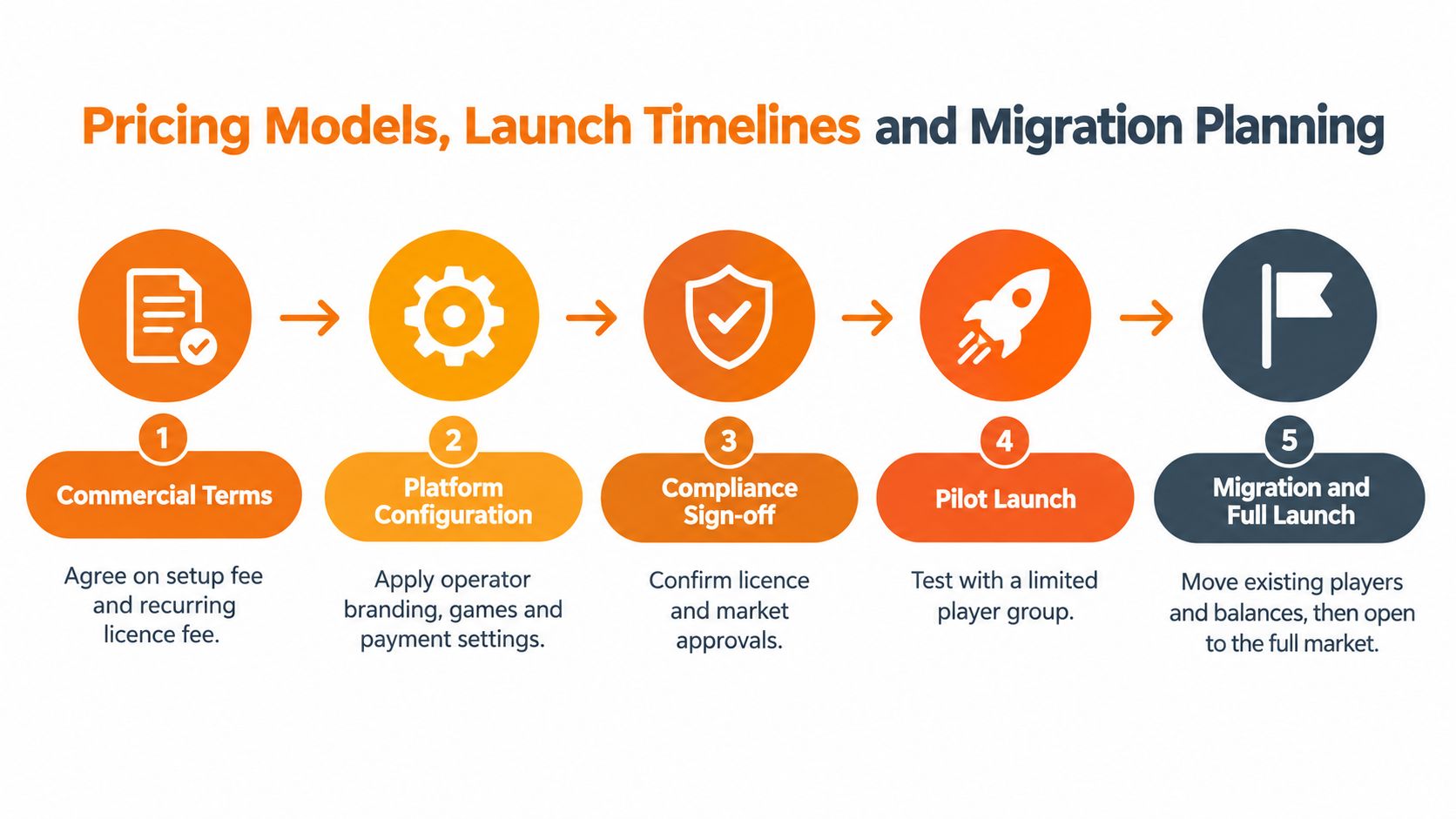
Run the work in this order, and do not skip a gate because the sales calendar is tight.
- Commercial terms and the compliance map. Fees, share basis, and which markets the quote really covers.
- Configuration. Branding, games, payment routes, and limits.
- Integration test and certification. RNG evidence for this build, plus payments and KYC in a non-production environment.
- Soft launch. A capped player set, with settlement reconciled every day.
- Full go-live. Only after an export job has been proven on real data.
Costs the headline hides
Budget for recertification when you add a market, for the labor of getting data out, and for parallel running during a move. Three habits belong in the statement of work from day one.
- Export early: Wallet balances and transaction history leave in a documented format before you are under pressure.
- Shadow period: Old and new ledgers run together until the break file is boring.
- Rollback: A written path back if balances do not match at cutover.
A quote with no line for exit is an incomplete quote. Add the line yourself and make the vendor price it.
Choosing the Right Platform for Your Launch Scenario
The cheapest launch can become the most expensive migration. Choose a platform based on what you need to control and what you can move later: compliance records, liquidity, player data, and wallet balances.
An established casino adding poker should prioritize a shared promotions setup and a back office its team already knows. Turnkey suits a side vertical if the operator accepts the vendor's player pool and wallet. Choose hybrid if the casino must retain control of its balance and player data.
A sportsbook seeking one balance should focus on settlement between a bet and a poker chip stack. A hybrid model with the operator's wallet in front of the poker client usually offers more control than a sealed cashier. Confirm how the vendor handles failed transfers and reconciles transactions.
A crypto studio entering regulated markets should check fiat payment routes, KYC requirements, and whether compliance records can move with the business. A crypto-only data model creates rework if the operator later needs to meet different market requirements. Choose turnkey only when the market-entry requirements are clear and the vendor can show how records are exported.
An operator replacing a legacy backend should prove data export and settlement before investing in a new brand experience. Modular or hybrid models may offer a better fit, provided the operator can test data portability and run both ledgers during migration.
NexGrate offers a turnkey white-label stack covering casino, sportsbook, payments, and compliance controls. It is the wrong default if you must keep an external wallet or need source-level control of the ledger.
Shortlist two or three vendors. Ask each for a market-entry matrix, load-test dossier, and data-flow diagram, then compare the documents against your requirements. A pitch deck is not evidence.
NexGrate supplies a turnkey white-label stack that covers casino, sportsbook, payments, and compliance controls for operators who want one backend rather than a pile of vendors. If poker, wallet portability, and market entry are on your roadmap, start with the same three artifacts this guide asks for. Visit NexGrate and request the market-entry matrix, the load-test dossier, and the data-flow diagram for your target markets.