
API integration is the process of connecting separate software systems through defined interfaces so they can exchange data and trigger actions. In iGaming, that can mean sending a payment request to a processor and using the confirmed result to update a player's wallet.
You're preparing a casino launch, adding a sportsbook, or replacing a payment provider. Each supplier may have usable software, but your player still needs a coherent journey from registration to withdrawal. Your operations team also needs records it can explain when something doesn't match.
The useful question isn't whether those systems can connect. It's whether your teams can keep their shared workflows correct, secure, and supportable after launch.
Table of Contents
- Why iGaming Platforms Need Connected Systems
- How API Integration Connects Software
- Comparing REST and WebSocket Integration
- API Integration Examples in iGaming
- Benefits of API Integration for Operators
- Key Considerations for Reliable Integrations
- A Practical Integration Decision Checklist
Why iGaming Platforms Need Connected Systems
A casino or sportsbook isn't necessarily a single application doing everything. Consider an operating setup where a studio supplies games, a processor handles payments, an identity service checks documents, and an external feed supplies betting information. The operator must coordinate those capabilities without making the player move between separate businesses.
Think of a hotel reception desk. Guests see a unified service, even though housekeeping, reservations, and billing have different responsibilities. Your platform plays a similar coordinating role, passing the right information to the right service and presenting a consistent result.
The player journey crosses supplier boundaries
Without a dependable connection, staff might need to compare payment records with wallet entries or transfer account information between tools. That introduces opportunities for delays, inconsistent records, and duplicate work. An integrated workflow lets software perform those handoffs according to agreed rules.
For example, reviewing your payment and cashier setup means examining more than the deposit screen. Product teams need understandable statuses, operations teams need traceable transactions, and compliance teams need appropriate access to supporting records.
- For players: Connected services should support a coherent account experience.
- For operations: Shared references should make transactions easier to investigate.
- For compliance: Data exchanges should remain controlled and explainable.
From isolated applications to connected platforms
The public API ecosystem illustrates this broader shift: ProgrammableWeb started in 2005 with roughly 40–54 APIs, depending on the historical account, and exceeded 17,000 listings by the first quarter of 2017, according to the ProgrammableWeb historical archive.
For an operator asking “what is API integration?”, the practical answer is coordination across those boundaries. The connection matters because it lets separate specialists contribute to a shared business operation without requiring staff to re-enter every instruction.
How API Integration Connects Software
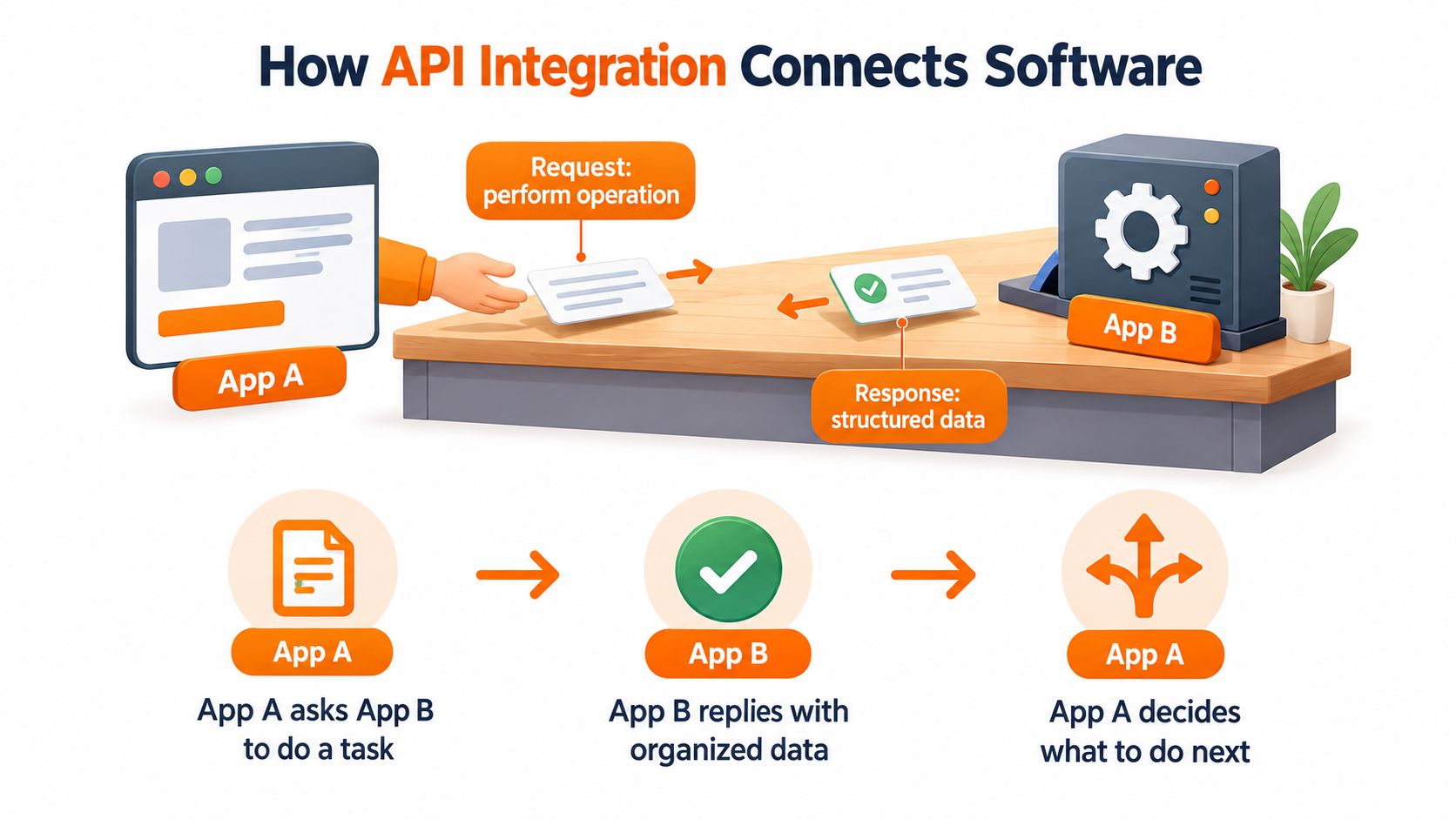
An API, short for application programming interface, is like a service counter with a menu. The menu describes what you can request, what information you must provide, and what kind of answer you can expect. It doesn't give you unrestricted access to everything behind the counter.
The integration is the arrangement your team builds around that counter. It prepares requests, interprets replies, and connects the result to your platform's business rules.
The diagram shows that basic exchange.
Follow the request through the service counter
Suppose your backend needs information about a player account held in another service. The provider operates that service and documents the available operation. Your backend is the consumer, because it uses the provider's interface.
The workflow has distinct responsibilities:
- Prepare the request: Your application supplies the required account reference and credentials in the expected format.
- Process the operation: The receiving service checks the request and performs the permitted task.
- Interpret the response: Your application reads the returned fields and decides what the result means for the player journey.
- Apply the next action: The platform displays information, changes an allowed account state, or routes an unresolved result for investigation.
A structured response is organized data with defined fields rather than a message someone must read manually. However, software still needs agreed meanings for those fields. A status indicating that a request was received shouldn't automatically be interpreted as confirmation that the underlying business operation finished.
The interface isn't the whole integration
An endpoint is a particular addressable operation exposed through the interface. Think of it as a specific service on the counter's menu, not the entire relationship between the businesses.
The same general pattern can support account retrieval, payment submission, authentication, wallet changes, or notifications to another service. Each operation still needs its own documented inputs, outputs, and business interpretation.
Practical rule: An API describes what a service lets you ask for. An integration determines how your business uses the answer.
This distinction matters during procurement. Documentation can demonstrate that an operation exists, but your team must still establish how its result affects the product. A technically valid reply is useful only when the receiving application understands what to do next.
Comparing REST and WebSocket Integration
Calling a service desk when you need an answer feels different from staying on an open radio channel. REST-style integration resembles the individual call: an application sends a request and receives a response. WebSocket integration resembles the open channel: connected applications can exchange messages over a persistent connection.
These aren't interchangeable labels for quality. They describe different communication approaches, and your team should choose according to the operation rather than assuming one is universally better.
REST and WebSocket Integration Compared
| Consideration | REST Integration | WebSocket Integration |
|---|---|---|
| Interaction style | Individual request-response exchanges | A persistent connection carrying messages in both directions |
| Typical fit | Retrieving records, submitting transactions, checking status | Receiving changing odds and live-market updates |
| Application responsibility | Interpret each request's outcome | Maintain connection state and interpret incoming updates |
| Failure concern | A missing response can leave an operation's outcome uncertain | A disconnect can leave the consumer missing updates |
| Recovery question | How can the application establish what happened? | How can it restore a trustworthy current view? |
For a cashier, an individual request can be a natural way to submit an instruction or retrieve a transaction's status. The caller has a specific question and needs a defined answer.
For in-play betting, repeatedly asking whether anything changed can be an awkward fit. A persistent channel allows the provider to send updates as they become available. That's useful when the application needs to follow an evolving market rather than retrieve an occasional record.
Choose by business behavior, not protocol preference
A sportsbook might use request-response interactions to discover events and a live connection to follow market changes. Those choices can coexist within the same product. Neither communication pattern, by itself, determines whether a displayed price is appropriate for accepting a bet.
Ask the product team to describe the required behavior before engineers select the transport:
- An occasional lookup: Does the application need information only when a player or staff member requests it?
- A changing display: Must the application receive updates while the screen remains open?
- A consequential instruction: What evidence will establish whether the provider accepted the action?
The distinction also changes operational work. With REST-style exchanges, teams investigate individual requests and responses. With WebSockets, they must also account for connection interruptions and the state of the consumer after reconnecting.
Don't mistake an open connection for a complete view of the market. The transport carries information; your application still needs rules for deciding whether that information is usable.
API Integration Examples in iGaming
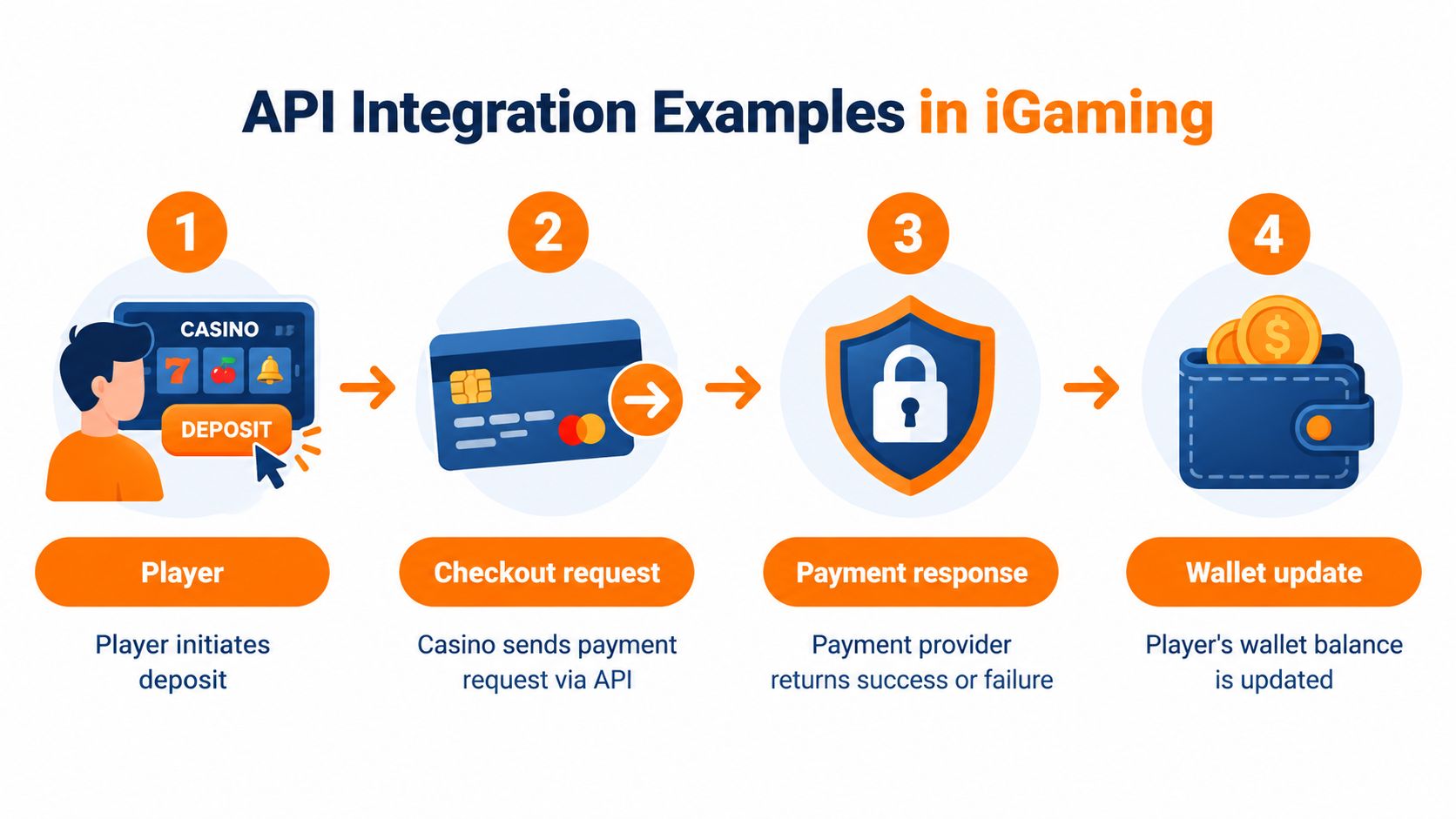
A deposit is a useful starting point because the player sees a simple action while several systems may participate behind the screen. The following scenarios are illustrative workflows, not claims that every provider uses identical endpoints or processing rules.
The deposit diagram highlights the handoffs your team needs to understand.
A deposit moves from instruction to account balance
The player submits a deposit instruction through the cashier. The casino backend passes the required payment details to the processor, which returns a result or an indication that processing continues.
The platform then applies its rules for recognizing the payment and making funds available. Treat the diagram as a simplified journey: an initial response might not be the evidence required to credit a wallet. Product teams should define what the player sees while the outcome remains pending.
The practical lesson is to distinguish request acceptance, payment confirmation, and available balance. They describe different business states, even when the interface makes them look like a single action.
Game content and market data serve different purposes
For a casino game launch, a representative workflow might involve the backend requesting the information needed to open a selected studio title. The operator should establish which account context the studio receives and how the player returns to the casino experience when a launch can't proceed.
For betting, an external feed may supply event and market information that the sportsbook interprets for its own operation. When assessing a sportsbook API integration, separate displaying market data from deciding whether a wager can be accepted. Those responsibilities shouldn't be treated as equivalent.
The accompanying video offers another format for considering these connected workflows.
Compliance results need an operational interpretation
An identity provider might return a completed check, an unresolved result, or a request for further review. Your platform must translate that outcome into the appropriate account controls rather than treating receipt of a response as permission to proceed.
For a compliance reviewer, the useful questions are concrete:
- Evidence: Which result informed the account decision?
- Context: Which player and verification attempt does it belong to?
- Action: What restriction or review task should follow?
Operators can build direct provider connections or use an aggregation platform. NexGrate is one option that consolidates game content, betting engines, payments, and compliance controls, with content integrations through a single API and prebuilt adapters for established RNG and live casino studios.
That arrangement changes where integration work happens. It doesn't remove the operator's need to understand the decisions made at each handoff.
Benefits of API Integration for Operators
Integration can let an operator reuse a specialized capability rather than commission a separate implementation for every product surface. Think of a shared warehouse serving different shopfronts: the storefronts can differ while relying on a common fulfillment operation.
In platform terms, a documented service can support web applications, mobile experiences, internal tools, and approved partners. The benefit goes beyond less code. It is the possibility of maintaining a consistent business capability across those channels.
Reuse can change delivery priorities
In Postman's 2024 State of the API research, which surveyed more than 5,600 developers and API professionals, 74% described their organizations as API-first, 63% of teams could produce an API in under a week, and 62% reported working with income-generating APIs.
These findings describe the surveyed organizations, not a promised launch schedule for an iGaming operator. They support a narrower conclusion: teams increasingly treat interfaces as planned organizational assets rather than incidental technical outputs.
An API-first approach means designing and documenting interfaces early. For an operator, that can help product, engineering, and partner teams agree on shared capabilities before they develop separate experiences around incompatible assumptions.
- Less duplicated development: Teams can consume an existing capability instead of recreating it.
- Broader partner options: Documented boundaries can make it easier to evaluate alternative suppliers.
- Focused internal effort: Engineers can spend more attention on operator-specific workflows instead of rebuilding specialized services.
Initial savings aren't the entire business case
Using a connected service also creates a dependency. Your team may avoid building a payment capability internally, but it still needs people who understand how that capability affects support, account balances, and reporting.
Buying access to a capability doesn't transfer ownership of your player's experience.
Evaluate benefits against the work your organization retains. A connector may reduce setup effort while still requiring provider coordination, release reviews, and incident handling. The strongest business case names both the development work avoided and the operational work someone must continue doing.
Key Considerations for Reliable Integrations
Treat an integration like an agreement to share access to a controlled workplace. You need to know who holds a pass, which rooms they can enter, what they can change, and who investigates when something goes wrong. A working connection answers none of those questions by itself.
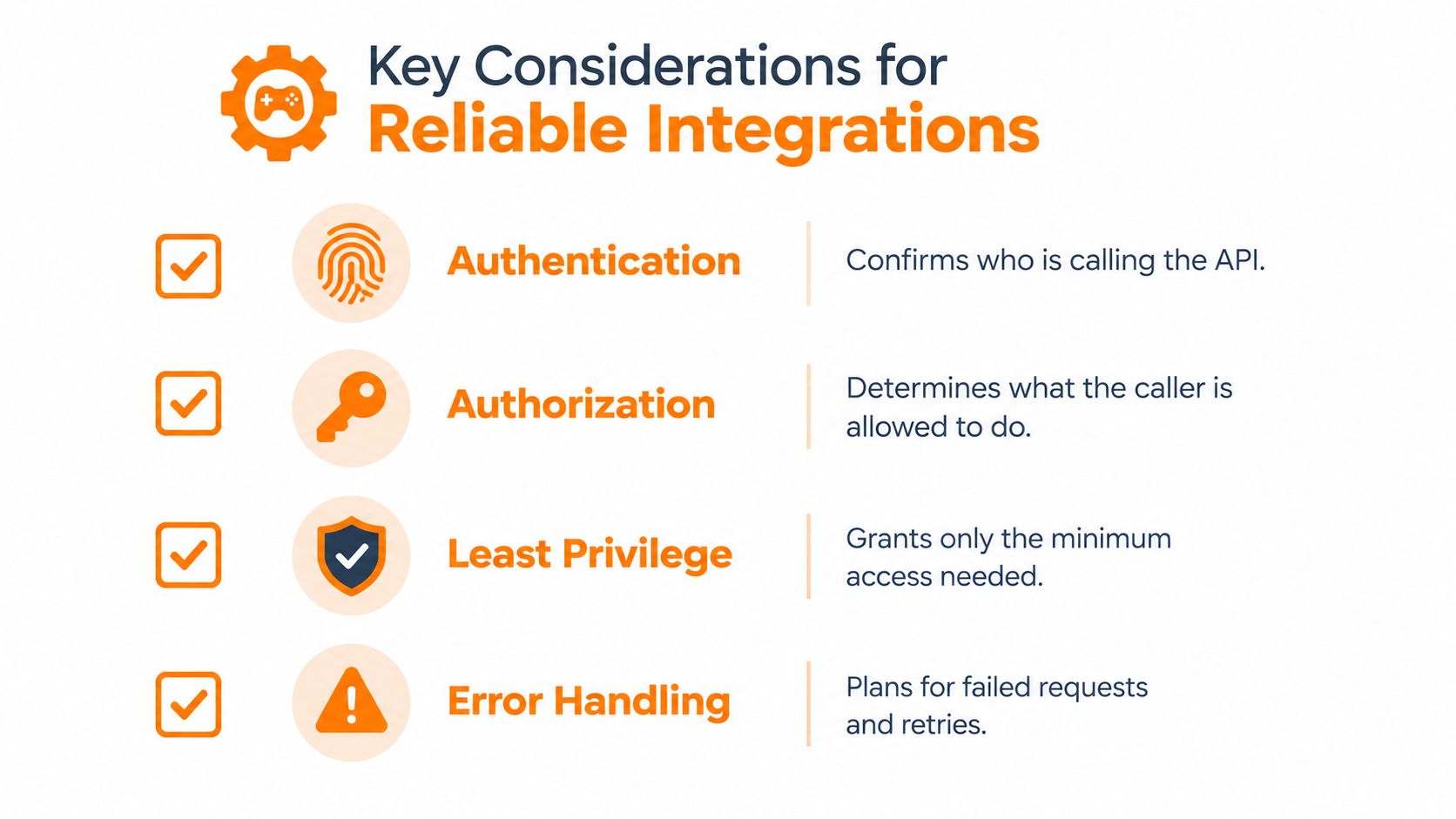
The security review should make those boundaries explicit.
Verify identity and restrict authority
Authentication establishes who is calling. Authorization determines what that caller may access or change, while least privilege limits access to what the task requires.
Salt Labs reported that 95% of observed API attacks during the preceding 12 months originated from authenticated sources, according to its API security report announcement. Valid credentials therefore aren't sufficient evidence that a request is appropriate.
Test whether a caller can access another player's records by changing an account reference. Restrict read, write, settlement, and administrative permissions separately where the workflow requires it. Store credentials in controlled secrets management, plan revocation, and keep sensitive fields out of ordinary logs.
Protect the agreement as providers change
An API contract covers field formats and expected behavior. Contract testing checks whether those expectations still hold when either party changes software.
Ask providers how they announce changes, support versions, and retire old behavior. Test rejected requests, missing fields, delayed results, and interrupted workflows, not just successful examples. Compliance reviewers should also identify relevant regional data rules, currency handling, timezone interpretation, and settlement-finality requirements.
An API can respond successfully while supplying information your business shouldn't use. Monitor stale market data, unexpected balance differences, and incomplete compliance outcomes alongside technical availability.
Recover without creating another error
Idempotency means recognizing a repeated instruction so it doesn't create an unintended duplicate business action. For payments or bets, establish how the provider identifies the original operation before enabling automatic retries.
Build recovery around explicit responsibilities:
- Controlled retries: Use backoff, meaning progressively spaced attempts, and respect provider rate limits.
- Unresolved messages: Route events that can't be processed to a dead-letter queue for investigation.
- Reconciliation: Compare internal records with the provider's authoritative records to identify discrepancies.
- Traceability: Preserve references and audit trails that let staff follow a transaction across services.
Operational test: Can your support team explain what happened without asking an engineer to reconstruct it from scattered logs?
Assign ownership and preserve an exit
In Akamai's APAC survey, 85% of organizations experienced an API-related security incident in the preceding year, while only 37% could confirm which APIs exposed sensitive data, according to its API Security Impact Study announcement. Visibility deserves a named owner, not an assumption that the provider handles everything.
Define who receives alerts, who can pause affected workflows, and who communicates with players. Include anomaly detection and escalation in your vendor-management practices, alongside data-export rights and replacement procedures.
A replacement plan must cover unresolved transactions and historical evidence, not just routing new requests elsewhere.
A Practical Integration Decision Checklist
Assess a proposed integration as an operating agreement, not a shopping list of endpoints. Think of commissioning a new supplier for a restaurant: the delivery entrance matters, but so do acceptance criteria, rejected deliveries, and arrangements when the supplier can't deliver.
A useful review should produce decisions that product, operations, compliance, and engineering can all understand. Organize it around the business operation, the boundaries around it, and the plan for disruption.
What must the systems accomplish together?
Start with a plain-language outcome. A wallet integration should produce an explainable account movement; a game integration should support an authorized launch; a compliance integration should inform a defined account decision.
- Name completion: Specify the evidence that lets staff call the operation finished.
- Describe uncertainty: Agree what players and back-office users see while the outcome remains unresolved.
- Set exclusions: Record what the integration doesn't do so teams don't infer unsupported capabilities.
Avoid accepting “the API returned successfully” as the business acceptance criterion. Ask the product owner to demonstrate the expected result in the operating workflow.
What protects the operation?
Review the agreed contract and security boundary together. An interface can be clearly documented while still granting more access than its consumer needs.
Require evidence appropriate to the risk: representative failure tests, permission checks, data-handling decisions, and an approved change process. Compliance staff should be able to identify which information crosses the boundary and why the recipient needs it.
How will the team manage disruption and replacement?
Use a short review table to turn the design into accountable work.
| Decision | Evidence to request |
|---|---|
| Detect a problem | An alert tied to a meaningful business failure |
| Establish the outcome | A documented investigation and reconciliation procedure |
| Recover safely | An exercised recovery scenario with an assigned owner |
| Replace the dependency | A transition plan covering records and unfinished operations |
Bring these decisions into launch approval rather than leaving them in an engineering backlog. Revisit them when the provider, product scope, or operating market changes.
A unified API and prebuilt adapters can reduce initial integration overhead. The lasting value depends on whether your teams can maintain trustworthy outcomes and manage third-party risk throughout the relationship.
NexGrate offers consolidated game content, betting engines, payments, and compliance controls, including a single API and prebuilt content adapters. Visit NexGrate to discuss your planned player workflows and ask how integration responsibilities, provider handoffs, and ongoing operations would fit your launch or migration.