A Champions League match is live, the underdog scores early, and the book's in-play liability jumps before the trading team has finished checking the first wave of bets. A price move may be ordinary match reaction, a cluster of customer activity may need investigation, and an unsettled payment or bonus pattern may change how the account should be handled. The risk lead needs one clear view of what's happening, and a documented way to act.
That's the day-to-day reality of sports risk management. Market surveillance, liability controls, customer and payment signals, and escalation procedures must work as one operating discipline. Each can be owned by a different team, but they can't rely on separate dashboards, conflicting thresholds, or handoffs that arrive after the market has moved.
Table of Contents
- What Sports Risk Management Really Covers on a Match Day
- Core Concepts Every Risk Operator Must Internalize
- Configuring Limits, Margins, and Markets Before Kickoff
- In-Play Risk Rules That Actually Hold Up Under Pressure
- Liability Controls, Exposure Limits, and Customer-Level Risk
- Monitoring, Alerting, and Escalation Workflows
- Your 30-Day Sports Risk Management Rollout
What Sports Risk Management Really Covers on a Match Day
Suppose the early goal pulls prices sharply and liability toward the underdog starts building. Trading needs to know the book's net position and decide whether to adjust limits or suspend a market. At the same time, integrity monitoring checks whether the odds movement fits the event, while customer-risk teams look for linked accounts, unusual deposits, or other behavior that changes the case.
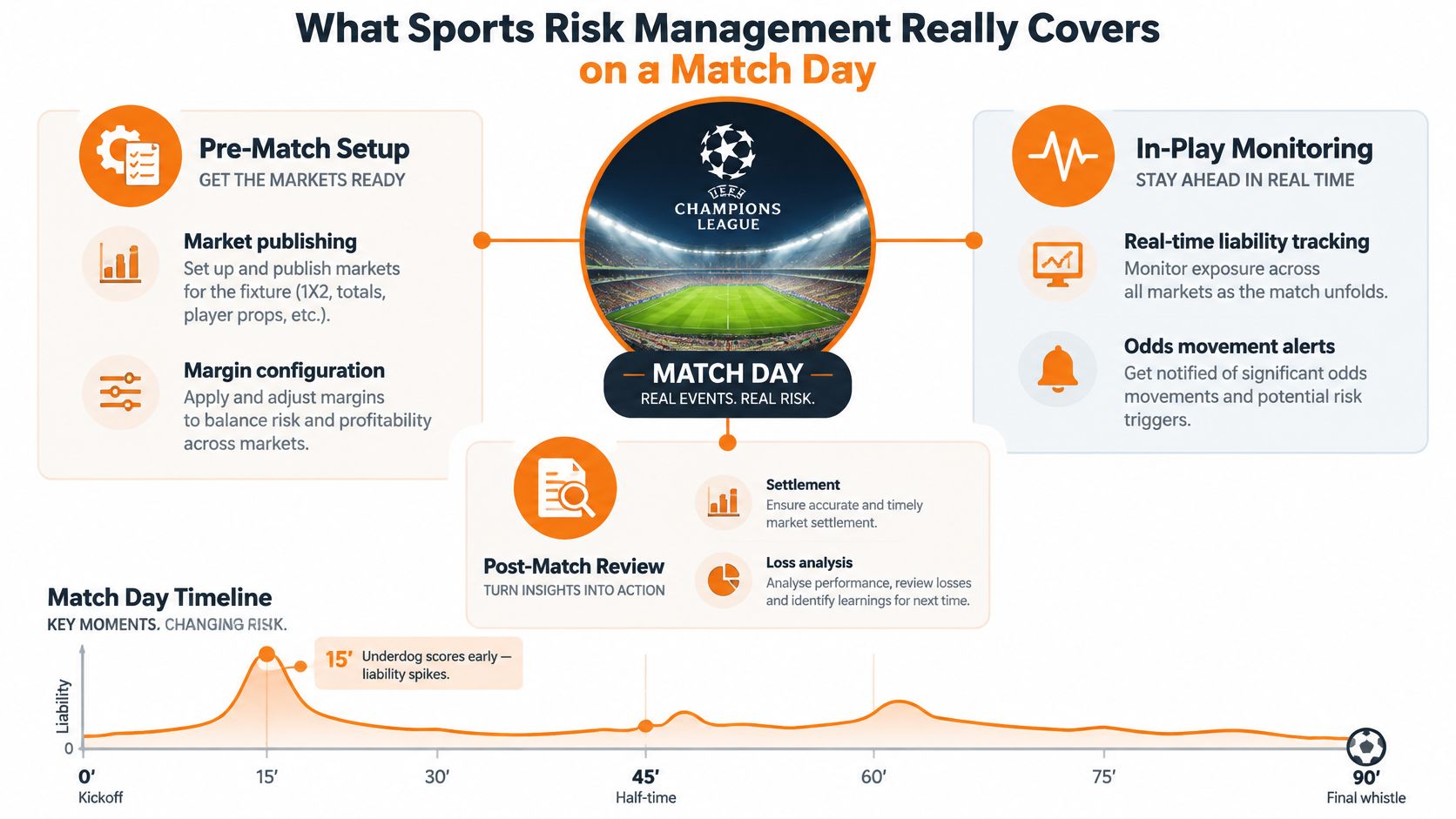
Those are parallel workstreams, not a queue of tasks to handle one at a time:
- Market surveillance compares odds, bet timing, liquidity, and customer patterns with the event's normal profile. A signal prompts review, but it isn't proof of manipulation.
- Liability control measures what the operator could owe on each outcome and how that payout changes if the score or price changes.
- Player and payment integrity brings together account behavior, payment activity, KYC and AML concerns, and responsible-gambling indicators. A customer shouldn't be assessed in isolated systems if the same activity affects multiple risks.
- Escalation governance assigns decision rights, records why a market was changed, and makes sure the right people can review and report a case.
The shared vocabulary matters. Handle is the amount wagered; exposure describes risk still attached to outcomes; liability is the amount payable if a particular result wins; hold is the operator's retained amount after settling bets; and net position shows the combined position once relevant stakes and payouts are accounted for. If trading and finance use these terms differently, an escalation can be delayed by arguing over a dashboard rather than controlling the book.
Integrity risk can be rare across a broad event set and still demand attention. Sportradar reported that its monitoring system tracked approximately 850,000 sporting events across more than 70 sports and 92 countries in 2022, identifying 1,212 matches with suspicious activity. It also reported that 99.5% of monitored events showed no indication of match-fixing, a reminder that monitoring must distinguish a low-frequency signal from routine activity (Sportradar's 2022 integrity report). A mature operation is judged by how quickly it contains a credible risk, preserves evidence, and communicates the decision, not by how polished its policy document looks. Operators building that foundation should connect their risk processes to the wider sportsbook operating model.
Core Concepts Every Risk Operator Must Internalize
A team can't manage exposure consistently if traders, finance, and compliance use the same terms to mean different things. Start with handle, the total amount accepted in wagers. Handle isn't revenue: the operator can take substantial bets and still lose if winning payouts exceed stakes retained.
Liability is outcome-specific. For a simple back bet, a customer stakes an amount on a team to win at decimal odds. If the bet wins, the operator pays the stake plus the winnings; if it loses, the operator keeps the stake. The potential payout depends on both stake and odds. A lay position reverses the perspective: the operator accepts a bet against an outcome and must consider how much it would owe if that selection wins.
Read the whole position, not just the ticket
Consider a match-winner market where several customers back the same underdog. Before kickoff, calculate what the operator owes if that team wins, compare it with likely losses on other outcomes, and check the net position. If the underdog scores, the odds change and so does the value of the remaining liability. A risk manager needs to consider new bets at the revised price alongside existing tickets; treating the goal as if it reset the book would hide risk that's already accepted.
Margin and overround are related but not interchangeable in practice. Overround describes how the implied probabilities in a set of prices add up relative to a fair probability total. Margin is the operator's intended pricing cushion, but realized hold depends on how customers bet and which outcomes occur. Setting a larger margin doesn't guarantee a better result if customers avoid the market or a poor price attracts one-sided action.
Nor should operators confuse trading exposure with customer-level fraud or bonus risk. Those signals can inform how a bet is reviewed, but the market-level question is still what the book owes across outcomes and what action protects its position. Shared terms make that handoff faster.
| Metric | What it measures | Where to watch it |
|---|---|---|
| Handle | Total accepted stakes | Event and market betting dashboard |
| Liability | Potential payout on an outcome | Outcome exposure view |
| Net position | Combined position after accepted bets | Trading risk dashboard |
| Hold | Amount retained after settlement | Settlements and finance reports |
| Overround | Combined implied probability in a market | Odds configuration screen |
| Customer exposure | Risk associated with an account or linked accounts | Player-risk case view |
Configuring Limits, Margins, and Markets Before Kickoff
Pre-match decisions determine how much room the live team has to respond once the event starts. Begin with the market catalogue. Publish markets your team can price, monitor, and settle reliably. A popular match may support a broad menu, while a lower-tier event with sparse information may call for fewer markets and tighter controls.
Build a market-specific limit ladder
Set margin by market and competition, not by a single rule applied everywhere. A derby with uneven information access may need different oversight from a routine fixture, but loading extra margin onto a thin market can backfire: it may attract little useful volume while increasing disputes if prices become difficult to defend. The goal is a price and limit structure that reflects both customer demand and the quality of available information.
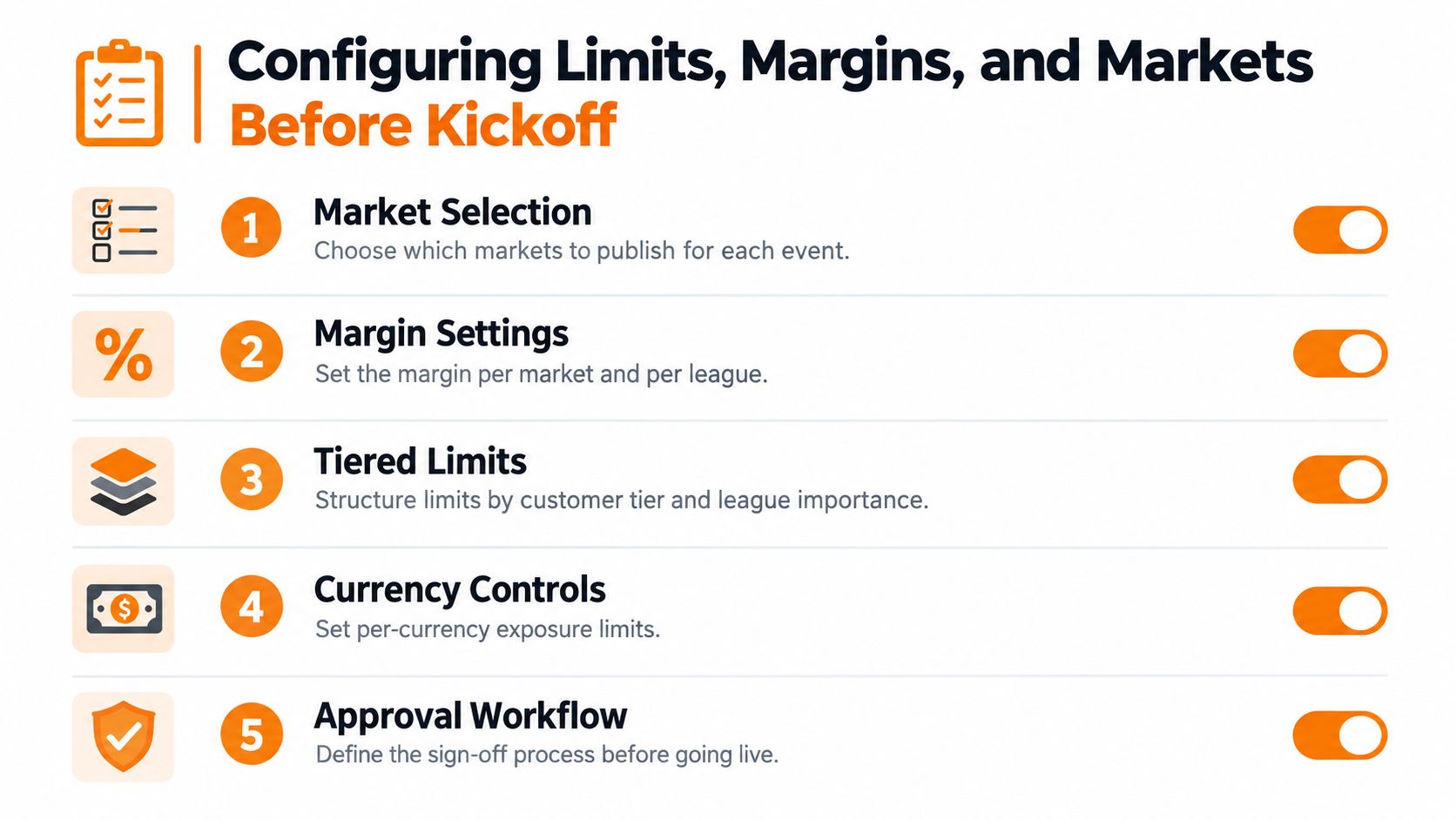
Maximum stakes should reflect liquidity and the ability to manage a position. A stake limit appropriate for a major-league match winner could be too generous for a lower-division tennis outright. Add customer-level limits, per-event caps, and a tiered limit ladder so one high-stake account can't force a price change the book can't support. Separate limits by currency where needed, because exposure in one currency may not offset a position held in another.
Trading rule: A limit is only useful if the team knows who can change it, what conditions justify a change, and where that decision gets recorded.
Before kickoff, set a fixture freeze window for material changes to markets or configuration. That doesn't mean freezing a market in the face of new information. It means requiring a deliberate review when a late lineup announcement, price feed change, or unusual bet pattern would otherwise alter assumptions at the last moment.
Confirm the following with the relevant owner before the event goes live:
- Market selection: Each published market has an assigned monitoring and settlement path.
- Margin settings: Pricing reflects the market and competition, with a clear approval route for exceptions.
- Stake limits: Per-customer and per-event caps fit the market's liquidity and the operator's appetite.
- Currency controls: The team can see and manage open exposure by currency.
- Approvals: Traders know who can adjust limits, suspend a market, and authorize reopening.
In-Play Risk Rules That Actually Hold Up Under Pressure
A useful in-play rule tells the operator what to do when a defined condition occurs. A brittle rule fires on one raw price move without asking whether the market is liquid, whether there's a legitimate match event, or whether the movement appears across related markets. The result is a book that either reacts too late or suspends normal activity too readily.
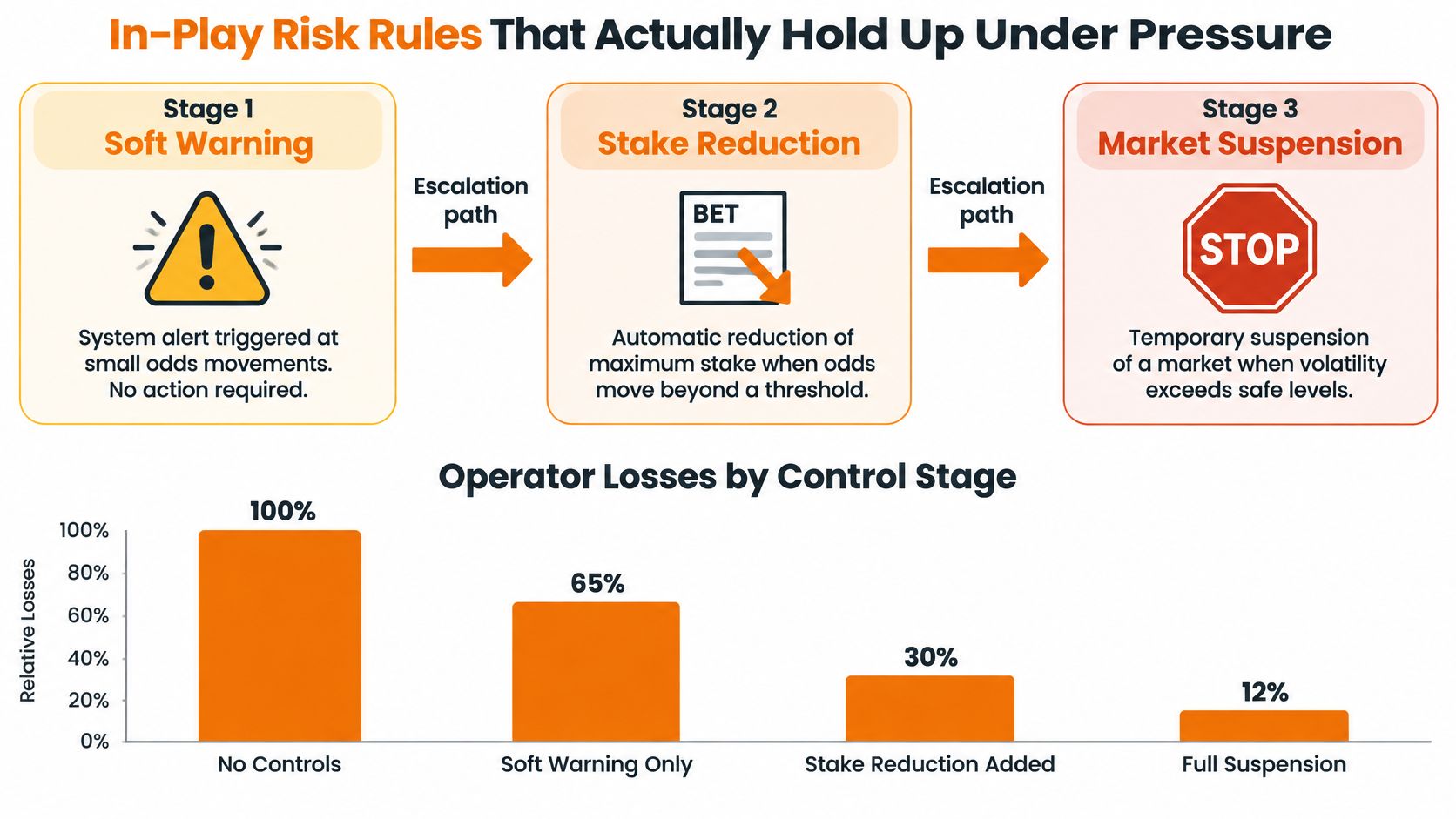
Use graduated controls. A soft warning flags a deviation for the trader without automatically changing customer access. If the movement grows, or the same market attracts an unusual concentration of bets, reduce the maximum stake and route the activity for review. Suspend the market when a sharp move, feed uncertainty, or combination of indicators makes continued acceptance unsafe.
That sequence can't rely on price movement alone. A rule-based trigger is useful when the action is clear: if a feed is delayed, suspend the affected market until the feed is verified. A model-based trigger can compare current activity with a baseline for the event and market, accounting for characteristics that affect expected volume. A demonstrated approach to high-frequency Italian Serie B in-play data used outlier detection to identify unusual activity relative to expected betting volume (analysis of in-play betting patterns). The model can help prioritize cases, but it shouldn't make high-impact decisions without review.
What a controlled suspension looks like
Suppose a match-winner market moves abruptly while a cluster of bets arrives on one outcome. The system flags the move, the trader checks the live event and the odds feed, and the market is suspended while the team assesses liability and customer activity. If the feed checks out and the price is supportable, the trader can reopen with a reduced limit while preserving the alert, decision, timestamps, and rationale.
This approach connects back to pre-match controls. A market with a tighter limit before kickoff shouldn't receive a much larger in-play limit without an authorized decision. The controls need to work together, with the same exposure view and clear permissions across trading and risk.
Over-automation is a risk of its own. A legitimate lineup update, injury, or shift in liquidity can produce a sharp price move. If every unusual movement causes an automatic suspension, sharp customers encounter repeated interruptions and traders learn to dismiss alerts. Measure whether alerts lead to useful review and timely containment, and tune them against event context rather than treating every deviation as evidence of misconduct.
Liability Controls, Exposure Limits, and Customer-Level Risk
A risk manager watching one market sees the stake. What they can miss is the same customer building correlated positions across five markets on the same event. Per-event exposure caps exist for that gap. Set them alongside customer payout limits and controls by league and currency, and scale them to the quality of information available. A cup final with broad interest and strong coverage earns a higher ceiling than a friendly with limited liquidity, even when the same nominal stake appears on both.
When a net position approaches its approved ceiling, the options are narrower than they look. Lower maximum stakes, reprice the affected markets, or suspend acceptance while the book is reviewed. The right call depends on why the pressure exists. Concentrated customer preference, an information change, a feed issue, and a possible integrity concern each demand a different response, and a single large ticket can be routine in a liquid market while being a serious problem in a thin one.
The harder discipline is customer-level risk, because the signals live in different systems. Consider an account that was low-volume for months, then stakes heavily on live markets, changes device and location, and makes a rapid deposit followed by a withdrawal. Trading sees aggressive in-play activity. Payments sees a velocity flag. The player-protection team sees a spend pattern. None of those signals proves wrongdoing or harm on its own, but if each team works its own queue in isolation, nobody holds the full picture.
IBIA data compiled in a 2025 analysis recorded 1,240 alerts between 2021 and 2025, averaging 248 per year, with annual alerts rising from 236 to 300, a 6.18% compound annual growth rate (analysis of integrity alerts and suspicious betting activity). Those figures describe alerts, not confirmed manipulation. Rising report volume can reflect better detection or broader coverage, so alert counts alone are a weak basis for judging how corrupt a sport or market is.

Joining the signals up does not mean every team sees every detail. It means a trading decision on a flagged account can draw on the payment flag and the protection assessment before a limit is applied or a withdrawal is held, with access still restricted by role. Give customers an explainable reason and an appeal path when a decision materially affects their account, because opaque account actions generate complaints and regulator attention faster than the original risk did. Operators refining how teams and controls fit together can compare their approach with these risk-management practices.
Monitoring, Alerting, and Escalation Workflows
Alerts become operational controls only when someone owns them. Trading should own immediate market decisions, compliance should own regulatory assessment and reporting, and payments should investigate account or transaction concerns. The responsible-gambling team should assess customer-protection signals. Define expected response times internally for each alert class, and specify who can make an urgent decision when the usual owner isn't available.
Keep the case record useful
A sound escalation begins with a signal, not a conclusion. Trading receives an odds-movement alert, checks feed integrity and event context, and compares the move with accepted bets and current liability. If there's a credible risk, the authorized person suspends the affected market and records the reason, time, markets involved, and evidence considered.
Compliance then assesses whether the facts call for external reporting or a referral to an integrity body. Payments reviews relevant transaction activity, while the player-risk team considers any protection concern. Each team's findings should be added to the same case timeline, with access controls that protect sensitive information.
The UK Gambling Commission recorded 587 unusual or suspicious betting reports in April 2025 to March 2026, including 173 from licensees (Gambling Commission reporting figures). That reporting volume makes structured intake and triage more useful than a shared inbox with no owner. A case record should preserve the original alert, subsequent decisions, supporting evidence, and any reason for reopening or settling the market.
To reduce alert fatigue:
- Calibrate by event: Compare activity with the relevant market and event profile, not a single universal baseline.
- Separate detection from confirmation: An alert is a prompt to investigate, not a finding of misconduct.
- Review recurring noise: Close false positives with a reason code and use the review to refine rules.
- Protect high-impact decisions: Require human approval for significant suspensions, account restrictions, or external reports.
- Set clear handoffs: Record who owns the next action and when that action is due.
Your 30-Day Sports Risk Management Rollout
A rollout succeeds when it produces working controls that teams can rehearse, not a collection of unapproved policies. Assign a named owner to each phase and make acceptance depend on observable evidence.
Foundation
Deliverables: Approved risk policies, decision rights, event and customer dashboards, and a shared definition of core metrics. Owner: Risk lead, with trading, compliance, and payments input. Acceptance criterion: A tabletop review confirms that every critical alert has an owner and an authorized decision-maker.
Configuration
Deliverables: Market catalogue, margin settings, stake and exposure limits, in-play triggers, and suspension procedures. Owner: Head trader or sportsbook risk manager. Acceptance criterion: The team can trace a sample exposure alert from trigger to decision and verify that the action matches the approved limits.
Integration
Deliverables: Linked customer and market-risk signals, payment and responsible-gambling referrals, case management, and role-based access. Owner: Product or operations lead working with risk, payments, and player-protection teams. Acceptance criterion: A test case appears in the shared workflow with its reason codes, owner, evidence, and restricted-access controls intact.
Validation
Deliverables: Market-suspension rehearsal, regulatory dry run, alert review, and post-event findings. Owner: Compliance lead with trading support. Acceptance criterion: The team can reconstruct the event timeline from the case file and explain why each decision was taken.
Use this plan as a working tracker, not a launch announcement. Operators assessing the technology needed to support integrated operations can review the sports betting platform options alongside their own control requirements.
Document the thresholds. Name the decision-makers. Review the evidence.
NexGrate provides a white-label casino and sportsbook platform with sportsbook markets, stake and exposure controls, payments, player-account tools, and compliance features. If you're evaluating how to bring those operations together, visit NexGrate to discuss your requirements.