A deployment pipeline is the automated sequence of build, test, and release steps that takes a code commit from a developer's machine into production, with quality gates and approvals woven into each stage. In the CNCF's 2024 survey, 60% of organizations reported using CI/CD for most or all production applications, up from 46% in 2023, a 31% year-over-year increase (CNCF Annual Survey 2024).
It's Friday at 11 p.m. The sportsbook team is publishing a promotion for the Champions League final. Minutes later, the wallet service turns red. Players can log in, but their balance screen is blank. The on-call engineer is searching through three dashboards while another team asks whether the promotion, the wallet API, or a recent configuration change caused the failure.
That situation is exactly what a well-designed deployment pipeline should help prevent. It doesn't promise that software will never fail. It makes each change repeatable, testable, observable, and reversible, so an operator can identify what changed and stop its exposure before a small release becomes a platform-wide incident.
Table of Contents
- What a Deployment Pipeline Is
- The Core Stages From Commit to Production
- Comparing Rolling, Blue-Green, and Canary Strategies
- DORA Metrics and How to Read Them
- Pipeline Design for Multi-Tenant White-Label Platforms
- Security and Compliance Controls Inside the Pipeline
- A Sample Pipeline for Casino and Sportsbook Operations
- Putting It All Together and What to Measure Next
What a Deployment Pipeline Is
A deployment pipeline is the automated route a code change follows from commit to production. It packages the change, runs tests and security checks, stores a versioned artifact, promotes that artifact through controlled environments, and checks the release after users receive it. For an iGaming platform, the same route might carry a wallet migration, a live-dealer integration, or updated geofencing rules.
A manual “FTP and pray” release works differently. Someone builds locally, copies files to a server, edits configuration by hand, restarts services, and relies on memory to confirm success. That may seem quick for a small change, yet it leaves weak evidence and makes rollback depend on whoever is available. A pipeline replaces that fragile handoff with recorded steps, repeatable inputs, and a known recovery path.
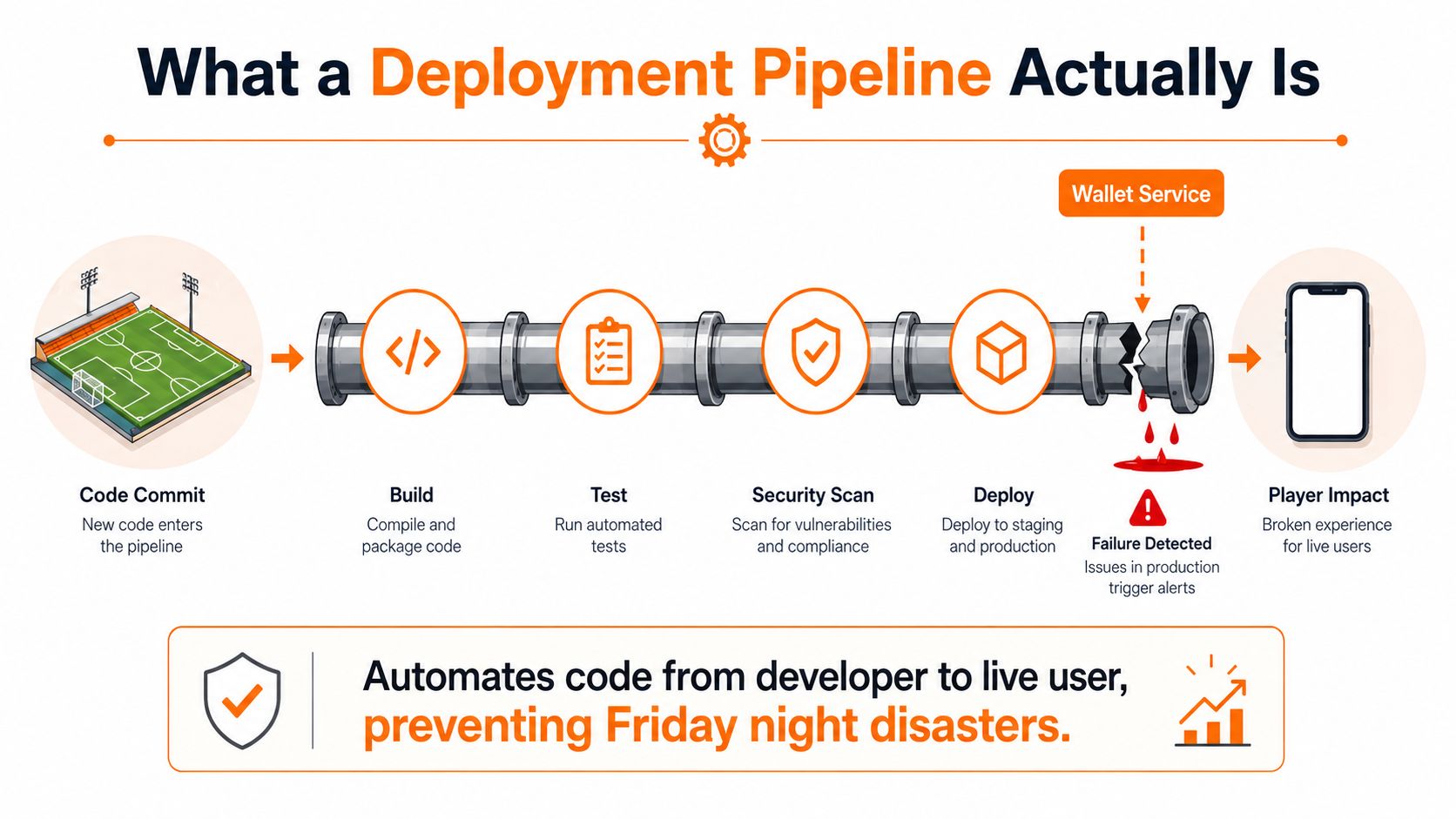
CI and CD describe different release controls
Continuous Integration, or CI, begins when developers commit or merge changes into shared source control. Automated builds, unit tests, code analysis, and related checks provide quick feedback on whether the change integrates safely.
Continuous Delivery keeps a tested release ready for production, usually with deliberate approval before final promotion. Continuous Deployment allows qualifying changes to reach production automatically. Both can use the same pipeline. The difference is how the final release decision is controlled.
The pipeline is a control surface for the technical and operational record. Approval entries, deployment evidence, artifact signatures, change tickets, rollout rules, and rollback controls all belong in the delivery path. A wallet update needs evidence that balances remain consistent. A live-dealer change needs checks around active sessions. A geofencing update needs proof that market-access rules were tested. In a multi-tenant platform, the record should also show which brands received the release and in what order.
Practical rule: If an operator must prove who approved a release, which artifact ran, what checks passed, and how the team recovered, the pipeline should capture that evidence automatically.
CI, Continuous Delivery, and Continuous Deployment therefore describe connected practices rather than interchangeable labels. The useful question is whether the pipeline removes hidden handoffs while preserving the checks required for regulated change windows, tenant-specific rollouts, and reliable player experiences. For an MGA-aligned audit trail, every promotion should connect the source revision, tested artifact, approval, environment, and outcome.
The Core Stages From Commit to Production
Take a sportsbook odds update for the Champions League final. A trader or product team may see one feature, but the pipeline sees a chain of technical and operational decisions.
1. Commit and trigger
A developer commits the odds-service change to Git. A webhook starts the pipeline and records the commit identifier, author, branch, associated ticket, and intended release context. The trigger should be predictable, so the team can connect a production incident to the exact source revision that produced the deployed artifact.
2. Build and package
The pipeline compiles the odds engine, builds the JavaScript client, applies approved configuration inputs, and packages the result. It creates a versioned artifact, such as a container image or release package, rather than asking each environment to rebuild the software independently.
That distinction prevents staging and production from receiving subtly different outputs. The same validated artifact should move through the environments, with environment-specific values supplied through controlled configuration.
3. Test and scan
The test sequence should match the risks of the workload.
- Unit tests check odds calculations, rounding, market suspension logic, and settlement rules.
- Integration tests exercise the service against a fixture odds feed and dependent APIs.
- End-to-end smoke tests confirm that a player can view a market, place a test bet, and receive the expected response in a disposable environment.
- Security checks inspect dependencies, source code, images, and secrets before promotion.
A failed quality gate stops the release. The team fixes the code or reverts the change instead of pushing a known-broken build toward production.
4. Store and promote the artifact
The verified artifact goes into an immutable registry, tagged with the commit and release metadata. Development, staging, pre-production, and production should all consume that same artifact. Each promotion can have its own approver, test evidence, and audit record.
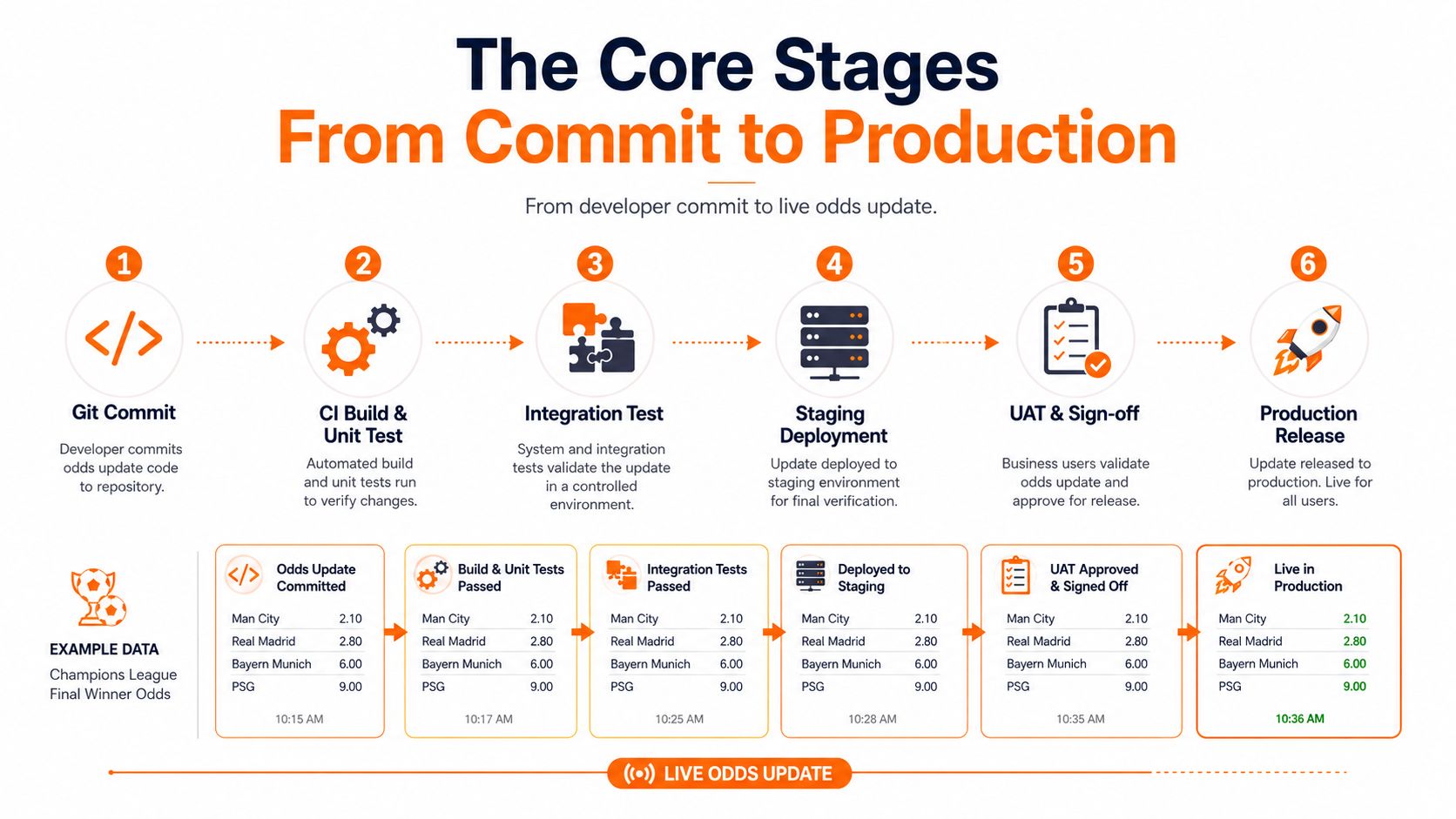
5. Validate the live release
Production validation doesn't end when the deployment command succeeds. Health checks, synthetic bets, odds freshness checks, settlement probes, and service-level dashboards should confirm that the release works under real operating conditions.
Automatic rollback can respond to a defined failure signal, while an operator retains the authority to pause a rollout. Deployment frequency and lead time become useful operational measures. Deployment frequency describes how often changes reach production, while lead time for changes measures the time from commit to successful production deployment (Grafana's DORA metrics guide).
The pipeline therefore forms a controlled progression, not a single push button. Every stage answers a different question: can the code build, does it behave correctly, is it safe to release, is the artifact traceable, and does the live service remain healthy?
Comparing Rolling, Blue-Green, and Canary Strategies
A casino game release shows why rollout strategy matters. Replacing a front-end bundle is different from changing wallet behavior or updating the service that maintains a live-dealer session.
A rolling deployment replaces instances gradually behind a load balancer. It usually uses less infrastructure than a parallel environment, making it a practical default for low-risk front-end changes. The trade-off is that old and new versions run together, which can complicate session behavior, schema compatibility, and rollback.
A blue-green deployment maintains two comparable environments. The new casino release goes to the inactive environment, where the team runs validation before switching traffic. This gives operators a clean traffic reversal and is particularly useful for a substantial wallet migration, provided the database transition supports both application versions during the change.
A canary deployment sends a limited portion of real or simulated traffic to the new version first. It suits a sportsbook margin-model change because the team can watch bet acceptance, pricing behavior, settlement responses, and error signals before opening the release more widely.
| Dimension | Rolling | Blue-Green | Canary |
|---|---|---|---|
| Session continuity | Existing sessions may encounter mixed versions, so compatibility matters | Traffic can move as a group, but active sessions still need careful handling | Selected sessions or tenants may use the new version while others remain on the old one |
| Rollback | Requires reversing or completing instance replacement | Usually fast because the router can return traffic to the previous environment | Fast for limited exposure, provided routing and feature controls are reliable |
| Infrastructure cost | Lower, because environments are replaced in place | Higher, because parallel environments need capacity | Variable, depending on how much parallel capacity the canary needs |
| Database changes | Must support old and new instances during the rollout | Requires compatibility across the traffic switch | Requires compatibility while both versions receive traffic |
| Sticky sessions | Can preserve sessions, but mixed versions need compatible behavior | Router configuration must preserve or deliberately reset sessions | Session selection and stickiness must be controlled closely |
| Geofencing | Rules must behave consistently across instances | Both environments need identical jurisdiction controls before switching | The canary must represent the jurisdictions and tenant rules being evaluated |
A live-dealer release deserves extra caution. A rolling strategy can be efficient for a cosmetic table interface change, while blue-green may offer a clearer recovery path for a coordinated service upgrade. Canary is strongest when the operator can isolate exposure by tenant, jurisdiction, game, or service capability.
The right question isn't which strategy is universally best. Ask which failure would be most damaging, how quickly traffic can be reversed, whether sessions can survive mixed versions, and whether the data model supports two releases operating safely at once.
DORA Metrics and How to Read Them
A pipeline can run automatically and still deliver poorly. The useful measures focus on whether releases move quickly and recover safely, rather than counting pipeline steps.
GitLab's CI/CD analytics model tracks four core measures: deployment frequency, lead time for changes, change failure rate, and time to restore service (GitLab CI/CD analytics documentation). The DORA program popularized these metrics as a way to assess delivery health.
Translate each metric into an operator question
- Deployment frequency: How often do sportsbook odds changes, casino releases, wallet fixes, or compliance updates reach production?
- Lead time for changes: How long does a change take from commit to a successful production deployment?
- Change failure rate: How often does a release cause a rollback, hotfix, payout incident, stuck spin, or other production failure?
- Time to restore service: How long does the team need to return normal play after a failed release?
| Metric | Elite | High | Medium | Low | iGaming meaning |
|---|---|---|---|---|---|
| Deployment frequency | Frequent releases | Regular releases | Occasional releases | Infrequent releases | Measures how often each platform surface can ship safely |
| Lead time for changes | Short path from commit to production | Predictable path | Delayed path | Long, uncertain path | Shows whether a KYC rule or odds change can move through controls efficiently |
| Change failure rate | Few failed changes | Failures are contained | Noticeable release risk | Frequent release disruption | Connects delivery quality to wallet, betting, casino, and bonus incidents |
| Time to restore service | Rapid recovery | Reliable recovery process | Recovery varies | Prolonged disruption | Shows how quickly normal betting, play, and payments return |
These bands are directional, not a licence to chase speed blindly. A regulated platform may deliberately use a longer soak period for a wallet migration or a jurisdiction-sensitive rule. A low change failure rate and dependable recovery process are more valuable than frequent releases that create player-impacting incidents.
Track the measures per surface, not only across the whole platform. A front-end change may ship regularly while wallet releases require deeper validation. Combining the numbers can hide that difference and make an apparently healthy pipeline difficult to operate.
Pipeline Design for Multi-Tenant White-Label Platforms
A white-label platform often uses one codebase to serve brands with different jurisdictions, payment methods, content, currencies, responsible-gaming rules, and geofencing requirements. The pipeline must keep those differences explicit instead of relying on a developer to remember which runtime switch belongs to which tenant.
Separate the build, configuration, and tenant context
A tenant-aware pipeline should identify the target brand and jurisdiction before it produces a deployable artifact. A Curacao-only feature must not leak into an MGA-licensed skin just because both brands share the same source repository.
Use isolated build and promotion paths where the risk demands it. The pipeline should validate:
- Tenant identity: The artifact and release record name the brand receiving the change.
- Jurisdiction rules: Geofencing, KYC, AML, responsible-gaming, and reporting settings match the target license.
- Wallet model: Shared-wallet and separate-wallet tenants follow compatible migration and reconciliation paths.
- Content permissions: Casino and live-dealer providers are enabled only where the tenant's commercial and regulatory configuration allows them.
- Configuration provenance: Each promoted configuration set has an owner, version, approval record, and rollback path.
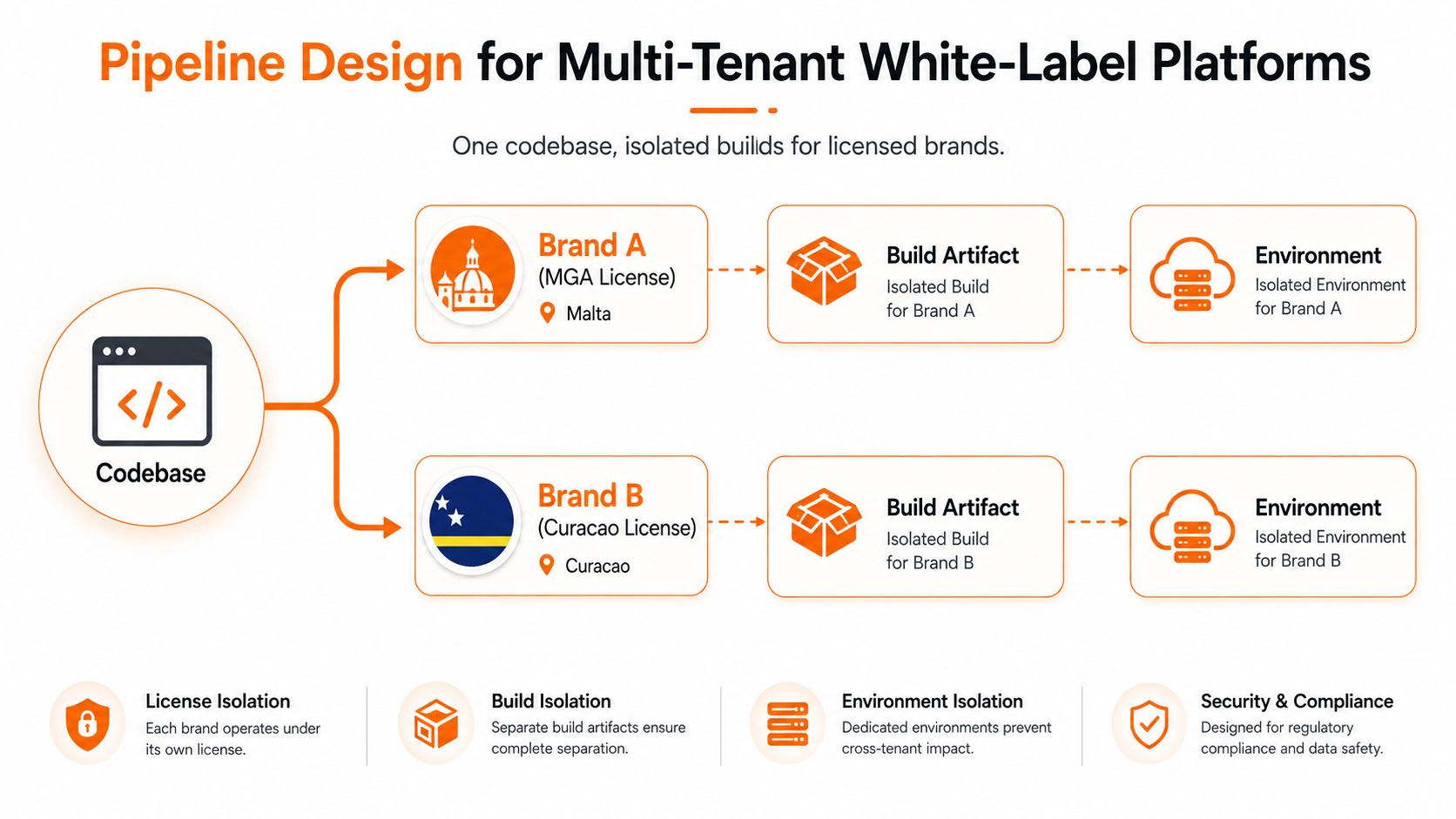
Promote one tenant ring at a time
A workable flow can move a release through shared development, tenant-specific staging, regulator-aware user acceptance testing, and per-tenant production. That sequence lets the operator test a new Evolution, Pragmatic Play, or Ezugi integration against the tenant configuration before exposing it to every brand.
Configuration promotion is usually harder than code promotion. The source may be identical, while the effective behavior changes through payment routing, provider availability, limits, market access, bonus rules, and geofencing. Treat those values as governed pipeline inputs, not informal runtime switches.
A deployment record should show the exact tenant, artifact, configuration version, approvals, test results, and production outcome. Operators planning the broader integration model can also review this white-label casino integration guide for the platform concerns that feed into those pipeline decisions.
Security and Compliance Controls Inside the Pipeline
Automation doesn't make a release safe by itself. It makes the chosen process repeatable, including any unsafe assumptions that engineers have encoded into it.
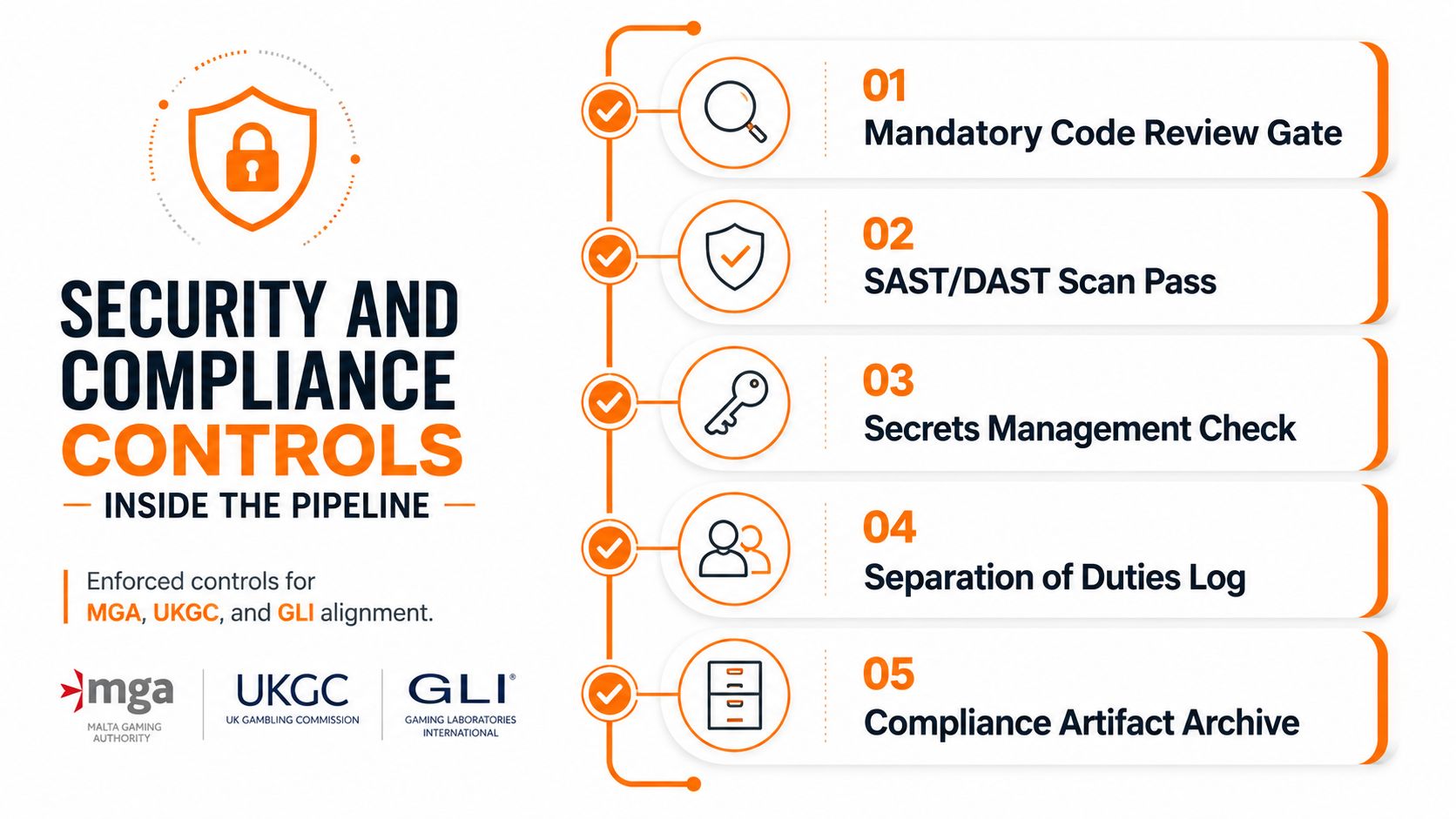
An MGA, UKGC, or GLI-aligned operating model needs evidence that the organization controlled the change, tested the software, protected secrets, and preserved a reliable audit trail. The pipeline should enforce those controls at the point where a release could otherwise move forward.
Put the controls at the relevant stage
- Before merge: Require signed commits where appropriate, mandatory code review, and a two-person approval model for sensitive components such as wallets, settlement, identity, and geofencing.
- During build: Run SAST, dependency scanning, image inspection, and secret detection. A critical vulnerability or exposed wallet key should fail the job rather than create a warning that someone may ignore.
- Before promotion: Store signed artifacts in an internal registry and link the artifact to the commit, ticket, test evidence, and intended tenant or environment.
- At production approval: Enforce four-eyes approval and separation of duties. The person who wrote the change shouldn't be the only person authorizing its production release.
- After deployment: Archive deployment events, health results, rollback decisions, and evidence packs in an immutable record that supports the applicable retention obligations.
A manual approval isn't automatically a process failure. In a regulated release, it can be the control that proves an independent person reviewed the evidence before production exposure.
The operational gap is often hidden manual work. Recent survey coverage reported that 64% of infrastructure-code deployments still relied on manual steps, 50% of application deployments still used manual processes, and 55% of build pipelines lacked proper quality gates (software engineering excellence report). Those figures show why a pipeline diagram can look automated while operators still copy configuration, request approvals in chat, or perform undocumented production actions.
The answer isn't to remove every human decision. It's to make each necessary decision visible, authorized, time-stamped, and connected to the release record. Guidance on compliance reporting can help teams think through the reporting surface that the pipeline must support.
A Sample Pipeline for Casino and Sportsbook Operations
Consider a release that touches four connected surfaces: the casino client, sportsbook odds service, payments and wallet ledger, and a live-dealer studio integration. The commit changes an RNG profile, adds a sportsbook market type, updates a PSP webhook handler, and refreshes a live-dealer token.
That bundle should not move as an unexamined package. The pipeline can coordinate the release while keeping validation and rollback controls specific to each surface.
The release path
- Source and review: The developer commits the change and links it to a change record. Reviewers inspect the RNG adjustment, market behavior, webhook handling, and token-management logic separately.
- Automated validation: Unit tests cover casino outcome handling, odds calculations, wallet ledger entries, webhook signatures, and token expiry. Contract tests verify that dependent services still agree on request and response formats.
- Static and supply-chain checks: The pipeline runs static analysis, dependency checks, secret scanning, container inspection, software bill of materials generation, and artifact signing.
- Tenant-isolated staging: The signed build moves into a staging ring that mirrors the target brand's wallet, payment provider, jurisdiction, content catalogue, and geofencing rules.
- Operational tests: Synthetic bet replay exercises the new market. A wallet reconciliation dry run compares expected ledger movements. A live-dealer handshake confirms that the refreshed token permits the intended session flow. Casino smoke tests verify launch, play, result handling, and balance updates.
- Controlled exposure: The release canary targets one white-label tenant before the operator promotes it to the wider production ring. Dashboards watch bet errors, wallet mismatches, game launch failures, provider responses, and live-dealer session health.
Keep approvals and rollback independent
The wallet migration step needs change advisory approval because ledger integrity and reconciliation carry a different risk from a front-end casino update. Live-dealer operations should approve the release after the handshake succeeds, while compliance attestation confirms that the target tenant and jurisdiction controls are correct before production opens.
Feature flags should separate the surfaces. If the casino client shows a regression, the operator should be able to disable the casino change without blocking the sportsbook cutover or payment webhook fix. The production record should capture every promotion, pause, approval, rollback, and re-enable decision.
This is the operating model expected from an integrated white-label sportsbook solution, where the sportsbook doesn't operate in isolation from wallets, payments, casino content, and compliance services.
Putting It All Together and What to Measure Next
A deployment pipeline turns software delivery into a governed flow. The useful design work begins when an operator maps that flow to actual failure modes, tenant differences, regulatory controls, and recovery decisions.
Before redesigning the next release path, lock in these decisions:
- Choose by surface: Use rolling releases for low-risk interface changes, canary exposure for behavior that benefits from limited real traffic, and blue-green promotion where fast reversal and parallel validation justify the added infrastructure.
- Measure by service: Track deployment frequency and lead time separately for casino, sportsbook, wallet, payments, and live-dealer integrations.
- Protect approvals: Enforce separation of duties at production gates, especially for wallet, settlement, identity, geofencing, and compliance changes.
- Preserve evidence: Treat artifact signatures, test results, configuration versions, approvals, health checks, and rollback events as part of the release artifact.
- Test recovery: A rollback plan that has never been exercised is an assumption, not an operational control.
Start with four KPIs: change failure rate, mean time to recovery, deployment frequency per surface, and time to detect bet-affecting regressions. The DORA model provides the delivery-health foundation, but iGaming operators need to apply it to the player journeys that matter, including placing a bet, receiving a payout, launching a game, maintaining a live-dealer session, and accessing the correct market.
The target isn't maximum automation or maximum release speed. It's a pipeline that makes safe change routine, keeps regulated decisions auditable, limits exposure when a release misbehaves, and gives the on-call team a clear path back to normal play.
NexGrate provides a turnkey white-label platform that brings casino, sportsbook, wallet, payments, live-dealer integrations, monitoring, and compliance controls into one operating stack. Visit NexGrate to explore how a governed deployment model can support your next iGaming brand launch or platform migration.