
You're under pressure to launch a sportsbook brand, but the stack is still a mess. Payments are in one queue, compliance questions are in another, odds feeds are being compared in spreadsheets, and every vendor says their part is “almost ready.” A white label sportsbook solution exists for exactly that moment, when speed matters, but the actual challenge is making sure the convenience you buy today doesn't turn into dependency tomorrow.
Table of Contents
- Introduction to White Label Sportsbook Solution
- Understanding White Label Sportsbook Solution
- Core Modules Explained
- Benefits and Practical Use Cases
- Compliance and KYC AML Considerations
- Integration Planning Timeframes and Pitfalls
- Selection Checklist and Pricing Models
- Key Takeaways and FAQs
Introduction to White Label Sportsbook Solution
A new operator often runs into the same operational problem in a different form. One team has the brand, another handles payments, legal asks for jurisdiction checks, and trading needs live odds before marketing can even shape the launch plan. A white label sportsbook solution brings those moving parts into one package, so the work that usually scatters across several projects stays under a single vendor framework.
The market context supports that model. The broader iGaming platform and sportsbook software market reached about $14.8 billion in 2025, while the B2B segment represented 58.3% of revenue, or roughly $8.6 billion, because operators are increasingly buying managed technology instead of building proprietary stacks from scratch (market data). Sports betting also remained the largest application segment, at 38.7% of revenue, about $5.7 billion, which shows how central sportsbook capability is to platform demand.
The main appeal is broader than speed to launch. A vendor can provide the betting engine, player management, risk controls, and compliance tooling as one operating layer, while the operator focuses on brand, acquisition, and market fit. That changes the launch question from whether the business can build the stack to whether it can run the stack well.
A useful way to judge the model is to separate convenience from control. The fast setup can hide dependence on the vendor's release calendar, feature priorities, payment changes, and risk updates. Those operational choices matter as much as the front-end branding, because the parts you do not own still shape the customer experience.
Practical rule: if your launch plan depends on three or more separate vendors staying aligned at every step, the project is already fragile.
The hidden risk is vendor dependency. A white label setup can shorten the path to market, but it also means the operator must treat governance, escalation, and service quality as part of the launch plan from day one.
Understanding White Label Sportsbook Solution
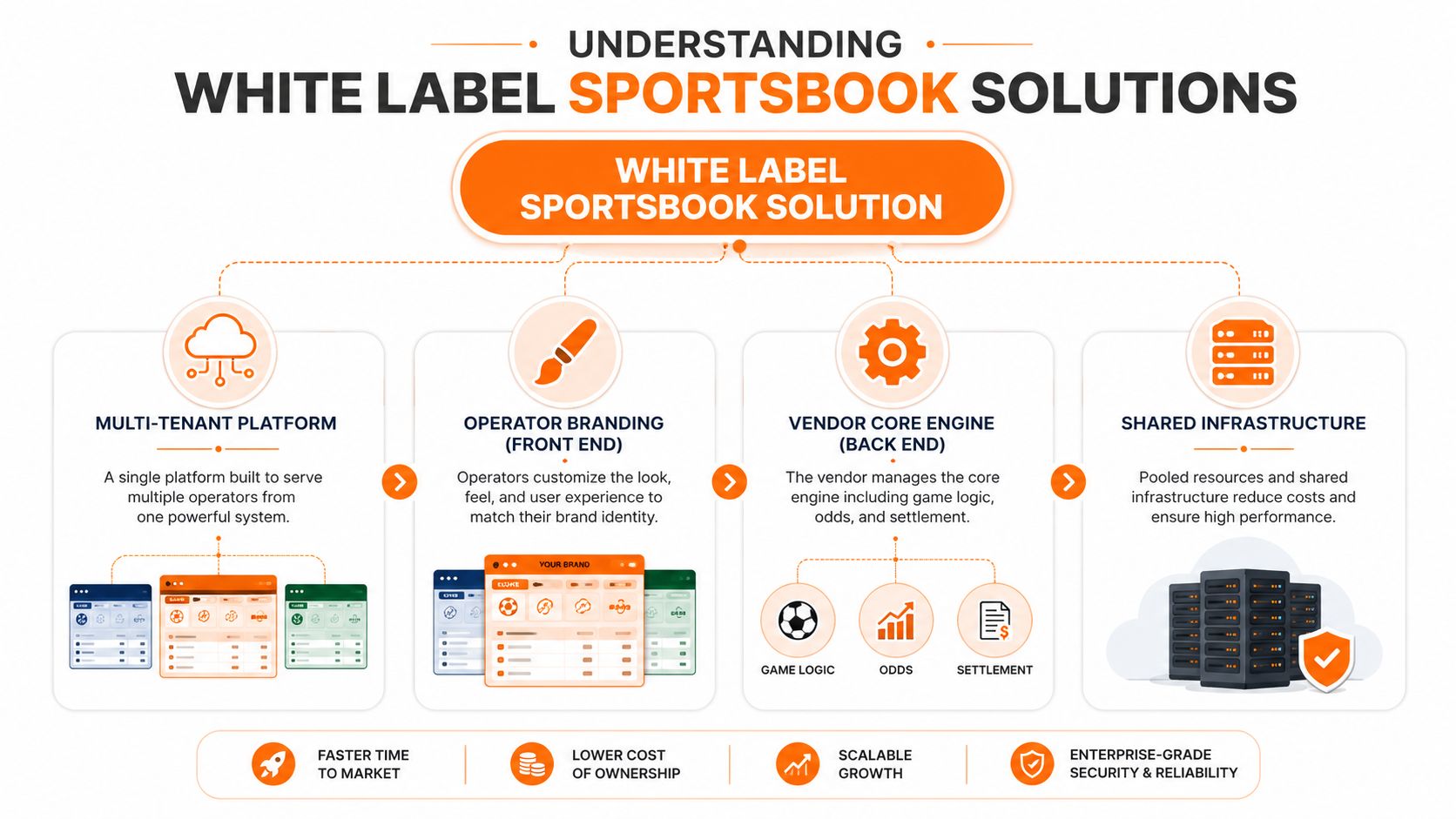
A white label sportsbook solution is usually a multi-tenant, pre-built platform where the operator gets the branded front end, while the vendor keeps control of the core sportsbook engine, PAM, payment integrations, hosting, and compliance tooling. That setup reduces how much you have to integrate yourself, because wager processing, odds ingestion, settlement, and wallet logic are already connected inside the vendor stack. For operators comparing deployment options, a platform architecture reference can help clarify where the vendor's responsibility begins and where your own operational control starts.
A practical way to picture the model is a shopping center with a managed back office. You control the storefront, the signage, and the way customers experience your brand, while the landlord maintains the building systems that keep the property running. The storefront can move quickly, but the back office still sets many of the limits.
What the operator actually owns
In practice, the operator owns the customer-facing experience. That means the logo, color palette, promotions, content strategy, and often the market positioning. The vendor owns the machinery underneath, including release cycles for leagues, bet types, PSP changes, and risk-engine updates.
That division is useful, but it is not neutral. It gives you a faster launch path, yet it also means your differentiation lives mostly in branding and commercial strategy rather than deep product engineering. If the vendor does not support a feature, your ability to request it depends on their roadmap, not your urgency.
Why the model keeps expanding
Managed technology has moved into the center of sportsbook planning, because operators want speed to market without building every system from scratch. The pattern shows up in broader market data as well, where B2B software holds a large share of activity and sportsbook demand remains a major driver.
That matters because white-label delivery works best when the operator needs fast market entry, compliance tooling, and integrated payments without assembling an in-house trading department. It also explains why many launch teams now treat white-label platforms as the default starting point rather than a compromise.
The hidden risk is vendor dependency. A white label setup can shorten the path to market, but it also means the operator must treat governance, escalation, and service quality as part of the launch plan from day one.
Core Modules Explained
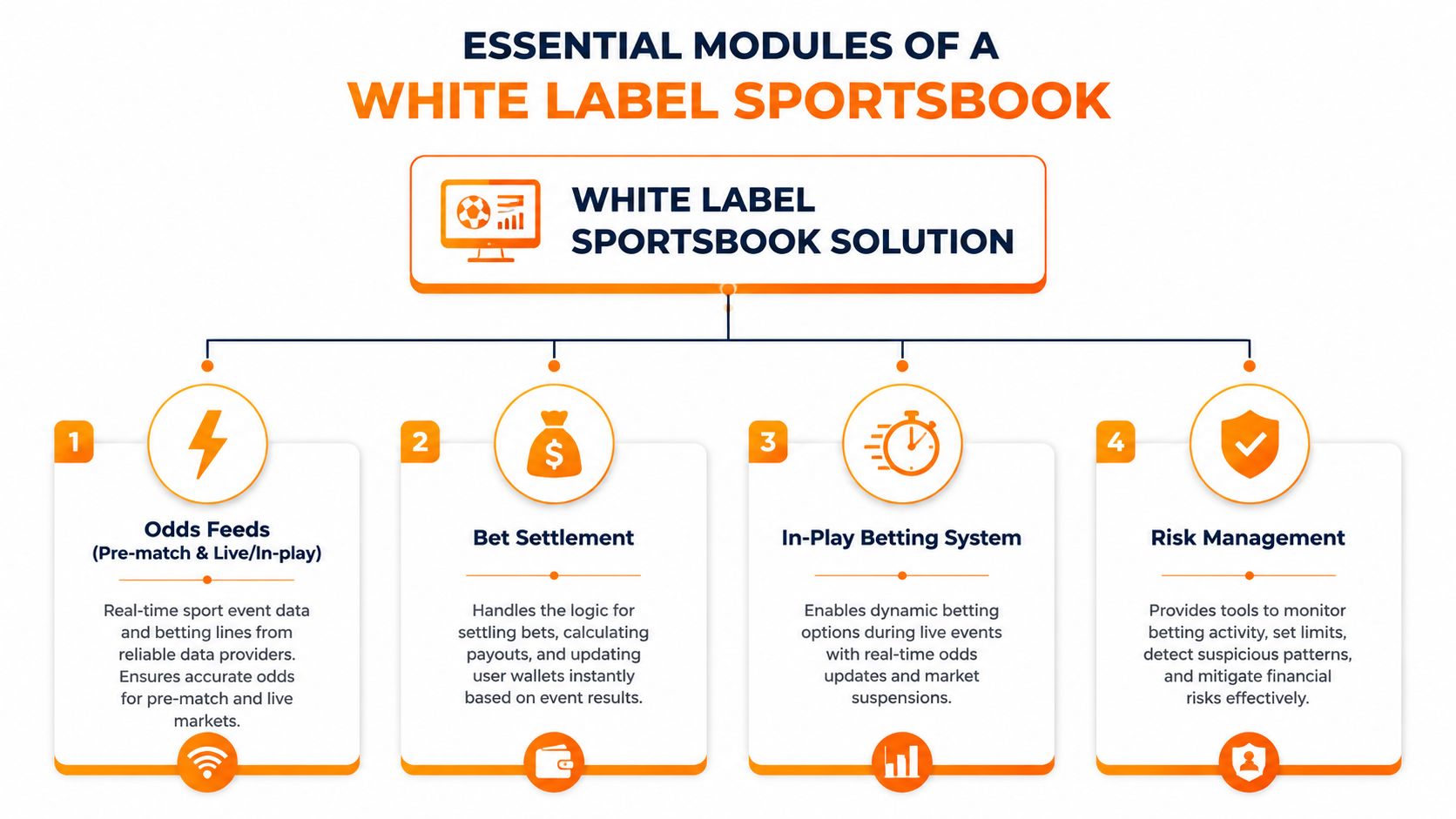
A sportsbook looks simple to the player, but under the hood it behaves like a chain of tightly linked systems. If one module lags, the others feel it immediately. That's why modern white-label platforms are judged less by the homepage and more by how the plumbing behaves under live traffic.
Odds feeds and live trading
The odds feed is the pulse of the sportsbook. It has to handle pre-match markets and live, in-play movement without breaking trust at the point of bet placement. Industry guidance says modern white-label platforms deliver live odds updates with sub-2-second latency, which helps keep in-play pricing accurate and reduces stale-price arbitrage risk (technical reference).
That speed matters because live betting is unforgiving. If the feed is slow, players see outdated prices, traders lose control over exposure, and the operator absorbs avoidable risk. A reliable feed also needs clear market coverage, because its true worth is not just speed, but breadth and consistency.
Settlement and wallet logic
Bet settlement is where the sportsbook turns an event result into account balances. The system calculates payouts, updates the wallet, and records the transaction trail. If that logic is inconsistent, customer support becomes the first line of defense, which is exactly where you don't want operational errors to land.
In-play control and risk management
Live betting depends on continuous trader oversight. The platform must monitor exposure, stake rules, void conditions, and exceptions in real time. If the risk layer is weak, a single poorly managed market can create pricing problems across the rest of the book.
Unified wallet services
A unified wallet is what keeps the experience coherent. Players expect one balance, not a patchwork of sub-accounts. From an operator standpoint, that also means cleaner reconciliation and fewer reconciliation disputes between payments, gaming activity, and reporting.
The technical test isn't whether the platform can accept a bet. It's whether it can accept, settle, reconcile, and report that bet without creating manual cleanup later.
For teams mapping these modules to a deployment plan, the clearest way to evaluate scope is to compare the sportsbook engine against the rest of the operating stack on the platform overview. The questions you ask there are usually the same ones that show up again during integration.
Benefits and Practical Use Cases
A white-label rollout makes sense when the operator's priorities are competing at the same time. Marketing needs a launch path. Finance wants fewer systems to fund and reconcile. Compliance wants a clear operating trail. A well-chosen platform can support all three, but only if the rollout plan is realistic about vendor dependency and the limits of a prebuilt setup.
Rapid launch without a build cycle
Speed is the headline benefit, and it is easy to see why. A white-label sportsbook can let an operator enter the market without waiting for a full custom build, which matters when a launch window is tied to a campaign, a season, or a licensing milestone. Industry guides also point to deployment models that can begin with setup fees around US $10,000 and a time-to-market of under eight weeks (deployment benchmark). That benchmark is not a promise for every project, but it explains the appeal of the model.
A practical case is a brand that already has casino traffic and wants to add sportsbook as a second vertical. Instead of assembling odds feeds, wallets, KYC, settlement, and reporting from separate vendors, the team can concentrate on acquisition, bonus design, and market positioning while the platform handles the operational core.
Less vendor sprawl, clearer daily work
The next benefit is simpler coordination. When the sportsbook engine, payment routes, and back office live in one environment, the operator spends less time chasing handoffs between suppliers. For B2B teams with limited headcount, that can remove a surprising amount of friction from day-to-day work.
There is a practical analogy here. A fragmented stack is like running a hotel where reception, housekeeping, and billing each use a different system and a different supervisor. The rooms may still be sold, but every small issue creates extra manual work. A white-label setup reduces that scatter, although it also means the operator has to accept the vendor's structure for how those parts connect.
That trade-off matters because reduced vendor sprawl does not eliminate dependency. It shifts the dependency from many integrations to one primary platform partner, so service quality, release cadence, and support responsiveness become part of the commercial decision, not just the technical one. For teams that expect to iterate quickly, that dependency deserves the same attention as the feature list.
Where the model fits best
The strongest use cases tend to be new brand launches, where the aim is to enter a market quickly with a credible sportsbook presence. The model also fits existing casino operators that want a sportsbook add-on sharing the same customer base, wallet logic, and reporting flow.
Multi-jurisdiction teams often see value too. Standardized operations can make it easier to keep branding, player journeys, and reporting aligned across markets, even when the commercial strategy differs by territory. That consistency matters when the alternative is stitching together separate logins, separate wallet rules, and separate dashboards.
Operators should also use the model as a risk filter, not just a launch shortcut. A white-label platform can reduce build complexity, but it can also hide weak spots until a change request, a support ticket, or a regulatory update exposes them. For teams comparing operating models, a good starting point is the compliance planning overview, because the same vendor dependency that speeds launch can later affect how quickly policy, reporting, or control changes are implemented.
The main caution is simple. Fast launch can conceal operational fragility. If the vendor controls too many of the working parts, the operator may gain speed at the start and inherit a harder operating model later, especially when product changes, support issues, or market-specific requests begin to pile up.
Compliance and KYC AML Considerations
A sportsbook can launch quickly and still fail the first serious compliance review. The usual weak point is not the rule itself, but the way responsibilities are split between the operator and the vendor. If no one can say who approves a case, who updates a jurisdiction rule, or who stores the evidence, the setup is not ready for regulated play.
In a white-label setup, the platform may handle much of the plumbing, but that does not remove operator accountability. The vendor may supply the tools, yet the operator still has to answer for the controls, the records, and the market-specific obligations. That is why compliance should be treated like an operating process, not a box to tick after launch.
What the platform should support
The platform should give compliance teams clear workflows for identity verification, AML screening, geofencing, audit logs, and reporting. Those functions are the operational foundation for regulated markets, because they shape how players enter, how activity is checked, and how records are produced later. If a system hides these tools or makes them hard to configure, it creates work for the team before the first customer is even onboarded.
A useful way to judge the platform is to ask whether each control can be used without a support chase. A strong setup lets the compliance team view alerts, review cases, export evidence, and confirm player location without depending on a vendor response for every small change. For a closer look at the control set, review the compliance toolkit overview against the rules in each target market.
Where responsibility usually splits
The vendor usually handles the technical layer of compliance tooling, while the operator handles policy decisions, approvals, and regulatory submissions. That split is manageable only when both sides have a clear handoff map. Otherwise, an alert can sit in limbo, a rule update can be delayed, or a report can go out with the wrong assumptions behind it.
A simple test helps here. If a jurisdiction changes its requirements, can the operator describe who updates the rule, who checks the change, and who signs off on the result? If the answer is vague, the operating model still depends too heavily on informal coordination.
Practical rule: if your compliance team cannot explain who changes rules when a jurisdiction changes rules, the operating model is not finished yet.
What to verify before launch
Start with the KYC workflow depth, because onboarding needs to be strict enough to verify identity without creating unnecessary friction. Then check AML alert handling, since suspicious activity needs a clear review path and a clear owner. Geolocation controls should also be tested carefully, because market access must be restricted with precision rather than assumed from a demo.
Audit logging needs equal attention. Regulators often care less about how polished the interface looks and more about whether the trail is complete, searchable, and exportable. A platform can appear ready in a presentation and still struggle in live operations if the evidence is hard to retrieve or the review steps are hard to follow.
Compliance should be evaluated as a working discipline. That means checking whether the controls can be operated day after day, not just whether they exist in the product sheet.
Integration Planning Timeframes and Pitfalls
A sportsbook integration can look complete on paper and still miss launch readiness. The usual failure point is confusion between being connected and being operational, much like a store with shelves installed but no stock, no pricing labels, and no checkout process. APIs can be live while the wallet mapping is still inconsistent, the test data is incomplete, or geo-rules do not match the target market. The safer approach treats integration as a staged rollout with ownership, checkpoints, and a clear definition of done.
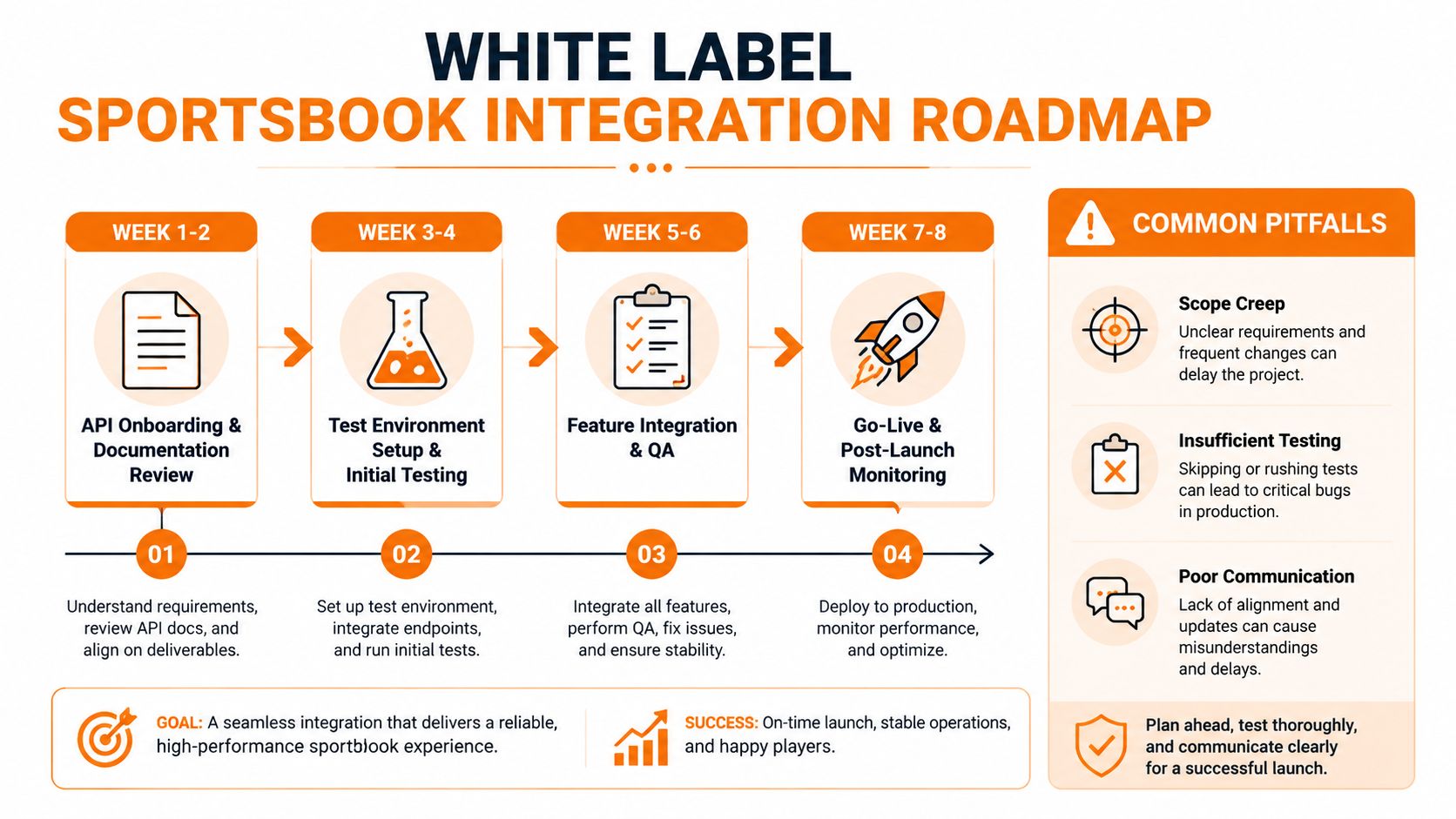
A practical rollout sequence
A realistic plan starts by separating technical connection from operational readiness. A good deployment benchmark can help teams understand what a controlled rollout usually looks like, but the real test is whether each party knows its role before launch pressure arrives.
A workable sequence usually looks like this:
- API onboarding and documentation review, where both sides confirm data fields, event triggers, and account logic.
- Test environment setup and initial testing, where wallets, odds feeds, and settlement flows are checked with dummy records.
- Feature integration and QA, where the operator verifies promotions, risk rules, and reporting outputs.
- Go-live and post-launch monitoring, where the team watches for failed transactions, odds mismatches, or delayed settlements.
Each stage serves a different purpose. API onboarding answers whether the systems can talk to each other, testing shows whether the messages are understood correctly, QA checks whether the business rules behave as expected, and post-launch monitoring confirms whether live traffic creates new edge cases. Operators that skip one of these layers often discover the problem only after customers do.
The mistakes that delay launch
Three issues repeat across integrations. Scope creep is the first, because teams keep adding features after the schedule is already fixed. Insufficient testing is the second, especially when payment flows or market-specific rules are checked too late. Poor communication is the third, because no one wants to own the issue once it becomes a production incident.
The operational risk is bigger than it first appears. A payment rail failure at launch does more than create inconvenience, it can interrupt deposits, slow customer trust, and force manual reconciliation. A latency issue in live betting can create stale pricing and customer disputes before support teams have time to react. Those are the hidden costs competitors often gloss over, even though they are usually what make a rollout feel fragile.
How to reduce the risk
Keep sign-off separate for payments, trading, and compliance. Use a checklist for each environment. Treat launch day as a handover, not the start of testing.
Operators comparing vendors and rollout approaches can also use this sportsbook solution comparison resource to frame the trade-offs before contracts are signed.
A well-run integration is boring in the best way. The strongest operators are usually the ones that clear the small operational problems before the brand goes public.
Selection Checklist and Pricing Models
Choosing a vendor is less about comparing brochures and more about stress-testing dependency. Two platforms can look similar in a sales call and behave very differently when the first payment issue, jurisdiction update, or custom request lands. That's why the selection process should start with what the vendor controls, what you control, and what becomes hard to replace later.
One overlooked issue is operational resilience. Operators often miss the risks around PSP concentration, data portability, and compliance update constraints, even though those issues can drive switching costs and continuity problems later (vendor risk guidance). If the platform is strong but the payment stack is narrow, the whole setup becomes more fragile than it looked in procurement.
What to check before you sign
Use a checklist addressing the parts most likely to create lock-in:
- Sports and league coverage, because a launch-ready book should match your audience, not just the demo.
- Odds latency and trading controls, because live betting quality depends on how fast and how consistently the feed behaves.
- Wallet flexibility, especially if you need multiple currencies or crypto support.
- Compliance scope, so you know whether the vendor or your team owns updates, reporting, and jurisdiction-specific rules.
- Data ownership and exit rights, because migration is expensive when data export is weak.
- Support response terms, because launch problems rarely happen during business hours.
Pricing models and hidden cost traps
Commercially, white-label deals often use a mix of setup fees, recurring license fees, revenue share, or hybrid pricing. The cheapest-looking quote is not always the lowest-cost path, because the full cost can appear in PSP integrations, custom feature requests, or compliance changes that sit outside the base package.
That's where negotiation matters. Ask which payment methods are native, which require development, and which are “available on request.” Ask how many changes are included in the standard release cycle. And ask what happens if your target market changes and the current payment or compliance setup can't keep up.
For teams comparing providers against each other, a structured view like the platform comparison page can help organize the decision around control, support, and long-term flexibility rather than just first-year price.
A low-friction contract is useful, but only if it still leaves room to grow without starting over.
The best vendor relationship is one where you can scale without discovering that every meaningful change is a custom project.
Key Takeaways and FAQs
A white label sportsbook solution makes the most sense when launch speed, compliance handling, and day-to-day consistency matter more than building every layer from scratch. Its primary value comes from three checks done early, the module set, the compliance split, and the vendor's dependency footprint. Handle those carefully, and the platform supports your operation. Ignore them, and it can turn into a constraint that is hard to unwind later.
A common mistake is treating the vendor as a simple software supplier. In practice, the sportsbook behaves more like a shared machine, your team may control the brand and commercial choices, while the provider controls parts of the engine, release timing, and support path. That matters because small gaps in ownership can become large operational risks once real traffic, regulatory reviews, and payment exceptions start to pile up.
How long does integration typically take?
Industry guidance shows that controlled launches can happen in under eight weeks when the scope is kept tight and rollout planning is disciplined (deployment benchmark).
What customization is usually possible?
Most changes sit in the front end, branding, promotions, and market setup. Core logic usually stays inside the vendor's release cycle, so changes there tend to move more slowly.
Who handles compliance updates?
The vendor may provide the tools, but the operator still carries jurisdictional responsibility, policy decisions, and the final regulatory obligation. That split needs to be clear before launch, because confusion here can delay approvals and create reporting gaps.
What if we outgrow the platform?
Then data portability, exit terms, and migration support become the pressure points. If those points were not agreed early, moving to a new stack can cost far more time and money than expanding the original setup.
If you are reviewing a new launch or rethinking an existing sportsbook stack, talk to NexGrate about how a unified white-label approach can help you launch faster while still keeping compliance, control, and long-term operational resilience in view.