
Margin settings are the configurable levers that determine an operator's hold across sportsbook markets and casino products. In a standard two-way sportsbook market, -110/-110 produces about a 4.76% built-in hold, while -105/-105 lowers it to about 2.38%.
The counterintuitive part is that the highest margin isn't always the most profitable choice. A wider price can improve theoretical edge on an individual market, yet reduce competitiveness, betting activity, or player trust. At the largest operators, parlays reportedly generated 70% to 80% of gross gaming revenue in 2025, even while overall US sportsbook hold was reported around 6.2% to 8.5% of handle, according to analysis of sportsbook margin and promotional engineering. The operational question isn't just how much margin to add. It's where to add it, who should see it, how quickly the trading team can change it, and whether the compliance team can explain every decision afterward.
Table of Contents
- Understanding Margin Settings in iGaming
- The Mathematics Behind Sportsbook Margins
- Casino Margins and Unified Platform Strategy
- Configuring Margin Settings in NexGrate
- Market-by-Market Calibration Strategies
- The Case for Tiered Margin Structures
- Compliance and Regulatory Considerations
- Admin Best Practices for Margin Management
Understanding Margin Settings in iGaming
Margin settings are operating controls, not static percentages. They define the overround or hold built into sportsbook odds and the expected return created by casino rules and payouts. In both cases, the configuration affects what players see, how the operator prices risk, and how reliably the business can forecast revenue.
A sportsbook margin is applied within individual markets, while a casino margin is reflected in the relationship between rules, payouts, and expected returns. The commercial objective is to protect revenue without making prices visibly uncompetitive. An aggressive setting on a high-profile event can push informed bettors elsewhere. A uniformly cautious setting can leave revenue on the table and fail to reflect different levels of liquidity, competition, or exposure.
The back-office determines whether those trade-offs remain manageable. A unified platform should let authorised teams set market or product rules, apply exceptions, record changes, and review the resulting exposure without relying on disconnected spreadsheets. That operational history also gives compliance staff a basis for explaining why a setting changed, who approved it, and whether the same policy was applied consistently within a jurisdiction.
A configured theoretical margin and the book's realized hold are different measures. The first is the expected edge embedded in prices or game rules. The second reflects actual outcomes, bet mix, limits, voids, promotions, settlement corrections, and customer behaviour. A target setting cannot guarantee income, particularly when liabilities concentrate or player activity shifts.
Why the setting matters operationally
A margin change can affect several teams at once:
- Trading needs room to respond to liquidity, injuries, line movement, and feed quality.
- Commercial teams need competitive prices for acquisition activity and priority events.
- Risk managers need controls for correlated exposure, sharp action, and unusual betting patterns.
- Compliance teams need an audit trail showing that pricing controls operate within each jurisdiction.
That makes margin configuration part of understanding what a sportsbook is, rather than an isolated odds setting. The practical goal is a controlled policy that teams can adjust within clear permissions, with exceptions assigned to an owner and reviewed against commercial, risk, and compliance outcomes.
Practical rule: Treat margin as a controlled operating policy, not a permanent number. Every exception needs an owner, a reason, and a review path.
The Mathematics Behind Sportsbook Margins
Sportsbook pricing begins with implied probability. American odds of -110 imply a probability of 52.38% for each side. Add both sides together and the total reaches 104.76%, leaving an overround of about 4.76% for the book.

The calculation is simple, but operators often misread what it means. The overround is the sum of the implied probabilities above a fair 100% market. It expresses the embedded pricing buffer before the operator accounts for the uncertainty of actual outcomes. A balanced market can still produce a poor realized result if liabilities cluster on one side or if the event settles unexpectedly.
Comparing two price configurations
The difference between -110/-110 and -105/-105 illustrates why small odds changes deserve operational attention. At -110/-110, each side implies 52.38%, and the market total implies 104.76%. At -105/-105, the hold falls to about 2.38%, as documented in this explanation of sportsbook hold.
That adjustment may support a more competitive position on a liquid event, but it also reduces the theoretical buffer. The decision depends on the operator's objective. A flagship market may justify tighter pricing to attract volume and demonstrate price quality, while a less transparent market may support a wider buffer if liquidity and competition are weaker.
The bettor-side theoretical hold can also differ slightly from the book-side overround. For -110/-110, one operator-economics analysis identifies a book-side overround of about 4.76% and a bettor-side theoretical hold of about 4.55%, as shown in this discussion of in-play betting margins. That distinction matters when teams compare a pricing rule with financial reporting. They must define the denominator and the calculation method before deciding whether performance is on target.
A useful implementation workflow is:
- Define the implied probability for every outcome.
- Sum the probabilities to calculate overround.
- Compare the result with the intended market tier.
- Monitor realized hold separately after settlement.
- Review the gap before changing the underlying price rule.
Casino Margins and Unified Platform Strategy
Casino margin management follows the same commercial principle as sportsbook pricing, but the mechanics differ. A sportsbook embeds overround in odds that respond to an event and its liabilities. A casino game generally derives its expected edge from rules, payout tables, reel configurations, game speed, and the distribution of outcomes.
Slots, table games, and live dealer products therefore shouldn't inherit one generic sportsbook margin rule. A slot portfolio may be managed through content selection, payout characteristics, bonuses, and player segmentation. Table games require attention to rules and limits. Live dealer products add operational factors such as studio capacity, session availability, and the way promotions interact with game economics.
One wallet, different controls
Separate platforms make these distinctions harder to manage. Trading staff may adjust sports prices in one interface, casino teams may configure promotional mechanics elsewhere, and finance may reconcile the results in a third system. That fragmentation creates avoidable questions:
- Which margin rule was active when the customer placed the bet?
- Did a bonus change the effective economics of the transaction?
- Can finance reconcile sportsbook and casino outcomes against the same player wallet?
- Can compliance retrieve a complete record for the relevant market and jurisdiction?
A unified back-office gives teams a shared control environment without pretending that every product has identical economics. The sports module can retain market-level odds rules, while casino administration can preserve game and promotion controls. A common player account, wallet, permissions model, and reporting layer then give operations a consistent view of how those decisions affect the wider customer relationship.

The best architecture doesn't flatten the differences between verticals. It makes those differences visible and governable. A sportsbook manager should be able to adjust a market rule without changing casino mathematics, while senior administrators should be able to see both effects in a consolidated operational report.
Configuring Margin Settings in NexGrate
Margin configuration works best as a controlled workflow inside the back office. The operator should start with the market or product taxonomy, then assign a default rule, define approved exceptions, and record who can activate each change. A global setting may be useful as a baseline, but it shouldn't replace market-specific controls.
A practical configuration sequence
Start with permissions. Give traders access to the adjustments required for their role, but reserve structural changes, player-level rules, and jurisdictional overrides for appropriately authorized administrators. A person who can change an event price doesn't necessarily need permission to alter the default margin for an entire sport.
Create the baseline. Set a default margin policy for each major product family. Keep the rule understandable. If the team can't explain what the default does, it won't recognize when an override behaves unexpectedly.
Add controlled overrides. Use market, competition, bet-type, and jurisdiction fields to make exceptions explicit. An override should include a reason, an effective period, an approver where required, and a rollback path. Avoid hidden manual edits that exist only in a trader's memory.
Test before publication. Preview the resulting prices and implied probabilities in a non-production environment where possible. Check that the rule applies correctly to pre-match and in-play markets, multiple outcomes, void scenarios, and different customer channels.
Monitor after release. Review price changes, acceptance rates, liability, realized hold, and customer-impact signals. A configuration that works for a major event may be unsuitable when liquidity changes or a feed becomes unreliable.
Keep compliance inside the workflow
A unified interface should connect margin controls with audit logs, responsible gaming rules, geofencing, KYC status, and risk alerts. That doesn't mean a compliance tool should decide every price. It means the platform should prevent an operator from making a commercially sensible change that violates a jurisdictional or player-protection control.
The operational advantage comes from traceability. Teams can respond quickly while preserving a record of the old setting, the new setting, the responsible user, and the reason for the change.
Market-by-Market Calibration Strategies
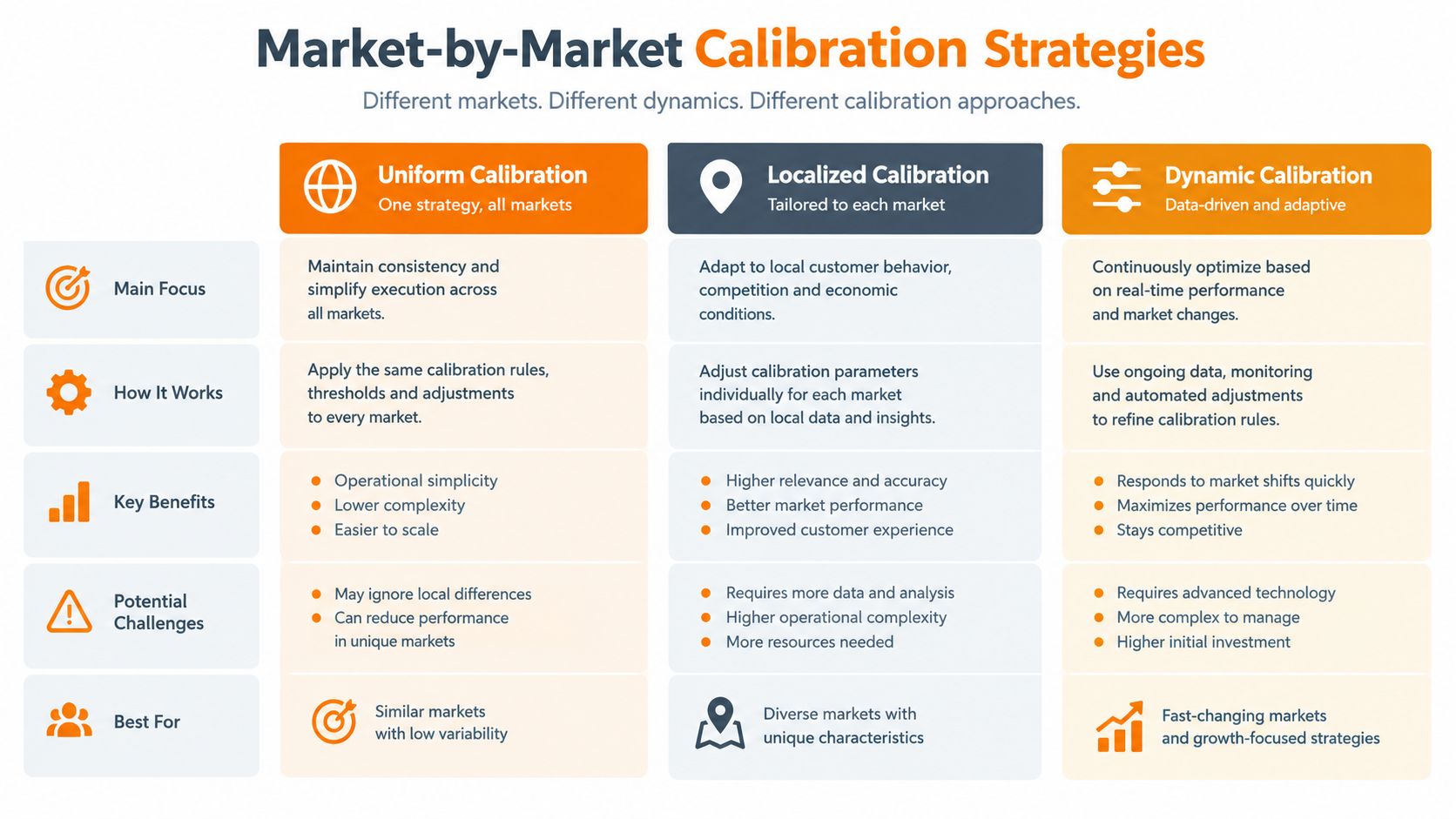
A single global margin is easy to administer and difficult to defend. Markets differ in liquidity, competition, price sensitivity, information quality, and the likelihood that customers can compare the offer elsewhere. Those differences make calibration more useful than uniformity.
For highly liquid major football markets, one industry glossary describes total implied probability commonly sitting around 102% to 104%. Less efficient or lower-liquidity markets may run at 107% to 110% or higher, allowing the operator to protect itself where customers have less pricing information and fewer direct comparisons, as described in this overview of sportsbook margin settings.
A decision framework for operators
Use four questions before assigning a tier:
| Question | Operational implication |
|---|---|
| How liquid is the market? | Deep liquidity usually supports sharper pricing and more reliable risk transfer. |
| How visible is the price? | Widely compared markets need stronger competitiveness. |
| How predictable is the bet mix? | Concentrated or correlated action may require more risk protection. |
| How costly is an error? | Thin markets and fragile feeds need tighter controls and clearer limits. |
This framework supports different treatment for major match winners, niche competitions, player props, futures, and in-play selections. It also gives the trading team a reasoned basis for an override instead of relying on intuition alone.
A lower margin is a commercial investment only when the operator knows what it expects in return, such as stronger volume, better market relevance, or improved customer value.
What doesn't work is applying the widest setting to every low-volume market because it feels safer. That can make the offer look poor, encourage customers to shop around, and conceal whether the underlying problem is pricing, limits, feed quality, or insufficient liquidity. Calibration should protect the book where protection is needed and preserve competitiveness where price comparison is intense.
The Case for Tiered Margin Structures
A single margin setting is a blunt operational tool. It can protect revenue in one product while making another uncompetitive, increasing customer complaints, or hiding exposure that limits and monitoring should address. Tiered structures let operators connect pricing to the product, customer journey, and risk controls configured in the unified back-office.
Lower margins do not automatically produce more valuable customers. Price-sensitive bettors may compare every selection, while others value convenience, entertainment, live betting, or complex formats. The profitable approach depends on how margin affects conversion, retention, exposure, and support workload.
Available 2025 industry data illustrates the difference. US sportsbook hold was reported around 6.2% to 8.5% on handle, while parlays reportedly represented 70% to 80% of GGR at the largest operators, as discussed in the sportsbook margin and promotion analysis cited earlier. Those figures do not justify applying the highest margin to every parlay. They show why product-level economics need separate rules, review, and monitoring.
Build tiers around behavior and risk
A practical structure can distinguish:
- Straight wagers, where competitive prices are easy for customers to compare.
- Player props and futures, where information depth, liquidity, and market efficiency can differ from major match markets.
- Parlays, where combined selections create a different pricing and correlation profile.
- Promotional bets, where the effective margin depends on the bonus mechanic, eligibility rule, and redemption behavior.
Each tier can carry its own margin range, limits, monitoring intensity, and promotion policy. The back-office should record who approved the configuration, which jurisdiction it applies to, and what risk condition would trigger a review. A wider price combined with restrictive limits can frustrate customers. A clearly defined tier with consistent terms gives trading, compliance, and support teams an explanation they can use.
Avoid hidden discrimination
Bet-type segmentation is easier to defend than changing prices based on opaque assumptions about an individual player. Customer-level rules need a legitimate risk, compliance, or commercial rationale, documented approval, and periodic review. They should not penalize customers for winning or create inconsistent experiences that support staff cannot explain.
The strongest tiered structures are visible in the product. Customers receive clear prices, limits, and promotional terms. Internally, operators can identify sustainable activity, disproportionate exposure, and cases where a product or limit change is more appropriate than another margin increase.
Compliance and Regulatory Considerations
Margin settings operate inside a regulatory environment, not above it. A price that is commercially attractive in one jurisdiction may require a different treatment elsewhere because rules, taxes, disclosure expectations, affordability checks, and responsible gaming obligations can change the operator's practical options.
A 2026 Congressional Research Service summary identifies sports betting as legal in 39 states plus Washington, D.C., while industry commentary continues to describe uncertainty around federal proposals, as reported in this review of betting margin conditions. The operational lesson is straightforward. Don't build one margin policy and assume it can be copied unchanged across every regulated market.
Make each rule explainable
Compliance and operations teams should maintain a jurisdictional register covering:
- Permitted products and market types.
- Applicable disclosure and responsible gaming requirements.
- Affordability or player-protection controls that can affect availability.
- Tax and reporting considerations that change the commercial outcome.
- Authorized users and approval requirements for pricing changes.
- Retention rules for configuration and decision records.
The compliance reporting framework should connect to the same operational evidence. Auditors may need more than the final price. They may need to know which rule produced it, when it changed, who approved the change, which jurisdiction applied, and whether the customer-facing display matched the recorded configuration.
Separate commercial urgency from regulatory shortcuts
Live trading creates pressure. A feed moves, a market opens, or an exposure alert fires, and the team wants immediate control. Build that speed into approved workflows rather than allowing emergency access to bypass oversight. Emergency changes should be time-bound, logged automatically, and reviewed after the event.
Affordability checks and responsible gaming controls also need priority over margin goals. If a player should be restricted, a more favorable price doesn't resolve the underlying obligation. The platform should apply the player-protection decision first and preserve enough information for the responsible gaming team to assess what happened.
Admin Best Practices for Margin Management
Good administration turns margin settings from a collection of numbers into a repeatable control system. The essential components are permission discipline, versioned configuration, reliable monitoring, and a review routine that includes trading, risk, finance, commercial, and compliance stakeholders.
Set a hierarchy that reflects operational reality. Traders can manage approved event-level adjustments. Senior trading or risk leaders can authorize broader market changes. Compliance administrators can control jurisdictional constraints. No single role should own every part of the pricing chain.
Build a working control loop
Use a simple cycle:
- Define: Document the purpose and intended scope of each margin tier.
- Deploy: Publish through a controlled workflow with the correct permissions.
- Observe: Compare configured expectations with realized outcomes, exposure, customer activity, and settlement behavior.
- Review: Investigate material deviations and decide whether the rule, limit, feed, or promotion caused them.
- Retire: Remove obsolete overrides so temporary decisions don't become permanent policy.
Keep an audit trail that captures the previous value, replacement value, timestamp, user, approval, reason, affected product, and jurisdiction. Train staff to interpret overround, realized hold, liability, and promotional cost as separate measures. Confusing those terms leads teams to fix the wrong problem.
A daily dashboard should show exceptions rather than overwhelm users with every unchanged market. Flag unusual margin changes, unresolved overrides, exposure concentrations, settlement discrepancies, and differences between customer-facing prices and back-office records. Pair that dashboard with the principles in this guide to sportsbook risk management, using risk signals to inform pricing decisions rather than treating margin as a substitute for risk controls.
The immediate checklist is practical: review permissions, identify undocumented overrides, map each tier to a business reason, confirm jurisdictional rules, test rollback procedures, and schedule cross-functional reviews. That discipline supports faster decisions because staff can act within known boundaries instead of waiting for ad hoc approval.
NexGrate gives operators a unified white-label environment for sportsbook and casino management, including margin configuration, player wallets, payments, compliance controls, and back-office operations. Visit NexGrate to assess how a centralized platform can make pricing decisions more controlled, auditable, and practical across your iGaming operation.