A German player deposits EUR through Sofort while a Canadian player tops up in CAD with Interac. At the same time, a Brazilian user sends USDT over TRC-20. Your cashier needs to quote each player in a familiar currency, authorize the correct payment method, credit the right wallet, settle funds into the operator's treasury, and later return a withdrawal in the player's original currency.
That isn't a theoretical edge case for a white-label casino or sportsbook. It's a normal operating day. The difficulty is keeping those transactions fast for the player while controlling FX exposure, payment costs, compliance obligations, and the reconciliation workload behind every deposit and withdrawal.
The scale makes weak infrastructure expensive. IMF analysis published in 2025 estimated that global cross-border payments approached one quadrillion dollars in 2024, while high-value transactions represented most of the value in financial-institution and customer payment flows. The same analysis notes that settlement speed and cost still vary significantly between corridors, which is why multi currency payment processing has become a core operating capability rather than a cosmetic cashier feature. Read the IMF analysis of cross-border payment value and settlement friction for the broader market context.
Table of Contents
- What Operators Actually Need from Multi Currency Payment Processing
- The Core Concept Behind Multi Currency Payment Processing
- Anatomy of a Multi Currency Payment Stack
- Integrating and Implementing Multi Currency Payment Processing
- Compliance, AML, and Reconciliation Across Currencies
- Where and When to Convert Currency
- Cost, Risk, and Conversion Optimization
What Operators Actually Need from Multi Currency Payment Processing
A Curacao-licensed operator launching a new brand doesn't need a cashier that merely displays a few currency symbols. It needs a payment system that can connect local methods, player wallets, FX rules, merchant accounts, and finance reporting without forcing the operations team to reconcile each rail manually.
The German player expects a EUR deposit and immediate access to gameplay. The Canadian player wants CAD through a method that feels domestic. The Brazilian user may expect a crypto deposit to appear quickly, but the operator still needs to record the transaction, apply risk controls, credit the correct balance, and decide whether treasury should retain the asset or convert it. Those are separate workflows sharing one player account.
The operational requirements
A functioning stack has to deliver several outcomes at once:
- Local payment coverage: The cashier should expose payment methods that make sense for the player's country, currency, device, and risk profile.
- Fast deposit-to-play conversion: Authorization, fraud checks, wallet crediting, and bonus evaluation need to happen in a controlled sequence without unnecessary manual review.
- Predictable withdrawals: The operator should know which currency, rail, account, and approval path will handle a payout before the player submits it.
- Controlled settlement: Treasury needs to choose which funds remain in EUR, CAD, USD, or crypto and which funds convert into a base currency.
- Daily financial closure: Finance needs transaction-level records connecting the player amount, processing currency, FX rate, fees, settlement amount, and ledger entry.
The commercial outcomes follow from that foundation. Local methods can reduce deposit abandonment, clear wallet balances faster, and give the brand a better chance of converting traffic from markets where cards aren't the default. Better routing can reduce avoidable declines, while wallet-level controls help apply bonuses and withdrawal rules in the currency the player uses.
The strategic requirement
An operator entering a new market shouldn't need to rebuild its entire platform. The cashier, wallet, FX engine, and reporting model should accept new currencies and payment providers through configuration and controlled integration.
The operator also needs a policy for volatility. If player liabilities sit in several currencies while treasury expenses sit in another, every delayed conversion can change the value of the balance sheet. Poor timing, forced conversion, and fragmented reporting create margin leakage that may not appear in the payment provider's headline fee.
Practical rule: Treat every currency as an operational balance with an owner, a settlement path, a conversion policy, and a reconciliation rule.
Multi currency payment processing works when these operational, commercial, and strategic needs reinforce one another. If the cashier localizes prices but the wallet only supports one base currency, the player experience and accounting model are misaligned. If the operator supports many methods but lacks payout and reconciliation controls, growth increases the workload faster than it increases usable revenue.
The Core Concept Behind Multi Currency Payment Processing
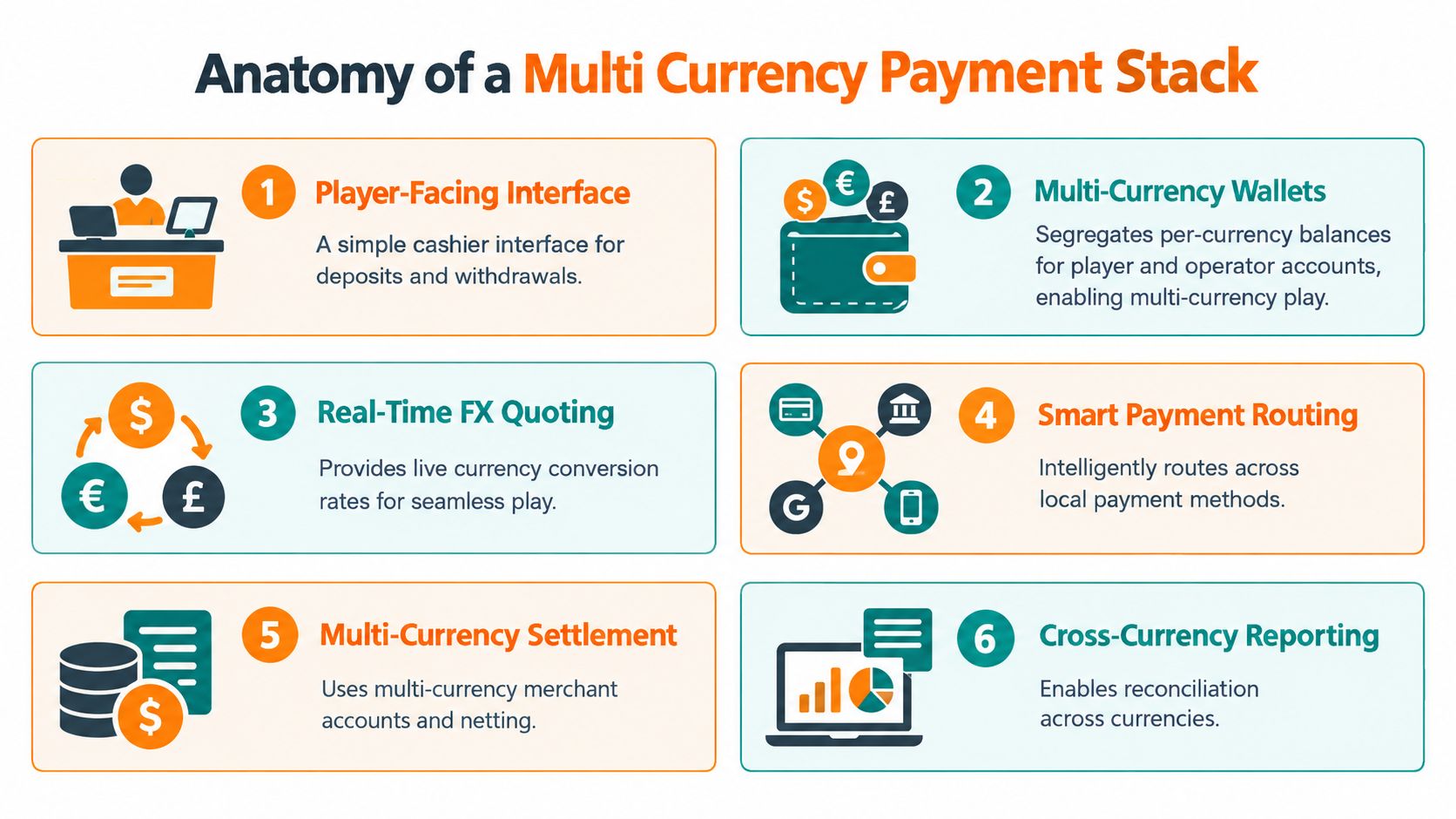
For an iGaming operator, multi currency payment processing is a layered transaction system, not a single gateway. Each layer answers a different question: what does the player see, where is value recorded, when does conversion occur, and which rail moves the money?
The first layer is the cashier. It presents deposits and withdrawals in the player's selected or permitted currency, shows available methods, applies limits, and communicates the expected amount. A player might see a EUR deposit amount, while the operator's internal treasury ultimately holds USD or a crypto asset.
The second layer is the wallet. A proper wallet records balances by currency for both the player and the house. It can preserve a EUR player balance, a USD operator balance, and a crypto balance without treating every movement as an immediate conversion. That separation matters for bonuses, gaming activity, refunds, withdrawals, and audit trails.
The third layer is the FX engine. It chooses the rate, source, timestamp, rounding method, and conversion event. Depending on the design, the rate may come from an interbank source, a PSP quote, or liquidity associated with a crypto rail. The engine should also record the original amount and converted amount instead of overwriting the transaction history.
The fourth layer is routing and authorization. It selects an acquirer, PSP, local alternative payment method, bank rail, or crypto path based on geography, currency, method, risk, cost, and availability.
The payment stack in context
The final layer is the underlying payment rail, which includes card schemes, local APMs, bank transfers, and blockchain networks. Rails determine where the operator can accept funds, how quickly a transaction confirms, what settlement files look like, and which compliance checks apply.
Currency concentration still shapes the architecture. IMF research using SWIFT data found that the U.S. dollar and euro have remained the dominant pair in cross-border transaction usage, with the USD accounting for about 40% of cross-border SWIFT flows at the end of 2021. More recent IMF work found the USD leading in 2024, with USD and EUR together representing over 70% of financial-institution payments and more than 80% of customer payments. The IMF research on currency usage in cross-border payments also identifies a commercially important long tail that includes GBP, JPY, AUD, HKD, and CAD.
Mapping the layers to operator outcomes
Geographic reach comes mainly from the rail and acquiring layers. Payout speed depends on wallet design, provider availability, and settlement schedules. Margin control depends on the FX engine and the decision to hold or convert balances. Player trust depends on clear cashier presentation and predictable payout amounts.
That mapping is the central concept. Operators shouldn't ask only whether a provider supports a currency. They should ask where the currency exists in the stack, who owns the risk, and which business metric improves when that currency is enabled.
The flow becomes easier to understand when the cashier, wallet, and FX engine have completed their work. The rails then move the approved value, while settlement and reporting preserve the evidence needed to operate the brand.
Anatomy of a Multi Currency Payment Stack
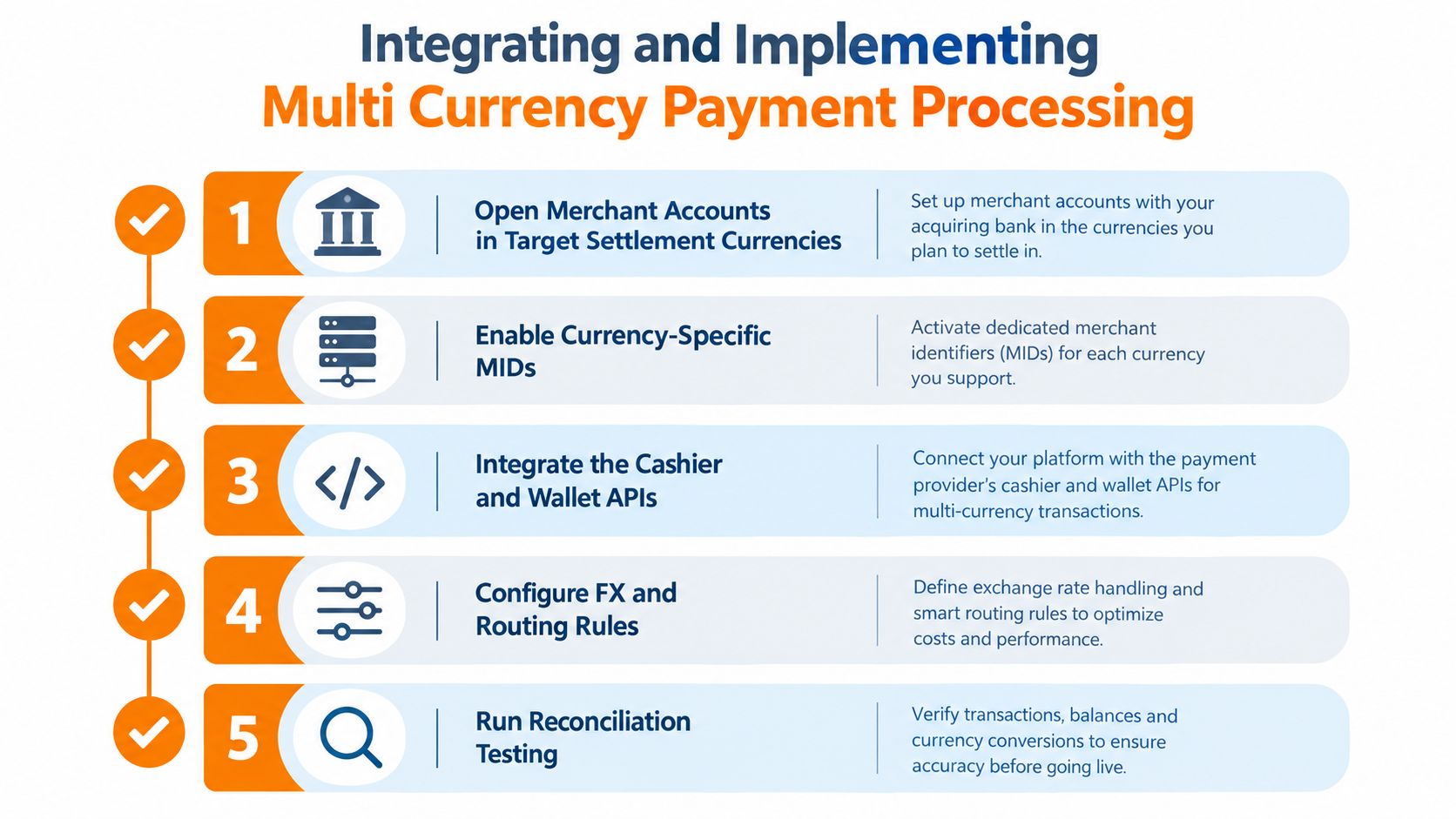
A real cashier flow passes through six functional components. They shouldn't be treated as interchangeable modules because each protects a different commercial outcome.
The six components in a live transaction
Wallets record value by currency. The player wallet receives the authorized amount in the transaction currency, while the operator ledger records the corresponding liability and any conversion. Separate balances support multi-currency play, currency-specific bonuses, refunds, and withdrawal decisions. A wallet that collapses every deposit into a base currency too early creates extra conversions and makes audit trails harder to interpret. A useful reference for the wallet model is this guide to multi-currency wallet architecture.
FX conversion determines when value changes. Conversion can occur at authorization, clearing, or settlement. Each point changes the party carrying exchange-rate risk and determines whether the operator can hold the original currency. The rate, timestamp, spread, and resulting ledger movement should remain visible to finance.
Routing chooses the payment path. A routing engine can prioritize a primary account or PSP, then cascade to a secondary option when the first attempt fails. The decision should use decline reason, geography, method, currency, provider availability, and cost. Sending every transaction to the same endpoint may simplify integration, but it makes the operator vulnerable to local outages and provider-specific decline patterns.
Acquiring provides the merchant relationship. The acquirer holds the relevant merchant account and connects the transaction to the payment network. An operator may need different acquiring arrangements for different currencies or jurisdictions. A PSP can aggregate those relationships, but the operator still needs to understand which entity is acquiring the payment and where the settlement obligation sits.
PSPs coordinate providers and payouts. A PSP can reduce the number of direct integrations and offer access to cards, bank methods, and local APMs. It may also impose its own FX markup, reserve rules, settlement schedule, refund process, and reporting format. The integration is simpler, but the economics and control can become less transparent.
Crypto rails create a parallel money movement path. Stablecoins, blockchain networks, exchange services, and on-ramp or off-ramp providers don't behave like card or bank rails. Confirmation logic, wallet screening, network fees, asset conversion, and transaction monitoring need separate controls. Crypto can broaden coverage, but it also expands the compliance perimeter.
Where each component earns its keep
The cashier earns its keep through clarity and completion. The wallet earns it through accurate balances and product flexibility. FX timing protects treasury margin, while routing protects approval continuity. Acquiring determines local access and transaction economics. PSP selection determines how quickly the operator can add methods, but also how much operational control is delegated.
At scale, settlement design becomes just as important as authorization. CLS says it settles over US$8.0 trillion of payments each day across 18 major currencies, and that its multilateral netting approach reduces funding requirements by over 96%, as described in this overview of multi-currency payment processing and netted settlement. The lesson for an iGaming treasury team is practical: matched currency positions and netted flows can reduce the need to fund every currency leg independently.
A single integration can hide this hierarchy, but it can't remove it. When a provider outage, rate discrepancy, or settlement delay occurs, the operator needs to know which component owns the failure and which fallback can safely take over.
Integrating and Implementing Multi Currency Payment Processing
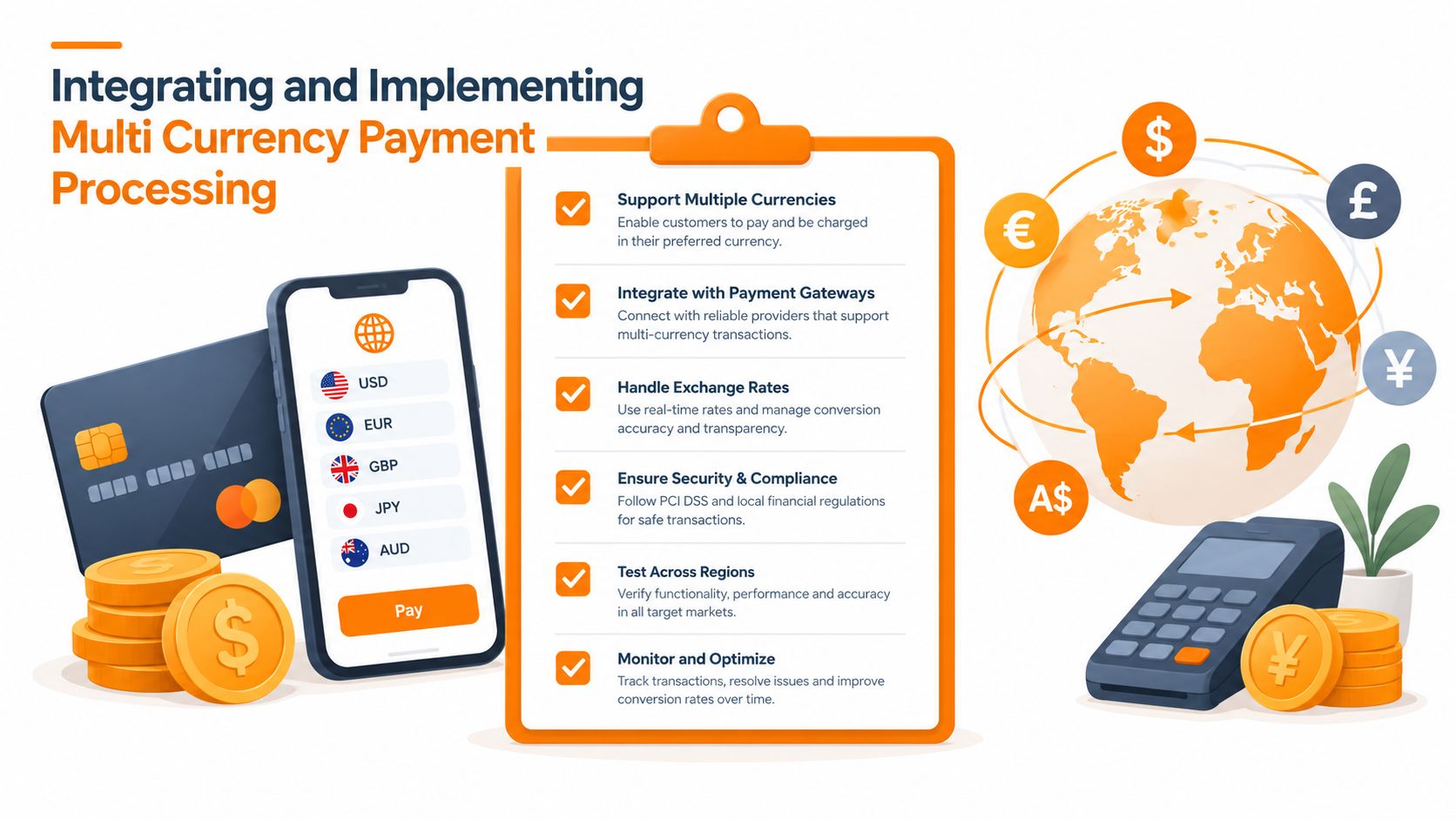
Integration should be treated as a phased build. Switching on a currency in the cashier before the merchant account, wallet, payout, and reporting paths are ready creates a transaction that looks successful to the player but becomes difficult for operations to settle.
Build the settlement foundation first
Start with the currencies the operator needs to hold or pay out. Open the relevant merchant and settlement accounts, document who owns each account, and confirm whether the PSP supports separate currency sub-balances. A provider that accepts a currency but converts it automatically may not satisfy the operator's treasury policy.
Next, enable currency-specific MID pools and connect them to the cashier rules. The system should know which MID, acquirer, or PSP to use for a given currency, country, method, and transaction type. Keep deposits, refunds, chargebacks, and withdrawals in the same design conversation. A deposit path that works while its refund path does not is not production-ready.
Configure routing before traffic arrives
Create cascade rules that try the preferred rail first and move to alternatives when the failure is actionable. A soft decline, provider timeout, insufficient account capacity, and compliance rejection shouldn't all trigger the same fallback. Routing based only on generic failure can send repeat attempts into the same problem or create unnecessary customer friction.
For every currency and method, define:
- Transaction limits: Establish minimum and maximum amounts before launch, then apply them in the player's displayed currency and the operator's accounting currency.
- Jurisdiction gates: Restrict methods and currencies according to the player's location, license, KYC state, and risk profile.
- Payout rules: Confirm available destination currencies, expected processing windows, fees, and what happens when the original deposit rail isn't available.
- Bonus logic: Check eligibility against the wallet currency and preserve the conversion record when a bonus is awarded or released.
Test the operational edge cases
Technical teams should verify webhook delivery, idempotency keys, retry behavior, and reconciliation file formats. Finance should be able to match the provider's settlement record to the player wallet entry without downloading several unrelated exports and joining them by hand.
Testing needs more than a successful card deposit. Run end-to-end scenarios for FX movement between authorization and settlement, partial approvals, duplicate callbacks, refund requests, chargebacks, delayed bank transfers, crypto confirmation delays, provider downtime, and payout rejection. Re-run those tests when a new PSP or currency is added.
Before live volume: Ask the provider to demonstrate the complete lifecycle, from deposit authorization to settlement, refund, chargeback, wallet reversal, and daily reconciliation.
A controlled launch can begin with selected traffic, methods, and currencies. Monitor approval outcomes, conversion discrepancies, payout aging, and reconciliation breaks before expanding the route. The operator's objective isn't to activate every available option. It's to make each enabled option accountable.
Compliance, AML, and Reconciliation Across Currencies
Multi-currency operations multiply the number of records that must agree. A player liability in EUR, a treasury balance in USD, and a USDT deposit aren't different versions of one generic amount. They have different owners, valuation events, settlement paths, and control requirements.
The compliance team needs a clear answer to four questions for every currency and payment method:
- Who holds the funds? Identify the licensed entity, merchant account, wallet, or custodian responsible for the balance.
- Which currency is the liability? Record whether the player is owed EUR, USD, crypto, or a converted amount under the platform's terms.
- Who carries FX risk? Define whether the operator, PSP, acquirer, or player bears movement between deposit, gameplay, and withdrawal.
- Which controls apply? Connect KYC, source-of-funds review, PEP screening, sanctions screening, geofencing, and transaction monitoring to the country, currency, method, and player profile.
Crypto rails add a separate control layer. On-chain screening, wallet risk scoring, travel-rule processes where applicable, asset conversion events, and network confirmation policies need to connect to the same player and ledger records as fiat activity. A generic payment-status flag won't provide enough evidence when compliance asks why a crypto deposit was accepted, converted, or withdrawn.
Reconciliation touchpoints by currency type
| Currency Type | Primary Risk | Required Control | Reporting Frequency |
|---|---|---|---|
| Fiat card currency | Settlement amount differs from the player wallet credit because of timing, fees, or FX | Store authorization, capture, clearing, settlement, fee, and FX records as linked events | Daily |
| Local bank or APM currency | Delayed confirmation or reversal leaves the wallet status out of sync | Match provider references to wallet entries and flag unresolved statuses | Daily, with alerts for aged items |
| Operator base currency | Treasury conversion obscures the original player liability | Preserve the source currency, conversion rate, timestamp, and destination balance | Daily and at month-end |
| Stablecoin or other crypto asset | On-chain transaction, asset valuation, and provider settlement don't align | Record transaction hash, network, screening result, asset rate, fees, and wallet movement | Per transaction and daily |
| Refund or chargeback currency | Reversal reaches a different rail or exchange rate than the original deposit | Link the reversal to the original transaction and document any currency difference | Daily |
Reconciliation should close by currency before it closes at the group level. A dashboard showing one total can hide a shortage in a local balance or an unresolved crypto movement. The operator's compliance and finance teams can use a structured approach to compliance reporting for regulated operations, but the underlying ledger still needs transaction-level completeness.
Break alerts should identify the cause, not just the existence of a mismatch. Useful categories include missing provider events, duplicate webhooks, unexpected FX rates, unallocated fees, wallet reversals, and settlement files that arrived late. This turns reconciliation from a month-end investigation into a daily operating control.
Where and When to Convert Currency
FX timing determines both the operator's exposure and the player's understanding of the transaction. The same deposit can produce different economics depending on whether the conversion happens when the payment is authorized, when the network clears it, or when the provider settles the funds.
Authorization-time conversion gives the player and operator a defined rate early in the flow. It reduces uncertainty between approval and wallet credit, which suits corridors where the operator has limited tolerance for movement. The trade-off is that the provider or operator must protect itself with a spread, and that spread can make the transaction less competitive.
Clearing-time conversion sits between the two extremes. The operator may receive a rate closer to the market environment at the time the payment is processed through the network, but the balance remains exposed between authorization and clearing. The accounting model also needs to explain which rate applies if the payment is delayed or partially captured.
Settlement-time conversion is operationally straightforward. The provider converts when it pays out or when treasury initiates the movement. That can support more deliberate treasury management, but it leaves the operator exposed for longer and may produce a less predictable player-to-ledger relationship.
FX timing decision matrix
| Conversion Stage | Rate Control | Settlement Risk | Treasury Complexity | Best Fit |
|---|---|---|---|---|
| Authorization | Strong control over the quoted transaction rate | Lower exposure after approval | Requires robust quoting and variance rules | Volatile corridors, thin-margin deposits, and transactions where immediate certainty matters |
| Clearing | Moderate control with closer alignment to network processing | Exposure remains until clearing completes | Requires timestamped event handling and exception logic | Operators balancing rate quality with manageable processing risk |
| Settlement | Highest flexibility over when treasury converts | Longest exposure window | Simpler payment integration, heavier treasury oversight | Stable corridors and operators with active liquidity management |
The right choice depends on player segment, transaction profile, currency volatility, and treasury capacity. A high-volume corridor with narrow economics may justify earlier conversion even when the displayed rate is less attractive. A mature market with reliable settlement may allow the operator to retain the currency and convert only when it has a real liability or funding need.
Match conversion to liabilities
The cleanest treasury decision is often not to convert. If the operator expects EUR withdrawals, supplier invoices, or refunds, holding EUR can avoid a needless conversion into USD followed by a later conversion back into EUR. The same principle applies to crypto balances when the operator has a defined crypto payout obligation and an appropriate control framework.
Netting positions can also reduce conversion frequency. Rather than converting every inflow independently, treasury can offset incoming and outgoing currency obligations, then convert the residual position under an approved schedule. That approach requires accurate forecasts and clear limits. It shouldn't become an excuse to leave player liabilities unhedged or unexplained.
Treasury decision: Convert because the business has a funding need, not because an automated workflow makes conversion the default.
Player transparency still matters. The cashier should show the amount the player will deposit or receive, the currency used, and any applicable conversion or processing information. Internal treasury optimization shouldn't create a surprise between the amount shown at withdrawal request and the amount delivered.
Cost, Risk, and Conversion Optimization
The payment fee is only one part of the economics. Operators usually lose margin through a combination of FX markup, cross-border processing cost, and finance labor. Each leak needs its own metric because a single blended payment-cost figure won't show where the problem starts.
Traditional banks can add 2% to 3% in FX markups on cross-border business payments, according to the industry source on multi-currency payouts and FX reconciliation costs. The same source notes that manual cross-border processing can cost €40 to €60 per payment once onboarding, error correction, and reconciliation labor are included. These figures are useful benchmarks for identifying exposure, but an operator should calculate its own realized cost from transaction and settlement records.
Track the following every month:
- Realized FX spread: Compare the operator's applied rate with the approved reference rate at the recorded conversion timestamp.
- Cross-border payment cost: Separate scheme, interchange, acquirer, PSP, local method, and payout charges instead of grouping them into one provider fee.
- Reconciliation effort: Count manual breaks, aged exceptions, duplicated records, and staff time spent resolving them.
- Payout aging: Measure how long approved withdrawals remain unpaid by currency and rail.
- Decline and recovery performance: Compare first-attempt outcomes with successful cascades by provider, country, method, and currency.
Margin leak versus optimization lever
| Margin Leak | Typical Impact | Optimization Lever |
|---|---|---|
| Hidden FX markup in a PSP quote | The operator pays more than the headline processing fee suggests | Store the reference rate and provider rate, then review realized spread by currency and route |
| Unnecessary double conversion | Treasury pays to move funds into a base currency and later back into a liability currency | Hold matched currency balances and convert only when a funding or risk policy requires it |
| Fragmented reconciliation | Finance spends time joining exports and investigating avoidable breaks | Use one event model linking payment, wallet, FX, settlement, refund, and chargeback records |
| Poor payout routing | Delayed or failed withdrawals increase support contacts and weaken player confidence | Route by destination currency, provider availability, compliance status, and payout history |
| Single-provider dependency | An outage or local decline pattern blocks otherwise valid deposits | Maintain controlled fallback routes with reason-based cascading |
| Unclear cashier currency | Players face unexpected conversion prompts or don't understand the payout amount | Display the transaction currency clearly and validate limits in the player's wallet currency |
Local rails can improve the experience where they match player behavior and settlement requirements, but they still need economic testing. The cheapest transaction isn't always the best route if it produces more declines, slower confirmation, or expensive manual handling. Compare net revenue per attempted deposit, not just the fee on a successful transaction.
Payout timing also has a behavioral cost. Instant payouts may require more liquidity, stricter fraud controls, and a provider capable of real-time processing. Batched payouts can simplify treasury and screening, but they may create support pressure and encourage players to abandon the withdrawal process. The right policy varies by risk tier, currency, and payment method.
Conversion optimization starts in the cashier but depends on the whole stack. Show the local deposit currency, remove unnecessary conversion choices, pre-check wallet limits and bonus eligibility, and give routing analytics to the payments team. That team should investigate why a PSP declines a transaction and whether another route can recover it, rather than selecting a provider solely because its listed fee is lower.
Operators should also formalize controls for payment risk management best practices. A white-label platform such as NexGrate can combine casino and sportsbook operations with player wallets, fiat and crypto payment support, and back-office compliance controls, but the operator still needs to define its own currency, treasury, routing, and reconciliation policies.
NexGrate provides a white-label iGaming platform with integrated casino, sportsbook, payments, multi-currency wallet management, crypto deposits and withdrawals, and compliance tooling for operators managing these workflows. Visit NexGrate to review how its platform can support a controlled multi currency payment processing setup for your next brand or migration.