A global dispute volume of 261 million card transactions in 2025, representing approximately $33.8 billion in chargeback value, shows why chargeback management can't remain a back-office task. Mastercard-linked industry reporting projects 324 million cases and about $41.7 billion by 2028, before merchants account for fees, staff time, payment processing overhead, and lost customer value.
For iGaming operators, the operational question isn't whether a player used a stolen card. A dispute may begin with a confusing billing descriptor, a delayed withdrawal, an unclear bonus condition, or a support team that answered after the player had already contacted their bank. Effective chargeback management therefore combines fraud controls, payment operations, customer service, compliance reporting, and evidence discipline.
Table of Contents
- The Scale of the Chargeback Problem in iGaming
- Understanding Chargeback Types and Reason Codes
- Why Most Chargebacks Stem From Operational Friction, Not Fraud
- Building a Prevention Workflow That Actually Works
- The Representment Playbook for Gaming Disputes
- Network Monitoring Programs and Threshold Changes
- Integrating Chargeback Management into Your Platform
The Scale of the Chargeback Problem in iGaming
Global disputes are projected to rise from 261 million transactions in 2025 to 324 million by 2028, while disputed value increases from $33.8 billion to $41.7 billion. That is roughly 24% growth in volume and 23% growth in value, according to Mastercard-linked 2025 and 2026 chargeback reporting. For iGaming, the operational impact extends beyond the disputed deposit. Recurring billing defects, unclear transaction descriptors, delayed refunds, and slow support responses can turn ordinary player friction into a bank dispute.
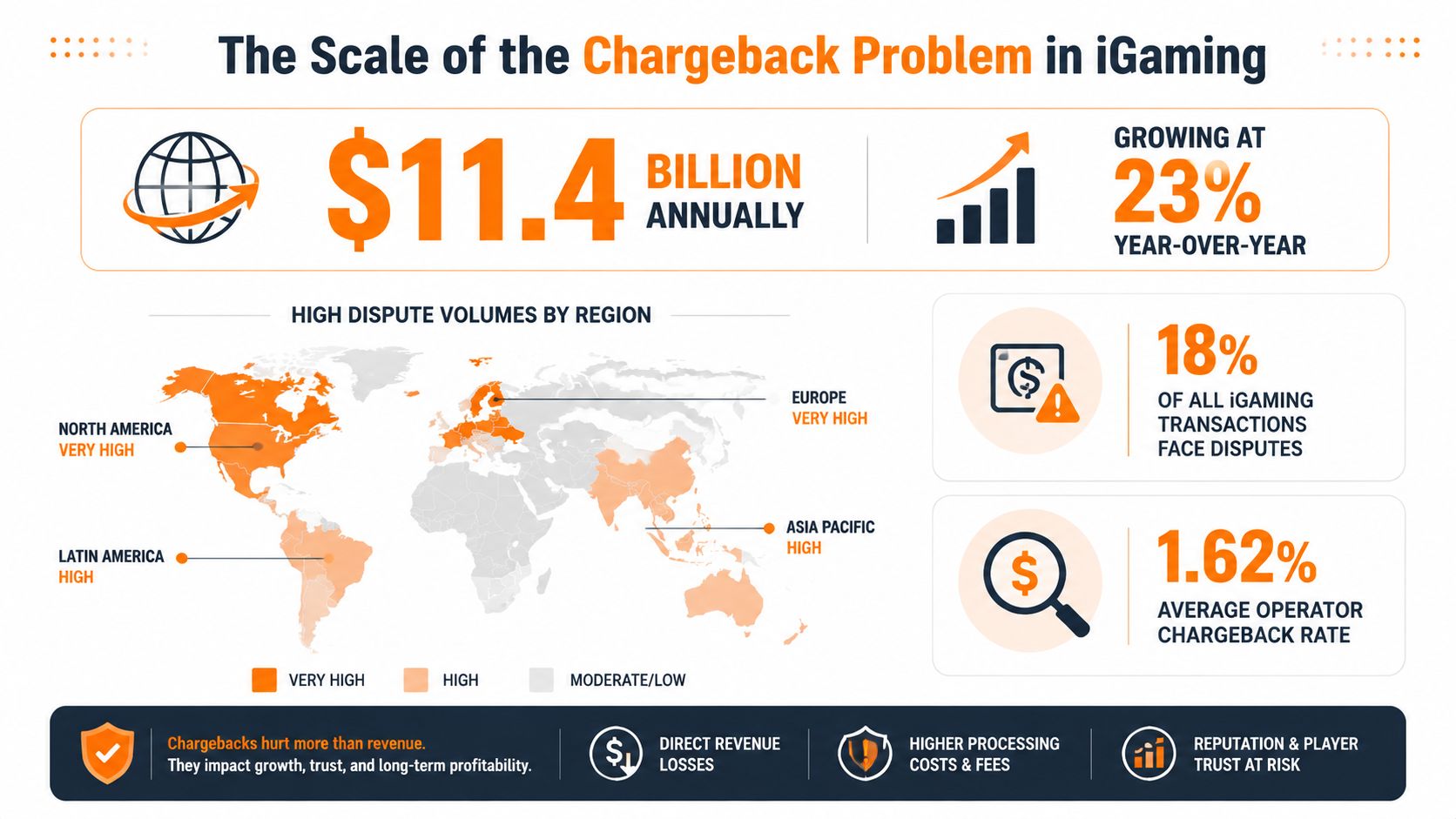
The disputed principal is only the visible loss. The operator may also pay a chargeback fee, fund internal review, handle processor administration, prepare evidence, and investigate the player account. A refund path that is difficult to find or slow to complete can create another dispute before the original issue is resolved. Billing and support workflows therefore deserve the same attention as fraud controls.
Why iGaming carries unusual exposure
Casino and sportsbook payments combine high transaction velocity, digital fulfillment, recurring player activity, and complex account rules. A physical retailer can provide a signed delivery record. An iGaming operator must show that the correct account made the deposit, that the payment was authorized, that the player accessed the service, and that the relevant wagering or withdrawal terms were presented clearly.
Digital fulfillment creates evidentiary ambiguity. A player can deposit, play, lose, request a withdrawal, and later dispute the deposit. The dispute may concern the payment rather than the gaming outcome, yet a weak response may include only a payment receipt. Stronger case files connect the payment to account access, gameplay, communications, withdrawal status, and the terms shown at the time.
Operational rule: Treat every disputed transaction as a cross-functional incident. Payments data alone rarely tells the complete story.
The recovery economics make passive handling expensive. U.S. merchants have been estimated to lose about $4.61 for every $1 of fraud loss after fees, goods, and labor are included, according to industry chargeback statistics compiled by Redo. In high-risk gaming, digital goods do not remove those costs. Support labor, investigation time, processor charges, and account exposure still consume margin.
A chargeback management program should answer four questions for every dispute: What caused it? Can the process prevent a repeat? Is the evidence sufficient to contest it? Does the pattern threaten a network threshold? Operators that answer only the third question recover individual transactions while leaving the billing, refund, and support defects that generate future disputes in place.
Understanding Chargeback Types and Reason Codes
A reason code describes how the cardholder or issuer framed a dispute. It does not identify the operational cause by itself. Triage should first classify the event as true fraud, friendly fraud, or merchant error, then compare that finding with the network's stated reason.
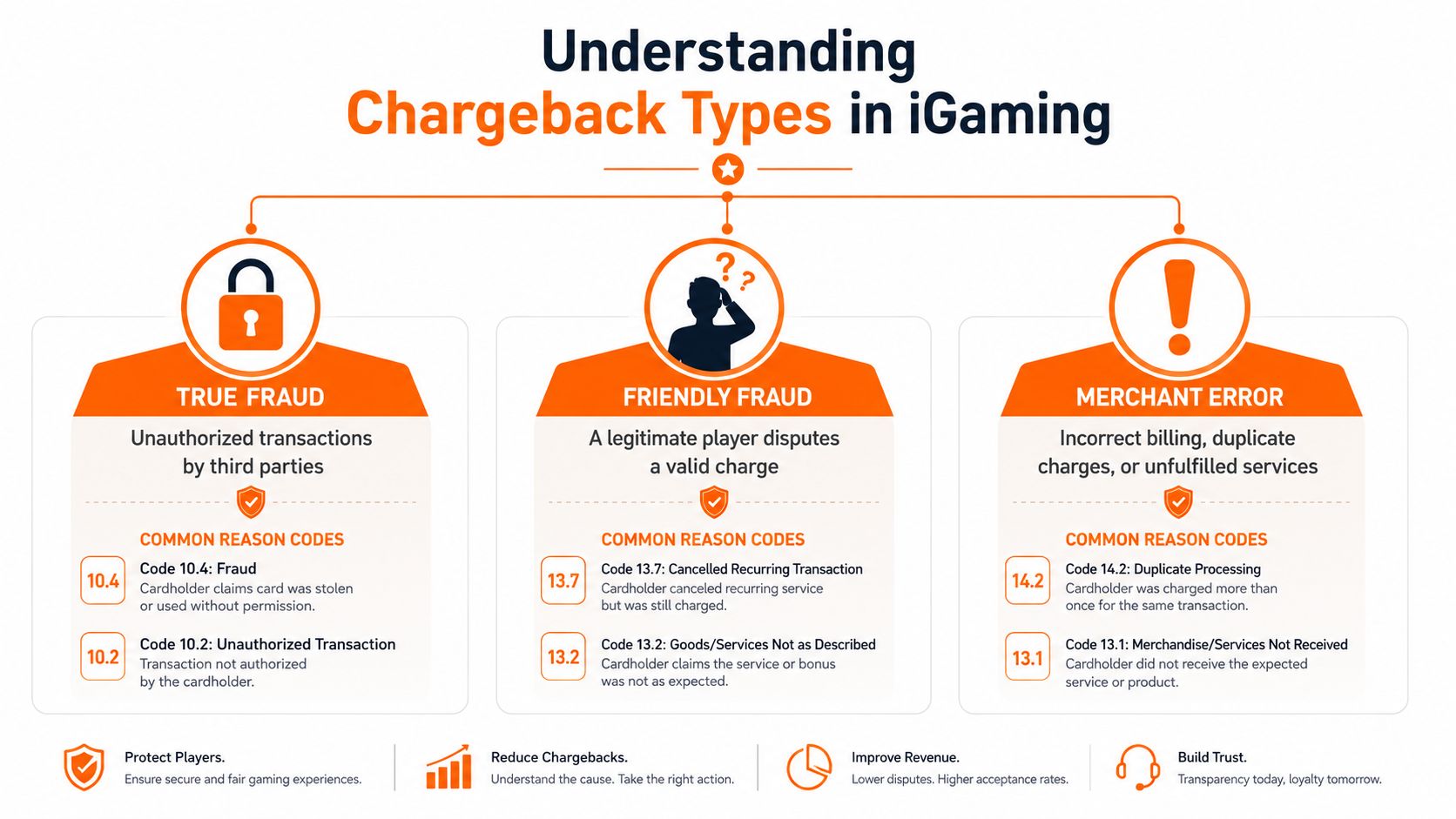
True fraud
True fraud means someone used payment credentials without the cardholder's authorization. In iGaming, patterns include a stolen card funding an account, an account takeover followed by a deposit, or payment credentials used with bonus abuse. Review the player profile for mismatches across identity data, device history, location, and payment behavior.
A fraud reason such as Code 10.4, Fraud requires evidence beyond an internal statement that the account passed screening. Pull the authorization result, AVS and CVV outcomes, device data, account access history, and identity or payment-method verification records. If those records do not establish authorization, accepting the dispute may make better commercial sense than sending a weak representment package.
Friendly fraud
Friendly fraud involves a legitimate cardholder disputing a valid transaction. The player may fail to recognize the billing descriptor, forget a deposit, misunderstand the relationship between the gaming brand and payment entity, or use the dispute process after receiving the service. Industry estimates vary by method, but recent reporting places friendly fraud at a substantial share of disputes. Some merchant surveys found it represented 50% or more of their chargebacks, as summarized by Redo's chargeback statistics overview.
Account activity is the working evidence for these cases. Show that the player logged in, deposited, placed bets, accessed casino content, or contacted support. Match each record to the specific claim and transaction. Irrelevant screenshots add volume without answering the issuer's question.
Merchant error
Merchant error covers operator-controlled failures, including duplicate billing, an incorrect amount, a refund that was mishandled, or a service problem. A recurring-payment complaint such as Code 13.7, Cancelled Recurring Transaction requires a review of cancellation timing, billing authorization, and refund handling.
The right outcome may be acceptance, remediation, or representment. If the ledger confirms the charge is invalid, contesting it wastes labor and can conceal a billing or support defect. A useful classification queue records the reason code, root cause, available evidence, player value, and whether the same defect could affect other accounts. That record turns dispute handling into a feedback loop for billing, support, and refund operations, rather than a narrow fraud review.
Why Most Chargebacks Stem From Operational Friction, Not Fraud
Fraud controls matter, but they cannot resolve disputes created by a broken customer journey. Mastercard's 2025 outlook reports that merchants identify 45% of their chargebacks as fraudulent, while refunds, merchant errors, and service failures remain significant sources of disputes. Mastercard's 2025 global chargebacks outlook shows why operator labels do not always reveal where a dispute began.
In casino operations, the first defect may be a billing descriptor that bears little resemblance to the brand a player knows. Another may be a support queue that gives no clear explanation of when a refund or withdrawal will be reviewed. Once an unfamiliar statement entry appears, or a support request goes unanswered, contacting the issuer can seem easier than waiting for the operator.
The avoidable defects
Billing confusion is one of the clearest causes to investigate. The descriptor should be recognizable, consistent with the player-facing brand, and aligned with the legal payment entity where applicable. If the player can identify the charge, a preventable “I don't recognize this transaction” dispute is less likely.
Refund friction creates another escalation path. A player questioning a deposit or requesting a refund needs an acknowledgment, a visible case reference, and a realistic status update. Payments teams should not promise an outcome they cannot deliver. Even when review is required, a specific explanation is more useful than silence.
Bonus ambiguity can produce the same result. Display wagering requirements, expiry terms, restricted games, withdrawal conditions, and maximum-conversion rules before the player accepts an offer. Support agents need access to the exact terms active at opt-in. A generic policy page may have changed and will not establish what the player saw.
A chargeback is often the final step in a failed service conversation, not the first sign of fraud.
Measure the journey, not only the dispute
Review the events before each dispute. Did the player contact support? Was a withdrawal pending? Did the cashier show a different merchant name? Did the operator reverse a transaction without explaining why? Sorting cases only by network reason code conceals these operational patterns.
A useful review connects the dispute to the responsible owner. Repeated descriptor complaints belong with billing operations. Refund delays require action from cashier and treasury teams. Disputes connected to bonus terms may require coordination among marketing, responsible gaming, and compliance.
Chargeback findings should return to product, payments, and support workflows. The objective is to correct the defect that triggered the complaint, then confirm that the change reduced repeat cases. Faster representment cannot compensate for unclear billing, delayed answers, or refund paths that leave players with no dependable status. Chargeback management works when the operator fixes the cause rather than becoming faster at defending the symptom.
Building a Prevention Workflow That Actually Works
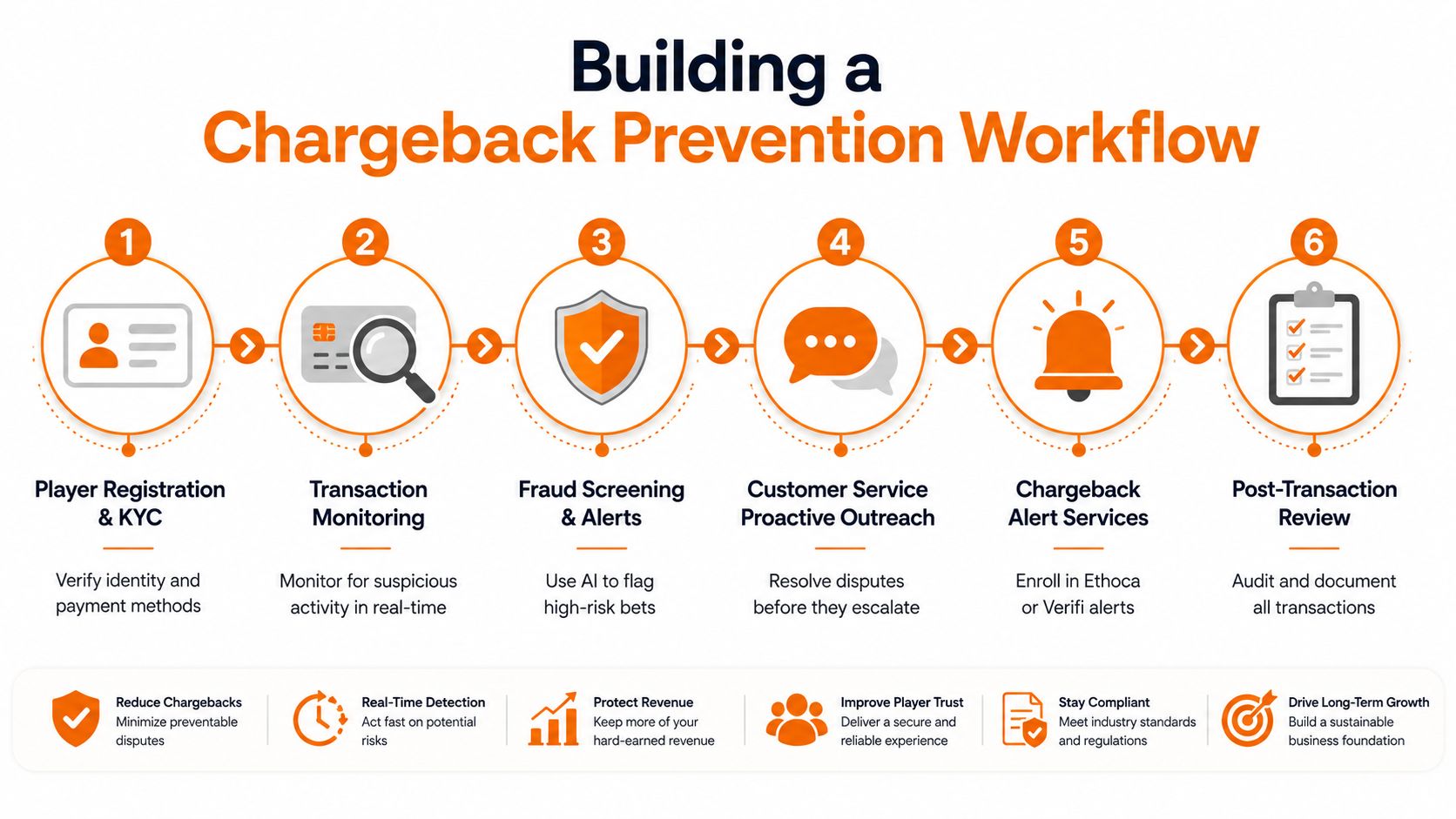
Prevention should follow the player and payment lifecycle. Each checkpoint needs an owner, a decision rule, and a record that can later support investigation or representment.
Start before the first deposit
At registration, connect KYC results, device data, jurisdiction, and payment-method ownership to the player profile. KYC isn't a substitute for transaction screening, but it gives the risk team a baseline for deciding whether a deposit fits the account's expected behavior.
At payment, evaluate velocity, repeated attempts, unusual device changes, mismatched locations, and abrupt shifts in deposit behavior. Use AVS and CVV checks where supported, and apply 3D Secure when the risk policy and customer journey justify the added authentication step. A rule should produce an action, such as approve, challenge, hold for review, or decline. A dashboard that only displays risk scores won't prevent anything by itself.
Make the cashier explain itself
The payment confirmation should identify the amount, date, payment method, brand, and any relevant processing status. The player should understand whether they've made a deposit, requested a withdrawal, or received a refund. Send alerts for significant account events and preserve the message in the player record.
The refund path deserves the same design attention as the deposit path. Give support agents a controlled workflow for confirming eligibility, escalating payment reviews, and communicating status. Risk management best practices for iGaming operators should connect fraud rules with operational ownership, rather than treating them as separate technical projects.
Intercept the dispute before the bank does
Alert services such as Ethoca and Verifi can give operators an opportunity to resolve eligible disputes before they develop into a full chargeback. The operator still needs a sensible response policy. Automatically refunding every alert may create abuse, while ignoring alerts wastes one of the few opportunities to repair the relationship directly.
Use post-transaction review to inspect accepted, declined, refunded, and disputed payments. Look for repeated player identifiers, shared devices, payment-method patterns, support tickets, and bonus activity. The purpose isn't to block every unusual player. It's to distinguish a genuine anomaly from a normal high-value customer and to identify process defects early.
A practical prevention workflow has to work inside a white-label environment. If the cashier, player account, KYC tool, fraud engine, support platform, and payment processor don't share reliable identifiers, staff will spend the response window assembling fragments instead of resolving the cause.
The workflow should be visible to operations teams, not buried in a vendor console. Define who owns each alert, what evidence must be retained, and when a player communication becomes part of the audit record.
The Representment Playbook for Gaming Disputes
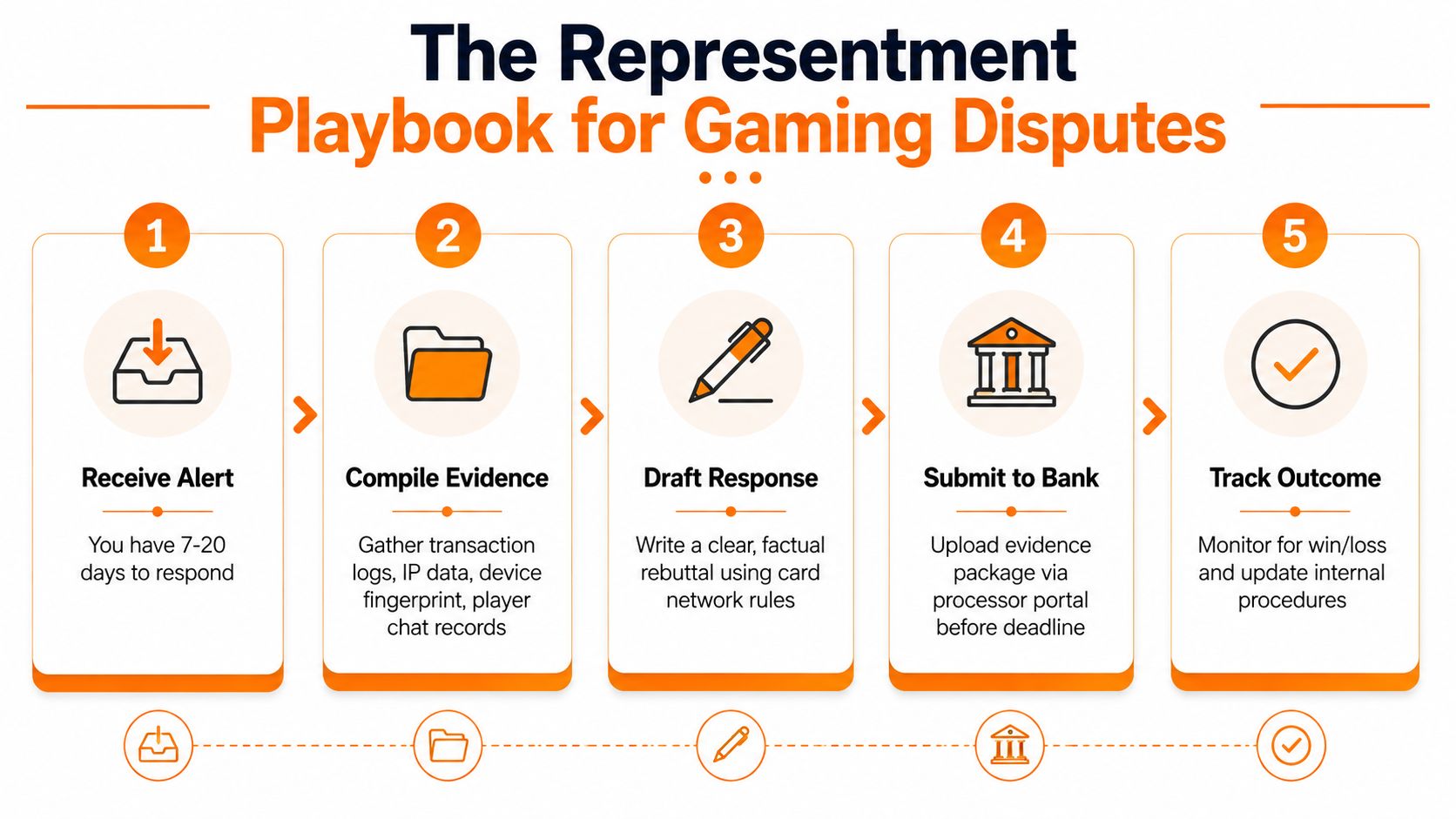
Representment is a documentation exercise, not a chance to write a long defense of the brand. The issuer needs a concise answer to the cardholder's specific allegation, supported by records that relate directly to the disputed transaction.
Triage the deadline first
Merchants commonly have 7 to 30 days to submit a response package, depending on the applicable process, according to representment guidance from Payments Mastery. Some operational alerts provide a shorter working window, so the internal receipt date matters more than a generic calendar assumption.
Assign the dispute immediately. Record the reason code, deadline, transaction identifier, amount, player account, processor, and network. A missed deadline usually converts a contestable case into an automatic loss, regardless of how strong the underlying evidence might have been.
Build evidence around the allegation
For an unauthorized transaction claim, gather the original receipt or authorization code, AVS and CVV results, authentication records, device and IP data, account access history, and payment-method verification. For a service or cancellation claim, add the relevant terms, refund record, support communication, and the timeline of the player's request.
Gaming evidence should show service use without overstating what it proves. Session logs can demonstrate that the account accessed the platform, while wager or bet records can establish activity after the deposit. They don't automatically prove that the cardholder authorized the payment. Pair behavioral evidence with authorization and account-security records.
Write a reason-code response
Structure the package so the reviewer can follow it quickly:
- Identify the transaction and the dispute claim.
- State the operator's position in factual language.
- Map each piece of evidence to the claim.
- Include the policy version active at purchase.
- Show relevant player communication and timestamps.
- Submit through the processor portal before the deadline.
- Track the outcome and record the lesson.
Avoid dumping every available log into the package. Excess material can obscure the decisive evidence. A clear timeline with labeled exhibits is more useful than an export of unrelated account history.
Operators should also connect dispute work to compliance reporting practices, especially where records support both payment review and regulated operational oversight. Accept disputes that are clearly valid, unsupported, or caused by an operator defect. Contest cases where the evidence directly answers the allegation and the expected recovery justifies the staff time and possible escalation cost.
Network Monitoring Programs and Threshold Changes
A merchant can win individual disputes and still create a network-level problem. Card networks examine the relationship between disputes and transactions, so chargeback management must track ratios by network, processor, legal entity, brand, and region. Total monthly volume can hide a dangerous concentration in one acquiring route.
Visa's VAMP program reportedly classifies merchants above a 1.5% chargeback ratio in most regions as “Excessive,” which can lead to acquirer fines, remediation pressure, and account risk, according to Payrails' chargeback management analysis. The threshold is a control limit, not a target. Operators should build an internal warning level below the formal program level so there's time to investigate and correct the trend.
Network Threshold Changes 2025-2026
The following figures are reported in Disputifier's 2025 chargeback management checklist. Treat them as network and processor policy details that require confirmation with your acquirer, because program definitions and applicable regions can differ.
| Network | Current Threshold | April 2025 | January 2026 | Penalty Structure |
|---|---|---|---|---|
| Card network threshold cited in industry coverage | Not specified | 1.5% | 0.9% | Program pressure and possible fees, subject to applicable rules |
| Stripe lost-dispute fee | Not applicable | $30 from June 17, 2025 | $30 | $30 for every lost dispute |
The 0.9% projected threshold by January 2026 makes trend monitoring more important for midsize operators that previously managed risk through manual review. The operator needs to know not only the ratio, but also which root causes are moving it: merchant errors, friendly fraud, unauthorized use, refund handling, or a specific payment method.
Decide whether automation pays
Break-even analysis should include recovered principal, avoided fees, staff hours, alert costs, processor penalties, and the commercial value of keeping the account in good standing. Compare that total benefit with the platform fee, implementation work, and ongoing review required to operate the tool.
Automation isn't automatically valuable because it generates more reports. It pays when it prevents a dispute, gives support a chance to resolve the issue, improves evidence quality, or stops deadlines from expiring. A queue that produces noise without ownership can increase workload while leaving the ratio unchanged.
Integrating Chargeback Management into Your Platform
Chargeback management performs best when the operator can reconstruct a payment from one connected record. The ideal player profile links identity verification, wallet movements, payment authorization, cashier events, bonus acceptance, gameplay or betting activity, support conversations, refunds, and account decisions.
A fragmented stack forces analysts to search across separate dashboards. That creates reconciliation risk. One system may show a deposit as successful, another may show a refund as pending, and a third may hold the only record of the player's support request. Staff then spend valuable response time proving which version is correct.
What the platform should connect
A unified casino and sportsbook backend should expose consistent identifiers for the player, wallet, payment, session, bet, refund, and dispute. It should preserve timestamps and policy versions, not just current account status. The record should also distinguish an authorization attempt from a settled transaction and a requested refund from a completed refund.
A multi-currency wallet adds another layer of operational detail. The ledger must show currency, conversion handling, balance movement, and the relationship between the original deposit and later wallet activity. Operators evaluating wallet architecture can use this multi-currency wallet guide as a reference point, but the practical requirement is straightforward: the dispute team needs an auditable transaction trail.
Evaluate integrations by response quality
Ask payment and platform vendors whether their APIs expose authorization data, AVS and CVV results, 3D Secure outcomes, processor references, refunds, and settlement status. Confirm that webhooks preserve event order and that failed or delayed events appear in an exception queue.
Also check whether the platform supports configurable fraud rules, alert workflows, role-based access, evidence exports, audit logs, and network-level reporting. A built-in rule engine is useful only when risk, payments, support, and compliance teams can see why a transaction was held or released.
The practical test: Give an analyst one disputed payment and ask whether they can produce a complete, reason-code-specific evidence package without opening a chain of unrelated systems.
Centralization won't remove the need for judgment. It gives the operator the context required to make that judgment consistently. For high-risk gaming brands, that means fewer avoidable disputes, faster investigation, more defensible representment, and earlier visibility into network exposure.
NexGrate provides a turnkey white-label iGaming platform that brings casino, sportsbook, wallets, payments, KYC, fraud controls, compliance workflows, and audit records into one operating environment. If fragmented systems are slowing chargeback prevention or representment, visit NexGrate to discuss a platform setup built for practical payments and risk operations.