
Real-time analytics means making data queryable within milliseconds to seconds of an event occurring, and the market around it was forecast at US$43.8 billion in 2026 in one estimate. That growth matters because iGaming operators don't buy speed for its own sake, they buy time to stop fraud, re-price live markets, and act before a player session goes cold.
In practice, real-time analytics is the difference between seeing a loss after the fact and seeing it while the player, wallet, and trading state are still live. For sportsbooks and casino operators, that distinction shapes everything from risk controls to retention logic, because a batch delay can be long enough for the damage to be irreversible.
Table of Contents
- Defining Real Time Analytics for Digital Businesses
- The Three-Layer Real-Time Analytics Pipeline Architecture
- The Latency Spectrum and Freshness Requirements
- Real Time Analytics in Casino and Sportsbook Operations
- Build Versus Buy Decisions for iGaming Platforms
- Implementation Checklist for Operators
- Connecting Analytics to Platform Strategy and Compliance
Defining Real Time Analytics for Digital Businesses
A clearer way to frame it is that real-time analytics is a decision architecture, not faster reporting. It means continuously ingesting, processing, and querying live data streams so teams can act on what is happening now, rather than waiting for the next batch window. For operators who are comparing platform options, the broader category is part of the same operating model covered in our guide to what is iGaming. One market view put the category at US$38.5 billion in 2022 with a 29.7% CAGR, while another forecast projected US$43.8 billion in 2026 and US$223.3 billion by 2033 at a 26.2% CAGR ClickHouse. Those projections matter mainly because they show that real-time analytics has moved into core infrastructure, not a side project for data teams.
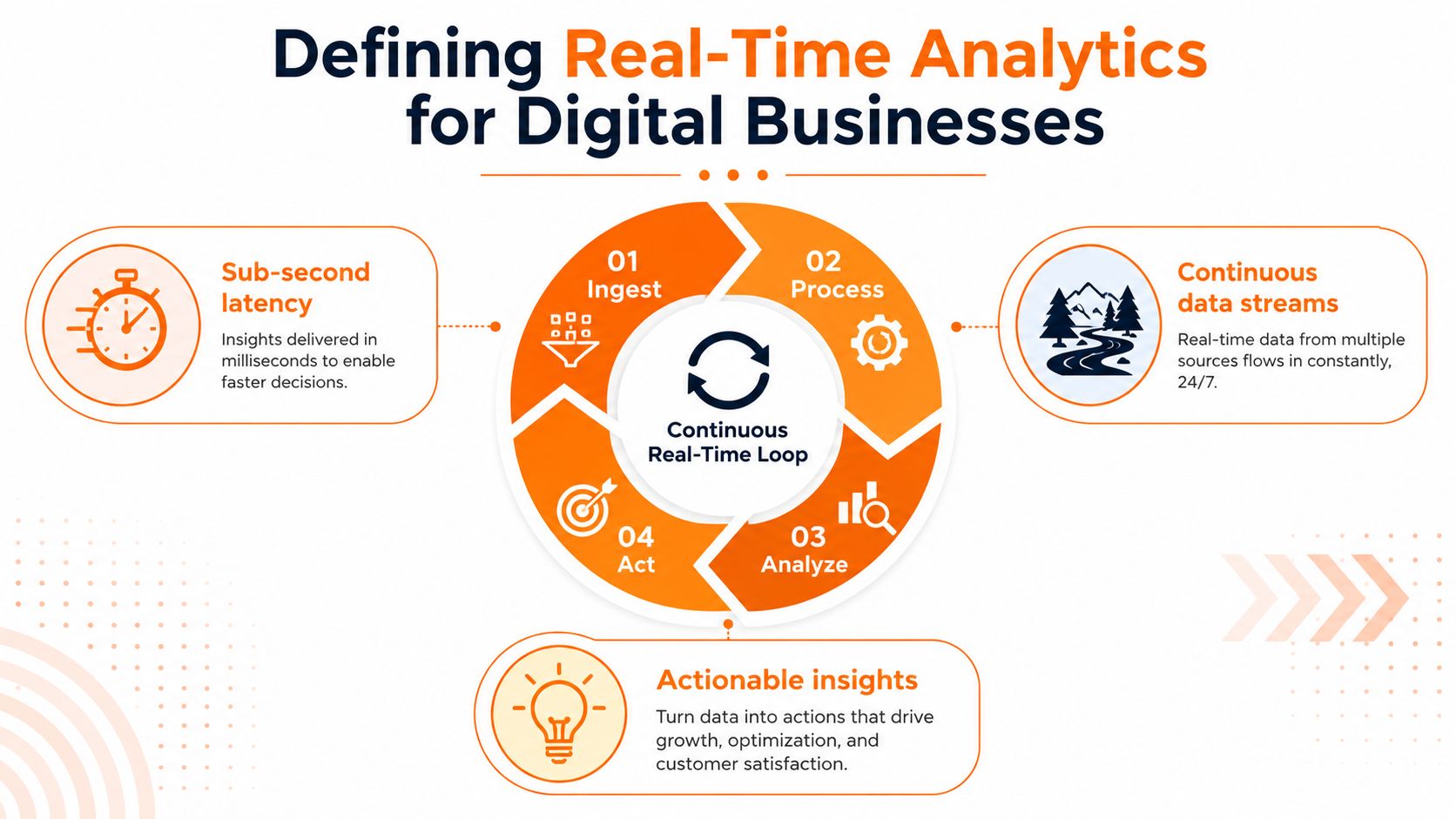
For operators, the practical test is simple. Does the data arrive soon enough to change a decision? A delayed fraud signal can let bonus abusers drain accounts before the risk team reacts. A stale odds feed can leave the book exposed to arbitrage. Slow player segmentation can miss the narrow window when a retention offer still has value.
Real-time analytics keeps the platform synced to live behavior, live exposure, and live risk. IBM describes it as a pipeline that spans collection, ingestion, processing, integration, analysis, and action IBM. That framing is useful in iGaming because a dashboard, an alert, and an automated hold do not share the same latency budget. A trading alert may need near-immediate freshness, while a CRM segment update can often tolerate a slower path if it reduces infrastructure cost.
Practical rule: if a metric can wait until the next batch without changing a player or trading decision, it is not a real-time workload. If the answer changes the moment a bet lands, a withdrawal request starts, or a bonus is claimed, it probably is.
The architecture behind that behavior usually has three parts: a streaming ingestion layer, an OLAP analytics store, and a serving layer for dashboards, APIs, or alerts Tinybird engineering guide. That structure lets a live sportsbook or casino stack keep ingesting events while risk, CRM, and trading teams query the current state without waiting for overnight ETL.
For teams still running on batch delays, the self-test is direct. If the trading desk, fraud team, or CRM manager is acting on data that is already stale by the time it appears, the platform is not running real-time analytics yet. It is running delayed analytics with a faster dashboard skin.
The Three-Layer Real-Time Analytics Pipeline Architecture
A live betting event has to move through the stack in a specific order. A player places an in-play bet, the platform captures the event, calculates the impact on exposure, and then pushes updated odds or alerts to the right people. That flow is easier to build when you split it into three layers, streaming ingestion, storage and analysis, then serving.
How the layers work together
The first layer is streaming ingestion. The bet placement, wallet movement, bonus action, or market update is captured as an event. In iGaming, brokers like Kafka or Kinesis are common here because they keep producers and consumers decoupled while event volume keeps rising.
The second layer is the OLAP analytics store. Current state gets updated and becomes queryable here. Columnar engines such as ClickHouse, Druid, and Pinot are widely used in this role because they are built for fast reads over high-frequency inserts. For sportsbook risk, that matters because the trading desk needs the latest exposure snapshot, not a transactional row store optimized for order entry.
The third layer is the serving layer. This is the part operators feel directly, because it powers dashboards, APIs, alerting, and automation. When the serving layer is cleanly separated, the platform can keep ingesting while analysts, risk systems, and product teams query fresh data at the same time. That separation is what keeps the architecture scalable instead of just fast in a demo.
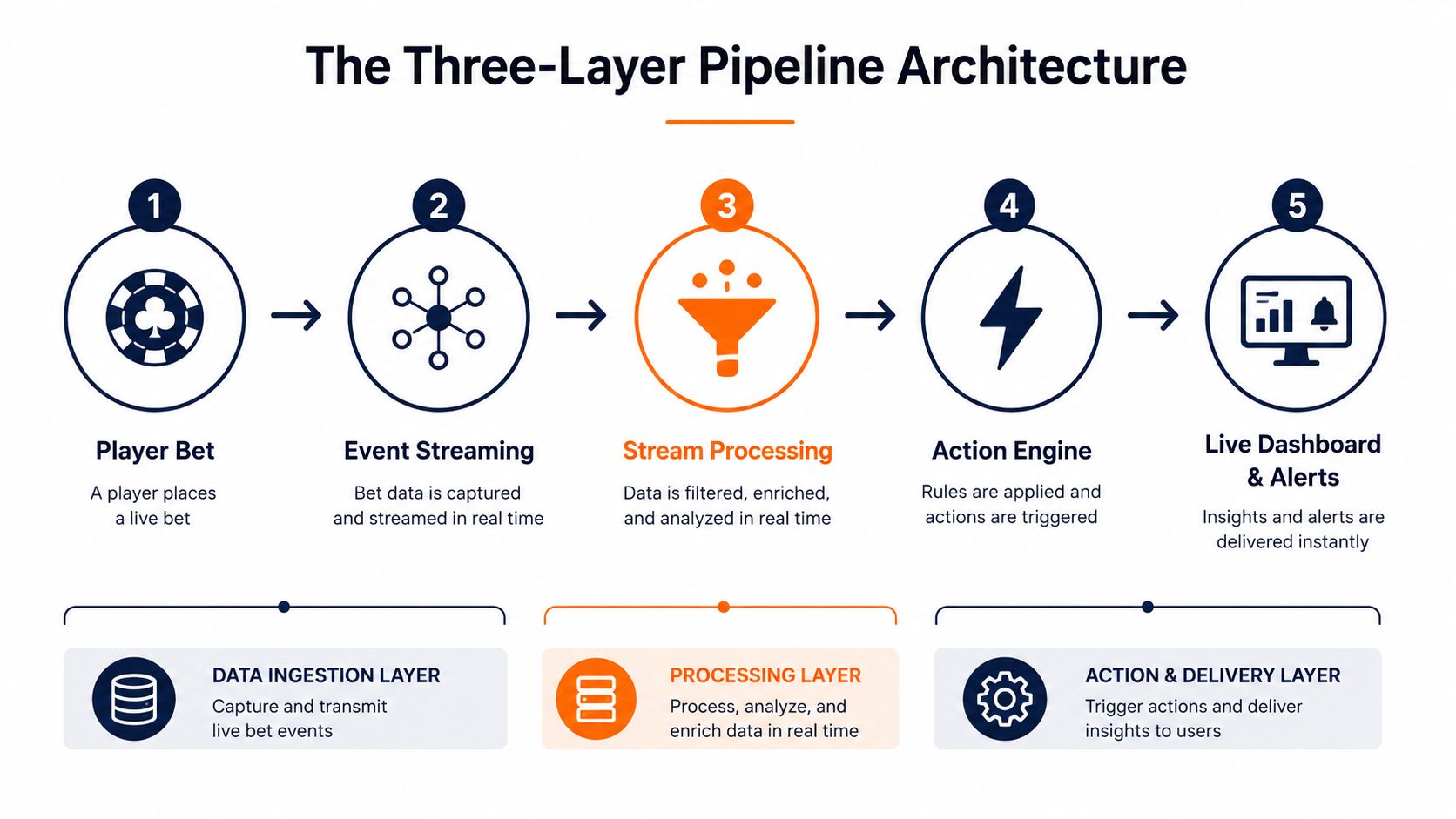
A live sports bet is a clear example because the chain is easy to see. The player action enters as a bet event, the stream processing layer enriches it with market context, the action engine decides whether to adjust odds or raise an alert, and the dashboard shows the current exposure. The point is not to make every step instant. It is to make each step fresh enough for its job.
If you are evaluating architecture, the main trade-off is handoff cost. Every time data moves through too many systems, you add latency, failure points, and operational overhead. The reason many teams pair Kafka-style brokers with ClickHouse-style stores is that the separation keeps throughput high while still letting operators query live state.
The same logic applies to build quality across the stack. A sportsbook platform that treats ingestion, analytics, and serving as one undifferentiated blob usually ends up fragile under load. A better design keeps the layers distinct, because that makes it easier to debug, scale, and evolve. That same split also shows up in serious online casino software development, where live event handling, risk controls, and product surfaces all depend on the same data path.
The fastest system is not the one with the fewest components. It is the one where each component does one job cleanly and can fail without taking the whole platform down.
The Latency Spectrum and Freshness Requirements
The biggest mistake operators make is assuming real-time means sub-second for everything. That's too expensive for many workloads and unnecessary for several others. The decision is, how fresh is fresh enough for each use case, and what does that freshness cost in compute, complexity, and operational burden.
Freshness depends on the decision
IBM's pipeline view and Databricks' freshness, latency, and concurrency framing both point to the same operational truth, not every dashboard or automation path has the same tolerance for delay IBM. A fraud hold needs a different latency budget from a VIP segmentation refresh. If you design both as if they were identical, you'll either overspend or underprotect the business.
| Use Case | Required Latency | Automation Level | Business Impact |
|---|---|---|---|
| Fraud detection alerts | Sub-second | High, automatic hold or review trigger | Helps stop suspicious withdrawals and bonus abuse before funds move |
| In-play odds updates | 1 to 3 seconds | Medium, trader-assisted or automated repricing | Helps manage exposure during fast-moving events |
| Bonus trigger evaluations | 5 to 10 seconds | Medium, rules engine with controlled action | Supports timely offers without forcing extreme infrastructure costs |
| VIP segmentation dashboards | 30 to 60 seconds | Low to medium, human decision support | Gives CRM teams fresh enough context for retention outreach |
That table is the part many vendors skip. A sportsbook doesn't need sub-second freshness for every segmentation tile, and a casino doesn't need an instant pipeline for every marketing metric. The danger is paying for ultra-low latency everywhere just because one critical workflow needs it.
Useful operating rule: design to the slowest latency that still protects the business outcome. Faster than that is only worth it if it changes the action.
The cost difference usually shows up in hidden places. You need more tuning, more monitoring, and more care around schema changes once your pipeline becomes tightly latency-sensitive. For a live trading desk, that's justified. For a player segmentation screen used by CRM staff, it often isn't.
This is why platform architects should classify workloads by decision urgency before they buy tools or rewrite pipelines. A fraud stop path, an odds recomputation path, and a retention dashboard are all “real-time” in a broad sense, but only one of them is typically worth pushing to the edge of latency engineering.
For operators comparing stack options, the broader platform implications are covered well in the best sports betting platform discussion. The analytics layer should match the business rhythm, not the marketing brochure.
Real Time Analytics in Casino and Sportsbook Operations
The value of real-time analytics becomes obvious when you watch a live operation under pressure. The platform isn't waiting to summarize the day, it's reacting while money, risk, and player attention are all moving at once.
In-play betting and exposure control
In-play betting is the clearest sportsbook use case because the market can shift in seconds. The platform has to ingest live bet events, compare them with current market exposure, and keep the trading team aligned with what's happening now. If the odds feed lags behind the wagering flow, arbitrage windows open and liability can drift before anyone notices.
Real-time analytics fixes that by keeping market state and exposure state close to the event stream. The business win isn't abstract speed, it's tighter control over pricing and liability during high-volume events. A trader can act on the latest exposure snapshot instead of a summary that's already out of date.
Bonus abuse detection and wallet risk
Bonus abuse is one of the most direct examples of why freshness matters. A player can move across accounts, deposit patterns, and promotional triggers quickly enough that a delayed batch check is too late. Real-time analytics lets the fraud layer spot suspicious combinations and place a hold before a withdrawal clears.
Automation matters more than display. If the system only shows a suspicious pattern to a human reviewer, the account may already be drained. If it triggers a controlled hold or step-up review immediately, the operator keeps the business safe without waiting for a morning report.
Live dealer monitoring and unusual game state
Live dealer environments add a different kind of risk because the platform is watching game state as it unfolds. Real-time analytics can track card sequences, roulette outcomes, or dealer session behavior against expected patterns and raise an alert when something doesn't fit. That doesn't prove tampering on its own, but it does give operations a chance to intervene quickly.
The strongest use here is not public-facing automation, it's internal observability. A live dealer floor needs fast anomaly signals because a bad table can create player trust issues very quickly. The analytics layer becomes part of the control system, not just a reporting tool.
VIP segmentation and retention timing
VIP retention is less about millisecond latency and more about hitting the right session moment. Continuous behavior analysis can identify high-value players showing churn signals, then feed CRM or marketing automation before the session goes cold. That gives the operator a chance to intervene while the player is still engaged.
The important distinction is that the insight might not need to trigger an automatic action. In many cases, a fresh dashboard or CRM queue is enough. Real-time analytics still matters because the value disappears if the player sees the offer after they've already left.
Across these four cases, the common thread is simple. Real-time analytics protects margin, reduces exposure, and improves timing. The difference is whether the response must be automated immediately or whether a human can act from a fresh live view.
Build Versus Buy Decisions for iGaming Platforms
Operators usually face this decision once the use cases get serious. A custom analytics stack offers maximum control, but it also asks for specialized engineering, ongoing monitoring, and a team that knows how to keep low-latency systems healthy. A white-label platform approach trades some flexibility for faster launch and less infrastructure to own.
What custom build really means
A custom build gives you freedom over data models, alert logic, joins, and downstream integrations. That's attractive if your risk rules are proprietary or your sportsbook and casino logic diverge in ways a generic stack can't support. It also makes sense when you already have a strong engineering and data platform team that can manage brokers, databases, observability, and schema evolution.
The hidden cost is not just initial delivery. It's the operational load of keeping the pipeline fresh, stable, and debuggable while the business keeps growing. Real-time systems don't forgive sloppy migrations or fragile handoffs, because failures surface immediately to users and traders.
Why buy is often the better first move
A platform-led approach gets you to market faster because the core backend is already assembled. That matters for new brands, studios, and operators launching into regulated markets where the primary problem is often coordination, not invention. Instead of spending months assembling ingestion, analytics, and serving pieces, the team can focus on market strategy, product, and compliance.
The trade-off is flexibility. A platform will constrain some data shapes, integrations, and custom workflows. That's acceptable when your differentiation lies in brand, acquisition, and operations rather than in building a unique data architecture from scratch.
Decision filter: if your real-time needs are mostly standard casino, sportsbook, payments, and compliance flows, buy. If your edge depends on bespoke risk models or highly unusual event logic, build.
A practical way to decide is to compare three things, not just one. First, your time-to-market pressure. Second, your internal engineering depth. Third, how much your analytics logic is part of your competitive advantage. If only one of those is extreme, a custom build may be overkill.
For operators who want the surrounding platform view, online casino software development is where the architecture conversation usually starts. The analytics choice should follow the operating model, not fight it.
Implementation Checklist for Operators
A real-time analytics project succeeds or fails on details that sound boring until they break production. Before you choose tools, map the actual event sources, define which KPIs need freshness, and decide what should be informational versus automated.
Start with the data sources
Pull a complete list of event producers first. That includes game providers, sportsbook odds feeds, payment processors, wallet movements, CRM events, and compliance signals. If the source inventory is incomplete, the pipeline will always have blind spots.
- Game provider feeds: Confirm which events arrive, in what shape, and whether live-dealer, RNG, and jackpot events all behave the same way.
- Wallet and payment events: Track deposits, withdrawals, reversals, chargebacks, and balance changes as separate streams.
- Player behavior events: Include logins, game starts, bet placements, bonus claims, and session changes.
- Odds and market feeds: Check how often market updates arrive and whether the feed supports the in-play intensity you expect.
Define the technical shape early
The architecture should be chosen around workload, not vendor comfort. You need to know where streaming ends, where analytics begins, and how dashboards or alerting systems consume the output. If the serving layer depends on the ingestion layer staying perfectly healthy, you've built a brittle system.
- Message broker choice: Ask what happens under burst load, schema change, and replay conditions.
- Analytics store: Confirm it can handle high insert rates and fast time-range queries.
- Serving layer: Make sure dashboards, APIs, and alerting can be isolated from heavy ingest traffic.
- Schema governance: Ask how changes roll out without downtime or data loss.
Tie the stack to business KPIs
The KPI list should be short, sharp, and linked to action. GGR, NGR, player lifetime value, fraud detection rate, bonus cost, exposure, and retention response times each need a clear owner. If nobody knows which team acts on a metric, the metric becomes decoration.
- Trading: Define which exposure views need second-level freshness.
- Fraud and risk: Specify which signals trigger an automatic hold versus a manual review.
- CRM and retention: Decide which player segments need live refresh and which can wait.
- Compliance: Confirm what must be logged, retained, and auditable in real time.
A good vendor conversation is less about buzzwords and more about failure modes. Ask what the maximum ingestion throughput is, how monitoring works, what the recovery process looks like, and how they handle schema evolution during live traffic. Those questions surface whether the system is operational or only demo-ready.
For platform teams that want to benchmark a broader stack choice, the implementation logic fits naturally with best sports betting platform requirements. The analytics layer should support the business flow you already have, not force a new one.
Connecting Analytics to Platform Strategy and Compliance
Real-time analytics becomes strategically valuable when it stops being a reporting feature and starts feeding the rest of the platform. The same live data streams that power fraud alerts and odds updates can also feed AI-ready features, because models perform better when they're trained and served on fresh, contextual data ClickHouse. That matters in iGaming because personalization and risk scoring both depend on up-to-date player behavior.
The compliance side is just as important. Multi-jurisdictional operators need continuous visibility into responsible gaming limits, geofencing enforcement, and transaction logs that can stand up in audits. Real-time analytics doesn't replace compliance controls, it gives them a live surface to work from.
There's also a useful distinction between real-time analytics and real-time operationalization. Analytics displays or surfaces the insight. Operationalization uses that insight to trigger an automated action. Fraud holds and odds repricing often justify automation, while VIP outreach or responsible gaming reviews may only need a fresh dashboard and a human decision.
That difference matters because not every workflow should be fully automated. Some actions are too sensitive to fire without review, especially where player harm, regulatory obligations, or market integrity are involved. A mature platform sets automation boundaries deliberately instead of assuming every low-latency signal should become a machine action.
The broader pattern is that live analytics strengthens platform resilience. It improves response speed, supports expansion into new regulated markets, and gives operators better control over the exact moments where money and risk intersect. In iGaming, that's where real-time analytics earns its keep, not in the abstract, but in the operational decisions it enables every minute.
If you're planning a sportsbook or casino rollout and want the analytics layer to match your trading, fraud, and compliance needs, talk to NexGrate. They build turnkey iGaming infrastructure that brings casino, sportsbook, payments, and compliance into one operating stack, which is exactly where real-time analytics becomes easiest to use and hardest to outgrow.