A chargeback spike rarely starts with one dramatic event. More often, an operator sees separate warnings in separate places: a payment provider flags unusual deposits, the casino team notices bonus abuse, the sportsbook team sees related accounts, and the KYC queue contains location anomalies. By the time someone connects the signals, the same device, wallet, or payment instrument may have moved through several accounts.
That's the operational problem fraud risk management software should solve. It must connect money movement, player behavior, identity data, and investigation outcomes into one controlled process. Detection matters, but so do explainable decisions, complete evidence, reconciled ledgers, and workflows that let investigators act before a suspicious pattern becomes a settled loss.
Table of Contents
- Why iGaming Operators Lose Control of Fraud Too Late
- What Fraud Risk Management Software Actually Is
- Core Features That Actually Reduce Losses
- Built-In Platform Fraud Controls vs Third-Party Solutions
- How Fraud Software Integrates with Casino and Sportsbook Backends
- KPIs and ROI for Fraud Risk Management Software
- Why Explanation Quality Matters More Than Raw Accuracy
- How to Select Fraud Risk Management Software as an iGaming Operator
Why iGaming Operators Lose Control of Fraud Too Late
An operator can have competent analysts and still lose control when its systems divide the evidence. The casino backend sees deposits and gameplay. The sportsbook engine sees bets and settlements. The payment provider sees authorizations and reversals. A standalone KYC tool sees identity checks. None of those views, by itself, explains whether several apparently unrelated events belong to the same risk network.
A typical incident begins with a delayed signal. A cluster of new accounts uses similar devices, deposits through different payment methods, converts bonuses quickly, and withdraws through beneficiaries that don't match the original funding pattern. Each alert lands with a different team. One reviewer closes a low-value payment alert, another clears a KYC exception, and nobody sees the combined behavior until chargebacks or withdrawals expose the pattern.
The Association of Certified Fraud Examiners' 2024 Report to the Nations analyzed 1,921 occupational-fraud cases across 138 countries and territories, documenting more than US$3.1 billion in losses. The typical fraud lasted 12 months before detection. Although occupational fraud isn't the same as player or payment fraud, the operational lesson applies: periodic review leaves too much time for a bad pattern to spread.
Practical rule: Treat every alert as part of an evidence chain, not as an isolated ticket.
Operators also need a reporting channel that doesn't disappear inside a payment queue. Tips uncovered 43% of cases in the ACFE study, making integrated reporting, analytics, and case handling important even in highly automated environments. A useful overview of how control ownership and escalation fit into broader operations is available in NexGrate's risk management practices.
What Fraud Risk Management Software Actually Is
Fraud risk management software is a closed-loop control environment. It collects events, connects them to entities, evaluates risk, routes decisions, records evidence, and uses investigation outcomes to improve future controls. A rules engine alone can block a transaction, but it can't provide the context an investigator needs when the same player appears across a casino account, sportsbook wallet, device, and withdrawal beneficiary.
The foundation is a unified event graph. It should connect:
- Player identity, including KYC attributes, declared residence, account history, and verification status.
- Technical identity, including device fingerprints, IP addresses, geolocation, browser signals, and repeated VPN use.
- Payment identity, including payment tokens, ownership information, deposits, reversals, chargebacks, and withdrawal destinations.
- Behavioral identity, including betting, casino play, bonus use, deposit velocity, cash-out patterns, and changes from normal activity.
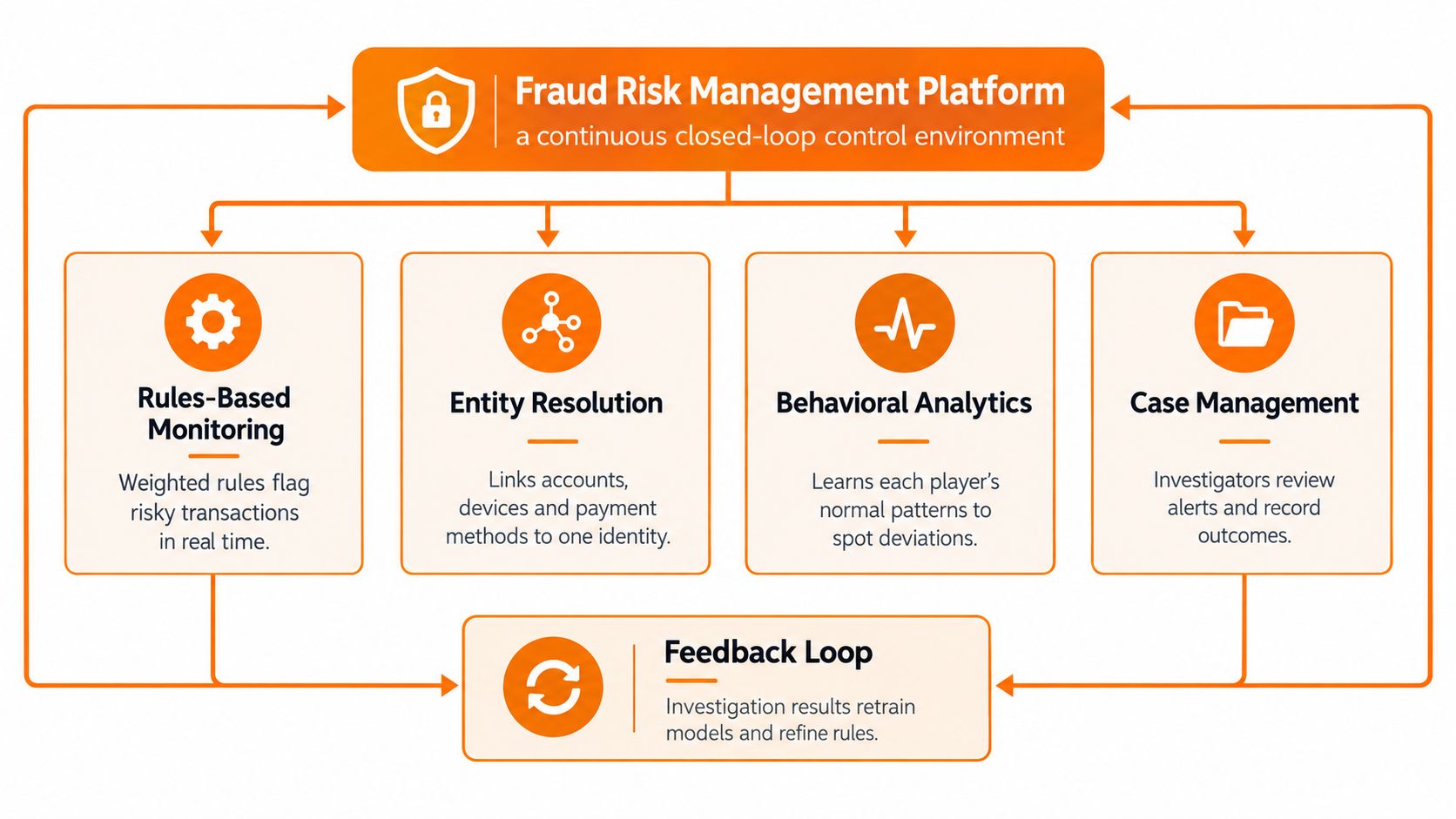
The control loop matters more than the individual model
Rules-based monitoring provides immediate policy enforcement. Behavioral analytics identifies deviations from a player's established pattern. Entity resolution links accounts and instruments that appear separate. Case management gives analysts a controlled place to review, document, and resolve the alert.
These functions should operate together. A new account using a previously suspicious device becomes more meaningful when it also deposits through one method, attempts to withdraw through another, and presents geolocation that conflicts with its declared jurisdiction. The system should aggregate those signals over time, apply a risk score, and explain how the score was produced.
That explanation is not a cosmetic feature. If a player is restricted, a payment is held, or KYC is requested, the reviewer needs to reproduce the decision from recorded evidence. The software should preserve immutable event histories, show the rules and signals involved, record who approved an action, and route complex cases to manual review instead of relying on an opaque block.
Core Features That Actually Reduce Losses
The right feature set follows the way fraud moves through an iGaming operation. It starts with an event, gains meaning through correlation, and becomes actionable through a documented decision. A platform that only counts blocked transactions may look active while missing linked wallets, payment ownership issues, and behavior that shifts between casino and sportsbook products.
| Feature | What It Monitors | Primary Operator Benefit | Compliance Value |
|---|---|---|---|
| Rules engine | Deposit, withdrawal, account, bonus, location, and payment conditions | Applies policy consistently and escalates known patterns | Provides traceable decision logic |
| Real-time risk scoring | Multiple signals across a player and related entities | Prioritizes intervention before settlement or cash-out | Supports documented, risk-based action |
| Device and IP fingerprinting | Shared devices, IP relationships, VPN use, and location conflicts | Exposes linked accounts and synthetic behavior | Preserves relationship evidence |
| Behavioral analytics | Changes in deposits, bets, withdrawals, and gameplay | Detects deviations from established activity | Shows why behavior became higher risk |
| Payment and reversal controls | Failed deposits, chargebacks, ownership mismatches, and reversals | Limits exposure to disputed or unauthorized funding | Connects payment decisions to investigations |
| Entity resolution | Players, devices, IPs, payment tokens, wallets, and beneficiaries | Creates a network view instead of isolated profiles | Supports consistent case evidence |
| Case management | Alerts, assignments, actions, outcomes, and supporting documents | Gives investigators a controlled queue and history | Creates an auditable investigation trail |
Signals need context
Relevant gambling-sector indicators include repeated VPN use, mismatches between declared residence and detected location, multiple accounts tied to one device or IP, payment-method ownership mismatches, sudden deposits inconsistent with account history, frequent failed deposits, rapid changes in deposit or withdrawal behavior, and transfers involving numerous parties. These indicators should feed a combined assessment rather than operate as automatic closure rules, as described in the gaming and gambling red-flag guidance.
A single VPN event may have an innocent explanation. A VPN event combined with shared-device activity, conflicting residence data, and a payment-method mismatch deserves deeper review. The software should show that chain clearly, including the time sequence and the entities connected to it.
Case outcomes must improve controls
The analyst's decision is part of the detection system. Confirmed fraud, cleared alerts, requests for additional KYC, payment holds, and false positives should all be recorded in a form that supports rule tuning and model review. Without that feedback, the operator accumulates alerts but doesn't improve decision quality.
Built-In Platform Fraud Controls vs Third-Party Solutions
Operators usually choose between controls embedded in a unified platform and specialist tools connected through APIs. Neither approach is automatically correct. The decision depends on how much control the operator needs, how quickly it must launch, and whether its existing architecture can produce a complete view of money movement.
Built-in controls usually have an integration advantage. A unified casino and sportsbook backend can already understand player accounts, wallet balances, bonuses, bets, settlements, KYC status, and cashier events. That reduces the work required to normalize data and lowers the chance that an alert arrives without the context needed to act.
Third-party tools can offer specialist detection capabilities and deeper control over thresholds, models, and workflows. They may be appropriate for an established operator with a mature data team, a clear integration layer, and the capacity to maintain multiple vendors. The trade-off is operational: every separate system creates another contract, data feed, failure mode, support queue, and audit boundary.
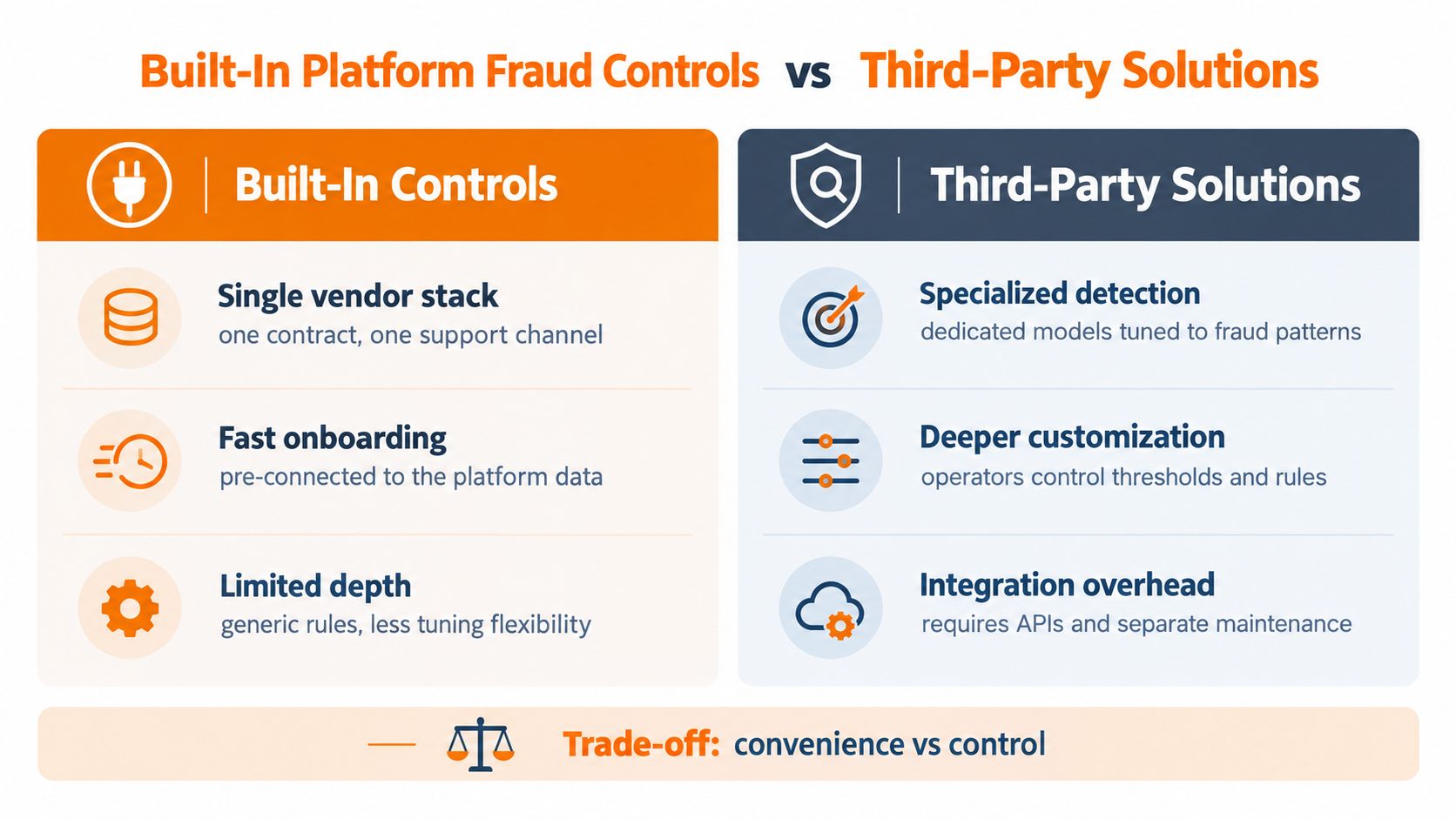
The real comparison is visibility versus specialization
| Decision area | Built-in platform controls | Third-party solution |
|---|---|---|
| Data access | Usually connected to core player and wallet records | Depends on APIs, webhooks, and data quality |
| Deployment | Faster when controls are pre-connected | Requires mapping, testing, and ongoing maintenance |
| Tuning | May provide a narrower rules and model layer | Often allows more specialist customization |
| Operations | One support and escalation path | Multiple vendors and ownership boundaries |
| Audit trail | More likely to remain within the platform record | Requires reliable synchronization across systems |
| Failure impact | Platform-wide dependency | Additional integration and availability dependency |
NexGrate's unified white-label model provides one backend and player wallet for casino and sportsbook operations, with KYC and AML workflows, payments, reporting, and fraud controls in the same operating environment. That can reduce integration overhead, but it doesn't remove the need for explicit rule design, access governance, analyst training, and testing against real money-flow scenarios.
A bolt-on tool isn't automatically a bad choice. It becomes a bad choice when the operator can't answer which system owns the final decision, where the evidence is stored, how overrides are approved, or how an investigation outcome returns to the rule and model layer.
How Fraud Software Integrates with Casino and Sportsbook Backends
Integration should be designed around the lifecycle of funds, not just around a list of APIs. The fraud engine needs events from registration, KYC, deposits, gameplay, betting, bonuses, settlements, withdrawals, reversals, chargebacks, and account closure. It also needs the relationships between those events.
Start with the player and wallet record. Add casino and sportsbook activity, then connect the cashier, payment providers, geolocation service, device intelligence, and KYC workflow. The resulting stream should preserve event time, source system, player identity, related entities, amount, currency, status, and the action taken.
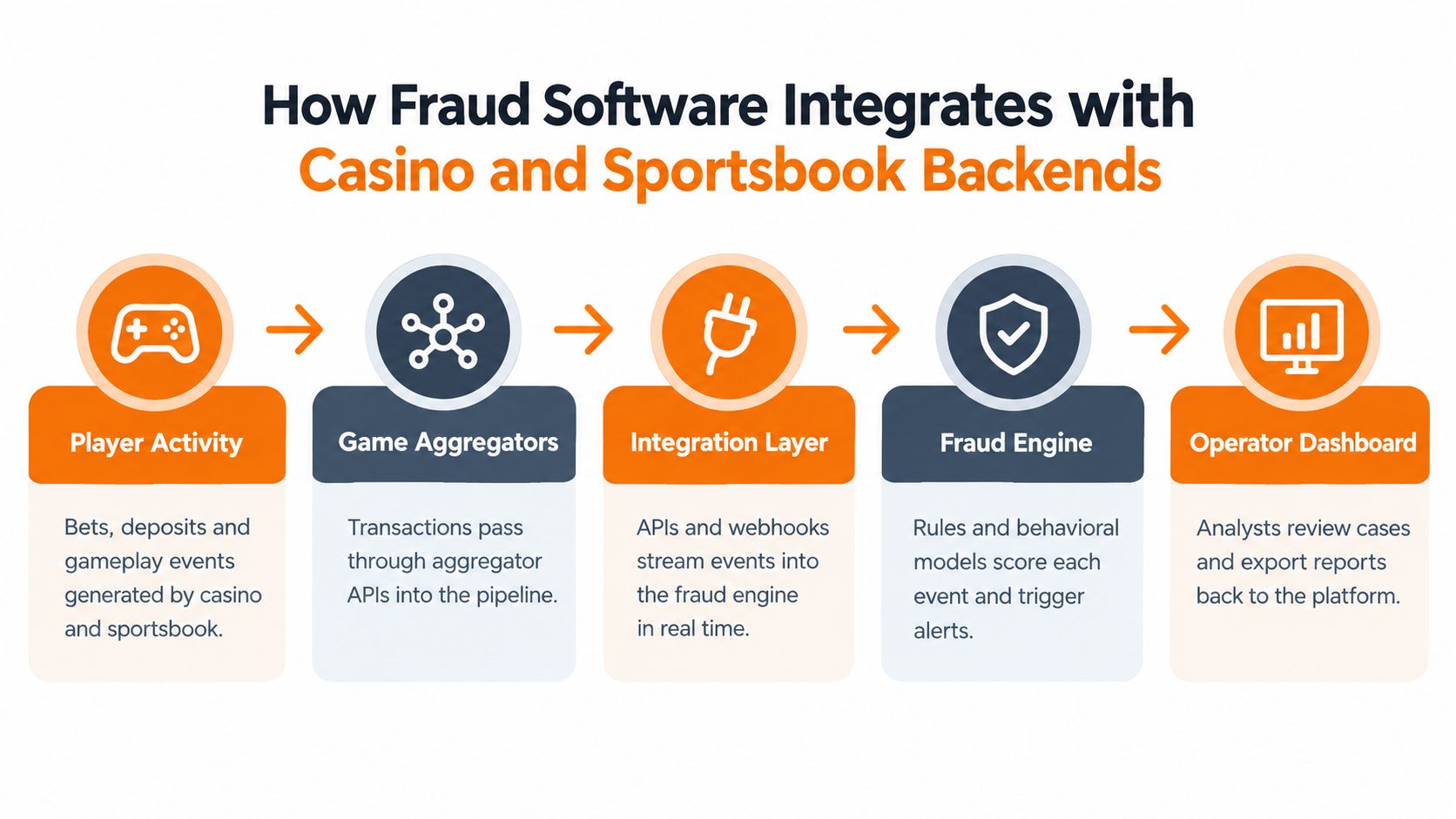
Design the money path before the alert path
A strong architecture answers five practical questions:
- Who funded the account? Check payment-method ownership and whether third-party funding is allowed under the operator's policy and jurisdiction.
- Where did the funds move? Track deposits, wagers, bonus conversion, wallet transfers, and withdrawals across linked accounts.
- Can the player withdraw through an unrelated route? Closed-loop withdrawal controls should connect the cash-out method to the original funding history and approved exceptions.
- What happened after a reversal? A reversed deposit, chargeback, or failed settlement should update the player's available balance and risk state.
- Can the ledger reconcile? Deposits, bets, bonuses, settlements, chargebacks, and withdrawals must agree across systems.
Open-loop payment systems deserve particular attention because they can allow funds to move between payment methods, obscure the source or destination of money, and enable gambling with stolen cards. The UK Gambling Commission risk update covered by Legal 500 also highlights prepaid cards, vouchers, third-party funding, crypto-linked loading, forged identity documents, and fraudulent account creation as emerging concerns.
A lower chargeback rate doesn't prove that the money-flow control is sound. Check what happens between funding, wagering, bonus conversion, and withdrawal.
Automated reconciliation is the control that exposes the gaps. Fragmented ledgers can hide management overrides, duplicate credits, stale reversals, or exploitable balance differences. Operators should also review sportsbook risk management practices when designing controls across betting, settlement, and wallet events.
KPIs and ROI for Fraud Risk Management Software
A blocked-transaction count is an activity metric, not a control-quality metric. It can rise because the system found more fraud, because rules became too broad, or because an integration began duplicating events. Management needs measures that connect alerts to decisions, losses, customer friction, and evidence quality.
Track the complete investigation path:
- Alert-to-review time: How quickly an analyst starts examining a material alert.
- Confirmed-fraud precision: How often escalated alerts result in a confirmed fraud or policy breach.
- False-positive rate: How often legitimate players face unnecessary friction.
- Median loss before intervention: How much exposure exists when the operator acts.
- Repeat-offender detection: Whether linked entities return through new accounts or payment routes.
- Evidence completeness: The share of resolved alerts containing the required reasoning, documents, approvals, and actions.
These measures align with the ACFE finding that active controls, including monitoring, internal audit, automated transaction monitoring, and reconciliation, are associated with faster detection and lower losses. The ACFE discussion of the 2024 global study also emphasizes the importance of measuring control effectiveness rather than relying on detection volume alone.
Calculate value across the operating model
ROI should include avoided chargebacks and fraud losses, but that's only the starting point. Include reduced manual review effort, fewer duplicated investigations, lower loss severity, faster release of legitimate payments, and the staff time saved during regulatory or internal audits.
IBM's 2025 Cost of a Data Breach research examined breaches at 600 organizations between March 2024 and February 2025. Organizations with extensive AI and automation across security operations reported an average breach cost of US$3.62 million, compared with US$5.52 million for organizations without those technologies, a difference of US$1.9 million, or roughly 34%. They also reported a breach lifecycle that was shorter by an average of 80 days. The figures concern security breaches rather than iGaming fraud directly, but they support the economic case for automated controls paired with response and governance.
Don't optimize one metric in isolation. A system can reduce card chargebacks while allowing layering through open-loop withdrawals or third-party instruments. Profitability depends on controlling the full money path without turning legitimate players into permanent investigation subjects.
Why Explanation Quality Matters More Than Raw Accuracy
A model can rank suspicious activity effectively and still fail the people responsible for defending its decisions. Compliance teams need to explain why an account was restricted, why a withdrawal was held, or why additional KYC was requested. “The model gave it a high score” isn't an investigation rationale.
A 2026 systematic review of 49 peer-reviewed studies found that roughly 80% treated predictive performance as a substitute for measuring explanation quality. The review also identifies an explanation and imbalance problem: oversampling rare fraud cases can distort SHAP, LIME, and similar explanation methods, making them less faithful to the underlying model behavior.

Test explanations as operational evidence
For casino deposits, sportsbook bets, withdrawals, bonus abuse, account takeover, and crypto transactions, an explanation should answer:
- Which signals changed the risk assessment?
- Which linked entities contributed to the decision?
- What time window and historical baseline were used?
- Which rule, policy, or threshold caused escalation?
- What action did the reviewer approve, and why?
- Can another reviewer reproduce the conclusion from the stored evidence?
Measure explanation fidelity separately from precision and recall. Also test whether analysts can use the explanation, whether customer-facing communications remain accurate, whether auditors can trace the decision, and whether compliance teams can defend it to a regulator. A highly accurate model that produces unstable or misleading explanations can create governance risk that its performance dashboard won't show.
How to Select Fraud Risk Management Software as an iGaming Operator
Start procurement with a data-flow test, not a feature brochure. Ask the vendor to demonstrate a scenario in which one player, a related device, a shared IP, a payment token, a sportsbook wallet, and a withdrawal beneficiary produce a single correlated case. The demonstration should show the raw events, score reasoning, rule outcomes, reviewer assignment, approval history, and final evidence record.
Then test the money ledger. Require reconciliation across casino deposits, sportsbook bets, bonuses, settlements, chargebacks, reversals, and withdrawals. Check how the platform handles closed-loop withdrawals, payment ownership mismatches, source-of-funds evidence, crypto activity, and management overrides.
Use NexGrate's overview of iGaming software providers as a starting point for mapping platform requirements, but evaluate every provider against your own workflows.
Procurement checklist
- Integration breadth: Connects casino, sportsbook, cashier, wallet, KYC, device, geolocation, and payment events.
- Entity resolution: Links players, devices, IPs, payment instruments, wallets, and beneficiaries.
- Decision transparency: Shows the signals, rules, thresholds, and evidence behind each outcome.
- Investigation feedback: Sends confirmed outcomes and false positives back into rule and model governance.
- Override control: Requires documented approval, role-based access, and periodic review of overrides.
- Operational resilience: Defines ownership for failed feeds, delayed events, duplicate events, and unavailable providers.
- Reporting readiness: Exports complete case histories and reconciled activity for internal and regulatory review.
A successful proof of concept should use representative casino and sportsbook events, not sanitized sample data. If the vendor can't show how the system handles conflicting signals, incomplete payment data, or a legitimate player who resembles a known risk pattern, it hasn't demonstrated fraud control. It has demonstrated a dashboard.
NexGrate provides a turnkey white-label casino and sportsbook platform with a shared backend and player wallet, integrated payments, KYC and AML workflows, audit logs, and fraud controls for rule-based alerts and investigation handling. Visit NexGrate to assess how its platform can support unified money-flow monitoring, case workflows, and compliance operations for your iGaming brand.