Most payment guides start with the wrong assumption: secure payment processing means passing PCI DSS and encrypting card data at checkout. Those controls matter, but they don't explain why a compliant operator can still lose access to its cashier, suffer a ransomware outage, or approve a payment manipulated by a social-engineering attack.
In iGaming, the payment flow runs through processors, gateways, fraud vendors, identity providers, wallet services, banking partners, platform integrators, and internal operations teams. A secure design protects the whole chain, not just the page where a player enters card details. It also connects authentication, fraud decisions, reconciliation, vendor governance, and incident response instead of treating each as a separate compliance task.
Table of Contents
- Why Secure Payment Processing Is Bigger Than Card Data
- Core Components of a Secure Payment Flow
- PCI DSS Compliance in Multi-Brand Operations
- Crypto Versus Fiat Payment Security Trade-offs
- Fraud Prevention and Dispute Management Integration
- Third-Party Risk and Ecosystem Security Governance
- Implementation Best Practices for iGaming Operators
Why Secure Payment Processing Is Bigger Than Card Data
PCI DSS established a common global security baseline for protecting payment-card data, and its influence is substantial. Yet PCI compliance is a control framework, not a guarantee that every dependency around a payment stack is resilient. An operator can satisfy card-data requirements while leaving a privileged integration, remote support channel, settlement dependency, or vendor connection capable of disrupting deposits and withdrawals.
Visa's payment ecosystem security perspective describes the highest-impact breaches as increasingly occurring outside traditional financial institutions, particularly among processors, merchants, and other non-financial service providers. The same source reported a 41% increase in ransomware incidents affecting payments ecosystem entities in the first half of 2025. That figure changes the operating question. It's no longer enough to ask whether the checkout form is protected. You have to ask which suppliers can stop your cashier, alter transaction routing, access player information, or delay settlement.
Compliance doesn't equal operational resilience
A PCI audit usually examines defined systems, evidence, policies, access controls, monitoring, vulnerability management, and cardholder-data handling. Those controls reduce exposure, but they don't automatically validate every vendor's recovery process or confirm that a third party can maintain service during an attack.
For an iGaming operator, the practical blast radius can include:
- Payment availability: Players may be unable to deposit, withdraw, or receive refunds even when no card data has been stolen.
- Transaction integrity: A compromised integration can misroute status messages, duplicate operational events, or create uncertainty around whether funds settled.
- Privileged access: Support accounts and API credentials can provide a path into payment orchestration without exposing the public checkout page.
- Regulatory evidence: An outage or disputed ledger can make it difficult to produce reliable audit trails for licensing, AML, or player-funds obligations.
Practical rule: Treat every system that can influence payment authorization, status, routing, settlement, or reconciliation as part of the security boundary.
The new weak point is often outside the platform
Ransomware is only one scenario. A vendor can introduce vulnerable software, mishandle credentials, expose logs, or change an API without preserving the security assumptions your platform relies on. The operator still owns the customer relationship and regulatory consequences, even when the technical failure sits elsewhere.
That's why ecosystem governance needs named owners, documented responsibility boundaries, tested failover procedures, and continuous monitoring. Secure payment processing protects confidentiality, but it must also protect availability, transaction correctness, and the operator's ability to prove what happened.
Core Components of a Secure Payment Flow
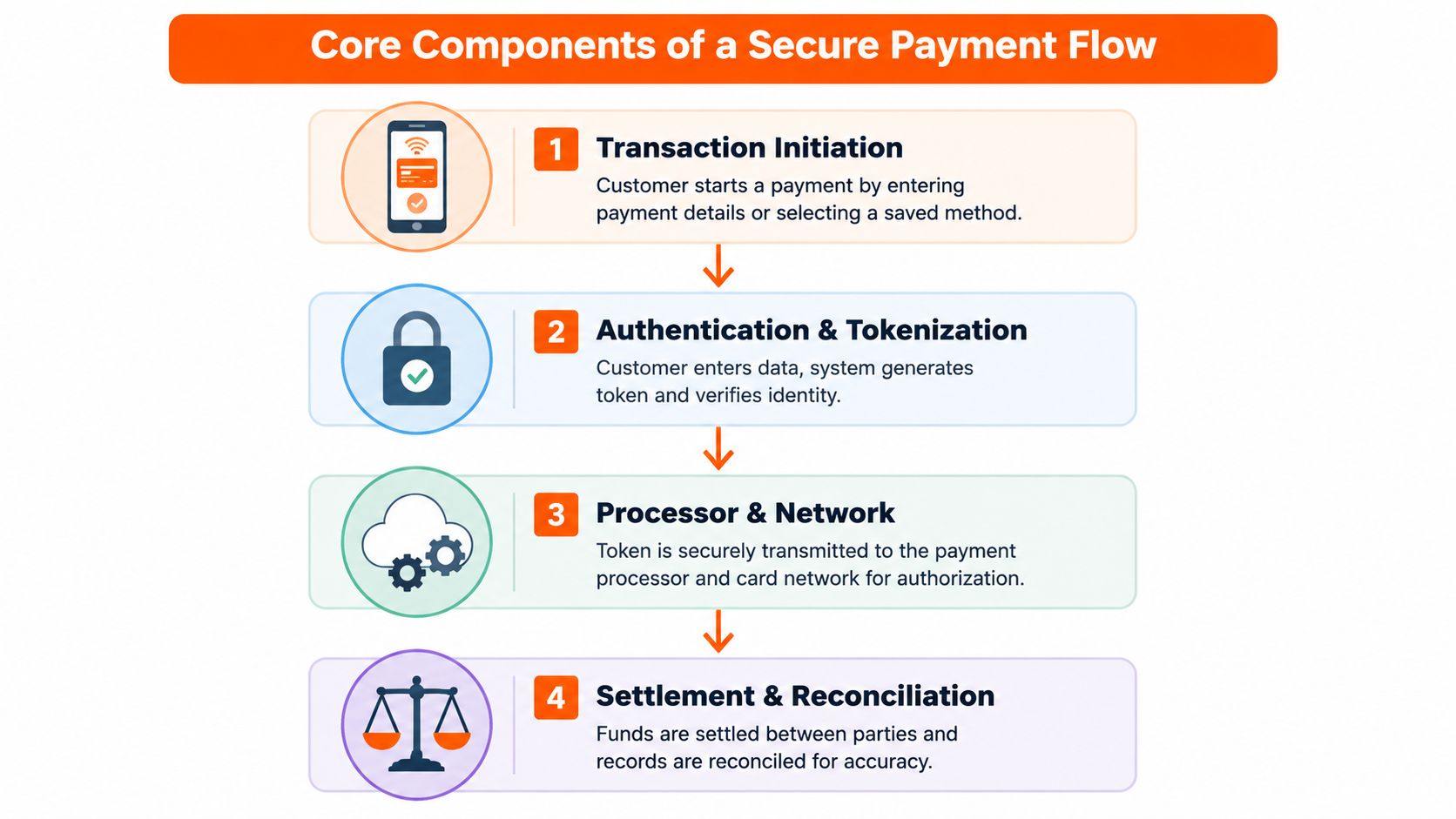
A secure payment flow separates sensitive data, authentication decisions, processing events, and financial records. The player might experience one button click, but the backend should treat each stage as a controlled handoff with its own logs, permissions, and failure behavior.
Start with data minimization
When a player initiates a card deposit, the cashier should collect only what the payment provider needs. The operator's internal services should receive a reference or token rather than the Primary Account Number. Tokenization replaces the PAN with a surrogate token, and the token has no exploitable value outside the system that securely maps it back to the original account data, as explained in Stripe's tokenization guidance.
A practical flow looks like this:
- Transaction initiation: The player selects a payment method and amount. The cashier sends the request to a controlled payment service rather than distributing card data across wallet, bonus, CRM, and reporting systems.
- Authentication and tokenization: The payment provider or vault handles sensitive card details, returns a token, and records the relationship between token, player, brand, and provider.
- Processor and network decision: The orchestration layer routes the transaction, applies risk rules, requests issuer authentication where appropriate, and records authorization responses.
- Settlement and reconciliation: The platform matches provider reports, ledger entries, fees, reversals, refunds, and player balances. A successful authorization isn't the same as final settlement.
Tokenization reduces the number of systems that store or route card data, which can reduce PCI scope and the amount of infrastructure requiring card-data hardening. It doesn't remove responsibility for access control, vendor oversight, logging, or the vault itself.
Apply controls around the token
The token vault deserves stronger protection than ordinary application data. Use role-based access, separate operational duties, restrict de-tokenization to narrowly defined services, and segment the vault from player-facing workloads. A sportsbook service may need a payment status, but it usually doesn't need the ability to retrieve the underlying PAN.
For 3D Secure 2, avoid a blunt rule that challenges every payment. Use issuer authentication and risk-based step-up logic so higher-risk transactions receive more friction while lower-risk activity can proceed through an appropriate flow. The control should produce useful evidence, including authentication outcome, transaction identifiers, risk signals, and the decision that followed.
Finally, design for failure. A processor timeout, rejected authentication, delayed webhook, or duplicate callback should create a reviewable state, not an automatic balance change. Idempotency, immutable event logging, and a separate financial ledger protect the operator when external systems behave unpredictably.
PCI DSS Compliance in Multi-Brand Operations
Multi-brand operators often underestimate how quickly compliance boundaries multiply. Each brand may have different domains, cashier configurations, acquirers, currencies, jurisdictions, customer-support teams, and promotional workflows. The platform may be shared, but the evidence, access paths, and operational responsibilities still need to be clear.
The historical value of PCI DSS is its common baseline for protecting payment-card data. Its operational value comes from applying that baseline consistently across the systems that store, process, or transmit cardholder data. Tokenization and segmentation help because they keep PANs away from internal services and reduce the number of components that need direct card-data controls.
What the compliance figures mean
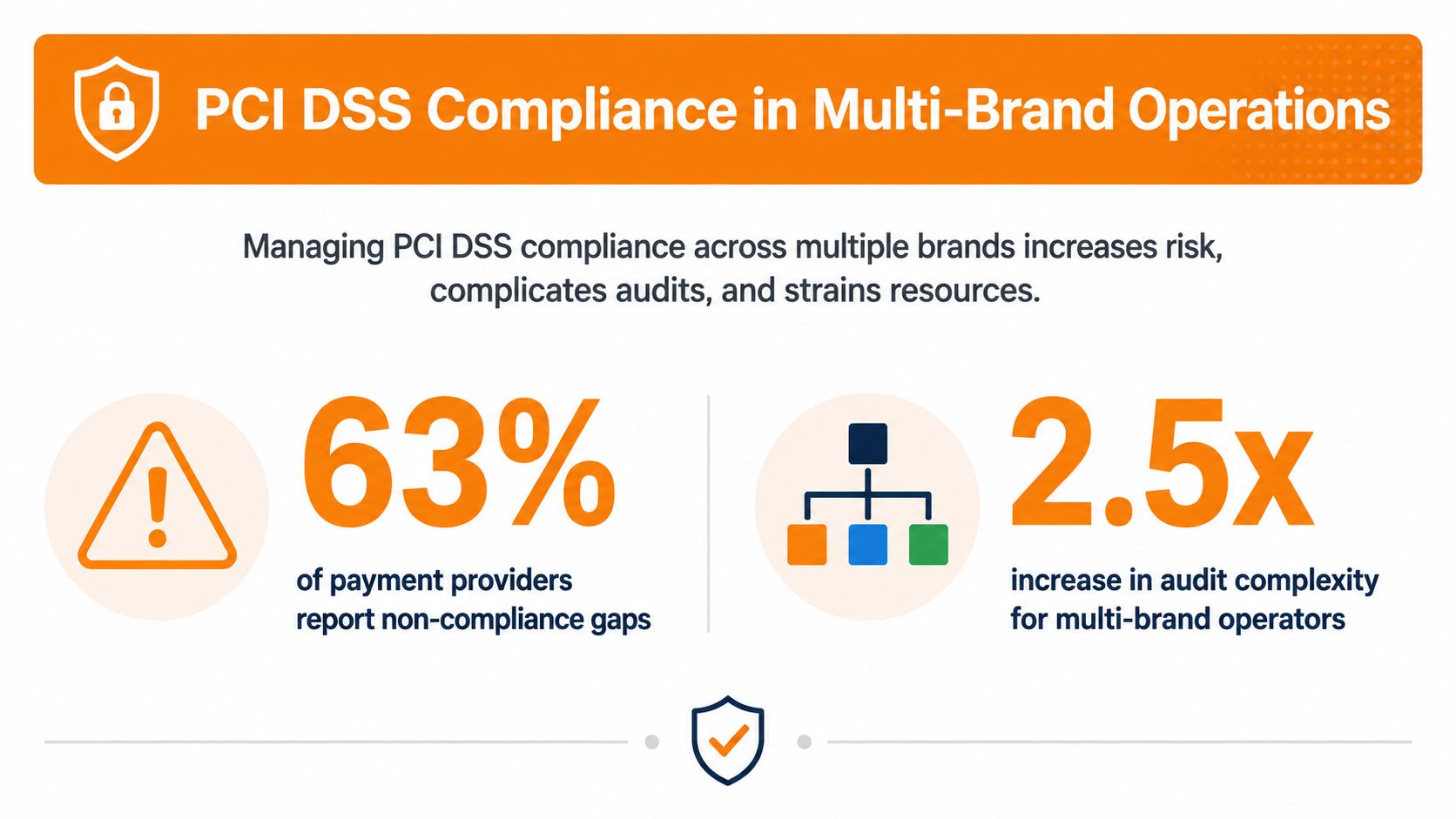
A PCI DSS industry summary reported that 63% of data breaches involving payment cards in 2023 involved organizations that weren't compliant with PCI DSS. The same summary reported that 62% of global merchants reported full compliance with PCI DSS 3.2.1 in 2023, up from 55% in 2021. It also stated that 96% of more than 1.2 billion active payment cards worldwide were processed through PCI DSS-compliant systems.
These figures don't mean that certification prevents every incident. They show why operators should treat PCI DSS as a baseline operating discipline rather than a document produced for an audit. Non-compliance can expose weaknesses in access management, vulnerability handling, monitoring, testing, or network design. Compliance can also become superficial when teams focus on collecting evidence instead of controlling real payment paths.
Build one control model across brands
A multi-brand environment needs a single inventory of payment components, data flows, service accounts, and vendors. Map the difference between shared infrastructure and brand-specific configuration. Then assign an owner to each control and record which party supplies the evidence.
Useful practices include:
- Separate tenant access: Brand teams should see only the player, reporting, and payment data required for their duties.
- Centralize sensitive services: Keep tokenization, key management, payment routing, and high-risk administrative functions behind controlled services.
- Record configuration changes: Log who changed an acquirer route, risk rule, payout setting, or webhook endpoint, and require review for sensitive changes.
- Test evidence continuously: A clean audit folder can't compensate for stale inventories, inactive accounts, or undocumented integrations.
- Preserve financial traceability: Reconcile provider reports to the internal ledger and retain the relationship between authorization, capture, refund, chargeback, and balance movement.
The biggest audit failures usually aren't exotic cryptographic problems. They're forgotten accounts, unclear ownership, excessive privileges, incomplete vendor evidence, and environments that have expanded beyond the original scope. Design the architecture to make the secure path the easiest path to operate.
Crypto Versus Fiat Payment Security Trade-offs
Crypto and fiat payments can share a cashier and player wallet, but they shouldn't share identical risk logic. Cards and bank payments rely on regulated intermediaries, issuer decisions, settlement files, and dispute mechanisms. Cryptocurrency transactions rely on wallet custody, blockchain addresses, network confirmation, transaction screening, and operational controls around irreversible transfers.
The important distinction is reversibility. A card transaction can enter a chargeback or refund workflow. A confirmed blockchain transfer generally can't be pulled back by the operator because a player claims the payment was unauthorized. That makes address validation, withdrawal approval, wallet governance, and transaction monitoring central to crypto security.
| Security Aspect | Cryptocurrency | Fiat (Cards/Bank) |
|---|---|---|
| Fraud prevention | Wallet screening, transaction monitoring, address controls, withdrawal review, and custody protection | Issuer authorization, acquirer controls, 3D Secure 2, velocity rules, device signals, and transaction risk scoring |
| Dispute handling | Transfers are generally difficult to reverse, so prevention and operational review carry more weight | Refunds, reversals, and chargebacks provide formal dispute paths, but create liability and evidence requirements |
| Data exposure | Operators focus less on PAN storage and more on wallet keys, signing permissions, addresses, and transaction metadata | Operators must control cardholder data, tokens, payment credentials, provider access, and authentication records |
| Compliance workflow | Screening and source-of-funds controls must account for wallet activity and asset movement | KYC, AML, sanctions screening, acquirer rules, and card-network obligations shape processing |
| Reconciliation | The ledger must account for blockchain confirmation, network fees, asset denomination, and exchange-rate treatment | The ledger must match authorizations, captures, settlement files, fees, refunds, and chargebacks |
For multi-currency wallet design, keep the player-facing balance model separate from payment-rail mechanics. A unified backend can present one account view while maintaining distinct controls for fiat settlement and crypto custody. Operators evaluating this model can also review multi-currency wallet architecture as part of their platform assessment.
Crypto doesn't eliminate payment risk. It changes where the risk sits. Fiat concentrates risk around credentials, intermediaries, authentication, and disputes. Crypto concentrates it around key custody, transaction finality, address manipulation, asset handling, and reconciliation discipline.
Fraud Prevention and Dispute Management Integration
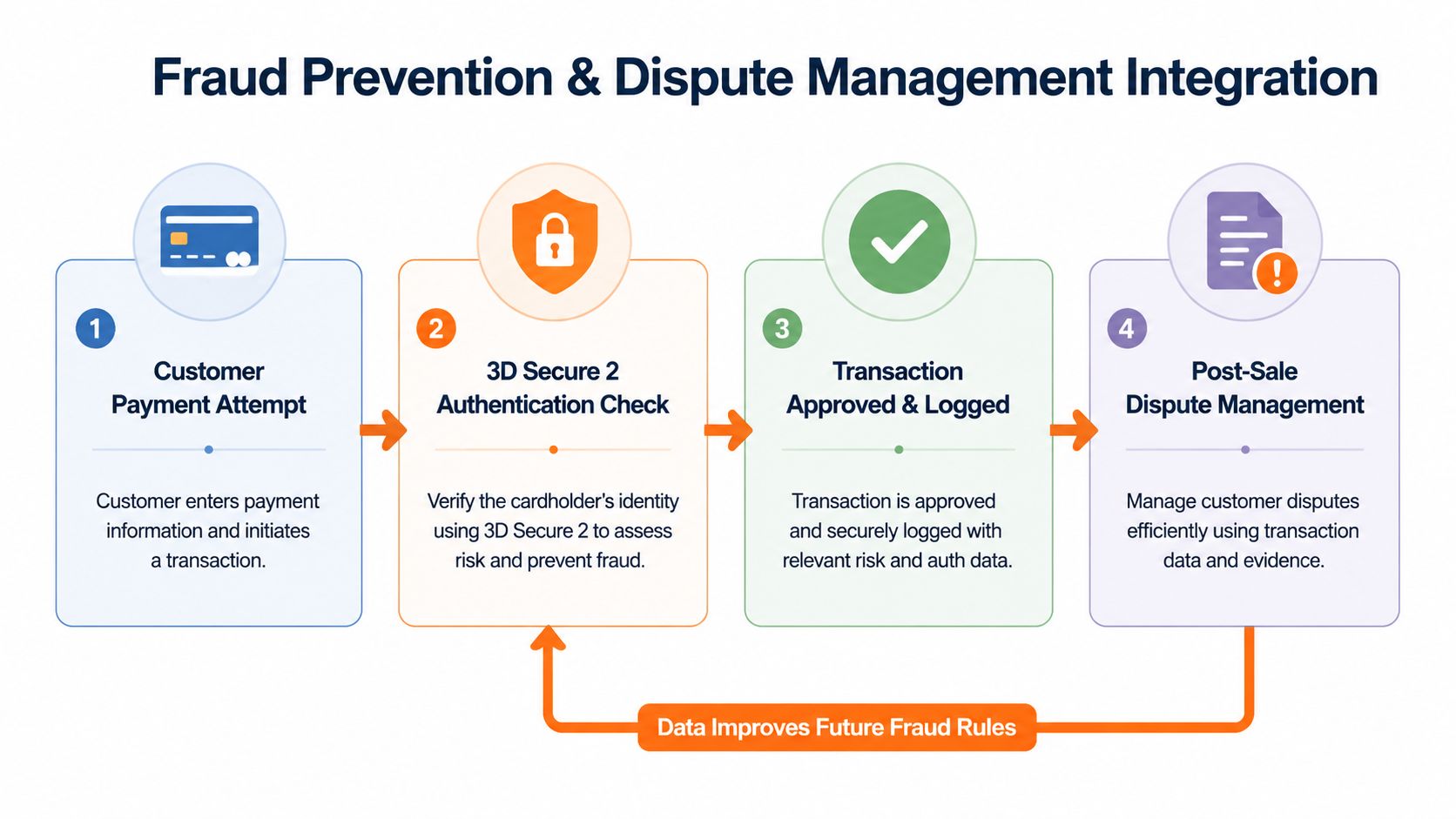
Authentication and disputes belong in one feedback system. A 3D Secure 2 result can affect authorization, liability, evidence collection, and later chargeback handling. If the fraud engine decides without retaining the signals behind that decision, the dispute team may receive only a transaction ID and little usable context.
The European Central Bank reported that the EEA payment-fraud rate was around 0.002% of total transaction value in 2024, while total fraud reached €4.2 billion, up from €3.5 billion in 2023. The same report recorded 19.6 million fraudulent payment transactions in 2024, including about 17.06 million fraudulent card transactions out of roughly 111.05 billion card transactions. The operational lesson is clear: a small rate across substantial payment volume still creates a workload that needs automation, evidence retention, and disciplined exception handling. The ECB and EBA report provides the underlying figures.
Use adaptive authentication with usable evidence
3D Secure 2 supports card-not-present payments by authenticating the cardholder through the issuer and potentially shifting fraud liability away from the merchant when authentication succeeds. A challenge on every deposit adds friction and can reduce approvals. Shopify reported a 26-basis-point increase in payment success rates and an 8-basis-point reduction in chargeback rates for merchants using optimized 3DS, as documented by the PCI Security Standards Council's 3DS Core information.
Implementation detail matters more than the label. Store the authentication result, exemption or challenge reasoning, device and session context, provider response, and final authorization outcome. Send the relevant evidence into the dispute workflow at decision time. Asking a separate team to reconstruct the event later usually leaves gaps.
Operators managing fraud and dispute workflows in parallel benefit from documented risk-management practices, including clear ownership for rules, evidence, reviews, and escalation.
Strong authentication alone cannot address manipulation-based fraud
The ECB and EBA found that strong customer authentication remains effective against the fraud types it was designed to mitigate, while manipulation-based attacks are increasing. In these cases, the payer may complete authentication after being deceived about the transfer, recipient, or payment purpose. The ECB statement on emerging fraud patterns distinguishes credential and authentication attacks from this manipulation problem.
Controls must therefore extend beyond OTPs and 3D Secure:
- Confirm the transaction context: Show the amount, merchant or recipient context, and meaningful payment details before approval.
- Score behavior: Compare device, session, account, deposit, withdrawal, and beneficiary patterns instead of relying on one authentication result.
- Delay high-risk payouts: Send unusual withdrawals to manual review or enhanced verification when the risk model warrants it.
- Learn from disputes: Feed confirmed fraud, player reports, account-compromise indicators, and provider outcomes back into the rules.
- Separate player support from approval authority: A support agent should not override a financial control without a logged, reviewable process.
A mature dispute operation preserves evidence, classifies the event, identifies the failed control, and updates the prevention layer. It can reject unsupported claims while accepting valid disputes and correcting the process that allowed them through.
Third-Party Risk and Ecosystem Security Governance
Your payment stack is only as secure as the vendor connection that can bypass its intended boundaries. A processor, fraud provider, KYC service, affiliate system, observability tool, or integration partner may not hold PANs, yet it can still expose credentials, alter transaction metadata, interrupt service, or create a route into privileged operations.
Visa's reported 41% increase in ransomware incidents affecting payments ecosystem entities in the first half of 2025 reinforces why point-in-time vendor approval isn't enough. The operator needs a living governance model that covers onboarding, changes, monitoring, incidents, exit planning, and evidence. A vendor's certification can support due diligence, but it doesn't replace an assessment of how that vendor connects to your environment.
Make responsibility explicit
For each provider, document the data it receives, the actions it can perform, the credentials it uses, the systems it can reach, and the events it sends back. Contracts should address breach notification, audit cooperation, security requirements, subcontractors, access termination, recovery expectations, data handling, and assistance during investigation.
Use vendor management practices for payment ecosystems to structure the review, but keep the decisions specific to payment impact. A low-risk marketing integration and a payment router shouldn't receive the same access, monitoring, or approval path.
Segment third-party access so a compromised supplier can't move laterally into the player database, wallet ledger, token vault, or administrative plane. Prefer short-lived or narrowly scoped credentials, restrict inbound connections, validate webhook signatures, and monitor unusual volume, timing, destinations, and administrative activity. Test revocation before an incident forces you to discover that nobody knows which credentials are active.
A practical governance review should answer:
- Which vendor can stop deposits or withdrawals?
- Which supplier can change transaction routing or payout rules?
- Which integration can write to a player balance or financial ledger?
- How will the operator continue processing if that provider is unavailable?
- Which logs remain available if the vendor account is compromised?
- Can the operator replace the vendor without losing transaction history or reconciliation evidence?
The video below provides additional context for thinking about security boundaries and third-party exposure.
Secure payment processing is therefore a governance problem as much as a technical one. The strongest operator knows where responsibility ends, where it begins, and how to contain the damage when a trusted provider fails.
Implementation Best Practices for iGaming Operators
Start with a payment-architecture review, not another checklist. Trace a deposit and withdrawal from cashier request through authentication, processor response, internal ledger, settlement file, refund, and dispute. Mark every point where data, credentials, or financial state changes.
Use these implementation priorities:
- Reduce card-data spread: Tokenize at the provider boundary and keep PANs out of wallet, bonus, sportsbook, and analytics services.
- Protect the vault: Separate token services, restrict de-tokenization, enforce role-based access, and log every sensitive operation.
- Tune 3D Secure 2: Use adaptive challenges, preserve authentication evidence, and avoid applying unnecessary friction to every player.
- Separate crypto and fiat controls: Give crypto wallets, signing permissions, address checks, and asset reconciliation their own risk policies.
- Reconcile independently: Match provider events to an internal ledger and make callbacks idempotent, reviewable, and resistant to duplicate processing.
- Govern vendors continuously: Review privileged access, subcontractors, incident obligations, recovery procedures, and exit options.
- Test operational failure: Simulate processor outages, delayed webhooks, compromised credentials, rejected settlements, and disputed withdrawals.
NexGrate provides a turnkey white-label platform combining casino, sportsbook, payments, player wallets, KYC and AML workflows, fraud controls, compliance reporting, and third-party integrations for iGaming operators. If your current stack has grown into disconnected payment, risk, and reconciliation services, review the architecture with NexGrate and identify which controls can be consolidated, segmented, or monitored more effectively.