Buy-in is the amount a player commits to enter a game, tournament, or betting market. In an iGaming stack, that isn't just a payment, it's a wallet event with rake, prize pools, and KYC attached.
You're probably seeing it land in your cashier, your tournament lobby, or your reporting view and wondering whether it means the same thing everywhere. It doesn't, and that's where operators get into trouble fast.
Table of Contents
- Why Operators Ask What Buy-In Really Means
- Defining Buy-In Inside Casino and Sportsbook Products
- How Buy-In Money Flows Through the Wallet
- Rebuys and Add-Ons That Extend the Buy-In
- Compliance and Player Protection Around Buy-Ins
- Crypto Versus Fiat for Buy-In Payments
- Implementation Checklist for Platform Operators
- Connecting Buy-In to Stakeholder Support and Settlement Risk
Why Operators Ask What Buy-In Really Means
The first buy-in on launch day looks like a simple success event. A player taps to enter, the wallet debits, and the lobby updates. Then the edge cases arrive, and that's where the key question starts.
A buy-in can mean a seat at a poker table, entry into a slot tournament, a sportsbook contest fee, or even the broader business idea of stakeholder support. In finance, the term also has a strict market meaning tied to failed delivery and replacement securities, which makes it even easier to confuse if you only rely on casual language. The cleanest operator habit is to separate the meaning by product and by workflow, not by intuition alone. Cambridge's definition of buy-in captures the modern support sense, while the securities-market definition covers the settlement sense.
Why the casual definition breaks down
If you say “buy-in means entry fee,” you still haven't answered the important questions. Does the money go to a prize pool, to operator revenue, to a rake line, or to a reserved tournament ledger? Does the player receive a seat, chips, a contest ticket, or just eligibility to place a bet?
Practical rule: treat buy-in as a state change, not a label. Once the player pays, your platform should know which game state, wallet bucket, and compliance checks are triggered.
That distinction matters on regulated platforms because operations, finance, and compliance all need the same event to mean the same thing. One team may call it entry, another may call it activation, and a third may log it as a sale. The platform has to reconcile all three without ambiguity.
Defining Buy-In Inside Casino and Sportsbook Products
A good way to understand buy-in is to compare it with a day pass versus class enrolment. A day pass gets you in once, while enrolment ties payment to a specific experience and a specific rule set. In gaming, that same split shows up across poker, tournaments, and contest products.
The product view
At a poker table, buy-in usually means the amount needed to sit down with chips. In a slot tournament, it's the ticket that lets the player compete for a prize pool. In a sports betting contest or fantasy-style entry, it's the amount that activates participation in that structured event rather than a normal wager.
The operator doesn't just collect money in these cases. The platform needs to map the debit to the correct game object, the correct ledger, and the correct user entitlement. That's why a buy-in is different from a normal deposit.
| Buy-In Formats Across Casino and Sportsbook Products | |||
|---|---|---|---|
| Product Type | Buy-In Trigger | Player Receives | Operator Captures |
| Poker cash game | Player chooses a seat and funds the stack | Chips or seat eligibility | Rake and session activity |
| Tournament | Player enters a scheduled event | Tournament registration and starting stack | Entry funds tied to the event pool |
| Slot tournament | Player joins a timed competition | Competition access and score tracking | Entry funds and event participation data |
| Sportsbook contest | Player joins a market-based competition | Contest entry and scoring rules | Entry funds plus contest metadata |
Why the wallet has to understand the difference
A casino wallet should not treat every buy-in like a generic debit. A one-off tournament entry is not the same as a recurring poker seat purchase, because the downstream accounting differs. If you blur them together, you make it hard to answer basic questions about entitlement, refunds, and prize allocation.
The clean mental model is simple, a buy-in is the player's pre-paid entry commitment. The wallet confirms the money, the product grants the right to participate, and the back office records where that money is supposed to land.
How Buy-In Money Flows Through the Wallet
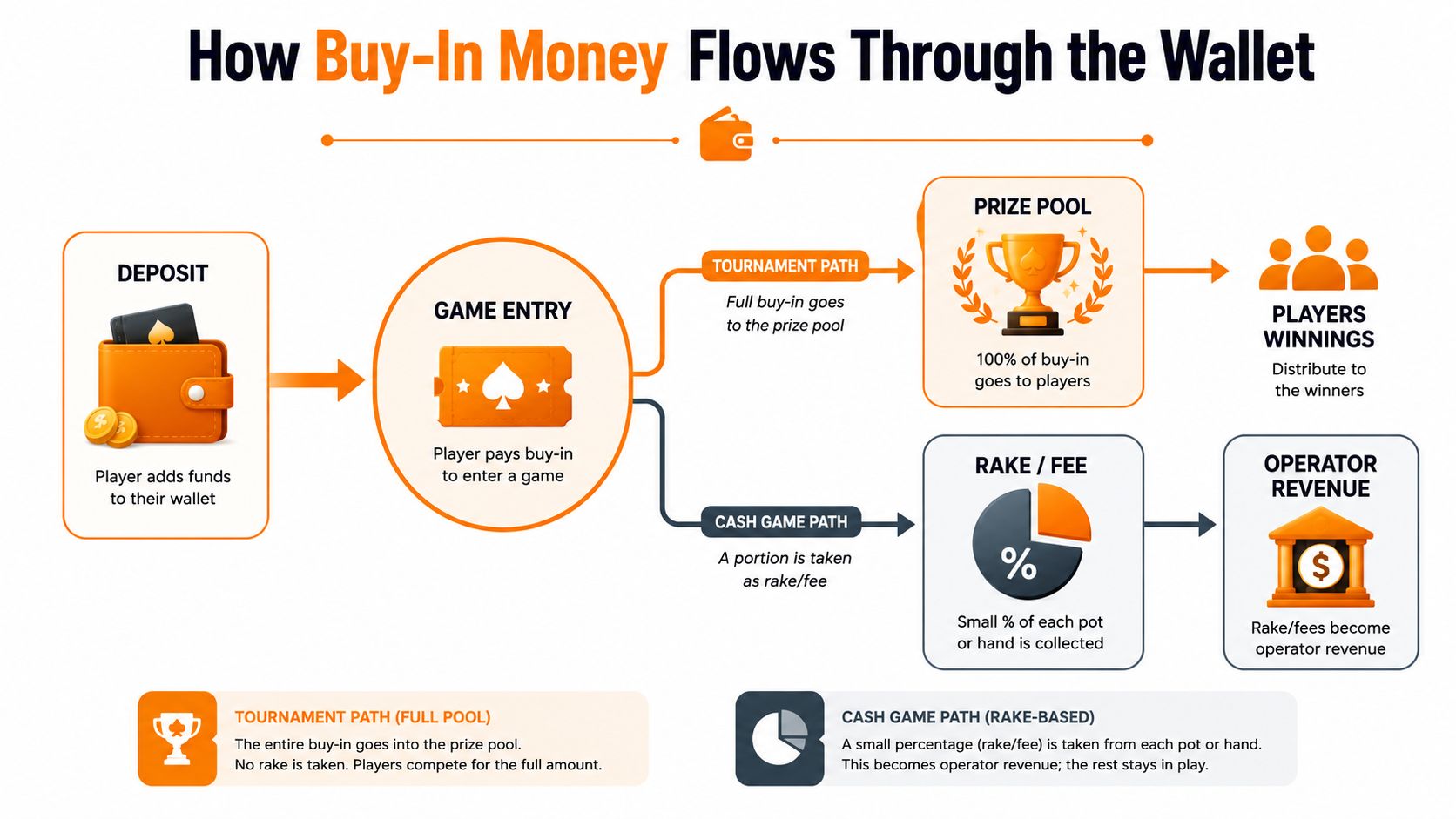
The money path matters more than the label. When a player buys in, the platform has to decide what portion becomes a pool contribution, what portion becomes a fee, and what portion stays reserved for later settlement. If that logic is wrong, every report downstream gets noisy.
Cash games and rake-based models
In a rake-based cash game, the player's buy-in funds the stack, and the operator takes a slice as the fee. The important point is that the operator doesn't keep the whole amount as revenue, because part of it belongs to game state, not the house. That split needs to be visible in the cashier, the game engine, and finance reporting.
Tournaments and guaranteed pools
Tournament buy-ins work differently. The entry funds usually feed the prize pool, while the operator may also recognize a separate fee line depending on the product design. If the event is guaranteed, the operator can end up absorbing any shortfall between entries and the promised pool. That's why tournament finance is not just collection, it's commitment management.
A simple worked example helps. If a player enters a $10 plus $1 event, the wallet should record $10 toward the pool and $1 as the fee line, so ten entries create a $100 prize pool and a $10 fee line. The platform then needs double-entry logic so the pool liability, fee revenue, and player balance all reconcile cleanly.
A buy-in that looks small on the front end can create three separate obligations in the back office, player entitlement, pool funding, and operator revenue.
For operators wiring this into a unified cashier, the wallet layer has to stay consistent across products, especially if the same player can move between casino and sportsbook flows. A multi-currency architecture helps here, and a practical example of that kind of wallet design is outlined in NexGrate's multi-currency wallet overview.
Rebuys and Add-Ons That Extend the Buy-In
Tournaments make buy-in more complicated because the first entry is often only the start. Players can re-enter, top up, or add extra value at a defined break, and each of those actions changes the wallet and prize logic in a different way.
Rebuys versus add-ons
A rebuy restores the player to a fresh starting position after busting out or falling below a threshold. An add-on is different, because it's usually a fixed extra package offered at a specific point in the event, often during a break. The rebuy behaves like a new buy-in of the same type, while the add-on behaves like an extension to the existing tournament position.
That distinction matters in reporting. If your platform treats both as the same event, you can overstate player participation or misstate the prize pool. You also risk letting bonus balances subsidize an add-on in a way your terms never intended.
What the wallet must do
The cashier should post a rebuy as a fresh entitlement tied to the same event ID, not as a generic deposit. An add-on should be recorded as a separate, controlled uplift with its own eligibility rule and timestamp. If the tournament allows both, the back office needs to show exactly when each occurred and which balance source funded it.
For operators, the trap is simple. A player who rebought twice is not the same as a player who entered once and bought an add-on. The ledger has to preserve that difference so finance, customer support, and compliance can all read the same truth.
Compliance and Player Protection Around Buy-Ins
Buy-ins trigger compliance checks because they move money into a regulated environment and create a recorded gambling event. That means the cashier can't just approve payment and move on. It has to compare the transaction against KYC status, responsible-gaming settings, jurisdiction rules, and AML monitoring logic.
What gets checked before approval
If a player tries to buy into a contest after hitting a daily limit, the cashier should block the transaction or route it for review, depending on policy. The point is not to punish the player, it's to enforce the limit the operator already promised. The same logic applies when a wallet is funded from an account that hasn't cleared identity checks or when a player is outside a permitted region.
A solid audit trail for each buy-in should include the player ID, product ID, timestamp, amount, funding source, limit check result, geofence result, and final transaction status. Regulators and internal auditors both want a record that shows what the system saw, what decision it made, and why.
Why this is a design issue, not just a policy issue
Compliance fails when systems are stitched together loosely. If KYC lives in one service, geofencing in another, and wallet posting in a third, the buy-in can slip through one gate and fail at another. That creates support tickets, reconciliation issues, and avoidable risk.
A platform architect has to think in terms of event order. Verify the player, check the jurisdiction, evaluate the limit, and then post the buy-in. If those steps happen out of sequence, the ledger can say yes when the regulator expected no.
Crypto Versus Fiat for Buy-In Payments
Payment rail choice changes the buy-in experience in visible ways. Cards, bank transfers, e-wallets, and crypto all move value, but they don't create the same operational burden. The cashier has to handle them differently or the reporting layer gets messy fast.
Fiat buy-ins
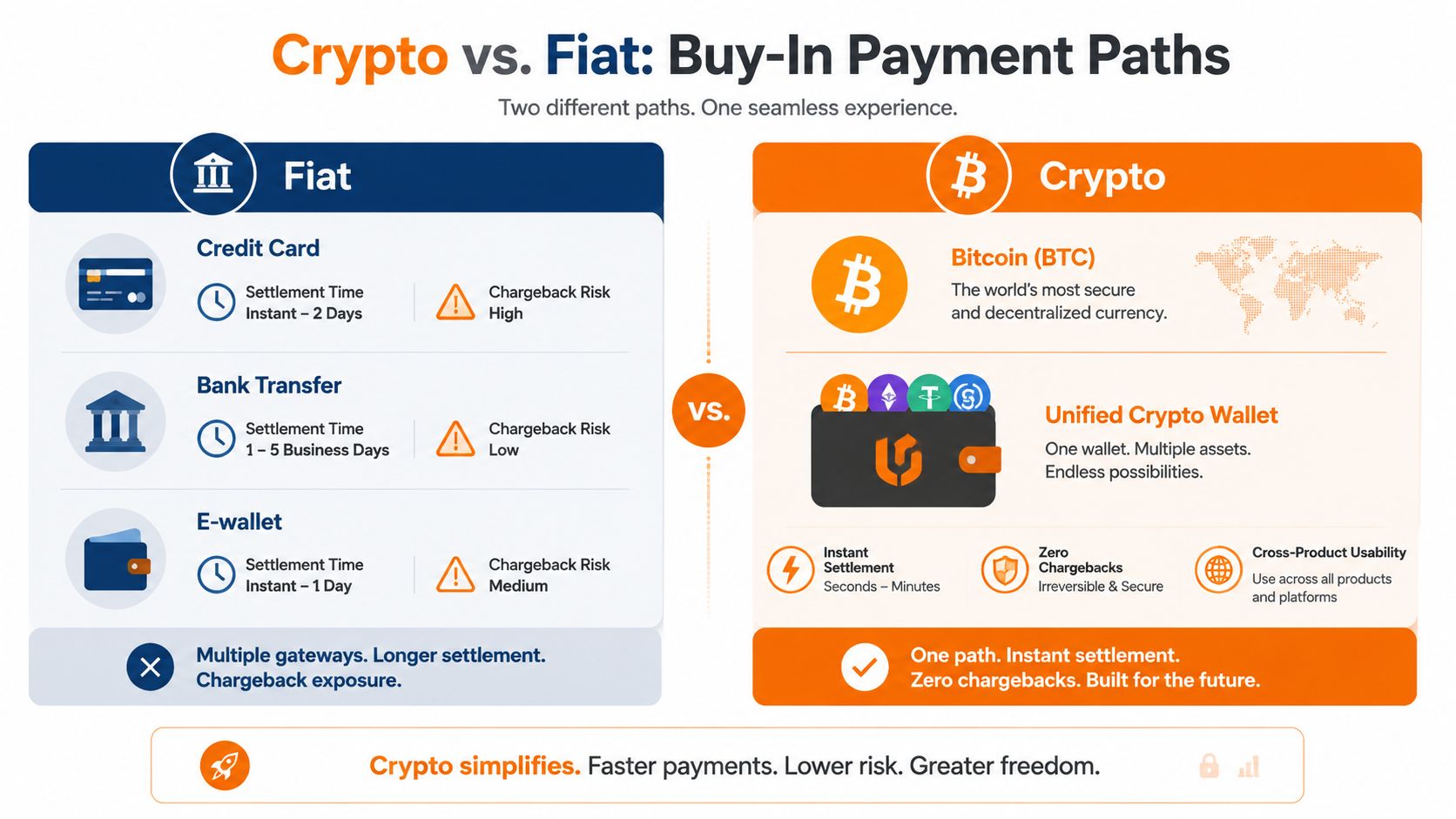
Fiat is familiar to most players. Cards and bank transfers fit standard refund workflows, and that makes them easier to explain to support teams and finance staff. They also make it simpler to line up marketing, bonuses, and accounting because the money path is already familiar to most internal teams.
Crypto buy-ins
Crypto gives operators a different set of advantages. It often settles faster, it avoids chargebacks, and it can support a more unified wallet experience across casino and sportsbook products. Players who value speed, privacy, or cross-product continuity often prefer it, especially if they already manage digital assets.
The best cashier design doesn't force one rail into the reporting model of another. Instead, it preserves a single buy-in event schema and tags the funding source clearly so promotions, limits, and revenue reporting stay coherent. If you're building that kind of stack, NexGrate's crypto casino software overview is a useful reference point for how unified wallet thinking shows up in practice.
Operational takeaway: don't let payment choice create a second version of the buy-in event. The cashier should record one entry model, then decorate it with rail-specific details.
Implementation Checklist for Platform Operators
A buy-in flow should be auditable from the first click to the final ledger post. If it isn't, the platform can misread a refund, a rebuy, or a promotional entry, and the reporting trail starts to drift apart.
What to verify before launch
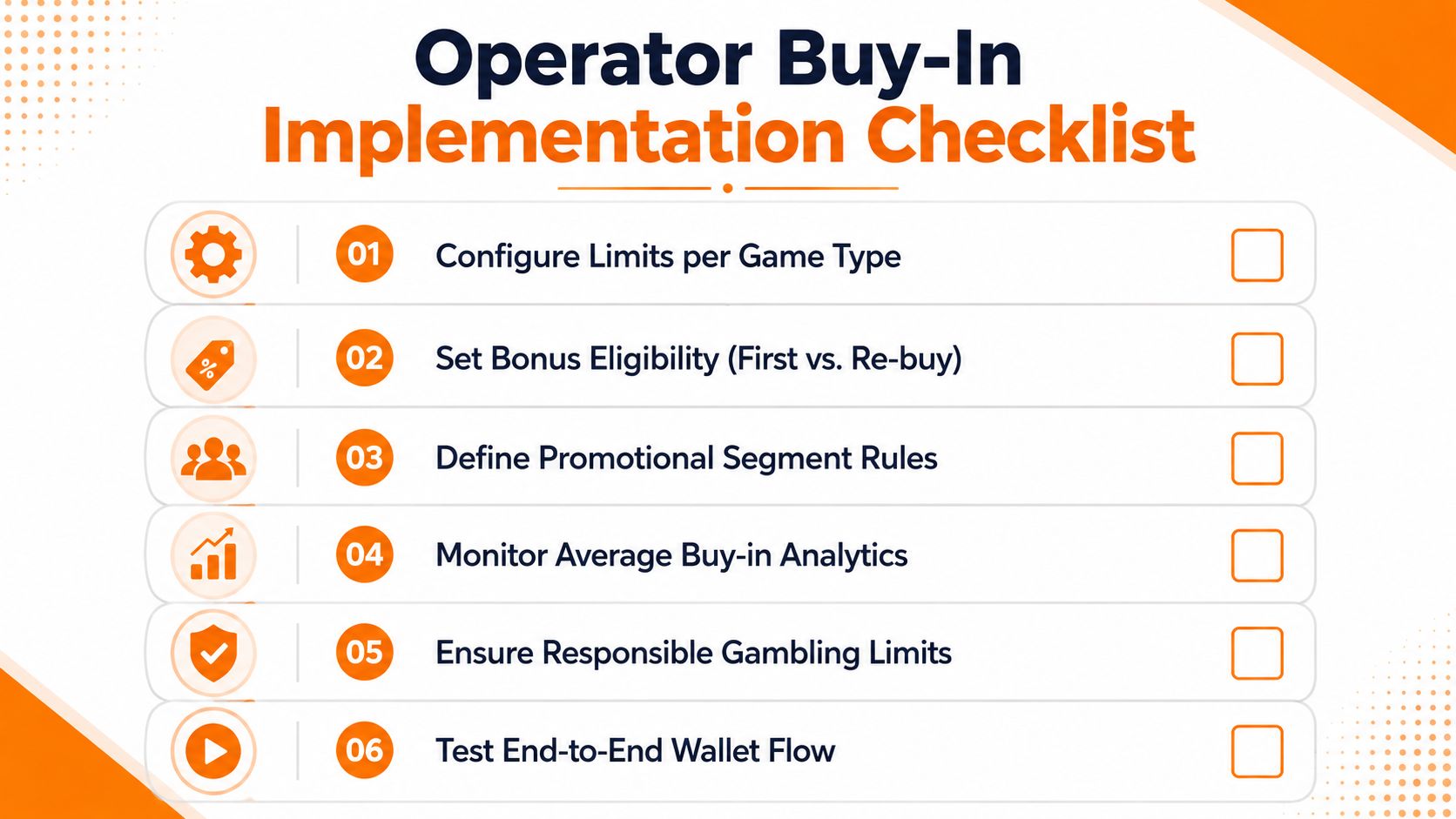
- Configure limits per game type. Set separate caps for tournaments, cash games, sportsbook contests, and any other buy-in product so one rule does not leak into another.
- Set bonus eligibility cleanly. Decide whether the first buy-in, a rebuy, or an add-on can use bonus funds, then encode that rule in the cashier.
- Define promotional segment rules. If a promo buy-in is only for a cohort, the CRM and wallet need the same segment definition.
- Monitor buy-in analytics. Track entry volume, re-entry behavior, and product mix so support and finance see the same story.
- Enforce responsible gaming limits. Daily, weekly, and product-level limits should block or flag buy-ins before approval.
- Test end-to-end wallet flow. Run the full path from payment initiation to event registration, settlement, and refund handling.
How to test the messy cases
Refunded buy-ins after a cancelled tournament need a dedicated script, not an improvised manual fix. The same applies to chargebacks, duplicate entries, and failed rebuys. If the back office cannot show who changed what and when, the buy-in logic is not ready for production.
The best test is to run the same player through different paths, first entry, rebuy, add-on, cancellation, and refund. If the logs stay clean and the balances match, the platform is ready. For a wider view of operational controls around player funds and settlement risk, see best practices for risk management.
Connecting Buy-In to Stakeholder Support and Settlement Risk
A casino operator can get the player-facing buy-in flow right and still run into trouble if the internal teams are not aligned. The same word, buy-in, also means active support and willingness to participate, which is why management teams ask for it before a launch or a policy shift. Merriam-Webster's definition captures that support meaning clearly, and it has nothing to do with a cashier debit.
That second meaning matters in practice because rollout failures often look like product failures when they are really coordination failures. A product owner may approve a new sportsbook feature, but if support, compliance, finance, and payments are not committed to the process, the launch slows down at execution. The issue is not vocabulary, it is whether the right people are ready to act on the same plan.
The securities meaning adds another layer. In market practice, a buy-in is the forced repurchase of securities when a seller fails to deliver, so the buyer can replace the position and recover the loss, or in contractual settlement language, restore the parties to the intended economic position. The ICMA explanation of buy-ins shows how closely the term is tied to settlement discipline, not agreement or enthusiasm.
For operators, that distinction is useful because it separates three different control problems. In iGaming, a buy-in is a player's entry commitment and the wallet event that funds it. In management, it is stakeholder support for execution. In securities, it is a remedy for failed settlement. The common thread is obligation, alignment, and enforcement, but each system uses those ideas in a different way.
That is why platform teams should treat buy-in as a wallet-and-compliance design problem first. The cashier has to know when funds are committed, the ledger has to show what was reserved or consumed, and support teams have to explain the rule without mixing it up with stakeholder buy-in or settlement language. For a practical framework on the control side of that work, see best practices for risk management.
NexGrate helps operators connect cashier logic, compliance controls, and unified wallet flows into one platform. For casino and sportsbook teams, that means the buy-in rule is not just a label in the UI. It is a controlled event that can be tracked, explained, and settled in the same way from the first deposit to the final status update.