
A turnkey sportsbook solution is a pre-built, integrated platform combining odds feeds, betting engines, payments, and compliance controls so operators can launch quickly without custom development. The global sports betting market was valued at USD 100.9 billion in 2024 and is projected to reach USD 187.39 billion by 2030, but the fastest route into that opportunity isn't always the best permanent architecture.
That tension defines the turnkey model. Operators get a working foundation instead of coordinating separate trading, cashier, player account, compliance, and reporting vendors. They also accept boundaries around customization, commercial terms, data portability, and the provider's product roadmap.
The practical answer is to treat turnkey as a launch strategy. Use it to validate a brand, enter a jurisdiction, and establish operations. Then retain the option to replace the components that become strategically valuable as betting volume, regulatory obligations, and product differentiation increase.
Table of Contents
- What Is a Turnkey Sportsbook Solution
- How Turnkey Sportsbook Technology Works
- Why Turnkey Platforms Accelerate Launch
- Turnkey vs White-Label vs Custom Development
- Vendor Evaluation Checklist
- Vendor Lock-In and Scaling Strategy
- Getting Started with Your Turnkey Launch
What Is a Turnkey Sportsbook Solution
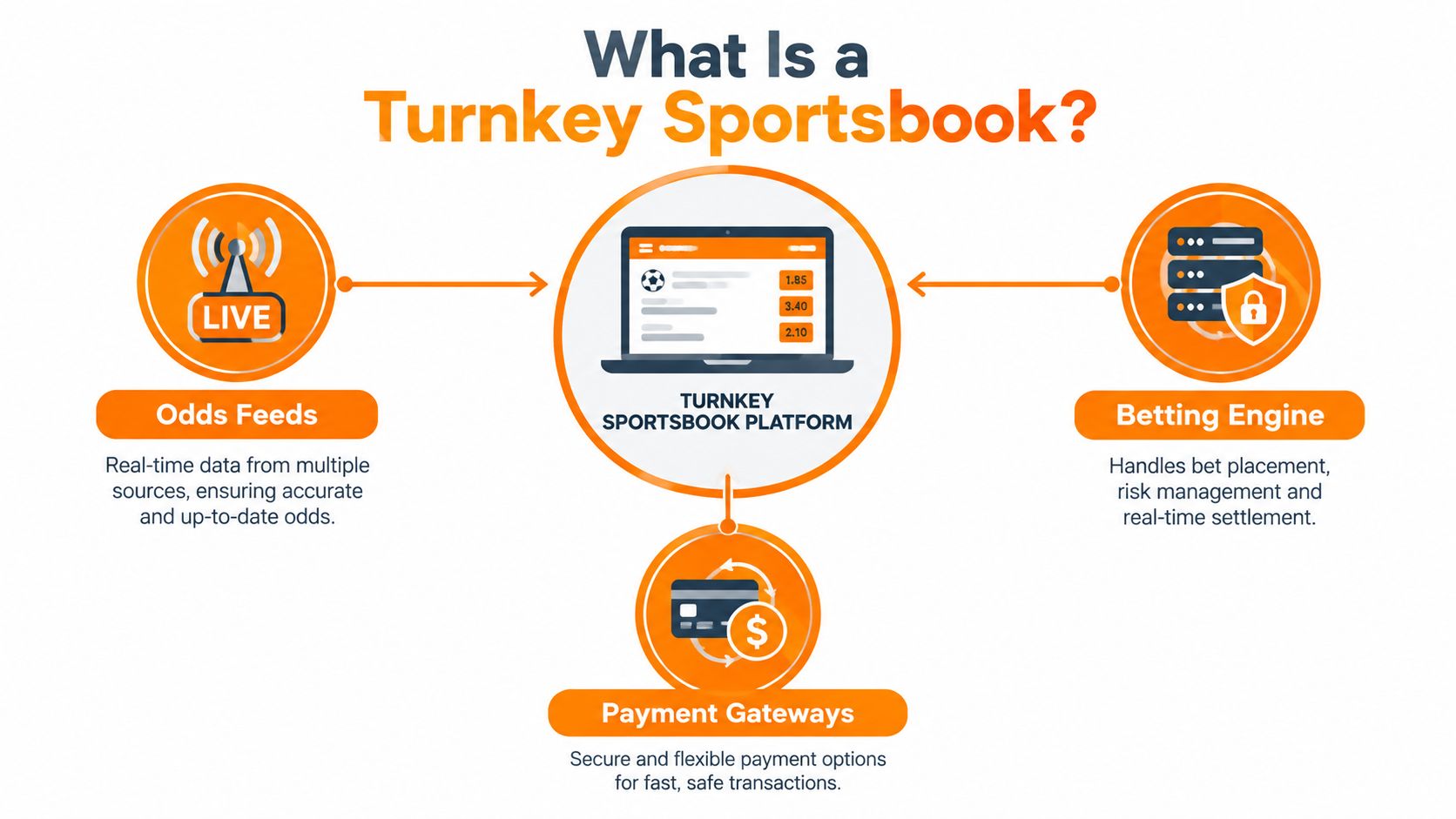
A turnkey sportsbook solution is a complete betting platform supplied with the core infrastructure needed to operate an online sportsbook. That usually includes odds feeds, market management, bet acceptance, settlement, player accounts, wallet functions, payment connections, risk controls, reporting, and compliance tooling in an integrated environment.
The difference from assembling a sportsbook yourself is operational. Instead of selecting a trading provider, building an acceptance service, connecting a cashier, and creating regulatory reports as separate workstreams, the operator configures a platform that already connects those functions. The provider handles much of the underlying engineering, while the operator focuses on licensing, brand positioning, acquisition, promotions, and day-to-day trading decisions.
The integrated kitchen behind the brand
A useful analogy is a restaurant kitchen. A custom build means sourcing each appliance, designing the preparation areas, hiring specialists, and connecting every station before serving the first customer. A turnkey platform arrives with the stations wired together. You still decide the menu, pricing, customer experience, and operating standards, but you aren't constructing the kitchen while taking orders.
That integration matters because a sportsbook isn't just a front end showing prices. An odds update must reach the market display, a bet must be checked against the current price and exposure rules, and the resulting transaction must flow into settlement, the wallet, reporting, and customer support records. A break between those systems creates rejected bets, disputed balances, stale prices, or incomplete audit trails.
Who benefits from the model
The model suits new operators, brands entering an additional jurisdiction, casino businesses adding sports betting, and teams that want to test a proposition before funding proprietary infrastructure. It also suits operators that have strong marketing or trading capabilities but don't want to maintain every platform layer internally.
Turnkey doesn't remove operational responsibility. The operator remains accountable for the brand, customer treatment, responsible gaming, regulatory obligations, commercial performance, and vendor governance. The platform reduces the amount of technology that must be built, but it doesn't turn sportsbook operation into a passive activity.
How Turnkey Sportsbook Technology Works
A production sportsbook typically separates its critical path into stateless odds ingestion, stateful bet acceptance, and idempotent settlement. That split isn't academic. Each service has a different job, different failure mode, and different tolerance for delay, as described in this technical guide to sportsbook data flow.
1. Odds ingestion keeps market information moving
Odds feeds arrive from data and trading providers. The platform normalizes event names, participants, markets, prices, status changes, and suspension signals into a common internal format. Stateless ingestion services can process and distribute updates without storing the entire betting transaction state in each worker.
Event-driven brokers such as Kafka or NATS commonly move updates between feed handlers, market services, caches, and client-facing systems. At the edge, Redis can support fast reads, while WebSocket services push price and status changes to connected users rather than waiting for repeated page requests.
2. Bet acceptance protects transaction integrity
Bet acceptance is stateful because the system must evaluate the precise moment of placement. It checks whether the market is open, confirms the available price, applies stake and exposure rules, authenticates the player, and writes the wager atomically.
Rate limiting, retries, and circuit breakers help contain feed volatility. A retry can be useful for a temporary network failure, but it mustn't create a duplicate wager. A circuit breaker can stop the platform from accepting bets when a dependency is returning unreliable market states.

3. Settlement must be repeatable and auditable
Settlement grades the result, calculates returns, updates balances, and records the ledger event. Idempotency ensures that repeating a settlement message doesn't pay the same wager twice. That protection matters during failover, queue redelivery, or a temporary connection loss between the sportsbook and wallet.
Live betting adds a strict timing problem. Technical guidance cites under 500 milliseconds as feasible in tuned architectures, while about 2 seconds is described as an upper ceiling before an update begins to feel stale, according to this live betting latency and failover analysis. Slower ingestion or market-state writes increase stale-price exposure, arbitrage risk, and the likelihood of market suspensions.
Practical rule: Ask a vendor to demonstrate what happens when a feed goes stale, a market suspends during bet placement, and the primary service fails. A diagram isn't enough. You need the recovery behavior and the audit record.
Why Turnkey Platforms Accelerate Launch
The strongest business case for turnkey is not that it makes technology unimportant. It makes technology less likely to become the launch bottleneck.
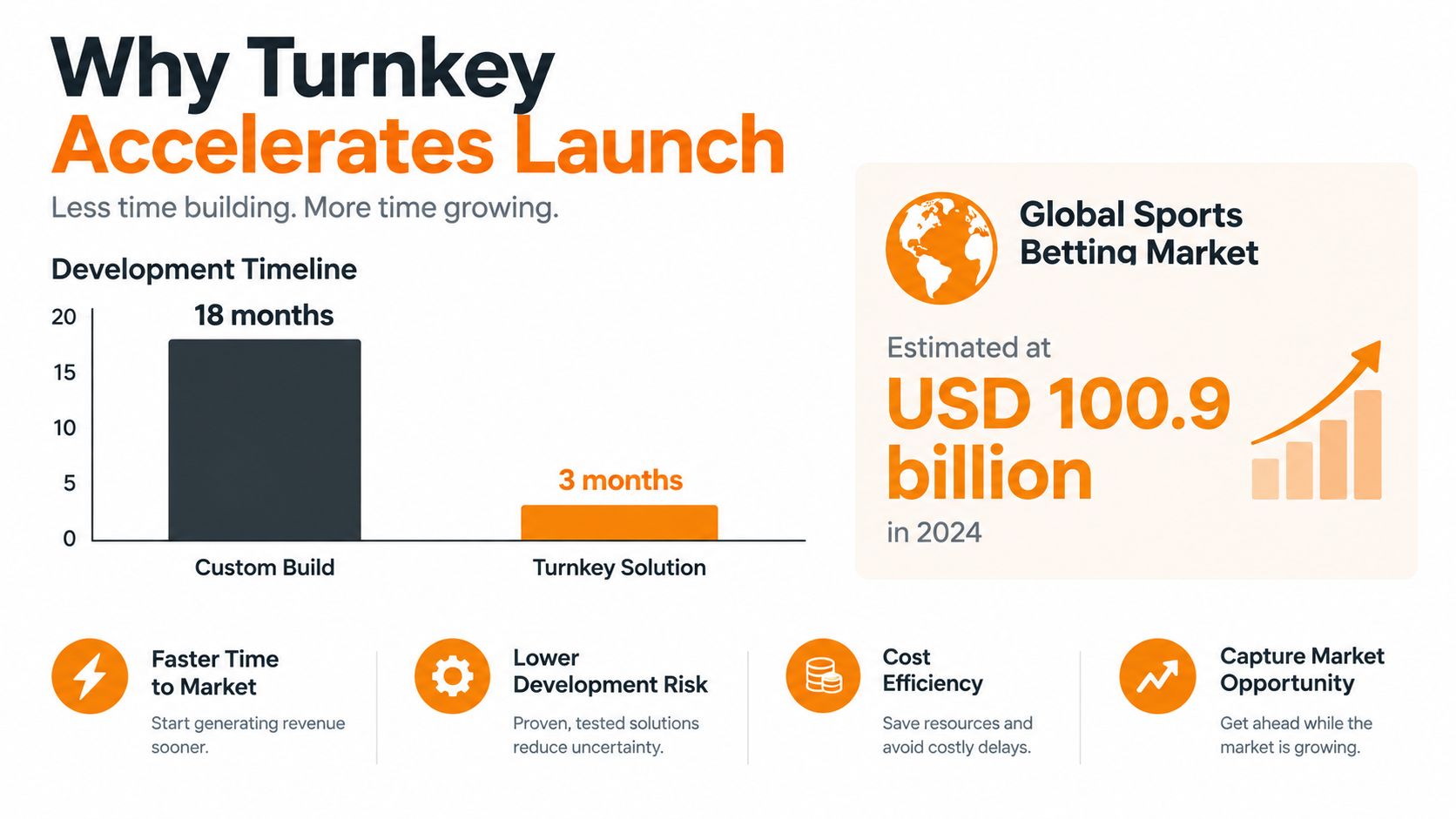
The global sports betting market was estimated at USD 100.9 billion in 2024 and is projected to reach USD 187.39 billion by 2030, according to Grand View Research's sports betting market analysis. The same source projects the online segment to grow at a 12.8% compound annual growth rate from 2025 to 2030.
That expansion creates a timing problem. A brand may have a strong acquisition plan, a market opportunity, or a seasonal launch window, but none of those advantages matter if the team is still integrating payments and building settlement controls. Turnkey platforms combine the principal operating layers, allowing the operator to progress on several launch workstreams at once.
Integration reduces coordination risk
With a fragmented build, the operator must define ownership across odds, trading, wallet balances, payment status, identity checks, customer support, and regulatory reporting. Every handoff needs testing, monitoring, escalation rules, and a fallback process.
A consolidated platform doesn't guarantee a clean launch, but it reduces the number of independent interfaces that can fail. It can also provide a common back office, shared player records, and consistent transaction identifiers. Those details make operational teams faster when they investigate a rejected bet, a delayed withdrawal, or a settlement dispute.
The online segment's stronger projected growth makes this especially relevant for digital-first operators. A platform designed for online betting can connect front-end experiences to live pricing, payments, and account controls without requiring the operator to create the entire operating layer before testing demand.
Speed has a limit
Fast deployment is valuable only if the launch market, license path, payment coverage, and operational support are ready. A turnkey vendor can supply the technology, but it can't decide which jurisdictions fit the business, secure every approval, or create a credible responsible gaming operation on the operator's behalf.
The best use of turnkey is therefore selective. Compress the engineering work that isn't your differentiator, then invest internal attention in market selection, player protection, trading quality, customer support, and commercial execution.
Turnkey vs White-Label vs Custom Development
These models are often treated as interchangeable, but they distribute control differently. White-label usually prioritizes speed and provider-managed operations. Turnkey offers a more configurable integrated platform, while custom development gives the operator ownership of the architecture and roadmap at the cost of greater delivery responsibility.
| Model | Launch Speed | Customization | Cost Structure | Best For |
|---|---|---|---|---|
| White-label | Fastest route when the provider controls most of the setup | Limited, with branding and configuration within provider boundaries | Provider fees, often tied to managed services or commercial sharing | Entrepreneurs testing a brand with minimal technical ownership |
| Turnkey | Fast, because core sportsbook, payments, and operating tools are pre-integrated | Moderate, depending on APIs, front end, workflows, and provider permissions | Setup or license fees, service charges, and potentially revenue-share pricing | Operators seeking a usable platform with more control than white-label |
| Custom development | Slowest, because the operator builds and integrates the stack | Deepest control over product, data, risk logic, and roadmap | Higher development and maintenance responsibility | Established businesses treating technology as a competitive asset |
A white-label arrangement can be sensible when marketing and distribution matter more than product ownership. The trade-off is that shared infrastructure and provider constraints can make differentiation and migration harder. A turnkey model gives the operator more room to shape the customer experience and operating workflows, but the provider still owns critical technology layers.
Custom development is the right direction when proprietary risk management, unusual betting logic, or complete roadmap control directly supports the business model. It isn't automatically better. The operator must fund engineering, security, compliance updates, data relationships, uptime management, and support processes over the life of the platform.
For a deeper explanation of the fastest model and its limitations, compare this white-label sportsbook solution overview. The useful decision question isn't “Which model is best?” It's “Which capabilities must we own, and which can we rent while we prove demand?”
Vendor Evaluation Checklist
A vendor meeting should end with evidence, not a feature catalogue. Evaluate the platform across the layers that can stop a launch or weaken the operation after launch.
Technology and operating resilience
Ask how odds are normalized, how market suspensions propagate, and how the platform behaves when a feed, wallet, or payment dependency becomes unavailable. Request API documentation, sandbox access, incident records, service-level definitions, and a walkthrough of bet-level traceability.
Look for idempotent settlement, clear observability, regional deployment options, failover procedures, and a back office that lets staff investigate transactions without engineering assistance. A polished front end can't compensate for opaque ledger behavior.
Compliance belongs in the first workstream
Ask which target jurisdictions are supported and what evidence the provider can supply for certification, audit logs, geo-controls, KYC, anti-money laundering workflows, responsible gaming, and regulator reporting. Recent operator guidance on sportsbook platform development and compliance warns that licensing and certification treated as late tasks can leave a technically complete platform unable to launch.
Payments, integrations, and commercials
Test the cashier with the actual payment methods and currencies required by your target market. Clarify who owns the processor relationship, who handles reconciliation, how chargebacks are managed, and whether crypto support changes the compliance workflow.
Then review the contract:
- API access: Confirm which data and services are available through documented interfaces.
- Provider dependencies: Identify proprietary trading, payment, identity, and reporting components.
- Data ownership: Establish access, retention, export format, and migration rights before signing.
- Support coverage: Define escalation paths for trading incidents, settlement disputes, and outages.
- Commercial triggers: Model license, usage, integration, and revenue-share costs against realistic growth scenarios.
Use this sports betting platform evaluation guide as a further reference point, but make the final decision from demonstrations, contract language, and technical tests rather than sales claims.
Vendor Lock-In and Scaling Strategy
Turnkey is frequently sold as an end-to-end destination. In practice, it often works better as a staged architecture.
The initial benefit is obvious. The operator launches on established infrastructure, uses integrated trading and cashier functions, and learns which parts of the business create competitive value. The hidden cost appears later, when the provider's trading engine, data model, release schedule, or commercial structure limits a strategy that has started to work.
Recent operator guidance on turnkey sportsbook software identifies limited customization, dependence on the provider's trading engine, and revenue-share pricing as important trade-offs. The same guidance describes a hybrid path, where operators launch on turnkey infrastructure and replace high-value components as volume and complexity justify the investment.
Where the economics can change
Revenue share may be acceptable while the business is validating acquisition, brand positioning, and market fit. It becomes harder to defend when the operator has substantial proprietary exposure models, a well-developed affiliate program, or a customer journey that depends on workflows the vendor can't prioritize.
The question isn't whether the provider charges a fee. Every platform has a cost. The question is whether the fee remains aligned with the value the provider supplies after the operator has built its own expertise, customer data, and distribution.
Architecture principle: Rent the undifferentiated layer at launch, but preserve the interfaces and data rights needed to own differentiated layers later.
Build the exit path before you need it
A credible hybrid plan starts with boundaries. Keep the brand and customer experience portable. Require access to player, wager, settlement, and affiliate data. Document integration contracts, event schemas, reconciliation rules, and ownership of custom work.
The first replacement should usually target the component with the clearest strategic or economic payoff. That might be proprietary risk management, affiliate attribution, a specialized wallet workflow, or a market-specific integration. Don't replace stable infrastructure merely to appear more independent. Replace the layer when the operational benefit, margin improvement, or roadmap control justifies migration risk.
Vendor governance matters throughout the transition. This vendor management best-practices resource can help structure ownership, service reviews, escalation rules, and renewal decisions. A hybrid model succeeds when the operator plans the boundaries before the first dependency becomes permanent.
Getting Started with Your Turnkey Launch
Start with the business constraint, not the product demo. Write down the target market, launch window, licensing position, payment requirements, sports coverage, trading model, and customer experience you need at launch. Then separate essential capabilities from features that can wait.
Run compliance and technology work in parallel. Confirm that the platform can support the relevant geo-controls, KYC and responsible gaming processes, audit records, reporting obligations, and data requirements before commercial negotiations become too advanced. A provider's claim that a market is “supported” should lead to evidence, not assumption.
Use a structured vendor process:
- Define ownership: Decide which data, workflows, integrations, and product decisions must remain under your control.
- Test the critical path: Place test bets, trigger price changes, simulate suspensions, review settlement, and reconcile wallet updates.
- Review the commercial model: Compare fixed charges, usage costs, third-party fees, and revenue-share exposure over the intended operating horizon.
- Negotiate portability: Include data export, API access, transition assistance, service levels, and exit terms in the contract.
- Plan the next architecture: Identify the components you may replace if volume, regulation, or differentiation makes internal ownership worthwhile.
A turnkey sportsbook solution isn't a compromise when it matches the operator's stage. It becomes a problem when the launch contract dictates the company's long-term strategy.
Choose the platform that gets you live without hiding the path beyond launch. Demand a working technical demonstration, a jurisdiction-specific compliance review, a complete cost model, and a written answer on data ownership before you commit.
NexGrate provides a turnkey white-label platform that combines sportsbook, casino, payments, player management, compliance controls, and third-party integrations in one operating environment. If you're assessing a rapid sportsbook launch while keeping future scaling options in view, visit NexGrate to discuss the platform and your requirements.