
The 2026 U.S. National Money Laundering Risk Assessment records over 137,000 suspicious activity reports tied to $312 billion in suspicious activity through December 31, 2024. The operational lesson for iGaming is immediate: detection isn't only about finding suspicious behavior. It's about separating useful cases from a queue large enough to overwhelm investigators, then connecting fiat, gaming, identity, and crypto evidence into one defensible story. FinCEN's international AML timeline shows how modern AML programs grew around identifying abnormal activity, documenting it, and routing it for investigation.
A sportsbook or casino doesn't behave like a conventional bank. Player wallets, bonuses, bets, settlements, peer-to-peer games, affiliates, payment providers, and blockchain addresses create a moving network of relationships. A practical money laundering detection program therefore has to do three jobs separately: reduce alert noise, add behavioral context, and trace value across crypto and fiat rails.
Table of Contents
- Why Money Laundering Detection Is Harder Than It Looks in iGaming
- Common Money Laundering Typologies in Online Gaming and Sportsbooks
- Detection Methods from Rules to Machine Learning
- Identity KYC and Crypto On-Ramp Signals That Feed Detection
- Risk Scoring Alert Triage and SAR Reporting Workflow
- Integrating Detection into an iGaming Platform Stack
- Where Detection Still Fails and What Operators Must Do About It
- Operating Checklist Metrics and Regulatory Considerations
Why Money Laundering Detection Is Harder Than It Looks in iGaming
Most AML programs begin with rules because rules are fast to deploy and easy to explain. A deposit velocity threshold, a withdrawal mismatch, or a high-risk jurisdiction flag can create an alert in a way that a regulator and an investigator both understand. But iGaming detection becomes difficult when those alerts arrive without the player's full operating context.
The same account can claim a bonus, place low-risk bets, lose deliberately in a peer-to-peer game, deposit through several methods, and withdraw to a crypto wallet. Each event may look ordinary in isolation. Together, they may indicate coordinated bonus abuse, chip dumping, mule activity, or laundering through a payment chain.
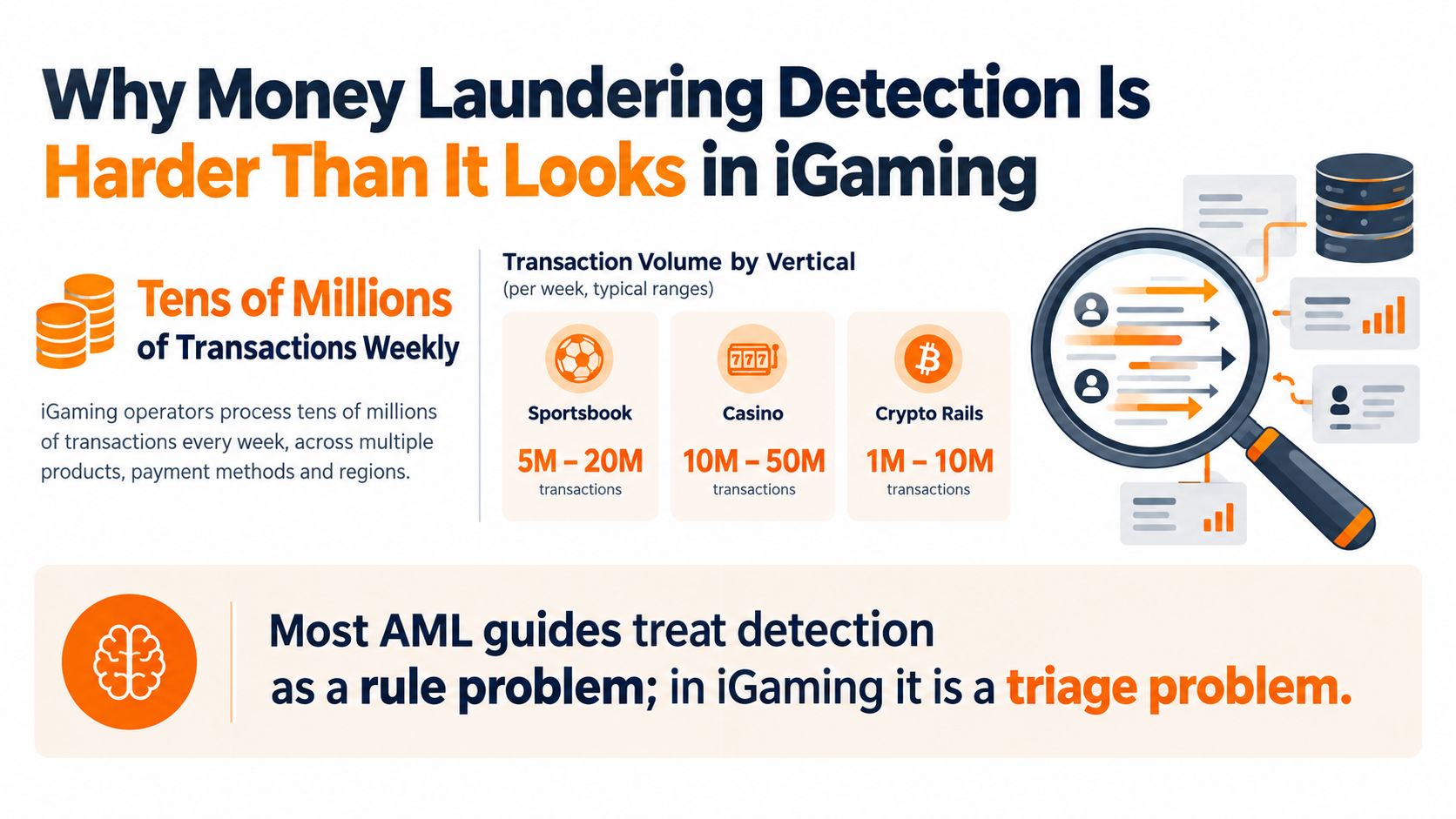
Three jobs, not one detection engine
Alert-volume triage asks whether the monitoring system is generating work investigators can realistically handle. Rules that trigger on every borderline event may seem thorough, but they consume attention and make serious cases harder to find.
Behavioral context explains why the activity matters. A $500 withdrawal means something different for a long-established player with consistent wagering than for a newly verified account linked to several devices, affiliates, and payment instruments.
Crypto and fiat bridging joins evidence that normally sits in separate systems. A platform may know the player, wallet, deposit method, and bet history, while a chain analytics provider knows the address exposure and transaction path. Neither view is sufficient on its own.
Practical rule: Treat the alert as an entry point, not the conclusion. The investigator needs the account history, linked entities, device relationships, payment path, and relevant gaming activity in the same case view.
The Basel AML Index 2025 covered 177 countries and jurisdictions and reported a global average risk score of 5.28 on a 0–10 scale, compared with 5.30 previously. More than half of jurisdictions improved, while 43% worsened, which points to uneven capacity rather than a solved detection problem. Basel Governance's AML Index overview reinforces why operators need automation and risk scoring, but those tools still need investigative design.
Common Money Laundering Typologies in Online Gaming and Sportsbooks
A bonus-abuse ring may look like a successful marketing campaign until the operator examines how the accounts behave. Several accounts register through the same affiliate channel, claim similar promotions, play at low stakes, meet only the minimum wagering conditions, and withdraw soon after funds become available. The useful signals aren't just the withdrawals. They include registration timing, device reuse, payment overlap, session similarity, and the relationship between stake size and available bankroll.
Chip dumping is more direct. In a peer-to-peer game, one account repeatedly loses to another, often in patterns that don't match ordinary play. Shared devices, synchronized sessions, repeated counterparties, and a narrow group of receiving accounts provide stronger evidence than any single loss. Rules may identify extreme outcomes, but graph analysis and investigator judgment usually reveal whether the players are coordinated.
Mule rings create another shape. A recruiter or controller may onboard multiple verified users, route funds through accounts that each make modest deposits and withdrawals, then consolidate value through an e-wallet or crypto address. KYC can pass because the documents belong to real people. The relationship between devices, IP behavior, affiliate sources, payment endpoints, and withdrawal destinations exposes the network.
Sportsbook activity adds its own variants. A player may place large bets on long-shot outcomes while maintaining a relationship with the counterparty or market, structure deposits to avoid internal triggers, or use rapid in-play activity to move funds through the wallet rather than pursue a genuine betting position. The key distinction is intent inferred from the whole sequence, not the odds or stake alone.
| Typology | Player Behavior Signature | Primary Detection Method |
|---|---|---|
| Bonus abuse | Coordinated registrations, low-risk wagering, rapid promotional withdrawals | Rules plus cohort analytics |
| Chip dumping | Correlated losses, repeated counterparties, synchronized sessions | Graph analysis and investigator review |
| Mule rings | Shared devices, linked payment endpoints, many verified accounts, consolidation | Entity resolution and network analytics |
| Sportsbook laundering | Unusual stake-to-bankroll relationship, structured deposits, pass-through betting | Rules, behavioral scoring, and case context |
| Crypto laundering | Wallet exposure, rapid conversion, layered withdrawals, weak source-of-funds explanation | Chain analytics and manual tracing |
These patterns overlap. A mule can exploit bonuses, dump chips to a controller, and withdraw through a crypto wallet. Your typology model should allow multiple tags on one case rather than forcing investigators to choose a single explanation too early.
Detection Methods from Rules to Machine Learning
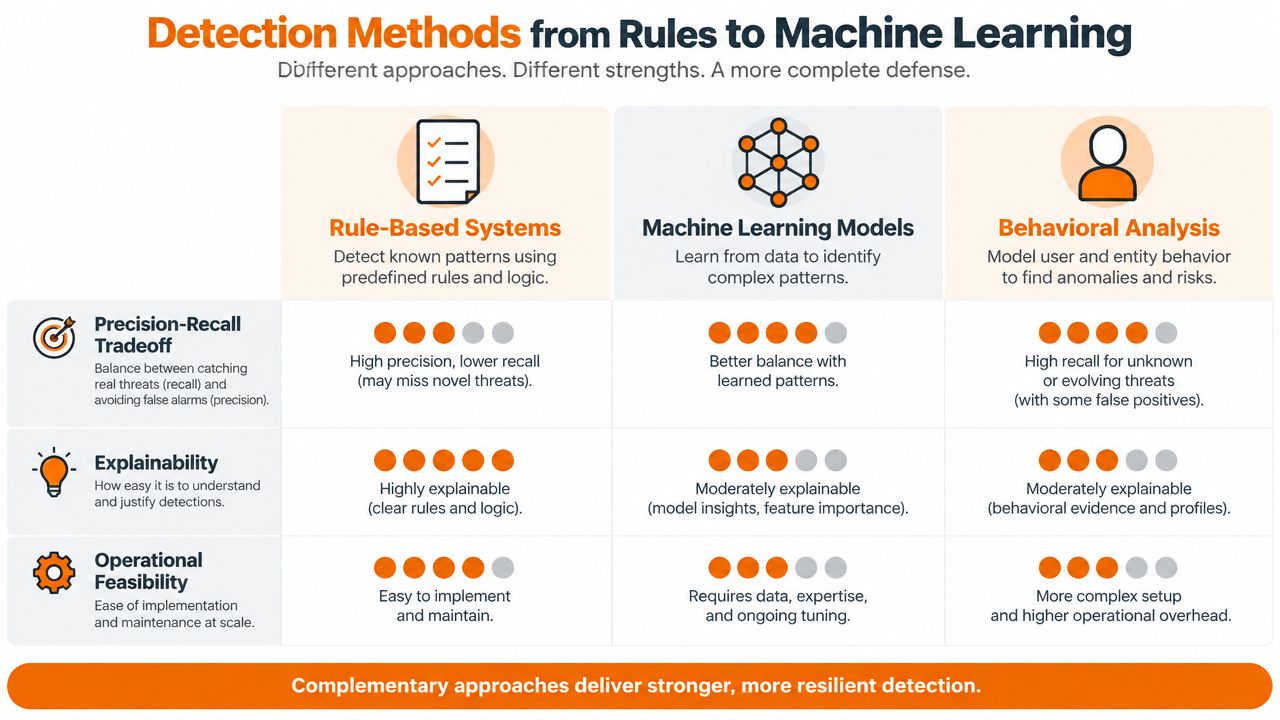
Rules, supervised machine learning, and behavioral analytics solve different problems. Treating them as competing replacements usually produces a weaker program than assigning each method a clear role.
Rules-based monitoring gives operators speed, transparency, and a defensible rationale. It works well for known conditions such as rapid deposit and withdrawal cycles, unusual jurisdiction combinations, repeated payment failures, and threshold behavior. The downside is noise. Static rules also age quickly when players or organized groups learn the boundaries.
Supervised ML can rank cases more effectively when the operator has reliable confirmed outcomes. An empirical study using actual U.S. financial-institution transaction data found that artificial neural networks consistently outperformed logistic regression, while support vector machines and random forests performed differently depending on event rates and sampling strategy. The study of supervised learning for AML detection supports a practical conclusion: model selection and class balance affect the precision-recall tradeoff, so teams shouldn't assume one algorithm works everywhere.
Unsupervised behavior analytics is useful when labels are scarce or the pattern is network-based. Peer-group deviation, device clusters, counterparty graphs, and community detection can expose coordinated activity that never crosses a simple threshold. This approach demands stronger data engineering and entity resolution, but it gives investigators context that row-by-row monitoring can't provide.
A practical maturity path looks like this:
- Starting program: Deploy explainable rules, then add a graph layer for devices, accounts, payment instruments, affiliates, and gaming counterparties.
- Developing program: Use behavioral features to prioritize alerts and route related accounts into one case.
- Mature program: Add supervised scoring, retrain on a planned cadence, and feed investigator outcomes back into model development.
False-positive suppression can be a separate layer rather than a replacement for transaction monitoring. One Springer study reported an 86% F-beta score and said 11% of money-laundering customers were incorrectly closed out of 1,926 test cases in its XGBoost-based suppression approach. The XGBoost false-positive suppression study illustrates why a second-stage model can reduce unnecessary review while preserving recall, provided the operator monitors missed-risk outcomes.
Identity KYC and Crypto On-Ramp Signals That Feed Detection
Downstream monitoring can't compensate for weak identity data. If the operator doesn't know whether several accounts belong to related people, the alert engine will either miss the relationship or generate separate, incomplete cases.
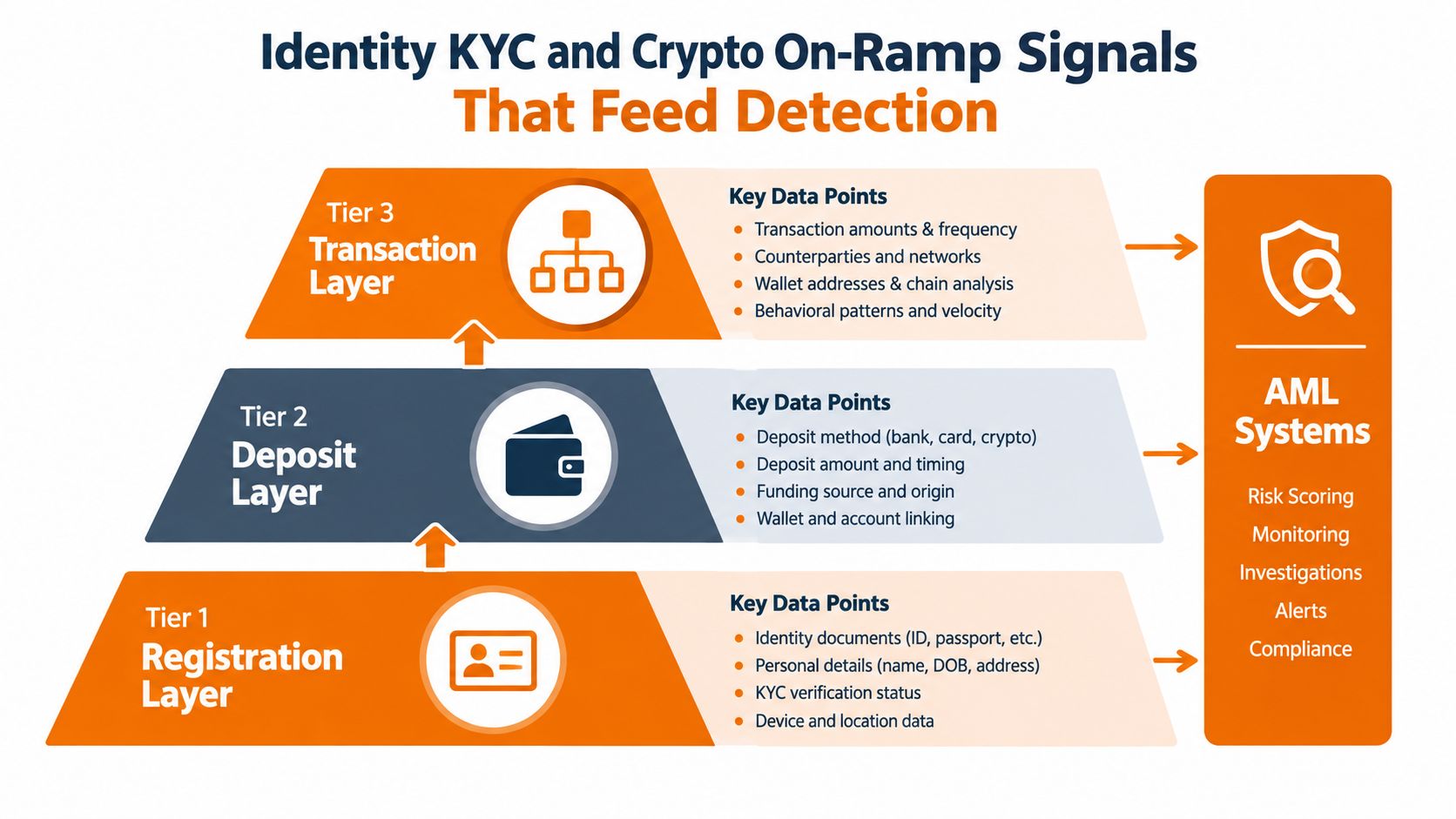
Use layered KYC at three points:
- Registration: Verify identity documents, liveness, sanctions, PEP status, email quality, device fingerprint, IP reputation, and proxy indicators.
- Deposit: Recheck identity and payment ownership when risk changes. Capture payment instrument reuse, wallet ownership assertions, source-of-funds responses, and changes in location or device.
- Withdrawal: Compare the destination with the funding history, gameplay, account ownership, and prior risk decisions. A withdrawal shouldn't be assessed as an isolated cashier event.
The monitoring engine should receive these events as structured signals, not as notes buried in a vendor console. Useful events include identity_verified, device_linked, payment_authorized, wallet_received, source_of_funds_requested, source_of_funds_resolved, and withdrawal_requested.
Crypto requires a separate evidence model. Track wallet age, address reuse, exposure to mixers or sanctioned services through a chain analytics provider, exchange-to-wallet paths, stablecoin funding, and whether the player can explain the source of funds. A chain score isn't a final finding. It is a reason to preserve the path, identify counterparties, and ask focused questions.
For operators assessing a crypto-focused build, crypto casino software capabilities should be evaluated alongside KYC, wallet controls, transaction monitoring, and case-management integration. A payment rail that sits outside the AML workflow creates avoidable blind spots.
The strongest alert is often the one that arrives with the identity problem already attached, not the one that makes an investigator discover it from scratch.
Risk Scoring Alert Triage and SAR Reporting Workflow
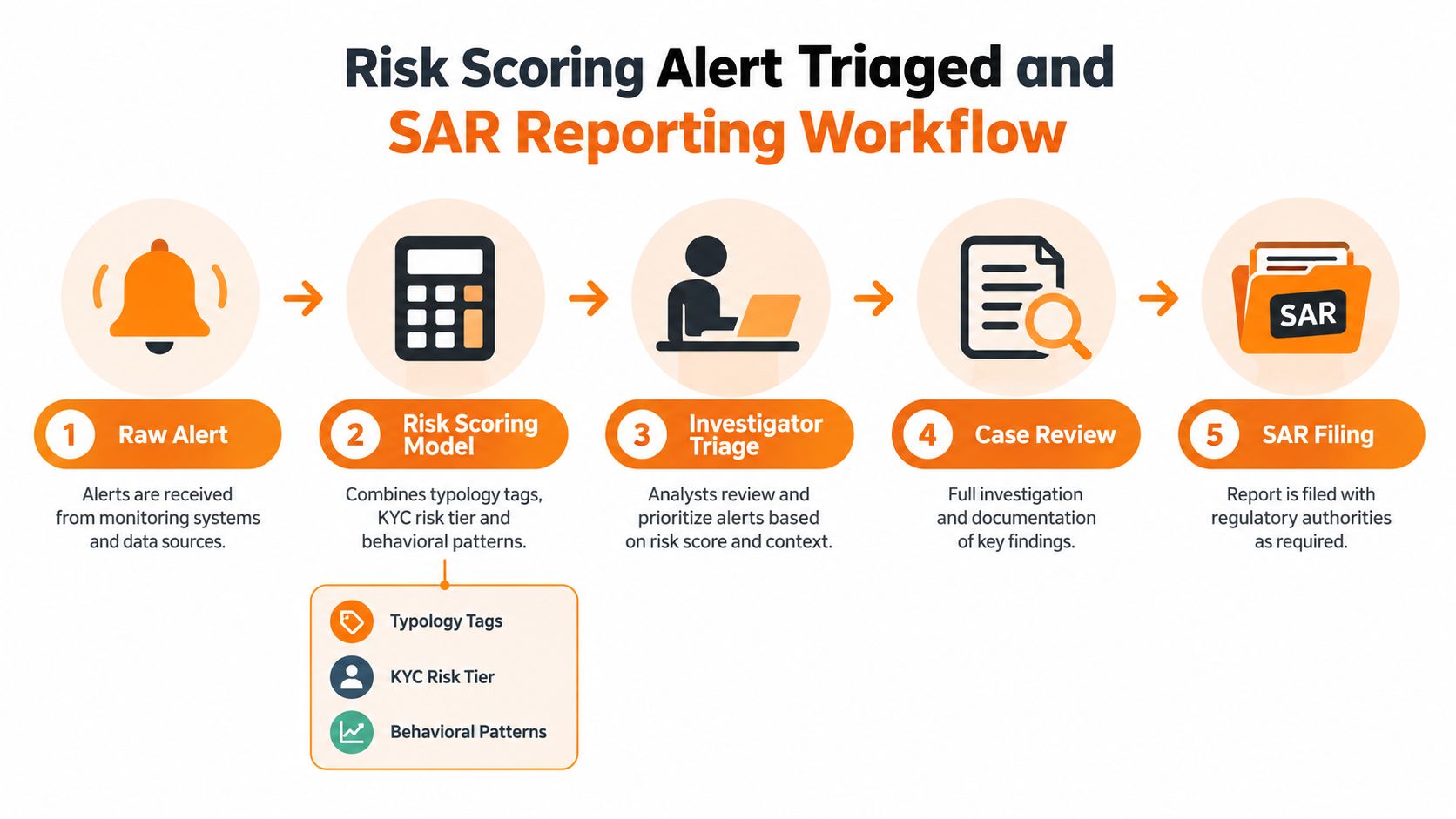
Risk scoring should combine evidence rather than just add more triggers. A workable design weights typology tags, KYC tier, behavioral anomalies, payment and device relationships, crypto exposure, and counterparty risk. The score should route work according to investigator capacity and the seriousness of the evidence.
A practical case pipeline
- Raw alert: Capture the triggering event, rule or model version, transaction IDs, player ID, wallet, payment method, and timestamp.
- Risk scoring: Add account history, linked entities, typology tags, and external risk signals.
- Initial triage: Auto-close only when the evidence supports closure and the decision is logged. Send ambiguous cases to an analyst.
- Case review: Build a timeline, inspect the entity graph, review gameplay and payments, request source-of-funds evidence where appropriate, and preserve relevant communications.
- SAR decision: A senior investigator decides whether the evidence supports filing, continued monitoring, account action, or closure.
Automation should stop where judgment becomes material. Customer outreach, source-of-funds assessment, evidence interpretation, and the final filing decision need accountable human ownership. Automation can prepare exhibits and timelines, but it shouldn't invent a narrative or obscure uncertainty.
A useful SAR narrative answers who, what, when, where, why, and how. For iGaming, that means identifying the account controller, describing the relevant deposits and withdrawals, explaining the bonus or gameplay behavior, mapping linked devices and counterparties, documenting crypto movements, and stating why the combined activity appears suspicious. Preserve chat logs, KYC decisions, payment records, wallet traces, and investigator rationale as exhibits.
Teams that want to formalize the reporting layer can use compliance reporting guidance as a reference point for connecting operational evidence with documented reporting processes. Peer review, timeliness checks, and feedback from filed cases should tune future scoring.
Integrating Detection into an iGaming Platform Stack
A detection architecture becomes practical when every important player action produces a consistent event. The platform team shouldn't ask the AML engine to reconstruct activity from disconnected exports after an alert fires.
| Source Event | API or Integration | Required Audit Fields | Latency Budget |
|---|---|---|---|
| Player registration | Identity verification webhook and account service | Player ID, identity result, device ID, IP, timestamp, decision reason | Event-driven |
| Payment authorization | PSP risk API and wallet service | Transaction ID, instrument token, amount, currency, risk response, actor ID | Near real time |
| Bet settlement | Sportsbook event feed | Bet ID, market, stake, outcome, settlement time, wallet impact | Event-driven |
| Withdrawal request | Cashier and payout provider webhook | Withdrawal ID, destination, amount, approval state, reviewer, rationale | Near real time |
| Bonus claim | Promotion service event stream | Bonus ID, campaign, affiliate, eligibility decision, wagering state | Event-driven |
| Crypto wallet receipt | Chain analytics endpoint and wallet service | Address, transaction hash, asset, network, risk result, timestamp | Provider-dependent |
For payment decisions, many operators set a service objective of under five seconds for alert generation, while behavioral models can run in scheduled batches when they need a broader activity window. The critical design choice is isolation. Monitoring workloads shouldn't block bet placement, wallet updates, or settlement processing.
Every alert and case needs immutable references. Store transaction IDs, player and actor IDs, model or rule versions, source events, decision rationale, timestamps, reviewer identity, linked cases, evidence hashes where appropriate, and the exact state before and after an action. If a regulator asks why a withdrawal was delayed or why an account was closed, the operator should reconstruct the decision without relying on a mutable spreadsheet.
A unified platform can reduce integration seams, but it doesn't remove governance work. For example, NexGrate describes a white-label iGaming platform that brings casino, sportsbook, payments, KYC and AML workflows, fraud controls, reporting, and audit logs into one operating environment. Operators still need to validate configuration, jurisdictional coverage, provider responsibilities, and evidence retention before relying on any platform capability.
Where Detection Still Fails and What Operators Must Do About It
Transaction monitoring doesn't solve activity that only becomes suspicious after the underlying predicate crime or wider network is understood. The ENSEMBLE project notes that laundering linked to areas such as drug trafficking, cultural goods, and artefacts may be detected only after the underlying perpetrators are identified. It also describes human intelligence as the primary starting point for many investigations, with transactional data often helping reconstruction more than initial detection. ENSEMBLE's analysis of money laundering detection is a useful corrective to the assumption that more alerts automatically produce better outcomes.
In iGaming, a bonus-funded ring may never create an unusual payment amount. Chip dumping may produce normal deposits and ordinary bet settlement records. A mule network may pass KYC because every document belongs to a real person. Rules alone won't connect those facts.
Build the missing intelligence layer
Operators need investigators who can link people, devices, affiliates, payment endpoints, and gaming behavior across cases. That means combining network analytics with manual research, relevant counterparty information, law-enforcement feedback, and carefully governed external intelligence. Public leak material can be useful only when collected and handled lawfully, with clear provenance and access controls.
Crypto makes the gap wider. The Council of Europe identifies permissionless access, automated transactions, cross-border activity, absent conventional intermediaries, and difficulties with attribution and jurisdiction as enforcement challenges in DeFi. Its guidance on crypto-asset investigations shows why operators need evidence preservation and entity attribution, not only bank-style velocity rules.
Measure the program by closed-case quality, useful escalations, defensible filings, and missed-risk findings. Alert counts can rise while investigative effectiveness falls.
Operating Checklist Metrics and Regulatory Considerations
A quarterly review should test whether the program produces useful decisions, not merely whether controls are switched on. Start with a baseline and segment results by typology, product, jurisdiction, payment method, and risk tier.
| Metric | Target Benchmark | Driving Requirement |
|---|---|---|
| Alert-to-SAR conversion | Set a defensible internal baseline, then review by typology | Demonstrates whether alerts produce actionable cases |
| False-positive rate by typology | Reduce avoidable noise without weakening recall | Protects investigator capacity |
| Median time to triage | Define service levels by risk tier | Supports timely intervention and reporting |
| Case closure quality | Peer-reviewed, evidence-backed rationale | Demonstrates effective governance |
| Source-of-funds escalations | Consistent triggers and documented outcomes | Strengthens risk-based customer review |
| Withdrawal control overrides | Named approver and written rationale | Prevents informal exceptions |
| Network-linked cases | Track linked accounts, devices, and endpoints | Measures cross-entity detection |
Controls to review this quarter
- Source of funds: Define escalation conditions and store the request, response, evidence, and decision.
- Withdrawal velocity: Use controls that reflect account history and risk, not a single universal threshold.
- High-value customers: Require documented overrides, independent review, and clear rationale.
- Model governance: Version rules and models, record changes, test for drift, and review investigator feedback.
- Audit readiness: Preserve the full timeline from registration through payment, gameplay, withdrawal, and case disposition.
Jurisdictional obligations differ across the UK, Malta, Curaçao, Ontario, and emerging U.S. state regimes. Operators should map local requirements to the controls they operate, including the UK's MLR 2017, Malta Gaming Authority expectations for novel arrangements, and AGCO standards where applicable. A risk-based monitoring framework should be documented, tested, and updated rather than treated as a one-time licensing exercise.
Use risk-management best practices to support the governance layer, then make the next ninety days concrete: baseline the metrics, tune two noisy rules, publish a typology playbook, connect device and crypto signals, and schedule an independent effectiveness review before the next regulatory audit.
NexGrate provides a white-label iGaming platform with casino and sportsbook operations, payments, KYC and AML workflows, fraud controls, reporting, and audit logs in one environment. If you're designing a detection stack that needs those components connected, visit NexGrate to review the platform and discuss your operating requirements.