A player passes registration, deposits successfully and starts betting. Later, your payments team approves a withdrawal while your bonus team investigates a linked account. Each team followed its process, but neither saw enough to stop the payout. That's the problem with fraud risk controls built around separate systems: operators can approve every individual event and still miss the scheme connecting them.
Table of Contents
- What Fraud Risk Controls Are and Why iGaming Needs Them
- The Control Layers and How They Connect
- How to Verify Players Through KYC and AML Checks
- Risk Rules and Signal Combinations That Trigger Action
- Controls for Crypto, Instant Payments and Withdrawals
- Keeping AI Models Accountable and Audit-Ready
- Compliance Obligations and Audit-Ready Records
- Audit Your Fraud Controls Before the Next Review
What Fraud Risk Controls Are and Why iGaming Needs Them
A building's security system needs locks at the entrance, cameras in the corridors and someone who reviews suspicious footage. Fraud risk controls work the same way. They're the policies, checks, rules and reviews that prevent, detect and respond to deception throughout the player lifecycle.
Their jobs fall into a clear sequence:
- Prevent: Verify the player and payment before allowing money to move.
- Detect: Identify suspicious patterns once account activity begins.
- Respond: Hold, investigate, restrict, close or report activity when the evidence justifies it.
For an iGaming operator, these controls protect player accounts, wallets, bonuses and payouts. Attackers can take over accounts, drain wallets, farm bonuses through connected registrations or withdraw funds before investigators understand what happened. A document check alone can't cover all those failure points.
The security-system analogy also shows why monitoring needs a human response.

Controls extend beyond the cashier
Internal decisions matter too. In occupational-fraud cases, the ACFE's 2024 Report to the Nations identified lack of internal controls in 32% of cases and management override of existing controls in 19%. Those findings concern occupational fraud, not player-fraud rates, but they expose a governance weakness operators should address: a control offers little protection if someone can bypass it without scrutiny.
Document who can release a withdrawal, change a bonus restriction or override an identity decision. Require a recorded justification and independent approval for sensitive exceptions.
Practical rule: Treat the ability to override a control as a separate risk, not an administrative convenience.
For a useful distinction between prevention and detection, BUNCH's explanation of detecting suspicious transactions and behavior helps frame what happens after activity begins. Detection identifies something worth investigating; it doesn't establish guilt.
Place those decisions within a broader operating framework, such as the ownership and review practices discussed in our risk-management best practices. No single check protects every asset, and no alert helps unless someone owns the response.
The Control Layers and How They Connect
A fraud-control stack should answer different questions at different stages. Identity checks ask who the player is. Transaction monitoring asks whether money movements make sense. Case management records what investigators concluded.
Fraud control layers by purpose and stage
| Control layer | What it catches | Where it runs | iGaming example |
|---|---|---|---|
| Governance and audit | Policy gaps and control overrides | Continuous | Independent review of bonus and withdrawal overrides |
| KYC and identity checks | Synthetic and stolen identities | Account creation | Document and selfie match before first deposit |
| AML screening | Sanctions, PEP and source-of-funds risk | Onboarding and periodic rescreening | Watchlist check and source-of-funds review at a policy-defined threshold |
| Risk rules | Known patterns and limits | Deposit, bet and withdrawal | Hold a first withdrawal to a new bank account for review |
| Transaction monitoring | Unusual velocity and value | Real time and batch | Flag rapid deposit-to-withdrawal cycles |
| Behavioral analytics | Account takeover, bots and bonus abuse | Session and event level | Flag coordinated betting and bonus-claim patterns |
| Case management | Investigation outcomes | After an alert | Documented disposition codes and escalation paths |
Don't confuse an AML indicator with proof of fraud. A politically exposed person isn't automatically a fraudulent player, and an unusual withdrawal isn't automatically money laundering. Each layer supplies evidence for a decision, not a substitute for judgment.
Give every layer a shared player record
Build a player profile that connects identity records, device identifiers, payment instruments, wallet movements and betting history. Casino and sportsbook teams should read the relevant fields from that profile rather than reconstructing the player independently.
Keep an immutable event history: preserve original events and append corrections instead of replacing records. Include timestamps, originating systems and identifiers that let reviewers reconstruct the sequence. Restrict access to sensitive information without hiding risk-relevant relationships from authorized investigators.
Say payments approves a deposit from a newly added card. During the same session, another account using that instrument claims a bonus. If the cashier and bonus engine consult separate stores, each event may look acceptable even though the relationship warrants investigation.
Shared identifiers let both teams see the connection. They don't prove that connected players are dishonest, because households can share devices. They make a proportionate review possible.
Make ownership explicit
Governance and case management are easy to under-build because neither looks like a transaction filter. Yet an unreviewed exception can defeat prevention, while an alert without a final outcome leaves the rule team guessing whether its logic worked.
Create a control register with these fields:
- Accountable owner: The person responsible for operation, testing and remediation.
- Authoritative data source: The system supplying each field used in the decision.
- Decision and fallback: What happens when the control triggers or its data is unavailable.
- Downstream recipient: The team or service that receives the result.
Record which profile fields each layer reads and how quickly changes become available. A named owner can't manage a control whose inputs are undocumented, stale or inaccessible.
How to Verify Players Through KYC and AML Checks
KYC establishes identity; AML checks assess financial-crime exposure. Neither should end at registration. The FTC's 2024 Consumer Sentinel Network Data Book recorded more than 1.1 million identity-theft reports in the United States, a complaint-based measure rather than a complete count of incidents.
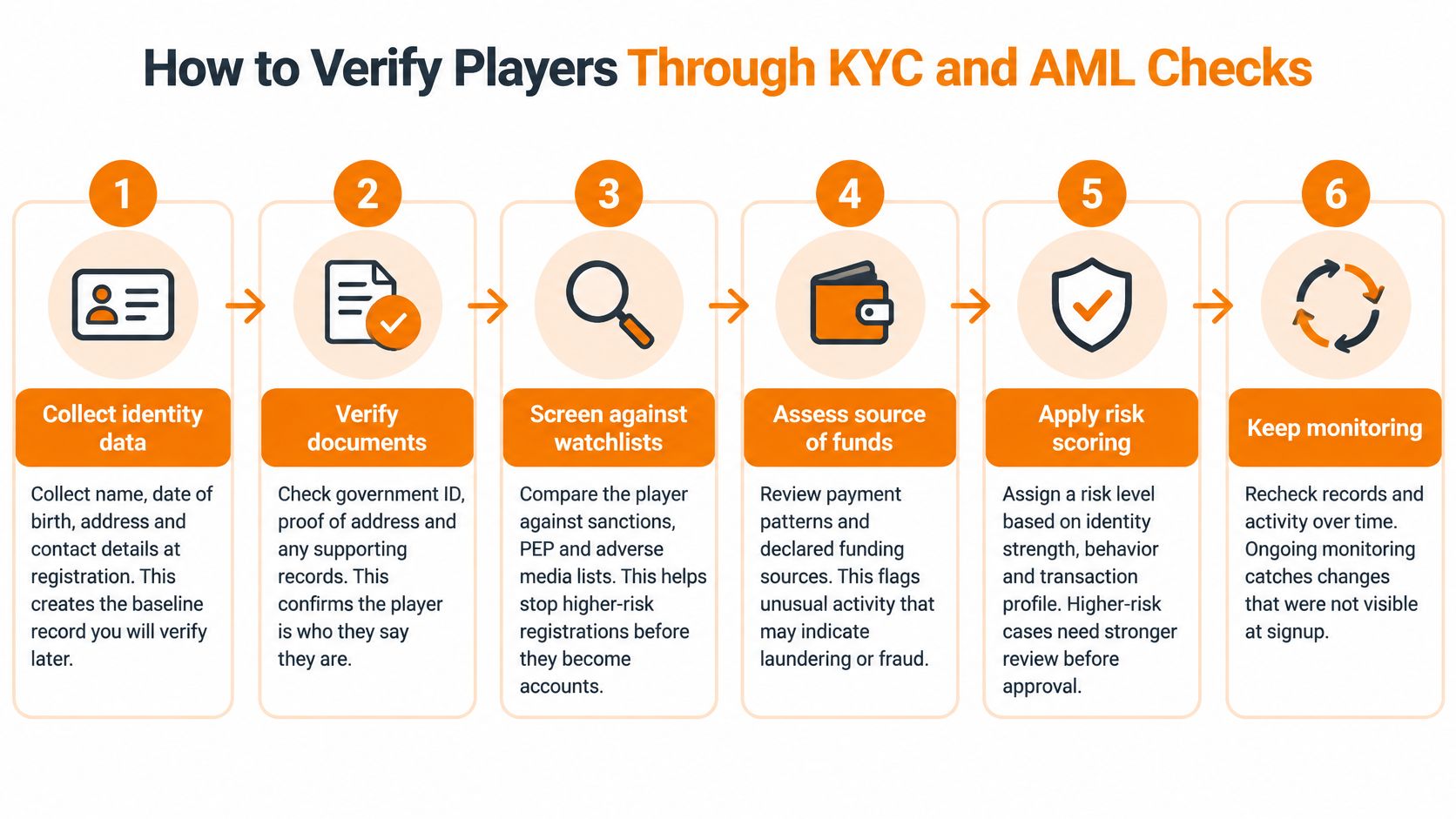
Use the verification flow as an ongoing process, not a completed signup task.
Run verification in a controlled sequence
Collect baseline details. Capture name, date of birth, address and contact information. Later comparisons depend on the accuracy of these fields.
Verify the identity evidence. Check document authenticity and match the holder through a selfie or liveness process. This helps identify stolen documents and fabricated identities, but it isn't an absolute guarantee.
Confirm payment ownership. Match the cardholder or account name to the verified player where the payment rail supports it. Investigate discrepancies instead of assuming a successful authorization proves ownership.
Screen for financial-crime exposure. Check sanctions, politically exposed person status and relevant adverse media. Resolve potential matches using identifying details rather than treating a name match as conclusive.
Assign a risk tier. Let identity confidence, jurisdiction, funding and activity determine review depth. Stronger checks should address specific risks, not create identical friction for everyone.
Re-verify when triggers occur. Large deposits, address changes and new payment methods should reopen the baseline identity, document, ownership and screening checks. Refresh those checks fully rather than accepting the original registration result.
Assess source of funds before relevant payouts. Apply your documented withdrawal threshold alongside earlier risk triggers and applicable obligations. Don't wait for a payout threshold if suspicious funding already requires investigation.
For teams translating these checks into operating procedures, the Lighthouse Consultants guide to AML controls provides additional context.
A verified identity doesn't establish that the same person still controls the account or owns a newly added payment method.
Avoid the registration-only mistake
An account can pass onboarding and later acquire an unrelated funding instrument. Unless that change starts a fresh review, the cashier may keep relying on verification evidence that no longer answers the current question.
Use the accompanying video as a discussion aid when training staff on the verification process.
Risk Rules and Signal Combinations That Trigger Action
The FATF report on gaming and gambling risks identifies indicators including repeated VPN or multi-device use, stated-versus-detected location mismatches, multiple accounts, payment-ownership discrepancies and frequent payment-method changes. Other indicators include failed-deposit patterns, sudden funding of inactive accounts and abrupt changes in deposits, withdrawals or wagering.
Combinations deserve more attention than isolated flags. A VPN login may have an innocent explanation. Add someone else's payment instrument and repeated failed deposits, and the reviewer has a materially different case.
The following response matrix is an operational starting point, not a regulatory classification or automatic finding of fraud.
Signal combinations and the response they warrant
| Signals present | Risk level | Response |
|---|---|---|
| One isolated signal, such as a single VPN login | Low | Monitor and log |
| Two related signals, such as a VPN login and a location mismatch | Medium | Step-up verification before the next withdrawal |
| Identity-payment mismatch with several failed deposits | High | Withdrawal hold and manual review |
| Linked accounts sharing a device and a payment instrument | High | Freeze bonuses and review the account network |
| Sudden funding of a dormant account with a rapid shift in wagering | High | Hold and escalate with a documented disposition code |
| Verified customer with a spike around a major sporting event | Low to medium | Confirm with the customer, no automatic block |
Apply restrictions only within your contractual and legal authority. A bonus freeze shouldn't become confiscation without notice, and a withdrawal review needs a defined owner and release criteria.
Write rules a reviewer can explain
Every rule needs a plain-language reason code. “Payment ownership mismatch plus repeated deposit failures” explains the intervention better than an unexplained risk score. Store the underlying evidence so reviewers can distinguish an actual discrepancy from a processor's missing name field.
Apply velocity limits by customer and payment instrument, not just account. Otherwise, an attacker may distribute attempts across connected accounts without crossing an account-level limit. Define the observation window, counted events, exclusions and action explicitly.
Route high-risk combinations to manual review with a documented disposition. Useful outcomes include confirmed unauthorized activity, legitimate activity verified, data-quality error and insufficient evidence. Don't force investigators to label every closed alert as either fraud or no fraud when the evidence supports neither.
Test for legitimate behavior too
A verified sportsbook customer may increase activity during a major event. Confirm unusual behavior through an established contact channel, but don't treat customer confirmation alone as proof that every funding source is legitimate.
Before deployment: Test both the suspicious scenario and the legitimate customer who could resemble it.
Write a candidate rule for each matrix row, then replay recent alerts and resolved cases against it. Count which cases would trigger, inspect incorrect interventions and check missed confirmed abuse. Review the proposed thresholds before enabling customer-facing restrictions.
Controls for Crypto, Instant Payments and Withdrawals
An irreversible payout changes the decision point. Once funds reach an attacker-controlled destination, an investigation may explain the loss without providing a practical recovery route. Speed, recoverability and fragmented identity therefore belong in payment-control design.
J.P. Morgan's payments outlook discusses an expanding attack surface across emerging payment methods and the immediate access that push payments can give criminals. Operators should configure controls around the actual rail and destination, rather than applying a card-deposit checklist to every payout.
Payment reviews need to connect the player, account session and destination.

Controls by payment rail
| Payment rail | Recoverability | Main fraud risk | Control to apply |
|---|---|---|---|
| Card deposits | Chargeback possible | Stolen card use | Cardholder name match and risk-based 3-D Secure challenge |
| Bank transfer | Recall requires bank cooperation | Account ownership mismatch | Verify account name against player identity |
| E-wallet | Provider dispute and recall rules apply | Linked-account abuse | Shared-instrument checks across accounts |
| Crypto deposit and withdrawal | Usually irreversible | Unknown beneficiary address and mixing exposure | Address screening and first-withdrawal review hold |
| Instant push payouts | Treat as irreversible for authorization | Account takeover followed by cash-out | Pre-withdrawal verification for new beneficiaries |
| Cross-border withdrawal | Corridor-specific recall arrangements | Jurisdiction mismatch | Geolocation and destination review |
These are control-design assumptions, not promises about recovery rights. Document the processor's actual dispute, recall and settlement arrangements for each supported route.
Move targeted checks before the payout
Instead of challenging every deposit, validate identity at account creation, examine destinations at beneficiary enrollment and authorize withdrawals against current account risk. A new beneficiary deserves closer attention than an established destination with an unchanged account profile.
For crypto withdrawals, screen the address and investigate relevant exposure rather than assuming a clean result proves ownership. For instant payouts, check whether the request follows a credential reset, device change or contact-detail update. Combine those facts with casino and sportsbook activity before release.
Operators evaluating low-friction onboarding can use our Pay N Play overview to frame the experience question. Faster access shouldn't mean removing the evidence needed to authorize a later payout.
Keep friction proportionate
Upstream checks can target risk more precisely than repeated checkout challenges, but they aren't automatically better in every flow. Measure abandonment alongside confirmed losses and mistaken restrictions.
An irreversible loss may outweigh a short review delay, yet unnecessary holds also harm legitimate players. Give reviewers a clear path to confirm activity, explain permissible next steps and release funds promptly when the concern is resolved.
Keeping AI Models Accountable and Audit-Ready
An AI score is an input, not a control. A defensible control also specifies what the score means, which action it permits, who can challenge that action and what evidence remains afterward.
Static rules need support when attackers adapt their identities and behavior. The Experian predictions report emphasizes explainability, monitoring, data quality, change management and meaningful human oversight in AI-enabled fraud defenses. Treat those as operating requirements, not documentation added after deployment.
Report whether the model helps decisions
A monthly risk report should distinguish detection quality from alert volume. More alerts may mean better coverage, a broken input feed or a threshold that now catches legitimate players.
Track these measures:
- Precision by market and payment rail: Among cases flagged as fraud, how many were confirmed? Use consistent outcome definitions so teams don't inflate results by labeling unresolved cases as confirmed.
- Recall by market and payment rail: Among known fraud cases, how many did the model detect? Explain that unknown or undiscovered fraud limits what this measure can establish.
- False positives for verified customers: Measure legitimate customers incorrectly flagged, using a defined denominator. Separate a harmless alert from a declined payment or restricted withdrawal.
- Intervention traceability: Check whether each action retains its reason code, model version, relevant inputs and reviewer decision.
- Operational outcomes: Include review delays, overturned restrictions and cases awaiting resolution, not just detected-loss estimates.
Keep a change log for model releases and threshold adjustments. Record who approved the change, what testing supported it and how the team will roll it back if results deteriorate.
Test networks and adversarial behavior
Test against bots, synthetic identities, cloned-voice attempts, rapid retries and linked-account scenarios. Include missing data, delayed events and failed integrations, because an accurate model can still produce unsafe decisions when its inputs are incomplete.
Graph analysis helps reviewers examine relationships among accounts, devices, wallets, payment instruments and affiliates. A group of individually ordinary accounts may reveal coordinated abuse when investigators inspect shared connections. Conversely, a shared household device may explain a connection without proving wrongdoing.
Sample cases from initial alert through final action on a scheduled basis. Check whether investigators could understand the evidence, challenge the recommendation and correct the outcome.
Automation should prioritize investigation, not remove accountability for decisions about a player's funds.
Assign accountable human review to consequential escalations involving access to funds, disputed identity or responsible-gaming and compliance concerns. Reviewers need authority to disagree with the model, not merely a button confirming its recommendation.
Compliance Obligations and Audit-Ready Records
An audit-ready record should let an independent reviewer reconstruct what happened without asking the original investigator to remember it. Traceability matters more than the appearance of a complete dashboard. Exact duties depend on the licence, jurisdiction and applicable law; no generic control list creates a legal safe harbor.
Keep evidence tied to each decision
Maintain distinct but connected records:
- Player verification: Documents checked, match results, screening outcomes, risk tier and the date and reviewer for each re-verification. Record resolved screening matches, including why the reviewer dismissed them.
- Alert disposition: Trigger, supporting events, investigator, communications, final action and justification. Preserve the relationship between the original alert and any later appeal or reversal.
- Control changes: Rule definition, owner, approved threshold, test results, approval and effective date. Retain previous versions so reviewers can establish which logic applied.
- Escalation decisions: Who raised the concern, who assessed it, whether reporting to the relevant financial intelligence authority was required and how that decision was documented.
A suspicious-activity procedure should identify an escalation owner and an alternative contact when that person is unavailable. Separate internal investigation notes from customer communications, and apply any relevant reporting-confidentiality restrictions.
Protect records without losing accountability
Linking accounts across products requires a documented purpose and appropriate data-protection controls. Limit access by role, log sensitive access and avoid copying identity documents into unrestricted case notes.
Set retention and deletion schedules against applicable obligations, licence conditions and lawful investigation needs. Don't keep everything indefinitely because storage is available.
Our explanation of compliance reporting helps distinguish operational evidence from the information teams assemble for formal reporting. Both should reconcile to the same underlying decisions.
Keep assurance independent from the staff whose exceptions and releases it examines. The practical audit test is straightforward: can you show who approved the control, what evidence it used and why the final action was justified?
Audit Your Fraud Controls Before the Next Review
Run a practical control check this quarter rather than waiting for an examiner's request. Use a controlled test environment or authorized test cases wherever a test could affect real funds.
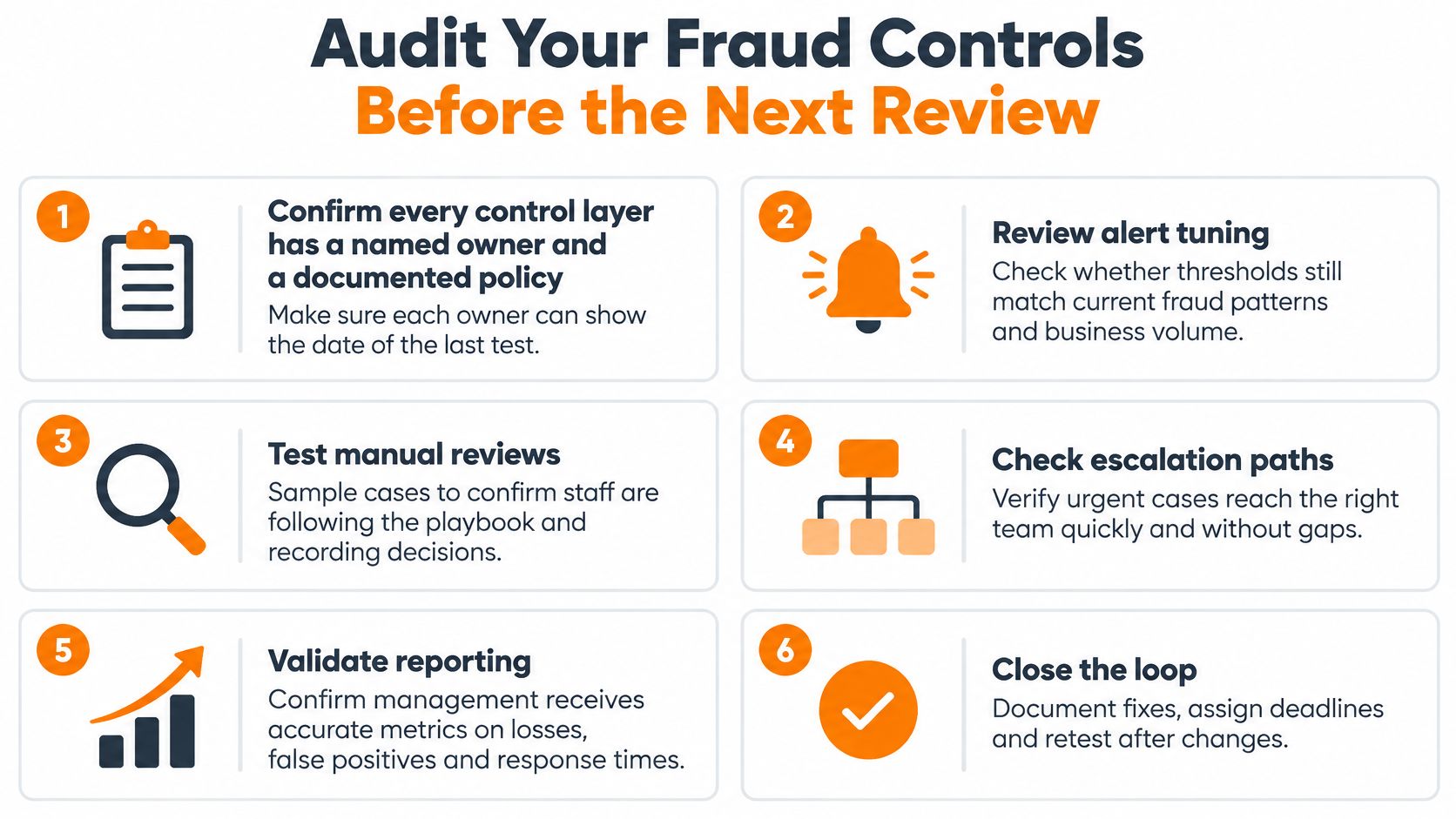
This checklist can support the review meeting and remediation log.
Turn each failed check into an assignment
- Confirm ownership and testing. Ask each control owner for the policy and last test result. Missing evidence means the team hasn't demonstrated that the control works.
- Inspect the shared profile. Trace identity, device, payment and betting events into a player record. Missing links identify decisions made with partial information.
- Test withdrawal handling across supported rails. Include a new beneficiary and a high-risk scenario. A hold that fails to trigger, or cannot be released correctly, needs remediation.
- Trace recent alerts to closure. Check reason codes, evidence, reviewer and disposition. An unexplained closure breaks accountability.
- Compare mistaken interventions over time. Investigate worsening results for verified players before changing thresholds. Check whether the cause is rule logic, customer mix or poor inputs.
- Review management exceptions independently. Inspect bonus and withdrawal overrides. Approval by the same person who requested the exception isn't independent assurance.
Maintain a confidential reporting channel for staff and accessible reporting routes for players. Schedule proactive analysis of linked accounts and payment anomalies instead of relying entirely on incoming complaints.
If reporting, payments and product activity remain disconnected, prioritize the missing connection that affects the highest-risk decision. Leave the review with a named layer to fix, an accountable owner and a completion date, followed by a retest.
NexGrate provides a turnkey white-label casino and sportsbook platform that brings payments, player management and compliance controls into a unified operating environment. Visit NexGrate to explore the platform and discuss how your team can connect fraud decisions across products and payment workflows.