
The usual advice for choosing a sportsbook website template starts with responsive layouts, attractive odds tables and easy branding. That's the wrong order. Start by finding out what happens when a price changes, a deposit times out or a player tries to set a gambling limit while a bet slip is open.
A polished interface can still conceal broken money flows and inaccessible controls. Your selection process should test betting behaviour, money integrity and informed choice before anyone starts comparing colours.
Table of Contents
- What a Sportsbook Template Must Cover Before You Buy
- Sportsbook Template Scorecard for Shortlisting
- How to Test the Full Betting Journey Step by Step
- Live Odds and Bet Slips Under Unstable Connections
- Connecting Feeds, Wallets and Payments Without Duplicates
- Responsible Gambling Design Without Hidden Controls
- Monitoring the Template After Go-Live
- Choose Your Template and Confirm the Launch Plan
What a Sportsbook Template Must Cover Before You Buy
You're buying the front end of a regulated betting operation, not an odds-page design. The Congressional Research Service summary explains how the Supreme Court's May 14, 2018 decision allowed states to legalize and regulate sports gambling independently. That market-by-market structure matters to your architecture.
The template must connect to jurisdiction-specific registration, identity verification, geolocation, responsible-gambling controls, wallets, bet records, settlement and reporting. Keep each market's configuration in a versioned module set, rather than scattering conditional rules across page components.
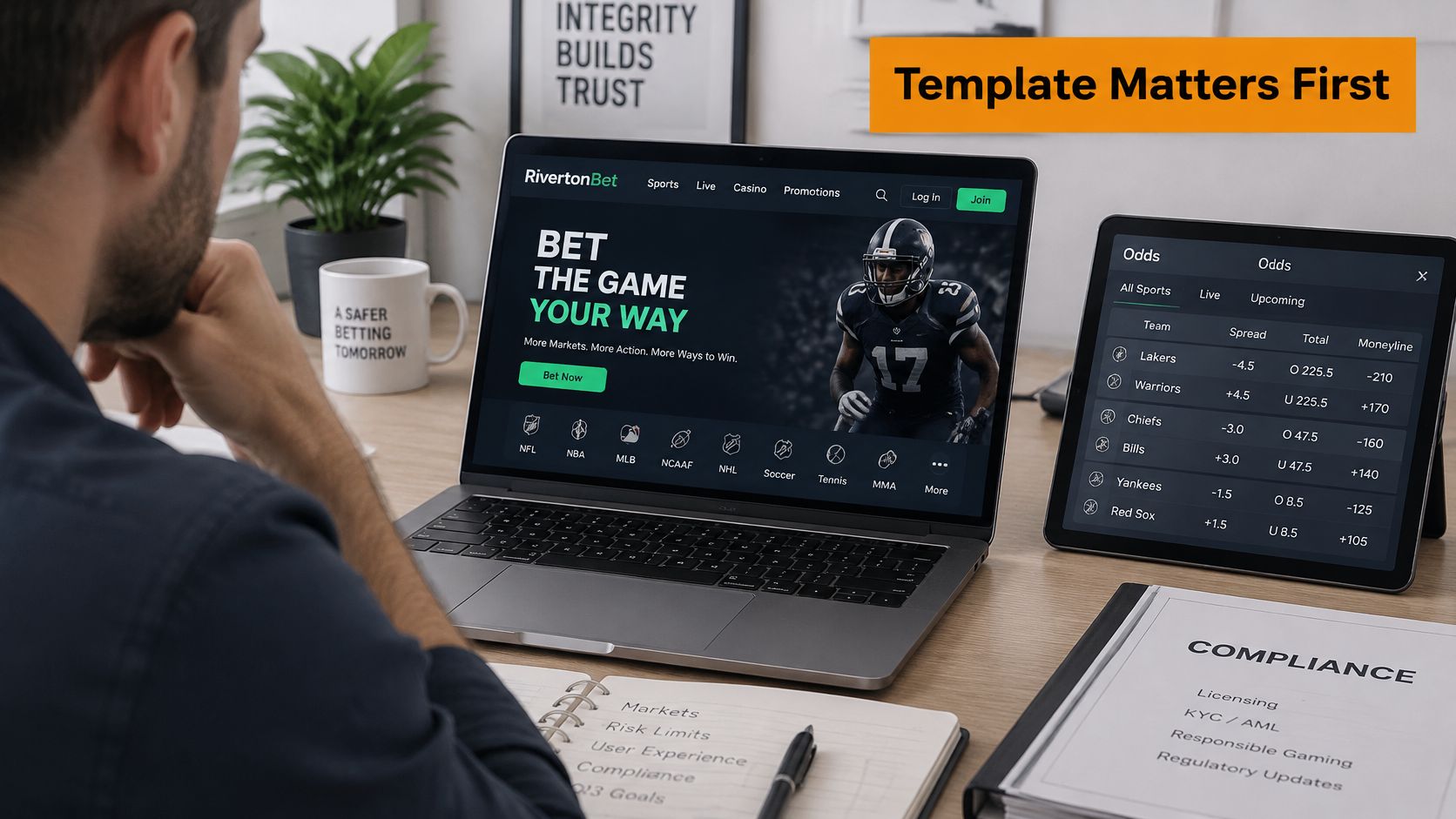
Decide what you're buying
- Template advantages: A defined integration path, reusable interface patterns and less initial development. Demand evidence before accepting claims that those patterns have been tested with bettors.
- Template constraints: Shared visual conventions, vendor-roadmap dependence, restricted code changes and potential export limitations.
- Custom-build justification: Proprietary trading tools, unusual bet types or a product journey that existing platforms can't support.
I'd favour a template for a conventional launch with a small market footprint and a tight delivery schedule. Custom development makes sense when differentiation depends on behaviour, not branding.
Buying rule: Write down every launch market and every rule that differs. That list determines mandatory capabilities before the design review begins.
Sportsbook Template Scorecard for Shortlisting
Use pass or fail, not a weighted average, for the initial shortlist. Accessibility conformance and audit logging are gates. A strong visual score can't compensate for either failing.
Run candidates against the same staging conditions. Don't compare a vendor's cached demonstration with another candidate connected to a live test feed.
Sportsbook template shortlisting scorecard
| Criterion | What to test | Pass mark |
|---|---|---|
| Mobile layout | Narrow phone viewport, open slip and onscreen keyboard | No horizontal scroll; all controls reachable with one thumb |
| Text contrast | Odds, bet slip and safer-gambling links | Meets the applicable WCAG AA text-contrast criterion |
| Zoom and reflow | Cashier and bet slip under enlarged text and browser zoom | No lost content or function |
| Accessibility conformance gate | Level A checks across full betting and cashier flows | No Level A failures |
| Odds refresh | Feed-to-screen latency logged in staging | Measured against your feed service level agreement |
| Suspended markets | Suspension, price change and selection lock | Message on the same screen; no silent removal |
| Safer-gambling tools | Limits, reality checks and self-exclusion from every bet-slip state | Reachable without search |
| Jurisdiction modules | Registration, identity checks and geolocation per market | Tested module set per market |
| Audit logs gate | Bet, settlement and wallet events | Each event carries user ID, timestamp and idempotency key |
Rank evidence, not promises
Record the build version, test environment and evidence location beside each result. A promised fix remains a failure until someone retests it.
Rank surviving candidates by integration effort, operational ownership and contractual flexibility. Include code access, export formats and upgrade responsibilities in that comparison. The cheapest licence isn't necessarily the least expensive system to operate.
How to Test the Full Betting Journey Step by Step
Test a complete process, not a collection of attractive screens. The W3C evaluation methodology calls for evaluating full pages and complete processes; for this purchase, set WCAG 2.2 AA as the conformance goal and include keyboard, screen-reader and 200–300% zoom checks in your test protocol.
Documenting an AA exception doesn't make the product AA-conformant. Track exceptions as unresolved acceptance decisions, with an owner and a remediation plan.
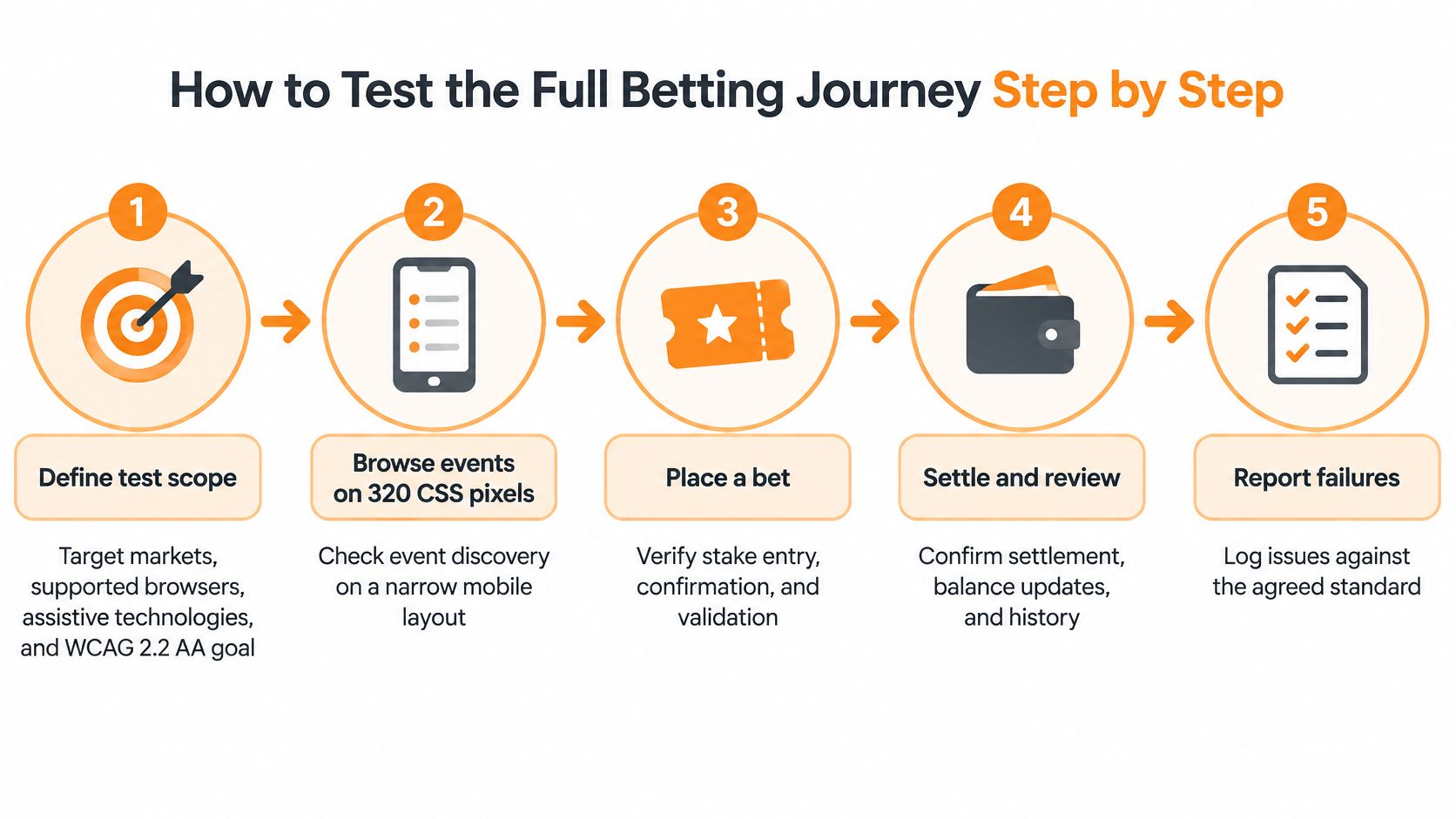
Run the journey with deliberate interruptions
Define the scope. Name launch markets, supported browsers, assistive technologies and the agreed accessibility target. The common slip is allowing each team to test against a different definition of acceptable.
Find an event. Use competition filters, search and market tabs on a narrow phone viewport, then repeat using only a keyboard. Check that focus remains visible when navigation panels open.
Build and edit the slip. Add selections, remove them and enter valid and invalid stakes. Screen readers should announce validation messages without forcing the player to hunt for the error.
Trigger conditional fields. Log in with accounts that require additional identity checks or payment information. Hidden-until-needed fields must receive sensible labels and enter the focus order when revealed.
Deposit and submit. Follow the cashier back to the pending slip, confirm the wager and exercise cancellation wherever supported. A lost return path or cleared stake can break a journey that looked fine in isolated component tests.
Change the market underneath the slip. Trigger suspension and a price change before submission. Require explicit acceptance of the revised price rather than treating an earlier tap as continuing consent.
Settle and inspect. Complete a test outcome and inspect history, result presentation and the resulting account balance. Check that status changes are understandable without relying on colour.
For help turning broad requirements into reproducible cases, use software scenarios from 99tests as a starting point for scenario structure. Add sportsbook-specific preconditions, account states and expected ledger effects.
Keep evidence that a developer can reproduce
Run keyboard-only, screen-reader, zoom, reflow, contrast, focus-order and touch-target checks throughout the journey. Pay particular attention to modal dialogs and asynchronous errors, where the visible screen and assistive-technology output can diverge.
Keep automated scan output alongside manual recordings and expected results. Automated checks alone can't establish whether someone can complete the betting and cashier processes.
Your shared failure sheet should include journey step, severity, reproduction instructions, expected behaviour, actual behaviour and build version. Block completion-critical defects rather than accepting a screenshot of the repaired component as proof that the journey works.
Live Odds and Bet Slips Under Unstable Connections
A bettor on a weak mobile connection at halftime taps a price that has already moved. The interface should show the revised price, explain the change and ask for acceptance. It mustn't imply that the displayed price remains available merely because the device hasn't received an update.
The in-play betting study published in Addiction Research & Theory discusses instant access, rapid deposits and interactive betting features as structural characteristics that can encourage spontaneous or impulsive betting. That makes clarity during fast-changing states a product-safety concern, not just a performance detail.
More markets don't automatically make a better template. A long market list with ambiguous suspension states is harder to use than a smaller catalogue with clear status and predictable confirmation.
Measure the state transitions
Evaluate these behaviours in order:
- Odds-refresh latency: Capture feed receipt, internal processing and browser-render timestamps. Separate network delay from rendering delay.
- Feed interruption: Mark stale information and stop actionable selections where authoritative prices aren't available.
- Suspension messaging: Preserve the selection visibly, explain its status and prevent submission.
- Confirmation timing: Distinguish pending, accepted and rejected bets. A spinner isn't an acceptance record.
- Bet-slip accessibility: Announce changed states without repeatedly stealing keyboard focus.
- Jurisdiction configuration: Verify that permitted live features match the selected market configuration.
When reviewing the sportsbook API integration, map incoming status events to the exact interface states the player will see. Include reconnects, reordered messages and event-version checks in that mapping.
Break the feed on purpose
Cut the feed during a staging event and record the screen alongside network and server logs. Note when prices stop updating, when the stale-state message appears and whether the submit control remains actionable.
Restore connectivity while the slip is open. The application should reconcile against current authoritative state, not replay cached updates as though they were new.
Choose the live-market depth your team can operate safely, not the longest list available in a demonstration.
If nobody owns continuous feed-health monitoring, favour fewer live markets and a cleaner suspension flow. Extra coverage creates extra failure states that someone must detect and resolve.
Connecting Feeds, Wallets and Payments Without Duplicates
Inventory what an attacker or bug could corrupt: player identity, wallet balances, payment tokens, bet placement, odds feeds, settlement calls, affiliate parameters, limits and back-office functions. Then assign an authoritative system and a reconciliation method to each integration.
Integration components and the failures to test
| Component | Source of truth | Reconcile by | Failure to test |
|---|---|---|---|
| Odds feed | Feed provider and internal price record | Price ID and timestamp stored on each bet | Stale price accepted after a market suspends |
| Bet placement | Betting engine | Client request ID checked for replays | Replayed request places a duplicate bet |
| Wallet ledger | Wallet service | Daily balance check against bet and settlement records | Stake deducted twice after a timeout |
| Settlement | Settlement engine | Settlement ID per market and selection | Retried call pays out twice |
| Payments | Payment provider callbacks | Provider transaction reference | Deposit credited without a confirmed callback |
| Affiliate parameters | Tracking service | Campaign ID stored against the account | Attribution lost after login |
Protect the transaction boundaries
Use the authentication, access-control, API-security and business-logic categories in the ASVS control mapping to organize verification. Add explicit abuse cases for manipulated odds, replayed requests, duplicate settlements, unauthorized transfers and privilege escalation.
Server-side price and market-status validation addresses stale or manipulated client displays. The browser submits an intention to bet, not an authoritative instruction to settle at whatever price it displays.
Use idempotency keys for bet and settlement operations. Retrying the same operation should return its established result, not create another debit or payout. If a response times out, query the original operation before creating a replacement.
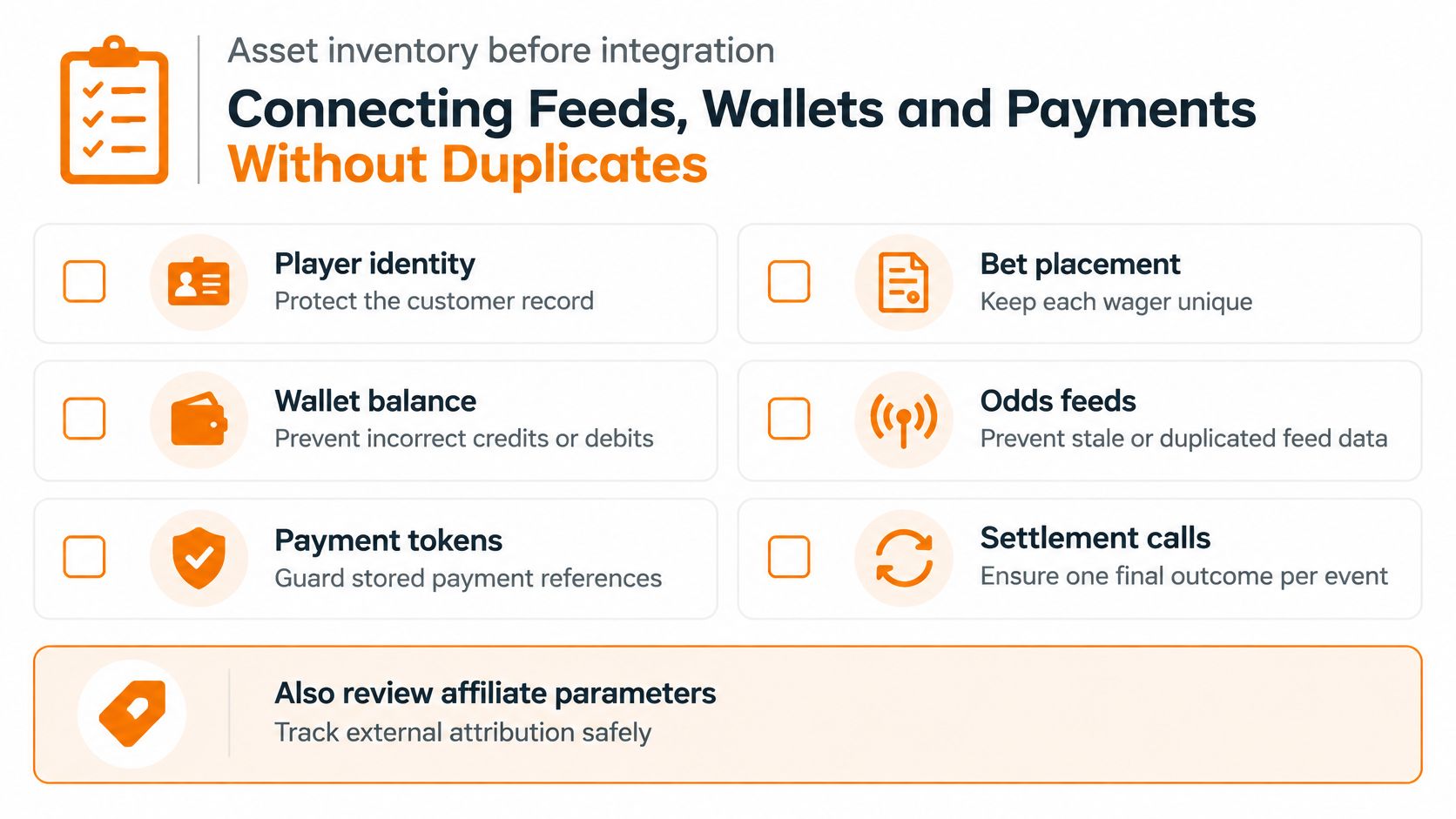
Make money movement explainable
Keep append-only audit records and reconcile the betting engine against the wallet ledger daily as an operating control. Investigate differences by transaction reference rather than adjusting a balance to make totals match.
For the payments integration, trace the path from provider callback through verification, ledger posting and cashier display. Authenticate callbacks, deduplicate provider references and handle reversals as explicit transactions.
Apply rate limits and step-up authentication to sensitive actions. Give player, trader, finance, compliance and administrator roles separate permissions, with negative authorization tests for each boundary.
- Validate client inputs: Accept the player's proposed stake and currency, but validate precision, balance, supported currency and limits server-side.
- Keep secrets out of logs: Record payment references and outcomes, not credentials or sensitive payment material.
- Test privilege boundaries: A finance user shouldn't inherit trading permissions because both use the back office.
Before launch, combine code review, dependency scanning, API fuzzing, penetration testing and adversarial business-logic tests. Repeat the affected tests after changes to feeds, payments, wallets or jurisdiction rules. A successful generic penetration test doesn't prove that retrying a settlement can't pay twice.
Responsible Gambling Design Without Hidden Controls
A template can make safer-gambling tools obvious or practically invisible. Treat that as a compliance and information-design decision, not a footer-styling preference.
The UK Gambling Commission's consumer research found that participants considered gambling sites cluttered and overwhelming, including advertisements and pop-ups appearing while they built bets. Participants wanted simpler interfaces and accessible betting and safety information.
Test visibility at the moment of use
Use this acceptance checklist on the branded template, not just its unmodified theme:
- Persistent controls: Keep deposit limits, loss limits, reality checks and self-exclusion accessible while the slip is empty, populated, pending or rejected.
- Readable links: Apply the applicable AA contrast requirement to safer-gambling text, including muted footer styles and promotional backgrounds. Test keyboard focus visibility as well.
- Useful explanations: Put betting rules and relevant probability or payout information where players make the decision.
- Nearby disclosures: Place material promotion conditions next to the offer, not behind a distant footnote.
- Undisturbed bet building: Keep promotional pop-ups out of selection and confirmation flows.
Search the site for limit. The result should lead directly to the relevant tools, not an editorial page that requires another navigation search.
Remove confusion, not safeguards
A usable conversion journey helps a player understand the stake, potential return, conditions and account state. It doesn't make depositing effortless while making limit-setting difficult.
Test an actual limit change and a self-exclusion request through to backend enforcement. Confirm that the interface acknowledges the outcome and that the audit trail records the request and resulting state.
Geofencing also needs understandable presentation. When a player is outside a licensed market, block or redirect restricted activity with a clear explanation, rather than leaving an apparently broken betting button.
Design test: A player seeking a safety control shouldn't have to dismiss an offer to reach it.
Don't assume visible safeguards will produce a measurable conversion uplift. Evaluate them as necessary product requirements, then measure whether the interface reduces confusion, failed tasks and support requests without weakening protection.
Monitoring the Template After Go-Live
Production changes can break behaviour that passed acceptance testing. Assign owners and alert conditions before launch; a field guide to application monitoring from GoReplay provides useful context for organizing signals and incident workflows.
| Check | Trigger for action | Owner |
|---|---|---|
| Feed health | Latency, heartbeat or suspension delivery exceeds the agreed service level | Platform operations |
| Money reconciliation | Any unexplained unmatched bet, settlement or deposit callback | Finance operations |
| Audit completeness | A sampled event lacks required identity, time or operation references | Compliance engineering |
| Safer-gambling visibility | A control becomes obscured, inaccessible or disconnected from search | Product and compliance |
Set the operating cadence
Run money reconciliation daily as a documented procedure. Sample bets, limit changes and self-exclusion records weekly; inspect safer-gambling search paths and live styling monthly, and after relevant promotional changes.
These are operating recommendations, not substitutes for market-specific obligations. Keep the results, exceptions and remediation decisions with the release record.
Define the pause rule within your sportsbook risk-management procedures: identify which markets stop accepting bets when feed reliability or ledger integrity becomes uncertain. Preserve account access, safety tools and transaction visibility wherever possible.
Name who can pause activity and who authorizes recovery. Operators shouldn't have to negotiate those responsibilities during an incident.
Choose Your Template and Confirm the Launch Plan
Use a working week to turn the shortlist into an evidence-based decision. Keep the environment consistent so differences reflect the candidate, not different test conditions.
- Monday: Apply the scorecard to a small shortlist. Drop candidates that fail the accessibility gate or lack auditable transaction records.
- Tuesday and Wednesday: Run the complete journey on the strongest candidates using the same devices, network profiles and equivalent test accounts. Record failures rather than accepting verbal explanations.
- Thursday: Force the integration failures, including replayed requests and timed-out wallet calls. Compare both the visible outcome and the authoritative records.
- Friday: Have compliance approve jurisdiction configurations and safer-gambling placement for each intended launch market. Assign owners to remaining contractual and operational dependencies.
Make the same demands of an internal build
If custom development is a genuine option, put it through the same scorecard. An internal team shouldn't receive an exemption because you know its engineers.
Before signing, request a demonstration that includes a feed interruption and a suspended market. Include acceptance evidence, remediation responsibilities, export rights and upgrade ownership in the launch agreement.
The deciding question is straightforward: which candidate cleared every gate and preserved correct betting behaviour when the feed broke? Choose that candidate over the one with the best screenshots.
We offer a turnkey white-label casino and sportsbook platform that operators can use to launch and scale their own brands, with a sportsbook API among our products. Visit NexGrate to discuss your launch markets and bring the scorecard, integration failure cases and live-feed demonstration requirements to the conversation.