Cloudflare Radar's DDoS reporting tracks the size distribution of observed attacks, and the bulk of them land in the small-to-moderate range, well below the gigabit figures that hosting pages advertise. Bandwidth is the wrong axis for choosing the best DDoS protection VPS for an iGaming platform. An attacker who points a few hundred megabits at a login endpoint can exhaust worker processes and database connections on a modest instance without ever nearing a volumetric threshold, and the damage surfaces as failed logins and stalled withdrawals rather than a saturated uplink.
Application survivability is the comparison that matters: whether sessions persist, APIs stay responsive, payment callbacks complete, and routing stays predictable while mitigation is active. A VPS that absorbs a large flood but sheds legitimate requests under a much smaller burst aimed at the cashier page has not been protected in any sense the operator cares about.
Table of Contents
- Compare DDoS Protection Approaches at a Glance
- Why Headline Bandwidth Misses Most Attacks
- Criteria That Separate Real Protection From Marketing
- Latency and Geography for Casino and Sportsbook Traffic
- Use Cases for Casino, Sportsbook and Crypto Operators
- How to Test a Provider Before You Commit
- Choose the Protection Setup for Your Platform
Compare DDoS Protection Approaches at a Glance
DDoS protection approaches compared
| Approach | Where Traffic Is Filtered | Layers Covered | Latency Impact | Best Fit |
|---|---|---|---|---|
| Provider network filtering | Provider edge ahead of the VPS network | Network and transport floods | Low when filtering is in-path | Smaller casino brands with modest traffic |
| Upstream scrubbing with BGP diversion | Provider scrubbing centers | Volumetric and packet floods | Can rise when traffic is backhauled | Platforms that need large capacity |
| Anycast edge scrubbing | Routing-selected edge node, ideally close to the attack source | Network, transport, and some HTTP, when included | Typically low; verify by region | Multi-region casino and sportsbook traffic |
| Reverse proxy or CDN in front of origin | Edge proxy before the origin | HTTP and API endpoints when security controls are enabled | Potentially low on proxied paths; test cache misses | Web-facing login, cashier, and API traffic |
| On-premises appliance | Your hardware at the data center edge | Supported traffic that reaches your link | Adds processing; cannot rescue a saturated upstream link | Operators with an in-house network team |
These rows compare approaches, not named providers, so a hosting shortlist can be assessed against the same architectural choices. They're complementary rather than direct substitutes: network floods need filtering upstream of the constrained link, while login, wallet, and odds APIs need HTTP-aware controls. A CDN subscription alone doesn't prove either capability, and an appliance's position in a network diagram doesn't establish what it can inspect.
Start with the row matching your traffic profile, then trace an actual request from the player to the application. Establish which service accepts the connection, where malicious traffic is rejected, how clean traffic reaches the VPS, and which team owns each decision. Don't accept a diagram that leaves the origin connection or return route unexplained.
Match the approach to the exposed service
A browser-facing casino can route its web application through a security proxy. A sportsbook may also expose persistent connections, partner APIs, and services that don't follow the same path. Inventory those separately rather than assuming the website's protection extends to every integration.
The best-fit column is a starting point, not a purchasing verdict. A small operator with unusual protocols may need more network engineering than a larger operator whose traffic is entirely HTTP.
Buying rule: Choose an architecture that covers your actual traffic paths, then require evidence for its filtering, routing, and operational claims.
Why Headline Bandwidth Misses Most Attacks
In the first quarter of 2025, Cloudflare automatically mitigated 20.5 million DDoS attacks, approximately 16.8 million of them at the network layer. That makes upstream protection foundational, but it doesn't make a bandwidth figure a complete measure of availability.
A VPS can remain powered on while its shared network link becomes unreachable. A host firewall can discard traffic that arrives at the machine; it can't recover capacity already consumed farther upstream. Check where the provider filters traffic relative to the access link, shared aggregation network, and VPS host.
Bandwidth and packet-processing capacity are different constraints. Gbps measures traffic volume, while packets per second measures how many individual packets equipment must handle. A stream of small packets can pressure virtual routers, firewall processing, and connection tracking without filling the advertised bandwidth.
Follow the failure through a player journey
Say a player opens the casino lobby successfully but can't sign in. Static content still loads, yet authentication requests wait for an exhausted application worker pool or an overloaded dependency. A network dashboard showing spare capacity wouldn't establish that the casino is usable.
The same distinction applies to a sportsbook. Odds may appear on screen while a bet-placement endpoint times out, or a cashier may accept a request while the payment callback can't complete. Operators need to observe those transactions separately.
Use distinct checks for distinct failure modes:
- Network reachability: Can legitimate traffic reach the protected service?
- Transport health: Can clients establish and maintain connections?
- Application completion: Can players finish login, wallet, and betting workflows?
- Operational continuity: Can staff access back-office and compliance services?
These checks prevent a misleading conclusion: that successful packet filtering necessarily means successful business operations. They also help engineers identify whether the limiting resource is the network, the virtual machine, the application, or a downstream service.
A provider should demonstrate both upstream capacity and continued service under a small, targeted application attack. Neither result substitutes for the other.
Criteria That Separate Real Protection From Marketing
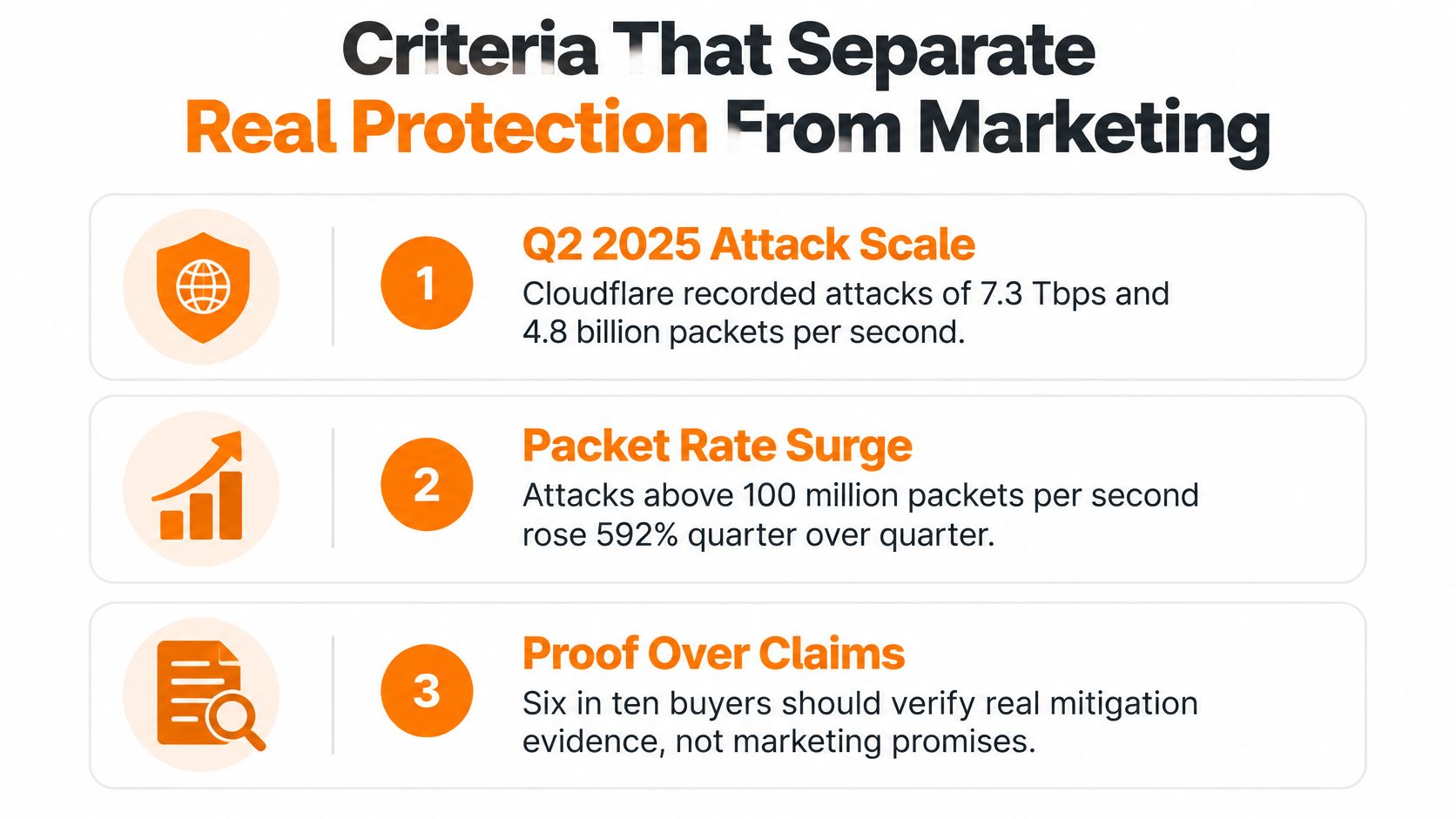
In its second-quarter 2025 report, Cloudflare recorded DDoS events reaching 7.3 Tbps and 4.8 billion packets per second, and reported that six out of every 100 HTTP DDoS attacks exceeded 1 million requests per second. Those are different processing challenges, so a protection claim needs more detail than a maximum bandwidth badge.
Require upstream filtering for floods, connection controls for transport abuse, and application-aware rules for expensive HTTP requests. Login, cashier, wallet, odds, and back-office endpoints shouldn't automatically share the same policy, because their legitimate clients and failure consequences differ.
Take a verification table into the vendor call
Treat the acceptable signals below as procurement requirements, not universal promises about what hosting plans include.
Verification criteria for DDoS protection
| Criterion | What to Ask | Acceptable Signal | Red Flag |
|---|---|---|---|
| Attack vector coverage | Does one policy cover UDP, SYN, DNS amplification, and HTTP floods? | Named coverage and exclusions for each vector | Full protection claimed without a vector list |
| Mitigation activation time | How long from detection to effective filtering? | Automatic activation with documented, tested timing | Activation requires a support ticket |
| Packet-rate capacity | What packet rate can the filtering service handle? | Stated packets-per-second capacity with relevant test evidence | Only Gbps figures advertised |
| Origin IP concealment | Can traffic bypass the protected path? | Restricted origin access, or protected routing with no unfiltered path | Direct application access around the filter |
| False-positive handling | Who blocks legitimate players, and who restores access? | Documented allowlist and escalation procedure | No stated decision or recovery policy |
| Cost during attack | Does attack traffic change billing? | Written treatment of attack traffic with a defined cap | Surcharges without a stated limit |
| Incident response | Who responds, and within what commitment? | Written SLA, responsible team, and escalation contacts | General support queue only |
Vector coverage must describe what happens to each traffic type, not merely name it. Ask whether the provider filters the attack, rate-limits the destination, or null-routes it. Null-routing can protect surrounding infrastructure while making your own service unavailable.
For activation and capacity, request evidence relevant to the service you're buying. A network-wide capacity claim doesn't establish a particular customer's entitlement, and a detection timestamp doesn't prove effective filtering began immediately.
Establish who can block and restore access
The written policy should identify whether an automatic rule, a provider engineer, or your operations team makes the blocking decision. It should also explain how a wrongly blocked player or integration is reinstated, including the allowlist's scope and expiry.
Stateful services need explicit treatment. Verify what happens to established player sessions, persistent feeds, and payment callbacks during a rule change or routing transition. A blanket browser challenge may be unsuitable for a machine-to-machine endpoint.
Finally, attach billing terms and incident responsibilities to the contract. Unnamed vectors, unspecified activation timing, and undocumented escalation remain unverified, however persuasive the sales presentation sounds.
Latency and Geography for Casino and Sportsbook Traffic
An in-play bettor needs current information and a timely response to a bet request. If mitigation changes the route substantially, a reachable sportsbook may still deliver an unacceptable experience. Evaluate the clean-traffic path during filtering, not just the VPS data center's location.
In a documented test, Cloudflare reported a 3 ms latency reduction with nearly zero packet loss for traffic routed through its network, while noting that multi-provider routing can produce latency measured in hundreds of milliseconds. That's a vendor test, not a guarantee for another operator's routes.
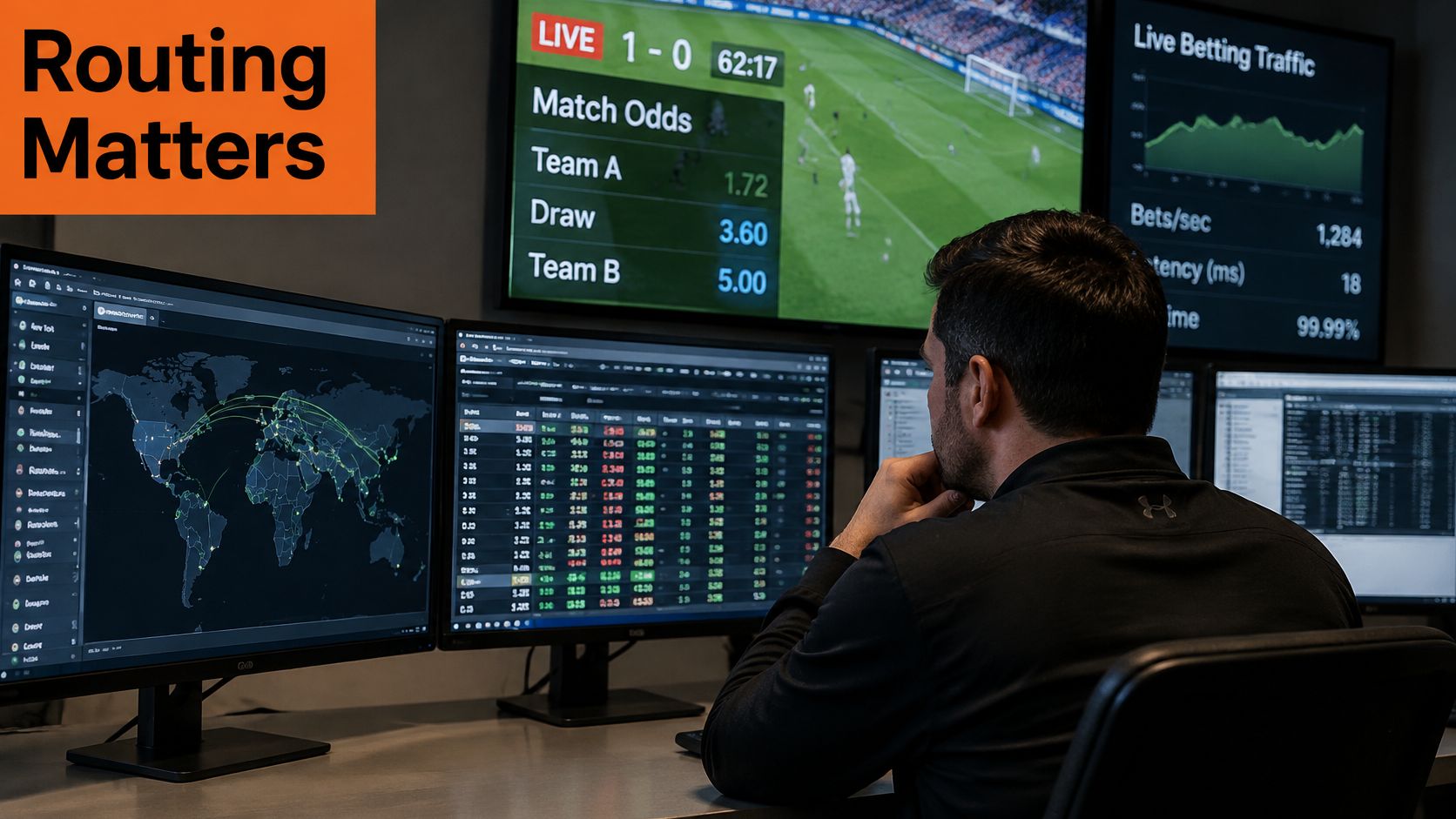
Define acceptance before generating traffic
Use the following as an operator-defined acceptance plan, not a claim about provider performance. Record the baseline, permitted deviation, and failure condition before the test window opens.
Performance acceptance targets during mitigation
| Metric | How to Measure | Target During Mitigation | Measured From |
|---|---|---|---|
| Round-trip time | Repeated probes from each player region | Minimal added delay within the agreed regional latency budget | Europe, North America, Asia |
| Packet loss | Continuous probes during an authorized test attack | Near zero | Europe, North America, Asia |
| Jitter | Variation across repeated probes | Within the written tolerance above the regional baseline | Europe, North America, Asia |
| TCP handshake success | Legitimate connection attempts during the test | Virtually all legitimate attempts succeed | Europe, North America, Asia |
| Application response time | Login, odds, and bet-placement transaction timing | Within each endpoint's agreed baseline-relative budget | Europe, North America, Asia |
For an initial reachability check, Fivenines explains how to measure network latency with ping. Pair those probes with TCP connection tests and application transactions, because ICMP responses alone don't establish that a protected API works.
Keep probe locations, request patterns, and timestamps consistent before and during mitigation. Distinguish a failed handshake from a slow application response rather than combining both into an average.
Verify the route and the origin separately
A reverse proxy can conceal an origin address, while BGP or Anycast protection can filter traffic destined for an address that remains public. Concealment and protected routing aren't interchangeable. The requirement is that attackers can't reach the application through an unfiltered alternative.
Document the forward path and return path, including tunnels and regional handoffs. Test representative player markets individually, since a successful route from one location doesn't establish acceptable performance elsewhere.
Use Cases for Casino, Sportsbook and Crypto Operators
Cloudflare counted 20.5 million DDoS attacks in the first quarter of 2025, according to its quarterly Radar report. That figure describes activity observed by Cloudflare, not an individual casino's probability of attack. For procurement, the practical response is to choose protection that can adapt to the services an operator exposes.
Launching a casino or running an in-play sportsbook
A single-brand casino launch can begin by evaluating provider network filtering alongside an HTTP-aware proxy. With modest traffic and a browser-facing application, that combination offers a manageable architecture to test. Pay particular attention to campaign-driven login bursts so legitimate acquisition traffic isn't mistaken for abuse.
A multi-region in-play sportsbook has a different priority: consistent routing and protection for betting APIs and persistent feeds. Don't stop at testing the public homepage. Exercise odds delivery, bet acceptance, and settlement-related integrations with the actual client types those services use.
At NexGrate, our products include a Sportsbook API, making API availability a concrete dependency to assess alongside the front end. Connect infrastructure decisions with sportsbook risk management, including how the operator handles stale odds, suspended markets, and interrupted requests.
Protecting wallets and changing infrastructure
A crypto casino should focus its application tests on wallet, deposit, and withdrawal-related paths. A rule that protects an interactive page may reject a legitimate payment integration that can't answer a browser challenge. Use sandbox callbacks and verify authentication, signature validation, retries, and duplicate handling during mitigation.
An operator migrating from a legacy backend needs a cutover plan that accounts for previously exposed origins. Updating DNS doesn't close an old route into the application. Check retired ingress paths, partner connections, and temporary migration access before transferring production traffic.
The migration also changes operational responsibility. Name who maintains filtering rules during the transition and who can reverse a mistaken block without undoing the entire deployment.
Expanding into additional markets
A multi-region operator should validate scrubbing and failover from each target market. Test the destination region's application dependencies as well as its ingress, since rerouting players won't help if a required backend remains unavailable.
Avoid treating regional expansion as a copy of an existing deployment. Establish which sessions can continue, which transactions need reconciliation, and which operational team owns recovery.
Scenario check: Match your platform to its most demanding workflow, not its easiest page to keep online.
How to Test a Provider Before You Commit
Make the evaluation a controlled acceptance exercise with named participants, written boundaries, and a shared results sheet. Coordinate it with hosting, application, payment, and security teams so a simulated incident doesn't become an unintended production disruption.
Run an authorized acceptance exercise
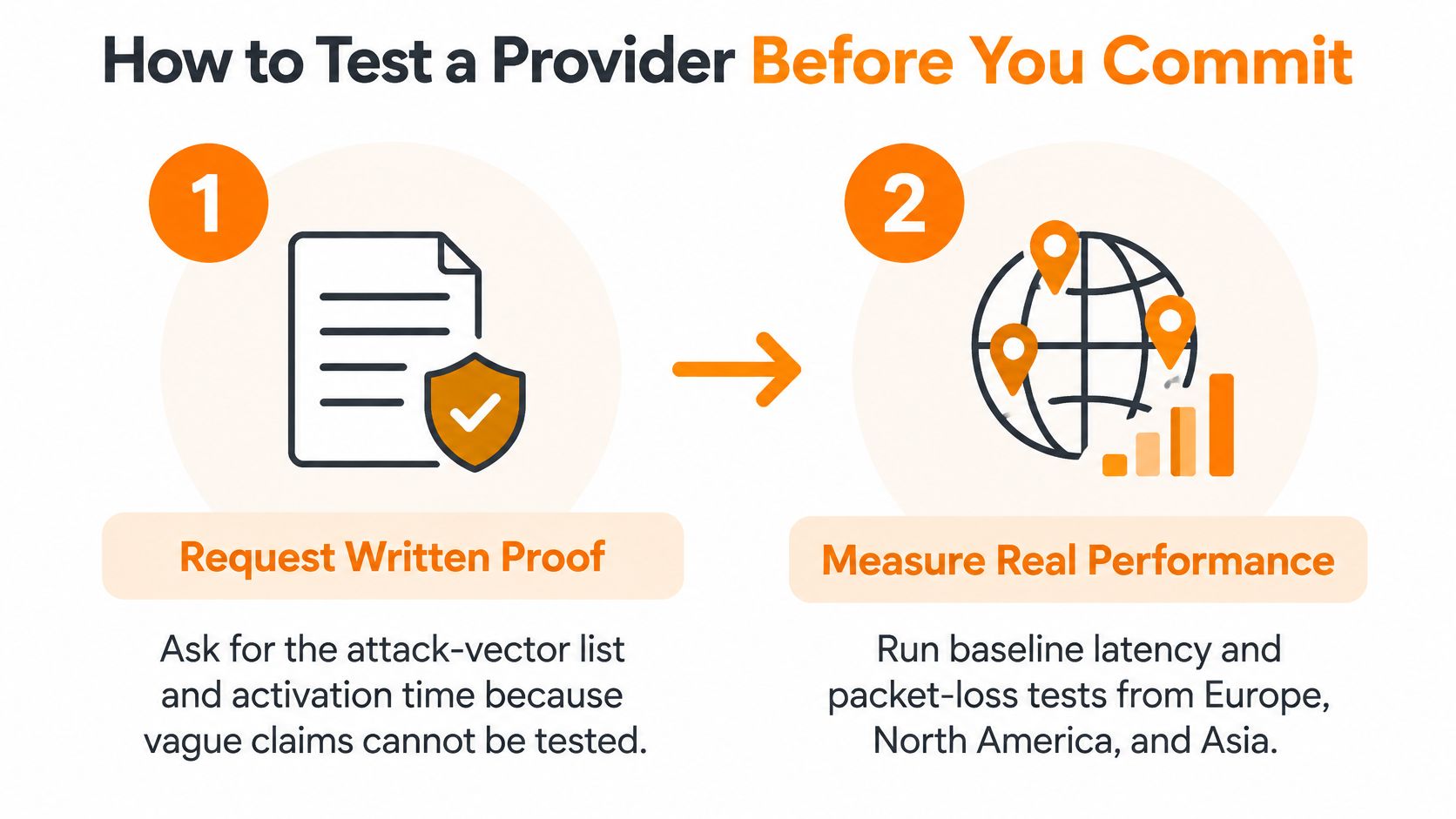
Request written proof. Obtain the covered-vector list, exclusions, activation process, and applicable capacity commitments. Turn each claim into a pass-or-fail observation rather than accepting a generic protection certificate.
Establish a regional baseline using probes from Europe, North America, and Asia. Capture reachability, connection establishment, and application transactions under representative legitimate load; an idle server is an inadequate reference for a busy sportsbook.
Agree the test window in writing. Specify the destination, permitted methods, traffic ceiling, stop condition, and emergency contacts with the provider and authorized testing service. Never generate disruptive traffic against infrastructure without explicit permission.
Check for an origin bypass using an authorized direct-connection test. Confirm that application access outside the intended protected path is refused or equivalently filtered; trusting the visible DNS record alone misses alternative ingress.
Exercise application workflows during mitigation. Use tools such as k6 or Locust for representative login, cashier, and odds requests, with sandbox services for financial actions. Inspect transaction completion and backend errors, not just successful HTTP responses.
Send legitimate requests from an allowlisted test client and an ordinary client. Deliberately trigger a safe test block, then measure the documented restoration process; allowlisting everything would conceal false-positive problems.
Review billing and response obligations. Compare the observed escalation process with the incident SLA and obtain a written interpretation of attack-traffic charges. Don't leave an uncapped fair-use provision unresolved before signing.
Record results side by side and preserve a rollback path. Include failed tests, configuration changes, and recovery behavior, then require a retest after material changes rather than accepting a verbal explanation.
Keep the evidence usable after procurement
Store the agreed policy, test authorization, monitoring exports, and incident contacts together. Apply the same discipline used in vendor management best practices: assign an owner, track unresolved exceptions, and document who accepts each remaining risk.
A successful demonstration shouldn't end with a screenshot of a healthy dashboard. Keep the underlying transaction results and timestamps so engineers can distinguish preserved service from a test that never reached the vulnerable dependency.
Choose the Protection Setup for Your Platform
The best DDoS protection VPS is the one whose protection matches your application paths, player geography, and operating team. Latency, capacity, and operational effort are separate trade-offs. Buying the largest advertised filter doesn't remove the need to manage the other two.
Make the choice against your operating model
| Operator Situation | Starting Architecture | Deciding Evidence |
|---|---|---|
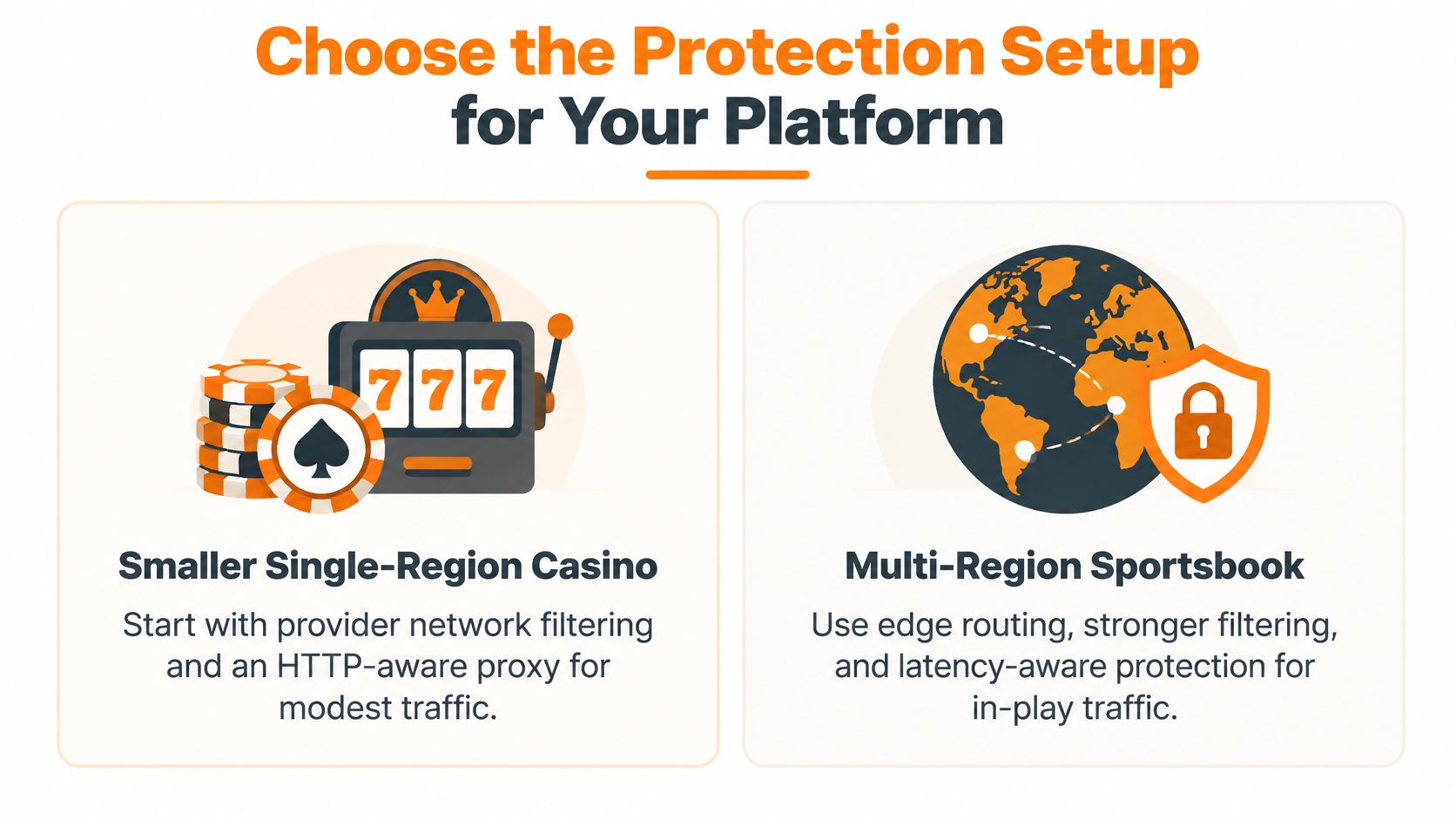
| Smaller single-region casino | Provider filtering plus HTTP-aware proxy | Legitimate player journeys complete during filtering |
| Multi-region in-play sportsbook | Anycast edge scrubbing with API-aware controls | Regional routing and transaction tests meet the agreed budgets |
| Platform expecting severe volumetric attacks | Upstream scrubbing with stated packet-rate capacity | Applicable capacity commitments and authorized test evidence |
| Operator with an in-house network group | Upstream protection plus local appliance where useful | Clear rule ownership and a workable escalation process |
Local filtering can support an experienced team's policy requirements, but it shouldn't replace upstream protection. Likewise, outsourced mitigation doesn't remove responsibility for application security. For teams protecting custom enterprise software, devPulse's cybersecurity consulting service is relevant context for evaluating the application responsibilities around the hosting layer, rather than treating DDoS protection as the entire security program.
Apply the same standard to turnkey platforms
A turnkey white-label arrangement changes who assembles the stack, not what constitutes acceptable service. Compare iGaming software providers on responsibility boundaries and demonstrable operating behavior, alongside their product coverage.
Our product pages cover Nex AI, Casino, Sportsbook API, Payments, Compliance, and Markets. Those components identify workflows to include in an evaluation; product breadth alone isn't evidence of mitigation performance.
Use the survivability requirement in section two and the scenario matching in section five to define scope, then run the authorized acceptance procedure in section six. This week, put your leading candidates through the origin-access check and regional baseline measurements, record the results side by side, and resolve material exceptions before committing.
NexGrate offers a turnkey white-label casino and sportsbook platform that operators can use to launch and scale their own brands. Visit NexGrate to explore the platform and discuss how hosting, monitoring, and DDoS protection fit your player markets and critical workflows. Bring your acceptance checklist so the discussion starts with measurable requirements for login, betting, wallets, and payments.