A player opens a live blackjack table while travelling, passes an invisible jurisdiction boundary, and keeps playing because the platform checked location only at login. The operator may not notice until a regulator asks why the account placed a wager outside the permitted territory, or why a withdrawal was approved after the player had already moved.
That scenario is why how to implement geofencing in iGaming starts with platform controls, not map drawing. A production system must identify physical location, assess confidence, enforce territory rules throughout the session, and leave evidence that compliance, finance, and risk teams can replay later.
Table of Contents
- Why Geofencing Is a Compliance Control, Not a Login Gate
- Choosing the Right Location Architecture
- Regulatory Requirements Across MGA and Other Jurisdictions
- Integrating Location Services With Wallet, KYC and Session Controls
- Implementing the Geofence From Design to Launch
- Handling Edge Cases and Spoofing in Production
- Deployment Checklist, Monitoring and FAQ
Why Geofencing Is a Compliance Control, Not a Login Gate
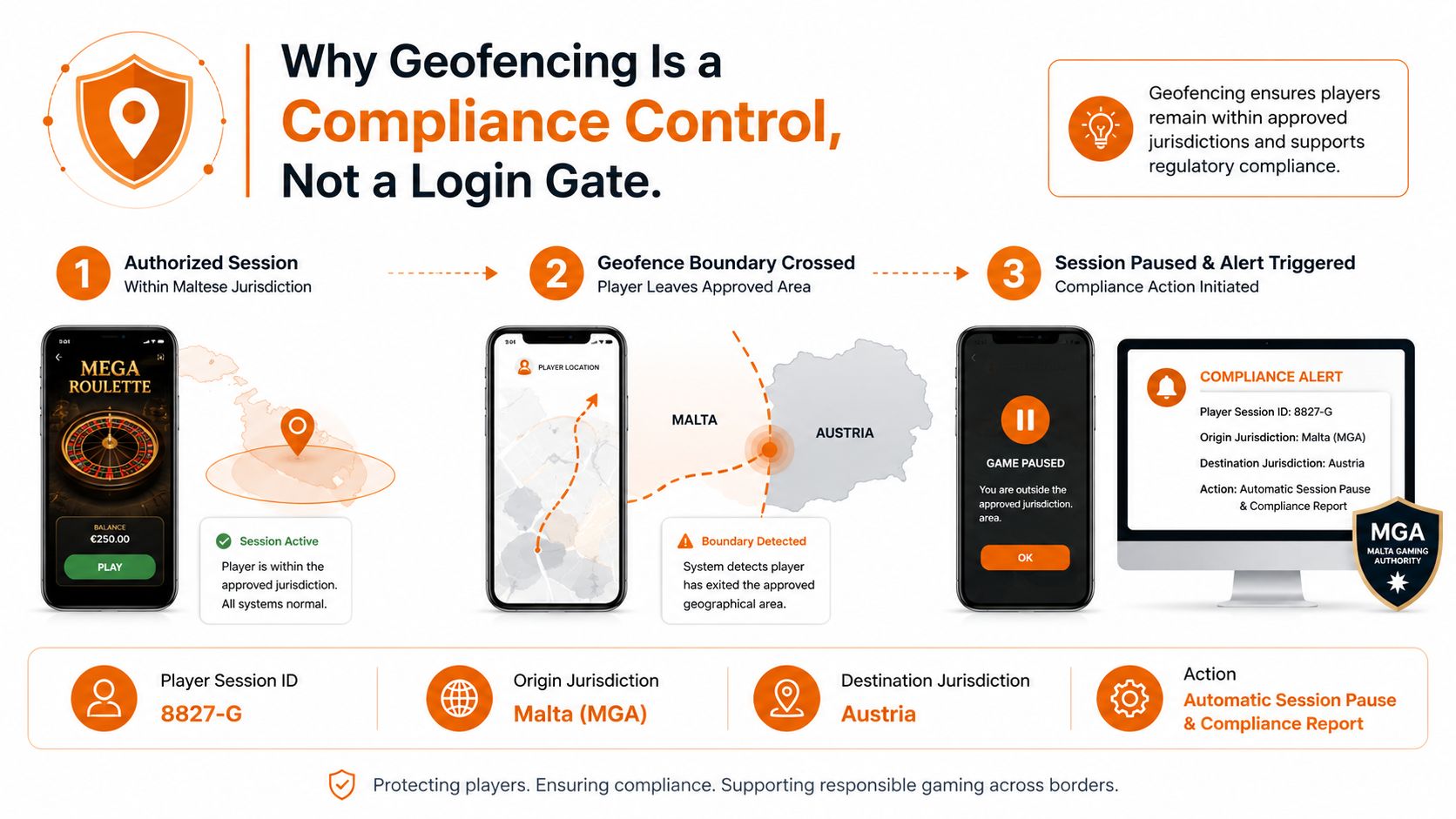
Consider a Maltese-licensed operator receiving traffic from Germany and the UK. A player begins a live blackjack session inside an approved territory, then drives across the Austrian border during a hand. A location check at login can prove only where the player was at the start. It can't prove where the next wager, deposit, withdrawal, bonus claim, or session resume occurred.
Michigan's technical rules require an internet sports betting platform provider to use a geofencing system that can reasonably detect location, monitor and block unauthorized attempts, and dynamically monitor the participant's location for the session. Michigan's technical rule makes the operational standard clear: location enforcement must continue after authentication.
Build the control around meaningful events
A useful implementation treats geolocation as a session state that other services can query. Re-evaluate location before or during:
- Session start and resume: Don't trust a stale browser session after a device reconnects.
- Wager placement: A live bet needs a current, sufficiently confident location decision.
- Deposits and withdrawals: Financial actions require their own compliance decision, not an inherited login result.
- Bonus claims: A promotion may carry territory-specific eligibility rules.
- Large or unusual bets: Risk rules can require a stronger location signal before approval.
When a player crosses a boundary, pause the game or block the event according to the applicable rule pack. Preserve the session identifier, location evidence, confidence assessment, rule evaluated, action taken, and timestamps so the logout or pause can be replayed during an audit.
Give downstream modules one trusted state
The geofence shouldn't sit beside the platform as an isolated filter. It should publish a trusted state such as permitted, uncertain, blocked, or degraded, with the wallet, KYC, bonus, responsible-gaming, and reporting modules reading that state.
This also matters for responsible gaming and AML traceability. A location failure must not disable deposit limits, self-exclusion, affordability controls, or transaction monitoring. Geofencing is a platform-level compliance control surface, and every sensitive action should consume its decision consistently.
Choosing the Right Location Architecture
A player can pass an IP check from a permitted region and still be outside the authorised area. That is why a production design combines several signals, assigns each one a clear role, and carries the result into the session, wallet, KYC, and responsible-gaming controls already running in a unified backoffice such as NexGrate.
- IP intelligence rejects clearly unauthorised traffic before it reaches the application.
- GPS and Wi-Fi provide stronger confirmation for wagers, withdrawals, and borderline locations.
- Cellular location supplies fallback evidence when permissions or satellite positioning are unavailable.
- Signal correlation checks whether the sources agree sufficiently for the requested action.
Signal quality varies by context. GPS-enabled smartphones achieved less than 10 meters of error for 95% of observations in some roadway-positioning research. A fused mobile-location analysis reported 15.032 meters, compared with 18.224 meters for GPS alone. Another assessment reported 3.20 meters for GPS and 55.56 meters for network-based location. The location-accuracy research provides the underlying comparisons.
Geofencing location source comparison
| Signal | Accuracy | Latency | Cost per lookup | Spoofing risk | Best-fit role |
|---|---|---|---|---|---|
| IP geolocation | Coarse network-region evidence, less reliable than device positioning | Low | Usually low | High, especially with VPNs and proxies | Initial traffic screening |
| GPS | Can be highly precise outdoors, but degrades indoors and when permission is denied | Variable | Device and provider dependent | Medium to high if device integrity is weak | Strong confirmation for sensitive events |
| Wi-Fi location | Android documentation describes typical Wi-Fi accuracy of 20–50 meters | Usually responsive, but background restrictions can delay alerts | Provider dependent | Medium | Indoor assistance and signal fusion |
| Cell triangulation | Much less precise than GPS, with accuracy around 55.56 meters in one assessment of network-based location | Available when other signals fail | Provider dependent | Medium | Fallback evidence, not sole approval evidence |
The geofencing performance review supports the table's comparison. Treat its accuracy figures as test results, not production guarantees. Each decision should evaluate signal age, estimated error radius, permission status, network context, and disagreement between sources.
The practical rule is simple: IP can reject obvious mismatches, while regulated wagers and withdrawals need stronger, current evidence. If the sources conflict, route the event to challenge, pause, or review rather than allowing a weak signal to approve it.
Regulatory Requirements Across MGA and Other Jurisdictions
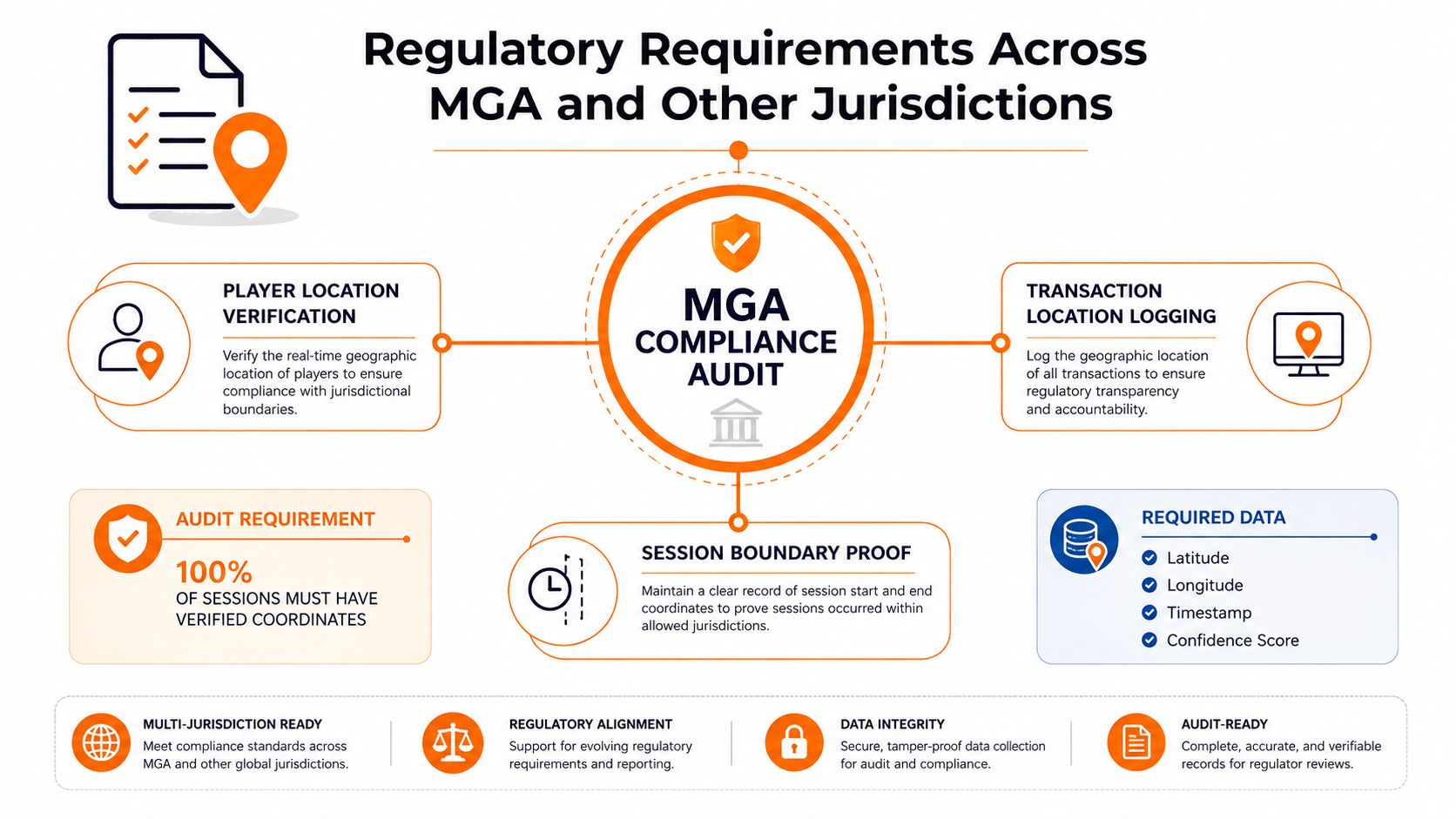
An MGA-licensed operator needs more than a green location result. It needs a defensible record showing which jurisdiction rule applied, what evidence supported the decision, and how the platform responded when confidence dropped.
The same principle appears in Michigan's requirements for dynamic monitoring. Pennsylvania's technical standards define geofencing as a virtual geographic boundary that triggers a response when a device enters a defined area, and require capability around the gaming-floor perimeter to detect and block wagers inside restricted boundaries. These rules support a design based on mapped polygons, active monitoring, and explicit block actions rather than a one-time country lookup.
What an audit trail should contain
For each material event, store enough context for an auditor to reconstruct the decision:
- Player and session identity: Account identifier, session identifier, device context, and event type.
- Location evidence: Coordinates or provider result, source mix, timestamp, and confidence or error information.
- Rule evaluation: Licensed territory, excluded territory, boundary version, and the rule pack used.
- Enforcement result: Allowed, challenged, paused, blocked, or placed into a degraded state.
- Recovery path: Re-authentication request, second-signal requirement, operator review, or session termination.
Keep the evidence attached to login, wager, deposit, withdrawal, and other events that can change the player's financial or gaming position. Define what happens when confidence falls below the approved threshold. The system should never leave that decision to an ad hoc support response.
Don't hard-code one global allow-list
Germany, the UK, the Netherlands, and Malta don't create one interchangeable compliance model. A multi-market operator needs jurisdiction-specific rule packs, player jurisdiction tags, configurable blocklists, and controls for market-specific evidence and retention requirements.
A backoffice should let compliance teams change a territory rule without deploying new application code. It should also expose the relationship between the location decision and the transaction record. Clear compliance reporting practices help teams organize those records for regulatory review.
The data model must also support legal exclusions unrelated to gaming boundaries. Washington and California-related rules can prohibit geofencing around certain in-person health care facilities within defined perimeters, while California AB 45 is scheduled to take effect in 2026, according to this legal analysis of California's location-data protections. Build the jurisdiction map and legal exclusion policy before enabling location-based processing in a new market.
Integrating Location Services With Wallet, KYC and Session Controls
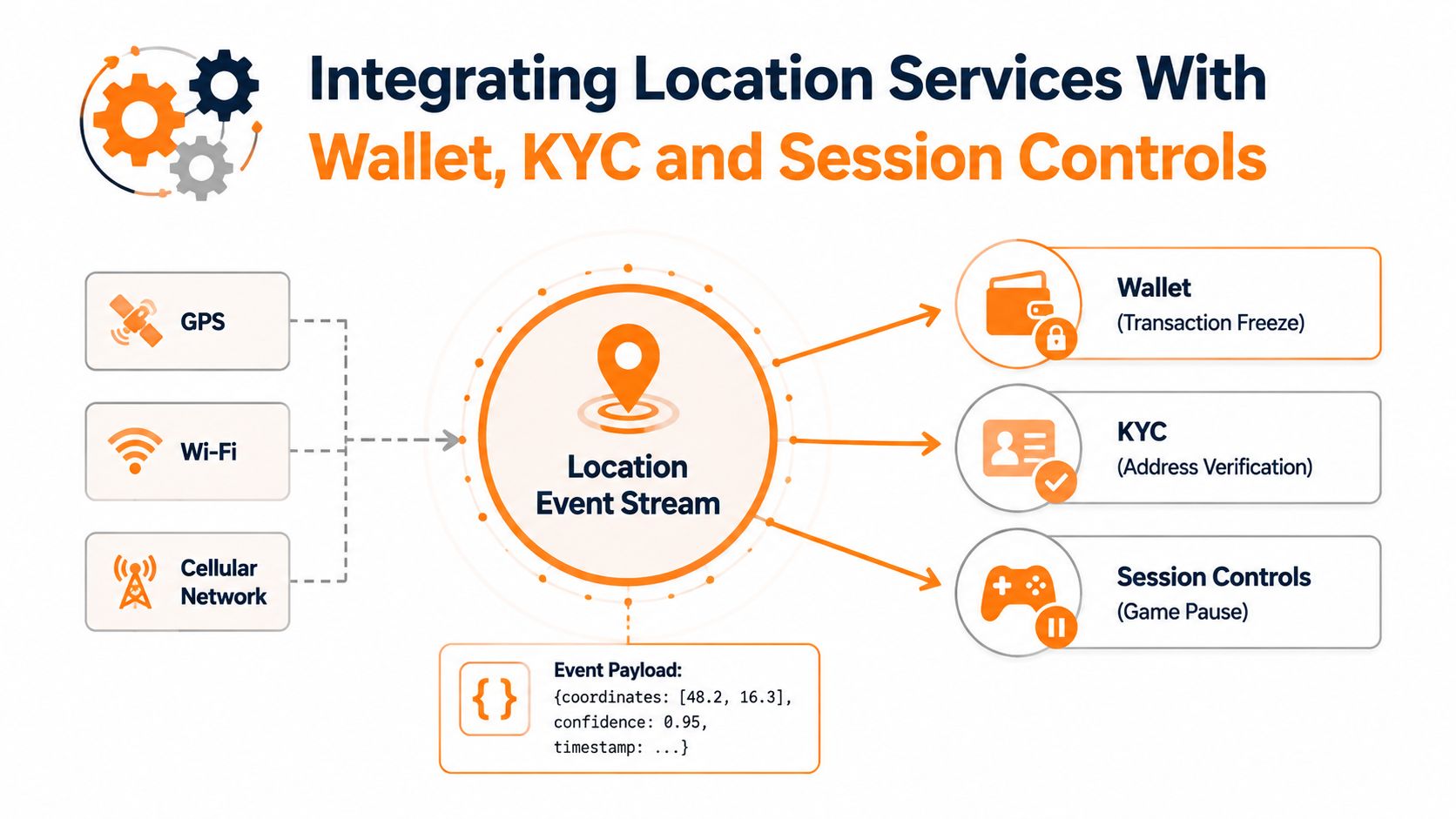
The location service should publish events, not merely return a Boolean response to the frontend. A useful event contains the current evidence, confidence assessment, jurisdiction decision, timestamp, and reason for any restriction. The platform bus then distributes that event to the controls that own the resulting action.
A unified backoffice makes this pattern easier because wallet, KYC, bonus, responsible-gaming, and session services already share account and transaction context. The location layer becomes a common policy input instead of a collection of custom checks hidden inside separate products.
Wallet decisions must be event-aware
A withdrawal request should trigger a fresh location decision. If the player moves outside an approved territory after placing a wager, the wallet needs a defined policy for unsettled bets, pending withdrawals, and payment instruments associated with excluded territories.
That doesn't mean every uncertain fix should confiscate funds. It means the wallet should pause the relevant action, preserve the reason, and route the case through the configured compliance workflow. A unified multi-currency wallet needs the same location state across fiat, crypto, deposits, withdrawals, and balance adjustments.
KYC and bonus controls consume different signals
KYC should trigger a jurisdiction review when the country changes, the confidence score falls, or the device presents contradictory evidence. The response may be a location recheck or document refresh, depending on the rule pack. Do not overwrite the player's known residence with a transient travel location.
The bonus engine has a separate concern. A territory-restricted promotion may need to stop awarding benefits when the player leaves the permitted region, while the account's responsible-gaming controls must continue operating even if geolocation is unavailable.
Keep responsible gaming active in degraded mode
A degraded geolocation state should block or restrict regulated gaming actions without turning off self-exclusion, deposit limits, session limits, or harm-prevention messaging. This separation is essential. A failed location provider is a geofencing incident, not permission to suspend safer-gambling controls.
The event payload should be immutable once written, with later corrections appended as new events. That gives compliance and operations teams a clear timeline instead of a mutable record that only shows the latest state.
Implementing the Geofence From Design to Launch
A player can pass the entry check, move across a boundary during play, and attempt a withdrawal minutes later. The implementation must therefore define a session-long control, not a single login decision. Start with policy. Compliance should approve licensed territories, restricted polygons, boundary behavior, evidence requirements, and the action for every decision state before engineering builds the service.
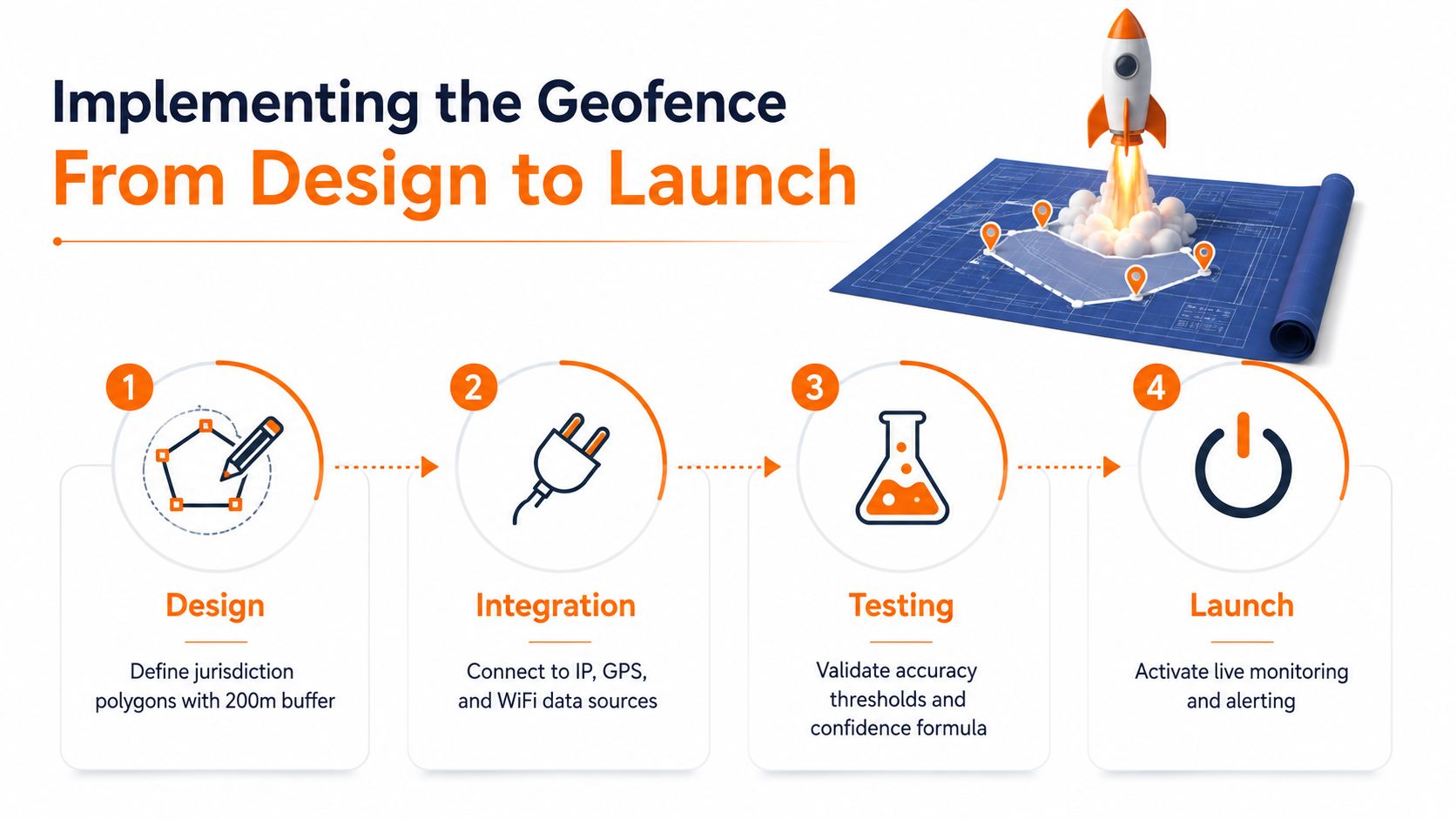
Design the decision model
Represent jurisdictions as versioned polygons, not informal country labels. Define an edge safety margin, confidence thresholds for each event type, and hysteresis so minor location changes do not flip a session repeatedly between allowed and blocked states.
Michigan's technical bulletin describes a session-control pattern with regular rechecks for static connections, shorter intervals near a permitted boundary, and proximity-based checks for mobile connections. Its model also accounts for an assumed travel speed and a maximum check interval. Use the Michigan geofencing technical bulletin as a regulatory reference, then configure the rule set for the relevant product and jurisdiction.
Specify degraded-mode behavior, audit fields, consent handling, provider-outage responses, and retention before implementation. The confidence formula should show how IP, GPS, Wi-Fi, and cellular evidence combine. Keep that formula configurable because regulators and products may apply different thresholds.
Build behind an internal interface
Place providers such as MaxMind or NetVerify behind an internal LocationService contract. Wallet, KYC, bonus, and game-session modules should request a location decision without depending on the vendor that produced it. In a unified backoffice such as NexGrate, this boundary also lets the same decision state reach payment and compliance workflows without duplicating provider logic.
Route requests through an API gateway with timeouts, circuit breakers, and controlled retries. Publish accepted, uncertain, blocked, and provider-failure events to the platform bus. Keep wager and withdrawal checks lightweight, while asynchronous enrichment adds audit context without delaying every player action.
Test the failure paths deliberately
Replay licensed and excluded territories, border conditions, denied permissions, null responses, stale coordinates, VPN indicators, and contradictory signals. Test entry and exit separately. Entry and exit evidence can behave differently, so do not assume that one transition rule works for both.
Load-test the synchronous path during provider degradation, not only in a clean development environment. Each phase needs compliance sign-off. A technically correct location response can still breach the approved operating policy.
Launch with controlled exposure
Use a feature flag and observe decisions before enforcement becomes binding. Compare the location stream with finance and game records, investigate unexpected blocks, and sample sessions for manual review. Retain the previous control as a rollback path until compliance confirms that evidence, alerts, wallet actions, KYC states, and enforcement decisions align.
Handling Edge Cases and Spoofing in Production
A player can pass the location check at login, then move onto a VPN, cross a border, lose GPS, or present stale evidence before placing a wager. Treat geofencing as a session control, not a one-time gate. IP-only checks fail under residential VPNs, mobile carrier-grade NAT, roaming, and shared Wi-Fi, and a determined user can manipulate the network path.
Use IP as an initial risk signal. Request device-level GPS or Wi-Fi evidence for sensitive actions, and revalidate when the player wagers, withdraws, or changes location context. If signals disagree, challenge the session instead of approving it without verification. The risk-management guidance for operators should connect that challenge to account, wallet, payment, KYC, and player-safety workflows in the existing backoffice.
Common geofencing edge cases and mitigations
| Edge Case | Failure Mode | Mitigation |
|---|---|---|
| VPN or proxy use | IP points to an allowed country while the device is elsewhere | Correlate IP with GPS, Wi-Fi, device integrity, and session history |
| Indoor GPS drift | A tablet or desktop reports a location that jumps across a tight boundary | Use a wider safety envelope, request a second signal, and challenge ambiguous fixes |
| Border crossing | Rapid jurisdiction changes create repeated pause and resume events | Apply hysteresis and require confirmed boundary transitions |
| Stationary mobile device | Background updates arrive late or become stale | Check signal age and confidence, then move to a controlled degraded state instead of locking the account immediately |
| Provider outage | Null or delayed responses block legitimate activity indiscriminately | Fail closed for regulated actions, preserve responsible-gaming controls, and alert operations |
Location evidence has practical limits. Indoor GPS may drift, background updates may arrive late, and Wi-Fi or IP data can conflict with the device position. A tightly drawn boundary can therefore create avoidable blocks, especially near jurisdiction edges.
Apply a confidence radius and hysteresis to every boundary. Do not block on one ambiguous fix, but stop accepting wagers when evidence remains stale or contradictory. Record the signal mix, signal age, confidence, rule version, provider status, and enforcement action for each decision. That record gives compliance a session-level audit trail and lets operations distinguish user spoofing from provider or device failure.
Deployment Checklist, Monitoring and FAQ
A deploy-ready geofence needs operational ownership, not just a passing integration test. Before launch, compliance should approve the jurisdiction matrix, polygon versions, excluded locations, signal thresholds, session revalidation cadence, degraded-mode rules, and evidence-retention policy.
Pre-launch readiness
- Validate territories: Confirm every licensed, restricted, and excluded polygon against the current legal rule pack.
- Test signal fallback: Verify behavior when GPS is denied, Wi-Fi is unavailable, IP is suspicious, or the provider returns no result.
- Review downstream actions: Confirm wallet, KYC, bonus, responsible-gaming, sportsbook, casino, and reporting services consume the same location state.
- Inspect evidence: Replay a session from login through wager, pause, withdrawal, and recovery using only stored audit data.
Go-live controls
- Use feature flags: Enable enforcement by market or product so operations can isolate unexpected behavior.
- Alert on failures: Notify the on-call team about provider outages, unusual block volumes, stale evidence, and repeated signal disagreement.
- Reconcile records: Compare location events with wagers, settlements, wallet movements, and compliance reports during the initial operating period.
Monitor the right indicators
Track decision latency, provider failure ratios, false-positive and false-negative investigations, VPN detection hits, stale-location events, challenged sessions, blocked-session percentage, withdrawal holds, and player-support contacts. Segment each metric by device type, operating system, jurisdiction, signal mix, and product. A single global average can hide a serious failure at a border or on a particular mobile platform.
Frequently asked questions
What should happen when GPS fails mid-session?
Move the session into an uncertain or degraded state, request Wi-Fi or another permitted signal, and apply the jurisdiction rule for the next wager or financial action. Keep responsible-gaming controls active.
Is IP-only geofencing enough for MGA?
IP can support initial screening, but device-based positioning and repeated checks are more appropriate for active territory enforcement. The source requirements above distinguish coarse network checks from stronger location evidence.
How should a player who relocates mid-game be handled?
Pause or restrict the next meaningful action according to the applicable rule pack, preserve the last accepted state, and require a confirmed transition before applying irreversible treatment to unsettled activity.
How long should location evidence be retained?
Use the period approved for the relevant jurisdiction, product, privacy policy, and audit obligations. Document the decision before launch rather than choosing a retention period inside application code.
What will auditors request?
Prepare session and transaction identifiers, timestamps, location evidence, confidence information, rule versions, recheck history, block decisions, provider incidents, and proof that wallet, KYC, and responsible-gaming actions followed the decision.
NexGrate provides a white-label iGaming platform with casino, sportsbook, wallet, KYC and AML workflows, reporting, audit logs, geofencing, and responsible-gaming controls in one operating environment. If you're planning a regulated launch or replacing fragmented backend services, visit NexGrate to discuss how its compliance and location controls can fit your rollout.