You're on shift, the dashboard is already noisy, and a sportsbook customer just lit up the queue. Five alerts hit in twenty minutes, one for a high-risk jurisdiction login, one for a third-party card deposit, and another for a withdrawal request to a new IBAN. The analyst has to decide fast whether this is bonus abuse, stolen payment use, money laundering, or a messy combination of all three.
That's the reality of suspicious activity detection in iGaming. It's not a single checkbox at sign-up, and it's not a back-office report that can wait until morning. It's a live operating layer that has to read cashier movement, casino behavior, sportsbook activity, and identity signals as one story.
Table of Contents
- The Late-Night Alert That Decides Your Brand's Compliance
- What Suspicious Activity Detection Really Means in iGaming
- Comparing Rule-Based Monitoring, Risk Scoring, and Machine Learning
- Reading Transaction Analytics and Player Behavior Together
- From Alert to Case to Filing in the Investigation Workflow
- How Detection Connects to KYC, AML, and Fraud Controls
- Regulatory Reporting Across MGA, AUSTRAC, FinCEN, and FATF
- A Working Standard Operators Can Audit Against
The Late-Night Alert That Decides Your Brand's Compliance
A player alert rarely sits alone. A customer can look ordinary in one channel and suspicious in another, especially when deposits, device changes, wallet activity, and payout requests happen close together.
The live question isn't “is there an alert”
It's whether the alert tells a coherent story. An analyst has to decide if the player is chasing bonuses, moving illicit funds, using a compromised card, or cycling cash through play to make it look legitimate. That decision changes the next step, from a soft review to a freeze, a KYC request, or a regulatory filing.
That is what suspicious activity detection looks like in practice, and it depends on more than reducing alert volume. It has to separate noise from conduct worth investigating. FATF's 2023 guidance treats suspicious transaction reporting as part of the evidence base for AML/CFT effectiveness, and it points operators and regulators toward tracking suspicious transaction reports, investigations, prosecutions, convictions, and asset seizure outcomes within broader AML/CFT data and statistics guidance (FATF AML/CFT-related data and statistics guidance).
In iGaming, one alert rarely stands alone
A cash-out request after a run of rapid deposits can mean different things depending on what happened before it. If the player also bounced across products, changed devices, or used a risky payment route, the case gets stronger. If not, the team may be looking at ordinary volatility and a pile of wasted analyst time.
Practical rule: treat every alert as a timeline problem, not a single-event problem.
The broader scale of laundering is why operators need that discipline. A 2025 peer-reviewed paper cites UNODC estimates that money laundering equals 2.1% to 4% of global GDP, which explains why detection programs are built to catch activity moving through systems at high volume. In iGaming, suspicious activity detection has to sit across the whole stack, from deposit to gameplay to payout.
What Suspicious Activity Detection Really Means in iGaming
A player logs in from a normal device, deposits as usual, then starts cycling through products and payment routes before asking for a withdrawal. That is the kind of sequence suspicious activity detection is built to catch. In operator terms, suspicious activity detection is continuous monitoring of player transactions, gameplay, account behavior, and payment flows for patterns that warrant review or reporting. Onboarding KYC tells you who the customer claims to be. Suspicious activity detection tells you what that customer does after the account goes live.
The regulatory weight behind everyday alerts
Suspicious activity reporting became a standardized anti-money-laundering control in the U.S. on April 1, 1996, when FinCEN introduced the Suspicious Activity Report system and replaced earlier criminal referral forms as the standard reporting mechanism. FinCEN data cited by GAO show SAR filings by depository institutions grew from about 163,000 in 2000 to more than 649,000 in 2007, and a FinCEN statistical review recorded more than 2.1 million SAR forms filed by December 31, 2004, with 1,660,387 from depository institutions between April 1996 and the end of 2004, as noted in the earlier FinCEN historical SAR notice.
For gaming operators, that history matters because reporting is evidence creation, not just internal suspicion. Analysts need a fact base that can stand up to a regulator, an auditor, or an MLRO. FATF treats suspicious transaction data as part of the evidence base for enforcement and risk analysis, so the work is operational as much as it is regulatory.
Why gaming stacks create distinctive risk
Casino and sportsbook products create fast movement by design. Players can deposit, wager, switch products, withdraw, and re-enter in quick succession. Bonus structures add another layer, because legitimate engagement and abuse can look similar until you correlate the full sequence.
A payments-only view breaks down fast. A third-party card, repeated cash-out attempts, or unusual wallet churn is useful, but those signals become far more actionable when they sit beside gameplay and account behavior. The job is to decide whether the activity still makes commercial sense, behavioral sense, and compliance sense at the same time.
In a unified casino and sportsbook stack, that usually means one operating view, not isolated checks. Rule design, risk scoring, case management, and cross-channel correlation all have to work together, or analysts end up clearing alerts without seeing the pattern behind them.
Comparing Rule-Based Monitoring, Risk Scoring, and Machine Learning
Most mature iGaming stacks run three detection layers in parallel, because each one solves a different problem. Rule engines give you hard controls. Risk scores let you sort the queue. Machine learning helps surface patterns that rules miss.
Rule-based monitoring where the line must be clear
Rules are the most defensible layer because they're deterministic. If you want to block a deposit velocity pattern, flag repeated payment instruments, or enforce a jurisdiction threshold, a rule engine can do that consistently. It's the right tool for hard stops and for scenarios where the analyst needs to explain exactly why the alert fired.
The trade-off is noise. Rule systems in AML and suspicious-activity monitoring can generate false-positive rates as high as 95% to 98%, which means most alerts are not suspicious (false-positive benchmark). In a sportsbook or casino environment, that volume can bury investigators in routine clears.
Risk scoring where queue management matters
Risk scoring works differently. Instead of saying “match” or “no match,” it weights signals across jurisdiction, payment route, KYC tier, device history, product behavior, and prior activity. The result is a per-player or per-case score that tells analysts what to inspect first.
That's the layer that keeps the queue usable. A score doesn't replace the rule engine, it organizes the output so high-risk cases get attention before low-value noise does. When the stack is unified, scoring also lets the MLRO see which cohorts are driving the most review load.
Machine learning where novel patterns matter
Machine learning is the third layer, and it's usually the least understood by compliance teams. Supervised models learn from confirmed cases. Unsupervised anomaly detection looks for behavior that falls outside the customer's or cohort's normal pattern. Both are useful when rules start missing new typologies or when alert volume overwhelms the team.
The technical gap is real, though. A 2024 customer-level fraudulent activity detection benchmark notes that the field still lacks standardized, customer-level datasets for evaluating suspicious-activity models, which makes cross-institution comparison difficult and pushes teams toward more realistic behavioral evaluation (customer-level benchmark). That's one reason mature operators keep ML in the residual-risk layer, not as a replacement for explainable controls.
| Approach | Signal Quality | False Positive Rate | Explainability | Best Fit |
|---|---|---|---|---|
| Rule-Based | Strong for known patterns | Often very high in noisy environments | High | Hard controls, policy thresholds, deterministic flags |
| Risk Scoring | Better triage across mixed signals | Lower than raw rules when tuned well | Medium | Queue prioritization, tiered review, case routing |
| Machine Learning | Strong on novel or subtle patterns | Depends on training and thresholds | Lower unless well-explained | Anomaly detection, behavioral clustering, residual risk |
For a practical view on how teams structure this layer, the risk management approach discussed in NexGrate's risk management guidance maps well to a combined rules and scoring model.
Reading Transaction Analytics and Player Behavior Together
A withdrawal that looks normal in the cashier can look very different once you line it up with login history, device changes, and game activity. That is the value of reading transaction analytics and player behavior together. Separate systems hide the sequence that turns a noisy alert into a usable case.
Transaction signals need behavioral context
Deposit velocity, withdrawal-to-deposit patterns, repeated card usage, e-wallet churn, and crypto on-ramp timing are the obvious transaction-side signals. On their own, each one can be explained away. Players top up, switch wallets, and cash out for ordinary reasons.
The stronger read comes from the full journey. If a customer deposits quickly, rotates instruments, and asks for a withdrawal to a new destination, the pattern matters more than any single event. It matters even more when the account also shows fresh login behavior or a jurisdiction mismatch.
Behavior signals complete the risk picture
Gameplay events carry the other half of the story. Session length variance, stake clustering, bonus-trigger behavior, and product-switch patterns can point to exploitation or laundering-style movement. Casino-to-sportsbook jumps, especially when they sit next to rapid wallet movement, deserve attention because the player is using the ecosystem, not just one product.
That requires a data model that keeps the case intact. A turnkey stack should expose timestamps, customer IDs, payment instrument history, game events, wallet movements, geolocation, and device history in one timeline. Without that, analysts end up exporting spreadsheets and rebuilding the case by hand, which slows review and weakens the audit trail.
Operational rule: a useful alert includes the transaction, the game event, and the identity context in the same case view.
The platform point is straightforward. Operators need the same customer record across casino and sportsbook. A separate ledger for each product creates gaps, while a unified stack keeps the behavior sequence intact. That is how an analyst gets from “interesting” to “actionable.”
| Signal Category | Example Indicators | Risk Question Answered | Typical Source |
|---|---|---|---|
| Transaction | Deposit velocity, repeated payment methods, withdrawal changes | Is value moving in a way that fits the account? | Cashier, wallet, payments |
| Behavior | Session variance, stake clustering, product switching | Does the play pattern fit normal customer use? | Game server, sportsbook engine |
| Identity | Login location, device changes, account edits | Is the account acting like the known customer? | KYC, device, geolocation |
For a practical view of payment and wallet flows, NexGrate's pay and play overview is relevant because it shows how cashier and play data need to sit together in one monitoring layer.
From Alert to Case to Filing in the Investigation Workflow
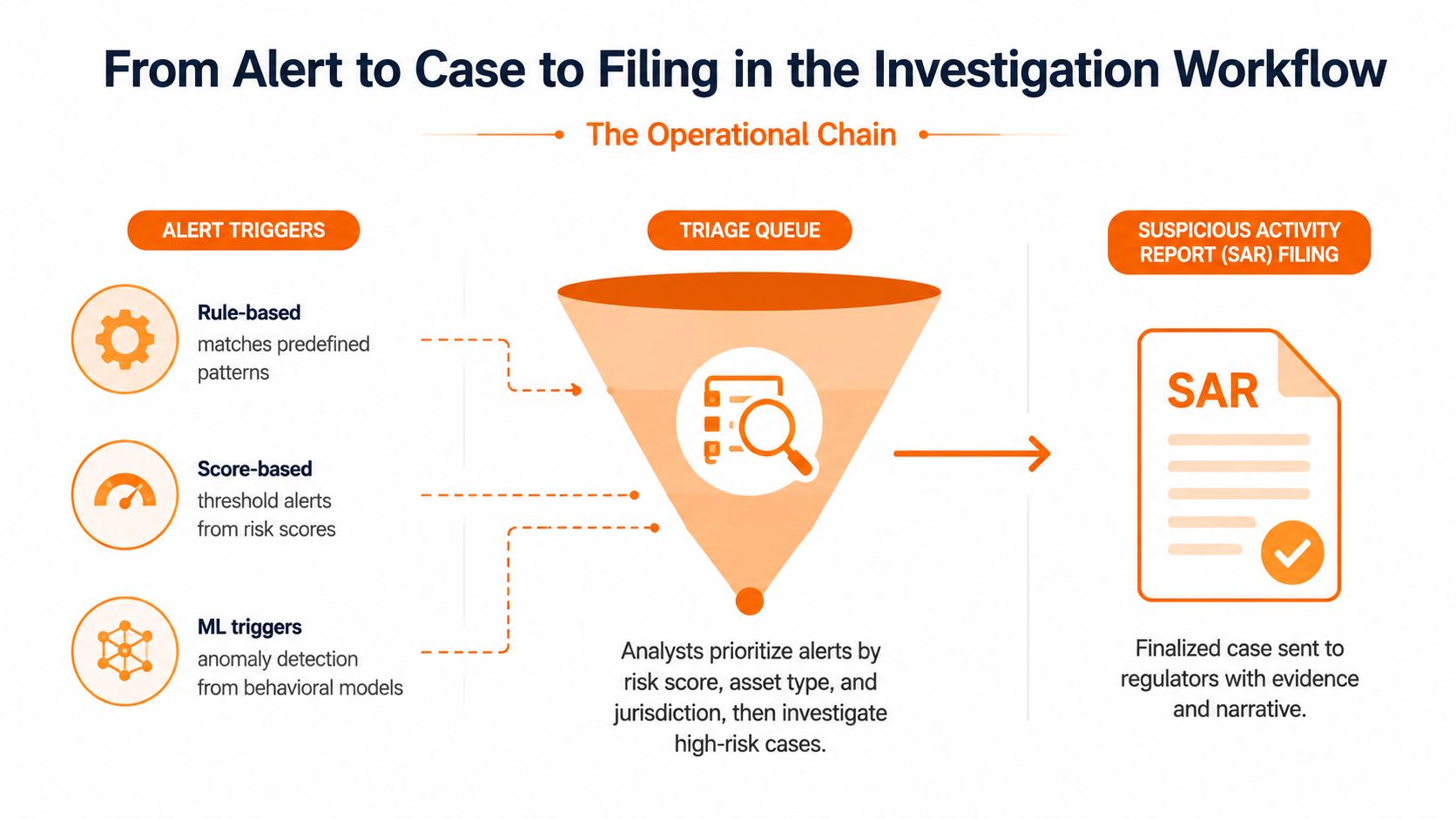
Alerts only matter if the workflow behind them is tight. In real operations, the path is not “flag and forget.” It's alert generation, triage, case building, investigation, escalation, and filing, all with a defensible audit trail.
Triage decides what gets human time
Alerts can come from rules, scores, or ML triggers. Analysts should not treat them equally. The first pass should sort by risk score, customer segment, jurisdiction, product, and whether multiple alerts are clustering around the same account.
That triage layer is where a lot of programs either save time or waste it. A solid queue makes it obvious which cases need immediate review and which ones can wait. It also creates consistency, which matters when your MLRO asks why two similar alerts were handled differently.
Investigation is a reconstruction exercise
A strong case file usually includes customer profile review, transaction reconstruction, gameplay playback, and external checks. Analysts need to see what happened first, what changed next, and what the account looked like before the alert fired. If the customer changed a device, altered account details, and moved money quickly, that sequence matters more than any single event.
Escalation should be explicit. If the case crosses the internal threshold, the MLRO or named compliance officer needs to review the narrative and approve the next step. The narrative itself should be fact-based, concise, and backed by evidence, not guesses.
Filing needs a clean paper trail
The filing packet should preserve timestamps, actor IDs, evidence references, and decision notes. That's how the team proves the workflow ran correctly later. A good audit trail also shows where the alert originated, how long it sat in queue, what evidence the analyst relied on, and who signed off on escalation.
If an investigator can't reconstruct the case six months later, the workflow isn't finished.
The external submission step should match the jurisdictional format, whether that's a SAR or an SMR. The internal case should remain tied to the original alert so the compliance team can trace every decision without reassembling the story from scratch.
How Detection Connects to KYC, AML, and Fraud Controls
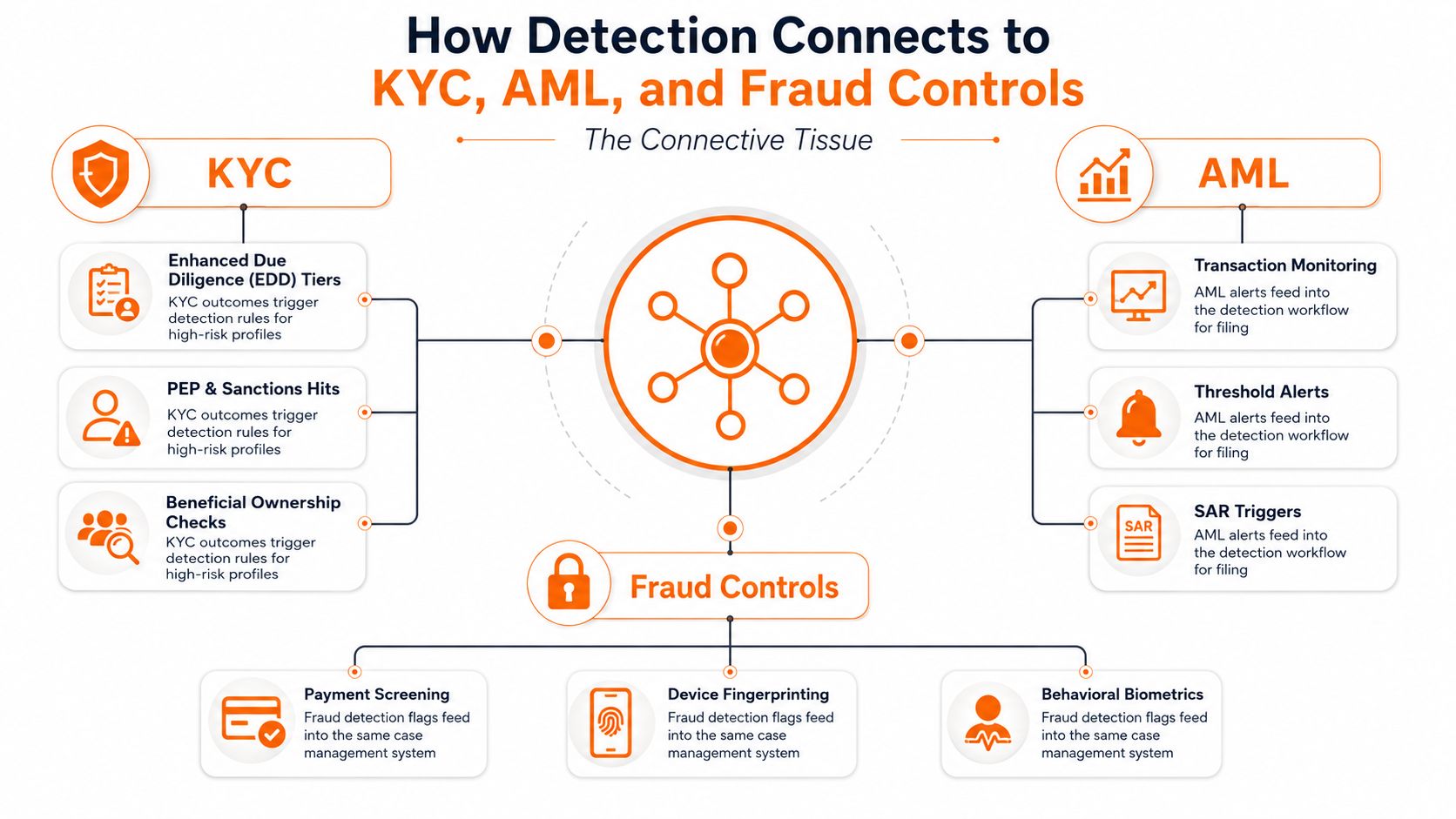
Suspicious activity detection works best when it sits between onboarding, payments, and product risk instead of beside them. KYC tells you who the customer is. Fraud controls tell you whether the session and payment are trustworthy. AML monitoring tells you whether the activity is consistent with the customer profile and the regulatory duty.
KYC outcomes should feed the risk baseline
Enhanced due diligence tiers, PEP and sanctions hits, and beneficial ownership checks should all influence the starting risk profile. That doesn't mean every high-risk customer is suspicious. It means the monitoring layer should pay attention sooner and with more context.
A single shared customer ID across KYC, wallet, and monitoring systems is essential. Without it, the analyst sees fragments instead of a coherent profile. That fragmentation is what creates duplicate work and inconsistent decisions.
Fraud signals belong in the same case file
Geolocation mismatches, device fingerprint changes, and multi-account indicators are fraud signals, but they often overlap with AML concerns. Bonus abuse, chargeback behavior, collusion, and synthetic identity concerns can all end up in the same investigation trail. A single case view avoids parallel investigations that compare notes too late.
A unified platform should let AML, fraud, and responsible-gaming teams read the same evidence set. If one team closes a case while another still sees live risk, the brand ends up with inconsistent controls and weak auditability. The goal is one case file, one customer timeline, and one decision history.
Integration points matter more than dashboards
The real implementation work is plumbing. You need event streams from the wallet and game server, a shared customer master, case status sync, and notes that survive exports. If those pieces don't connect, analysts spend their time reconciling systems instead of reviewing risk.
NexGrate's back-office model is one example of how a unified stack can expose wallet, KYC/AML workflows, risk rules, and fraud controls in one environment, which is the kind of layout that makes cross-functional review easier without splitting investigations across tools.
Regulatory Reporting Across MGA, AUSTRAC, FinCEN, and FATF
A report only stands up if the underlying case does. Operators have to shape detection and case management around the jurisdiction they operate in, the report type required, and the evidence they can produce.
Reporting expectations differ, but the evidence packet looks similar
Under FATF, suspicious transaction reporting sits inside the core AML/CFT data model, and jurisdictions build their own filing rules from that base. In practice, the internal packet still needs alert history, KYC records, transaction timelines, and the analyst's rationale.
MGA, AUSTRAC, and FinCEN then add their own forms, timing, and accountable roles on top of that packet. The filing format changes. The evidence standard does not.
Retention and accountability must be built into the workflow
Record retention has to be part of the monitoring design, not something added later. Systems should preserve the alert trail, case notes, evidence attachments, and sign-off history in a format that can be retrieved without manual reconstruction. Named-officer accountability matters too, because regulators want a clear owner for the filing decision.
For the U.S. market, FinCEN's historical SAR system shows how reporting became standardized and scaled quickly in banking, which is a useful reminder that volume can grow faster than manual processes can absorb. For iGaming operators, the lesson is simple, build for traceability before the queue grows.
| Jurisdiction | Report Type | Filing Trigger | Retention | Accountable Role |
|---|---|---|---|---|
| MGA | Suspicious transaction reporting and related regulatory submissions | Suspicion of laundering, fraud, or probity concerns | Preserve player and transaction records for the required period | MLRO or designated compliance officer |
| AUSTRAC | Suspicious matter reporting | Suspicion of identity fraud, money laundering, tax evasion, or proceeds of crime | Keep customer and transaction records in line with AML/CTF obligations | Reporting officer or MLRO function |
| FinCEN | SAR filing | U.S. reportable suspicious activity and continuing-activity review | Retain case records and supporting evidence as required | BSA/AML officer or equivalent |
| FATF-aligned jurisdictions | Suspicious transaction reporting framework | Suspicion consistent with local AML law and risk-based guidance | Retention set by local regulation | Named compliance owner |
For a broader view of filing structure and audit readiness, NexGrate's compliance reporting overview is a useful operational reference point.
A Working Standard Operators Can Audit Against
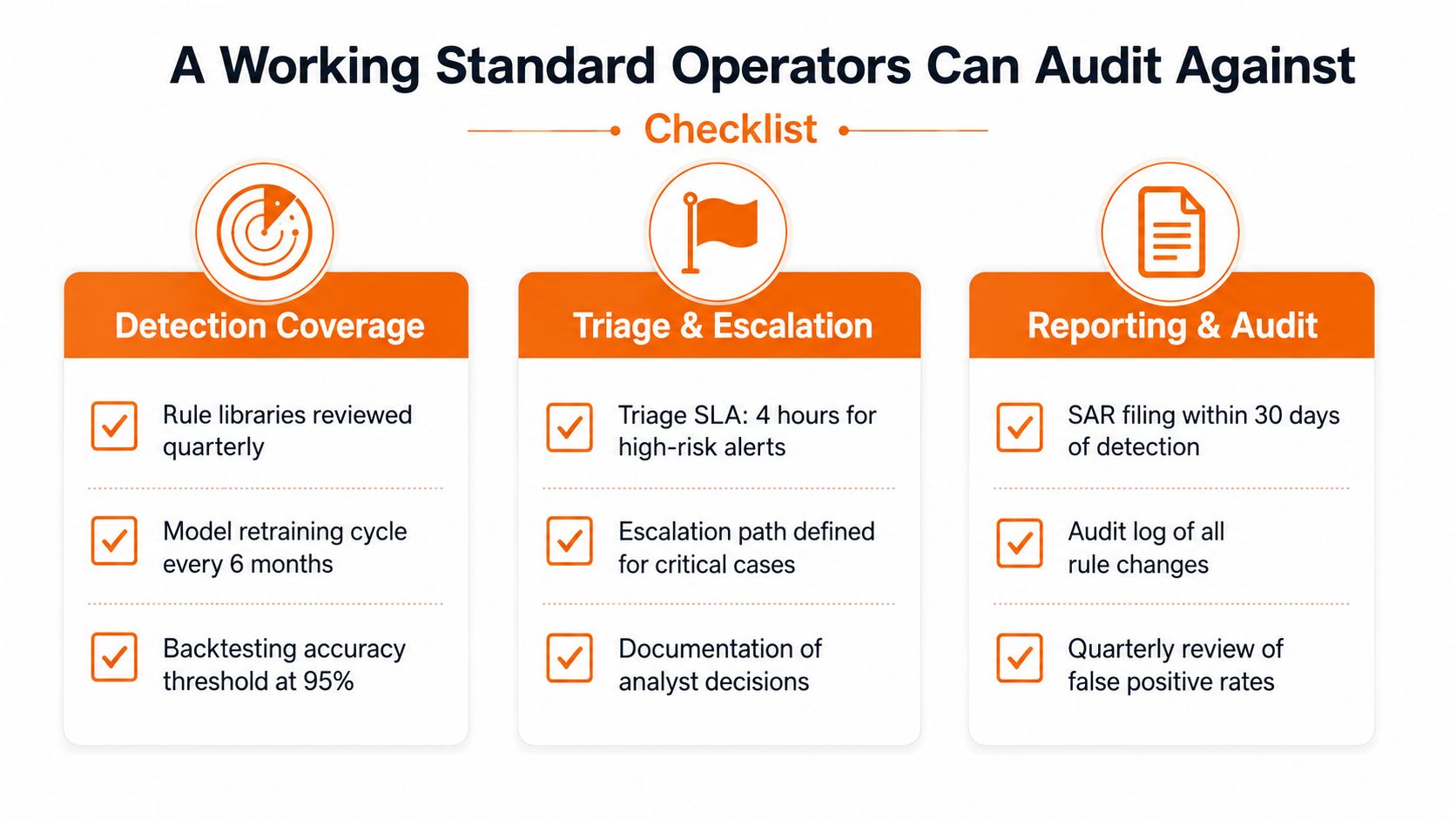
A program only becomes real when someone can audit it. The fastest way to test suspicious activity detection is to turn it into a binary operating standard that says present or missing, not vague or “in progress.”
Detection coverage
- Rule libraries reviewed quarterly, so thresholds don't drift past business reality.
- Model retraining cycle in place, with documented validation before any production change.
- Backtesting results logged, so the team can see which patterns the stack still misses.
- Weekly alert tuning cadence, especially after launch, major promo changes, or payment route shifts.
Investigation hygiene
- Triage SLA defined for high-risk alerts, and the queue actually meets it.
- Four-eyes review used for critical cases, especially before account freeze or filing.
- Analyst rationale documented per escalation, with evidence tied to the decision.
- Monthly false-positive review completed, with the noise sources tracked to their root cause.
Reporting and audit readiness
- SAR or SMR filing log maintained, with timestamps and submission owner.
- Named MLRO sign-off recorded, not implied or buried in a note thread.
- Retention evidence available on request, including the case file and supporting records.
- Annual policy refresh completed, with jurisdiction changes folded into the workflow.
Integration integrity
- KYC sync working across the stack, so risk tiers and monitoring stay aligned.
- Geolocation and device signals feeding the same risk view, not separate queues.
- Fraud and AML cases cross-linked, so teams don't investigate the same player twice.
- Wallet, game, and sportsbook events visible in one timeline, which is the only way to make the alert defensible.
The best programs don't promise perfect detection. They prove that the stack is tuned, the workflow is consistent, and the evidence survives scrutiny. That's what a board, an acquirer, or a regulator needs to see.
If you're building or tightening suspicious activity detection across casino and sportsbook operations, NexGrate can support the workflow with a unified back office, live fraud visibility, case handling, and compliance controls in one stack. Visit NexGrate to see how a single platform can help you connect wallet activity, play behavior, and reporting without splitting the investigation across disconnected tools.