A major football final is underway. A jackpot promotion has just gone live. Players arrive from paid campaigns, affiliates, mobile notifications, and partner sites at the same time. The sportsbook is refreshing odds, the casino lobby is loading games, the cashier is handling deposits, and live casino providers are opening new sessions. Then response times climb, bets fail intermittently, and the operations team starts asking a question they should've answered before launch: how much traffic can the platform absorb?
That question matters because an iGaming platform doesn't serve one isolated request. It coordinates player identity, wallet balances, game sessions, odds, settlements, payment providers, fraud controls, promotions, and regulatory records. A smooth homepage doesn't prove that a withdrawal remains reliable while live betting traffic rises. A successful pre-release test doesn't prove that autoscaling will add capacity quickly enough during a real event.
A load testing platform provides the operational safety net. It helps teams reproduce player behavior, apply controlled pressure, observe the entire stack, and decide whether the system can remain responsive and accurate under changing demand. The category has expanded beyond a niche QA utility. One market estimate places load testing software at USD 255.83 million in 2026, with a projection of USD 463.97 million by 2035, representing roughly 81% growth across that period at a 6.8% CAGR (market estimate for load testing software).
This guide approaches performance from an operator's perspective. It explains what the platform does, how distributed generation works, which casino and sportsbook scenarios expose real weaknesses, how to read results, and how to make scalability validation part of delivery rather than a frantic exercise before launch.
Table of Contents
- Introduction Why iGaming Cannot Afford to Guess at Scale
- What a Load Testing Platform Is and How It Works
- Inside the Architecture That Generates Realistic Load
- iGaming Test Scenarios That Reveal True Breaking Points
- Key Metrics Thresholds and How to Read Them
- Designing Executing and Integrating Tests Into Your Pipeline
- Reporting Governance and Your Sample iGaming Test Plan
Introduction Why iGaming Cannot Afford to Guess at Scale
An operator can recover from a campaign that underperforms. Recovering from failed bets, delayed cashouts, or a live casino outage is harder because the failure affects revenue, player trust, support workload, and compliance evidence at the same time.
Consider a promotion that sends players directly to a bonus campaign. New sessions create account checks, wallet reads, eligibility evaluations, and game launches. Existing players continue spinning, placing bets, and requesting withdrawals. The traffic pattern isn't a clean line that rises and falls. It's a changing mixture of short API calls, longer sessions, third-party responses, database contention, and background settlement work.
A conventional test may confirm that an endpoint handles requests. That's useful, but it leaves critical questions unanswered:
- Can autoscaling react before player-facing latency becomes unacceptable?
- Can the wallet prevent duplicate or conflicting transactions?
- Can odds updates, bet placement, and settlement stay consistent during an in-play event?
- Can live casino sessions maintain stable connections while the cashier and sportsbook experience pressure?
- Can the operator produce an understandable record of what happened and why?
The broader market signals why this shift matters. Independent research values the wider load testing tools market at USD 2.8 billion in 2025 and projects USD 7.1 billion by 2034, at a 10.9% CAGR. It also reports that software represented 62.4% of the market in 2025, while North America accounted for 38.2% of revenue (load testing tools market research). Those figures indicate a mature software category, but buying a platform isn't the same as validating an operation.
The practical standard: don't ask only whether the system can generate traffic. Ask whether it can prove that player journeys remain correct as infrastructure, dependencies, and workload composition change.
Operators, product managers, QA engineers, compliance teams, and platform owners need the same evidence viewed from different angles. Engineering needs resource and dependency detail. Product needs confidence that a launch won't damage conversion. Operations needs useful alerts and recovery signals. Compliance needs traceability around regulated actions.
The right approach treats performance as a continuous property of the platform. Peak events still deserve dedicated tests, but the deeper objective is to validate elastic behavior, end-to-end transaction integrity, and operational resilience before players discover the limits in production.
What a Load Testing Platform Is and How It Works
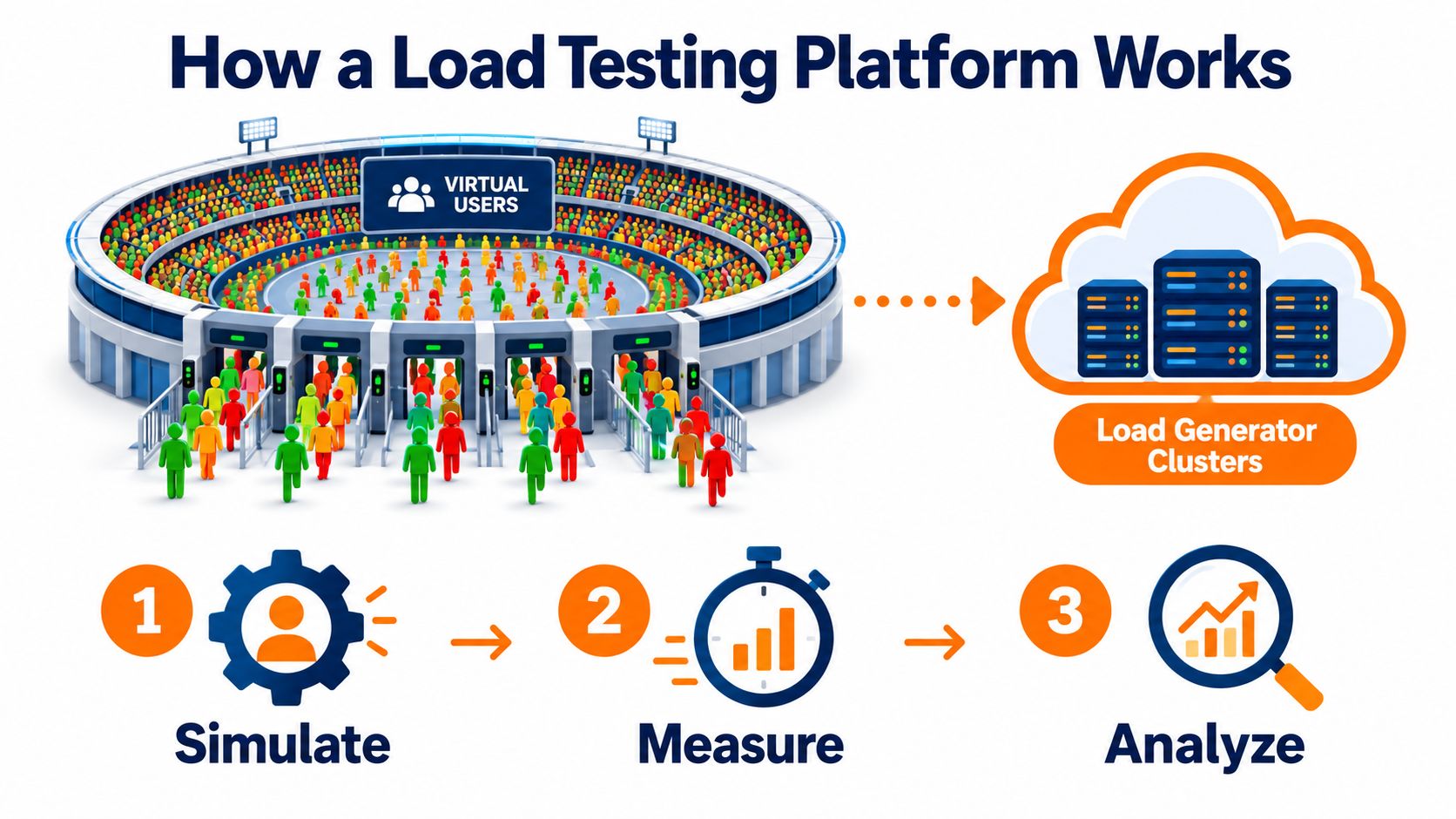
Think of a stadium operator preparing for a major event. They don't test the building by opening every gate randomly. They model entrances, queues, security checks, seating areas, emergency routes, and the timing of arrivals. They place observers around the venue, coordinate the exercise, and review where congestion formed.
A load testing platform applies the same logic to software. It coordinates virtual users, load injectors, test scripts, orchestration, result collection, and analysis. A script describes behavior, but the platform manages the complete experiment.
Start with the workload
A credible test begins with a workload model, not a tool button. Define who the virtual players are, what they do, how often they perform each action, and how long the activity continues. A sportsbook scenario might combine market browsing, odds refreshes, login checks, bet placement, and account balance reads. A casino scenario might combine lobby navigation, game launches, spins, bonus checks, and wallet updates.
The test must also specify workload mix, concurrency, and duration. Without those elements, two runs aren't meaningfully comparable. Guidance on distributed-system benchmarking emphasizes throughput, latency, error rate, and resource utilization, while also stressing reproducible workload design (distributed systems benchmarking guidance).
Know the test types
These labels describe different questions:
- Load testing checks behavior under an expected workload.
- Stress testing increases pressure until the system degrades or fails, revealing limits and recovery behavior.
- Spike testing applies a rapid change in demand, useful for promotions, event starts, and sudden odds interest.
- Scalability testing examines whether the system adds or removes capacity effectively as demand changes.
They overlap, but they shouldn't be treated as interchangeable. A load test may show stable service at a planned level. A scalability test asks whether additional nodes, containers, or services improve the operating envelope.
Think in platform capabilities
The platform should let teams design scenarios, distribute execution, capture results, connect application telemetry, and compare runs. It should also support the lifecycle around a test, including reusable data, environment selection, approvals, reports, and pipeline integration.
That distinction prevents a common mistake. Teams often choose an engine because it can send HTTP requests, then discover that they still need to build the control plane, distributed runners, dashboards, alerting, and evidence workflow. A load testing platform earns its place by making the complete validation cycle repeatable.
Inside the Architecture That Generates Realistic Load
A single load generator is like one stadium entrance used to represent every gate. It may produce activity, but it can also become the bottleneck. Once the generator saturates its CPU, memory, network, or connection capacity, the test measures the generator's limitations instead of the application's behavior.
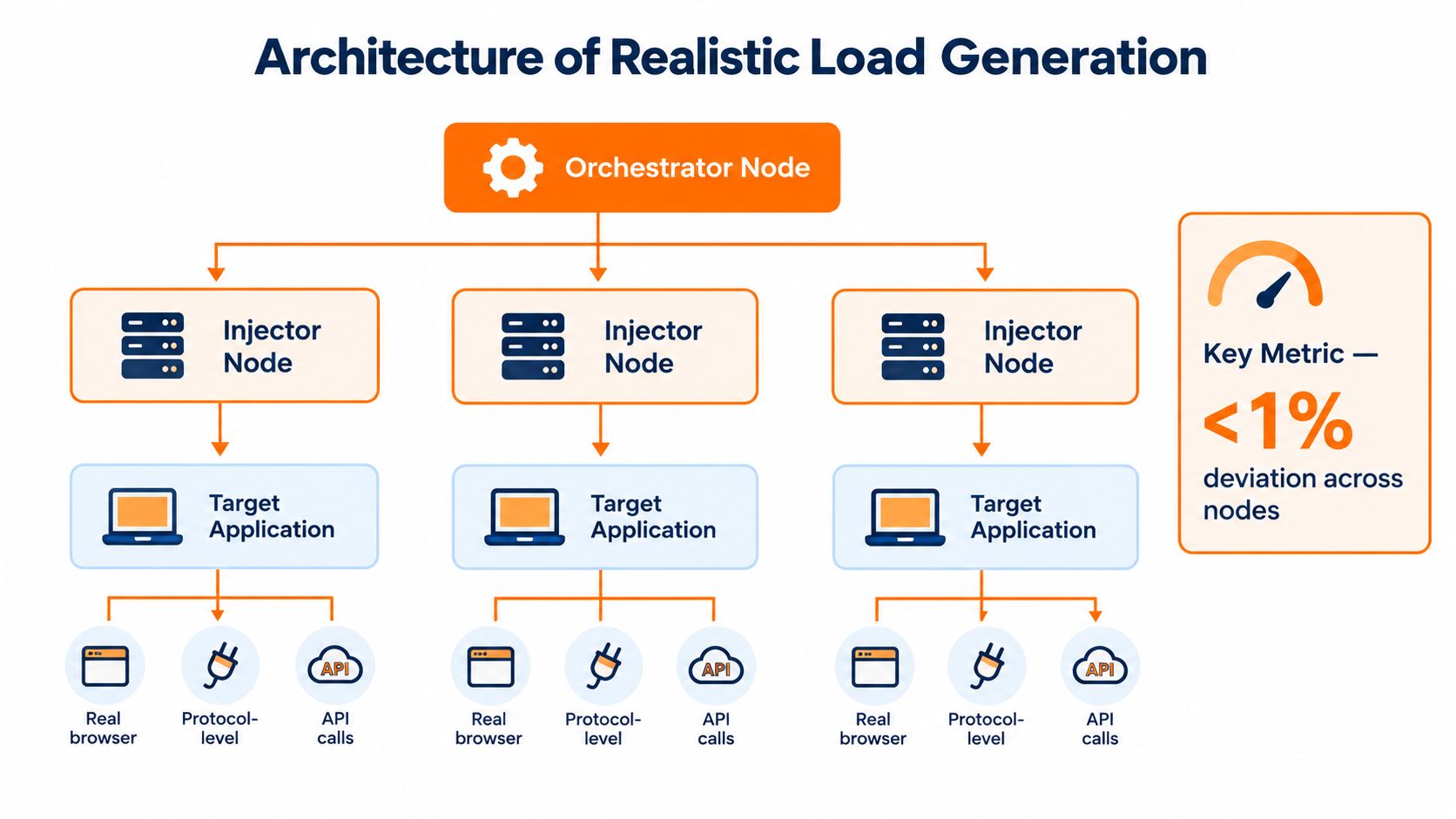
High-scale testing therefore uses distributed injectors or coordinated nodes. An orchestrator assigns work, synchronizes execution, collects results, and helps maintain a consistent workload across nodes. The target application receives traffic from multiple generators, while the platform records whether each node produced the expected contribution.
The layers that make a test credible
Orchestration controls start time, ramp profile, scenario allocation, and shutdown. It should make a run reproducible rather than relying on operators to start separate processes manually.
Injection creates the request or session pressure. Distributed nodes allow the platform to increase traffic while reducing the chance that one machine distorts the result.
Execution engines affect efficiency and scripting style. Research comparing load-testing approaches describes Gatling's asynchronous JVM engine and built-in HTML percentile reporting, while k6 follows a Go-based single-binary model suited to CI and Grafana-style observability (comparison of load-testing execution models). These are architectural differences, not merely branding differences.
Test data gives virtual players distinct identities, balances, payment states, markets, and game conditions. Reusing one account across every session can create artificial locks, cache behavior, or transaction conflicts that don't represent production.
Observability connects test results with application performance monitoring, logs, traces, database metrics, queue depth, provider responses, and autoscaler events. Without that correlation, the team sees that latency rose but not which dependency caused it.
A platform such as NexGrate's iGaming platform brings the evaluation back to end-to-end coverage, where casino, sportsbook, payments, wallets, compliance controls, and provider integrations must be considered together.
The video below adds a visual explanation of how coordinated load generation fits into performance testing.
Before approving a tool, ask whether it can generate the required traffic without becoming the limiting component. Confirm node coordination, result aggregation, network placement, data isolation, and visibility into injector health. A test that overwhelms its own runner can create false confidence in either direction.
iGaming Test Scenarios That Reveal True Breaking Points
Generic request volume doesn't represent an iGaming business. Players don't behave like identical API clients, and the most damaging failures often emerge when several journeys compete for the same wallet, identity, database, or provider capacity.
Event traffic changes the workload shape
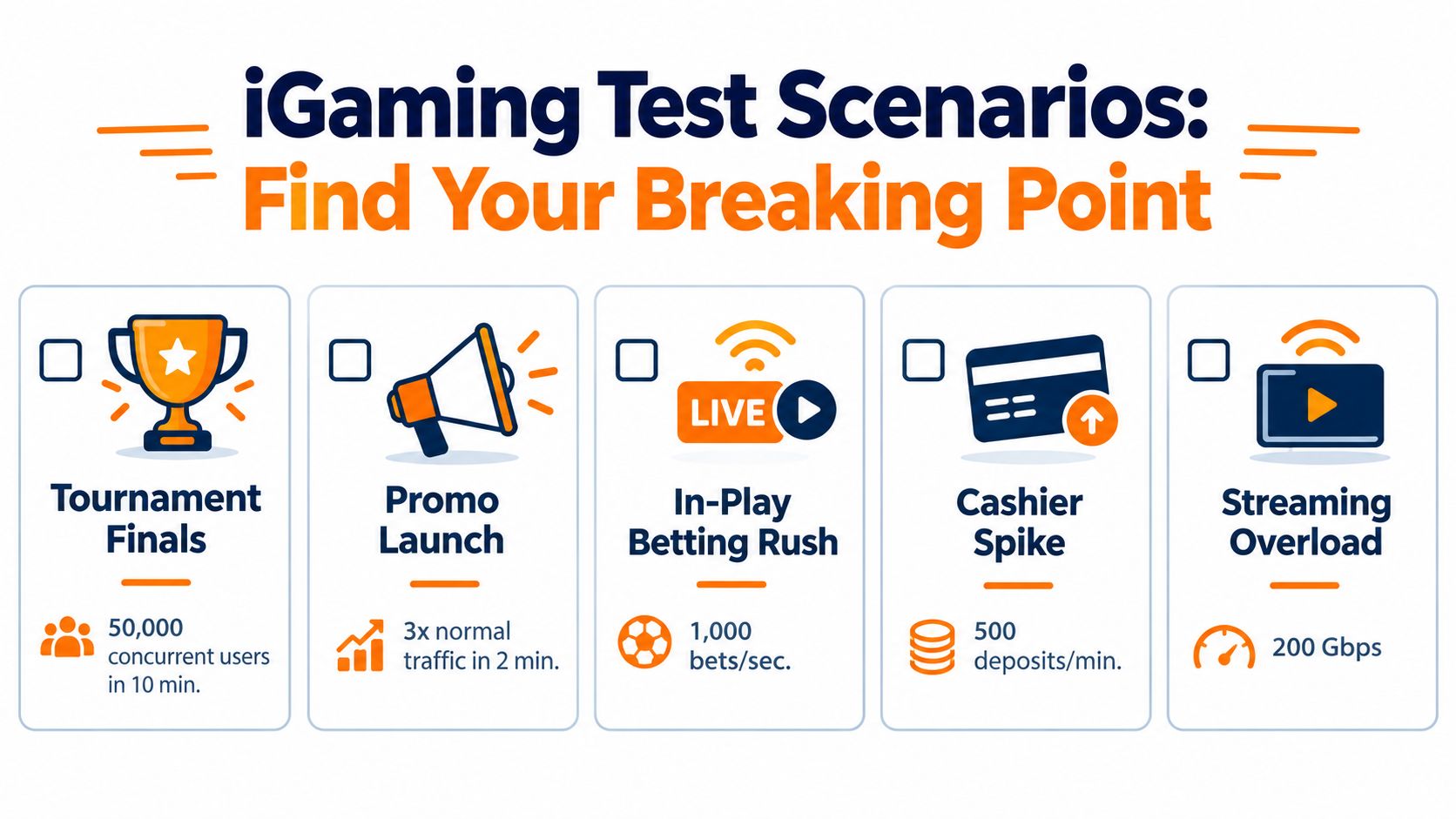
A tournament final can produce concentrated arrival activity, while an ordinary casino session may build gradually. Test the complete sequence, including authentication, lobby discovery, market or game selection, wallet access, and the actions that follow a successful transaction.
A promotion adds another layer. Players may claim bonuses, open qualifying games, check eligibility, and receive campaign messages while regular activity continues. The important variable isn't just the peak. It's the ramp speed, because an elastic stack may handle a high steady state but react too slowly to a sudden arrival wave.
In-play betting stresses consistency
In-play betting combines fast-changing odds, market availability, bet validation, acceptance, rejection, and settlement. The scenario should include odds refresh behavior and realistic decision timing, not just repeated bet submissions.
Test different outcomes. A bet may be accepted, rejected because odds changed, refused because a market closed, or delayed by a provider dependency. The platform must preserve the correct wallet and ledger state in each case. A low error count is not enough if the errors hide incorrect balances or inconsistent bet status.
Cashier traffic exposes dependency weakness
Deposits and withdrawals depend on payment gateways, risk controls, KYC or AML checks, currency handling, wallet locks, and notification workflows. Card, bank, and crypto journeys can have different timing and callback behavior. Include successful, declined, pending, reversed, and retried transactions.
Run cashier activity alongside gameplay. A platform may serve game reads smoothly while payment-related database contention slows every authenticated request. Teams exploring infrastructure resilience should also consider how traffic protection and availability controls support peak operations, as discussed in this iGaming DDoS protection and hosting guide.
Live casino has a different pressure profile
Live casino introduces persistent sessions, streaming delivery, provider APIs, table availability, seat selection, and game-state updates. Players may remain connected while making wallet requests or moving between tables. Test provider latency and failure handling instead of assuming the application controls the entire experience.
The most useful scenario suite combines these journeys. Run event browsing, in-play activity, casino sessions, live tables, promotions, and cashier operations together, then vary the arrival pattern and dependency health. That reveals contention between services that isolated endpoint tests can't expose.
Key Metrics Thresholds and How to Read Them
A test result isn't a pass because a dashboard contains attractive averages. Teams need four signals: throughput, latency percentiles, error rate, and resource utilization. Together, they show what the system delivered, how quickly it delivered it, how often it failed, and which parts of the stack approached saturation.
Read the tail, not just the middle
Average latency can hide a group of players who experience severe delay. The p95 and p99 percentiles expose that tail, which matters for user-facing service-level agreements. If the average bet request looks healthy but p99 rises sharply, some players may be waiting long enough to retry, abandon the action, or submit duplicate requests.
Throughput needs context. A high request rate with rising errors isn't a success. Compare delivered transactions with the intended workload, then inspect whether the system rejected work, timed out, queued it, or returned an application-level failure.
Resource utilization adds the likely cause. CPU saturation, memory pressure, database connection exhaustion, queue growth, garbage collection, network limits, and third-party response time each point to different remedies.
| Metric | What It Reveals | Threshold Signal and Next Step |
|---|---|---|
| Throughput | Completed requests or business transactions under the defined workload | If delivered volume falls below the planned workload, check application capacity, dependency limits, and injector health |
| p95 latency | Experience of slower players, excluding the extreme tail | If p95 rises while average latency stays stable, inspect queueing, contention, and uneven service distribution |
| p99 latency | Severe tail slowdowns that can affect player-facing SLAs | If p99 spikes, correlate traces and logs with database, provider, network, and autoscaler events |
| Error rate | Failed requests and unsuccessful business outcomes | If errors increase, separate transport failures, timeouts, validation responses, payment declines, and settlement issues |
| Resource utilization | Saturation and unused capacity across the stack | If one resource reaches its limit before others, test that component independently and review scaling policy |
Set thresholds around player journeys
Thresholds should describe acceptable outcomes for a real flow. A sportsbook team might define separate criteria for odds viewing, bet placement, and settlement. A cashier team should distinguish a controlled payment decline from a timeout that leaves transaction state uncertain.
Write the workload mix, concurrency, duration, environment, build version, and dependency conditions into the test record. Repeatable definitions make release comparisons meaningful and help the team decide whether a change improved capacity or merely changed the traffic pattern.
Interpretation rule: a green infrastructure chart cannot override a failed wallet transaction or an unacceptable p99 response.
When a run fails, don't jump straight to scaling. First identify whether the bottleneck is generation, application logic, storage, a provider, or an intentionally enforced limit. Then rerun with a focused scenario to confirm the diagnosis.
Designing Executing and Integrating Tests Into Your Pipeline
A live betting event can expose a scaling flaw before a simple load test does. Continuous validation treats load testing as a release control for an elastic iGaming stack, checking whether autoscaling, live casino sessions, and cashier flows remain reliable as demand changes.
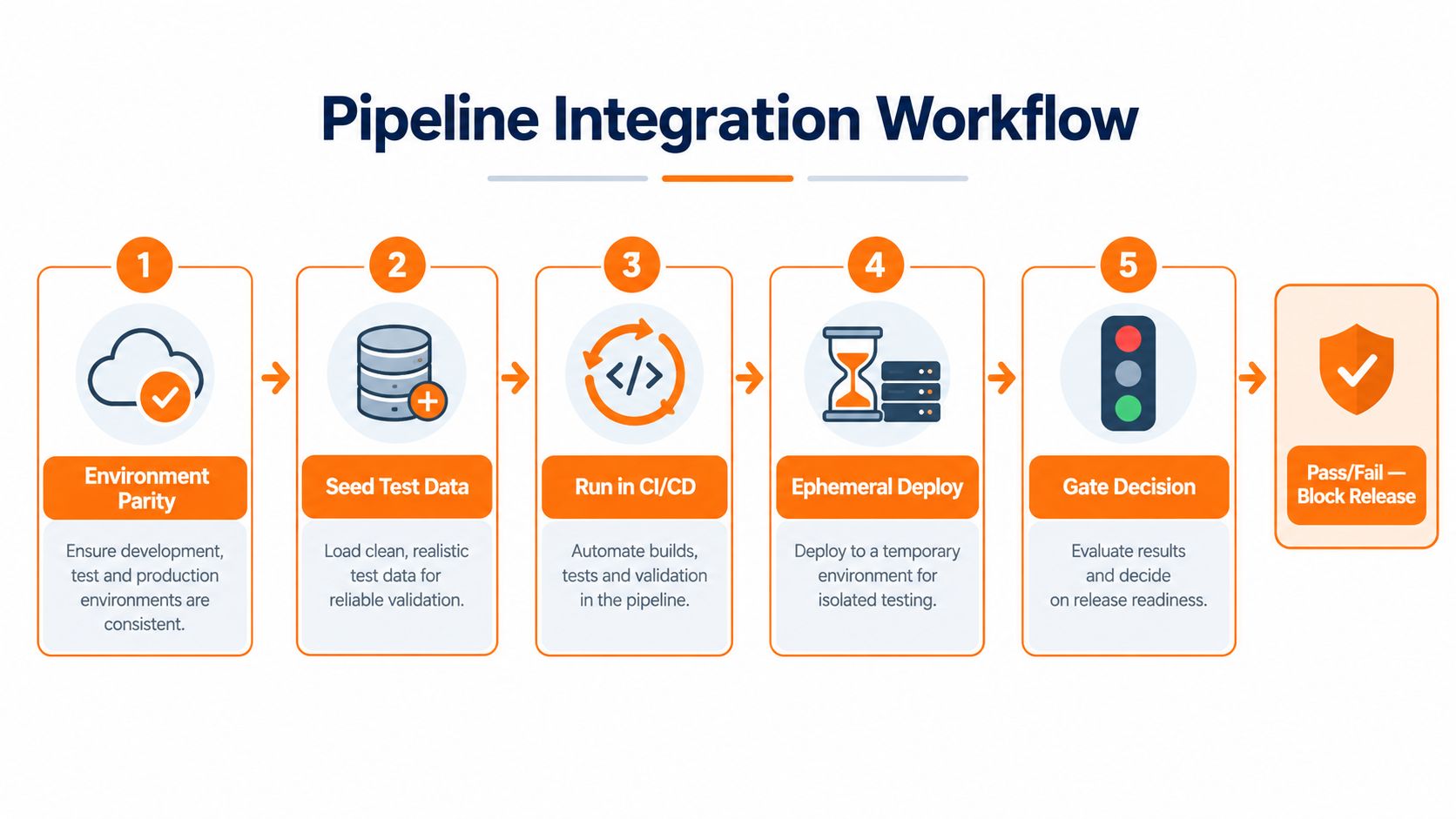
Start with an environment that explains what the result represents. Match the production deployment topology where possible, then document differences in network paths, service versions, data shape, caches, feature flags, provider behavior, and autoscaling policies. Temporary infrastructure is useful, but it should still reproduce initialization, service discovery, secrets, data setup, scaling signals, and teardown closely enough to support a release decision.
Build the test in a deliberate sequence
Create environment parity. Use representative services and dependencies. If a payment provider is mocked, model realistic response times, declines, callbacks, and failure states rather than returning instant success.
Seed meaningful data. Prepare player accounts, wallet conditions, game catalogs, markets, promotions, balances, and transaction histories. Give virtual users unique records wherever the application expects uniqueness.
Validate scripts at low volume. Check authentication, correlation, dynamic tokens, wallet transitions, odds changes, provider callbacks, and cleanup. A broken script produces misleading failures at scale, so fix it before increasing traffic.
Apply progressive profiles. Use a gradual run to measure capacity, a spike run for sudden event demand, and a soak run for leaks, queue accumulation, or long-lived connection problems. Include live casino sessions and deposit or withdrawal journeys, then observe scale-out and scale-in behavior to confirm that autoscaling responds and settles as designed.
Gate delivery. Store scripts and workload definitions in source control. The pipeline can stop a release when agreed latency, error, or business-transaction criteria fail, while scheduled runs examine longer-term platform behavior and recovery.
Account for total ownership
Tool price is only one part of the decision. Market snapshots place entry plans for some cloud load-testing tools around USD 79 to USD 149 per month, while open-source tools avoid license fees but shift work into self-hosting, scripting, distributed execution, and reporting (load-testing tool cost and operational comparison).
For a mid-market team, an inexpensive engine can still require substantial engineering time. Compare infrastructure, test preparation, specialist effort, support, dashboards, failure triage, and the cost of delaying a release. The platform should fit the team's ability to create data, operate runners, inspect failures, and repeat tests reliably.
Cloud-native testing can use ephemeral environments where appropriate. Confirm that their startup time, scaling signals, provider simulation, and cleanup remain consistent across runs. A temporary environment that scales differently from production can produce confidence without producing useful evidence.
Reporting Governance and Your Sample iGaming Test Plan
A useful report turns graphs into decisions. Include percentile timelines, throughput by transaction type, error categories, injector health, dependency timings, database behavior, and resource utilization on the same time axis. An executive summary should state the workload, result, failure point, player journeys affected, and release recommendation without hiding the technical evidence underneath.
Regulated operators need more than performance charts. Preserve test definitions, build identifiers, environment details, approvals, raw results, and incident notes. Where applicable, include geofencing behavior, responsible gaming journeys, audit-log creation, identity checks, wallet records, and reporting outputs. A broader compliance reporting guide can help teams connect operational evidence with regulatory processes.
A practical sample plan
| Area | Plan |
|---|---|
| Objective | Validate player-facing responsiveness, transaction correctness, elastic scaling, and recovery behavior during combined casino and sportsbook demand |
| Workloads | Account login, casino browsing and gameplay, live casino session, pre-match browsing, in-play betting, promotion claim, deposit, withdrawal, and support or back-office activity |
| Test profiles | Gradual capacity run, rapid spike run, sustained soak run, dependency degradation run, and scale-in recovery observation |
| Test data | Distinct player identities, varied balances, active promotions, changing markets, payment outcomes, and provider responses |
| Environment | Representative cloud topology with documented differences, monitoring enabled, controlled third-party behavior, and isolated test data |
| Measures | Throughput, p95 and p99 latency, error categories, wallet and settlement correctness, CPU, memory, database, queues, network, provider timing, and autoscaler events |
| Sign-off | Product, engineering, operations, and compliance review the evidence and record exceptions before release |
Keep the plan small enough to run repeatedly, then expand coverage around known risk. A failed test should create an owned engineering action, not disappear into a dashboard archive. Over time, the history becomes a capacity record that supports launch planning, vendor conversations, and regulatory confidence.
Continuous testing is the practical answer to elastic iGaming complexity. It replaces assumptions with repeatable evidence about what happens when players arrive, transactions collide, providers slow down, and infrastructure scales.
NexGrate provides a turnkey white-label environment that brings casino, sportsbook, payments, wallet, compliance, and operational capabilities into one platform for iGaming businesses. Use that unified scope to define end-to-end load scenarios rather than testing isolated services, then visit NexGrate to discuss how your launch and scalability requirements can be evaluated.