Most conversion optimization advice starts in the wrong place. A sudden drop in an iGaming funnel is treated as a registration form problem, a weak bonus, or a poor call to action. After auditing casino and sportsbook onboarding flows, the more uncomfortable explanation appears often: the measurement is broken before the experience is.
A player may complete KYC on one device, confirm a crypto deposit through a separate payment flow, and place a first bet inside a sportsbook module that reports events differently from the casino. If those actions aren't joined correctly, the dashboard turns an attribution gap into a product diagnosis. Conversion funnel analysis only becomes useful when the operator can trust the events, define the stages, and follow the same cohort through the full journey.
Table of Contents
- Why Your Funnel Data Might Be Lying to You
- Mapping the iGaming Player Journey
- Calculating Stage Drop-Offs and Cohort Progression
- Segmenting Traffic to Find Hidden Leaks
- Designing the Circular Funnel for Retention
- Diagnosing and Fixing Funnel Drop-Offs
Why Your Funnel Data Might Be Lying to You
A visible funnel drop-off does not prove that a player hit a usability problem. In iGaming, it can reflect missing, duplicated, delayed, or misattributed events. Pixel blocking, consent restrictions, cross-domain payment flows, and inconsistent product tracking can make the dashboard look precise while describing the wrong journey. A 2026 analysis of conversion measurement reliability reports that these gaps can make conversion data 30% to 40% inaccurate, enough to send a product team toward the wrong experiment.
A registration event may fire when the form opens instead of when the account exists. A KYC event may be logged when document upload begins, even though compliance treats verification as complete only after approval. A crypto deposit can show as successful in the cashier while blockchain confirmation arrives later, or never reaches the analytics layer. The same player may also move between casino, sportsbook, and a shared wallet whose systems use different identifiers.
Practical rule: Do not redesign a screen until you can prove that its outcome event fires once, at the correct time, for the correct player.
Start with an event contract
Create an event taxonomy accepted by product, analytics, payments, compliance, and engineering. Every event needs a stable name, a defined trigger, a player identifier, session or device context, and a status that separates initiation from completion. Include versioning and ownership so teams know who changes the definition and who responds when it breaks.
Audit these actions first:
- Account creation: Record successful registration, not just form submission or button clicks.
- Compliance initiation: Separate KYC started, document uploaded, data submitted, manual review, approval, and rejection.
- Deposit lifecycle: Track cashier opened, method selected, payment initiated, payment approved, payment failed, and funds credited.
- Product entry: Distinguish casino lobby entry, sportsbook lobby entry, market selection, game launch, and bet slip creation.
- Real-money conversion: Treat a confirmed first deposit and a settled first wager as separate business outcomes.
The counting unit changes the diagnosis. To measure KYC approval, count unique players who reached that state, rather than every approval event. If a player retries a failed document upload, retain the retry for friction analysis, but do not let it inflate progression. QA should replay these journeys across web, mobile web, native apps, payment methods, and product handoffs before a release reaches production.
Establish one source of truth
The front end can report a deposit button click. The payment service determines whether funds were credited. The KYC provider confirms verification status, while the player account system exposes the state used for operational decisions.
Document the system of record for each stage, then reconcile analytics with operational records. Sample completed registrations, approved verifications, credited deposits, and settled bets. Cross-device identity rules need the same attention. A player who registers on mobile and deposits on desktop must remain one cohort, not two unrelated users.
Conversion windows also shape the result. A short window can label a delayed KYC journey as abandonment. A broad window can combine unrelated behavior. Align the observation period with the player journey and acquisition cycle, following the funnel drop-off analysis guidance. Then review delayed conversions separately from genuine exits, so measurement timing does not become a product verdict.
Mapping the iGaming Player Journey
An e-commerce funnel often ends at payment. An iGaming funnel doesn't. The operator still needs to establish identity, satisfy jurisdictional controls, fund the wallet, help the player find a relevant product, and confirm a meaningful real-money action.
Start the map at the first expression of intent. That might be an affiliate landing page, a sportsbook event page, a casino game page, or a branded registration form. Preserve the campaign, affiliate, country, device, language, product interest, and landing template as dimensions attached to the player journey.
Define stages around completed outcomes
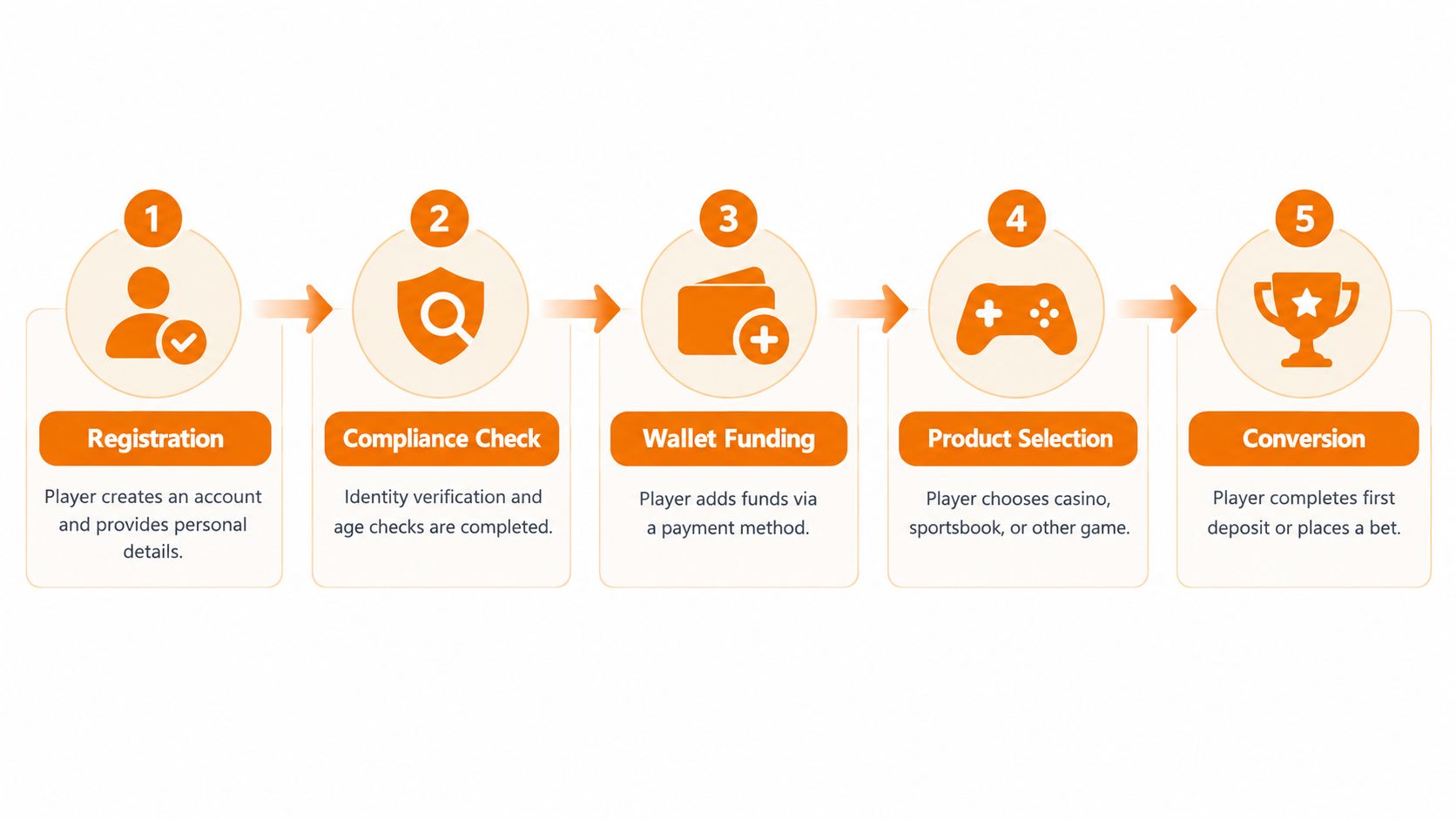
A useful unified funnel can contain five operational stages:
- Registration: The player creates an account and completes the required personal details. Track the landing context, form start, validation errors, submission, account creation, email or phone confirmation, and duplicate-account handling.
- Compliance check: The player reaches the KYC and age-verification workflow. Track the provider selected, document type, upload result, liveness or identity result where applicable, manual-review state, rejection reason, and approval.
- Wallet funding: The player selects a payment route and adds funds. Separate fiat and crypto methods, payment initiation, provider response, credited balance, failed attempt, refund, and pending confirmation.
- Product selection: The player chooses casino, sportsbook, live dealer, or another available product. Track lobby entry, game or market discovery, odds or game interaction, and movement between products.
- Conversion: The player completes the chosen real-money action. A first deposit and a first settled bet are different events, so don't force them into one ambiguous conversion label.
The wallet is the connective tissue. If casino and sportsbook use separate identifiers, balances, or transaction states, the operator can't reliably measure cross-product progression. Track wallet creation, balance visibility, product wallet transfer where applicable, and the destination product for each funded account.
Add failure reasons, not just exits
An exit event says a player stopped progressing. A reason code helps explain why. Store structured failure information for invalid personal details, unsupported jurisdiction, document quality, provider timeout, declined payment, pending crypto confirmation, insufficient balance, unavailable market, and responsible-gaming restrictions.
Don't hide these states behind a single “drop-off” category. A player waiting for a verification review is not equivalent to a player rejecting the offer. The product response, compliance response, and retention message will differ.
A healthy taxonomy also records latency. Capture timestamps for each transition so teams can distinguish an immediate abandonment from a delayed completion. This is particularly important when a blockchain confirmation or manual review sits between intent and wallet credit.
Calculating Stage Drop-Offs and Cohort Progression
The arithmetic is simple. At each stage, divide the users who reach the next stage by the users who entered the current stage, then multiply by 100. Total funnel conversion divides users who complete every defined step by users who started the funnel, also multiplied by 100, following the platform documentation logic used by analytics teams.
The common diagnostic error is treating the largest percentage decline as the most important leak. Start with the absolute decrease in users between stages. A large KYC loss can affect more revenue than a steeper drop among a much smaller group reaching first bet. For iGaming, also validate that each transition is recorded once, with the correct player, product, wallet, and event timestamp. A broken event can look like abandonment.
Use same-cohort progression
Monthly snapshots are convenient, but they distort regulated journeys. Players who register near month-end may still be waiting for verification, resolving a document issue, or deciding how to fund an account when reporting closes. Their later actions appear in the next month, creating misleading stage relationships.
Follow each cohort from entry through its expected progression window. For longer buying cycles, the provided benchmark guidance recommends a full 90-day window. Calculate every ratio from the same cohort. For example, MQL-to-SQL equals the SQLs that advanced from that cohort divided by the MQLs that entered it, as outlined in B2B sales funnel benchmark guidance.
The window must fit the product path. KYC review, crypto confirmation, manual checks, and cross-product wallet movement can separate intent from completion. If the reporting model closes before those states resolve, it will classify pending players as lost players.
Benchmark ranges are context, not targets
Comparison ranges can orient an investigation, but they do not set an iGaming target. Casino and sportsbook journeys include compliance checks, payment constraints, wallet mechanics, and product intent that standard commerce funnels do not share.
| Funnel Stage Transition | Standard Benchmark Range | Top Performer Target |
|---|---|---|
| B2B funnel end to end | 1% to 5% | 5% or higher |
| E-commerce sessions to purchase | 2% to 3% | Not specified |
| SaaS freemium free trial | 3% to 9% | Not specified |
| Strong targeted SaaS trial | 10% to 20% | Not specified |
| B2B visitor to lead | 1.5% to 2.5% | Not specified |
| B2B lead to MQL | 37% to 41% | Not specified |
| B2B MQL to SQL | 32% to 42% | Not specified |
| B2B SQL to opportunity | 40% to 48% | Not specified |
| B2B opportunity to customer | 31% to 39% | Not specified |
Use these figures as directional context only. Compare registration-to-KYC, KYC-to-funded wallet, funded wallet-to-product engagement, and first deposit-to-first wager against the operator's prior quarter and comparable traffic segments. Review the underlying event logs before changing acquisition, onboarding, or cashier flows. A conversion rate is only useful when the instrumentation behind it reflects the player journey.
Segmenting Traffic to Find Hidden Leaks
An aggregate funnel can look stable while one valuable player path is failing. Segment the journey by traffic source, device, landing template, payment method, jurisdiction, and product intent before approving a site-wide redesign.
Crypto-focused affiliate traffic may arrive with a strong preference for digital assets but encounter friction when the cashier defaults to cards. Fiat-oriented players may understand bank payment flows but hesitate when the operator presents a crypto-first wallet. Both groups can enter the same registration report while experiencing different failures later.
The same contrast appears on device. Mobile players may complete short forms comfortably but struggle with document capture, file permissions, image quality, or a payment redirect. Desktop players may pass that stage while encountering a separate issue in sportsbook navigation. An overall average hides these differences.
Compare paths, not just audiences
Build a segment matrix that follows each group through identical milestones:
| Segment dimension | Compare | Likely diagnostic question |
|---|---|---|
| Acquisition | Affiliate, paid search, organic, direct | Does the landing promise match the onboarding experience? |
| Device | Mobile, desktop, tablet | Does document upload or cashier navigation fail on one form factor? |
| Funding | Fiat, crypto, local method | Is the payment method visible, supported, and credited promptly? |
| Product | Casino, sportsbook, live dealer | Does the first product match the player's original intent? |
| Identity state | New, returning, partially verified | Are returning users being forced through unnecessary steps? |
Preserve affiliate identifiers through registration and conversion. The iGaming affiliate program framework is relevant here because attribution needs to survive the handoff from acquisition into account, wallet, and product events. If an affiliate sends sportsbook-intent traffic to a generic casino page, the resulting drop isn't necessarily a registration problem. It may be an intent mismatch.
Avoid over-segmentation
Segmentation can create its own noise. Start with one suspected difference, then validate it against event quality, cohort timing, and operational records. A payment issue should appear in provider responses and credited-balance data, not only in a chart filtered by device.
Compare casino and sportsbook journeys separately before evaluating the unified experience. Casino players may move from lobby to game quickly, while sportsbook players may wait for a market, review odds, or return around an event. A single timing model can misclassify normal consideration as abandonment.
A useful segment doesn't merely describe who converted. It reveals which product decision, provider dependency, or promise changed the probability of progression.
Designing the Circular Funnel for Retention
A first deposit or first wager isn't the end of the iGaming funnel. It creates the starting point for the next loop: return, fund again, try another product, respond to loyalty mechanics, or become dormant. Operators that stop measurement at first conversion optimize acquisition while ignoring the behavior that determines whether the player remains valuable.
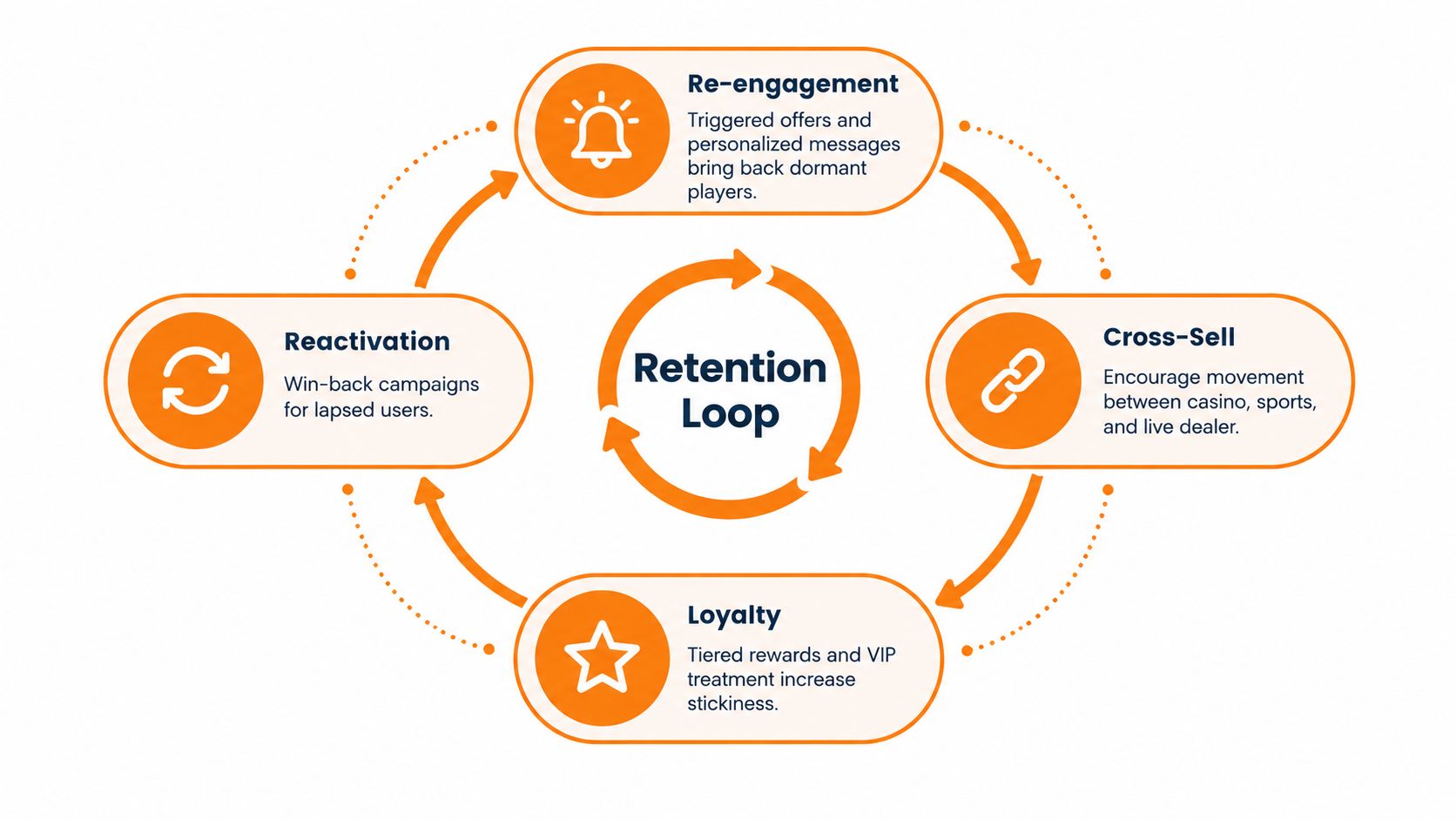
A circular model should connect re-engagement, cross-sell, loyalty, and reactivation to the original acquisition path. Store the source campaign, affiliate, landing promise, first product, payment method, KYC experience, bonus state, and first real-money action. Later, compare those attributes with repeat deposits, casino-to-sportsbook movement, sportsbook-to-casino movement, and return activity.
Measure the loop as connected decisions
A player who deposits but never places a bet needs a different intervention from a sportsbook player who bets once and never returns. Likewise, a casino player who has never opened the sportsbook may need a relevant cross-sell prompt, while an active multi-product player may need loyalty recognition rather than another acquisition-style offer.
Track the transitions explicitly:
- First action to repeat funding: Did the player return to the cashier and complete another deposit?
- Single product to multi-product use: Did a casino player enter sportsbook, or did a sportsbook player launch casino content?
- Active to dormant: When did meaningful activity stop, and what events preceded it?
- Dormant to reactivated: Which message, offer, or product route preceded the return?
- Loyalty interaction to sustained activity: Did tier progress, rewards, or VIP treatment correlate with continued engagement?
Retention analysis shouldn't erase responsible-gaming controls. Suppression rules, affordability checks, self-exclusion, and jurisdictional restrictions must remain part of the funnel logic. A reactivation event is only a success when the player is eligible to receive and act on the communication.
Use adaptive mapping carefully
The funnel changes as payment methods, content, markets, and player expectations change. Recent coverage reports that multi-step funnels can lose 60% to 90% of users before final conversion, while another review reports AI-assisted funnel mapping reducing average stage drop-off by 28.4%. Those figures come from recent funnel drop-off and retention coverage, and they should be treated as directional external reporting, not as a guaranteed operator outcome.
AI can help identify paths that a fixed dashboard misses. It can cluster players by behavior, surface unusual transitions, and suggest where a flow has changed. It can't replace event governance, compliance judgment, or controlled testing. If the underlying wallet or KYC events are unreliable, an adaptive model will scale the wrong conclusion.
A practical retention review should ask whether the initial funnel created the conditions for the loop. A confusing first deposit, delayed balance credit, or poor product handoff can reduce repeat activity even when the first conversion appears successful.
The gaming loyalty programs guide offers useful context for connecting rewards mechanics with longer-term player journeys. Loyalty belongs inside the measurement model, not in a separate marketing report.
Diagnosing and Fixing Funnel Drop-Offs
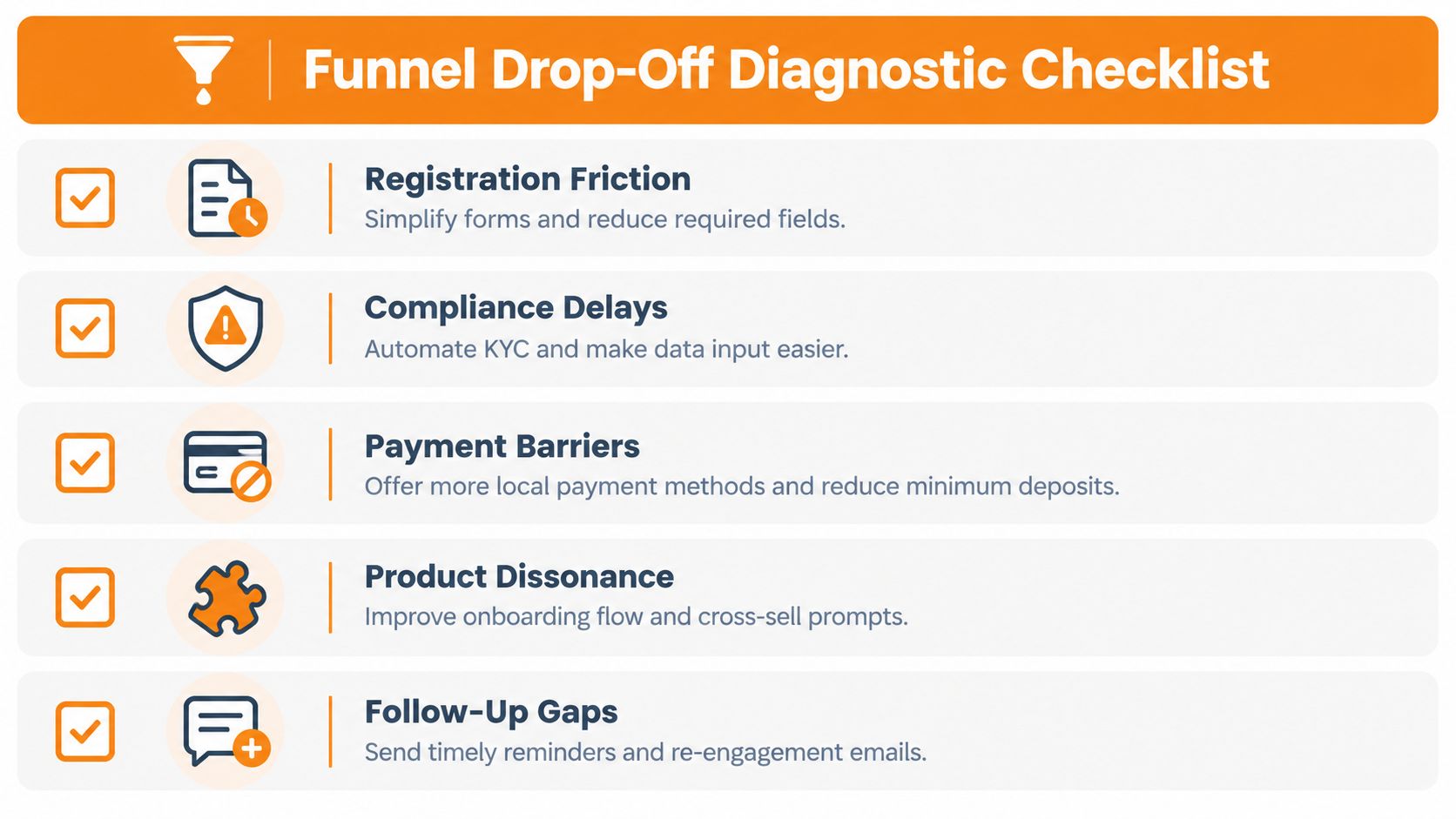
A stage drop is a signal to investigate, not an automatic reason to redesign the flow. The reliable sequence starts with instrumentation QA, then moves through segmentation, player evidence, and one tightly scoped intervention.
Use a fixed diagnostic sequence
- Confirm the event. Check that entry and completion events fire consistently across web, app, casino, sportsbook, cashier, KYC, and wallet surfaces. Reconcile analytics with the operational system that owns the action.
- Check the time window. Delayed KYC decisions, pending payment states, crypto confirmations, and event-driven sportsbook behavior can make active users look lost.
- Find the absolute loss. Calculate the user decrease between adjacent stages. Investigate the largest absolute loss rather than chasing the most dramatic percentage.
- Inspect the upstream step. A drop at product selection may begin with a slow wallet update, unclear deposit status, or a confusing KYC handoff. A later visible drop is often the result of friction earlier in the journey.
- Segment the failure. Break results down by source, device, payment route, product, jurisdiction, and landing template. A localized failure needs a localized fix.
- Review the player experience. Combine session evidence, support tickets, error logs, and provider responses. The aim is to establish what the player saw, attempted, and could not complete.
- Test one hypothesis. On a compliance screen, test clearer requirements, document guidance, or a more transparent review state. In the cashier, test routing, method visibility, and status messaging. Do not combine a bonus change, form redesign, and payment change in one experiment.
- Watch for displaced friction. A higher KYC completion rate has limited value if document rejections increase or funded-wallet progression worsens. Track downstream quality as well as the targeted step.
- Reconcile the result. Use the same cohort definition, event rules, and segments before and after the change. Record the decision, owner, and next review point.
Fix mechanics before persuasion
Bonus changes often mask a broken flow. They will not resolve a payment-provider timeout, an unexplained pending state, or a mobile document upload failure. Fix the mechanical blocker first, then assess whether the offer, message, or product selection still needs work.
Payment routing requires operational scrutiny. A declined card, unavailable local method, or delayed crypto confirmation should return a useful status and a recovery path. The player needs to know whether to retry, select another method, wait for confirmation, or contact support.
Cross-product wallets create another failure point. A player may complete registration in the casino but stall when a sportsbook balance, bonus balance, or withdrawal state is not visible in the next product. Test the handoff as a complete transaction, including balance updates and event attribution.
Compliance screens require clarity without weakening controls. Explain why information is needed, show accepted documents, preserve progress where allowed, and surface review status. The goal is to make the required effort understandable and recoverable.
Diagnostic standard: Every proposed fix should name the failing event, affected cohort, suspected cause, and downstream outcome it must improve.
Operators assessing shorter onboarding flows can also review the pay and play model. The measurement standard remains the same. Removing a step helps only when account, compliance, wallet, and wagering events remain valid and auditable.
NexGrate gives casino and sportsbook operators a unified white-label platform with shared wallets, payments, KYC and AML workflows, affiliate tracking, and campaign analytics. Visit NexGrate to explore a platform for auditing onboarding leaks, improving cross-product progression, and supporting the circular funnel beyond first conversion.