
A loyalty and rewards platform only earns its place when it turns enrollment into repeated, measurable participation. Yet just 55% of loyalty-program members were reported as active in the programs they belonged to, according to Open Loyalty's summary of loyalty-program statistics. For an iGaming operator, that gap is the starting point: registrations and points issued don't prove that rewards changed player behavior or improved margin.
Table of Contents
- What a Loyalty and Rewards Platform Does in iGaming
- Six Features Every iGaming Rewards Platform Needs
- How the Platform Connects to Wallets, CRM and Finance
- Metrics That Prove the Program Works
- Design Rules for Rewards Players Keep Using
- A Worked Example from First Bet to Tier Upgrade
- Decide Between Building and Buying Your Rewards Layer
What a Loyalty and Rewards Platform Does in iGaming
An iGaming loyalty and rewards platform reads qualifying player activity, applies rules to it, and posts points, status, or rewards to the player's account. Think of it as a casino host's notebook for each guest, except it can track tens of thousands of players and update automatically after every eligible event.

A basic points card records purchases and offers a reward later. An iGaming platform has a harder job. It must interpret events such as deposits, settled bets, casino rounds, bonus claims, and reversals, then apply the correct rules across casino and sportsbook. It also needs to distinguish real-money play from bonus-funded play, prevent duplicate credits, and return approved rewards to the right wallet balance.
The market is substantial, but the scale alone doesn't make a program effective. One estimate valued the global loyalty-management sector at USD 10.67 billion in 2023 and projected it to reach USD 12.07 billion by 2030, a 9.2% compound annual growth rate from 2024 through 2030, according to Open Loyalty's market and engagement statistics. The same source reports that members were active in only 55% of the programs they belonged to. A registration count can therefore look healthy while most enrolled players do nothing.
Practical rule: Judge the program by repeated qualifying activity, redemptions, and incremental value, not by enrollment or points issued.
The system also needs to fit the operator's payment and wallet architecture. When planning those connections, iGaming payment integration options can help frame the cashier and payment choices that sit alongside the rewards flow.
A useful working definition for vendor conversations is this: a loyalty and rewards platform is the rules engine, event processor, player-facing reward service, and auditable ledger that connects eligible activity to benefits across casino and sportsbook. Ask vendors to demonstrate each part with real wallet events, including a reversal, rather than showing only a points dashboard.
Six Features Every iGaming Rewards Platform Needs
Every feature should map to a player action and a wallet event. This table shows how the same loyalty function can work across casino and sportsbook.
| Feature | What It Does | Casino Example | Sportsbook Example |
|---|---|---|---|
| Tiers | Grants status based on rolling activity and unlocks perks | Slots players reach Silver after a set monthly wagering volume | Bettors reach a higher tier for qualifying stakes at preferred odds |
| Points | Converts qualifying wagers into a balance redeemable for rewards | 1 point per 10 EUR wagered on slots, excluding bonus-funded bets | 1 point per settled sportsbook stake, with a lower earn rate on live betting |
| Bonuses | Credits promotional money with its own rules and expiry | Deposit match with a fixed wagering requirement | Stake-back on a qualifying accumulator |
| Free spins | Gives a set number of spins on a named game | 20 spins on a featured slot for reaching a tier | Rarely used; free bets fill the same role |
| Personalization | Selects offers from segment, behaviour and stated preferences | A free-spin offer for players who prefer a particular slot genre | Bet-builder boost offered to football bettors on their usual leagues |
| Affiliate tracking | Attributes sign-ups and first deposits to partner IDs for commission | Partner earns commission on depositors tracked to its link | Same tracking for sportsbook-only players, with commission rules set per product |
Tiers turn activity into status. Decide which qualifying actions move a player up or down and whether the tier uses a rolling window or a fixed review period. A player's casino and sportsbook activity may need separate weighting, especially if one product has a different margin profile.
Points require product-specific earning rules. For example, an operator might award one point per 10 EUR wagered on slots, while awarding points on settled sportsbook stakes at a lower rate for live betting. The critical configuration is what counts: exclude bonus-funded wagers if they're not eligible, and specify how voided or reversed activity affects the balance.
Bonuses are promotional money, not ordinary cash. Set the wagering requirement, expiry, eligible games or markets, and any withdrawal restrictions clearly. Free spins need equally explicit rules: a fixed number of spins on a named game, with the reward and any resulting winnings handled according to the offer terms.
Personalization uses behavior, segment membership, and stated preferences to select an offer. Affiliate tracking records the partner ID and attribution events so the operator can apply its commission rules. Both features depend on clean data and should be tested against account and wallet events before launch.
Set earn rates by product, tier-review windows, expiry rules, and reward-value caps before campaign teams start building offers. Simple controls matter: Deloitte's 2024 consumer loyalty survey found that 86% of more than 9,800 consumers surveyed rated financial rewards, simplicity, and ease of use as important or very important. Give marketing staff configurable rules, but don't make every campaign depend on a developer.
Promo mechanics also need abuse controls. When reviewing exclusions, account limits, and suspicious redemption patterns, this guide to preventing automated promo abuse offers a useful companion to the rewards rules themselves.
How the Platform Connects to Wallets, CRM and Finance
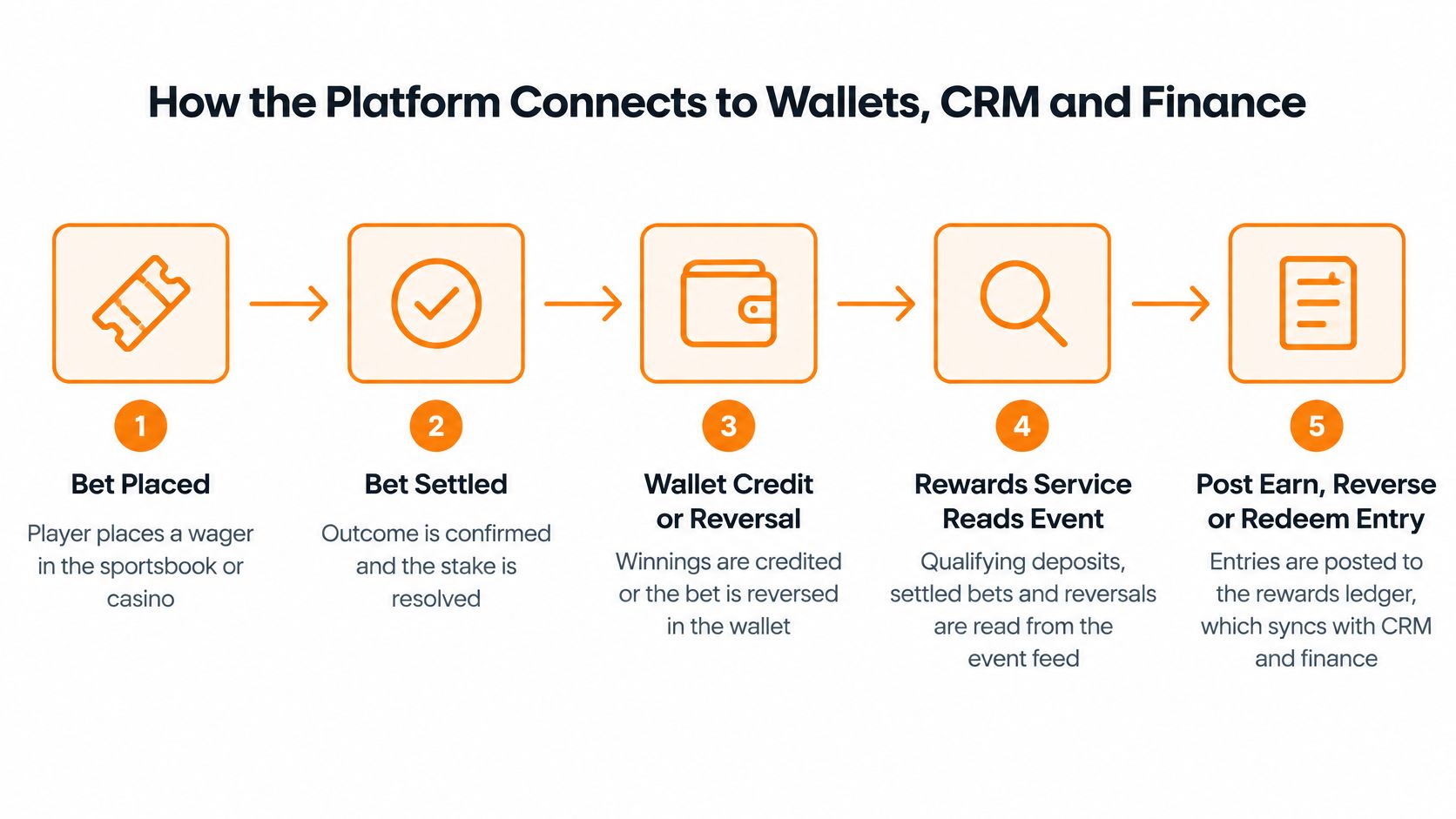
Start with the event path. A player places a bet, the bet settles, and the wallet credits winnings or reverses the transaction. The rewards service reads the event and posts a corresponding earn, reverse, or redemption entry to its own sub-ledger. That sequence is what keeps the player's visible balance aligned with what the operator can reconcile.
The wallet usually separates real-money funds from bonus funds. If the rules exclude bonus-funded play, the rewards service must know which balance funded the wager. It must also react to voids and reversals, or points can remain credited after the qualifying activity has disappeared.
The CRM connection supplies the player profile, segment, consent flags, and tier history. Those fields need to update within a defined operational window. Otherwise, a campaign may reach someone who has opted out, is ineligible in their jurisdiction, or must be suppressed under responsible-gaming rules.
| Integration Point | Data That Must Flow | Failure If Missing |
|---|---|---|
| Real-money wallet | Stake placed, settled, reversed and win credited, with balance after each event | Points awarded on voided or reversed bets |
| Bonus wallet | Bonus balance, wagering progress, expiry date | Reward money that cannot be withdrawn, or bonus play counted twice |
| CRM and segmentation | Player profile, segment, consent flags, tier history | Offers reach excluded or unconsenting players |
| Affiliate tracking | Partner ID, registration and first-deposit timestamps | Commission paid on players who can't be attributed |
| KYC and responsible gaming | Verification status, self-exclusion, jurisdiction | Rewards reach players who should be blocked |
| Rewards sub-ledger | Earn, reverse, redeem, expire and adjust events | Liability reports drift away from wallet balances |
For multi-currency operations, agree how the wallet, rewards service, and reporting layer handle currency conversion and balance display. This guide to multi-currency wallets is relevant when deciding what currency context the loyalty ledger must preserve.
Finance needs more than a campaign summary. Under IFRS 15 and ASC 606 concepts, points can represent a separate performance obligation, with revenue deferred until the reward is redeemed or expires. KPMG's loyalty-program analytics guidance highlights breakage estimation as a key input to valuing deferred loyalty liabilities.
Require an auditable event stream for earn, reverse, redeem, expire, and manual adjustment. Each event should post idempotently, meaning a repeated message won't create a second credit. Reconcile the rewards sub-ledger to wallet and finance systems on a set cadence, such as daily, and review expected breakage by cohort, jurisdiction, currency, tier, and reward type.
Metrics That Prove the Program Works
Member counts, points issued, and offer opens can all rise without the program creating additional value. A player may have wagered anyway, and an offer open doesn't establish that the offer caused a deposit, a bet, or a return visit.
A randomized holdout provides a cleaner test. Randomly assign eligible players to a group that receives the offer and a control group that doesn't. Compare how outcomes change in each group, then subtract the control group's change from the treated group's change. The difference, not the treated group's raw revenue, estimates the incremental effect.

For a simple example, suppose eligible players who receive an offer increase net gaming revenue by €8 per member, while similar players in the control group increase it by €3. The approximate incremental lift is €5 per member. This method helps account for baseline behavior and natural changes that would have happened without the campaign.
Use these measures together. Each answers a different question, so a single dashboard total can't establish whether the program works.
| Metric | How to Calculate | How to Read It |
|---|---|---|
| Active member rate | Members with a qualifying action in the period divided by total enrolled | A low rate means enrolment isn't turning into play |
| Redemption rate | Points redeemed divided by points issued in the same period | Very low redemption suggests rewards feel unattractive or hard to reach |
| Incremental NGR per member | Change in treated group minus change in control group | Estimates what the program adds beyond the control trend |
| Reward cost ratio | Reward cost divided by net gaming revenue from the cohort | Rising cost with flat lift signals waste |
| Tier migration rate | Players moving up or down a tier divided by players in that tier | Shows whether thresholds motivate play or push players out |
| Outstanding liability | Outstanding points times cost per point times (1 minus breakage) | Tracks the future cost of rewards already promised |
The method matters as much as the dashboard. In its guidance on personalization, McKinsey reports that personalization most often produces a 10% to 15% revenue lift, with company-specific results ranging from 5% to 25%. These figures are benchmarks, not promised outcomes. Report observed uplift separately from statistically validated incremental uplift, and show confidence intervals by segment, jurisdiction, channel, and reward type. Use net gaming revenue or contribution margin, not deposits alone.
A short explainer can help stakeholders understand why raw activity and causal lift are different. Use the video as a discussion aid, then apply the test design to a real campaign:
Design Rules for Rewards Players Keep Using
More tiers, badges, and campaigns can make a loyalty program harder to use rather than more engaging. Players need to understand what earns a benefit, how to claim it, and whether the reward fits what they really do.
In Deloitte's 2025 survey of 5,564 U.S. loyalty members, consumers belonged to an average of eight programs but actively participated in only five. Global consumer research also found that 40.7% want points not to expire, 40.0% want more ways to earn, and 81.2% of members prefer reward customization, while only 49.2% of program owners offer it, according to Deloitte's loyalty-program research. The practical signal is clear: make rewards flexible before adding more layers of program complexity.
Make rewards easier to earn and use
Let operators configure earn-and-burn rules by product, while keeping the player's explanation simple. Longer validity periods can give players time to use their balance; partial redemption can make smaller balances useful rather than leaving them stranded.
Offer a choice of benefits where the rules allow it. A player might choose between a free-spin bundle and another permitted reward, while another player may prefer a sportsbook benefit. Shared or family accounts may work in some business models, but iGaming operators need to assess them carefully against account ownership, identity checks, and applicable rules.
Put responsible-gaming and trust controls first
Reward value shouldn't rise in a way that encourages a player to chase losses. Offers should respect wagering and affordability signals, and self-exclusion and eligibility checks should run before an offer is sent. Personalization should be explainable: the operator should be able to show why a player qualified and why an excluded player didn't receive the offer.
Data use needs the same discipline. Ask only for information that supports a clear program purpose, give players a preference center, set retention limits, and apply suppression rules before a campaign goes out. For operators evaluating the broader controls around eligibility and risk, these iGaming risk-management practices are relevant to the reward rules as well as the campaign workflow.
A Worked Example from First Bet to Tier Upgrade
Consider a player who uses the sportsbook and casino over the course of a month. The example is hypothetical, but each action depends on a real system event being recorded correctly.

On the first day, the player registers and deposits through a partner link. Affiliate tracking stores the partner ID and registration event. The CRM assigns an initial segment and records consent and eligibility flags. Those records determine which campaigns can later be sent.
During the second week, the player places qualifying wagers. The wallet sends settled-bet events to the rewards service. The service checks which stakes qualify, posts points to the rewards sub-ledger, and updates the player's progress toward the next tier. If a wager is voided, the reversal event must also reach the ledger so the points can be corrected.
In the third week, the player stops betting for ten days. The CRM changes the segment to lapsed, but the campaign system doesn't send a reload offer until it checks consent, self-exclusion, verification status, and jurisdictional eligibility. That gate is essential: a lapsed segment alone isn't permission to contact or reward every player in it.
By the fourth week, the player reaches the tier threshold and qualifies for free spins on a named game. The bonus wallet credits the spins, and the account displays the wagering requirement. Afterward, the operator compares the player's campaign group with a holdout group that received no offer. The reported result is the net difference between those groups, not the player's raw spend.
Each step relies on two foundations: a clean wallet event and an up-to-date CRM record. If either is missing, the operator risks misattributing activity, awarding the wrong reward, or contacting someone who should have been excluded.
Decide Between Building and Buying Your Rewards Layer
Buy a rewards layer when the operator needs it to share the casino and sportsbook wallet, CRM, and compliance stack, and launching quickly matters more than custom logic. Build when the operator has in-house data science and engineering capacity, unusual reward economics, or a focused single-product setup that makes a custom service manageable.
Before signing, ask the vendor to demonstrate the integration points in the table above, using test events rather than slides. The checklist should include:
- Shared player and wallet model: Casino and sportsbook activity should resolve to the right account and balance.
- Money separation: Real-money and bonus balances should remain distinct in earning and redemption rules.
- Finance audit trail: Every earn, reversal, redemption, expiry, and adjustment should be traceable.
- Campaign experiments: The analytics layer should support randomized holdouts and separate observed activity from measured incrementality.
- Eligibility controls: Consent, suppression, KYC status, self-exclusion, and jurisdiction rules should be enforceable before an offer is issued.
- Attribution and reporting: Affiliate events and campaign outcomes should be available for reconciliation and evaluation.
NexGrate is one option to assess against those criteria. Its white-label platform combines a casino and sportsbook backend and wallet with bonus systems, free spins, loyalty tiers, segmentation, affiliate tracking, and campaign analytics. An operator can use a pilot to test the wallet, CRM, and finance events alongside the wider choice of iGaming software providers.
Start with one segment and one reward. Run a 30-day holdout, confirm that wallet and ledger records reconcile, then decide whether the measured incremental margin justifies expanding the program.
NexGrate provides a white-label iGaming platform with casino and sportsbook operations, wallet and payment integrations, loyalty tiers, bonuses, segmentation, affiliate tracking, and campaign analytics. If you're assessing how those components fit together for your rewards program, visit NexGrate to review the platform and discuss an integration pilot.