
Your casino or sportsbook is live. The lobby looks good, the payment stack works, and the game catalog is competitive. Then the hard part starts. Paid traffic is expensive, organic takes time, and every acquisition channel feels fragile when one policy change or one bad campaign can wreck a month's forecast.
That's where a serious iGaming affiliate program stops being a side project and becomes part of the operating model. Done properly, it gives you distribution through partners who already own audience trust, search visibility, or media buying skill. Done badly, it creates payment disputes, attribution arguments, compliance exposure, and a long list of affiliates who never send a single valuable player.
The difference usually isn't the headline commission rate. It's whether your commercial terms, tracking, compliance controls, and partner onboarding work together as one system. New operators often focus on recruiting affiliates before they've built the operational rails to support them. That's backwards. Affiliates stay where data is clean, payments are predictable, and compliance issues don't put their earnings at risk.
Table of Contents
- Introduction Beyond Launch Day to Sustainable Growth
- Designing Your Program's Commercial Structure
- The Technology Stack for Accurate Affiliate Tracking
- Navigating iGaming Compliance and Regulations
- Recruiting and Activating the Right Affiliate Partners
- Managing and Optimizing for Long-Term Profitability
- Conclusion Your Affiliate Program as a Core Business Asset
Introduction Beyond Launch Day to Sustainable Growth
A new brand owner usually reaches the same conclusion after launch. Buying players one campaign at a time doesn't scale cleanly, and it rarely creates durable margin. An iGaming affiliate program can, because the model aligns payout with measurable outcomes instead of vague awareness metrics.
The underlying economics are attractive when the structure is chosen correctly. The global iGaming affiliate market is projected to grow at a 10.57% CAGR and reach $161.32 billion by 2030, with performance-based marketing driving most of that expansion, according to industry trend analysis from Reach Effect. In practice, online casino remains the highest-volume affiliate category inside that ecosystem.
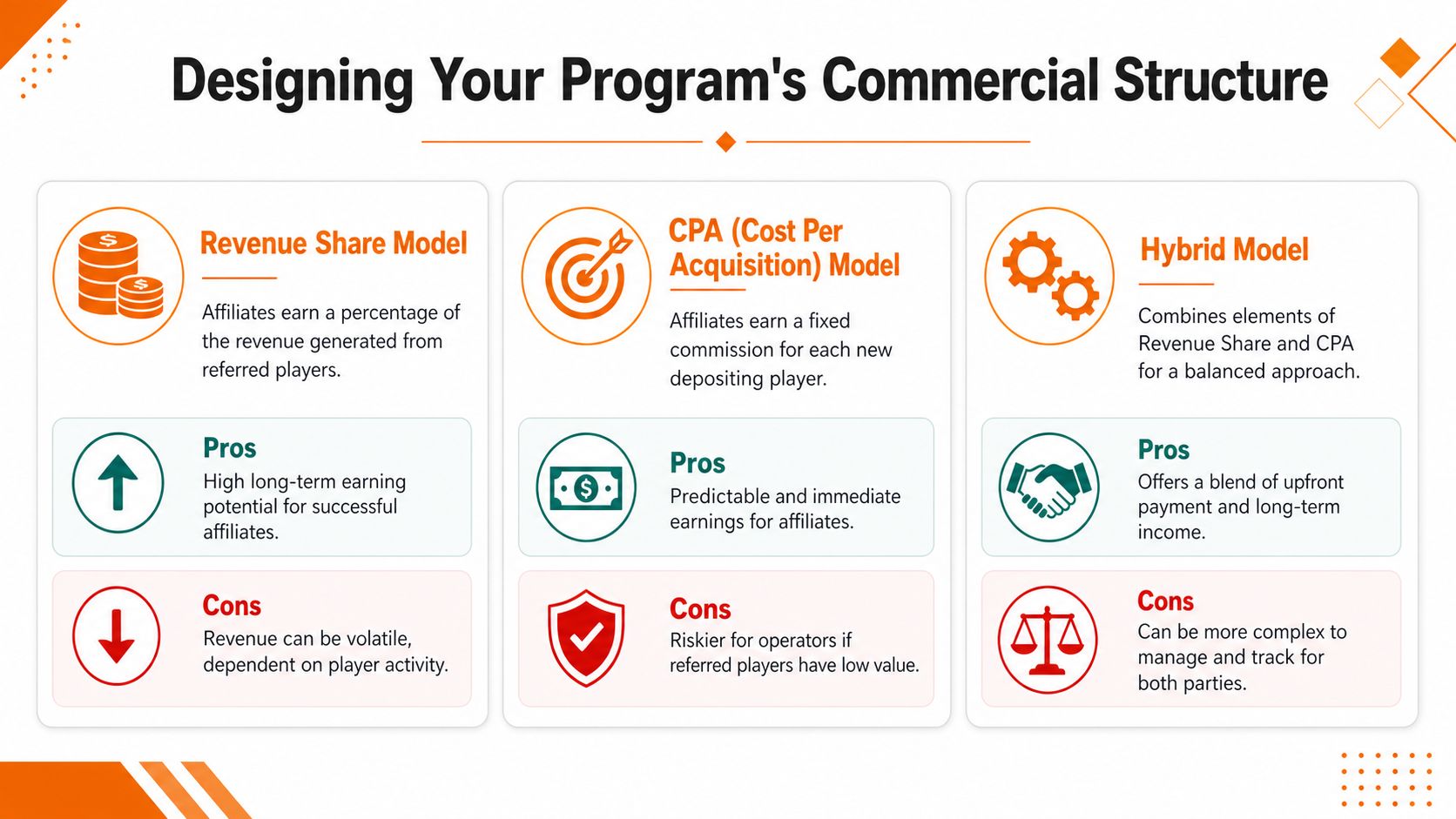
The first decision is commercial. RevShare suits operators who want partner incentives tied to player quality and long-term value. CPA suits brands that need predictable acquisition cost and can absorb more upfront risk. Hybrid deals fit operators who need to attract stronger affiliates without giving away too much margin on either side.
Practical rule: Choose the model that matches your cash-flow tolerance and your confidence in player retention. If retention is weak, an aggressive CPA plan can punish you very quickly.
An affiliate channel becomes sustainable when commercial design, tracking accuracy, and compliance controls support each other. Without that foundation, launch day just opens another leak in the business.
Designing Your Program's Commercial Structure
A new operator usually feels pressure to publish attractive commission numbers fast. That is how weak programs get built. The commercial model should come after three internal decisions are settled: what counts as qualified revenue, how much acquisition risk the business can carry, and which compliance controls must be met before any commission is approved.
If those rules sit in separate tools or separate teams, disputes start early. Affiliates challenge deductions. Finance challenges payout accuracy. Compliance blocks accounts after traffic has already been bought. A unified platform matters here because commission logic, player status, KYC outcome, chargeback adjustments, and market-level restrictions need to feed the same settlement record.
Revenue Share Model
Revenue share remains the cleanest long-term structure for casino and mixed-product brands that retain players well. It protects cash flow at launch and gives affiliates a reason to send traffic that deposits, stays active, and does not trigger fraud reviews six weeks later.
The rate matters less than the revenue definition. Affiliates will inspect your NGR formula before they trust your offer. They want to know which items are deducted, whether bonus cost is fully or partly included, how payment fees are handled, whether taxes are excluded, and whether negative carryover applies.
Set those terms in writing before recruitment starts.
Revenue share works best when:
- Player value compounds over time: Cross-sell from casino to sportsbook, or vice versa, increases the life of the account.
- Your fraud and bonus controls are mature: Low-quality players can still damage margin under RevShare if abuse is not filtered early.
- You want commercially aligned partners: SEO and content affiliates usually accept slower payout in exchange for recurring earnings.
The trade-off is speed. Good affiliates may compare your long-term upside with a competitor offering immediate CPA cash, especially in newly regulated markets.
CPA Model
CPA shifts risk toward the operator. That can still be the right decision if the business needs predictable acquisition cost and has strict qualification rules behind the headline number.
A careless CPA setup creates two common problems. First, affiliates optimize for deposit volume rather than durable value. Second, internal teams discover too late that a "qualified player" passed tracking rules but failed affordability, KYC, source-of-funds review, or payment screening. At that point, the commercial promise and the compliance reality are already in conflict.
A workable CPA model needs clear acceptance criteria such as:
- Verified first-time depositors only
- Minimum deposit threshold
- No duplicate, self-excluded, or bonus-abuse accounts
- Commission approval only after KYC and fraud screening
- Defined clawback rules for chargebacks or reversed deposits
That is not red tape. It is margin protection.
Use CPA when paid media affiliates need fixed economics, when finance requires cost certainty by market, or when retention is still too volatile to support aggressive RevShare offers. Price it from actual player contribution after bonus cost, payment cost, compliance rejection rates, and expected churn. Pricing from competitor gossip usually ends badly.
If your BI team cannot show how a qualified CPA player reaches profitability by cohort, lower the CPA or tighten the qualification rules.
Hybrid Model
Hybrid deals are often the best starting point for a new brand because they solve two commercial problems at once. The affiliate gets some immediate return. The operator keeps part of the upside tied to player quality.
Hybrids also expose operational weaknesses faster than single-model deals. If deposit qualification, KYC approval, and revenue attribution are not connected in one system, monthly statements become an argument about which players count toward which part of the deal. That is why unified commission management matters more in hybrid programs than in simple RevShare plans. The platform must apply the same player status and market rules to both the upfront and recurring components.
Use hybrid when:
- You need stronger recruitment terms without committing to full CPA exposure
- You are entering a market where established affiliates expect upfront value
- You want to test partner quality before expanding either side of the deal
The downside is administrative load. Hybrid contracts need tighter definitions, cleaner reporting, and less room for manual adjustment.
iGaming Commission Model Comparison
| Model | Best For | Operator Risk | Affiliate Appeal |
|---|---|---|---|
| Revenue Share | Retention-led brands, content affiliates, long-term portfolios | Lower upfront spend, margin depends on clean NGR rules and player value over time | Strong for affiliates who want recurring income |
| CPA | Fixed acquisition planning, paid traffic deals, short-term volume pushes | Higher upfront exposure if qualification, fraud, or churn control is weak | Strong for affiliates who want faster and more predictable cash flow |
| Hybrid | New program launches, market entry, competitive partner negotiations | Moderate payout complexity, higher reporting and settlement discipline required | High, especially for established affiliates balancing cash flow and upside |
Commercial structure also signals what kind of affiliate base you will attract. Serious partners read terms as a proxy for operator quality. If the deal is vague on deductions, carryover, restricted GEOs, brand-bidding rules, or compliance rejection handling, the best affiliates assume reporting will be just as loose.
Build the commission model as part of the operating model. That means finance signs off on margin logic, compliance signs off on qualification rules, and the platform enforces both automatically. That is how an affiliate program scales without turning settlements into a monthly dispute cycle.
The Technology Stack for Accurate Affiliate Tracking
A new brand signs its first ten affiliates, sees registrations coming in, and assumes tracking is working. Two weeks later, finance cannot match first deposits to the affiliate report, one partner disputes missing conversions, and compliance asks who approved traffic from a restricted GEO. That is the point where operators learn the stack is not a reporting tool. It is part of the control system for revenue, partner trust, and regulatory exposure.

Tracking in iGaming breaks when commercial events and compliance events live in separate systems. A player may click on mobile, register later on desktop, complete KYC after a reminder, deposit after source verification, and only then generate qualifying revenue. If your stack cannot connect that chain with one consistent player record, every report becomes a debate.
Track five items with one source of truth: affiliate source, player account, registration time, first deposit status, and settlement revenue. Those records also need version control around status changes. If a deposit is reversed, an account is closed, or a bonus abuse flag is applied after the fact, the affiliate ledger must reflect it the same way finance does. Otherwise, your manager is negotiating from one report while your finance team closes the month from another.
Server-to-server postbacks help because they reduce dependence on browser-side tracking and ad hoc scripts. More importantly, they create an auditable handoff between the affiliate click, the player event, and the operator backend. That matters in iGaming because disputes rarely center on clicks alone. They center on whether the operator can prove which event qualified, when it qualified, and whether the player remained valid after KYC, fraud screening, and payment review.
A workable stack usually includes:
- Affiliate link and sub-ID control: Clean tracking parameters, source labels, and campaign-level attribution that can be reconciled later.
- Backend event validation: Registration, KYC status, deposit confirmation, and revenue events passed from system records, not guessed from front-end behavior.
- Fraud and quality controls: Duplicate accounts, self-referrals, payment anomalies, device overlap, bonus abuse patterns, and unusual source-to-deposit ratios.
- Dual reporting views: Affiliates need transparent performance data, while internal teams need reconciliation, exception handling, and margin visibility.
- Rule-based commission execution: CPA, rev share, and hybrid terms should calculate from the same event logic used by finance and risk teams.
The build decision matters as much as the features. New operators often bolt together an affiliate platform, CRM, cashier, KYC vendor, fraud tools, and spreadsheets for settlement. It can work, but only if someone owns the data model across all of them. In practice, that ownership is usually weak at launch. When attribution breaks, every vendor can show its own logs and still leave the operator without a usable answer.
That is why unified systems reduce risk beyond convenience. When affiliate tracking, player status, deposit approval, bonus costs, and revenue calculation sit closer together, your team can resolve disputes faster and enforce the same business rules everywhere. A platform with an integrated affiliate and back-office layer gives a new program tighter control over approvals, ledgers, and audit history than a patchwork setup that reconciles after the month closes.
A fragmented stack creates extra work for finance, compliance, and affiliate managers. The affiliate manager sees a missing conversion claim. Finance sees unreconciled player revenue. Compliance sees weak audit evidence.
Here's a useful product walkthrough for how an integrated casino platform environment can look in practice:
A practical compliance checklist inside tracking operations
Tracking configuration is also compliance configuration. If the system accepts traffic, records conversions, and triggers payments without control points, the program is exposed before any legal review catches up.
Use these checks as operating requirements:
- GEO enforcement: Click origin, player registration country, and accepted market permissions should align before a conversion is approved.
- Creative access control: Affiliates should only pull approved banners, offers, and copy for the jurisdictions and brands they are allowed to promote.
- Audit logging: Changes to commission terms, partner permissions, rejected players, and payout approvals need a timestamped record.
- Responsible gaming inclusion: Landing pages, promo assets, and templates must carry the required messages for each licensed market.
- Role-based permissions: Affiliate managers should not be able to override payment, compliance, or fraud decisions without review.
Clean tracking supports growth because it prevents small operational gaps from turning into payment disputes or regulatory problems. If the stack is fragmented, each new affiliate adds reconciliation work and more room for error. If the stack is unified, each new affiliate adds volume inside a system that can prove what happened and why.
Navigating iGaming Compliance and Regulations
Most affiliate compliance failures don't begin with an obviously reckless decision. They begin with shortcuts. A manager approves a partner before reviewing their traffic method. A creative gets translated without legal review. A streamer improvises bonus language on air. By the time the issue surfaces, the operator is already exposed.
That's why an iGaming affiliate program needs compliance rules that are operational, not aspirational. The standard isn't whether you have terms on paper. The standard is whether affiliates can only do what your controls permit.
How bad affiliate compliance usually starts
Consider three common partner types.
A large SEO site asks for localized landing pages and bonus copy. If your terms are broad and your approval workflow is weak, they may publish outdated offer language that remains indexed for months.
A Twitch or video creator wants a simpler promo script because live content moves fast. If your brand team approves messaging informally, they can drift into misleading claims without anyone catching it in time.
A Telegram owner can deliver strong volume in some markets, but if your tracking, geo rules, and approval logic aren't built for that source, the relationship becomes a monitoring problem from day one.
None of those scenarios are unusual. They're normal. The operator's job is to build a system that assumes these pressures will happen.
The operator audit checklist
Use a short but unforgiving checklist before an affiliate goes live:
- Licensing alignment: The partner can only promote markets and products your licenses allow.
- Traffic-source disclosure: The affiliate must state exactly how they acquire users. General answers aren't enough.
- Creative controls: Only approved assets, terms, and bonus language should be available to affiliates.
- Responsible gaming requirements: Mandatory links, warnings, and age-gating language must appear where required.
- Brand bidding and keyword rules: If you prohibit these, define it precisely and enforce it consistently.
- Recordkeeping: Keep evidence of approvals, edits, and partner acknowledgments.
Operators that want a tighter operational framework usually benefit from a compliance-focused control layer built into the platform environment, because manual policing does not scale once affiliate count grows.
Compliance is easier to defend when the system prevents bad behavior before it reaches the public.
How to approach different partner types without creating risk
A high-traffic SEO affiliate usually needs structured assets, approved claims, and clear market permissions. They don't need daily hand-holding, but they do need a dependable review process for content updates.
A streamer or creator needs a stricter briefing process. Live content is fast, and the chance of off-script promotion is much higher. Give them fewer claims, simpler approved language, and a direct escalation route for questions.
Telegram and community-led traffic needs the most scrutiny. The channel can be strong commercially, but only if the operator can verify what is being promoted, where it is being promoted, and whether the acquisition path can be tracked and audited properly.
If you treat compliance as a legal afterthought, affiliate growth creates compounding exposure. If you treat it as partner infrastructure, it becomes a filter that improves both player quality and brand durability.
Recruiting and Activating the Right Affiliate Partners
You approve 40 affiliates in the first month. Six ever send traffic. Two send the wrong traffic. One creates a compliance problem before the first invoice is due. That is a common launch pattern, and it usually starts with weak partner selection rather than weak demand.
Recruitment should be treated as an operating decision, not a top-of-funnel numbers game. The goal is to sign partners whose traffic model, market coverage, content process, and reporting discipline fit the way your business works. If those pieces do not line up, the program gets expensive fast. Your team spends time on reviews, exceptions, tracking disputes, and payment questions instead of revenue.
Recruit for traffic fit and operating fit
A large affiliate roster has little value if your platform, compliance process, and commercial model cannot support how those partners acquire users.
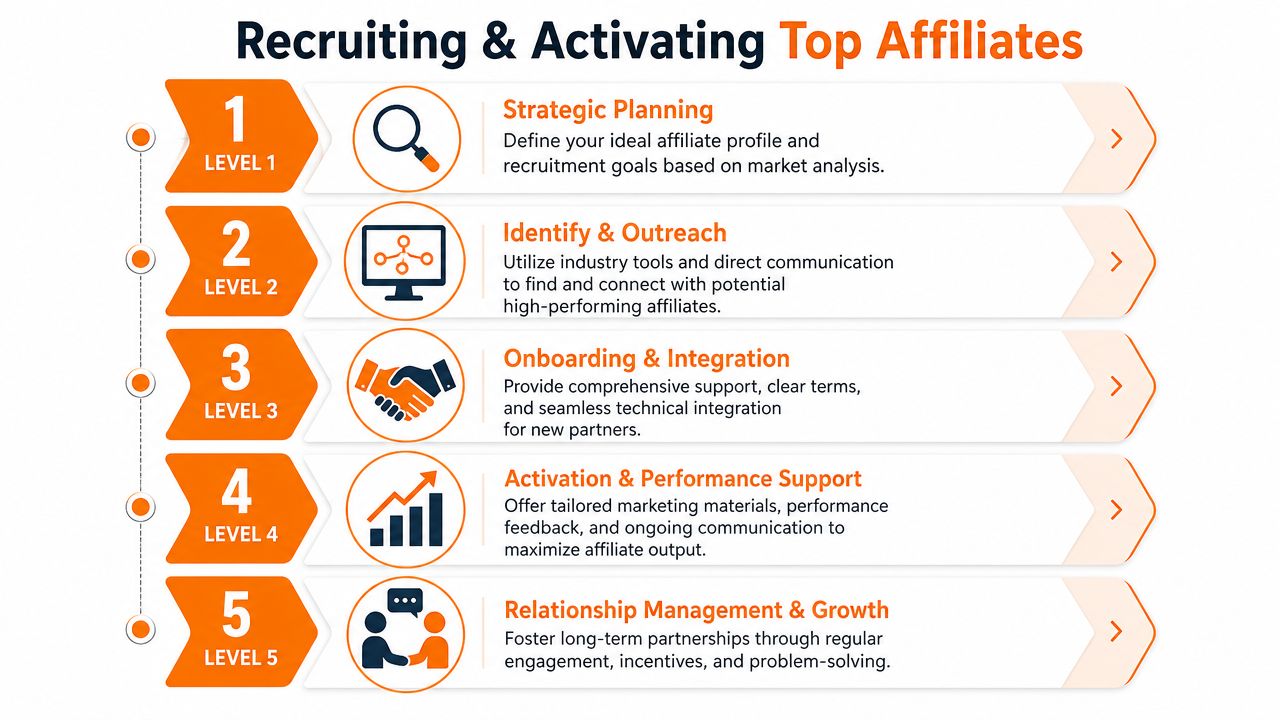
Start with acceptance criteria that your affiliate manager, compliance team, and finance team can all apply the same way. I would define them in this order:
- Traffic source: SEO, PPC, streaming, Telegram, community, email, media buying
- Target markets: Where the partner acquires traffic, not just where they say they can promote
- Promotional method: Reviews, bonus content, live content, comparison pages, influencer placements
- Operational reliability: Speed of communication, documentation quality, willingness to use approved materials
- Commercial fit: CPA, rev share, hybrid, minimum volume expectations, payment terms
That order matters. A partner with average commercial expectations and clean traffic is usually more valuable than a high-volume applicant whose acquisition methods create reporting gaps or regulatory exposure.
Market planning needs the same discipline. Partner recruitment by region should match your licensing position, payment readiness, KYC flow, and local content approval process. If your team is still assessing priority jurisdictions, map affiliate demand against your market-entry requirements across regulated and emerging iGaming regions before you approve partners you cannot support properly.
Different affiliate types need different operating support
SEO affiliates usually produce the most stable long-term contribution, but they expect consistency. They care about tracking logic, product stability, page quality, and whether terms change without warning. If you want serious SEO partners active, give them approved GEO coverage, clear commission definitions, tested landing pages, and a named contact who can answer tracking questions without delay.
PPC affiliates are less patient and more sensitive to execution problems. They test offers quickly and reallocate budget just as quickly. If attribution is unclear, if first-time deposit validation takes too long, or if your landing pages underperform on mobile, they will stop spending. That is not a relationship issue. It is an operating issue.
Creators and streamers need tighter campaign design. Their value comes from trust with their audience, so generic banners and recycled offer copy do very little. Give them a simple brief, approved talking points, event-based hooks, and a fast path for approving custom assets. Keep the claims narrow. Keep the process fast.
Telegram and community-led partners can perform well in the right markets, but only if you can verify source quality and attribute the traffic cleanly. If the platform cannot separate those users properly, or if your team cannot monitor what was promoted, do not send the deal live on verbal promises alone.
Activation is a controlled rollout, not a welcome email
Many operators lose momentum here. The affiliate is approved, receives a login, downloads a few links, and then nothing useful happens for three weeks. By then the partner has either deprioritized the brand or launched with poor setup.
A better activation plan is tighter and easier to audit:
- Launch one campaign first: One product, one GEO, one offer path
- Match landing pages to intent: Sports traffic, casino bonus traffic, and brand search traffic should not be pushed into the same generic page
- Validate tracking early: Review clicks, registrations, deposits, and source tags with the partner within the first reporting window
- Control asset distribution: Give each partner the materials that suit their channel, not a bloated folder of everything
- Set a first review point: Assess traffic quality, compliance behavior, and communication speed before expanding terms or volume
A unified platform earns its keep. Recruitment, approvals, tracking, market permissions, and partner reporting should sit in one operating flow, not across disconnected tools and spreadsheets. When those controls are connected, the brand can approve faster, catch mismatches earlier, and scale without creating avoidable risk in attribution or compliance.
The first month is less about headline volume and more about partner behavior. Does the affiliate send the traffic they described? Do they use the approved route? Do registrations convert into depositing players at a level that justifies more exposure? Do they raise issues early, or only after numbers diverge?
Portfolio balance matters too. Overreliance on one partner type, one top affiliate, or one acquisition channel creates avoidable commercial risk. Search rankings change, ad accounts get restricted, creators lose reach, and compliance scrutiny can shut down a traffic source with very little notice. Strong programs spread acquisition across a mix of partner models on purpose, then scale the ones they can measure and control.
Good affiliate managers recruit selectively, activate tightly, and expand only after the operating basics hold up under real traffic. That is how a new program grows without creating a backlog of dormant accounts, payment disputes, and preventable compliance problems.
Managing and Optimizing for Long-Term Profitability
A brand can look healthy in month one and still build an unprofitable affiliate channel.

The pattern is familiar. Registrations rise, affiliates ask for higher caps, finance sees growing acquisition spend, and nobody can answer a basic question with confidence: which partners are bringing players who clear KYC, deposit, stay active, and generate net revenue after bonuses, payment costs, and fraud losses?
That is the point where long-term management stops being an affiliate task alone. It becomes an operating discipline across tracking, CRM, payments, risk, and finance. If those teams work from different systems or different definitions of value, the program drifts into overpayment, disputes, and poor capital allocation.
Read affiliate performance past clicks and registrations
Clicks and registrations are early signals. They are not decision metrics for scaling partner spend.
The useful view starts at qualified first deposit and follows the player through retention, net gaming revenue, bonus cost, chargebacks, and withdrawal behavior. An affiliate that sends fewer registrations can still be the better commercial partner if its traffic verifies cleanly, deposits without excessive bonus pressure, and remains active beyond the first promotional cycle.
Review performance at three levels:
- Funnel quality: registration completion, KYC pass rate, first-time deposit rate, and time to first deposit
- Revenue quality: NGR, average bonus cost, payment processing cost, fraud flags, and reversal rate
- Player durability: repeat deposit behavior, active days, short-term retention, and early churn
Operators often miss margin here. They reward top-line volume while product or payments friction destroys conversion further down the funnel. If an affiliate sends strong intent traffic but your KYC flow stalls, your reporting may label that partner as weak when the underlying problem sits inside your own operation. A unified platform reduces that blind spot because acquisition, verification, payments, and revenue reporting sit in the same workflow.
One warning sign deserves fast action. High registration volume with weak first deposits usually points to low-intent traffic, poor pre-sell messaging, bonus hunters, or a broken onboarding path. Each cause needs a different response, and all of them get more expensive if you keep paying on shallow metrics.
Where profits are usually won or lost
Long-term profitability comes from contribution margin, not headline CPA efficiency.
A partner can look cheap on acquisition and still lose money once retention softens, bonus cost rises, or withdrawals come too quickly to recover media spend. The reverse is also true. Higher CPA traffic can be commercially sound if those players deposit repeatedly, respond to CRM, and stay within acceptable compliance and risk thresholds.
The practical question is simple. Does this affiliate cohort repay acquisition cost inside the payback window your business can support?
Answer it with cohort reporting, not blended averages. Measure each affiliate by market, brand, device mix, payment method, and promotion type. Then compare payback period, net revenue after direct cost, and retention curve. That is how operators avoid two common mistakes: over-scaling noisy affiliates and cutting partners that would have performed well under the right landing page, payment mix, or CRM journey.
Retention has to be part of affiliate optimization. Acquisition teams influence who arrives. Product, payments, KYC, and CRM determine whether that player becomes profitable. If those functions are disconnected, affiliate managers end up negotiating commission terms to fix problems they do not control.
How to tier and manage affiliates like a portfolio
Run the program like a portfolio of risk-adjusted revenue sources, not a flat list of accounts.
A workable structure looks like this:
Core partners
These affiliates produce consistent net revenue, acceptable compliance behavior, and predictable operational workload. Give them faster approvals, direct access to decision-makers, and market-specific commercial terms tied to verified performance.Growth partners
These accounts show potential but still need work on traffic mix, creative alignment, or conversion quality. Keep them on tighter review cycles and scale only after the underlying issue is clear.Test partners
Use capped exposure, fixed validation windows, and strict source disclosure. If the traffic quality is real, they can move up quickly. If not, losses stay contained.Exit partners
These affiliates consume time, create reconciliation issues, or trigger repeated compliance concerns without delivering durable value. Close them cleanly and document why.
Portfolio discipline matters because concentration risk is real. A program that depends too heavily on one super affiliate, one GEO, or one traffic model can lose a large share of revenue after a ranking change, a payment disruption, a compliance intervention, or a contract dispute. Balanced programs spread volume across partner types they can verify, track, and pay accurately.
The management cadence should be explicit. Review new partners weekly during the first phase. Review mature partners monthly by cohort quality, not just volume. Reprice deals when retention, bonus cost, or regulatory overhead changes the margin profile. Investigate anomalies before invoicing, not after payment goes out.
Strong affiliate programs are not maintained by occasional optimization pushes. They are maintained by clean data, tight controls, and one operating view of attribution, compliance status, commercial terms, and payout exposure. That is why unified infrastructure matters long after launch. It lowers reconciliation effort, shortens dispute cycles, and gives the operator a clearer line from traffic source to actual profit.
Conclusion Your Affiliate Program as a Core Business Asset
A sustainable iGaming affiliate program isn't built from commission headlines or flashy recruitment. It's built from five decisions made well: commercial structure, tracking integrity, compliance control, partner fit, and disciplined optimization.
Get the commercial model wrong and you'll attract the wrong behavior. Get tracking wrong and nobody trusts your numbers. Get compliance wrong and growth creates exposure instead of value. Recruit without traffic fit and your pipeline fills with inactivity. Optimize only on clicks and registrations, and you'll reward noise instead of profit.
The operators who scale this channel successfully treat it like core infrastructure. They don't separate affiliate performance from finance, compliance, payments, or retention. They run it as part of the business, because that's what it is.
If you're building from scratch, the safest path is to avoid fragmented operations. A unified platform reduces reconciliation work, sharpens oversight, and gives affiliates a cleaner experience from onboarding through payout.
If you're building or upgrading an iGaming affiliate program, NexGrate gives operators a unified white-label stack that brings affiliate tracking, back office, payments, and compliance controls into one operating environment. That matters when you want faster launch, cleaner attribution, and fewer gaps between acquisition, reporting, and regulation.
Powered by the Outrank app