
A new iGaming brand can have its casino catalogue, sportsbook feed, payment methods, and KYC provider selected before the first serious integration problem appears. Then launch preparation begins. The wallet can't reconcile a sportsbook bet and a casino round at the same time, a payment callback arrives after the player has already changed verticals, or a compliance rule works in one product but not the other. Each vendor may work correctly in isolation, yet the brand still fails to deliver one reliable player account.
That's the operational reality of cross-platform integration in iGaming. The challenge isn't merely moving API requests between systems. Operators must keep balances, player status, bets, bonuses, settlements, identity decisions, audit records, and jurisdictional controls aligned while external providers behave inconsistently. Industry estimates show sustained demand for enterprise connectivity, with the market projected to reach $45.21 billion by 2030 in one assessment and $41.79 billion by 2031 in another, as documented by The Business Research Company's enterprise application integration market analysis. The architecture matters because a fragmented integration layer eventually becomes a constraint on expansion.
Table of Contents
- Why Cross-Platform Integration Breaks iGaming Launches
- The Three-Layer Architecture That Scales
- Synchronous Versus Asynchronous Integration Patterns
- The Legacy System Bottleneck That Derails Integration
- Security and Governance in Multi-System Environments
- Evaluating Turnkey Platforms Versus Custom Integration
- Building Integration That Survives Market Expansion
Why Cross-Platform Integration Breaks iGaming Launches
The launch plan looked straightforward. A casino provider supplied game content, a sportsbook vendor supplied odds and settlement, a payment processor handled deposits and withdrawals, and a KYC provider promised automated checks. Each contract described a tested integration. The operator assumed the remaining work involved connecting endpoints and styling the front end.
The first end-to-end test exposed the problem. A player deposited funds, opened a casino game, placed a sportsbook bet, and triggered a KYC review after changing jurisdiction-sensitive account details. The casino balance updated immediately, the sportsbook held a separate balance snapshot, and the compliance platform had no single view of the player's activity. Nothing was necessarily broken inside an individual vendor system. The failure sat between them.
The wallet is the operational centre
A unified wallet isn't just a balance display. It's the transaction authority for deposits, wagering, reversals, bonuses, withdrawals, currency handling, and responsible gaming controls. If the casino and sportsbook each interpret wallet events differently, the player sees contradictory information and the operations team starts reconciling records manually.
State synchronization creates the hardest questions:
- Which event wins: If a bet placement and a withdrawal request arrive close together, the platform needs a deterministic ordering and reservation policy.
- Who owns the balance: Providers should request authorized wallet operations, not maintain independent versions of the player's financial truth.
- How are retries handled: A repeated callback must not debit the player twice or issue duplicate bonus credit.
- What happens during an outage: The platform needs a known policy for pending transactions, delayed settlements, and provider recovery.
The same issue appears in KYC. A player who passes verification for one vertical may still need a new jurisdiction check, source-of-funds review, or responsible gaming restriction before accessing another. Treating compliance as a plug-in attached to one product creates gaps that only become visible during audit or incident review.
Practical rule: Design the player account, wallet, and compliance state before choosing the connector pattern. The connectors should serve those capabilities, not define them.
Vendor coordination adds another layer of risk. Contractual responsibilities, release schedules, callback formats, support escalation, and data ownership need explicit operating rules. A practical vendor management approach for iGaming teams should cover technical dependencies as well as incident ownership, certification evidence, and change notification.
The cost of weak integration appears in delayed launches, manual support work, inconsistent player experiences, and regulatory friction. Operators should treat integration as a product and operating-model decision from day one, not as plumbing assigned to the last phase of delivery.
The Three-Layer Architecture That Scales
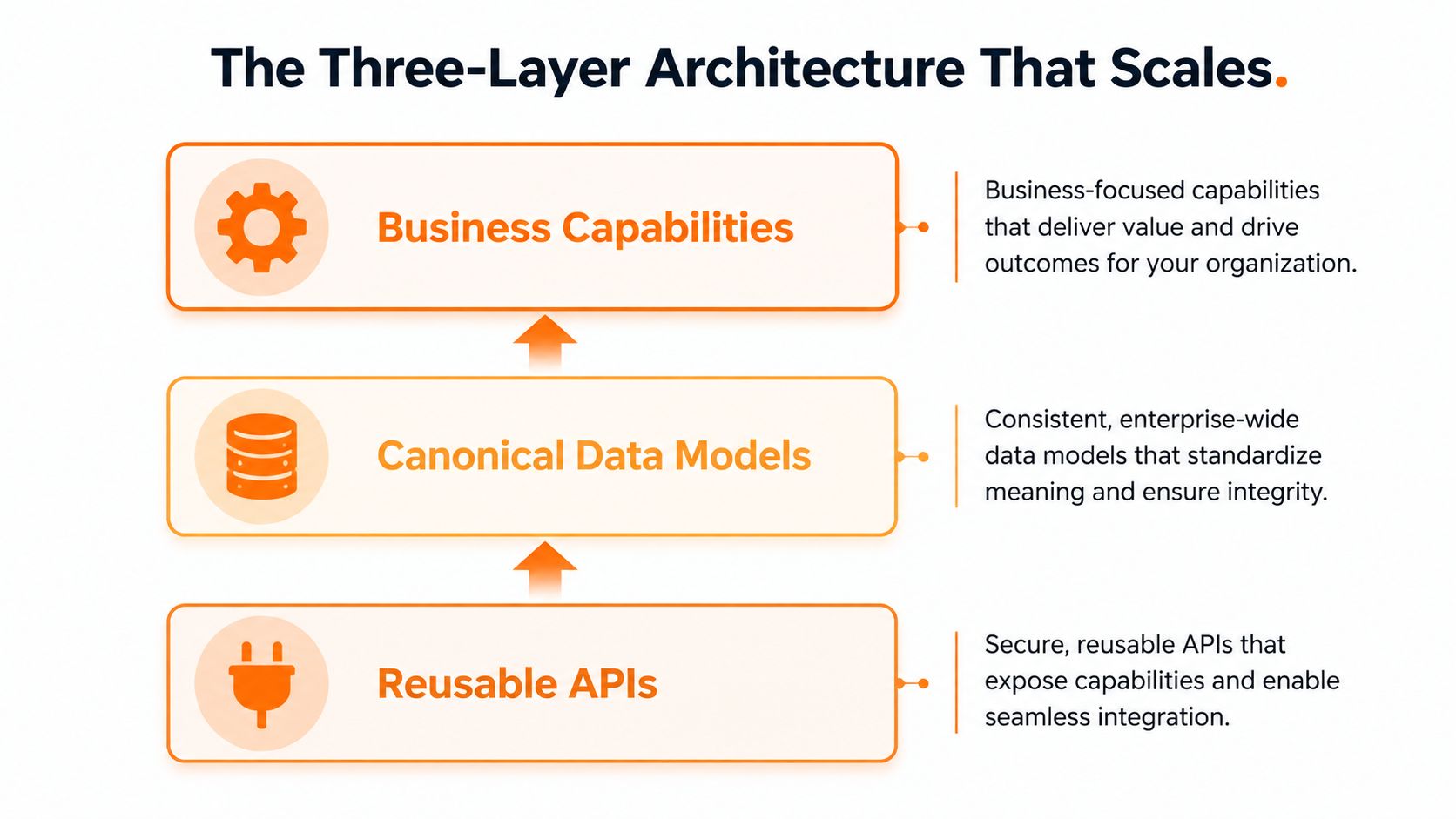
A scalable integration layer separates business capabilities from provider-specific mechanics. The casino engine shouldn't force the rest of the platform to understand one studio's session format. The sportsbook shouldn't dictate how the wallet represents a debit. The architecture needs stable internal contracts that absorb external variation.
Start with business capabilities
Define the capabilities the operator owns, such as player identity, wallet authorization, game session management, bet placement, settlement, bonus eligibility, payment orchestration, and compliance decisions. These capabilities should remain stable even when the underlying provider changes.
A system API then abstracts a provider. A casino adapter converts a studio's launch, round, and callback messages into the platform's internal game-session contract. A payment adapter translates processor-specific statuses into consistent states such as initiated, authorized, failed, reversed, or settled. The adapter owns authentication, field mapping, retries, and provider quirks.
That boundary prevents vendor terminology from leaking into core business logic. It also gives engineering and operations teams one place to monitor provider-specific failures.
Use canonical models as the shared language
A canonical data model defines how the platform represents a player, wallet transaction, bet, game round, payment, KYC decision, and audit event. It should include stable identifiers, jurisdiction context, currency, timestamps, idempotency keys, status transitions, and correlation references.
Canonical models need discipline. Don't flatten every provider's unique field into the shared contract, and don't discard information required for reconciliation or compliance. Keep provider extensions at the edge, while preserving the internal fields needed to operate the brand consistently.
Orchestrate processes, then serve channels
Process APIs coordinate multi-system workflows. A bet settlement process might validate the player, reserve or release funds, record the wager, receive the provider result, update the wallet, apply a bonus rule, and emit an audit event. A withdrawal process can coordinate payment screening, compliance checks, risk review, processor submission, and player notification without placing that logic inside a front-end endpoint.
Experience APIs should expose only what a web client, mobile application, back office, or partner channel needs. This three-layer separation, system APIs, process APIs, and experience APIs, reduces coupling and makes policy enforcement and versioning easier as the platform grows. It also aligns with the broader architectural principle of separating identity and access decisions from the systems that consume them, as discussed in digital identity and payment access architecture.
For operators building or extending online casino software, the practical test is simple: adding a game provider should require a new adapter and configuration, not a rewrite of wallet, bonus, reporting, and front-end logic.
Synchronous Versus Asynchronous Integration Patterns
The wrong timing model can make a stable platform collapse during a busy event window. Synchronous requests are appropriate when the player or transaction must receive an immediate, authoritative answer. Asynchronous events are better when the business can tolerate delay and needs resilience more than instant confirmation.
A wallet balance check before a bet, a bet-placement authorization, and a withdrawal eligibility decision usually belong on a synchronous path. The request should return a clear result before the interface confirms the action. Even there, the platform shouldn't call every downstream provider in sequence. Keep the critical path narrow, cache only information that can safely be stale, and enforce strict timeouts.
Status updates, billing triggers, audit fan-out, marketing segmentation, and non-critical notifications usually fit event-driven flows. A sportsbook settlement event can update the wallet, publish reporting data, notify the player, and trigger a loyalty calculation without forcing the settlement provider to wait for every consumer.
The choice matters because gateways, orchestration layers, and identity checks add overhead to each request. The World Bank's discussion of digital infrastructure and service flows provides useful context for why layered digital services need careful performance and reliability design. In practice, high-volume systems reserve synchronous calls for decisions that block the user action and move coordination into asynchronous processing wherever latency tolerance exists.
Select the pattern by business consequence
| Operation Type | Recommended Pattern | Latency Requirement | Failure Impact |
|---|---|---|---|
| Wallet authorization before a bet | Synchronous API | Immediate decision | The bet must not proceed without an authoritative result |
| Casino round debit | Synchronous command with idempotency | Immediate or near-immediate | Duplicate processing can create financial exposure |
| Bet settlement distribution | Asynchronous event flow | Tolerates processing delay | Consumers can retry without blocking the provider |
| Payment status update | Webhook or message event | Tolerates provider delay | The transaction remains pending until confirmed |
| Audit and analytics delivery | Asynchronous event flow | Non-blocking | Reporting consumers can catch up independently |
| Player-facing balance refresh | Synchronous read from the wallet service | Fast response | A stale value damages trust, so freshness rules must be explicit |
Isolate failures instead of hiding them
Use queues, dead-letter handling, replayable events, idempotency keys, circuit breakers, and reconciliation jobs. A slow payment provider shouldn't consume every application worker. A failed marketing consumer shouldn't prevent a wallet transaction from completing. Store the original event and the processing result so operations can investigate the exact state transition.
The wallet also needs a clear distinction between accepted, pending, confirmed, reversed, and failed. Ambiguous statuses create support tickets and invite unsafe manual adjustments. Teams designing a multi-currency wallet should define those transitions alongside currency and settlement rules, not after the payment adapters are already in production.
The Legacy System Bottleneck That Derails Integration
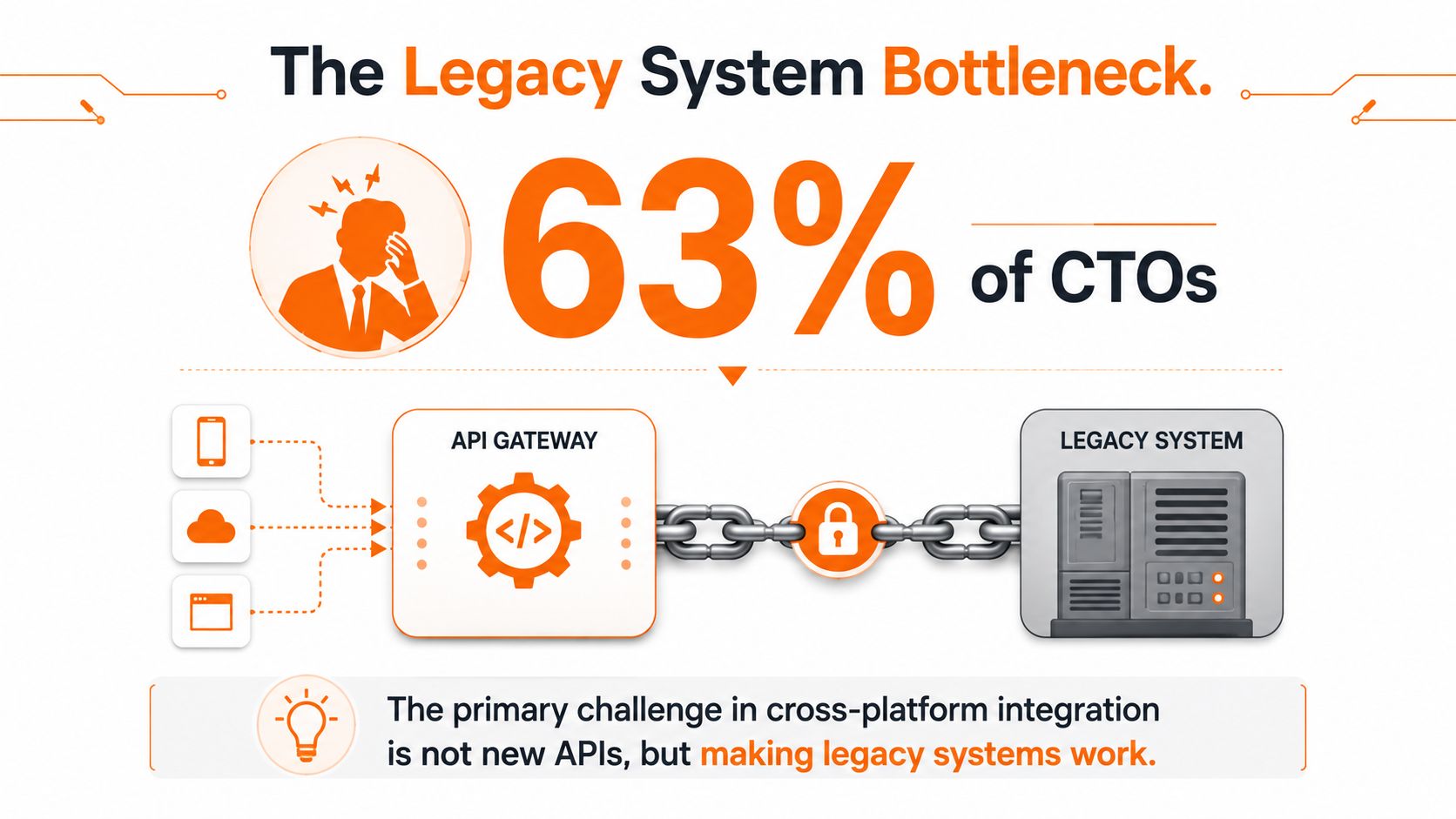
The difficult system is rarely the newest one. It's the established platform with undocumented fields, batch exports, fixed status codes, partial callbacks, or rules that only one operations analyst understands. A modern API gateway can standardize requests at the edge, but it can't make an old player database transactional or teach a legacy compliance tool to understand sportsbook activity.
A 2025 survey found that 63% of CTOs identified legacy integration as their biggest pain point, while 41% cited a lack of unified governance and 36% cited poor documentation, according to Vovance's analysis of API integration trends. Those figures point to an operating problem, not merely a connector shortage.
Where legacy fit causes damage
In iGaming, legacy constraints commonly surface in four places:
- Player identity: Casino and sportsbook systems may use different player identifiers, profile schemas, or account states.
- Wallet semantics: One system may record a debit at bet placement while another records it only after confirmation.
- Bonus rules: A promotion may exist in separate engines with different eligibility, expiry, and rollback behaviour.
- Compliance visibility: KYC, AML, risk, and responsible gaming systems may each see only part of the player's activity.
A point-to-point patch can solve the immediate mismatch, but every patch adds another ownership question. Who updates the mapping when a provider changes its status codes? Who approves a new data field? Who investigates a discrepancy that crosses three vendors?
Consolidate rules where accountability belongs
The platform should own the canonical player, wallet, and compliance state. Legacy systems can remain connected through anti-corruption layers, batch ingestion, read models, or controlled adapters, but they shouldn't become accidental authorities for decisions that affect every vertical.
This requires more than middleware. Teams need an integration inventory, named owners, documented contracts, change approval, test fixtures, and reconciliation procedures. Governance should specify which system is authoritative for each capability and which events other systems may consume.
A unified backend can reduce the number of operational handoffs by consolidating casino, sportsbook, payment, wallet, and compliance workflows. That doesn't eliminate legacy risk, but it limits the amount of new business logic built around old constraints. The objective isn't to pretend every system is modern. It's to contain legacy behaviour behind stable contracts so new market launches don't multiply the same problem.
Security and Governance in Multi-System Environments
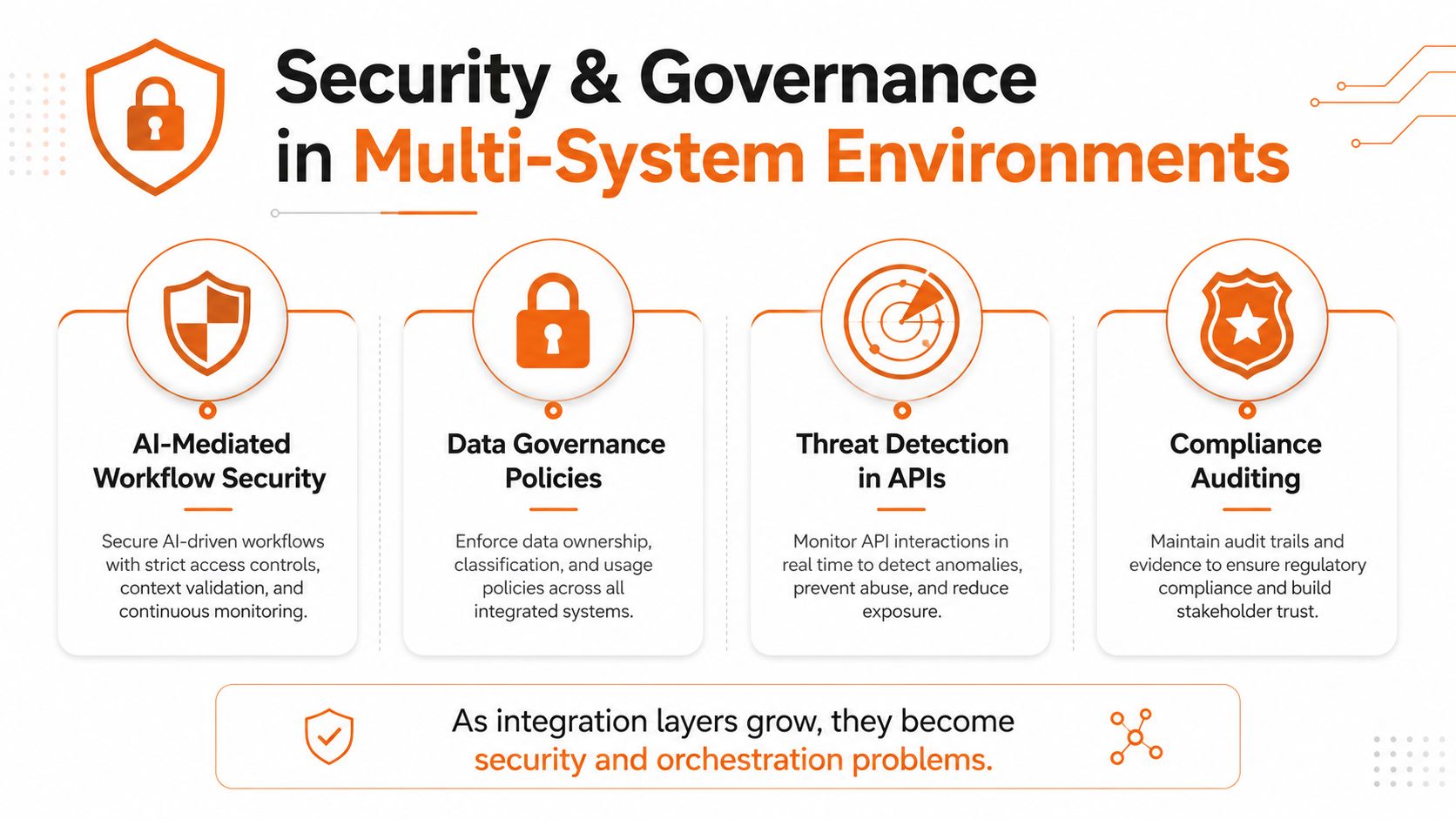
An integration layer becomes a security boundary as soon as it carries player identity, financial instructions, betting activity, and compliance decisions. It also becomes an orchestration boundary when one request can trigger actions across several services. Treating it as basic plumbing leaves too much authority in too many places.
AI-mediated workflows raise the stakes. Postman's 2025 API report found that 50.8% of respondents were concerned about unauthorized or excessive API requests from AI agents, 49% were concerned about AI access to sensitive information, and 45.95% were concerned about credential leakage, as reported in coverage of Postman's API findings. Those concerns matter in iGaming because an agent that can search APIs, initiate operational actions, or retrieve player data needs narrower permissions than a human administrator, not broader convenience access.
Govern access at the capability level
Use centralized identity and access control, but don't stop at service authentication. Define what each service, user role, partner, and agent can do. A content adapter may launch games and receive round events, but it shouldn't access full KYC records. A reporting consumer may read approved aggregates, but it shouldn't initiate wallet operations.
Policy decisions should include:
- Purpose limitation: Expose only the data needed for the operation.
- Action separation: Keep read, authorize, approve, and execute permissions distinct.
- Jurisdiction context: Apply market, player, product, and regulatory restrictions before execution.
- Traceability: Record actor, service, request, decision, correlation ID, and resulting state.
- Credential control: Use short-lived, scoped credentials and rotate provider secrets through managed processes.
Discoverability is part of security. Postman's report also found that 55% of respondents struggled with documentation and 34% struggled to find existing APIs, according to the same API report coverage. When engineers can't find an approved service, they create another integration. That duplication expands the attack surface and makes compliance evidence harder to assemble.
Make audit evidence a product feature
Every material action should produce an immutable, searchable event. Compliance teams need to answer who approved a withdrawal, which KYC decision enabled access, what rule blocked a transaction, and whether a provider callback was replayed. Monitoring should detect unusual request patterns, permission failures, schema changes, and repeated retries before they become player-impacting incidents.
Security review should begin with the business action an integration can perform, not only the endpoint it exposes.
Design AI agents as constrained clients. Put them behind explicit tools, allow-lists, approval gates for sensitive actions, data redaction, rate policies, and complete audit logging. That framework gives operators a defensible answer when auditors ask how automated workflows interact with regulated player data.
Evaluating Turnkey Platforms Versus Custom Integration
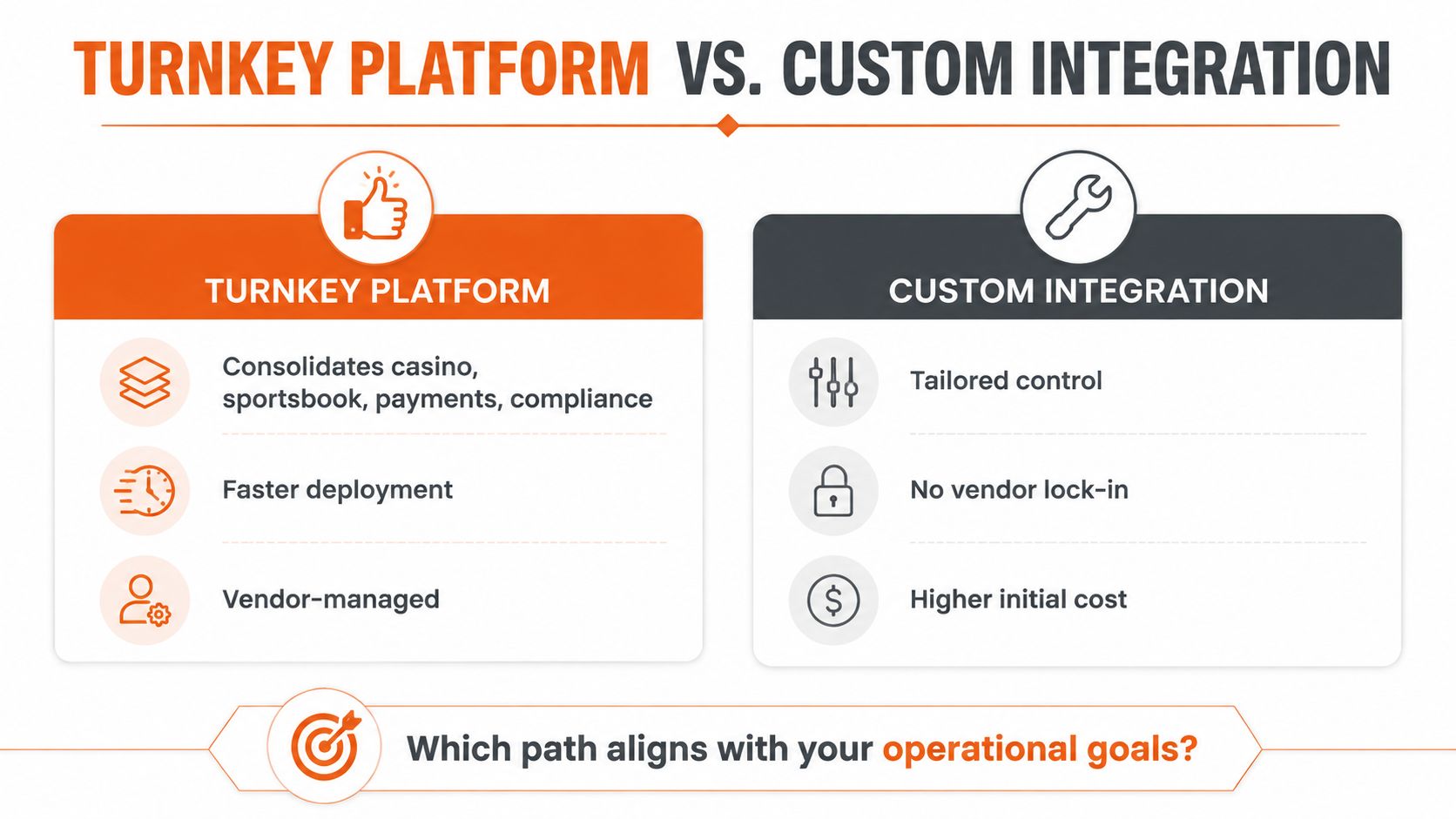
The choice between a turnkey platform and custom integration isn't a contest between speed and quality. It's a decision about where the operator wants to carry complexity. Custom work offers control, but the operator owns provider changes, testing, incident response, compliance mapping, and the long-term cost of keeping multiple systems coherent.
A turnkey platform can consolidate casino, sportsbook, payments, wallets, and compliance controls behind a shared operating model. NexGrate is one example of this approach, offering a white-label environment with integrated casino and sportsbook modules, player wallets, payment capabilities, KYC and AML workflows, reporting, geofencing, and back-office operations.
Evaluate the operating model first
Ask what the business must control directly and what it can delegate. A custom layer may be justified when the operator has unusual trading, wallet, risk, or player-account requirements that existing platforms can't represent. It can also make sense when the company already has mature platform engineering, compliance engineering, and vendor operations teams.
A turnkey option deserves serious consideration when the priority is coordinated launch execution across verticals and jurisdictions. Pre-integrated modules can reduce the number of separate contracts, technical dependencies, and operational dashboards. The trade-off is less freedom over internal abstractions, release timing, and provider choice.
Use a decision review that covers:
- Capability fit: Map wallet, settlement, bonus, KYC, payments, reporting, and responsible gaming requirements to real workflows, not feature labels.
- Integration boundaries: Confirm whether the platform exposes stable APIs, events, webhooks, exports, and audit data needed by your own systems.
- Compliance ownership: Identify who maintains regulatory controls, evidence, change records, and market-specific configuration.
- Exit and portability: Understand how player, transaction, and reporting data can be exported if the operating model changes.
- Operational support: Test escalation paths with failure scenarios, including delayed settlements and payment reversals.
The strongest evaluation is a proof of operation. Run a player journey across registration, KYC, deposit, casino play, sportsbook betting, withdrawal, and support intervention. Then inspect every resulting state, event, report, and audit record.
A platform that demos well but can't explain reconciliation, provider replacement, or jurisdiction-specific controls will create work later. Choose the model that matches the team's ability to operate integration after launch, not just the team's ability to deliver the first release.
Building Integration That Survives Market Expansion
Expansion exposes weak architecture quickly. A new jurisdiction introduces different identity checks, payment methods, responsible gaming requirements, reporting obligations, and geofencing rules. A new game studio brings different session callbacks. A sportsbook launch adds odds, bet, settlement, and trading states that the casino stack never needed.
The durable answer is a unified backend with clear ownership. A shared player identity prevents casino and sportsbook accounts from drifting apart. A central wallet gives every vertical the same transaction authority. Centralized compliance controls let teams apply market rules consistently instead of rebuilding them inside each provider connection.
Build for replacement, not permanent dependency
Provider adapters should be disposable. Keep credentials, field mappings, retry rules, and callback handling at the system-API boundary. Keep eligibility, wallet authorization, settlement policy, and compliance decisions in internal process services. That way, replacing a game studio or payment processor changes an edge component rather than the entire player journey.
Canonical content and transaction models also make expansion more predictable. New providers map into an existing contract. New front ends consume experience APIs instead of learning each backend's language. Operations teams can work from shared dashboards for player state, payments, bets, and compliance rather than switching between disconnected tools.
A scalable brand doesn't eliminate variation across jurisdictions. It contains that variation in controlled configuration and well-owned integration boundaries.
The commercial case is substantial. The enterprise application integration market is projected to grow from $23.01 billion in 2025 to $45.21 billion by 2030, with a projected 14.0% CAGR, according to The Business Research Company's market forecast. The API layer is also economically significant, with one industry report estimating that the API economy contributed $2.6 trillion to global GDP in 2023, up from $1.8 trillion in 2021, as outlined in API economy statistics from ZipDo. These figures don't remove the implementation work, but they reinforce that connected systems now underpin how digital businesses operate.
For a new iGaming brand, the practical framework is clear: define business ownership, centralize player and wallet state, isolate provider differences, select synchronous paths by latency tolerance, move non-critical coordination to events, and make governance visible in every transaction. That approach gives expansion teams a platform they can configure and audit, rather than a patchwork they must repeatedly rebuild.
NexGrate provides a turnkey white-label platform that brings casino, sportsbook, payments, wallets, compliance controls, and back-office operations into one iGaming environment. Visit NexGrate to assess whether its pre-integrated architecture fits your launch plans and multi-jurisdiction operating model.