You're probably seeing the same thing most new operators see when they start pricing Curaçao. One page says the license is affordable. Another gives you a regulator fee table. A third promises a fast route to market if you just “get the paperwork done.”
That's where budgeting usually goes wrong.
The actual Curaçao gambling license cost isn't just the regulator invoice. It's the regulator invoice plus the compliance stack you need to stay licensed, plus the local substance requirements that used to get waved away in older sales copy. If you build your launch plan around the sticker price alone, you'll underfund the project before the brand is live.
Table of Contents
- Understanding Curaçao's New LOK Gambling Framework
- The Official Curaçao License Fees Explained
- Budgeting for Mandatory Operational and Substance Costs
- Direct License vs White-Label Platform A Cost-Benefit Analysis
- Estimating Your Timeline and Long-Term Financials
- Key Takeaways for Building Your iGaming Budget
Understanding Curaçao's New LOK Gambling Framework
The first thing to understand is that the pricing conversation changed because the licensing model changed.
Under the newer LOK framework, Curaçao moved away from the old master and sub-license structure and toward a more direct licensing model with stronger supervision and more formal vetting. That shift matters because older “cheap Curaçao license” articles were written for a different market reality. They often describe a path that doesn't match the obligations a new applicant should expect under the current framework.
Why old pricing advice breaks down
In the old model, many operators focused on access. In the LOK environment, operators have to focus on demonstrable compliance.
That means the application isn't just a formality. The system now puts more weight on due diligence, corporate fitness, operational readiness, and local substance. If your launch budget still assumes that Curaçao is mainly a low-friction paperwork exercise, you're using the wrong planning model.
A lot of founders only discover this after they've already committed to branding, game contracts, or marketing prep. Then the compliance costs start showing up all at once.
Older Curaçao pricing content often answers the wrong question. It tells you what a license application costs, not what a compliant launch costs.
What operators are actually budgeting for now
A proper business plan under LOK needs to include at least three layers:
- Regulator fees: the direct amounts payable to the licensing framework.
- Substance requirements: the local presence and local operating commitments expected in Curaçao.
- Compliance operations: the people, processes, hosting, documentation, and tooling needed to keep the business audit-ready.
That's why teams that budget only for “the license” usually come up short. They price the permit but not the operating model behind it.
If you're building the budget seriously, treat compliance as part of the product, not as admin overhead. The operator that launches cleanly is the operator that has already priced policy work, local setup, technical controls, and recurring oversight into the plan from day one. That's also why it's worth reviewing a broader iGaming compliance approach before fixing your market-entry budget.
The Official Curaçao License Fees Explained
A founder usually sees the headline number first. True planning starts when you separate the regulator invoice from everything wrapped around it.
Under the 2026 Curaçao Online Gambling Act framework, a B2C gaming license carries a one-off, non-refundable application fee of €4,592 and a consolidated annual license fee of €47,450, according to The Point Legal's Curaçao gaming licence guide. That annual amount is split into €24,490 for the National Treasury and €22,960 for the Curaçao Gaming Authority.
For budgeting purposes, these are the direct charges from the licensing side.
| Fee Type | Cost (EUR) | Frequency | Payable To |
|---|---|---|---|
| Application fee for B2C license | €4,592 | One-off | Curaçao licensing process |
| B2C annual government license component | €24,490 | Annual | National Treasury |
| B2C annual supervisory component | €22,960 | Annual | Curaçao Gaming Authority |
| Consolidated annual B2C license fee | €47,450 | Annual | Split between Treasury and CGA |
Two practical points matter here.
First, the annual B2C fee is a fixed statutory charge. It is not structured as a GGR tax, so a startup with modest early revenue pays the same regulator fee as a better-established operator in the same license category. That changes the break-even math, especially for casino brands planning a gradual ramp rather than a heavy launch.
Second, timing matters. The source above notes that the statutory fees must be paid in full by January 15 each year to keep the license active. In practice, that means the annual fee should sit in your cash plan as a scheduled compliance obligation, not as a flexible operating expense you can push into a later quarter.
The official table is only the licensing floor.
It does not include legal support, document preparation, corporate structuring work, technical compliance setup, internal controls, hosting, KYC and AML tooling, or the local operating commitments that come with a compliant Curaçao setup. That is why founders comparing a direct application with a turnkey model should also review a direct license vs white-label cost comparison before treating the regulator fee as the full market-entry budget.
One more detail affects planning. The same source notes that the previous LBH system did not charge an initial application fee. That tells you the process is now more formal at the entry point, with more scrutiny before approval and less room for the old “license first, sort the rest later” mindset.
So yes, the official fee line is relatively clear. The common budgeting mistake is assuming “clear” also means “complete.”
Budgeting for Mandatory Operational and Substance Costs
A new operator gets quoted a regulator fee, company formation, and a launch package, then assumes the budget is under control. Three months later, legal prep expands, local setup turns into a recurring cost line, and AML tooling shows up as a separate annual contract. That is where Curaçao budgets usually break.
Where the hidden budget sits
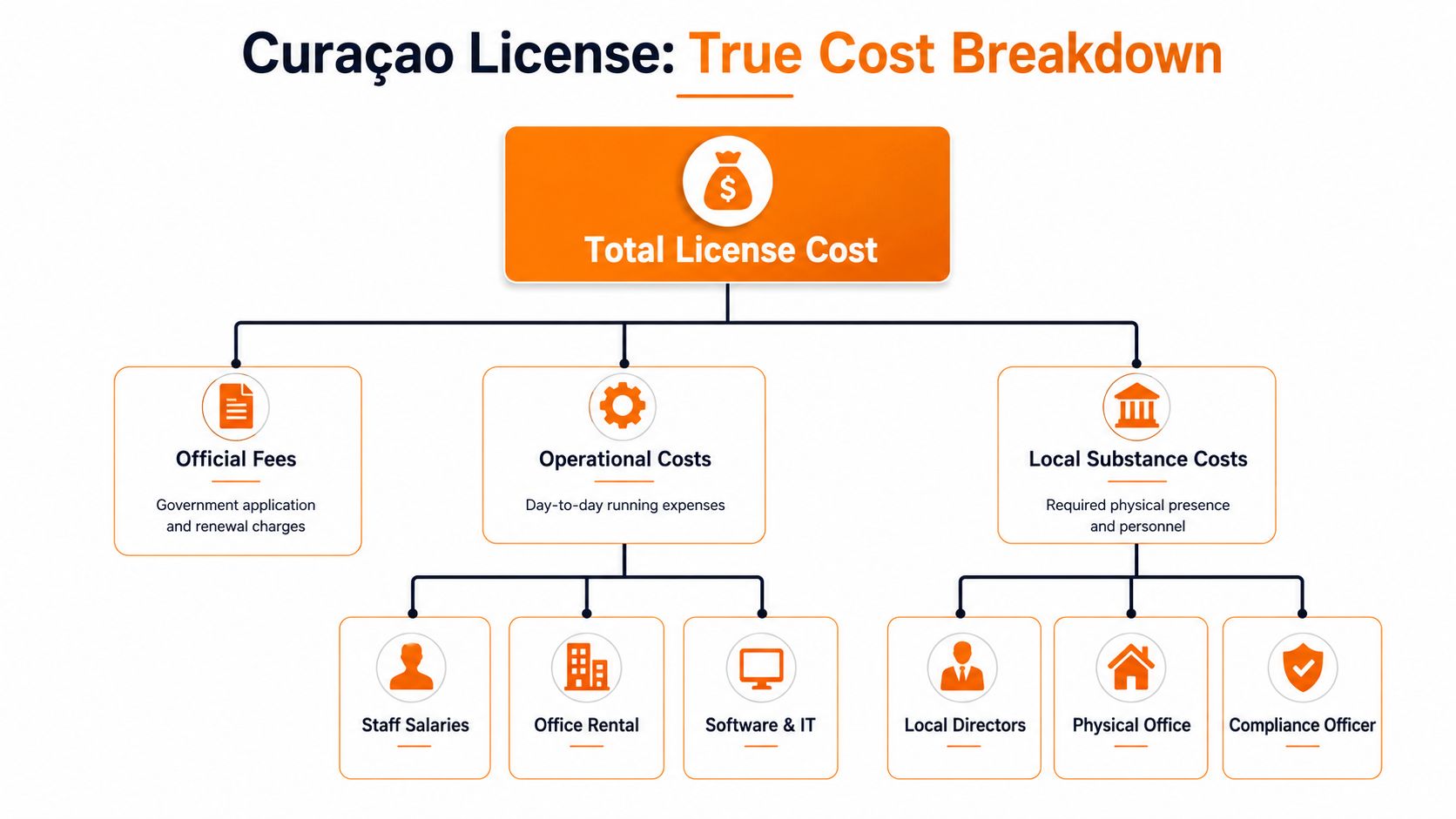
The gap between the advertised price and the usable budget is mostly a compliance issue, not a licensing issue. Operators who enter with a sticker-price mindset usually underfund the first year because they treat substance requirements and operating controls as items to solve later.
One of the clearest summaries of that problem appears in 4H Agency's breakdown of the new Curaçao license process, which states that many guides blur the line between direct regulator fees and the local substance costs that push the actual first-year budget much higher. The same source says a compliant single-domain setup sits far above the old bargain-bin estimates still used in sales copy.
That distinction matters because these costs do not arrive as one invoice. They appear across legal work, local office arrangements, appointed service providers, technical setup, audit-readiness work, and compliance software. Each line item looks manageable on its own. The combined total is what catches founders.
Some operators reduce that burden by starting with a turnkey iGaming platform model that bundles parts of the operational stack instead of procuring every function separately.
The costs that usually catch first-time operators off guard
The missing items tend to fall into a few predictable buckets:
- Local substance costs: office lease commitments, local representatives, and in-country operating arrangements tied to a compliant setup.
- Legal preparation: 4H Agency notes a range of €10,000 to €20,000 for legal preparation, which is often excluded from low-entry estimates.
- Compliance tooling: the same source cites €6,000 to €15,000 annually for AML and related compliance systems.
- Technical substance: local hardware, hosting, or equivalent technical arrangements needed for oversight, recordkeeping, and inspections.
This is the part many founders miss. A quote can be technically accurate and still be useless for planning if it excludes the costs of staying compliant after approval.
I usually tell operators to build two budgets from day one, then manage the business against the second one.
| Budget View | What it includes |
|---|---|
| Sticker-price budget | Regulator application and annual license fees |
| Compliance budget | Regulator fees plus legal prep, local substance, hosting, representations, compliance tools, and implementation work |
The first column helps with headline comparisons. The second column is the one that matters if you are raising money, forecasting runway, or deciding whether the direct license route is viable.
A quick explainer can help if your team needs a visual overview before budgeting in detail:
Use a simple test before accepting any “low-cost Curaçao” proposal. If the quote does not clearly price legal prep, local substance, compliance systems, and technical operating requirements, it is not a first-year budget. It is a sales teaser.
Direct License vs White-Label Platform A Cost-Benefit Analysis
A common founder scenario goes like this. The team budgets for the Curaçao license, signs a few supplier agreements, and assumes the hard part is done. Six weeks later, the real question hits the board deck. Do we want to operate our own compliance structure, or do we want to rent one while we prove the brand?
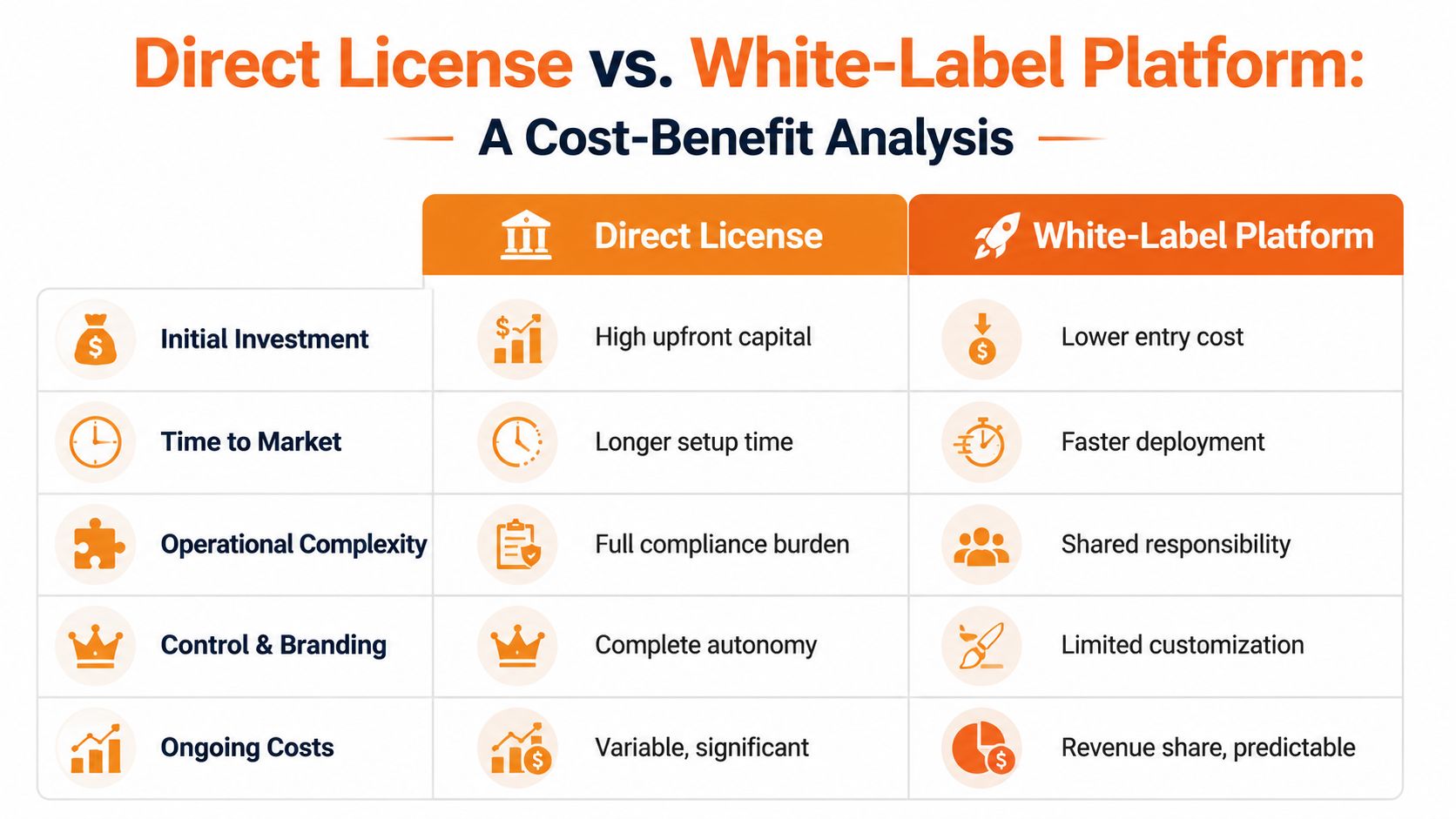
That decision changes far more than the application path. It changes who carries the regulatory workload, who controls the tech stack, how fast you can launch, and how much cash gets tied up before the first player deposits.
When a direct license makes business sense
A direct license suits operators building a real long-term asset. You control the compliance program, payment setup, internal rules, supplier contracts, and jurisdiction strategy. If the business plans to scale across markets or raise serious capital, that control has value.
The cost trade-off is straightforward. PMP Media's Curaçao iGaming license analysis puts official annual LOK fees for B2C operators at €47,450, but the realistic first-year budget rises to €70,000 to €110,000 once setup, advisory, substance, and infrastructure are included. Later years often settle into €55,000 to €85,000 annually. That gap is the part many sales quotes hide.
Direct licensing usually fits teams that already have:
- internal legal or compliance leadership
- enough cash to absorb recurring operating costs early
- a product and traffic plan strong enough to justify heavier fixed overhead
- appetite for a slower launch in exchange for more ownership
The gotcha is simple. A direct license gives independence, but it also makes the operator responsible for every control failure, every reporting gap, and every vendor issue.
When a white-label structure is the smarter move
White-label works better for a different type of operator. The goal is usually speed, lower setup risk, and tighter early-stage cash control. Instead of building the full compliance and operational framework from scratch, the brand launches on infrastructure that already exists.
That does not make white-label cheap in every case. It often replaces fixed compliance spend with revenue share, setup fees, platform fees, bundled supplier costs, and commercial restrictions. Over 12 months, some white-label deals end up more expensive than founders expected because the operator pays for convenience with margin and reduced control.
Here is the practical comparison:
| Decision factor | Direct license | White-label route |
|---|---|---|
| Upfront capital pressure | Higher | Lower |
| Compliance ownership | Internal | Shared with platform, contract-dependent |
| Time to market | Slower | Faster |
| Control over policies, suppliers, and tech | Higher | Limited |
| Margin retention | Higher if scale is reached | Lower due to platform economics |
| Exit flexibility | Stronger | Often restricted by contract terms |
I usually give new operators one rule. If the business has not yet proved acquisition, retention, payments stability, and fraud controls, white-label is often the cheaper way to learn. If those pieces are already in place, direct licensing can make more financial sense because the business stops paying a platform premium for capabilities it can manage itself.
For teams weighing both routes side by side, this direct license versus white-label comparison is more useful than comparing regulator fees alone.
There is one important carve-out for B2B models. The same source notes that the B2B supplier license is €24,490 annually, which changes the math for software vendors, platform providers, and service businesses that do not handle player-facing operations. In those cases, the direct route can be much easier to justify because the compliance burden is narrower and the revenue model is less exposed to consumer operations.
Estimating Your Timeline and Long-Term Financials
Cost planning gets distorted when teams think only in launch terms. In practice, Curaçao budgeting is also about timing, sequencing, and cash flow discipline after go-live.
The easiest way to stay realistic is to map spending to phases rather than treat the whole license journey as one invoice.
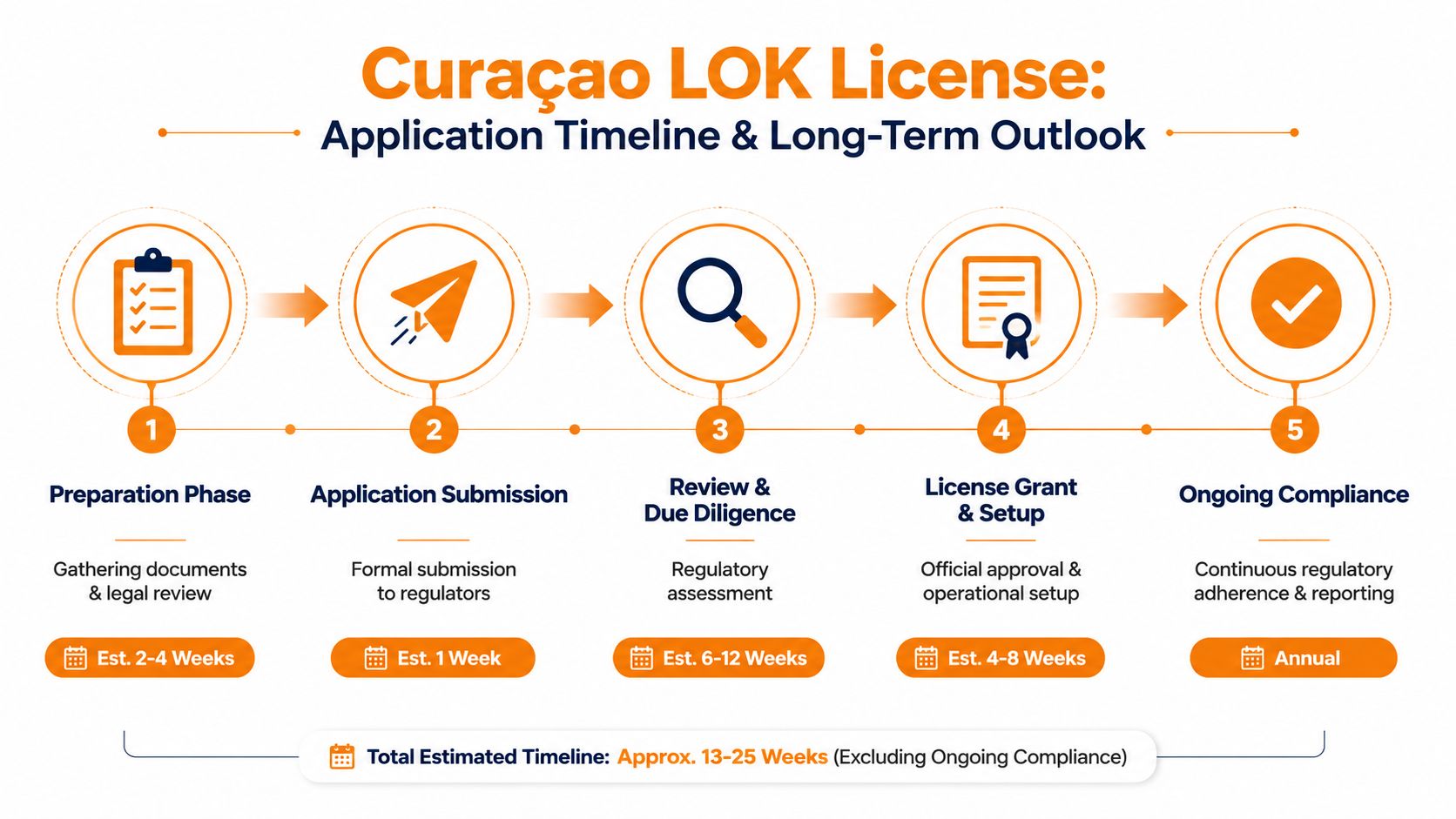
How the spending rhythm usually unfolds
The timing usually breaks into four practical stages.
- Preparation
Costs begin to accrue before any approval arrives. Teams gather corporate documents, identify ownership and control persons, prepare internal policies, review platform setup, and align local presence requirements. Most delays happen here because founders underestimate how much operational detail regulators and advisers will want to see documented clearly.
Application and review
Once the file is submitted, the business is effectively paying to wait and to answer questions well. That means advisory time, document revisions, clarifications, and internal coordination. The application may be submitted once, but the work around it rarely is.
Operational setup
Approval doesn't end the spending. It triggers another wave. You still need the operating environment to match the licensed model, including local arrangements, controls, and internal reporting discipline.
A delayed approval is expensive, but an approved license without an operationally ready business is worse.
What changes after launch
Year two planning is usually cleaner than year one, but only if the operator built recurring compliance into the operating model from the start.
A durable long-term budget should include:
- Annual statutory fees: these recur regardless of turnover under the B2C fee structure already discussed earlier.
- Recurring hosting and infrastructure: especially where local technical substance is expected.
- Ongoing compliance work: policy maintenance, reporting, monitoring, and audit support.
- Staff or outsourced oversight: someone still has to own AML, KYC, player protection controls, record keeping, and regulator-facing responses.
The biggest planning error after launch is assuming the hard part is over. The hard part changes shape. It becomes rhythm instead of setup.
Operators who manage this well usually do one thing differently. They stop treating compliance as a project and start treating it as a standing operating function. That shift is what protects margins and avoids panic budgeting when renewals, audits, or remediation work arrive.
Key Takeaways for Building Your iGaming Budget
A lot of first-time operators approve a budget for the license, then hit funding pressure when the setup bill starts arriving. The gap usually sits in compliance operations, local substance, and the people or vendors needed to keep the business regulator-ready after approval.
Build the budget from the operating model backward.
Use this checklist before you commit capital:
- Start with regulator fees: include the application fee, annual statutory charges, and any renewal-related filing work.
- Treat substance as a first-year cost, not a future problem: local office arrangements, local representation, and technical setup need budget approval before launch planning is credible.
- Fund compliance work as an operating function: policy drafting, KYC and AML procedures, due diligence support, monitoring, and audit preparation all carry recurring cost.
- Separate launch spend from recurring spend: setup costs belong in year one. Hosting, platform tools, reporting, support, and oversight belong in the monthly run rate and year-two forecast.
- Choose the structure that matches your team and cash position: a direct license gives more control but requires more internal ownership. A white-label model reduces setup burden, but you give up flexibility and part of the economics.
The central budgeting lesson is simple. Curaçao gambling license cost is a full compliance budget, not a single invoice. If the spreadsheet only shows permit fees, it misses the local substance, operational staffing, outsourced controls, and post-launch compliance work that determine whether the business can launch cleanly and stay licensed.
If you want a practical test, ask one question. Can this budget support approval, launch, and twelve months of compliant operation without emergency spending? If the answer is no, keep building.
If you're weighing a direct Curaçao license against a faster market-entry model, NexGrate is worth a look. It provides a white-label casino and sportsbook platform with payments, back office, compliance controls, and operational tooling in one stack, which can simplify launch planning when you don't want to build every moving part yourself.