KYC is the process of verifying who a customer is, and AML is the set of rules and systems that prevent that customer's funds from being used for money laundering. Together, KYC and AML compliance form a continuous risk system, not a one-time identity check.
A new casino or sportsbook brand is preparing to launch. The product team is focused on registration and payments, the sportsbook team is testing bet settlement, and the compliance lead asks a simple question: what is KYC AML compliance in operational terms? Before anyone chooses an identity provider or writes a monitoring rule, the team needs a shared answer.
The distinction matters because a player can pass an identity check and still become a higher-risk customer later. A new payment method, unusual wallet activity, exposure to a higher-risk jurisdiction, or a change in customer circumstances can require a fresh review. Regulators increasingly expect operators to keep risk assessments current across the customer lifecycle, rather than treating onboarding as the finish line.
Table of Contents
- A Working Definition of KYC and AML Compliance
- The Four Building Blocks Every Program Needs
- How a Typical Operator Workflow Actually Runs
- Core Technologies Inside a Modern Compliance Stack
- Obligations Across Major Jurisdictions With MGA in Focus
- Practical Implementation Guidance for Gaming Operators
- Bringing It Together for a New Operator Brand
A Working Definition of KYC and AML Compliance
A practical definition starts with the customer relationship.
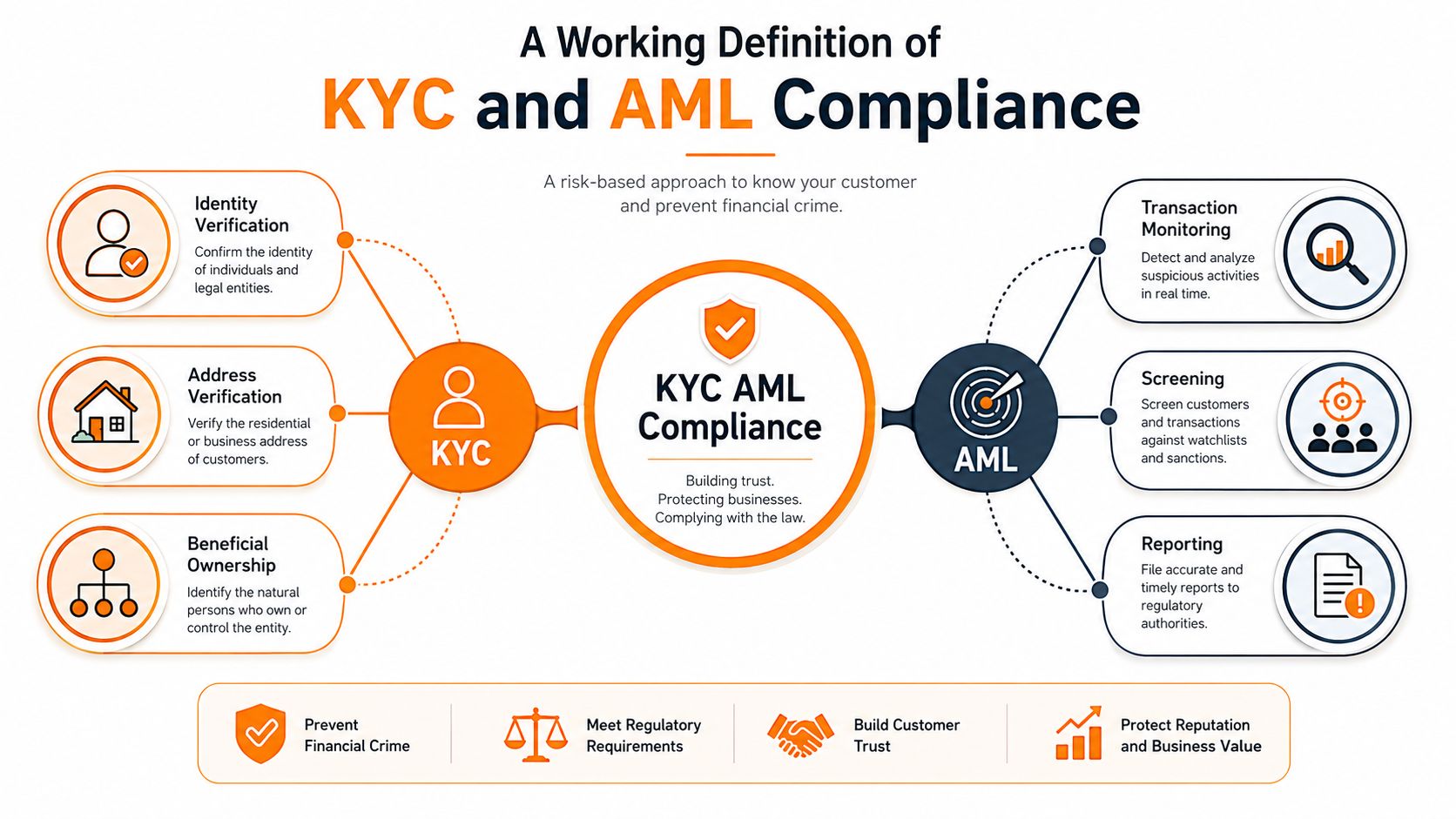
KYC, or Know Your Customer, verifies identity. The operator collects information, checks identity documents, confirms relevant details such as address, and determines whether the person is who they claim to be. For a corporate customer or business partner, KYC can also involve identifying the natural people who own or ultimately control the entity.
AML, or Anti-Money Laundering, is broader. It includes the rules, processes, technology, people, and reporting controls used to prevent a customer relationship and its payment activity from being misused for money laundering or related financial crime. KYC supplies the identity foundation, while AML uses that foundation to assess and manage risk over time.
A hotel analogy makes the difference clear. KYC is the front desk checking a guest's identity before handing over a room key. AML is the security and operations team paying attention to what happens during the stay, including unusual access, activity that conflicts with the guest's profile, and events that require escalation. A successful check-in doesn't prove that every later activity is safe.
Why the framework became foundational
KYC and AML became a major global regulatory framework after the Financial Action Task Force was created in 1989 and issued its original 40 Recommendations in 1990. FATF later revised those recommendations in 1996, 2003, and 2012, with the 2012 update strengthening customer due diligence and risk-based controls. The history is documented in Fenergo's overview of global AML, KYC, and sanctions enforcement.
That standards-based model was adopted across major markets, which is why KYC and AML are now foundational controls for banking, payments, gambling, and other regulated digital businesses. They aren't merely local policy choices added by an individual operator.
Practical rule: Treat identity as a starting data point. Treat customer risk as a profile that can change.
The modern program therefore works as a loop. The operator identifies the customer, understands the expected relationship, watches activity, updates the risk assessment, and escalates when new information changes the picture.
The Four Building Blocks Every Program Needs
A useful way to understand the program is to follow one player from registration through later account activity. Each control answers a different operational question, and none can replace the others.
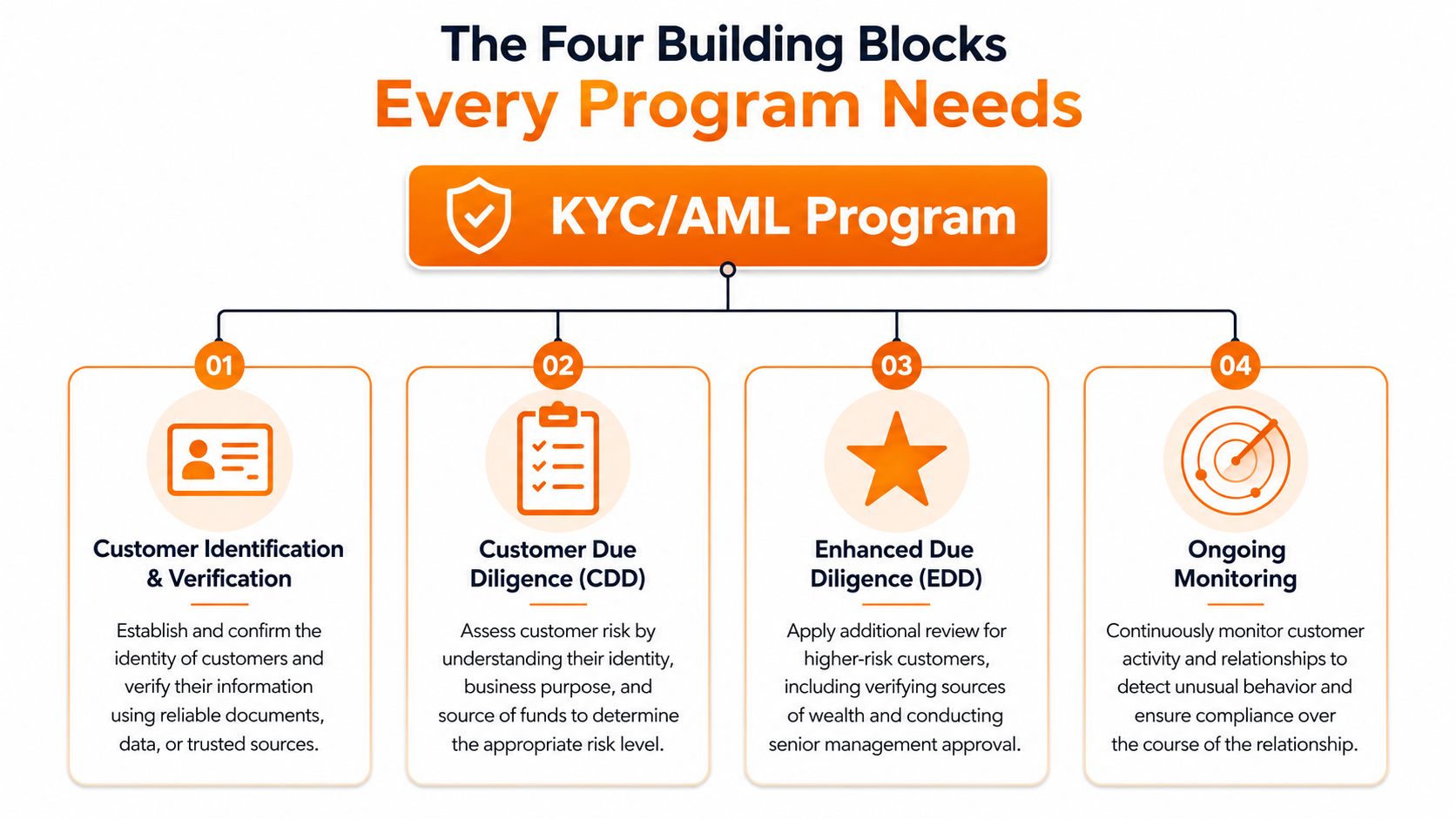
Customer identification and verification
At registration, the operator needs reliable information about the player and a method for checking it. Identity document validation, address checks, biometric comparison, and liveness controls can help determine whether the applicant is genuine and whether the submitted identity appears consistent.
This step answers, “Who is this person?” It doesn't answer whether the person's activity is appropriate for their stated profile.
Customer due diligence
CDD adds context. The operator assesses the customer's expected relationship, relevant geography, payment behavior, and available risk indicators. For a player who deposits through a normal payment method and behaves consistently with the declared profile, standard due diligence may be appropriate. A mismatch between the profile and account activity should lead to a reassessment.
CDD also applies to businesses and other relationships connected to the operator. Risk-management best practices from NexGrate can help operations teams document how risk information moves from intake to review.
Enhanced due diligence
EDD is the deeper review for higher-risk situations. Possible triggers include politically exposed person exposure, a high-risk country connection, unusual payment behavior, complex ownership, or activity that doesn't fit the customer profile.
EDD may require additional identity information, source-of-funds evidence, source-of-wealth information, adverse media review, or a documented compliance decision. The exact control should follow the risk, not operate as a universal burden on every player.
Ongoing monitoring
Monitoring tests whether the customer's actual behavior remains consistent with the earlier assessment. The operator can review deposits, stakes, wallet movements, withdrawals, payment instruments, and changes in geographic or product exposure.
These building blocks form a cycle rather than a straight line:
- Identify: establish who the customer is.
- Understand: assess the relationship and expected activity.
- Increase scrutiny: investigate higher-risk signals.
- Reassess: update the profile as behavior and circumstances change.
A player can move from standard review to enhanced review without having failed the original KYC process. That is the central difference between a static checklist and a continuous-risk system.
How a Typical Operator Workflow Actually Runs
A well-designed workflow connects the player journey to a series of decisions. The system shouldn't ask only whether a player passed KYC. It should record why the player passed, what risk tier applies, and what events would cause the operator to review that decision.
From signup to first activity
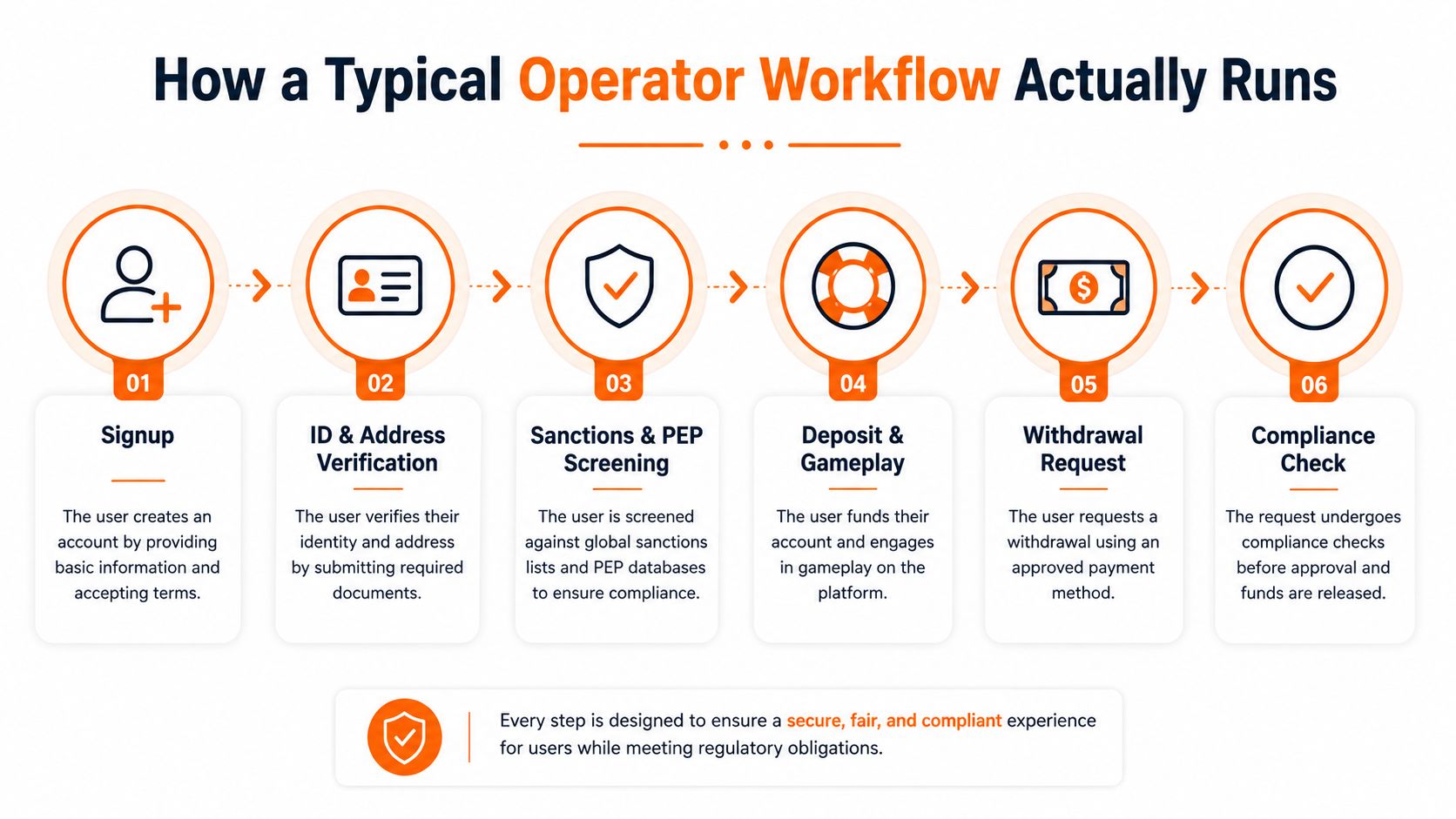
At signup, the platform captures identity, contact, residence, jurisdiction, and account details. It then sends the required information to identity verification. A failed document check, inconsistent personal information, or suspected duplicate account can stop the journey or route it to manual review.
The next control is sanctions and PEP screening. A potential name match isn't automatically proof of wrongdoing. It is a signal that needs a documented match-resolution process, including additional identifiers and a clear decision.
Once the player deposits and begins playing, monitoring compares activity with the expected profile. Relevant patterns can include unusual deposit and withdrawal behavior, rapid movement through the wallet, payment instruments associated with multiple accounts, or activity connected to higher-risk locations. The operator's rules should create a case when the pattern warrants investigation, not merely generate an unexplained alert.
Where the risk score changes
A withdrawal request is a key decision point, but it shouldn't be the first time the operator examines customer activity. The request may still trigger a review of payment ownership, unusual funding patterns, source of funds, account history, and any unresolved screening alerts.
A player who was low risk at registration may require enhanced review after a meaningful change in activity. The system should preserve the original assessment, the new signal, the reviewer's reasoning, the evidence considered, and the resulting action.
For operators integrating several product and payment components, NexGrate's pay-and-play overview provides relevant context on how payment and gaming journeys can be connected operationally.
Human review remains important when the facts are ambiguous. Automation can collect evidence, apply rules, and prioritize cases, but a trained reviewer must be able to assess context, request information, escalate a concern, restrict activity where appropriate, and document the decision.
A short video can also help new operations staff visualize how payment and player journeys fit together:
Core Technologies Inside a Modern Compliance Stack
Technology should be selected by the risk it helps the team detect and manage. A collection of disconnected tools can create more work if alerts, customer records, and decisions don't travel together.
Identity verification
An identity verification service checks documents and the data associated with them. Depending on the design, it may also use facial comparison, liveness detection, address verification, and document authenticity checks.
The operational question is not only whether the vendor returns a pass or fail. The team needs to know what evidence was checked, which exceptions were found, how failed attempts are handled, and how a reviewer can examine the result later.
Sanctions, PEP, and adverse media screening
Screening compares customer information with sanctions and politically exposed person data, while adverse media controls can help identify relevant reputational or financial crime concerns. Name matching is difficult because names can be shared, transliterated, abbreviated, or entered inconsistently.
The Hong Kong Monetary Authority says effective screening requires up-to-date databases, suitable system settings and tuning, clear potential-match procedures, and regular effectiveness reviews. Its guidance on beneficial ownership and AML controls shows why data freshness and configuration are control responsibilities, not technical housekeeping.
Poor tuning creates unnecessary false positives and slows legitimate customers. Weak matching can miss a genuine match. The program therefore needs documented model governance, review ownership, change control, and evidence that screening remains effective.
Transaction monitoring
Transaction monitoring examines activity rather than identity alone. For an online operator, the relevant signals can include deposits, stakes, withdrawals, wallet transfers, payment-method changes, bonus use, and movement between casino and sportsbook products.
Rules and analytical models should reflect the operator's risk assessment. A threshold is not a conclusion. It is a way to identify activity for review, after which the analyst considers the whole relationship and decides whether the explanation is credible.
Case management and audit evidence
Case management ties the stack together. It should show the alert, customer data, transaction context, screening result, requests for information, analyst notes, approvals, escalation, and final disposition.
Without that trail, an operator may have controls that function in practice but cannot demonstrate how they operated during an audit. The system should also separate duties where appropriate, protect sensitive information, track service-level ownership, and retain reports and decisions according to applicable requirements.
Obligations Across Major Jurisdictions With MGA in Focus
KYC and AML obligations don't become identical just because an operator uses one platform across several markets. The operator must map each license, product, customer segment, payment rail, and local reporting obligation to the controls that apply there.
The Malta Gaming Authority, or MGA, is a useful reference frame for many international gaming teams, but it shouldn't be treated as a substitute for market-specific analysis. The EU AML package expressly addresses gambling service providers and introduces additional customer due diligence obligations in certain circumstances, including occasional transactions reaching EUR 2,000. The Global Gambling Compliance Briefing discusses that threshold and the broader move toward enterprise-wide risk assessment.
The United Kingdom offers a different operational emphasis. The UK Gambling Commission says operators must monitor all transactions or activity and apply risk-based KYC measures when customer trigger factors appear. That approach reinforces the point that a player shouldn't disappear from compliance attention after the initial verification decision.
| Jurisdiction | CDD Trigger | Enhanced Checks | Monitoring Expectation | Reporting |
|---|---|---|---|---|
| MGA and relevant EU framework | Customer onboarding and applicable risk events, with additional obligations for certain occasional transactions reaching EUR 2,000 | Risk-based review for higher-risk customers, including relevant ownership, control, source-of-funds, and screening checks | Maintain a documented, risk-based program across customer and payment activity | Follow the applicable suspicious activity and regulatory reporting process |
| United Kingdom | Risk-based KYC at onboarding and when customer trigger factors appear | Expand review when activity, geography, customer information, or other signals increase risk | Monitor all transactions or activity, as required by the UK Gambling Commission | Escalate and report suspected activity through the applicable process |
| Other regulated markets | Local legislation, license conditions, and risk assessment determine the trigger | Local rules may require additional evidence, approvals, or restrictions | Map monitoring to local products, payment rails, customer types, and geography | Maintain market-specific reporting procedures and audit evidence |
The practical difference is significant. One market may focus on a transaction trigger, another on a behavioral trigger, and another on the operator's documented risk assessment. Teams should record the rule source, accountable owner, system control, exception process, and reporting route.
Regulators increasingly expect an enterprise-wide risk assessment that considers customer demographics, product mix, transaction patterns, and geographic exposure. That assessment should inform policies and monitoring rules across the group, not sit as a document disconnected from the operating platform. Teams building a reporting process can use NexGrate's compliance reporting resource as an operational reference point.
Practical Implementation Guidance for Gaming Operators
A defensible program starts with ownership. The MLRO or equivalent accountable officer needs authority, a clear escalation route, and access to the information required to make decisions. KYC, AML, fraud, payments, responsible gaming, and customer support teams may have different responsibilities, but they need shared signals and a common customer record.
Build the operating model before buying tools
Define the customer journey and mark every point where risk can change. Then assign each control to a person, system, or approval group.
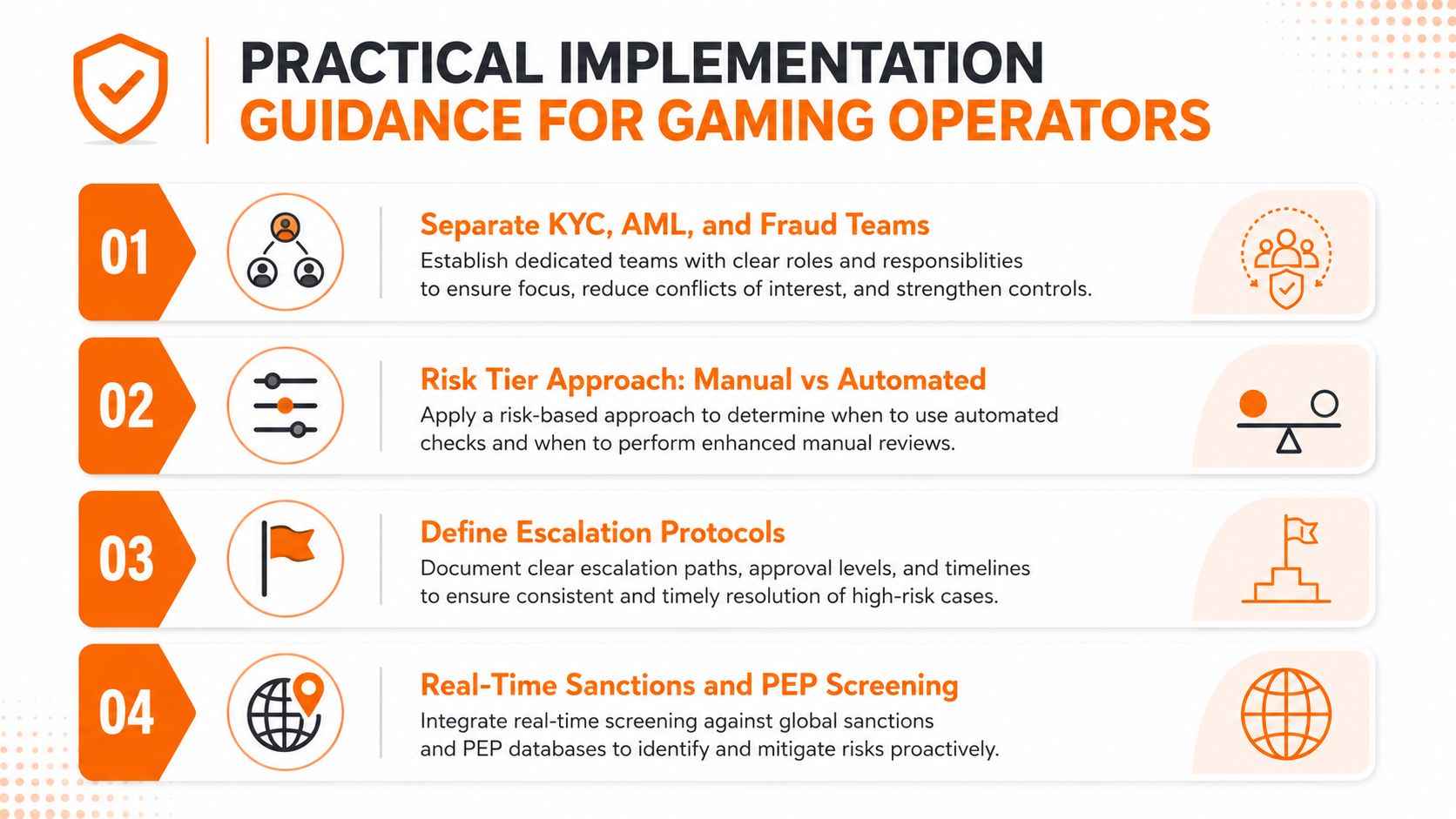
- Separate responsibilities: KYC verifies identity, AML investigates financial crime risk, fraud reviews abuse patterns, and payments manages transaction controls. The teams should exchange relevant signals rather than operate as isolated queues.
- Use risk tiers: Automate routine checks where the risk is understood and send exceptions or higher-risk cases to trained reviewers. Manual review should have defined evidence requirements and approval authority.
- Create escalation rules: Specify what happens after a screening match, unexplained source-of-funds response, unusual withdrawal pattern, or material change in customer information.
- Screen continuously: Keep sanctions and PEP data current, tune matching settings, review effectiveness, and document changes.
Connect fiat, crypto, and gaming signals
A fiat deposit, cryptocurrency transfer, sportsbook wager, casino session, and withdrawal shouldn't be assessed as unrelated events. The operator needs a consolidated view of the player, payment instruments, linked accounts, product activity, jurisdictions, and previous reviews.
Source-of-funds handling should follow the risk tier and the evidence needed to explain the activity. The process must state when the operator requests information, what documents or explanations are acceptable, who reviews them, and what happens when the response doesn't resolve the concern.
NexGrate is one platform option for operators that need a white-label casino and sportsbook environment with player accounts, wallets, payments, KYC/AML workflows, risk rules, fraud controls, reporting, and audit logs. Vendor selection still requires careful validation of configuration, data access, jurisdictional coverage, escalation logic, and audit support.
Three failures deserve specific attention:
- Stale customer profiles: The operator never updates expected activity or risk information after circumstances change.
- Siloed workflows: Fraud sees a payment pattern that AML cannot access, or KYC receives new information that never reaches monitoring.
- Weak escalation: Staff notice a meaningful signal but lack a clear route, authority, or deadline for action.
A good audit posture is built daily. Store the decision, evidence, reviewer, timestamp, policy version, and outcome. Test whether an independent reviewer could understand what happened without relying on informal explanations.
Bringing It Together for a New Operator Brand
A new or migrating operator should define the minimum viable control environment before launch:
- Identity verification: Establish who each customer is and retain the verification outcome.
- Screening: Check relevant sanctions and PEP data, then resolve potential matches through a documented process.
- Monitoring: Configure transaction and behavioral rules that reflect the enterprise-wide risk assessment.
- Ownership: Name the MLRO or equivalent accountable compliance lead.
- Reporting: Prepare a suspicious activity escalation and reporting playbook.
- Evidence: Preserve audit logs covering alerts, reviews, decisions, approvals, and customer communications.
A practical 90-day rollout can begin with process mapping and risk ownership, followed by configuration and test cases, then controlled launch review. During the first operating period, the team should examine alert quality, unresolved cases, failed verification patterns, source-of-funds requests, payment anomalies, and whether customer risk profiles are being updated as intended.
Maturity comes from governance, not from adding more alerts. The operator should establish an enterprise-wide risk assessment process, a monitoring review cadence, model and rules governance, staff training, internal testing, and higher-risk source-of-funds procedures for both fiat and crypto activity.
The clearest answer to what is KYC AML compliance is therefore operational: verify the customer, understand the relationship, watch the activity, update the risk view, and prove every important decision.
NexGrate provides a white-label casino and sportsbook platform with integrated player accounts, wallets, payments, KYC/AML workflows, risk controls, reporting, and audit logs for regulated gaming operations. Visit NexGrate to review how its unified platform can support a controlled launch and ongoing compliance operations.