
You're in the middle of a launch decision, and the spreadsheet in front of you is already telling the story. One vendor wants a fixed platform fee, another wants a cut of every player referral, and your white-label partner says revenue share will “scale with performance.” If you're running a casino or sportsbook, that choice isn't a side note, it shapes your cash flow, your risk, and how hard you can push acquisition before the model breaks.
Revenue share is simple on the surface and messy in practice. It can mean a clean split of income, or it can mean a contract full of deductions, reversals, and reporting rules that change the actual payout. In iGaming, that difference matters on day one, because a percentage that looks fair on a slide can turn expensive once bonuses, chargebacks, and settlement timing hit the back office.
Table of Contents
- The Deal Every New iGaming Operator Has to Make
- What Revenue Share Actually Means
- Gross vs Net vs Hybrid Revenue Share
- Worked Calculations for Casino and Sportsbook
- Revenue Share vs CPA and Fixed Fees
- Contract Clauses and Regulatory Implications
- Reporting, Audit Rights, and Back Office KPIs
- Negotiation Tactics and Common Operator Mistakes
The Deal Every New iGaming Operator Has to Make
A new operator usually starts with a very practical question, not a financial theory question. Do you pay a fixed platform fee, sign a revenue share deal with an aggregator or white-label provider, or take a CPA-style arrangement with affiliates who want payment for depositing players?

The wrong answer is rarely obvious at the start. A fixed fee can feel safer because it's predictable, but it also ignores upside if your brand takes off. A revenue share can feel generous because you only pay when monetization happens, but it can become painful if the base is defined too broadly or if the deductions are vague. That's why the choice is commercial, not just legal.
Why the choice changes your launch strategy
In a white-label or platform conversation, the contract often sounds like a pricing discussion, but it's really a control discussion. If the partner charges a fixed license, your downside is clearer, but you carry more of the upside and the operational pressure. If the partner wants rev share, you need to know what sits underneath the percentage, because the same headline rate can behave very differently once the platform starts processing real play, refunds, and promotional activity.
Practical rule: if you can't explain how the payout will change when a player wins more, bonuses rise, or a payment gets reversed, you don't yet understand the deal.
The commercial model starts to shape the whole business. Revenue share is common in media, software, affiliate marketing, and B2B partnerships because it ties compensation to monetization, aligning the partner who drives demand with the party that owns the product or platform, according to Paddle's explanation of revenue sharing. For a new operator, that alignment can be useful, but only if the contract is clear enough to survive audit and reconciliation.
For a launch team comparing stack options, a white-label structure can make the operating trade-offs easier to see because the same back office has to carry game content, betting, wallet, and compliance flows. If that setup is on your shortlist, the platform framing at NexGrate's white-label gaming solution overview fits the same decision point.
What Revenue Share Actually Means
Revenue share is a top-line compensation model. Instead of paying a fixed fee, a business distributes an agreed percentage of the revenue generated by a deal, customer, or platform activity to a partner, affiliate, or contributor. In plain English, the partner gets a slice of the money coming in, not a promise based on effort alone.
A simple example makes the math easier. On a $50,000 deal, if the business keeps 75% and pays the partner 25%, the payout is $12,500. That figure comes directly from the revenue base, before most operating costs are considered, which is why the contract wording matters so much.
Revenue share is not profit share
This is the part that confuses most new operators. Revenue share is usually calculated from revenue before most operating costs, while profit share is based on what remains after expenses. The same contract can create very different payouts depending on whether the base is gross revenue, net revenue, or profit.
A simple coffee-shop analogy helps. Revenue share is like taking a percentage of the till before rent and payroll are paid. Profit share is like splitting what's left after the bills are covered. CPA is different again, because it pays for the acquisition event itself, not for the ongoing monetization that comes after.
Revenue share works best when both sides care about the same thing, monetization that holds up after launch.
That's why the model grew quickly as digital platforms and affiliate ecosystems expanded. It gives operators a scalable way to compensate third parties without fixed upfront labor costs, and in affiliate-style models the partner may earn an ongoing percentage of the revenue produced by referred users for a defined period or even for the lifetime of those users. Cambridge also defines revenue sharing more broadly as a situation where an organization or government shares income it receives with related organizations, governments, or people, which shows the idea is older than internet commerce and already understood as a way to redistribute proceeds across stakeholders, as noted in Stripe's overview of revenue share.
Gross vs Net vs Hybrid Revenue Share
The first mistake operators make is assuming all revenue share contracts work the same way. They do not. The headline percentage only tells part of the story, because the base can be gross revenue, net revenue, or a hybrid formula that combines a fixed fee with a lower percentage.
A good way to test a deal is to ask one question first. What number does the percentage apply to? If the answer is unclear, the contract can look generous on paper and pay very differently in practice.
Gross revenue share
Gross revenue share is the simplest version. The percentage is applied before most deductions, so the partner payout is easier to forecast, but the operator takes on more of the economic exposure. In an online casino, that usually means the share is calculated from a top-line figure before many cost items are removed.
That simplicity is why gross terms often feel cleaner during early negotiation. A partner can estimate earnings quickly, and an operator can model the cost of acquisition without digging through a long deduction list. The tradeoff is that the operator has less room to recover from bonus-heavy traffic, payment friction, or other operating pressure.
Net revenue share
Net revenue share gives the operator more protection, but it is also where disagreements begin if the definitions are loose. Bonuses, payment fees, chargebacks, and sometimes tax can be deducted before the percentage is applied. The same headline rate can therefore produce a much smaller payout than a new affiliate or platform partner expects.
That gap between headline rate and actual payout is where contracts need precision. If the agreement says “net” but does not spell out the deduction stack, one side will assume a broader base and the other will assume a narrower one. In practice, that is how disputes start in the back office.
Hybrid deals
Hybrid deals combine a fixed component with a lower rev share percentage. They are common when you are launching into a regulated market and both sides want some stability without giving up all upside. For an operator, hybrids can reduce the pressure of pure performance pricing while keeping the partner interested in long-term volume.
They also help when traffic quality is uneven. A fixed floor can make the partner feel invested from day one, while the lower share rate prevents the operator from overpaying if the audience does not perform as expected. That balance is often easier to sell internally than a pure percentage model.
Here is the commercial reality. A casino and a sportsbook can both advertise a 30% revenue share rate, yet the payout basis can differ enough to make the deals almost incomparable. One may be based on gross gaming revenue with limited deductions, while another may be based on a narrower net figure after bonuses and transaction friction.
Operator takeaway: do not negotiate the percentage first. Negotiate the base, then the deductions, then the reporting cadence.
That sequence matters because the revenue base decides what gets shared. If that is unclear, you cannot tell whether a higher headline percentage is better than a lower one. For affiliate-style structures, the same principle shows up in partner pages and commission plans, which is why NexGrate's iGaming affiliate program article can help when you are comparing partner economics.
Worked Calculations for Casino and Sportsbook
A contract only becomes real when the month closes and the back office has to settle numbers. The same rev share language behaves differently in a casino and a sportsbook, because the revenue engine is different. Casino economics are heavily influenced by player winnings and bonus usage, while sportsbook economics depend on pricing margin, voids, and trading risk.
Casino example
Start with monthly stakes, then subtract player winnings to reach GGR, or gross gaming revenue. From there, subtract bonus cost and other agreed deductions to reach the net base used in the contract. If the agreement says the partner gets 30% of that net base, the payout follows from that number, not from the original stakes.
Now add two real-world friction points. If chargebacks spike, the operator may have to reverse value after the original payment looked settled. If bonus abuse rises over a weekend promotion, the deduction line expands and the partner's payout shrinks even though front-end play looked strong.
Sportsbook example
Sportsbooks work differently because the margin is created through the overround, not through house edge in the same way a casino game works. The operator sets pricing, then settles bets, deducts free-bet costs where the contract allows it, and handles voided events and trading adjustments. A 30% share here still sounds familiar, but the amount it applies to can be materially different from a casino calculation.
| Simple settlement step | Casino logic | Sportsbook logic |
|---|---|---|
| Revenue starts from | Stakes less winnings | Accepted bets after settlement |
| Main deduction pressure | Bonuses and chargebacks | Voids, trading risk, free-bets |
| Share base | GGR or NGR | Margin after agreed deductions |
A useful internal formula is this, written plainly: share payout = agreed revenue base × rev share percentage. The hard part is deciding what belongs inside that revenue base and what gets excluded before the percentage is applied. That's why two operators can both report a 30% rev share and still end up with completely different unit economics.
Revenue Share vs CPA and Fixed Fees
A new operator often sees three pricing models on the table at once, revenue share, CPA, and fixed fees. They solve different problems, and they shift risk to different parts of the deal.
CPA rewards acquisition milestones while revenue share rewards lifetime value
CPA, or cost per acquisition, pays when a player hits a defined event, often a deposit or another agreed milestone. In affiliate deals, that usually means the operator pays for the acquisition itself, so traffic volume gets rewarded even before anyone knows how much value that player will produce later. That works well for fast acquisition pushes, but it can become expensive if traffic quality is weak or inconsistent.
A simple way to test CPA is to ask what you are buying. If you are buying first-time action, CPA fits that job. If you are trying to align the partner with player retention, deposit frequency, and long-term monetization, CPA gives you less of that alignment by design. The comparison in NexGrate's affiliate program article shows why many operators treat pricing as part of partner strategy, not just a finance line item.
Fixed fees reward predictability
Fixed platform or licensing fees are easier to plan around because the number is known in advance. That makes budgeting simpler and can be useful when an operator is still shaping cash flow, staffing, and market entry costs.
The trade-off is upside. If traffic or player value grows quickly, a fixed fee does not move with it, so the operator keeps the extra margin while the partner does not participate in the growth. For a new brand with limited runway, that predictability can matter more than a more efficient model that is harder to forecast.
Revenue share rewards lifetime value
Revenue share sits between the other two models. The partner gets paid from monetization over time, so both sides are tied to the same result, but both sides also feel the swings from refunds, chargebacks, and deduction rules.
That is why revenue share usually fits better once an operator can see player lifetime value with some confidence and has a reporting setup that can support a variable payout model. A deal like that needs clean back-office data, because the same percentage can behave very differently depending on whether the base is gross revenue, net revenue, or a hybrid formula.
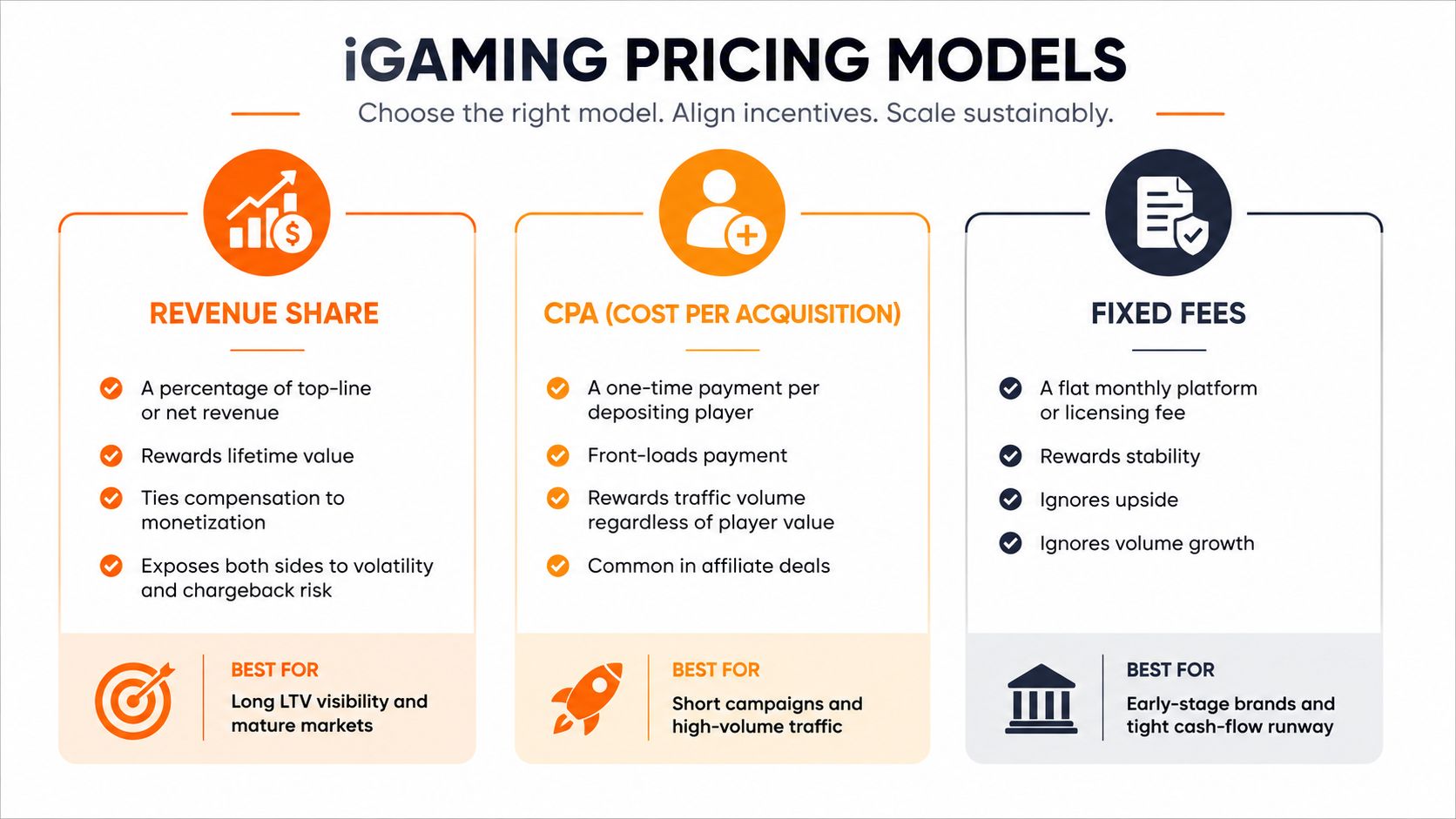
A practical way to choose is to match the model to the stage of the business. If your operation still lacks reliable retention data, a fixed fee is usually easier to defend than a complex rev share formula. If you already trust the traffic quality and want the partner to care about monetization, revenue share usually makes more sense. CPA sits in the middle when the goal is acquisition volume and the operator is comfortable paying for defined milestones rather than long-term value.
Contract Clauses and Regulatory Implications
A revenue share deal only works as well as the contract behind it. If the wording is loose, the operator ends up arguing about payout timing, report inputs, and what counts toward the share. If the wording is precise, the same model becomes easier to reconcile, easier to audit, and easier to defend when questions come up.

A useful way to review the agreement is to start with the money path. A player deposits, plays, wins or loses, and the back office records the result. The contract should say exactly where the partner share is taken from in that chain, because a small wording change can shift the economics of the whole deal.
Clauses that need to be explicit
- Revenue base definition: State whether the share applies to gross revenue, net revenue, or another defined base. This is the first number that matters, because it sets the rest of the calculation.
- Deduction order: List the deductions in order, such as bonuses, payment fees, refunds, chargebacks, taxes, or compliance-related costs. If the order is vague, two teams can read the same statement and reach different totals.
- Negative carryover: Say whether losses or reversals can roll into the next period. That choice affects how volatile the partner's cash flow will be.
- Bonus balances in escrow: If bonuses are held back before settlement, explain when they become payable or forfeitable. A bonus reserve without a clear release rule becomes a dispute waiting to happen.
- Reporting frequency: Define when statements are issued and which data feeds support them.
- Audit rights: Give both sides a path to inspect the numbers, not just accept them.
- Termination triggers: Link termination to compliance failure, fraud, or repeated reporting mismatch where appropriate.
Once those clauses are written, the regulatory layer still has to fit around them. Operators need to align revenue share with KYC, AML, geofencing, and responsible gaming controls, and the reporting trail has to hold up under review in MGA-oriented environments. A contract can be acceptable in one market and problematic in another, so the platform partner has to match the legal and reporting burden the operator carries.
The cleanest test is practical. If a clause cannot be traced through the wallet, the player record, the bonus ledger, and the audit log, it is not ready for a regulated iGaming deal. For operators who want that control point structure reflected in the back office, a platform built around wallet, compliance, and reporting functions can sit inside the commercial conversation. The same approach is reflected in a compliance reporting guide for iGaming operators, where the reporting logic is tied to the operational record rather than treated as a separate spreadsheet exercise.
Reporting, Audit Rights, and Back Office KPIs
Good revenue share reporting turns a contract into a managed process. Bad reporting turns it into a monthly argument. The goal is to give both sides the same view of the numbers, then let the payout follow the agreed formula instead of a spreadsheet reconstruction.
The monthly report set
| Core Rev Share Reports an Operator Should Run Monthly | |
|---|---|
| Report | Key Metric, Used For |
| GGR report | Gross gaming revenue, baseline settlement view |
| NGR report | Net gaming revenue, payout base and deductions |
| Player report | Player balances, activity, and account status |
| Transaction report | Deposits, withdrawals, reversals |
| Bonus report | Bonus issuance, redemption, and expiry |
| Fraud report | Risk flags, chargebacks, abnormal behavior |
| KYC report | Verification status and account readiness |
| Affiliate report | Partner performance and commission view |
| Provider report | Game and sportsbook contribution by supplier |
A unified back office helps here because the reports sit on the same data layer rather than being assembled manually. That matters for audit rights, because a partner can inspect the logic without forcing your team to reconcile every line by hand. A system with structured permissions and shared dashboards, such as the reporting and compliance setup described in NexGrate's compliance reporting guide, fits the same operational need.
KPIs that belong on the monthly dashboard
- NGR per tenant: Shows whether each brand or market is contributing after deductions.
- Bonus-to-deposit ratio: Flags bonus-heavy play before it distorts payout bases.
- Chargeback rate: Shows when reversals are likely to eat into shared revenue.
- Voided-bet ratio: Matters especially on sportsbook books where settlements shift after events are cancelled or amended.
- Fraud and KYC completion status: Tells you whether revenue is clean enough to share.
Useful rule: if a KPI can affect the rev share base, it needs to be visible in the same dashboard that calculates the payout.
That's where reporting stops being admin and becomes part of the commercial contract. A partner with audit rights doesn't need blind trust, they need access to the same data structure the operator uses, with the right permission levels and a clear reconciliation cycle.
Negotiation Tactics and Common Operator Mistakes
The biggest mistake is treating revenue share as automatically fair because it sounds performance-based. It isn't automatically fair. It's only fair when the base, deductions, timing, and audit path are all defined tightly enough that nobody has to guess what the number means.
The second mistake is accepting a gross share because the percentage looks simpler. Simpler on paper often means riskier in practice if deductions later show up somewhere else in the contract. The third mistake is ignoring negative carryover, which can push losses into future periods and distort partner behavior.
- Accepting headline simplicity: Ask for the base definition and the deduction waterfall before you look at the percentage.
- Skipping audit rights: Require a reporting trail that matches wallet, player, bonus, and transaction data.
- Treating bonus abuse as marketing only: Link bonus controls to payout-base protection.
- Ignoring chargeback timing: Check when reversals are counted, not just whether they're counted.
- Overlooking multi-channel volatility: Confirm whether casino, sportsbook, and promotional revenue are settled separately.
The checklist for the next negotiation is straightforward. Confirm the revenue base, test the deductions, ask about negative carryover, inspect the reporting cadence, and make sure your KPI dashboard can prove the payout. If the other side can't answer those five points cleanly, the percentage isn't the core issue.
If you're building or renegotiating a rev share model, NexGrate can help you manage the wallet, reporting, compliance, and partner controls that sit behind the numbers. Visit NexGrate to see how a unified back office supports casino and sportsbook operations when revenue share has to work in the world.