The audit notification usually lands on an ordinary Tuesday. Within hours, the compliance team is asking engineering for access logs, finance is exporting wallet and payment records, operations is checking KYC decisions, and the sportsbook team is trying to explain how a settled bet can be traced from placement to payout. Everyone has a policy. Nobody can immediately prove that the policy operated consistently.
That's the operational reality of a security compliance audit in iGaming. Auditors don't assess documents in isolation. They test whether player protection, financial controls, platform security, game operations, and staff activity work together in a regulated environment. The operators that manage audits well don't collect files before a review. They build systems that preserve trustworthy evidence as part of normal platform activity.
Table of Contents
- What a Security Compliance Audit Actually Means for iGaming
- Regulatory Standards and Frameworks That Shape the Audit
- Evidence Categories Auditors Request from Gaming Platforms
- How Platform Architecture Affects Audit Outcomes
- Remediation Workflows After Audit Findings
- Building an Audit Readiness Program for Regulated Markets
- Why Platform-Embedded Compliance Outperforms Periodic Audits Alone
What a Security Compliance Audit Actually Means for iGaming
An iGaming audit often begins with a request that sounds simple: provide evidence that the operator protects player data, controls privileged access, monitors suspicious activity, and complies with licensing obligations. The work becomes complicated when the evidence sits across a casino platform, sportsbook engine, payment processor, KYC provider, fraud tool, customer support system, and spreadsheets maintained by separate teams.
A reviewer may follow one player journey through several control points. They might examine account creation, identity verification, deposit approval, gameplay, responsible gaming intervention, withdrawal review, and account closure. For a sportsbook customer, the trail may include registration, geolocation checks, bet placement, odds acceptance, settlement, voiding, and payout. The auditor is testing whether each action has an accountable owner, a reliable timestamp, and an explanation when the expected process changes.
The audit follows risk, not your organisational chart
A security compliance audit for a gaming operator is broader than a generic infrastructure review. The scope normally reflects the obligations attached to the licence and the risks created by the product.
Auditors will want to understand how the operator:
- Protects player information: They'll review access permissions, authentication, encryption practices, retention, and evidence that sensitive records aren't available to people who don't need them.
- Maintains financial integrity: Wallet movements, deposits, withdrawals, reversals, bonuses, and settlement adjustments need a traceable record.
- Supports player protection: Deposit limits, self-exclusion, affordability or risk processes where applicable, and responsible gaming interactions must be demonstrable in operation.
- Controls gaming activity: Operators need evidence around game configuration, supplier management, random number generation dependencies, and changes affecting casino or sportsbook behaviour.
- Responds to incidents: A documented incident response plan matters, but the auditor also wants tickets, escalations, decisions, and closure records showing that staff can use it.
A policy can establish intent, but it can't prove execution. An access-control document won't answer which administrator changed a player limit, whether that person was authorised, or how the business reviewed the action afterwards.
Practical rule: Treat every material player, payment, game, and staff action as something an auditor may need to reconstruct later.
The most difficult audits usually expose fragmented ownership rather than an absent policy. Compliance may own the requirement, engineering may own the system, finance may own the report, and an external supplier may hold the underlying event record. If nobody has designed the evidence path across those boundaries, the operator ends up recreating its own history under deadline pressure.
Regulatory Standards and Frameworks That Shape the Audit
Gaming regulation defines the operating boundary. Security frameworks give auditors a structured way to test whether controls are designed, assigned, and operating. The Malta Gaming Authority is a common reference for operators in regulated markets, but MGA alignment does not replace a mapping exercise for the specific licence, jurisdiction, product, and supplier model.
ISO/IEC 27001 and SOC 2 often sit alongside gaming requirements. ISO/IEC 27001 provides an information security management system and a risk-treatment method. SOC 2 evidence examines whether controls related to security and other trust principles are designed and operating during the review period. Neither framework covers every gaming obligation, including player protection, geolocation, anti-money laundering, game integrity, and regulatory reporting.
Build a control map instead of collecting certificates
The practical question is not which certificate the operator holds. It is which obligation each control addresses, who runs it, and where the evidence is stored.
A useful mapping connects:
- Geofencing and location controls to network, device, identity, and exception-monitoring evidence.
- Responsible gaming limits to player-account configuration, intervention history, approvals for changes, and reporting.
- AML and KYC processes to verification outcomes, risk classifications, transaction monitoring, manual reviews, and escalation records.
- Access governance to role definitions, approvals, authentication settings, access reviews, and termination records.
- Change management to development tickets, approvals, testing evidence, deployment records, and rollback decisions.
- Supplier oversight to due diligence, contracts, assurance reports, issue tracking, and review outcomes.
The 2024 SOC reporting benchmark analysed 73 SOC 2 reports, nearly double the prior year's 38. It found confidentiality in scope in 64.4% of 2024 reports, compared with 34% in 2023, while reports containing more than 150 security controls increased from 16% to 23% year over year. For mature B2B gaming environments, that points to broader control coverage and more detailed evidence requests.
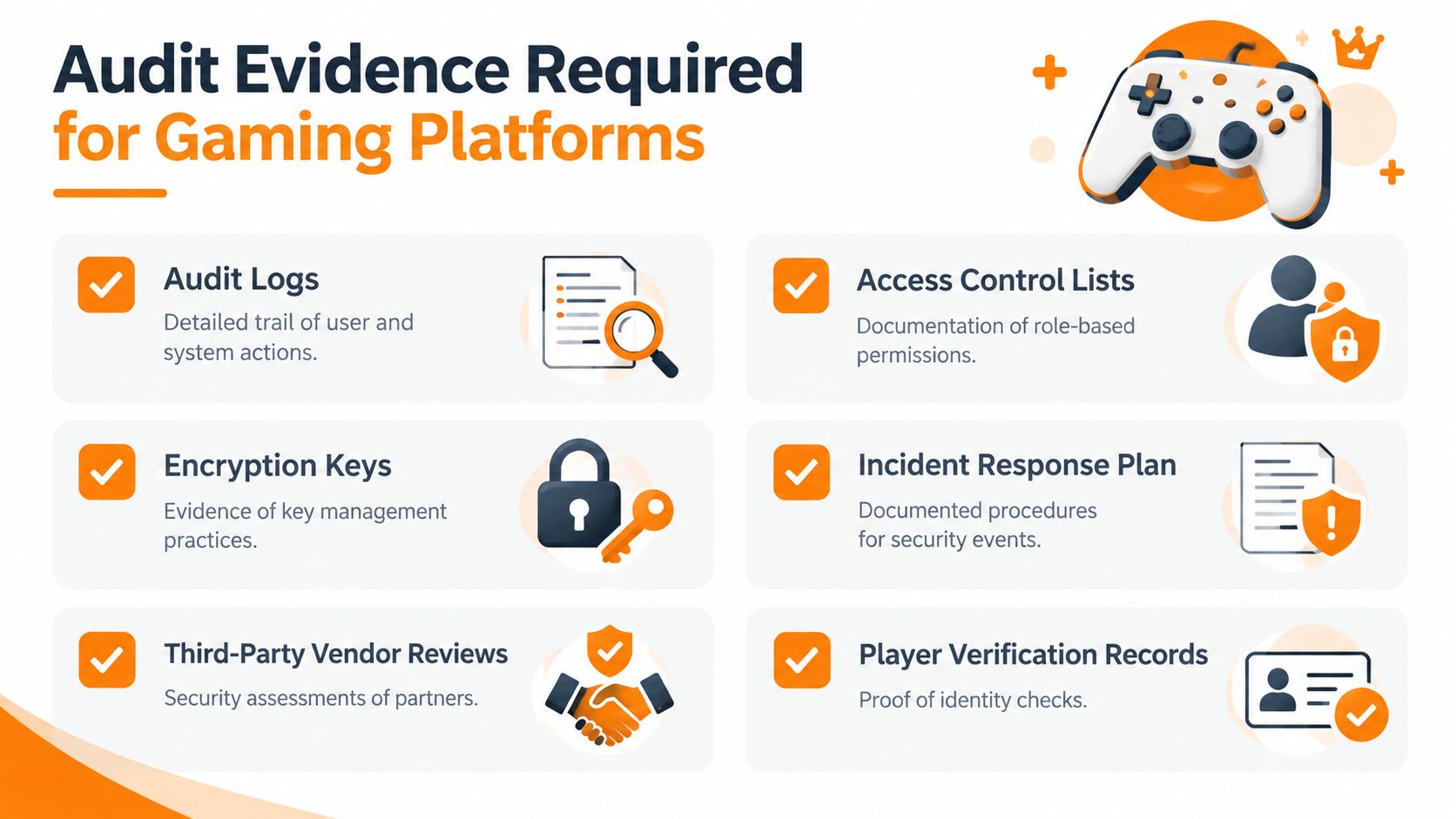
Maintain one control inventory with the regulatory source, system owner, evidence location, review frequency, and exception process. It should also show dependencies between casino, sportsbook, payments, compliance, engineering, and suppliers. Without that shared view, the same access review can be documented differently across teams, leaving auditors to reconcile fragmented records.
ISO/IEC 27001 audit analysis shows why framework adoption alone is insufficient. The ISO/IEC 27001 auditing analysis found recurring findings and serious non-conformities among audited companies. For operators, the practical lesson is clear: a recognised framework improves structure, but only consistent ownership, connected systems, and retrievable evidence demonstrate that controls work.
Evidence Categories Auditors Request from Gaming Platforms
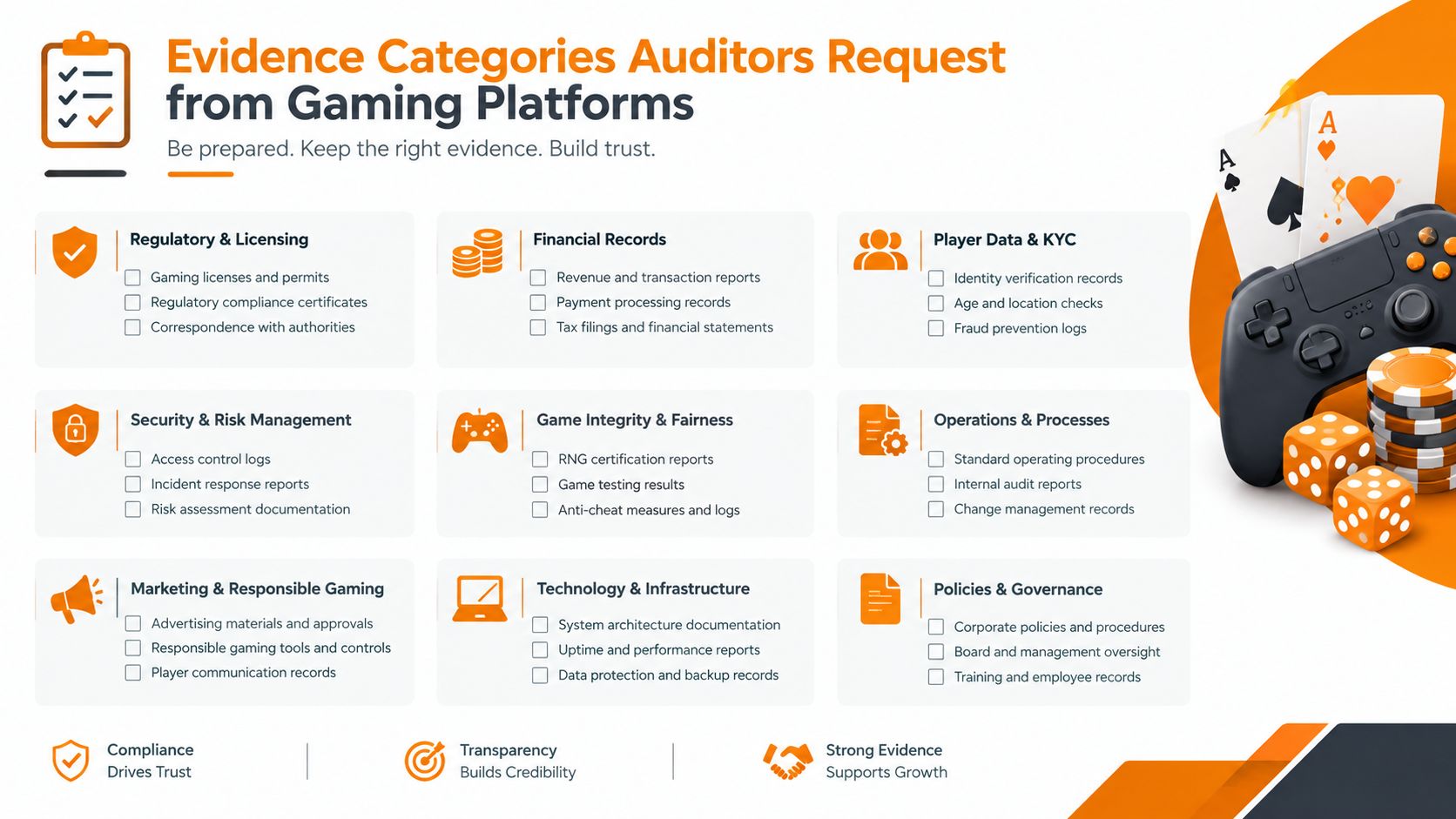
Auditors usually request evidence in categories that mirror the operator's highest-risk activities. Preparing a folder of policies won't be enough. Each control needs operational records that show what happened, who performed the action, when it happened, and how exceptions were handled.
Logs and monitoring evidence
Logging is foundational because it lets the reviewer reconstruct system and staff activity. The operator should be able to show administrative actions, authentication events, player-account changes, wallet movements, configuration changes, payment decisions, and security alerts where those activities fall within scope.
NIST SP 800-171 treats audit and accountability as a set of distinct controls. Its requirements cover log creation, tracing actions to users, reviewing logs, alerting when auditing fails, synchronising time, and restricting log-management privileges. The NIST SP 800-171 control reference also makes clear that audit information and log-management tools must be protected from unauthorised access, modification, and deletion.
In practice, that means separating log storage from production access, limiting who can administer logging, and using immutable or write-once storage where appropriate. A privileged user shouldn't be able to rewrite evidence after a suspicious withdrawal or an incident.
Access, identity, and player records
Prepare current role definitions, permission assignments, approval records, authentication configurations, staff access reviews, and termination evidence. Auditors may select an administrator and ask why that person can access player wallets, KYC decisions, or settlement functions. If the answer depends on an informal explanation rather than a recorded approval, the control is weak.
For player accounts, preserve the evidence trail around registration, identity checks, rejected documents, manual overrides, self-exclusion, limit changes, account restrictions, and reactivation. The record should distinguish automated decisions from staff interventions.
Payments, betting, and supplier evidence
Transaction evidence must connect the cashier to the player wallet and, where relevant, to the payment provider. Reviewers may also examine failed deposits, chargebacks, withdrawal holds, overrides, bonus awards, and reconciliation activity. Double-entry accounting records are particularly useful because they show how a balance changed rather than merely displaying its current value.
For casino and sportsbook activity, retain bet placement, acceptance, settlement, cancellation, voiding, and adjustment records. Supplier evidence should include security reviews, contracts, assurance material, incident notifications, and remediation tracking.
A useful compliance reporting workflow connects these records to recurring regulatory submissions rather than creating a separate audit-only process. That approach reduces conflicting versions of the same data and gives control owners a familiar place to investigate missing evidence.
A pre-audit evidence test
Before the auditor asks, select a real player journey, a real staff action, a real withdrawal, and a real platform change. Try to trace each from source event to report, approval, exception, and closure.
If the team needs manual reconciliation across several exports, that's an architecture issue. If a log exists but can be edited by the same administrator being reviewed, that's a control-design issue. If no one can identify the owner, that's a governance issue.
How Platform Architecture Affects Audit Outcomes
Two operators can hold similar licences and maintain similar policies while experiencing completely different audits. The difference often begins with architecture.
A fragmented operator may use one vendor for casino content, another for sportsbook trading, a separate wallet or payment processor, an external KYC service, a standalone fraud platform, and independent reporting tools. Each system can work adequately on its own. The audit problem appears when the reviewer asks for one coherent account of what happened.
The team may need to match a player identifier from the casino system to a wallet record, then to a payment-provider reference, then to a KYC decision, while also proving that a staff member had the right permission to intervene. Different clocks, retention rules, identifiers, and export formats create gaps that policies can't repair.
A unified white-label platform changes the evidence path. A consolidated backend and player wallet can connect casino activity, sportsbook activity, payments, player controls, staff permissions, and reporting through a common operational model. That doesn't remove the operator's responsibilities, but it can reduce the number of handoffs where evidence becomes incomplete.
The practical comparison
| Evidence Category | Fragmented Stack | Unified Platform |
|---|---|---|
| Player identity | KYC provider export must be matched to account records | Player account and verification history can be reviewed together |
| Wallet and payments | Reconciliation depends on processor references and separate ledgers | Wallet events, payment actions, and adjustments are visible in one operating flow |
| Staff permissions | Roles differ across casino, sportsbook, and compliance tools | Central permission keys provide a consistent access model |
| Betting and gaming activity | Event records may use different identifiers and retention policies | Casino and sportsbook activity can be traced through a shared player context |
| Change evidence | Tickets, deployments, and vendor changes live in separate systems | Platform changes can be connected to operational ownership and approvals |
| Security monitoring | Logs and alerts are distributed across providers | Monitoring and audit records can be consolidated for review |
Architecture test: Ask whether a reviewer can follow one player event without leaving the operating environment. If not, document the joins, owners, and reconciliation controls before the audit starts.
A unified design still requires careful configuration. Centralisation can create concentration risk, and a platform's audit trail is only useful if staff roles, retention, alerting, and export procedures are configured correctly. Operators should also examine hosting resilience, incident responsibilities, and recovery evidence. Guidance on DDoS protection and hosting belongs in that review because availability controls affect both operational continuity and the integrity of time-sensitive gaming records.
The strongest architecture is not automatically the one with the fewest vendors. It's the one that gives the operator clear ownership, consistent identifiers, protected evidence, and a defensible explanation for every critical handoff.
Remediation Workflows After Audit Findings
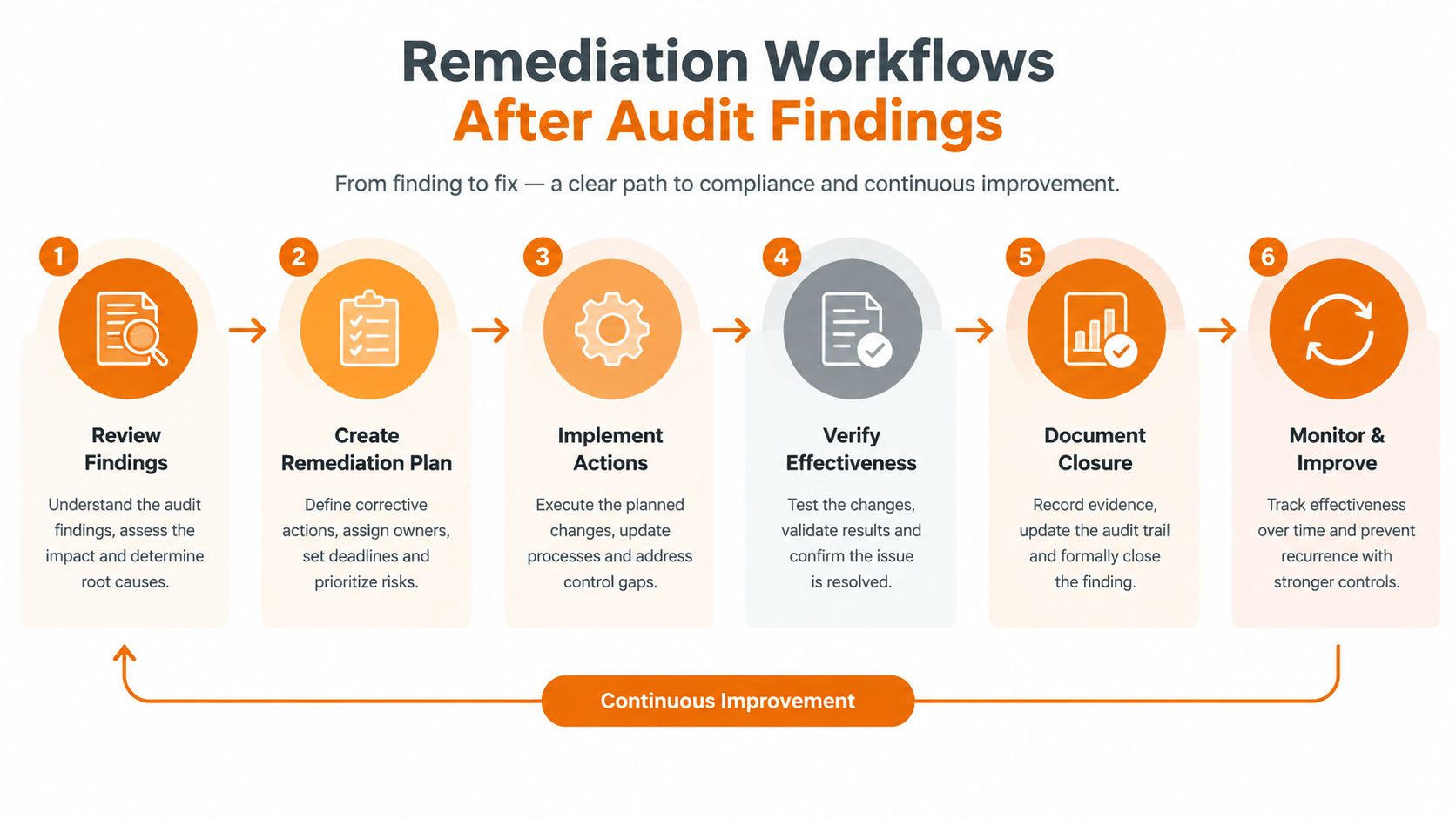
Audit findings become useful only when operators convert them into controlled work with clear evidence. As noted earlier, audits commonly produce findings, so operators should plan a remediation workflow without treating every issue as a failure of the entire compliance programme.
Classify each issue by regulatory exposure, player impact, evidence reliability, and the likelihood of recurrence. A missing screenshot and an administrator's ability to delete security logs should not enter the same queue. The first may need process repair. The second may require immediate technical restriction, preservation of evidence, and management escalation.
A remediation sequence that produces proof
Record the finding precisely. State the control requirement, affected system, evidence tested, failure condition, and responsible owner. “Logging needs improvement” is not actionable. “Privileged staff can modify audit records in the production environment” identifies a testable failure.
Contain immediate exposure. Restrict a risky permission, preserve relevant records, suspend an unsafe workflow, or add a compensating review while the permanent fix is designed.
Assign a control owner and delivery owner. Compliance should track the obligation, while engineering, security, payments, or operations owns the change that makes the control work.
Implement the fix in the operating environment. Granular permission keys can replace broad administrative roles. TOTP-based two-factor authentication can strengthen staff access. Automated reports can reduce manual compilation when the underlying data and report logic remain controlled.
Test the control as an auditor would. Create a representative event, inspect the resulting record, test an unauthorised action, and verify that alerts or approvals behave as intended. Testing should cover the handoffs between systems, where fragmented workflows often leave the evidence gap.
Store operating evidence. Keep configuration proof, approval records, test output, alert-response records, and review samples. A closed ticket shows that someone worked on a problem. It does not show that the control now operates consistently.
Common iGaming findings include incomplete access reviews, weak log protection, undocumented manual overrides, missing evidence for responsible gaming interventions, and inconsistent supplier monitoring. The recurring cause is often a disconnected workflow. Staff complete the correct action in one system, but the approval, business context, and resulting evidence remain elsewhere, leaving the control owner unable to retrieve a complete record.
Remediation should end with a repeatable operating procedure, not a one-off export. Set a review trigger, define the exception path, identify the system of record, and make the final evidence visible to the people responsible for the next control check. That structure lets operators prove both that the fix was deployed and that it continues to work in production.
Building an Audit Readiness Program for Regulated Markets
Audit readiness works best as an operating rhythm. The compliance team shouldn't have to reconstruct the business every time a regulator, partner, or independent auditor asks for evidence.
Begin with a control register that names the obligation, system, owner, review activity, evidence source, retention approach, and escalation route. Then connect recurring reports to that register. GGR, NGR, player activity, transaction history, fraud alerts, KYC completion, and affiliate tracking can support regulatory oversight when the operator can explain the source data, calculation logic, approval process, and change history behind each report.
A working readiness checklist
- Scope the market: Identify licence conditions, product boundaries, player locations, payment methods, and supplier responsibilities before testing controls.
- Map the evidence path: For every critical control, document where the event originates, where it's transformed, who reviews it, and where the final evidence is stored.
- Review privileged access: Check staff permissions, administrator roles, authentication settings, IP restrictions where used, and recent approvals.
- Test player protection: Verify that limits, self-exclusion, account restrictions, and responsible gaming interventions create reliable records.
- Reconcile money movement: Trace deposits, withdrawals, reversals, bonuses, adjustments, and settlements through the wallet and finance records.
- Inspect log governance: Confirm that logging is enabled, clocks are aligned, failures create alerts, records are retained, and administrators can't alter evidence.
- Exercise incident response: Run a practical review of detection, escalation, decision-making, communications, recovery, and lessons learned.
- Validate suppliers: Keep current due diligence, contracts, assurance reports, issue logs, and evidence of follow-up. A focused vendor management process helps assign responsibility where the operator relies on external game, payment, KYC, or hosting services.
- Check reporting consistency: Compare operational reports with source records and investigate unexplained differences before an external reviewer does.
Operators entering a new regulated market should reuse the control infrastructure they already operate, then identify jurisdiction-specific differences. A common evidence model for identities, wallet events, staff actions, and reports can shorten the path from licensing preparation to live operational assurance. It also makes market expansion less dependent on rebuilding compliance processes for every brand.
The readiness test is simple. Give a control owner an evidence request with no warning and see whether they can provide a complete, attributable, reviewable record without asking five vendors to search their archives. If they can, the programme is becoming operational rather than ceremonial.
Why Platform-Embedded Compliance Outperforms Periodic Audits Alone
A periodic audit is a point-in-time examination. Embedded compliance is how the operator makes safe behaviour repeatable between examinations.
The difference matters because auditors assess whether controls operate, not just whether policies exist. A platform that records staff actions, enforces two-factor authentication, applies permission boundaries, preserves account history, and produces jurisdiction-specific reports gives the operator evidence as a by-product of work. A disconnected stack forces the compliance team to create evidence after the fact.
The emerging AI governance problem makes this distinction more urgent. The State of the Audit survey found that 69% of security and compliance leaders say AI adoption is moving faster than their ability to implement controls, while 35% identify a lack of audit evidence for AI-related controls as a top concern. It also found that 91% of organisations must resubmit evidence at least sometimes. These figures point to a practical issue for iGaming operators using AI in fraud detection, customer support, risk scoring, or marketing. The question isn't only whether an AI workflow has a policy. It's whether the operator can show input governance, human oversight, decision history, access restrictions, changes, exceptions, and outcomes.

Operators should therefore evaluate a platform as a compliance decision as well as a technology decision. Look for protected audit trails, granular permissions, strong staff authentication, integrated KYC and AML workflows, responsible gaming controls, reporting, supplier accountability, and evidence that can be exported without manual reconstruction. Those capabilities don't replace governance, but they reduce the number of fragile handoffs that create findings.
A white-label platform such as NexGrate can provide a consolidated operating environment for casino, sportsbook, wallet, payments, player management, reporting, and compliance workflows. The operator still owns configuration, approvals, monitoring, and regulatory accountability. The architectural choice determines whether proving those responsibilities is a routine task or an emergency project.
NexGrate provides a turnkey white-label casino and sportsbook platform with integrated player wallets, payments, KYC and AML workflows, audit logs, reporting, geofencing, and responsible gaming features. If you're preparing for a security compliance audit or planning entry into another regulated market, visit NexGrate to review how a consolidated platform can support your evidence and control operations.