Most data retention advice starts with a table of time periods and ends with “delete when no longer needed.” That advice is incomplete for an online casino or sportsbook. The difficult audit question isn't only how long data should remain, but whether you can prove that expired records disappeared from production databases, backups, operational logs, fraud systems, analytics stores, and vendor platforms.
A defensible data retention policy connects each record to a purpose, a controlling obligation, a storage location, an expiry trigger, and evidence of execution. That matters in iGaming, where one player journey can generate account data, KYC material, payment events, bet history, communications, responsible-gaming records, and security telemetry across systems owned by different teams and suppliers.
Table of Contents
- Why Longer Retention Creates More Compliance Risk
- The Storage-Limitation Principle and How to Apply It
- Building Retention Schedules for iGaming Data Types
- Resolving Multi-Jurisdiction Retention Conflicts
- Implementing Deletion Workflows That Actually Work
- What Audit-Ready Retention Looks Like in Practice
Why Longer Retention Creates More Compliance Risk
Keeping everything forever feels safe because old records may appear useful during an investigation, dispute, or regulatory review. In practice, indefinite storage creates a larger population of sensitive information to protect, explain, retrieve, and eventually delete. Guidance on data retention risk and governance identifies over-retention as a source of greater breach exposure, compliance risk, and unnecessary storage burden.
For an iGaming operator, the problem often begins with a reasonable operational decision. A fraud team retains player communications for investigations. Finance preserves transaction exports for reconciliation. Engineering keeps application logs for troubleshooting. Marketing stores campaign history for segmentation. Without expiry logic, each exception becomes permanent infrastructure.
Practical rule: A record needs a named purpose and owner. “It might be useful later” isn't a retention justification.
Over-retention also complicates deletion rights. A customer request may be processed correctly in the player account system while the same identifiers remain in a support platform, data warehouse, fraud tool, event stream, or backup snapshot. The policy says the data was deleted, but the operator can't demonstrate the scope of the deletion or explain why a remaining copy is still necessary.
The audit burden grows with every duplicate
Auditors don't assess a policy only by reading its retention schedule. They test whether controls operate consistently. If a platform's written schedule says expired records are removed, the operator should be able to show the deletion trigger, affected systems, exception checks, completion status, and retained evidence.
A blanket rule such as “keep all player records for the longest applicable period” creates several weaknesses:
- Unclear purpose: The operator may not be able to distinguish legal records from data retained solely for convenience.
- Excessive access: More people and systems may continue to access historical personal data.
- Inconsistent deletion: Teams may interpret the same rule differently across databases and vendors.
- Poor defensibility: A regulator can ask why a particular record remained after its business purpose ended.
Operators should treat retention as a risk-management decision, not a storage preference. The risk management practices used by regulated businesses are relevant here because retention controls affect privacy, security, legal exposure, incident response, and vendor oversight at the same time.
The strongest policy is therefore not the one with the longest periods. It's the one that can explain why each category exists, who can access it, when the clock starts, what pauses deletion, and how completion is proved.
The Storage-Limitation Principle and How to Apply It
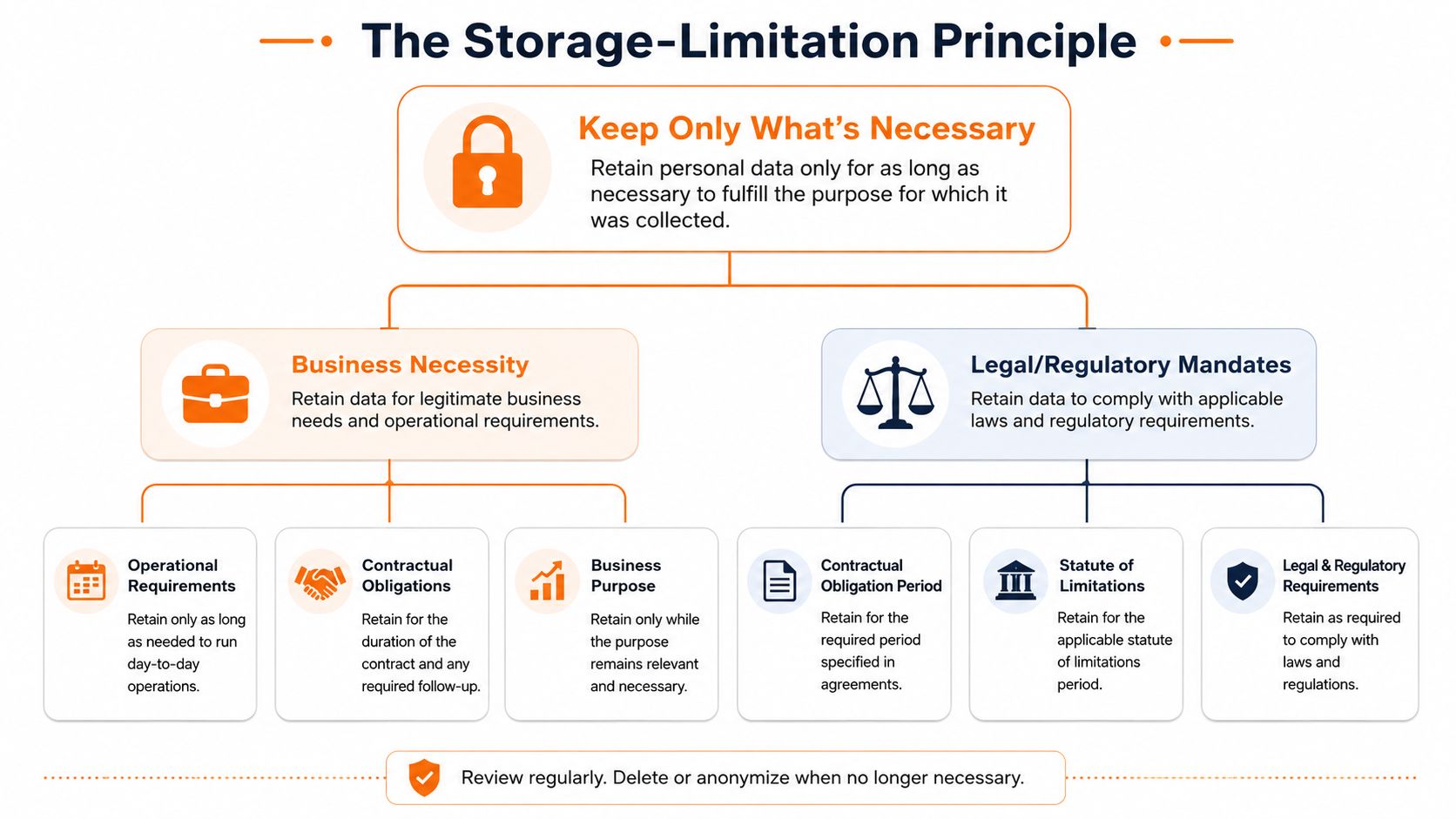
The storage-limitation principle makes the business prove why personal data remains in its systems. Under UK Information Commissioner's Office guidance on storage limitation, personal data should be kept only for as long as necessary. UK GDPR generally does not prescribe one fixed period for every category, so the operator must document its own reasoning.
That flexibility creates a practical burden. A retention period should connect to the original purpose, a legal or regulatory obligation, an operational need, and the risk of continued storage. The record owner should explain why deleting the record earlier would prevent the business from meeting a defined obligation. “Industry standard” alone is weak evidence.
Use evidence instead of a universal deadline
Public-sector schedules show why one period rarely fits every record. The UK Office for National Statistics uses a default retention review period of five years for data without personal-data attributes and two years when personal data is included, as described in the ICO storage-limitation guidance. The UK Competition and Markets Authority uses a broader framework, with two years for low-value administrative records, six years for finance and compliance records, ten years for governance and regulatory records, and fifteen years for records likely to have historical value, also reflected in that guidance.
These examples are not templates for gaming operators. They demonstrate a method: classify records, assess their value and obligations, define a review or deletion event, and preserve the rationale. A player identity document, payment ledger, promotional message, and technical error log should not receive the same period because they relate to one account.
The justification record should answer six operational questions:
- Purpose: What activity required collection and continued use?
- Trigger: Does the period begin at account closure, transaction completion, case resolution, or another event?
- Authority: Which legal, regulatory, contractual, or operational requirement applies?
- Scope: Which fields, exports, backups, logs, and downstream copies are covered?
- Exit action: Will the system delete, anonymize, aggregate, or retain the record under a documented exception?
- Evidence: Which event proves the workflow ran, which systems completed it, and what happened to failures?
That last question is often missed. A deletion job marked “complete” in the primary database does not prove removal from backup snapshots, audit logs, analytics stores, fraud tools, or vendor platforms. The schedule should identify those dependencies and record exceptions when technical deletion cannot occur immediately.
Review periods are not automatic permission to retain
A review date should start a decision, not extend storage by default. If the record still serves a documented purpose, its owner can renew the period with a reason. If the purpose has ended, the workflow should delete or anonymize it, then retain evidence of the action. This keeps review queues from becoming indefinite retention queues.
For regulated operators, the result is a defensible audit record. The business is not claiming that a regulator supplied one universal number. It is showing a repeatable method based on necessity, legal defensibility, actual data use, and proof that deletion reached the systems holding the record.
Building Retention Schedules for iGaming Data Types
An iGaming retention schedule should follow the platform's data model, not its organization chart. Classify each record when it is created: identify its personal-data content, regulatory role, retention trigger, and every system that receives a copy. Retrofitting classifications years later creates gaps, especially across backups, audit logs, analytics stores, fraud tools, and vendor platforms.
Compliance guidance for regulated records includes 12 to 15 months for SOC 2 Type II audit logs, six years for HIPAA documentation, and one year for PCI DSS logs with three months immediately available, according to audit-log retention guidance from ManageEngine. These are framework-specific reference points, not a universal schedule for iGaming records.
A workable schedule can look like this:
| Data Type | Retention Period | Storage Tier | Compliance Driver |
|---|---|---|---|
| Player account records | Purpose and jurisdiction dependent, with a documented closure trigger | Hot while active, then warm or cold | Privacy necessity, player-account obligations, disputes |
| KYC documents | The controlling KYC, AML, and local regulatory requirement | Restricted hot storage while active, then encrypted cold storage | Identity verification, AML, regulatory review |
| Transaction and financial records | Six years where the applicable finance or compliance obligation requires it | Warm or cold, with controlled retrieval | Finance, tax, audit, statutory limitation |
| Bonus and promotion records | Linked to the relevant campaign, dispute, and regulatory requirement | Warm storage with limited access | Promotional compliance, player disputes, reporting |
| Game session data | Purpose-specific, with shorter operational periods where no legal need remains | Hot for active monitoring, then deletion or aggregation | Security, dispute handling, analytics necessity |
| PCI DSS logs | One year, with three months immediately available | Hot for immediately available records, then warm or cold | PCI DSS monitoring and investigation |
| SOC 2 Type II audit logs | 12 to 15 months | Hot and warm tiers based on retrieval needs | SOC 2 audit evidence and control monitoring |
The schedule only becomes operational when its rules travel with the record. Store the record class, market, legal basis, retention start event, expiry date, legal-hold status, storage locations, and deletion method as metadata. Include downstream copies and backup treatment. A spreadsheet cannot show whether an expired record was removed from a snapshot, log pipeline, analytics warehouse, or vendor account.
Tier storage by retrieval need
Hot storage suits active player operations, fraud decisions, and current monitoring. Warm storage supports investigations that occur less often. Cold storage can preserve records that must remain available without immediate access. An audit-log retention methodology describes classification at creation, hot, warm, and cold tiers, automated deletion checks for legal holds, and evidence of deletion. It also notes that this approach can cut storage costs by 4 to 8 times, provided retrieval and evidence controls remain in place.
Cold storage is not the end of the workflow. The archive needs access controls, an expiry event, integrity protection, and tested retrieval. Deletion evidence should identify the affected object, systems processed, completion time, and any failed or deferred action. If a primary database reports completion while a backup, audit log, or downstream platform still holds the record, the operator cannot prove deletion. It has retained data, not an audit-ready outcome.
Resolving Multi-Jurisdiction Retention Conflicts
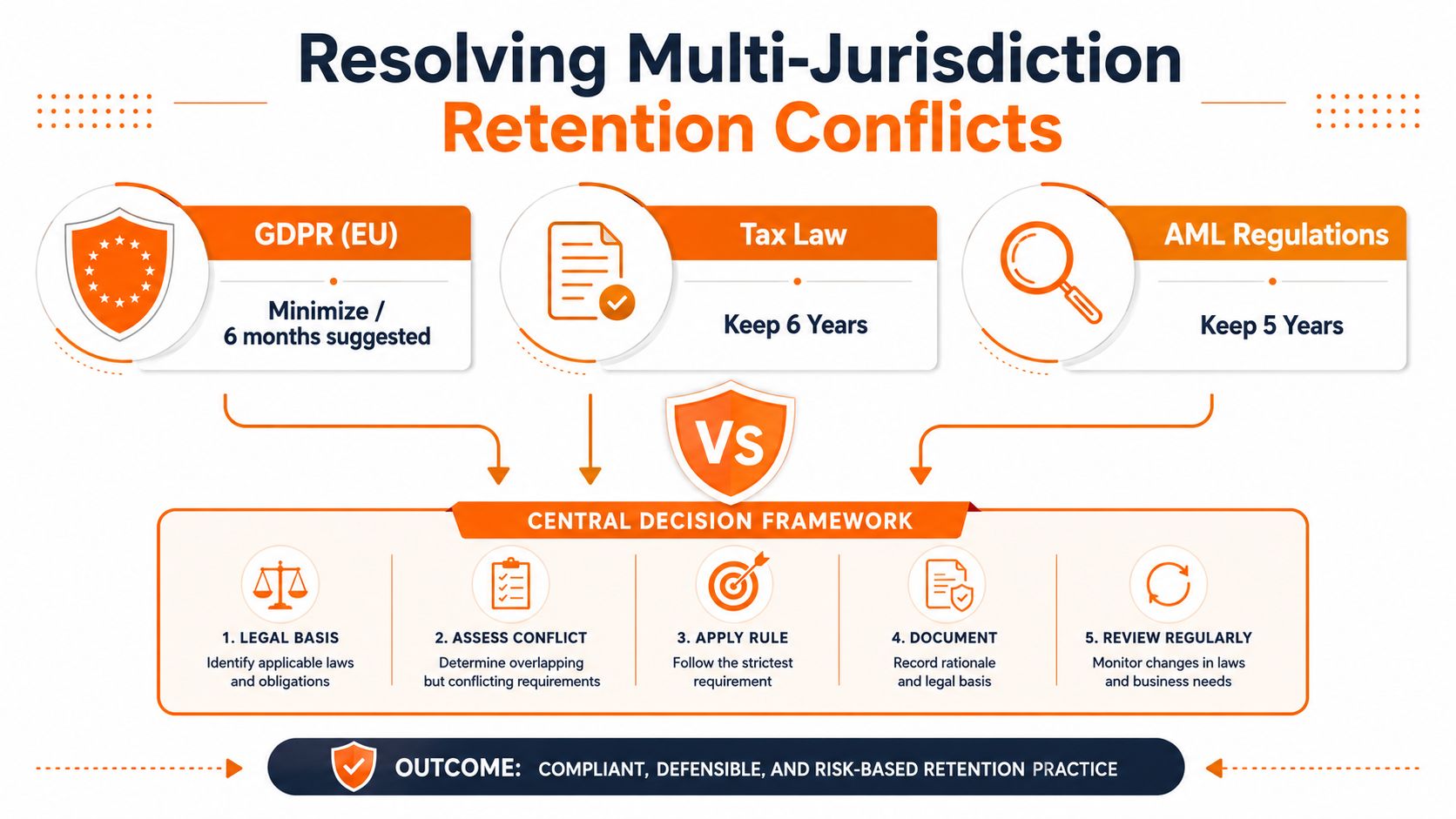
A global operator rarely faces one retention rule. GDPR may require minimization, tax requirements may support a longer financial-record period, AML obligations may require preservation of investigation material, and employment or consumer rules may apply to related records. The controlling period isn't selected by taking the longest number automatically.
Recent EU policy materials show that data retention remains contested. The Council working document on EU data retention issues discusses objections to undifferentiated obligations, unclear access limits, and retention windows ranging from six months to two years that aren't tied to strict necessity. The material also reflects continuing policy review, which reinforces the need for operators to document their own decision logic rather than treating a generic schedule as settled law.
Apply a conflict hierarchy
When several rules touch one record, use a documented sequence:
- Identify the record and market. Separate a KYC image from a KYC decision, and a payment token from a transaction ledger. Map where each copy is stored and which customers or regulator the record concerns.
- List every obligation. Capture privacy requirements, licensing rules, AML duties, tax and accounting needs, contractual terms, litigation holds, and security investigation requirements.
- Separate minimums from maximums. A minimum preservation duty may require retention. A privacy principle may limit retention once the purpose ends. A business preference isn't equivalent to either.
- Choose the narrowest defensible scope. Retain only the fields and copies needed for the controlling purpose. Consider masking, aggregation, or separation of identifiers where the full record isn't necessary.
- Record the decision. State which rule controls, why competing rules don't require the same data, who approved the interpretation, and when it will be reviewed.
The result should be a conflict memo linked to the schedule. It should include the jurisdiction, record class, applicable rules, chosen period, deletion trigger, exception conditions, affected systems, and approval history. Regulators are more likely to understand a carefully bounded decision than a blanket “longest period wins” approach.
Treat regional variation as an architecture issue
A single global database can make local deletion difficult. Market tags should travel with records into event streams, warehouses, support tools, and vendor exports. Where segregation is technically possible, regional storage or logically separated datasets can reduce conflict. Where it isn't, the operator needs field-level rules and a clear method for applying the strictest necessary treatment to personal data without destroying records that another rule legitimately requires.
The aim isn't to eliminate every conflict. It's to make each conflict visible, reasoned, approved, and executable.
Implementing Deletion Workflows That Actually Work
A deletion statement has little value if it only reaches the primary player database. In a gaming platform, an expiry event can affect the account service, wallet, KYC provider, payment processor, fraud engine, customer-support platform, analytics warehouse, log pipeline, reporting layer, replicas, and backup media.
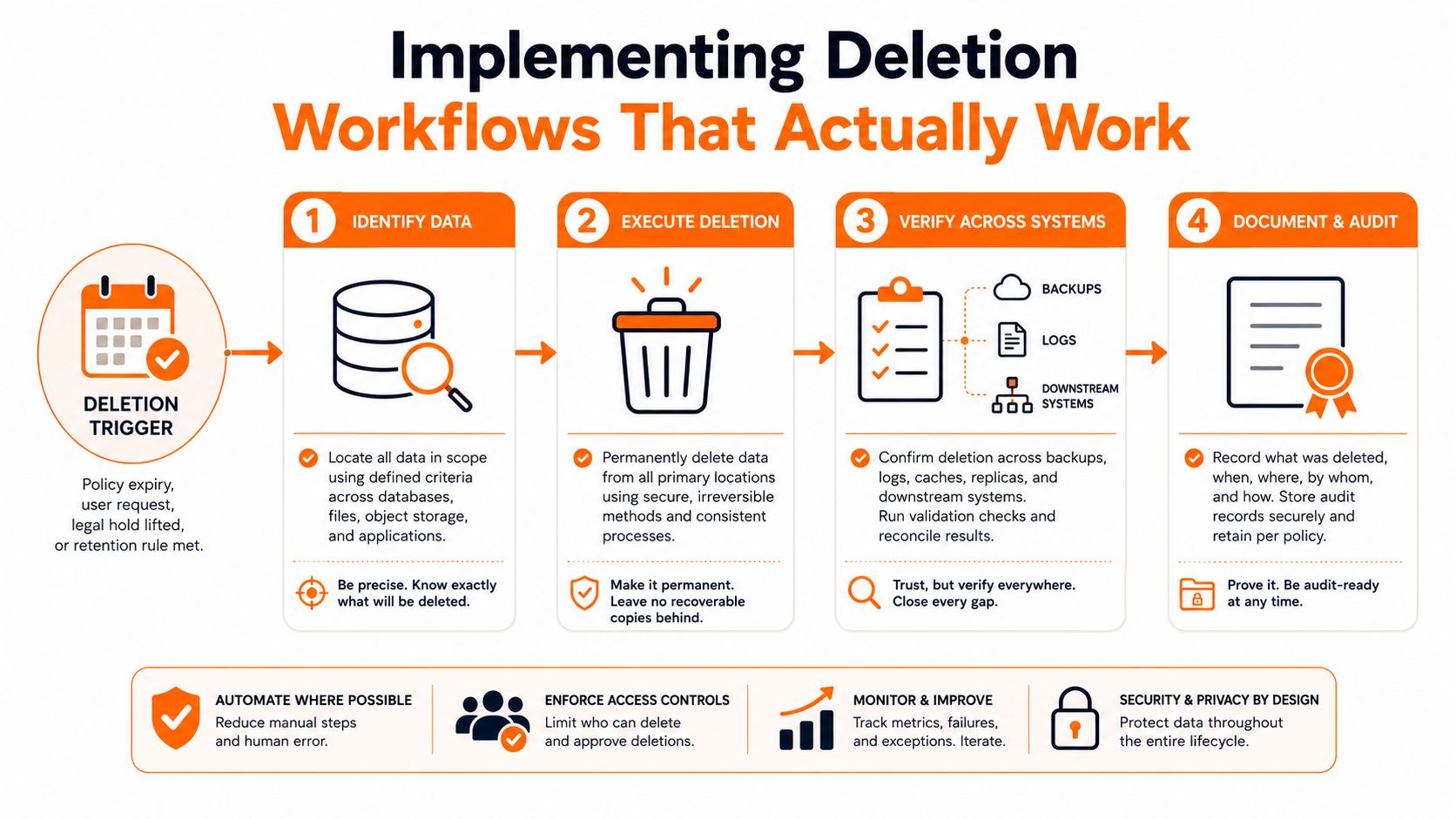
The workflow should begin when a defined trigger occurs, such as policy expiry, account closure, case resolution, or withdrawal of a processing purpose. It should then resolve legal holds before any destructive action. A hold must identify the affected records, systems, owner, start date, reason, and release authority. A hold that exists only in an email thread will eventually be missed.
Build the control as a chain of evidence
Use a deletion ledger that records the request or expiry event, data classification, systems identified, hold result, action taken, completion status, failures, retries, and approving owner. The ledger shouldn't reproduce the deleted personal data. It should preserve enough control metadata to prove what the system did.
The operational sequence is straightforward, but each stage needs an owner:
- Discover: Resolve identifiers, aliases, account IDs, device references, and vendor mappings.
- Assess: Check legal holds, unresolved disputes, regulatory investigations, and records that must remain segregated.
- Execute: Delete or anonymize the approved data in primary stores, replicas, indexes, caches, and downstream datasets.
- Verify: Confirm completion through system responses, reconciliation reports, and exception queues.
- Close: Record evidence, escalate failures, and prevent the same record from reappearing through replay or synchronization.
Backups need their own treatment. If a backup is immutable and cannot support selective deletion, the policy should define how the operator prevents restoration from reintroducing expired data, limits access to the backup, and allows the copy to age out under its backup lifecycle. The policy should never claim immediate erasure from a system that technically cannot provide it.
Pseudonymization also needs careful analysis. Replacing a name with an internal identifier doesn't necessarily remove personal data if the operator can reconnect that identifier to a person. Keep the re-identification key separate, restrict access, and apply a retention rule to both the pseudonymized dataset and the key.
Evidence is part of deletion. If the operator can't show what ran, where it ran, what failed, and how failures were resolved, the deletion control is incomplete.
Third parties create another common gap. Maintain a vendor register showing what each supplier receives, how deletion requests are transmitted, what confirmation is returned, and which copies the supplier's own retention schedule covers. The vendor-management practices used for compliance oversight should include these deletion obligations, not only security questionnaires.
Retained logs must remain usable. Expert guidance recommends testing archived retrieval quarterly, because an archive that can't be found, decoded, or authenticated won't support an audit or incident response. Place the retrieval test result in the same meta-audit trail as deletion events.
Use this video as a practical visual aid for the workflow:
What Audit-Ready Retention Looks Like in Practice
An audit-ready program doesn't depend on one immaculate policy document. It produces a connected record of decisions and system activity. The reviewer can start with a data category, trace its retention rationale, inspect the expiry trigger, confirm the legal-hold check, and review evidence from each affected system.
For an operator, that might mean separating a player's KYC image from the verification result and from the audit event recording that a check occurred. The image may require restricted storage for a defined regulatory purpose. The result may support compliance reporting. The event log may need a different period because it demonstrates that a control operated. Treating all three as “KYC data” hides the decisions an auditor needs to see.
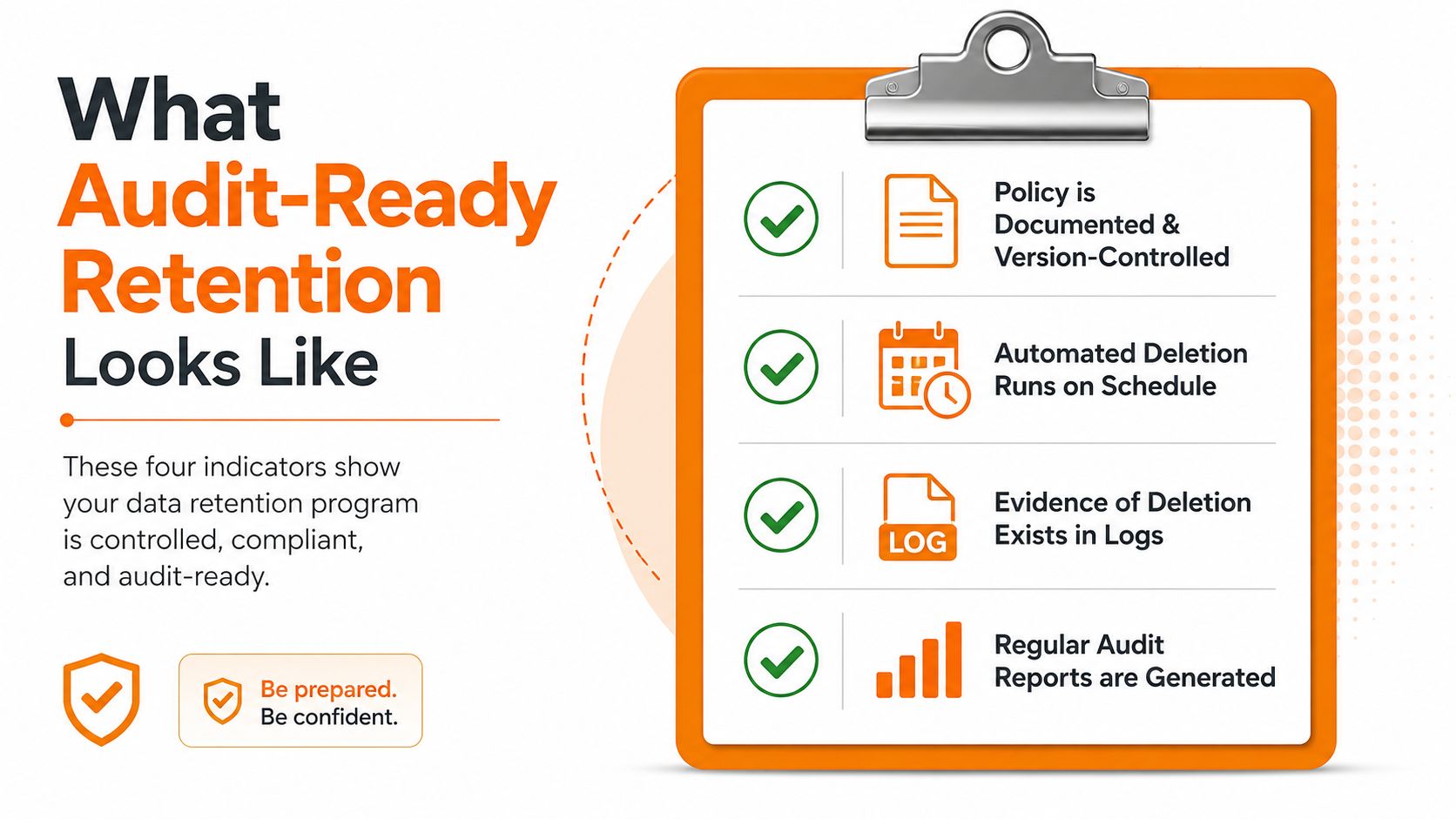
Four signs the policy is operating
- The schedule is version-controlled: Each rule has an owner, approval record, effective date, and documented rationale.
- Deletion runs automatically: Expiry jobs process eligible records, check holds, retry failures, and route exceptions to named staff.
- The evidence trail is independent: Deletion actions generate audit events without preserving the personal content that was removed.
- Retrieval has been tested: Teams periodically recover archived evidence and record whether the result was complete, readable, and trustworthy.
Review the program on a regular operating cycle. Confirm new systems and vendors are mapped, expired records were processed, holds were released correctly, exceptions were resolved, access permissions remain appropriate, and retrieval tests succeeded. Staff training should cover the practical failure points, especially exports, personal workspaces, screenshots, support tickets, and manual uploads.
A clear compliance reporting process turns these checks into evidence that management and regulators can review. Useful measures are control-oriented rather than vanity metrics: overdue deletion jobs, unresolved exceptions, untested archives, unclassified data sources, open legal holds, and vendors awaiting deletion confirmation.
The most convincing audit outcome is not a claim that deletion is perfect. It's a demonstrable process that identifies limits, records failures, assigns remediation, and shows that the operator learns from each review. Policy, execution, verification, and evidence must agree.
NexGrate provides a white-label casino and sportsbook platform with integrated player accounts, wallets, KYC and AML workflows, fraud controls, reporting, audit logs, and compliance features. If you're planning a regulated launch or replacing a fragmented stack, visit NexGrate to discuss how its operational platform can support your retention, deletion, and audit-readiness requirements.