
74% of iGaming operators now use affiliates as their primary customer acquisition channel, and affiliates can drive 40% to 70% of new player traffic for many online casinos, according to industry summaries of the sector's acquisition mix (iGaming affiliate marketing statistics 2026). That changes the way an operator should think about affiliate marketing casino. It's not a side tactic, it's a managed distribution system that touches tracking, payouts, compliance, fraud control, and retention economics at the same time.
When affiliates are doing that much of the work, weak process shows up fast. Bad attribution creates payout disputes. Loose compliance creates regulatory exposure. Thin oversight lets fraud sit inside your commission file for months before anyone notices. The operators who treat affiliates like a channel with rules, logs, and controls build steadier programs, while the ones who treat them like a list of links usually end up paying for noisy traffic and chasing problems after the fact.
Table of Contents
- Why Affiliate Marketing Now Runs Casino Acquisition
- What a Casino Affiliate Does
- Commission Models and How to Choose One
- How Tracking, Attribution, and SubIDs Work
- Compliance and Legal Considerations for iGaming Affiliates
- Affiliate Fraud and Commission Manipulation
- An Operator Workflow From Onboarding to Payout
- Channel Mix, Metrics, and Program Optimization
Why Affiliate Marketing Now Runs Casino Acquisition
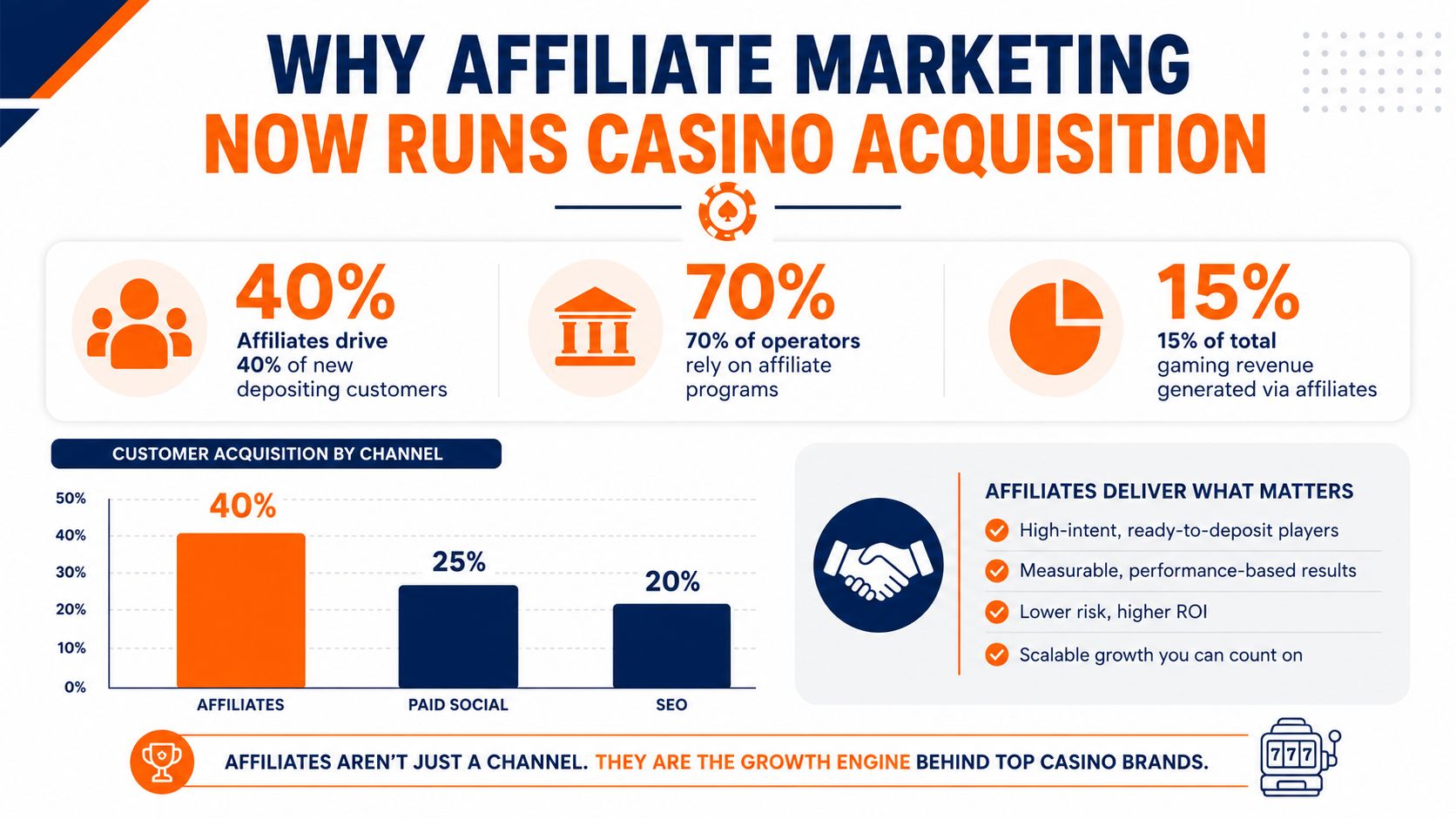
The operating reality is simple. A large share of operators now treat affiliates as a primary acquisition channel, and affiliates drive a meaningful portion of new player traffic for many online casinos. iGaming also takes a sizable share of global affiliate marketing spend, which is one reason the best placements, the best traffic sources, and the best compliance teams are so heavily contested (iGaming affiliate marketing statistics 2026).
That scale changes the way an operator should think about casino affiliate marketing. The key question is how to make the channel controllable, with clean attribution, acceptable player quality, and payout logic that protects margin. If your commission plan pays for raw volume without a strong first-deposit and retention signal, you will attract traffic that looks healthy in reports and underperforms in the cashier.
Think of affiliates as managed distribution
A casino affiliate functions more like a commissioned sales partner than a media placement. The affiliate controls audience access, framing, and pre-sell, while the operator controls the product, payments, onboarding, and compliance surface. The relationship needs to be managed like a commercial partnership, not a simple ad buy.
Practical rule: if you cannot explain how an affiliate's clicks turn into deposits, and how those deposits turn into retained revenue, you do not have an affiliate program yet. You have a referral list.
Serious programs instrument the full path, from click to registration to first deposit to revenue event. They also segment by GEO, content type, and quality tier, because a top-of-funnel comparison site, a streamer, and a cashback portal should not receive the same terms or the same oversight. Operators who get this right usually move faster on launch, because they can see which partners are safe to scale and which ones need tighter limits.
What a Casino Affiliate Does
A casino affiliate sits between the player and the operator, but not as a passive ad slot. The affiliate publishes, compares, recommends, or routes traffic, then earns when the referred player completes the agreed action. In practice, that makes the affiliate part publisher, part salesperson, and part audience owner.
The commercial relationship is three-way
The operator provides the brand, product, cashier, compliance rules, and payout logic. The affiliate provides attention and a pre-qualified audience. The player brings intent, deposits, and sometimes long-term value. If any one of those three legs is weak, the whole model becomes unstable.
That is why the affiliate category matters. A review site usually needs stronger editorial standards and clearer disclosures. A cashback or bonus site often needs tighter bonus-term review and brand permission controls. A streamer needs creative approvals and responsible-gaming discipline. A paid media buyer needs source-level scrutiny and stricter campaign monitoring because traffic can shift quickly and intent can be shallow.
The main affiliate types behave differently
- Content affiliates usually build around reviews, comparisons, and educational intent.
- Bonus and cashback sites lean on promotional framing and conversion at the offer level.
- Streamers and creators drive trust and urgency through personality and live play.
- Paid media affiliates buy traffic and depend heavily on landing-page and funnel efficiency.
Affiliates are not interchangeable. If you apply the same contract, creative policy, and commission plan to all of them, you will overpay some partners and under-control others.
From the operator side, the job is to match partner type to product stage. Early-launch brands often need affiliates that can explain the offer clearly and send compliance-safe traffic. Mature brands can layer in more aggressive acquisition partners, but only if the reporting stack can isolate them cleanly. The point is not to multiply names in the portal, it is to build a portfolio of distribution partners that can be governed.
Commission Models and How to Choose One
Commission design is where operator economics either stay clean or become messy fast. In affiliate marketing casino, the model you choose decides who carries the risk, how much cash leaves the business early, and what kind of traffic you'll attract. A payout structure that is too generous on acquisition can pull in low-quality traffic. A structure that is too rigid can leave you with no partners willing to push a new brand.
Revenue share, CPA, hybrid, and CPL each solve a different problem
Revenue share ties commission to player value over time. That aligns the affiliate with retention and ongoing player activity, which is why it's common in gambling programs. CPA pays for a defined action, often a first deposit or qualified registration, so it's easier to forecast but can invite volume-first behavior if the qualification rules are weak. Hybrid mixes both, which helps during launch because affiliates get upfront cash flow and still care about longer-term value. CPL is usually the least attractive for regulated casino acquisition unless the operator has very tight lead qualification and a clear downstream value model.
| Casino Affiliate Commission Models Compared | |||
|---|---|---|---|
| Model | Pays For | Operator Risk | Best Fit |
| Revenue share | Net player revenue over time | Higher long-tail exposure, lower upfront cash outlay | Mature brands, retention-led programs |
| CPA | A defined action, often a deposit or qualified sign-up | Higher upfront cost, easier budgeting | Launches, acquisition-heavy campaigns |
| Hybrid | Both upfront action and ongoing value | Balanced risk, more admin complexity | Regulated markets, mixed partner portfolios |
| CPL | Qualified lead | Lead quality risk if validation is weak | Narrow funnels with strong downstream filtering |
The rule I use is simple. If you're launching, a hybrid often gives you the best balance between partner appeal and operator control. If you already know your player economics and can reconcile quality cleanly, revenue share becomes more attractive because it keeps the affiliate focused on retention, not just first action.
Pick the model that matches your sales cycle
A quick decision filter helps. If the brand is new, the cashier is still being tuned, and support is learning the player base, avoid a structure that rewards raw sign-ups without deposit quality checks. If the brand has a stable funnel and strong fraud controls, you can afford more performance-based upside.
The biggest mistake is choosing the model the affiliate likes best instead of the model the operator can defend. Every commission plan should be tied to a documented qualification rule, a payment schedule, and a reconciliation method that finance can audit. That keeps the program commercial, not emotional.
How Tracking, Attribution, and SubIDs Work
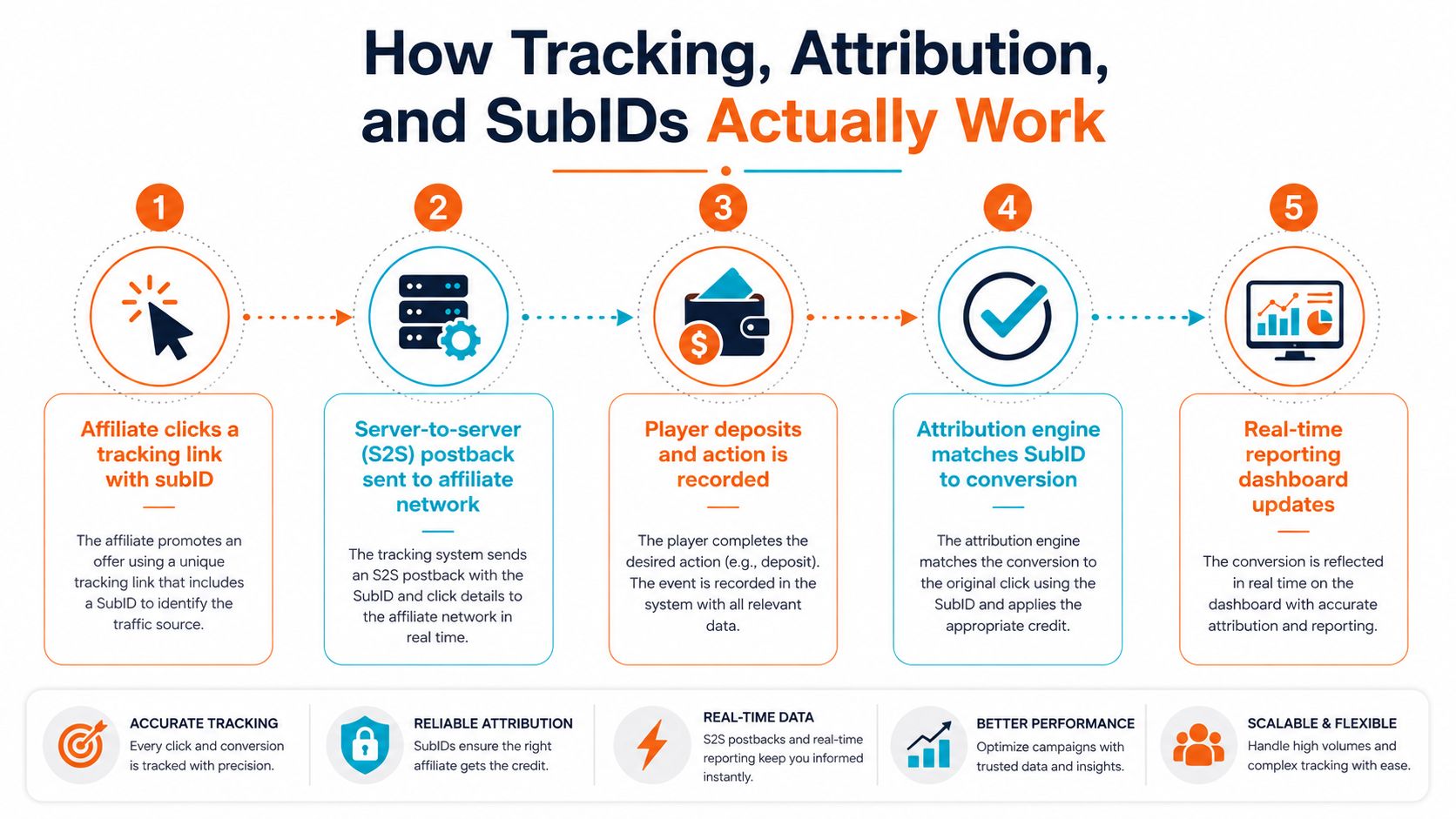
The backbone of casino affiliate attribution is server-to-server tracking, or S2S. Instead of relying on browser cookies alone, the operator sends conversion data directly to the affiliate platform through a postback URL, and the click ID/SubID becomes the single source of truth. That matters because cookie-based attribution is fragile in a restricted browser environment, while S2S reduces loss and helps reconcile registrations, deposits, and revenue events more accurately (The role of data and analytics in iGaming affiliate success).
The structure has to be consistent
A clean SubID schema should tell you where the traffic came from, what creative drove it, and which GEO or campaign it belongs to. If the naming changes every time a media buyer launches a fresh ad set, your reconciliation file becomes guesswork. The operator ends up paying for traffic they can't segment and can't defend.
A good internal standard usually separates campaign, source, creative, and market. That lets finance, affiliate management, and fraud review look at the same conversion path without translating shorthand. It also makes it easier to compare quality across partners, because the logic stays consistent from one program to the next.
Client-side pixels are not enough
Client-side pixels can still have a place, but they should not be the only attribution layer. The problem is not just privacy controls, it is also the loss of confidence when registration, deposit, and revenue data sit in different systems. S2S tracking gives the operator a cleaner audit trail because the conversion is recorded on the server side, where the business event happens.
If your affiliate reporting and cashier data do not speak the same language, you will spend the month arguing about numbers instead of managing growth.
The operational requirement is straightforward. Keep the postback endpoint stable, log the click ID at the operator level, and store event timing for registration and first deposit. Then use the same identifiers in reporting, reversal handling, and commission approvals. That is what turns tracking from a pretty dashboard into a control system.
A separate issue is how the reporting layer gets used day to day. If the affiliate is sending mixed traffic, or if the same sub-publisher appears under different labels, the numbers can look clean while the source quality is slipping. That is why a program needs disciplined tagging, regular reconciliation, and a reporting workflow that can be checked against the cashier and CRM data. For a useful operator-side framework on that discipline, see compliance reporting basics.
Compliance and Legal Considerations for iGaming Affiliates
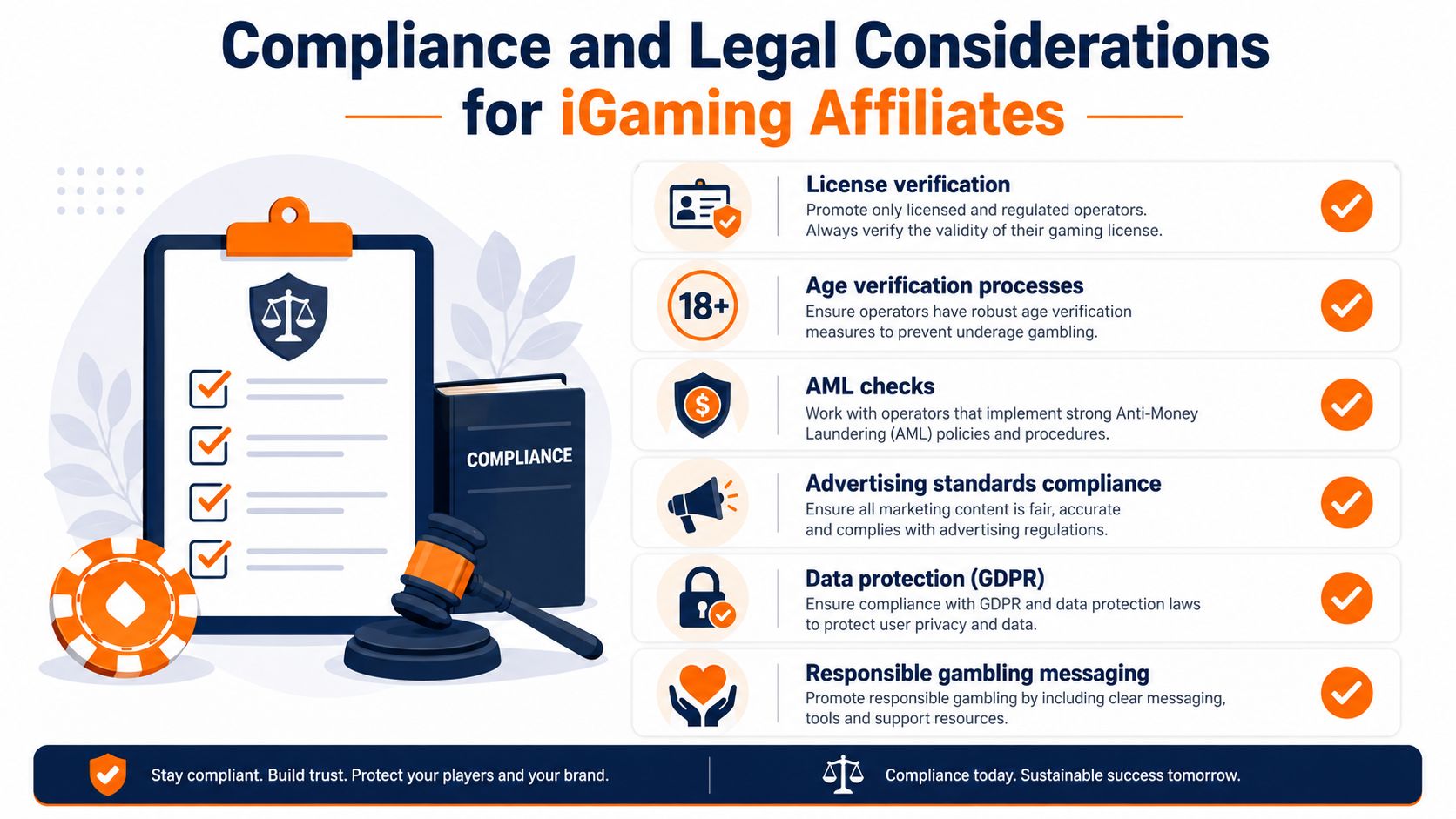
Affiliate programs sit inside the operator's regulated footprint, so the legal burden doesn't stop at the brand homepage. The affiliate is part of the distribution chain, which means geo-restrictions, age-gating, ad standards, and responsible-gaming messaging have to flow down into partner approvals and content review. In regulated markets, a creative that looks fine in one GEO can become a breach in another if the disclosure, tone, or offer framing doesn't match the local rule set.
The practical answer is not more generic policy language. It's tighter onboarding. Every affiliate should be checked for license compatibility, target-market restrictions, and content practices before the first link goes live. That is especially important where payment methods, bonus language, or player-facing claims are restricted by jurisdiction.
The operator's compliance checklist should be non-negotiable
- License verification for the target market and the brand's operating scope.
- Age verification processes for traffic and player onboarding expectations.
- AML checks where KYC and source-of-funds controls are part of the workflow.
- Advertising standards compliance for claims, bonuses, and promotional framing.
- Data protection controls for consent, storage, and partner access.
- Responsible gambling messaging in content, landing pages, and creatives.
That list only works if it's embedded in the program, not stored in a policy PDF nobody reads. Affiliate managers need to know which jurisdictions allow which offers, what needs pre-approval, and which statements must be removed from a page before launch. A good compliance process protects growth because it prevents bad traffic and bad headlines from entering the system in the first place.
For operators who want a deeper operational lens on reporting obligations, the internal overview on compliance reporting for gaming operations is a useful companion to this topic.
Contracts should flow risk back to the partner
The affiliate agreement needs to spell out content standards, geo restrictions, disclosure rules, and the right to suspend traffic if the partner steps outside the policy envelope. Otherwise, every escalation turns into a manual argument. The healthiest programs treat compliance as a commercial control, not a legal afterthought.
Affiliate Fraud and Commission Manipulation
The most underrated risk in affiliate marketing casino is fraud, not traffic scarcity. The Association of Certified Gaming Compliance Specialists warns operators to fold affiliate oversight into compliance programs because affiliates act as an extension of the business, and commission manipulation is a real operating issue in gambling affiliate work (Protecting against affiliate fraud and commission manipulation in online gambling). That warning should change how operators build controls. If the only thing you monitor is click volume, you're looking in the wrong place.
The abuse patterns are usually visible in the data
The common problems aren't mysterious. Duplicate-account behavior, self-referral abuse, cookie stuffing, suspicious first-deposit spikes, and traffic that doesn't match the stated source all leave fingerprints. The hard part is that they often look like “good performance” until someone checks the timing, the KYC data, or the downstream account behavior.
The response has to be rules-based and audit-friendly. Use anomaly detection on conversion timing, match KYC records against attribution claims, and screen for duplicate accounts before commissions go out. If a partner's traffic suddenly shifts source patterns or deposit quality without an obvious operational reason, that's a review trigger, not a celebration.
Oversight belongs in compliance, not just finance
Finance can reconcile payouts, but it usually can't see channel abuse early enough. Compliance and affiliate management need shared visibility into conversion logs, account-level flags, and reversal logic. The goal isn't to punish good partners, it's to stop distorted traffic from taking budget away from the partners who play clean.
A fast-growing affiliate file without audit logs is just a future dispute queue.
The most effective programs set alerts for conversion bursts, identical device or account behavior, and mismatches between traffic source and player quality. They also make sure suspicious patterns can be tied back to a named partner, a campaign, and a timestamp. That gives the operator a clean basis for withholding commission, requesting explanation, or shutting a source down.
For a broader framework on controls and escalation paths, the operator-side guidance in risk management practices for gaming teams fits naturally with affiliate oversight.
An Operator Workflow From Onboarding to Payout
A new white-label brand launching in a regulated market does not need a bigger affiliate list. It needs a tighter onboarding sequence. The operator starts by shortlisting affiliates whose traffic style matches the market, then checks licensing fit, jurisdiction restrictions, and content standards before any agreement is signed. That keeps the team from spending time on partners who cannot be approved or whose placements would need rewriting later.
The launch sequence should be boring in the best way
Start with contract review, then move to tracking setup, then creative approval. The tracking layer needs postback URLs, stable SubIDs, and an agreed event definition for registration and first deposit. If those definitions are loose, reconciliation gets noisy fast. Once traffic starts flowing, the operator watches conversion quality, not just click counts, and uses the same event data for monthly reconciliation.
If a partner is producing clean deposits, the payout file should be simple to verify. If the partner's conversions are noisy, reconciliation becomes a diagnostic exercise, and that usually means the traffic source needs tighter limits or a different commission shape. In both cases, the same backend data drives payout, fraud review, and segmentation. For teams building that operating model, the affiliate program framework in this iGaming affiliate program guide is a useful reference point.
One clean process beats three disconnected tools
A fragmented stack forces teams to manually match affiliate data against cashier records and fraud notes. That slows payout review and creates disputes that should have been caught earlier. A unified process lets the operator see whether a source is generating genuine value or just passing volume through the door. That matters during launch, when every bad assumption gets amplified by limited cash flow and a short testing window.
The strongest programs do not celebrate first deposits in isolation. They ask whether those deposits are retained, whether the affiliate respected the approved market, and whether the source can be scaled without creating a compliance drag. That is how affiliate operations stop being reactive and start behaving like a controlled acquisition system.
Channel Mix, Metrics, and Program Optimization
The durable mix in 2026 is broader than classic SEO. Recent affiliate guidance has shifted toward organic social, communities, and email, alongside search, because operators need channels that can survive platform and privacy changes while staying compliant (iGaming affiliate marketing strategies). The operator lesson is to avoid over-reliance on any single source, especially when acquisition depends on regulation-sensitive traffic.
Measure value, not just volume
Clicks are a weak success metric on their own. NDC, FTD conversion rate, and player quality banding tell you more about whether an affiliate is producing usable business. If one partner sends fewer clicks but a better deposit profile, that partner often deserves more budget than the louder source.
Keep the program simple to read. Compare partners by GEO, creative type, and conversion quality, then remove the ones that only look good at the top of the funnel. The best operators use the data already flowing through the affiliate stack to decide where to grow, where to cap, and where to stop.
Affiliate marketing casino works best when the operator treats it like infrastructure. The channel needs governance, not hope. It needs tracking, compliance, and fraud control, not just banners and commission rates.
If you want a platform that helps you launch and govern an iGaming brand with the same discipline you'd apply to affiliates, visit NexGrate and see how the stack supports compliance, tracking, and back-office control in one place. For operators planning a new launch or tightening an existing program, it's the right place to start.