
A release can look healthy right up until the first real player deposits, places a bet, triggers a bonus, and switches from sportsbook to casino. Then a wallet balance fails to refresh, an in-play bet settles against an outdated price, or a live dealer table shows a stream that no longer matches the recorded game state. Under MGA scrutiny, those aren't isolated defects. They're evidence that the operator's release process can't reliably protect player funds, game integrity, reporting accuracy, or responsible gaming controls.
That's why quality assurance gaming needs to operate as a release-gating system rather than a collection of disconnected test scripts. Casino, sportsbook, payments, identity checks, compliance rules, and back-office actions share state, and a defect in one area can surface as a regulatory, financial, or customer-service problem somewhere else.
Table of Contents
- Why Quality Assurance Gaming Fails Without a Program
- Core Test Types Every iGaming Platform Needs
- Building an Automation Strategy That Scales
- Performance and Load Testing for Real Player Peaks
- Compliance and Regulatory Checks You Cannot Skip
- Putting It All Together With CI/CD Test Gating
Why Quality Assurance Gaming Fails Without a Program
Launch night usually exposes the gap between testing activity and release readiness. A team may have tested the casino lobby, verified a sportsbook feed, and completed a payment checklist, yet still miss the transaction that links them: a player deposits, receives a wallet balance, places a sportsbook bet, opens a live casino table, receives a bonus adjustment, and later requests a withdrawal.
Each component can pass its own test while the player journey fails as a whole. A balance may be correct in the casino ledger but stale in the sportsbook interface. A voided bet may reverse the stake without restoring a promotional entitlement. A payment provider may return a successful response while the platform records the transaction as pending. These are state and reconciliation failures, not simple button defects.
The pressure is structural. A 2025 industry survey found that 77% of game developers conducted less QA than necessary on their most recent releases, while 50% said QA budgets weren't keeping pace with game complexity. The same 2025 industry survey on game QA reported that 94% of studios used some form of non-AI automation, which shows that automation is already common even though teams still struggle to achieve adequate coverage.
The wallet is the release boundary
For a unified casino and sportsbook platform, the wallet is where quality becomes commercial risk. Testers need to verify not only deposits and withdrawals, but also the timing and ordering of ledger events, idempotency after retries, currency handling, bonus restrictions, chargeback states, and the permissions that control manual adjustments.
The same discipline applies to game and betting outcomes. An RNG result must produce the expected settlement record. A live dealer round must preserve the relationship between stream state, table state, player action, and account balance. A sportsbook price update mustn't create an accepted bet against an unavailable or superseded market.
Practical rule: A release isn't ready because each module passed. It's ready when the shared player state remains correct across every supported journey.
What a real program controls
A QA program gives every release a risk model, an owner, an evidence trail, and a decision gate. It defines which checks must pass before deployment, which failures require a rollback, and which post-release signals trigger investigation.
The commercial cost extends beyond churn. A balance discrepancy can create disputes. A settlement defect can distort reporting. A missing audit event can weaken an investigation. A compliance control that works manually but fails under an unusual sequence isn't a control you can depend on.
The market reflects that seriousness. Independent market research estimated the global game QA and testing services market at about $2.8 billion in 2025, with a projection of $5.9 billion by 2034 and a 9.2% compound annual growth rate, as reported in the market research summary. The figures are a useful signal, but the operational lesson is more important: testing has become a major delivery function because platform complexity makes informal checking unreliable.
Core Test Types Every iGaming Platform Needs
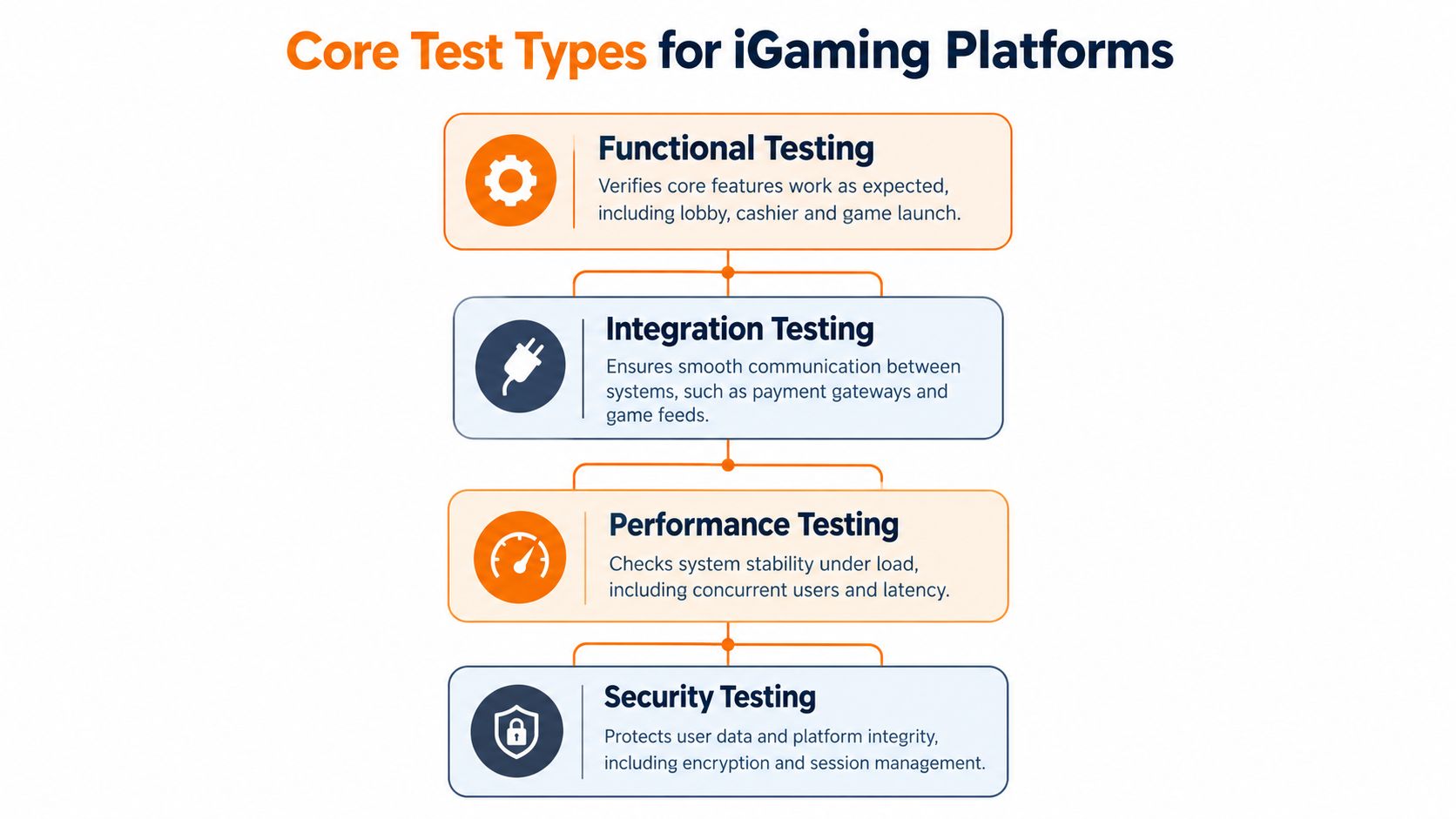
A useful iGaming test pyramid starts with deterministic checks and moves toward integrated player journeys. The order matters. Fast functional tests should catch obvious regressions before teams spend time running provider, settlement, streaming, or peak-load scenarios.
Functional testing establishes expected behavior
Start with the player-facing and operator-facing paths that must behave consistently:
- Account and access: Registration, login, password recovery, session expiry, device changes, and account status messages.
- Lobby and launch: Filters, game availability by jurisdiction, provider loading, launch parameters, interrupted sessions, and return-to-game behavior.
- Cashier: Deposit, withdrawal, verification prompts, limits, declined transactions, pending states, refunds, and visible balance updates.
- Promotions: Eligibility, wagering restrictions, expiry, free spins, opt-in requirements, and cancellation behavior.
- Back office: Player search, case handling, risk actions, manual permissions, reporting views, and audit events.
Product QA should own acceptance behavior, while operations and compliance should approve the expected result for restricted or regulated flows. A test that only checks whether a screen loads won't prove that the account, ledger, promotion, and audit record changed correctly.
Integration testing follows the transaction
A single API or adapter can simplify provider connectivity, but it doesn't remove integration risk. Testers should trace requests and responses across the platform, game provider, odds feed, payment gateway, identity service, and reporting layer.
Verify duplicate callbacks, delayed callbacks, malformed payloads, provider outages, authentication failures, retries, timeouts, and out-of-order events. For casino content, compare the provider's game state with the platform's session and wallet records. For sportsbook, exercise price changes, market suspension, bet acceptance, rejection, voiding, partial outcomes, and final settlement.
Teams working with fairness disclosures can also use the provably fair games guide as a reference point for the player-facing explanation of verifiable outcomes. QA still needs to test the actual implementation, including result generation, verification data, and the way the interface communicates the result.
RNG, live dealer, and sportsbook need specialist ownership
RNG testing focuses on game rules, payout logic, configured limits, bonus interactions, and the integrity of the result-to-settlement path. It isn't enough to click through a slot or table game and confirm that a result appears. A tester needs controlled scenarios that cover wins, losses, interrupted sessions, retries, and unsuitable account states.
Live dealer testing adds synchronization risk. Check stream availability, latency behavior, table opening and closing, seat or bet status, round transitions, disconnections, replay or recovery behavior, and the consistency of the recorded outcome. The live experience and the transactional record must tell the same story.
Sportsbook QA should own market and settlement scenarios with product and trading input. Test both pre-match and in-play behavior, especially stale odds, suspended markets, rejected bets, cash-out rules where supported, event cancellations, and result corrections. The key question is always: does the platform preserve the correct decision when external data changes at the same time as the player acts?
Building an Automation Strategy That Scales
Automation pays off when a test is repeatable, deterministic, and expensive to perform manually. It creates trouble when teams automate unstable provider behavior, encode unclear business rules, or build UI scripts that break whenever a label moves.
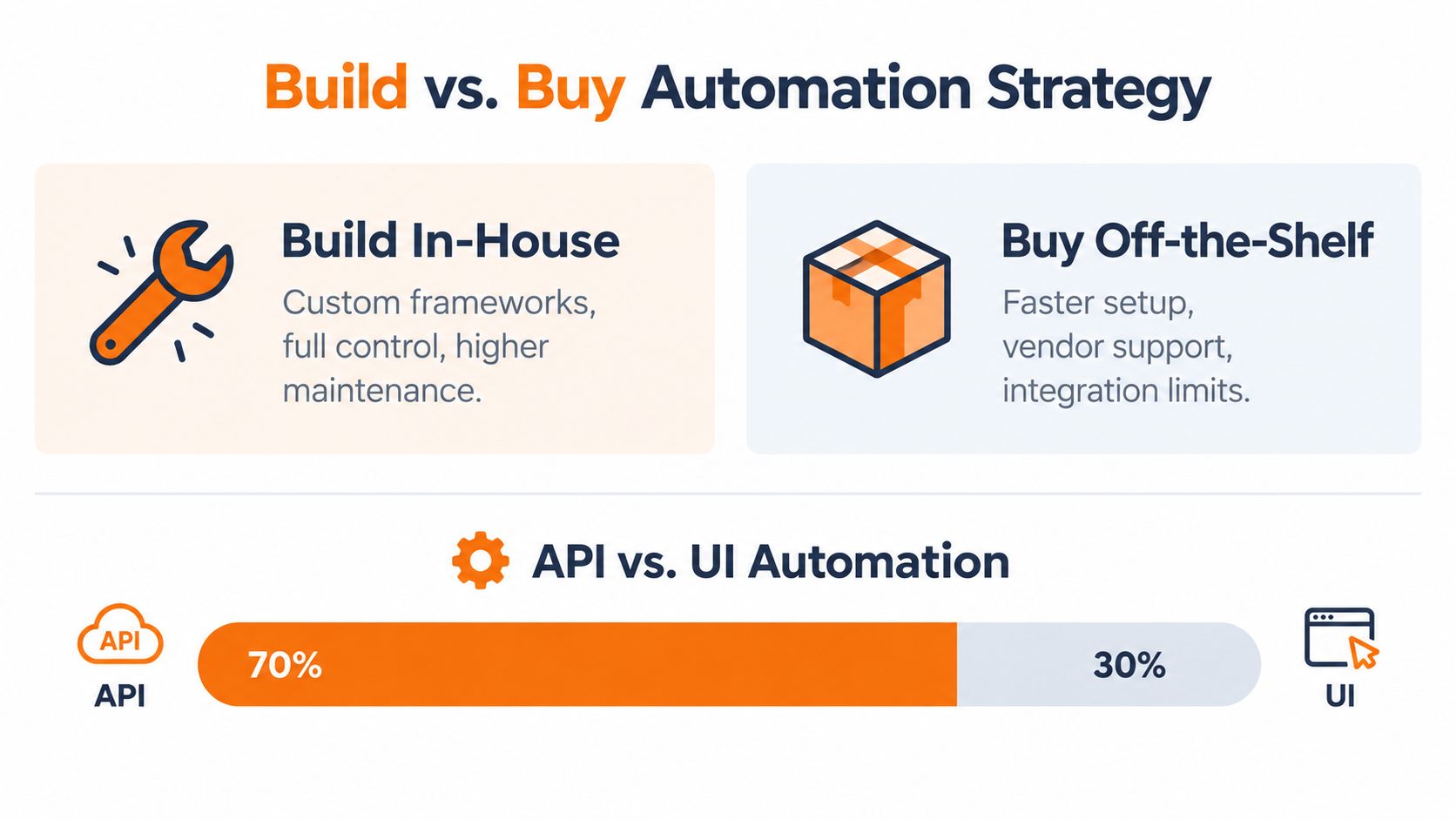
A practical split puts API checks at the center. Use APIs for wallet state, account transitions, bonus eligibility, bet placement, settlement, provider callbacks, and reporting reconciliation. Reserve UI automation for journeys where presentation and interaction are part of the risk, such as registration, cashier messaging, responsible gaming prompts, localization, and game launch.
Choose the method by risk and change
Manual testing remains valuable for exploratory work, visual judgment, unusual player behavior, and new content. It doesn't scale well for repetitive balance checks or regression coverage, and it can produce inconsistent evidence when testers follow slightly different paths.
Non-AI automation is usually the dependable base for deterministic assertions. It works well for stable contracts, known data, and repeatable settlement outcomes. Its maintenance cost rises when providers change payloads, environments drift, or test data isn't isolated.
AI-assisted testing can help generate scenarios, classify visual anomalies, summarize logs, or identify likely regression areas. It shouldn't replace human approval for financial outcomes, regulatory decisions, or ambiguous visual and behavioral findings. The 2025 survey reported that 88% of professionals considered AI-driven testing equal to or better than traditional methods for bug detection, while 87% felt somewhat ready for AI and only 18% felt fully prepared, according to the same industry survey. That gap argues for controlled adoption, not blind substitution.
| Test Area | Best Approach | Reason to Automate or Not |
|---|---|---|
| Wallet ledger and balance transitions | API automation with reconciliation assertions | Deterministic, high risk, and easy to repeat with isolated data |
| Registration and KYC messaging | API coverage plus targeted UI journeys | Backend rules need breadth, while wording and flow need visual confirmation |
| Odds and settlement | Contract, API, and event-driven tests | External data changes require fixtures, replayable events, and explicit expected outcomes |
| Live dealer experience | Manual exploratory testing plus targeted monitoring checks | Stream quality, synchronization, and recovery can require human judgment |
| Promotions and bonus rules | API-first automation with selected UI coverage | Rule combinations grow quickly, but player-facing eligibility still needs verification |
| Localization and accessibility | Native human review supported by UI automation | Truncation, context, cultural meaning, and assistive behavior aren't fully captured by scripts |
Make test data a first-class service
Create reusable account states for verified, unverified, restricted, self-excluded, bonus-eligible, high-risk, and payment-pending players. Seed balances and transaction histories deliberately, then reset them after each run. Never let one test's bonus, withdrawal, or risk flag leak into another test.
Provider content needs the same discipline. Use contract fixtures and replayable callbacks for known scenarios, then run a smaller set of live integration checks against each provider. When a game studio updates a title or an odds supplier changes a schema, the team should see which contract failed and why, rather than diagnose a cascade of vague UI errors.
Parallel execution can shorten feedback, but only when tests don't share mutable accounts, wallets, markets, or table sessions. A fast suite with contaminated data is worse than a slower suite that produces trustworthy failures.
Performance and Load Testing for Real Player Peaks
Performance testing must follow the transactions that carry financial and regulatory risk, not just the pages that attract the most visits. A casino and sportsbook platform can keep its lobby responsive while wallet writes queue, bet acceptance slows, or settlement workers fall behind.

Model the complete workload
Build scenarios around realistic mixes of actions:
- Wallet activity: Deposits, withdrawals, balance reads, bonus credits, reversals, and repeated requests after timeouts.
- Sportsbook pressure: Odds refreshes, market suspensions, bet placement, acceptance responses, cancellations, and settlement events.
- Casino concurrency: Game launches, round submissions, provider callbacks, live dealer table joins, and reconnects.
- Payment throughput: Successful, declined, delayed, and duplicated gateway responses, with reconciliation after each state change.
- Operational demand: Back-office searches, risk decisions, reporting jobs, and audit-log writes running alongside player traffic.
Measure latency by transaction, not just by average page response. Track error rates, queue depth, callback delay, settlement completion, balance consistency, database contention, streaming recovery, and the rate at which retries create duplicate work.
A pass criterion should describe a business outcome. For example, every accepted bet must settle once, every wallet mutation must reconcile, and a payment timeout must leave an inspectable state. A low response time doesn't compensate for a double debit.
Before testing, match production architecture as closely as possible. Include the same provider adapters, payment flows, caching behavior, observability, deployment configuration, and protection layers. Seed enough account, market, game, and transaction data to expose indexing and query problems. Synthetic traffic that only opens pages won't reveal ledger contention.
Teams should also understand how hosting and DDoS controls behave under pressure. The DDoS protection and hosting overview is relevant when documenting which traffic protections sit outside the application and which failures the platform itself must handle.
Chaos testing belongs after baseline load tests. Interrupt provider callbacks, delay odds messages, restart workers, make a payment dependency unavailable, and terminate live sessions during a round. The purpose isn't to create drama. It's to prove that the system fails visibly, preserves state, and recovers without manual guesswork.
The monitoring view should connect technical symptoms to player impact. A spike in database latency matters because it may delay balance refreshes. A stream reconnect matters because it may coincide with an unresolved table state. QA, engineering, trading, payments, and operations should review the same evidence before approving peak-event readiness.
Compliance and Regulatory Checks You Cannot Skip
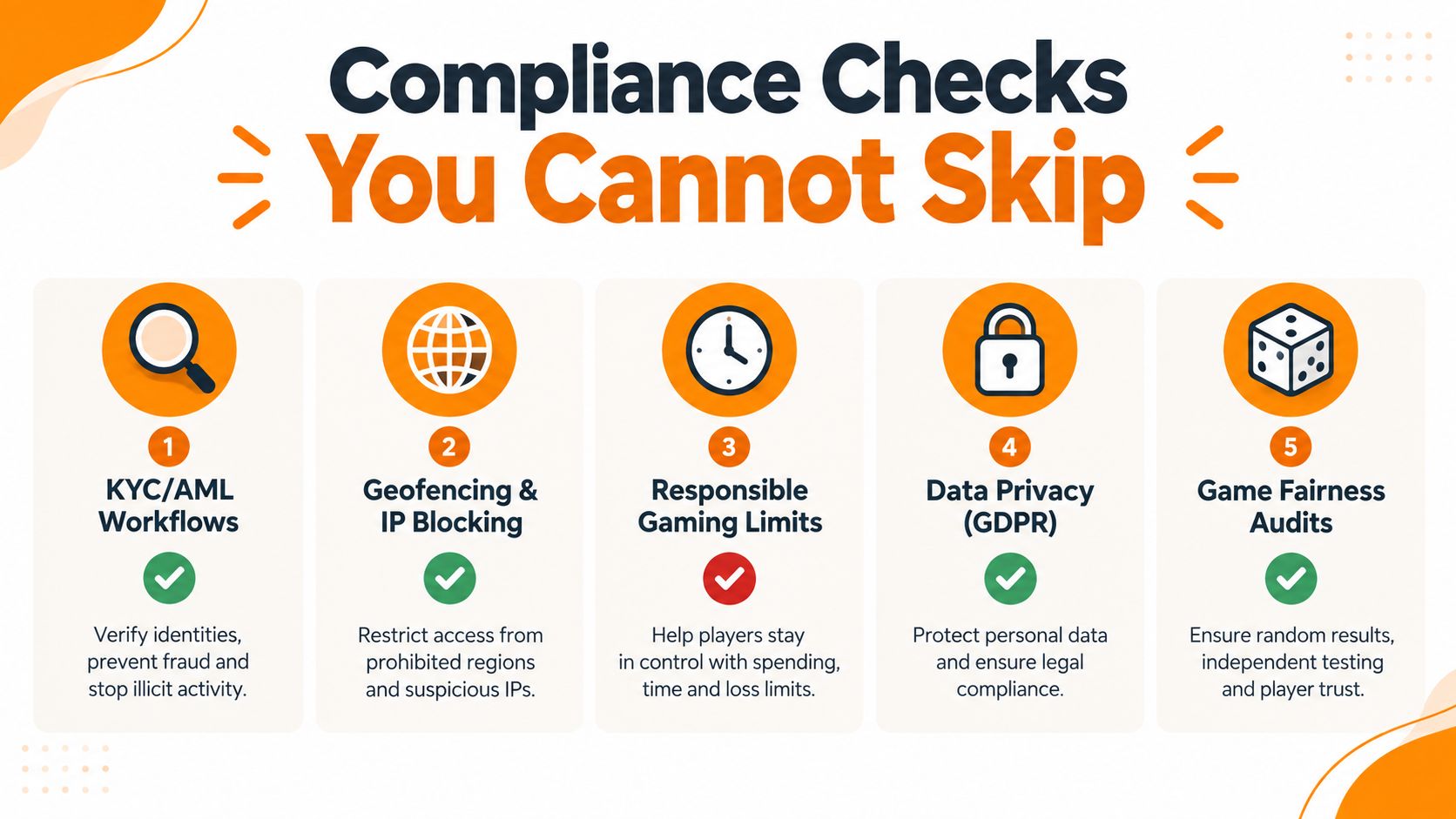
Compliance requirements become manageable when teams convert them into executable acceptance criteria. A policy document says what the operator intends to control. A QA program proves that the control activates, blocks or permits the correct action, records evidence, and remains accurate after deployment.
Test the control, not only the screen
KYC and AML coverage should include document outcomes, failed verification, pending review, duplicate identity signals, source-of-funds escalation where applicable, account restrictions, and the messages shown to the player. Testers should then verify the back-office status, reviewer action, evidence record, and audit event.
Geofencing needs more than a single location check. Exercise permitted and prohibited jurisdictions, inconsistent location signals, VPN or proxy indicators where supported, location changes during a session, and the behavior of an open game or bet when eligibility changes.
Responsible gaming tests should cover deposit limits, loss or wagering limits, time controls, reality checks, cooling-off actions, self-exclusion, and attempts to bypass restrictions through another surface. The casino and sportsbook must respect the same player-level control when they share an account and wallet.
The compliance reporting guide is useful for framing reporting as an operational process. QA should go further by reconciling source transactions, adjustments, bonuses, voids, and settlements against the reports that compliance and finance use.
Localization is a market-access test
Localization QA shouldn't stop at translated strings. Guidance published for 2026 recommends testing onboarding, accessibility menus, control mappings, assist settings, seizure warnings, and screen-reader behavior in each locale, as described in the 2026 game localization QA guidance. The same guidance emphasizes testing inside the actual game UI with native-speaking reviewers because string-only review can miss truncation, font rendering, and cultural problems.
For an iGaming release, include registration, KYC instructions, deposit and withdrawal messaging, responsible gaming notices, game rules, odds displays, settlement explanations, accessibility labels, and regulatory text. Check long words, date and number formatting, plural rules, right-to-left behavior where relevant, and whether a translated warning remains visible at the point of decision.
A translation can be linguistically correct and still fail the player because the interface hides the last line of a warning.
Produce audit-ready evidence
Every compliance test should leave a compact evidence package:
- Scenario definition: The rule, jurisdiction, account state, and expected outcome.
- Execution record: Build identifier, environment, timestamp, tester or service identity, and test result.
- System evidence: Screenshots where useful, request and response references, ledger entries, audit events, and report extracts.
- Exception handling: Defect identifier, severity, owner, decision, compensating control, and retest result.
Fairness checks should connect game configuration, outcome handling, and player-facing information. Privacy testing should cover access control, data minimization, retention behavior, export or deletion workflows where applicable, and the exposure of sensitive information in logs and back-office screens.
Putting It All Together With CI/CD Test Gating
A release gate turns QA from a late approval meeting into a set of enforceable conditions. The pipeline should reject a build when critical wallet reconciliation fails, a settlement contract breaks, a required compliance rule is bypassed, or a security control produces an unacceptable result.
Not every test belongs in the same pipeline stage. Fast API and contract checks can run on every change. UI smoke journeys can run against a deployment candidate. Provider certification, full regression, performance, and exploratory sessions can run on a release environment with results attached to the same release record.
Define gates by business risk
A practical gate model looks like this:
- Change validation: Unit, API, schema, and wallet-state checks run before merge.
- Integration validation: Payment, game-provider, odds, identity, and reporting contracts run against controlled fixtures.
- Release candidate validation: Critical casino, sportsbook, cashier, responsible gaming, and access journeys run through the deployed build.
- Operational readiness: Monitoring, alert routing, rollback procedures, permissions, and audit evidence are verified.
- Post-release observation: Teams watch balances, settlement queues, payment states, provider errors, fraud alerts, and player-impact signals before expanding exposure.
The gate owner must have authority to stop deployment. If a failed settlement test is treated as a discussion point rather than a blocker, the pipeline is only displaying information. It isn't controlling risk.
Start with the shared state
For a new brand, a migration, or a major backend change, prioritize the paths that cross system boundaries first. Create a canonical player journey from registration through verification, deposit, casino play, sportsbook betting, bonus handling, withdrawal, and account restriction. Use that journey to expose mismatches between the casino, sportsbook, wallet, payment, and compliance services.
In the first delivery cycle, focus on stable test data, ledger reconciliation, provider callbacks, settlement rules, audit events, and rollback evidence. Then add localization, accessibility, fraud workflows, peak-load scenarios, and broader exploratory coverage. The sequence can change by risk, but the shared wallet and regulatory controls shouldn't wait until the final pre-launch week.
NexGrate provides a turnkey white-label stack that brings casino content, sportsbook functions, payments, wallets, back-office controls, compliance tooling, and deployment operations into one operating environment. For operators evaluating a unified platform, NexGrate can be assessed against the same release-gating criteria used for any integrated iGaming architecture.
A short retrospective after every release keeps the program honest. Review escaped defects, false-positive tests, manual workarounds, provider changes, audit evidence gaps, and the signals that appeared before an incident. Then convert each useful lesson into a new assertion, fixture, alert, or gate.
Quality assurance becomes reliable when the release process can stop itself for the failures that matter.
If you're launching or migrating a casino and sportsbook brand, visit NexGrate to evaluate a unified platform with shared wallets, payments, game and betting integrations, compliance controls, and deployment support. Bring your highest-risk player journeys and release criteria, then use them to assess whether the platform can enforce quality before production exposes the gaps.