Microsoft's research found that MFA reduces the risk of compromise by 99.22% overall and 98.56% when credentials are leaked, while more than 99.99% of MFA-enabled accounts stayed secure during the study period. In iGaming, that's not an abstract security win. It's the difference between a player wallet that stays intact and an account takeover that drains funds, abuses bonuses, and drags support, fraud, and compliance teams into the same incident.
That's why how to implement two factor authentication in a casino or sportsbook backend isn't a checkbox exercise. It's a product decision, a fraud-control decision, and a recovery-design decision all at once. Password-only access fails fast once attackers start reusing breached credentials across login surfaces, cashier flows, admin consoles, and player self-service tools.
Table of Contents
- Why Two Factor Authentication Is Non-Negotiable for iGaming
- Choosing the Right Authentication Method for Your Platform
- Building the TOTP Enrollment and Verification Flow
- Integrating 2FA Across Sessions and Wallet Operations
- Designing Recovery Flows That Do Not Create Vulnerabilities
- Testing and Rolling Out 2FA to Your Player Base
- Monitoring 2FA Health and Responding to Failures
Why Two Factor Authentication Is Non-Negotiable for iGaming
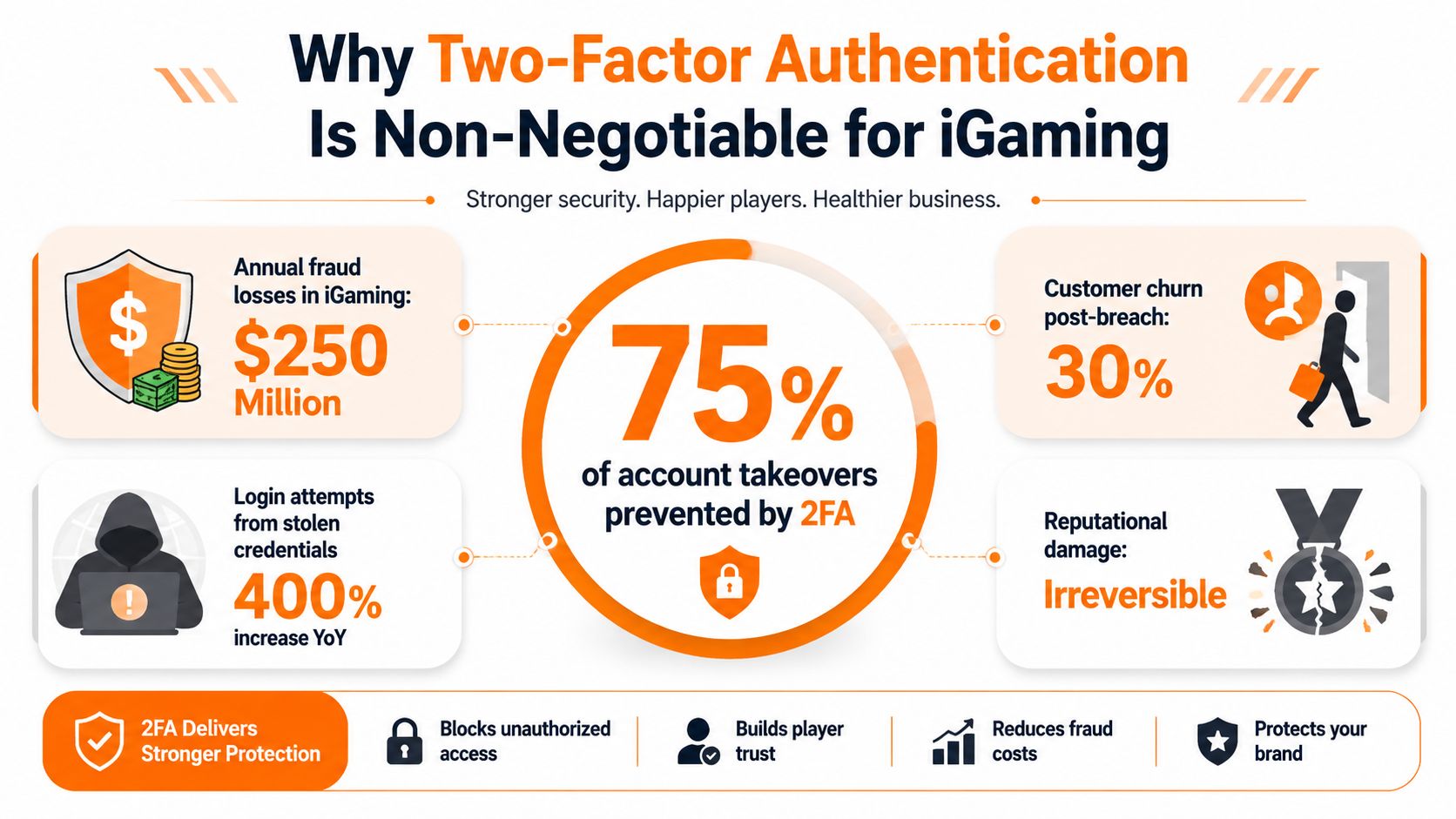
The security argument for 2FA is already strong in general enterprise systems, but iGaming makes it sharper. Player wallets hold real value, cashier workflows move money in and out of regulated accounts, and admin consoles can touch settlement, bonuses, KYC, and fraud controls in one place. A breached password in that environment isn't a nuisance, it's a direct path to abuse.
Microsoft's data makes the baseline clear, MFA cut compromise risk by 99.22% overall and 98.56% with leaked credentials, and more than 99.99% of MFA-enabled accounts remained secure during the study period. That's the operational reason 2FA belongs in login design, not just in policy documents or compliance slide decks. If you're protecting player balances, that reduction in exposure matters more than any marketing claim ever will. Microsoft MFA research paper
Implementation reality in regulated gaming
In casino and sportsbook environments, account takeover often shows up as a chain of smaller failures. The attacker logs in with reused credentials, changes payout details, drains a wallet, then uses bonus abuse or rapid wagering to obscure the trail. By the time the player contacts support, the damage has already crossed security, payments, and operations.
That's why regulated operators treat 2FA as an expected control, not an optional enhancement. Adoption has moved in that direction across the market, too. SecureGenTools reports that 57% of organizations now require 2FA for critical accounts, with adoption reaching 67% in enterprises and 89% in financial services, while consumer usage still lags at 34% for individual users. SecureGenTools 2FA statistics
Practical rule: If a login can reach balances, withdrawals, KYC records, or bonus controls, it deserves a second factor.
The best way to think about 2FA in iGaming is as a loss-prevention layer. It reduces the chance that a stolen password turns into fraud, chargebacks, support escalation, and regulatory noise. That's also why you should connect the control to broader risk management, not just authentication UI. NexGrate risk management best practices
Choosing the Right Authentication Method for Your Platform
A weak 2FA choice can create more operational pain than it removes. In iGaming, the decision is not just which factor looks strongest on paper, it is which one survives wallet access, regulated workflows, support load, and player frustration without turning recovery into an attack surface. The usual options are TOTP, SMS, push, and WebAuthn. Each one sits at a different point on the curve between player friction, implementation effort, and resistance to phishing.
Method-by-method trade-offs
| Method | Player Friction | Security Level | Regulatory Acceptance | Best Use Case |
|---|---|---|---|---|
| TOTP | Moderate | Strong for most consumer flows | Widely accepted | Player login, withdrawals, account changes |
| SMS | Low to moderate | Weaker because of SIM-swap and interception risk | Often tolerated as fallback | Recovery or low-risk fallback flows |
| Push notifications | Low | Strong when implemented carefully | Good for controlled apps and staff access | Internal teams, high-frequency approval flows |
| WebAuthn | Low after setup | Very strong, phishing-resistant | Strong for privileged access and sensitive operations | Admin consoles, back-office tools, VIP support |
TOTP is the default choice for most operators because it works offline, fits mobile players, and does not depend on carrier delivery. That makes it practical for login, withdrawal approvals, and account changes where you want a second factor that is independent of the telco layer. SMS still has a role as a fallback for recovery or lower-risk flows, but it is a weak primary control for wallets, crypto rails, or admin access because a SIM swap can put the second factor in an attacker's hands. Push notifications work well where you control the client and the device estate is managed, which is often true for internal teams. WebAuthn is the strongest option for privileged users and sensitive back-office access because it removes code entry and is far harder to phish.
Picking by user type
Back-office staff should get the strongest factor the platform can support without breaking daily operations. A compromised admin account has a much larger blast radius than a single player account, so the control has to match the risk. VIP players sit in a different place. They need strong protection, but they also expect support that does not turn into a long ticket chain, so a TOTP-first setup with predictable recovery is usually the better trade-off. General players care most about getting into the lobby quickly, which means the enrollment and recovery path matters as much as the factor itself.
Operational insight: Do not give every persona the same factor just to keep the code path simple. In production, that choice usually shows up later as recovery abuse, support friction, or players abandoning enrollment before they finish it.
If you are mapping authentication to wallet controls, the useful question is which action needs step-up protection. Login, balance views, withdrawal requests, payout detail changes, and sensitive account updates do not carry the same risk, and a platform with multiple currencies or integrated cashier logic needs that distinction built into the policy layer.
Building the TOTP Enrollment and Verification Flow
For player-facing 2FA, TOTP is usually the practical default, but the implementation details decide whether it survives production traffic or only works in a demo. The flow has to cover secret generation, QR enrollment, first-code verification, secure storage, and fallback recovery without leaving the account half-enabled. That means treating enrollment as a stateful process with clear checkpoints, not a single form submit. A six-step infographic showing the process for setting up and verifying two-factor authentication using TOTP.
The enrollment sequence that actually holds up
Generate a cryptographically secure shared secret for each user and keep it server-side, protected at rest. For TOTP, the standard pattern is a 30-second moving time step derived from floor(current_unix_time / 30), with the shared secret stored as a random 160-bit base32 value on the server and protected at rest. TOTP implementation reference
Use the otpauth:// payload so authenticator apps can bind the secret correctly. After the user scans the QR code, do not mark 2FA as active yet. Require the first TOTP code, verify it, and only then activate the factor. That extra step prevents a common production failure where the account appears protected in the UI, but the player never completed enrollment and cannot get back in.
Verification details that reduce support load
A small clock-drift window helps because real devices are not perfectly synchronized. A common pattern is allowing ±1 step so a legitimate user does not fail verification because the phone clock is slightly off. The trade-off is straightforward. A wider window lowers friction, but it also increases replay risk, so keep the window narrow and rate-limit attempts aggressively.
Practical rule: If the first valid code is not confirmed before activation, the recovery desk becomes part of enrollment whether you planned for it or not.
Use a temporary, limited token between password validation and OTP verification. That token should allow only the 2FA verification endpoint and should expire quickly. Once the OTP succeeds, issue the full session or access token. That separation matters because a password-only session should never carry the same privileges as a session that has passed second-factor verification.
Integrating 2FA Across Sessions and Wallet Operations
The login screen is only one place where 2FA belongs. In iGaming, its value shows up when you bind step-up checks to wallet moves, account changes, and session risk. If you only challenge at sign-in, attackers can still do damage after they inherit an active session.
Where step-up checks belong
At minimum, require a fresh second factor before withdrawals, crypto transfers, email changes, password resets, and disabling 2FA. Those are the actions that usually turn an account takeover into a full incident. If you support SSO across casino and sportsbook surfaces, keep the identity boundary stable, but step up again when the player crosses into a sensitive operation.
Session state should record whether the user has passed 2FA recently, and the backend should treat that as a scoped assurance level rather than a permanent green light. Once a session goes idle, moves to a new device, or hits an unusually sensitive workflow, re-authentication is the right response. That's cleaner than trying to trust a browser forever.
Wallet operations need their own policy
Withdrawals are the obvious case, but many operators miss smaller actions that still change risk exposure. Changing a payout method, swapping an email address, or approving a large bonus reversal can be just as important as the login itself. The right rule is simple. If the action can move money, redirect money, or remove visibility from the account owner, it should be a step-up event.
The architecture also needs to account for concurrency. Players may switch between devices, tabs, and branded surfaces in the same session. If your session design doesn't distinguish between a general authenticated state and a second-factor-cleared state, you'll either challenge too often or not often enough. Both outcomes are bad.
Operational insight: Bind the second factor to the action, not just to the browser. A wallet transaction should verify identity again even if the login session is still valid.
For platforms with unified wallet logic, this gets even more important because the same account state may drive casino play, sportsbook staking, and cashier actions. A single auth policy won't fit all of them cleanly, so the challenge engine should be aware of risk level, not just page route. NexGrate integrated wallet environment
Designing Recovery Flows That Do Not Create Vulnerabilities
The most common 2FA failure in production is recovery. A lost phone, a broken app, or a new SIM can turn a solid security design into a lockout problem if the fallback path is careless. The implementation guidance from IBM highlights the same weak spots again and again, weak recovery flows, missing re-authentication before disabling 2FA, and no rate limiting on OTP attempts.
Lost phone, new phone, and backup codes
A player loses their device on a Friday night. Support gets the ticket, and the user wants access now because there is a pending withdrawal or an active betting window. If you did not issue backup codes during enrollment, recovery depends on an ad hoc support decision.
Backup codes should be generated at setup, shown once, and stored hashed on the server just like passwords. They are single-use escape hatches, not a second password. If a player uses one, it should be invalidated immediately, and the account should log that event for review.
SIM swaps and support-assisted recovery
SMS recovery deserves extra caution because it is exactly where attackers like to operate. If a user's phone number changed, or a carrier reassigned it, that channel is no longer proof of identity. In a sportsbook or casino workflow, support should never disable 2FA just because someone can still receive a text.
A better pattern is verified fallback channels, then support-assisted recovery with strong identity checks and a reactivation flow that requires fresh enrollment. That keeps the support desk from becoming a bypass path. It also gives compliance teams a cleaner audit trail, which matters when account actions touch regulated funds or reporting obligations, including the kind of recordkeeping covered in compliance reporting practices.
Why the support script matters
Recovery staff need a strict script, because improvisation creates holes. The right sequence is confirmation, identity verification, re-authentication, then factor reset. Anything less gives an attacker a way to social-engineer the account back open.
A recovery flow should restore access without teaching an attacker how to bypass your controls.
If your operation has to document recovery handling for auditors or regulators, keep the evidence path clean and explicit. Structured reporting and logged approvals matter just as much as the technical reset itself.
Testing and Rolling Out 2FA to Your Player Base
2FA rollouts fail when teams test the happy path and ignore the edges. Clock skew, simultaneous logins, exhausted recovery codes, and interrupted enrollment are the problems that turn into support spikes later. The staging environment has to behave like production, including realistic mobile behavior and session persistence.
What to verify before public launch
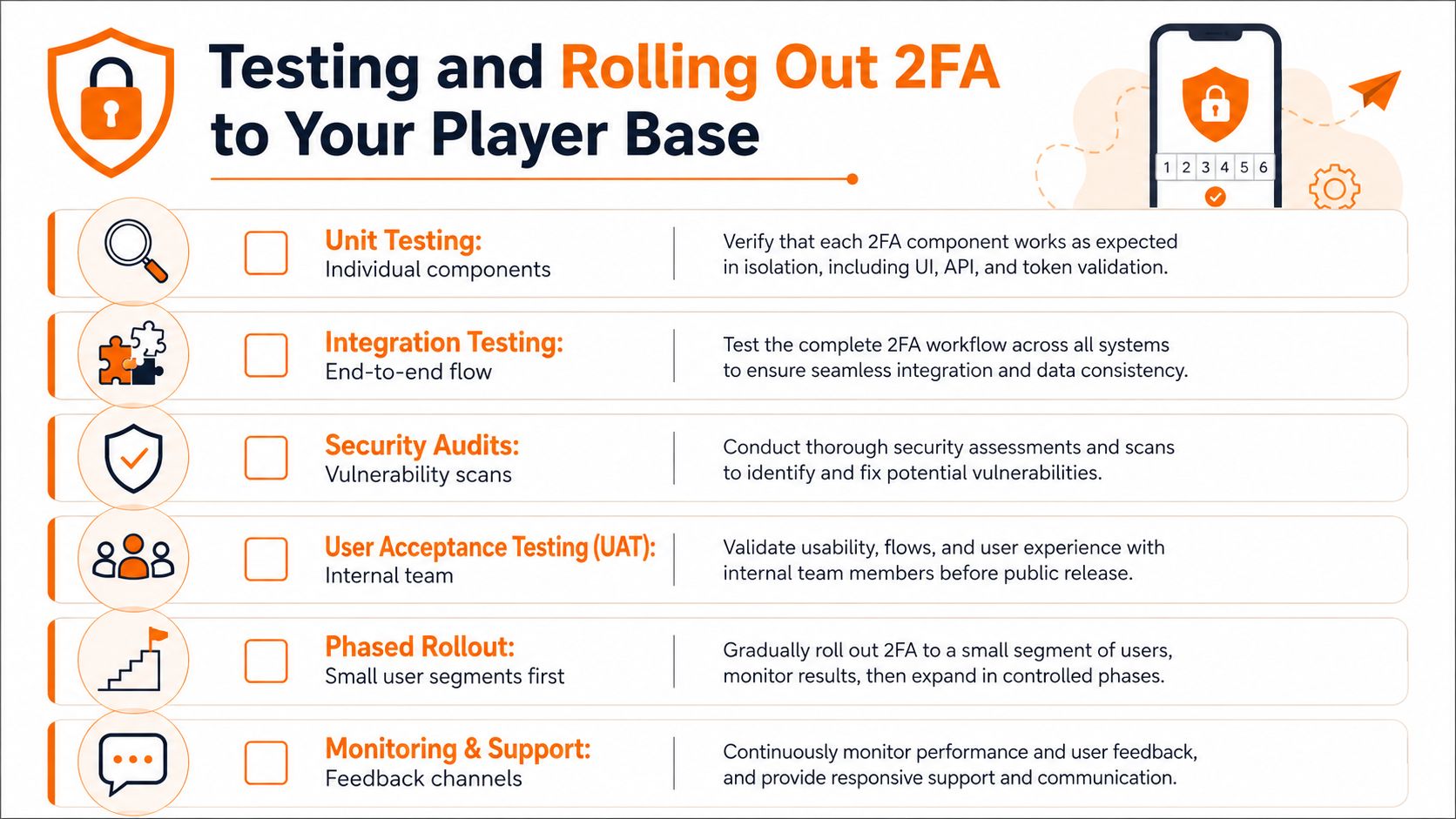
Use unit tests for secret generation, QR payload formatting, and code verification logic. Then run integration tests that cover password login, temporary token issuance, OTP verification, and final session creation. Security review should include rate limiting, replay handling, recovery code storage, and the disable-2FA path, because those are the routes attackers probe first.
User acceptance testing should include support, fraud, and operations staff, not just engineers. They're the people who will notice if enrollment language is confusing or if the recovery path creates friction. If internal users can't complete the flow without help, players won't fare better.
Roll out in layers, not all at once
Start with back-office staff, because their risk is highest and their user count is manageable. Then move to VIP players with dedicated support, where you can absorb edge cases without overwhelming the help desk. General player rollout comes last, once you've confirmed that messaging, recovery, and verification behave predictably.
A staged rollout gives you a chance to watch support tickets, failed enrollments, and verification retries before the whole player base is affected. It also helps you catch differences between desktop and mobile behavior. Those differences are common in iGaming because players often move between devices fast and expect the same session continuity everywhere.
Practical rule: Don't call the rollout complete until recovery and disable flows have been exercised under real support conditions.
The safest launch plans treat 2FA as a product change, not a backend toggle. That means communication, player education, and explicit expectations around what happens if a device is lost or replaced. If you skip that work, the first wave of tickets will write your rollout plan for you.
Monitoring 2FA Health and Responding to Failures
A healthy 2FA system doesn't just block attacks. It also stays invisible to legitimate users most of the time. Once it starts creating lockouts, support debt, or weird recovery patterns, the control is hurting the product even if the security posture looks good on paper.
Operational signals worth watching
Track enrollment completion, verification success, recovery code usage, support tickets tied to 2FA, and time to resolve lockouts. Those signals tell you whether users are getting through the flow cleanly or falling into the recovery path too often. If recovery code consumption spikes, that usually means device churn, poor enrollment instructions, or a broken app upgrade path.
You should also watch for repeated failures from the same account or the same network segment. That doesn't automatically mean an attack, but it does mean your throttling, challenge policy, or account recovery rules need attention. Rate limits should be enforced before the OTP check becomes a brute-force target.
The response playbook should separate user error from suspicious behavior. A legitimate player who mistyped a code twice doesn't need the same treatment as a coordinated attack against recovery flows. If your help desk resets 2FA too easily, attackers will eventually treat support as a bypass.
Operational insight: Treat 2FA telemetry as a fraud signal, not just an auth metric.
You'll also want a documented response path for suspected bypass attempts. That means locking down recovery temporarily when an account shows unusual activity, notifying the user through the verified channel, and preserving the event trail for review. In regulated environments, the auditability of the response matters almost as much as the response itself.
If you want a team that understands how 2FA, wallets, compliance, and player experience fit together in regulated gaming, visit NexGrate. They build the operational stack behind casino and sportsbook brands, and that includes the kind of access control thinking needed to ship 2FA without creating a support nightmare.