A live casino table is full, bets are arriving rapidly, and players are watching wallet balances update on their phones. Then one database node stops responding. The payment service still accepts a deposit, the betting engine records a wager, but the balance service can't confirm which transaction came first. Support agents face angry players, operations teams freeze withdrawals, and compliance staff start asking whether the audit trail is complete.
That situation isn't solved by keeping “a backup” somewhere. Data redundancy means deliberately maintaining additional copies, fragments, or service locations so an iGaming platform can continue operating or recover accurately after failure. The difficult part is choosing enough redundancy to protect wallets, bets, settlements, and regulatory records without creating unnecessary cost, latency, synchronization problems, or a wider failure surface.
Table of Contents
- Introduction to Data Redundancy
- History and Hidden Costs of Redundant Data
- Understanding Redundancy Models
- Consistency and Availability Tradeoffs
- Applying Redundancy to Transactional Gaming Data
- RTO and RPO Planning and Testing
- Conclusion and Best Practices
Introduction to Data Redundancy
Start with a simple distinction. A backup helps you restore information after an incident. Replication keeps another copy available for continued service. Storage redundancy protects data when a disk, server, or storage node fails. These mechanisms overlap, but they solve different operational problems.
For an online casino or sportsbook, the most sensitive data usually falls into separate groups:
- Transactional data: Wallet movements, deposits, withdrawals, bet placement, bonus awards, and settlement decisions need strong integrity.
- Operational data: Session information, game configuration, odds caches, and reporting views may tolerate different recovery behavior.
- Historical data: Completed bet records, invoices, reports, and audit archives need durable retention and trustworthy restoration.
- Non-production data: Test and staging copies help engineering teams, but they shouldn't receive the same protection profile as a live wallet ledger.
The right design assigns each group an appropriate recovery method. A player balance shouldn't depend on the same policy as a video replay archive, and a compliance log shouldn't be treated like a disposable cache.
Practical rule: More copies don't automatically mean more resilience. Every copy needs an owner, a purpose, a protection policy, and a tested recovery path.
This guide follows that decision process. It begins with the historical lesson that hidden data creates substantial overhead, then compares backups, replication, erasure coding, availability zones, and regions. It also examines the consistency and availability choices behind wallet and betting transactions, applies those choices to a complete gaming flow, and finishes with RTO and RPO testing.
The objective isn't to duplicate everything everywhere. It's to build a platform that can survive realistic failures, preserve player trust, meet governance obligations, and keep infrastructure spending aligned with business value.
History and Hidden Costs of Redundant Data
Redundancy started as a practical response to fragile hardware. Early enterprise teams copied databases to tape, mirrored disks, and maintained secondary systems because a failed drive or corrupted file could halt an operation. Modern platforms have more advanced options, but the underlying challenge has changed less than many teams assume: copies accumulate faster than anyone reviews them.
An iGaming operator might create one production database, a reporting replica, a staging refresh, a quality assurance environment, a disaster recovery copy, an analytics extract, and several backups. Each copy may have been justified when created. Over time, teams can lose track of which version is authoritative, how long it should be retained, and whether it contains sensitive player information.
The 2016 Veritas Global Databerg Report found that 52% of enterprise information was dark data and another 33% was redundant, obsolete, or trivial. Together, those categories represented 85% of stored data with little or no operational value in the report's analysis.
That finding matters because useless copies still consume management resources. They may require backup coverage, access controls, encryption, monitoring, retention decisions, security reviews, and deletion approvals. In a regulated gaming environment, an unclassified copy can also complicate the answer to a basic question: which record should an auditor trust?
Why hidden copies become an operational liability
Redundancy creates value when it supports a defined failure scenario. It becomes wasteful when operators replicate information without deciding what recovery requires.
A wallet ledger may need a highly available copy because a failed node shouldn't prevent a valid transaction from completing. A completed game-history archive may need durable, lower-cost storage instead of several high-performance replicas. A temporary test database may need controlled refreshes and masking rather than a permanent mirror of live player data.
The cost isn't limited to storage capacity. Copies can increase:
- Backup duration, because more data must be scanned and protected.
- Security exposure, because every location and credential becomes another control point.
- Governance effort, because retention and deletion policies must cover each copy.
- Synchronization complexity, because replicas can diverge or lag.
- Incident scope, because a faulty deployment may reach multiple synchronized environments.
The historical lesson is straightforward. Before adding another replica, identify the failure it addresses. If the team can't explain the recovery decision, the copy may be creating overhead rather than resilience.
Understanding Redundancy Models
No single redundancy model protects every iGaming workload. Operators normally combine several methods, assigning each one to a particular failure mode and data class.
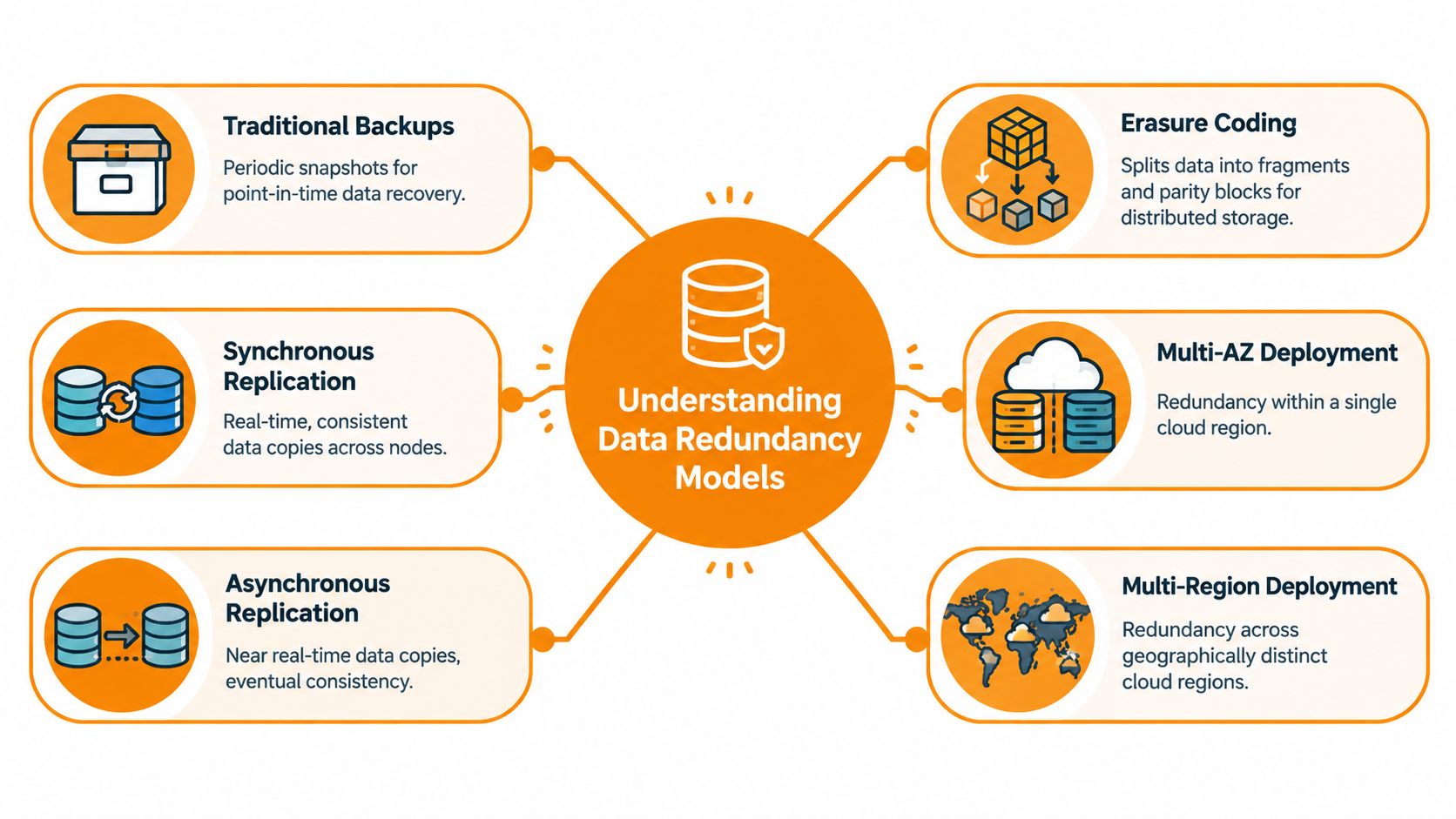
Traditional backups
A backup captures data at a point in time, whether through a database dump, snapshot, or backup stream. It's the safety net for accidental deletion, corruption, ransomware, faulty migrations, and historical restoration.
Backups generally don't provide the same immediate continuity as a live replica. Recovery requires locating a usable restore point, rebuilding services, validating the data, and reconnecting dependent applications. That makes backups especially suitable for bet history, reporting databases, configuration versions, and compliance archives, where recovery accuracy matters more than uninterrupted writes.
A backup also protects against a dangerous assumption: that replication alone is enough. If incorrect data is replicated, the secondary copy may preserve the same mistake. Point-in-time backups give operators a way to return to an earlier known state.
Synchronous replication
Synchronous replication commits a write to multiple nodes before the system confirms success. Think of two mirrored game servers in nearby facilities checking the same score before either accepts the result as final.
This approach supports strong consistency for sensitive transactions, but it adds coordination and can increase write latency. A network interruption between the nodes may force the system to pause or reject writes rather than risk conflicting wallet balances. Use it selectively for wallet movements, account ledgers, and other records where duplicate spending or an incorrect balance would be unacceptable.
Asynchronous replication
Asynchronous replication acknowledges the primary write before the secondary copy catches up. It can support geographic separation and reduce the delay imposed on the player-facing transaction, but the secondary may be behind during a sudden failure.
That makes it useful for analytics, reporting, read-heavy services, and disaster recovery copies where some lag is acceptable. Operators need monitoring that shows replication delay and clear procedures for determining which transactions reached the secondary system.
Erasure coding
Distributed storage commonly uses either replication or erasure coding. Replication creates exact copies, while erasure coding divides data into chunks and parity blocks that can reconstruct missing pieces with less storage overhead than full mirroring, as described in this distributed storage research paper.
Erasure coding suits large, durable datasets such as settled-game archives, media, and audit records. It can require more computation and reconstruction work than a direct replica, so it's usually a weaker fit for latency-critical wallet writes.
Multi-AZ and multi-region deployments
A multi-availability-zone design places services in separate facilities within one cloud region. It resembles mirrored game servers on adjacent campuses. It can protect against a local facility or host failure while keeping network paths relatively short.
A multi-region design places copies across geographically distinct regions, more like backup campuses separated by a continent or ocean. It provides broader isolation, but introduces more latency, more complex failover, additional data-transfer considerations, and harder consistency decisions. Use it when the business must address regional disruption, regulatory separation, or geographic recovery requirements.
For teams assessing a complete platform architecture, the online casino software development overview provides useful context on how game, payment, account, and back-office components fit together. Redundancy decisions should follow those service boundaries instead of treating the whole platform as one undifferentiated database.
Consistency and Availability Tradeoffs
A network partition creates a difficult choice. Two parts of a distributed system can no longer communicate reliably, and the platform must decide whether to keep serving requests or wait until it can confirm a single, authoritative state.
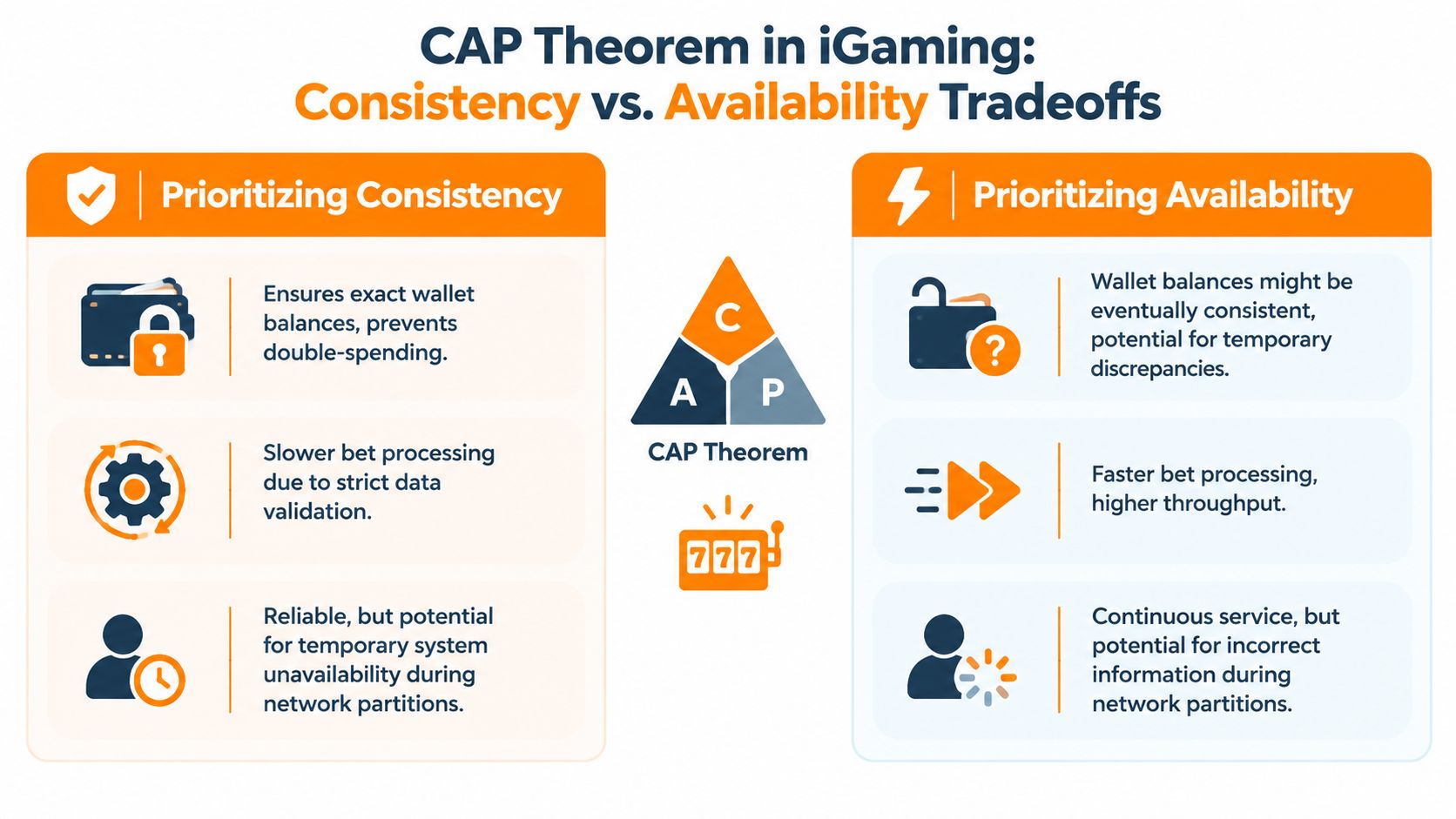
The CAP tradeoff becomes tangible during a live match. Suppose a player submits a wager while the primary wallet service can't reach its replica. A consistency-first design pauses the transaction until it can validate the balance and write the required records safely. An availability-first design may continue accepting activity, then reconcile the records later.
Neither choice is universally correct. The risk depends on the transaction.
Consistency-first decisions
For wallet debits, withdrawals, bonus balances, and bet acceptance, strong consistency usually protects the most important trust boundary. The system should know whether funds were available, whether a transaction was already processed, and whether the wager was accepted under the correct conditions.
The customer experience may become slower or temporarily unavailable during a partition. That inconvenience is visible, but a temporary refusal is often easier to explain than a balance that appears to support two competing transactions.
A consistency-first policy should define:
- The authoritative ledger, which determines the final balance.
- The commit condition, such as confirmation from the required storage nodes.
- The user message, which distinguishes a pending transaction from a rejected one.
- The reconciliation rule, which prevents retries from creating duplicate financial events.
Availability-first decisions
Availability-first behavior keeps the interface responsive and preserves service continuity, but it can expose temporary discrepancies. A player might see a stale balance, a bet could remain pending, or a reporting view might show a result before another service has received it.
That model can fit lower-risk functions, including odds browsing, game catalogs, promotional content, and some read-only account views. It requires idempotent transaction handling, clear pending states, and reconciliation jobs that can resolve conflicts without imperceptibly changing the player's financial position.
A fast response isn't a successful transaction unless the platform can explain and preserve the final state.
The operational cost of outages also deserves attention. The Uptime Institute's 2025 data center survey reported that 50% of data center operators had experienced at least one impactful outage in the previous three years, and one in five significant outages cost more than $1 million. The same survey identified power issues as a leading cause, which shows why copying data alone can't address every dependency.
Teams should therefore separate decisions by function. Strong consistency belongs around financial truth. Availability can take priority for services that can safely tolerate stale information. A resilient architecture also considers power, networking, identity systems, deployment tooling, and operators' ability to execute failover under pressure. For broader platform protection, DDoS protection hosting is one part of that wider availability plan, not a substitute for transaction integrity.
Applying Redundancy to Transactional Gaming Data
Consider a player moving through a normal sportsbook and casino session. The player deposits funds, receives confirmation, opens a game, places a wager, and later receives a settlement. Each event has a different recovery consequence, so applying one redundancy setting to the entire flow creates avoidable cost or risk.

Deposit and wallet posting
The payment provider sends a deposit result to the cashier. The platform should record the provider reference, player account, currency, amount, status, and internal transaction identifier in an authoritative ledger. A retry must not create a second credit, so the ledger needs an idempotency rule that recognizes the same provider event.
For this write path, synchronous replication is a strong candidate. The wallet service can confirm the deposit only after the required replica acknowledges the transaction, reducing the chance that a node failure leaves the customer with an uncertain balance. The design may accept a modest latency cost because the player's financial position matters more than shaving every possible moment from the response.
Currency rules add another layer. A platform supporting several balances should keep conversion, rounding, and transaction references explicit rather than hiding them in loosely synchronized copies. Operators designing those flows can review multi-currency wallet architecture for the account and payment considerations that affect redundancy boundaries.
Bet placement
The betting engine receives the selection, odds or game reference, stake, player identifier, and wallet authorization. It should create a durable bet record and a linked wallet event, with a clear state such as pending, accepted, rejected, or cancelled.
A synchronous wallet decision can prevent the platform from accepting a wager against an unavailable balance. The bet record itself may be replicated to a nearby secondary node for continuity, while an asynchronous copy can feed reporting or a geographically separate recovery environment. The important control is not limited to the number of copies. It's the relationship between the bet identifier, wallet debit, provider event, and eventual settlement.
Treat the wallet ledger as the financial source of truth, and treat replicas as recovery mechanisms rather than competing authorities.
Settlement and reconciliation
When a game or sporting event ends, the settlement service applies the result. It may credit winnings, release a pending amount, close the bet, and publish an event to reporting, customer notifications, and compliance systems.
Settlement should be repeatable. If a message is delivered twice, the system needs to recognize that the bet has already been settled rather than issuing another credit. Historical bet logs can be copied asynchronously because the primary operational concern is preserving the authoritative event sequence, not making every reporting query write synchronously across distant regions.
Later, operators can place immutable or tightly controlled audit records into erasure-coded storage. That approach is appropriate for large archives that need durability and economical retention, but the restore process must reconstruct the data and validate its integrity before compliance staff rely on it.
The player-facing service and the archive don't need identical performance characteristics. Keeping them separate prevents a slow archive rebuild from blocking a wallet debit, while clear references allow auditors to trace the financial event back to its original record.
The following video can help teams discuss redundancy and recovery as an operational design problem rather than a storage checkbox.
Finally, control non-production copies deliberately. The Perforce Delphix 2026 test data management research reported that 43% of surveyed enterprises kept one to four non-production copies per dataset, while 50% kept five to six. It also said non-production environments could contain as much as 90% redundant data. Those copies can help testing, but they need masking, access restrictions, lifecycle rules, and restore tests that prove the environment can support the intended use.
RTO and RPO Planning and Testing
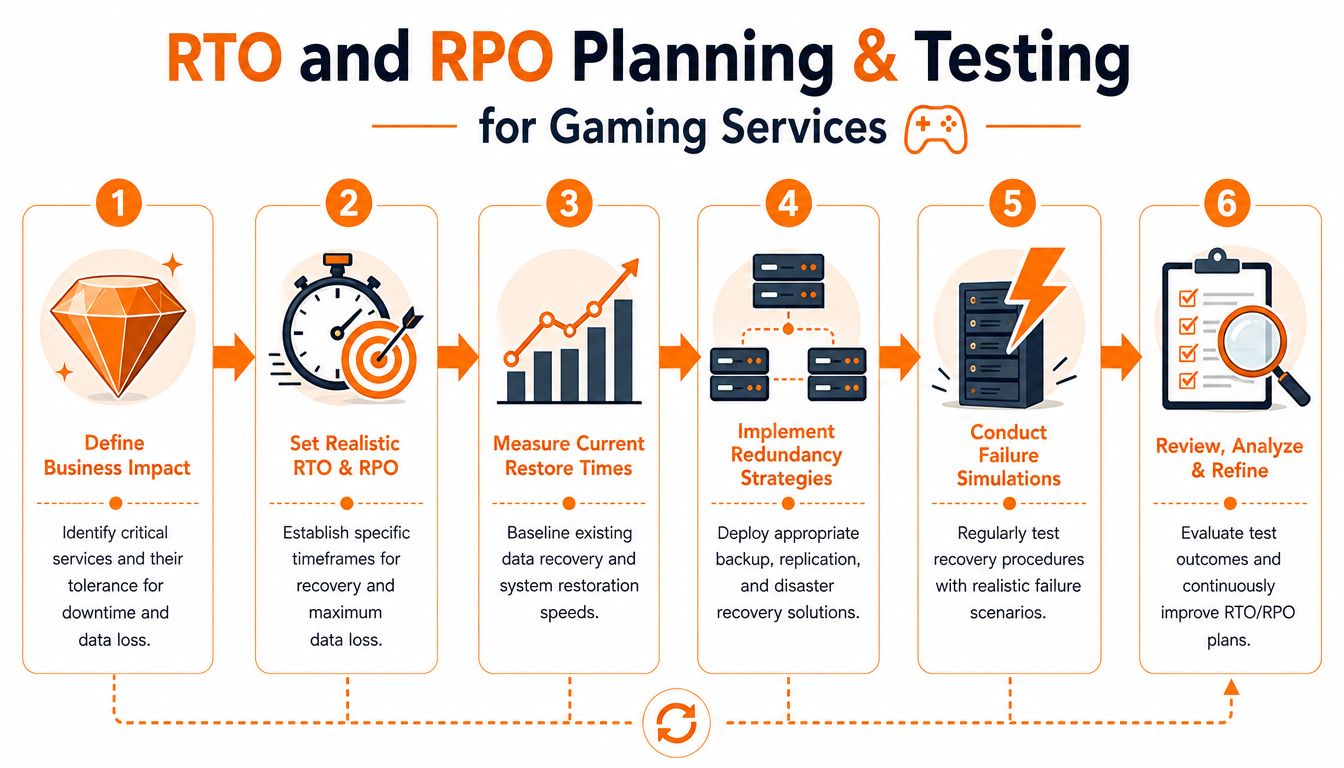
Recovery Time Objective, or RTO, defines how quickly a service must return after disruption. Recovery Point Objective, or RPO, defines how much recent data the business can afford to lose or reconstruct. These are business decisions expressed as technical requirements, not values that a storage vendor can choose in isolation.
A wallet service may need a tighter recovery profile than a marketing dashboard. A compliance archive may tolerate a longer restoration process if the records remain complete and verifiable. An odds display may recover differently from the settlement engine because stale odds and missing financial events have different consequences.
Define the recovery requirement
Start with a service inventory. Name the owner, dependencies, data source, customer impact, regulatory importance, and acceptable operating mode for each component.
Then document the failure scenario. “Database outage” is too broad. Separate a failed storage node, corrupted table, unavailable availability zone, lost region, compromised credential, broken deployment, and power-related facility incident. Each scenario can require a different recovery path.
Set objectives from evidence
Avoid choosing an RTO because it sounds impressive. Measure how long the team currently takes to detect an incident, authorize failover, restore data, validate dependencies, and reopen traffic. Include human approval steps, secrets access, DNS or routing changes, queue recovery, and third-party payment behavior.
For RPO, identify which events the secondary system has received and which events remain in transit. A platform that claims minimal data loss must demonstrate how it captures, replays, or reconciles those events after a failure.
Use a service matrix to make disagreements visible:
| Service | Primary concern | Recovery question |
|---|---|---|
| Wallet ledger | Financial correctness | Can the platform prove the final balance and prevent duplicate posting? |
| Bet acceptance | Transaction integrity | Can it identify accepted, rejected, and pending wagers? |
| Settlement | Accurate player credit | Can it replay the result without issuing a duplicate win? |
| Compliance archive | Completeness and traceability | Can staff restore and validate the required record set? |
| Analytics | Operational continuity | Can reporting resume with an acknowledged delay? |
Measure, simulate, and inspect
A recovery plan is only credible after a controlled exercise. Begin with a non-production rehearsal, then test a production-like environment under an approved change window.
- Fail over deliberately: Remove a node, interrupt a replica path, or isolate a service dependency according to the scenario being tested.
- Record elapsed time: Capture detection, decision, failover, restoration, validation, and full service times separately.
- Check transaction integrity: Compare wallet events, bet identifiers, settlement states, and payment references. Look for missing, duplicated, or reordered records.
- Test application behavior: Confirm that retries remain safe, pending transactions display correctly, and player sessions don't create duplicate submissions.
- Validate performance: Recovery isn't complete if the service is technically online but queues, database locks, or downstream providers can't handle normal demand.
- Audit the result: Record what failed, what required manual intervention, which assumptions proved false, and what action has an owner and deadline.
A declared RTO or RPO is a hypothesis until a failure drill measures it.
The Perforce Delphix research also highlights why teams should test real restoration instead of assuming that copies are usable. Enterprises often maintain several non-production copies, and those environments can contain substantial redundant data, so a successful backup job doesn't prove that operators can restore the right dataset, in the right order, with the right permissions.
Repeat exercises after major schema changes, provider migrations, region changes, and wallet upgrades. Review retention policies at the same time. If a copy no longer supports a business requirement, remove or downgrade it. If a recovery test exposes a gap, improve the architecture and rerun the scenario until the documented process matches what the platform can deliver.
Conclusion and Best Practices
Effective iGaming data redundancy is selective, tested, and tied to business risk. Use strong protection for wallet and settlement truth, asynchronous methods where lag is acceptable, erasure coding for durable archives, and geographic separation when the failure scenario justifies its complexity.
Operators should:
- Review architecture: Map every critical record, dependency, replica, and restore path.
- Monitor cost: Identify unused, duplicated, obsolete, or overprotected copies.
- Test failover: Run controlled drills and compare actual recovery with declared RTO and RPO.
- Govern access: Mask non-production data and assign retention owners.
- Validate integrity: Check for missing, duplicated, and conflicting transactions after recovery.
NexGrate gives iGaming operators a unified white-label platform for casino, sportsbook, wallets, payments, compliance controls, monitoring, and hosting operations. Visit NexGrate to discuss a resilient platform strategy that balances uptime, recovery confidence, and infrastructure cost.