
At 3 a.m., during a major football fixture, your sportsbook's payment page starts timing out. Live-betting traffic is rising, latency alerts are firing, and the duty director has to decide whether the issue belongs with the platform team, the payment provider, or the DDoS response team. Meanwhile, the uptime clock is running, players are abandoning bets, KYC transactions are failing, and the incident is becoming part of the operator's audit trail.
That's the operational reality behind uptime guarantees. The percentage in a contract matters, but it's only the opening question. For an iGaming brand, the protection you can rely on depends on the measurement window, excluded events, dependency chain, monitoring evidence, service-credit formula, and the infrastructure standing behind the promise.
Table of Contents
- What Uptime Guarantees Really Mean for an iGaming Brand
- From 99% to 99.99% Translating Percentages into Real Downtime
- Reading the SLA Fine Print Credits, Windows, and Exclusions
- Credit Tiers Versus Real Service Credits Compared
- Negotiating an SLA That Holds Up Under MGA Oversight
- How Hosting and DDoS Protection Back the Promise
- Operator Checklist Before You Sign the Uptime Clause
What Uptime Guarantees Really Mean for an iGaming Brand
An uptime guarantee is a contractual commitment that a defined service will remain available for a defined period. The commitment normally appears in a service-level agreement, or SLA, and describes availability as a percentage. The critical detail is the service definition. “Platform availability” might mean that a provider's dashboard responds, or it might mean that players can log in, complete KYC, deposit, place bets, receive settlement, and withdraw funds.
Those are not equivalent promises.
For a regulated operator, availability is also broader than a commercial performance metric. A failed cashier can interrupt deposits and withdrawals. A failed KYC integration can prevent onboarding. A sportsbook outage during an in-play market can affect bet acceptance and settlement. Each incident may require internal classification, investigation, evidence retention, and reporting under the operator's governance processes.
Practical rule: Treat the SLA as an operational control document, not as a procurement summary.
Availability is only one service metric
Availability answers whether the service was reachable and functional under the contract's definition. It doesn't tell you how quickly the provider acknowledged an incident, how long engineering took to restore service, or whether the platform remained technically reachable while transactions failed.
Keep these measures separate:
- Availability: Whether the agreed production service could be used.
- Response time: How quickly the provider acknowledged and triaged the incident.
- Restoration time: How quickly normal service returned.
- Resolution time: How quickly the provider completed the underlying fix.
- Evidence quality: Whether both parties can reproduce the calculation from independent records.
A provider can meet an availability target while offering weak incident response. It can also restore access quickly while leaving the underlying defect unresolved, creating repeat failures during the next peak event.
Marketing language isn't contractual protection
A website may promote “high availability,” “enterprise reliability,” or “always-on infrastructure.” Those phrases carry little weight unless the agreement defines the service, the measurement method, the exclusions, and the remedy for failure. The contract should identify the production wagering and cashier endpoints that count, rather than measuring an auxiliary component that players never use.
Google Cloud provides a useful illustration of availability tiers in public contractual documentation. Its Compute Engine SLA covers a single instance in the general family at 99.9% monthly uptime, while multi-zone configurations reach 99.99%, as summarized in this uptime guarantee benchmark. The distinction is architectural, not cosmetic. More redundancy changes the failure modes the provider can tolerate.
For an MGA-style operator, the right question isn't “Which provider advertises the highest percentage?” It's “Which player-facing functions count, who measures them, and what happens when a dependency fails?”
From 99% to 99.99% Translating Percentages into Real Downtime
Percentages become useful only after you translate them into time. The calculation is straightforward:
Allowable downtime = total minutes in the measurement period × (1 − availability percentage).
For a 30-day month, there are 43,200 minutes. For a year, there are 525,600 minutes. Applying the formula produces the following practical comparison. The yearly figures use a 365-day year.
| Availability Tier | Monthly Downtime, 30 Days | Yearly Downtime | Typical iGaming Risk |
|---|---|---|---|
| 99% | 7 hours 12 minutes | 3 days 15 hours 36 minutes | A major outage can consume the budget quickly and interrupt several player journeys |
| 99.5% | 3 hours 36 minutes | 1 day 19 hours 48 minutes | Repeated service disruption can affect cashier, KYC, or betting operations |
| 99.9% | 43 minutes 12 seconds | 8 hours 45 minutes 36 seconds | One multi-hour incident or several peak-period failures can use the allowance |
| 99.95% | 21 minutes 36 seconds | 4 hours 22 minutes 48 seconds | Short incidents during fixtures can consume a meaningful share of the budget |
| 99.99% | 4 minutes 19.2 seconds | 52 minutes 33.6 seconds | There's little tolerance for an unplanned failure during a high-value sporting event |
The 99.9% baseline, commonly called “three nines,” permits about 43.2 minutes of monthly downtime and roughly 8.76 hours annually, according to this documented uptime calculation. That's why it remains a common reference point in cloud and SaaS agreements. It sounds strong until an operator considers when those minutes occur.
A four-hour failure on a quiet weekday and a four-hour failure during a Champions League final consume the same contractual time. They don't create the same commercial, player, or compliance impact. A calendar-month calculation can therefore look acceptable while hiding the operational cost of an outage at the worst possible moment.
Why the extra nine changes the negotiation
The move from 99.9% to 99.99% cuts the monthly allowance from about 43 minutes to about four minutes. That gap is the key bargaining point. A provider promising four nines needs stronger failover, faster detection, tighter deployment controls, and more disciplined operational procedures than a provider offering three nines.
The calculation also gives finance and compliance teams a way to test a proposal without relying on the provider's presentation. Multiply the minutes in the agreed window by the permitted unavailability fraction. Then ask whether scheduled maintenance, partial failures, slow transactions, and third-party incidents are included.
The table is meaningful only if the SLA measures the functions the brand sells. If the agreement measures an API health check while the cashier is unusable, the percentage can remain intact while the operator experiences a commercial outage. A high number applied to the wrong endpoint is still weak protection.
Reading the SLA Fine Print Credits, Windows, and Exclusions
The headline percentage is often the easiest part of an SLA to understand. The difficult part is discovering what the provider removes before calculating it.
Start with the measurement window. A contract may calculate availability per incident, over a rolling period, or by calendar month. Each method changes the result. A monthly window can absorb several incidents into one total, while an incident-based method may treat each event separately. Neither approach is automatically fair. The operator needs a method that reflects how service failure affects players and regulated operations.
Define the measurement boundary
The SLA should name the services included in the calculation. For an iGaming platform, that may include:
- Player access: Login, account pages, responsible-gaming controls, and geolocation checks.
- Wagering: Pre-match and in-play bet placement, odds retrieval, acceptance, and settlement.
- Casino delivery: Game launch, session continuity, jackpot interfaces, and live-dealer access.
- Cashier functions: Deposits, withdrawals, wallet updates, and payment status.
- Compliance workflows: KYC, AML screening, audit logs, and regulatory reporting interfaces.
If the database tier, origin shield, payment connector, or jackpot random-number-generation service is excluded, the platform's effective availability can be limited by the excluded component. The vendor may meet its own metric while the operator's complete service path fails.
Exclusions decide the effective guarantee
Common exclusions include scheduled maintenance, force majeure, customer configuration errors, third-party providers, network incidents, and DDoS attacks above a stated threshold. Each exclusion may be commercially reasonable in a narrow context, but broad wording can remove the events most likely to hurt the brand.
Independent 2025 analysis cited in this SaaS SLA review identified a gap between vendor-reported outage duration and what customers observed, while also noting that many vendors experienced at least one potential SLA violation. That finding reinforces a practical point: the operator needs independent monitoring and a jointly agreed evidence process.
A payment processor outage shouldn't automatically excuse the platform if the provider promised a functioning cashier orchestration layer. A DDoS exclusion shouldn't cover every attack if the provider sells DDoS mitigation as part of the service. Force majeure shouldn't become a substitute for capacity planning.
Contract test: Ask which excluded event the provider expects the operator to prevent, and which control the provider will supply when prevention fails.
Credits are usually the remedy
Service credits are the standard contractual remedy. They typically reduce a future invoice or refund part of the monthly service fee after a breach. They rarely compensate the operator for lost wagering activity, player complaints, compliance work, or reputational harm.
The contract should specify how credits are calculated, whether the operator must submit a claim, when the claim is due, and whether the credit is the sole remedy. It should also state whether repeated failures trigger additional obligations, such as an RCA, remediation plan, executive escalation, or termination rights.
Finally, assign ownership of monitoring evidence. A provider-controlled probe is not enough. The operator should retain external synthetic checks, transaction tests, incident timestamps, and relevant application logs so the parties can compare records after an event.
Credit Tiers Versus Real Service Credits Compared
A credit-only SLA and a tiered accountability SLA may use similar availability language, but they buy very different outcomes.
Under a credit-only model, the provider calculates downtime, applies a percentage to the monthly fee, and closes the matter. The contract may not require a root-cause analysis, a corrective-action plan, or an engineering escalation. The operator receives a financial adjustment, but the recurring failure can remain an operational risk.
A tiered SLA links the availability breach to escalating obligations. The provider may owe higher credits at worse availability levels, produce a written RCA, meet a restoration target, and provide a remediation plan. The contract can also impose additional remedies when the same class of failure repeats.
| Clause | Credit-Only SLA | Tiered Service-Credit SLA |
|---|---|---|
| Primary remedy | Refund or credit against the service fee | Credits combined with operational and contractual remedies |
| Incident investigation | May be optional | RCA required under a defined trigger |
| Corrective action | No guaranteed commitment | Written remediation plan with owners and deadlines |
| Escalation | General support route | Named engineering and executive escalation path |
| Repeat failure | Often treated as a new event | Can trigger enhanced remedies, review, or termination rights |
| Operator outcome | Partial financial recovery | Financial recovery plus pressure to prevent recurrence |
Consider a contract with a €40,000 monthly fee and a 99.9% commitment. If a credit-only clause caps recovery at 25% of the monthly fee, the maximum credit is €10,000, even if the outage lasts an entire day. The figures in this example are arithmetic, not a claim about a market standard. The more important point is the remedy structure.
Under a tiered clause, the same failure could require a written RCA, a remediation plan, and contractual remedies if the failure recurs within 30 days. Those terms should be negotiated explicitly. They shouldn't depend on a provider's goodwill after the incident.
The useful SLA question isn't only “What credit do we receive?” It's “What forces the provider to prevent the next failure?”
For an MGA-licensed operator, that distinction matters. Regulators and internal auditors need evidence that the business identifies operational risk, assigns responsibility, preserves records, and follows corrective actions. A refund doesn't demonstrate control maturity. A documented investigation and tracked remediation plan do.
Negotiating an SLA That Holds Up Under MGA Oversight
An SLA for a regulated operator should be written as evidence you could hand to the Malta Gaming Authority during a technical review. Procurement can negotiate price and credits, but compliance and platform leadership must define what the agreement proves about service control.
Add these clauses before signature
Player-facing measurement scope: Name the production endpoints and transaction paths that count, including wagering, cashier, KYC, wallet, settlement, and responsible-gaming functions where applicable.
Peak-period treatment: Require reporting that distinguishes ordinary availability from availability during agreed high-risk periods. A monthly percentage alone can hide the outage that mattered most.
Reproducible credit formula: State the exact calculation, eligible fee base, claim deadline, cap, and treatment of partial service failure. An auditor should be able to reproduce the result from the contract and monitoring records.
Dependency register: Identify CDN, DNS, hosting, payment gateway, KYC provider, game supplier, odds feed, and jackpot services. Assign each dependency an owner and define whether its outage counts, is excluded, or triggers a provider continuity obligation.
Incident classification matrix: Define severity by player impact, transaction impact, geographic scope, and regulatory relevance. A failed dashboard shouldn't receive the same classification as a failed cashier.
RCA obligation: Require a written root-cause analysis within five business days, including timeline, customer impact, contributing controls, corrective actions, and accountable owners.
Audit cooperation: Require access to monitoring evidence, incident records, change records, and remediation status in a format your compliance team can retain and review.
A documented compliance reporting approach should align with this evidence model. The SLA doesn't replace regulatory reporting, but it should make the underlying operational records available and consistent.
Ask dependency questions that expose weak drafting
Before signing, ask who qualifies as a subcontractor, whether the provider remains responsible for subcontractor coordination, and how third-party outages are documented. Ask where the contract draws the line between force majeure and capacity miscalculation. A provider shouldn't classify an avoidable scaling failure as an uncontrollable event.
Also challenge vague phrases such as “commercially reasonable efforts,” “network availability,” and “provider monitoring.” Replace them with named services, measurable evidence, response obligations, and escalation contacts. If the provider refuses to identify the monitoring source or the excluded components, the percentage isn't ready for signature.
How Hosting and DDoS Protection Back the Promise
An uptime commitment is credible only when the infrastructure can produce it. The operator should map every major SLA obligation to a control and an evidence source.
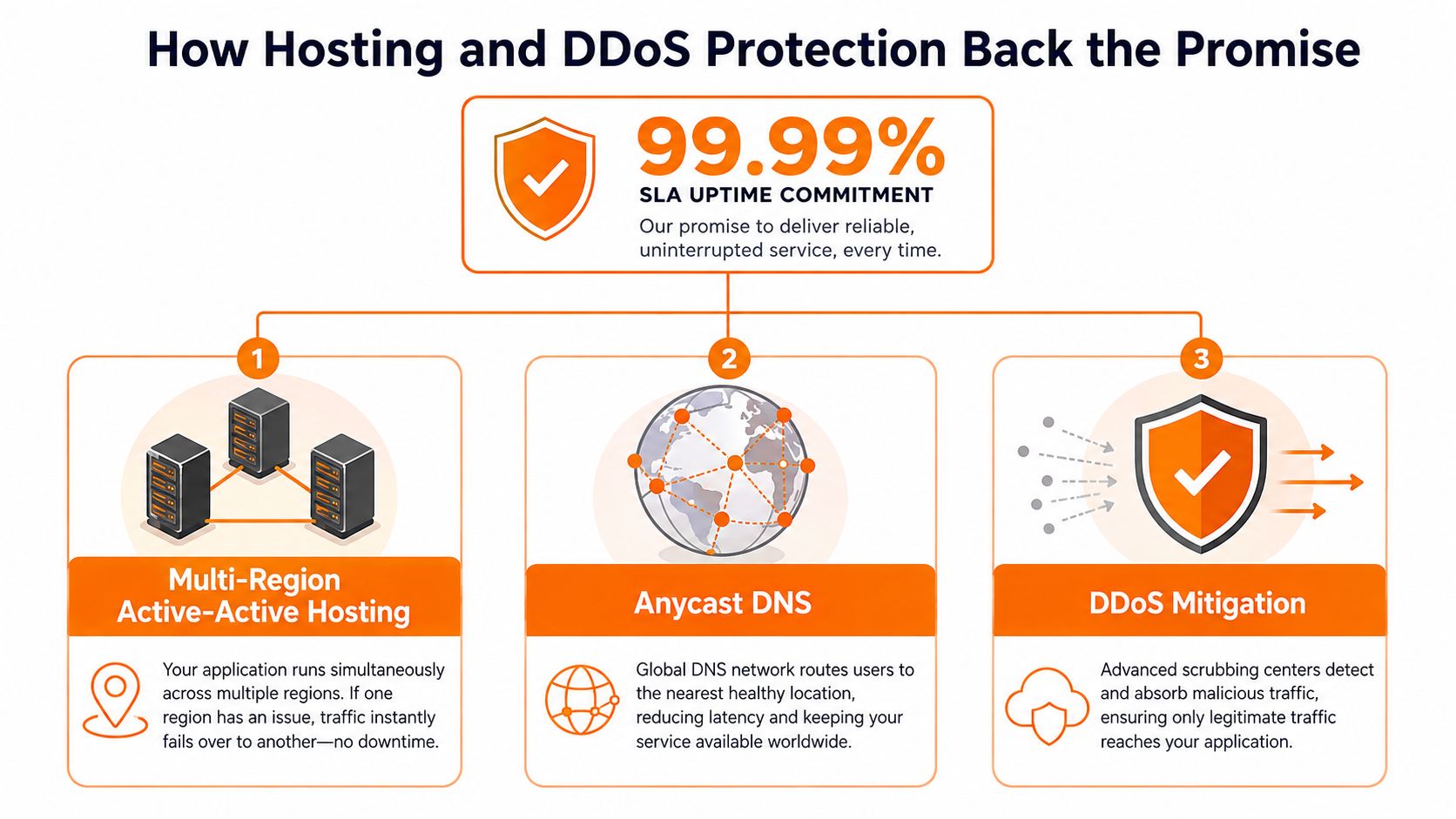
Multi-region active-active hosting reduces dependence on one location by serving production traffic from more than one operating region. Anycast DNS helps direct users toward an available entry point. Together, these controls make a four-nines target physically plausible, but they don't remove risks in shared databases, deployment systems, payment services, or third-party game integrations.
Match evidence to the promise
- External synthetic monitoring: Probes should test login, cashier, KYC, and wagering journeys from outside the provider's network.
- Real-user telemetry: Player-side data can reveal partial failures that a simple health check misses.
- Layer 3 to Layer 7 DDoS mitigation: Protection should cover network floods and application-layer abuse, with clear escalation and traffic-diversion procedures.
- BGP-based failback: The provider should document how traffic returns to normal after mitigation, rather than treating attack diversion as the complete response.
- Round-the-clock NOC coverage: A published escalation chain gives a time-to-restore clause a real operational owner.
The provider should show monitoring records, failover test results, DDoS response procedures, and incident communications. A DDoS protection hosting capability is useful only when the contract explains what it covers and how the operator can verify performance.
The dependency chain deserves special attention. Reliability analysis on modern API stacks explains that composite availability falls as critical third-party services accumulate. With five critical dependencies each advertised at 99.9%, combined end-to-end availability can fall to about 99.5%, creating more than four additional hours of annual downtime, as described in this API reliability analysis. That's why the operator should measure the full player journey, not just the hosting layer.
Operator Checklist Before You Sign the Uptime Clause
Run this verification routine before countersigning:
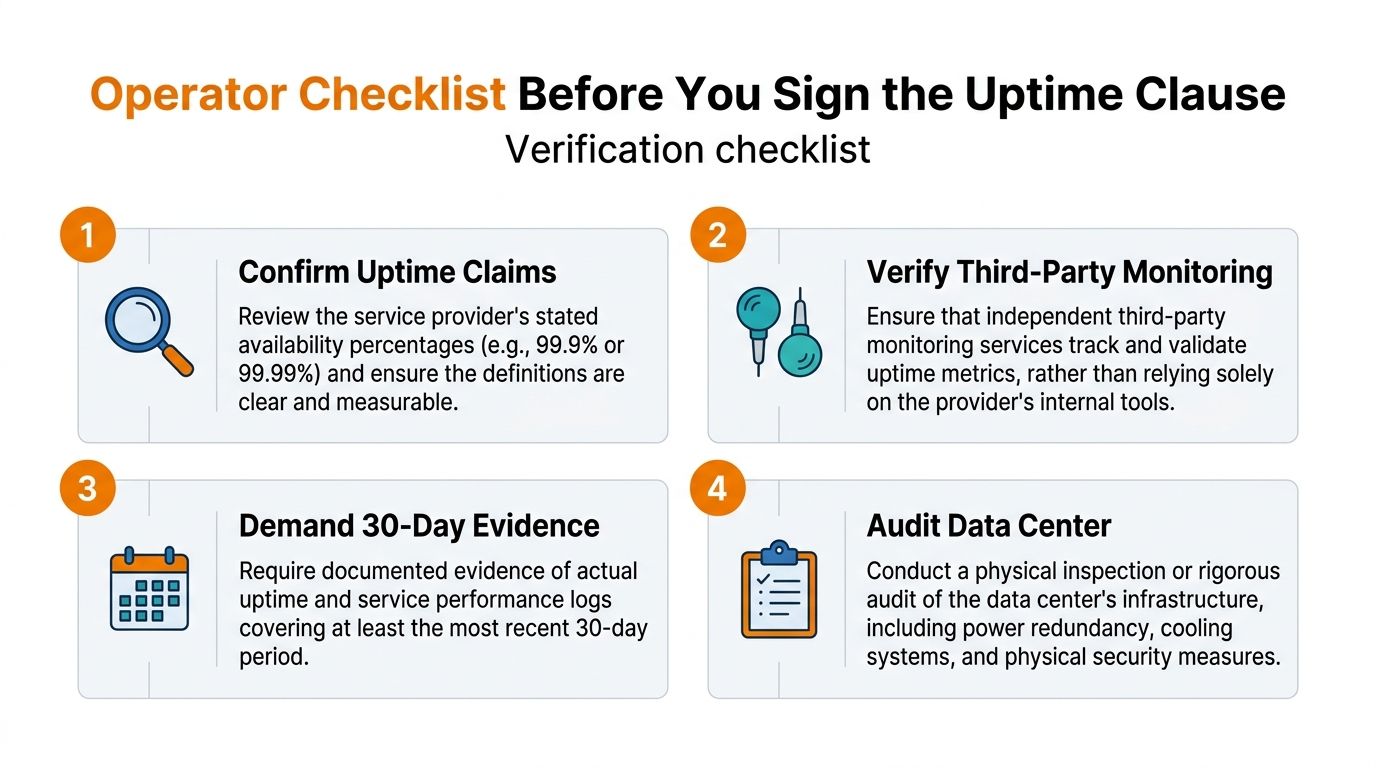
- Confirm the claim: Compare the proposed percentage with the exact production services and player journeys named in the contract.
- Verify independent monitoring: Check the claim against at least two external probes, not only the provider's own monitoring.
- Demand historical evidence: Request a 30-day rolling availability report and a 12-month historical report, with incident definitions and exclusions attached.
- Define exclusions in writing: Require precise wording for scheduled maintenance, force majeure, DDoS events, customer configuration, and third-party dependencies.
- Inspect the architecture: Challenge single-region designs when the provider offers a high-availability target.
- Test DDoS language: Reject vague thresholds measured only in Gbps unless the contract also defines mitigation, notification, escalation, and restoration obligations.
- Review escalation coverage: Obtain named contacts for Malta and UKGC operating time zones, plus an after-hours route.
- Read the last two post-mortems: Look for repeat causes, incomplete corrective actions, and evidence that the provider closes remediation items.
- Confirm audit retention: Verify that logs, monitoring records, incident timelines, and change evidence remain available for the period your regulator and internal policy require.
- Review vendor governance: Use a structured vendor-management process before approval.
Walk away if the provider won't identify the measured endpoints, owns all monitoring evidence, excludes core dependencies, or treats service credits as the only response to repeated outages. Also require a change-of-control clause compatible with MGA license-transfer requirements before the relationship becomes operationally critical.
NexGrate provides a white-label iGaming platform that brings casino, sportsbook, payments, player wallets, KYC and AML workflows, compliance controls, monitoring, and operational support into one environment. Visit NexGrate to assess how its hosting, routing, DDoS protection, and audit capabilities can support a contract-ready uptime strategy for your next regulated launch.