
Saturday night is usually when an iGaming platform earns its reputation, or loses it. A goal changes the match, in-play odds refresh, a casino promotion releases free spins, and a progressive jackpot triggers while players are logging in from multiple markets. The player doesn't care which vendor owns the wallet, sportsbook, casino aggregator, or database. They see one brand, one balance, and one expectation: the next action should work immediately.
That is the practical meaning of peak load management for iGaming. It's the discipline of absorbing synchronized demand without slowing odds updates, stalling spins, delaying withdrawals, or allowing latency to push players toward a competitor. The problem is an infrastructure problem, but operators experience it first as revenue protection, player trust, and controlled liability.
Table of Contents
- What Peak Load Management Means for an iGaming Brand
- Why iGaming Peaks Are Uniquely Punishing
- Core Architectural Strategies for Surviving Spikes
- Operational Practices That Keep Peaks Survivable
- How a Unified Backend Simplifies Peak Load Management
- Common Misconceptions Operators Bring to Peak Planning
- Your Peak Readiness Checklist for This Quarter
What Peak Load Management Means for an iGaming Brand
At 21:00, a sportsbook-plus-casino brand has several workloads competing for the same backend. A striker scores. The odds engine recalculates live markets. Thousands of players claim a free-spins promotion. A jackpot event starts settlement activity across accounts, games, and payment records. At the same time, new users are authenticating, existing users are checking balances, and support agents are opening player histories.
Nothing about that sequence is unusual. The danger comes from the timing.
A platform can have enough capacity for each activity in isolation and still fail when they arrive together. A wallet service that handles routine deposits may struggle when a campaign causes a burst of balance checks and bonus-credit requests. A sportsbook may refresh markets correctly while a shared database becomes saturated by casino activity. A payment request may be valid, yet appear broken to the player because the interface is waiting behind unrelated background work.
Practical rule: Treat every player-facing transaction as part of one platform experience, even when separate teams or vendors operate the underlying components.
Peak load management begins by identifying the difference between normal traffic and a peak event. A peak isn't only the largest number of concurrent users. It can be a short burst in writes, a sudden increase in authentication, a concentrated wave of odds requests, or a cross-product event that makes several services call one another at once.
The reader's practical jobs are straightforward:
- Define the peak: Separate logins, reads, writes, wallet operations, odds requests, game sessions, and settlement work instead of using one vague traffic figure.
- Recognize the iGaming pattern: Sports outcomes, campaign timers, and game randomness create combinations that generic retail planning often misses.
- Choose the right controls: Match auto-scaling, caching, queueing, load balancing, and rate limiting to the workload that is under pressure.
- Simplify the platform decision: Understand how a unified casino and sportsbook backend reduces the seams between wallet, betting, gaming, payments, compliance, and hosting.
The broader energy-sector history offers a useful analogy. Early utility efforts focused on flattening demand curves, while later policy frameworks formalized measures such as time-of-day pricing, load limiting, and flexible scheduling. The same basic principle applies in software: shift, defer, absorb, or reject nonessential work before it interferes with the most time-sensitive activity, as described in this history of peak load management.
Why iGaming Peaks Are Uniquely Punishing
A retail store can place customers in a checkout queue. An iGaming platform has fewer acceptable delays because many actions are time-sensitive, financially consequential, or tied to a live event.
Consider a Champions League final arriving at the same time as a Friday-night casino bonus drop. A goal changes prices and market availability. Players request fresh odds, submit bets, confirm selections, and check whether a wager was accepted. The bonus campaign sends thousands of users toward the same account, wallet, promotion, and game endpoints. Then a progressive jackpot triggers, creating settlement and notification activity across the casino ledger and player-facing interfaces.
Each workload has a different failure mode.
Live betting punishes stale information
In-play betting depends on current market data. Players expect odds and bet status to reflect fast-moving events, so a delay can create confusion over whether a price is still available or whether a wager has been accepted. The platform must protect the integrity of the transaction while keeping the interface responsive.
That requires more than adding web servers. The odds feed, pricing logic, risk controls, bet acceptance path, and settlement process need coordinated capacity. If the odds service is healthy but the wallet confirmation path is overloaded, the player still experiences a failed bet.
Promotions create synchronized wallet pressure
A bonus drop is a scheduled event, not a random browsing pattern. Marketing intentionally concentrates activity into a narrow window. Players may refresh the lobby, claim an offer, receive bonus funds, launch a game, and begin spinning almost simultaneously.
The platform therefore sees a mixture of reads and writes. It must verify eligibility, apply campaign rules, update balances, record audit events, and return a clear result. If every step runs synchronously, a short campaign burst can hold open connections and push unrelated requests into the same queue.
Jackpots fan out across shared services
A jackpot trigger can involve game state, prize logic, account records, notifications, reporting, and settlement. The event may start in the casino, but its consequences reach the wallet, compliance records, player communications, and operational dashboards. The sportsbook doesn't need to be the source of the spike to feel its effects if both products share stateful infrastructure.
This is why iGaming peaks aren't merely larger versions of e-commerce traffic. They're less predictable combinations of reads, writes, real-time updates, and money movement. A sports outcome is external and uncertain. A promotion is planned but concentrated. A jackpot is game-driven and irregular. All three can converge on shared databases and service dependencies.
The electricity sector illustrates why synchronized demand matters. Demand response programs have reduced peak demand in major U.S. markets, with reported reductions ranging from 1.4% to 4.1%, and one 2008 case involved a 38 GW summer-peak reduction, according to the World Bank review of demand response evidence. The software equivalent is selective flexibility: protect critical transactions, then move or slow work that doesn't need to complete in the same instant.
Core Architectural Strategies for Surviving Spikes
A spike becomes a player-experience problem when every request competes for the same limited resources. The platform needs separate ways to absorb read traffic, process delayed work, protect financial actions, and add application capacity without pushing an already busy database past its limits.
Auto-scaling adds capacity where demand appears
Auto-scaling adds application capacity as demand rises, then removes excess capacity when the event ends, much like a restaurant opens extra tables during a rush. Horizontal scale-out adds more stateless web or game instances and is usually easier to automate than repeatedly enlarging a stateful database.
Stateless services can accept work through a load balancer without keeping a player's complete history inside one process. Stateful systems need tighter controls because connections, locks, balances, and ordering rules must remain correct. A sportsbook may need rapid application scale-out, while a wallet service needs controlled write capacity and safeguards against duplicate transactions.
Scaling triggers should follow the service's limiting resource. CPU alone can miss connection saturation, queue depth, request latency, or database contention. The goal is to add capacity where it relieves pressure, not where a dashboard merely shows a convenient signal.
Load balancing prevents one node from becoming the bottleneck
A load balancer distributes requests across healthy instances and removes an unhealthy node from rotation. That keeps one server from becoming the narrow doorway through which every player must pass.
Health checks should test useful behavior, not only whether a process responds. A server that returns a successful health response while its database pool is exhausted is still unhealthy from a player's perspective. Sticky sessions can support live-dealer streams or other connection-sensitive experiences, but player state should not become trapped on one instance.
Caching absorbs repeated reads
Odds displays, game catalogs, configuration data, and selected profile information can create heavy read pressure during a peak. A cache serves repeated requests without sending every screen refresh to the primary database.
The freshness rule must match the data. A game catalog can use a longer time-to-live than live odds. A balance or bet status needs stricter handling because stale financial information damages trust. The decision is what may be cached, for how long, and how the system invalidates it.
Queueing separates urgent work from bursty work
A queue provides a controlled waiting room for work that does not need to finish inside the player's first request. The platform can record a request, return a clear state, and process suitable follow-up tasks asynchronously, such as reporting, notifications, bonus crediting, or selected KYC checks.
That separation protects the front door during a campaign or live event. It also requires idempotency, retry limits, dead-letter handling, ordering rules, and player-visible status. A queue cannot make an unsafe financial workflow safe, but it can stop optional work from consuming every application thread.
Rate limiting protects shared financial endpoints
Rate limiting controls how quickly a client, account, session, or service can call a sensitive endpoint. Wallet, bonus, authentication, and game-launch routes need different policies. A blanket limit may block legitimate players during a campaign, while a policy based on identity, route, behavior, and risk can be more precise.
These controls also contain runaway clients and automated bonus abuse before requests consume database connections. Operators should pair application safeguards with dedicated DDoS protection for iGaming hosting, because application controls cannot stop unwanted traffic before it reaches the platform.
| Peak Pattern | Primary Control | Secondary Control |
|---|---|---|
| In-play final | Auto-scaling for odds and betting services | Caching for suitable market reads |
| Free-spins drop | Queueing for bonus crediting | Rate limiting on claim endpoints |
| Jackpot cascade | Queueing for notifications and settlement-adjacent work | Load balancing across account and game services |
| Login storm | Load balancing across authentication instances | Rate limiting and cached configuration |
These controls should operate as one system. A queue preserves responsiveness, rate limiting limits abuse, caching reduces repeated reads, and auto-scaling adds application capacity. Together, they protect the player-facing paths while keeping shared financial services within safe operating limits.
Operational Practices That Keep Peaks Survivable
Architecture gives operators options. Operations determines whether those options are applied before a player sees failed bets, delayed balances, or unclear transaction states.
Capacity planning separates routine demand from event demand
Begin with the traffic curve rather than one maximum figure. Review previous events by workload, including concurrent sessions, login attempts, odds reads, bet submissions, wallet writes, game launches, bonus claims, and settlement jobs. Separate steady-state capacity from burst headroom, then map which services compete for the same resources.
A promotion can consume database connections or message-broker capacity needed for live betting. Reserve protection for high-priority player journeys and include dependencies such as third-party payment calls and observability pipelines. Vendor ownership also matters. Document escalation paths and review vendor management best practices before an event turns an integration issue into an incident.
Capacity plans should count only resources that can respond inside the event window. A review of U.S. wholesale-market demand response reported 33,272 MW in 2024, about 6.5% of RTO/ISO peak demand, as summarized in the research on the real-world ceiling of demand response. For platform teams, the operational lesson is direct: theoretical flexibility is not the same as dispatchable capacity.
Chaos testing makes failure behavior familiar
Run controlled failures before a major sporting event or promotion. Kill a wallet instance, throttle the odds service, force a cache miss, delay a payment provider, or replay staging traffic against production-like dependencies.
The exercise should answer four practical questions:
- Player impact: Can users still log in, view balances, and see a clear transaction status?
- Traffic routing: Does the load balancer remove unhealthy instances quickly?
- Work preservation: Do queued tasks retry safely without duplicate credits?
- Team response: Does the on-call engineer know which feature to throttle and who approves the change?
A useful drill exposes ambiguous ownership, unsafe retries, missing alerts, and undocumented dependencies. It does not need a perfect dashboard to produce useful findings.
Throttling policies decide what bends first
Write degradation rules before the queue grows. Background analytics can slow before wallet confirmation. Nonessential notifications can wait before bet acceptance. Optional casino features can degrade before core account access.
Operational rule: Encode priority in policy, not in the memory of the engineer holding the pager.
Multi-hour events need an operating mode that remains stable under sustained pressure. A European analysis describes prolonged high-residual-load conditions through a combination of efficiency, demand response, storage, flexible electrolysers, heat pumps, and backup generation, with economically optimal flexibility near 30 GW in a German 2035 target scenario, according to the FERC-published demand response assessment. For iGaming, the parallel is a layered plan that controls lower-priority work, protects player-critical paths, and remains predictable after autoscaling has reached its limits.
How a Unified Backend Simplifies Peak Load Management
A fragmented iGaming stack makes every peak an integration exercise. One vendor owns the wallet, another operates the sportsbook, a casino aggregator supplies content, a separate payment layer handles withdrawals, and hosting teams manage the seams between them. Each boundary adds an interface, a queue, a retry policy, an ownership question, and another place for state to diverge.
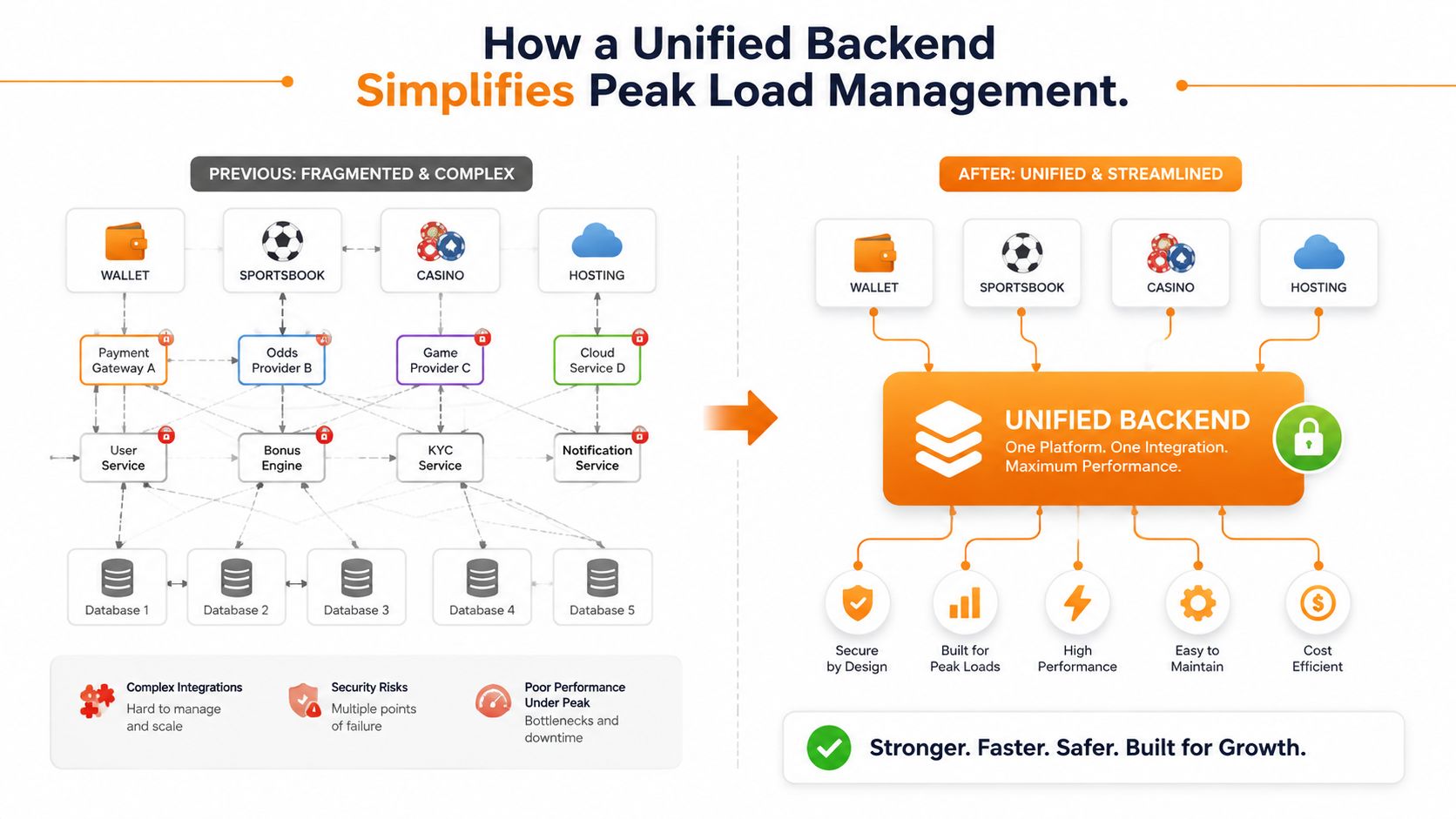
A unified backend changes the unit of planning from the individual vendor to the whole player journey. One wallet and balance service can represent casino spins, sportsbook bets, bonuses, deposits, and withdrawals consistently. That doesn't eliminate scaling challenges, but it reduces the risk that two products apply incompatible rules to the same player state.
Shared state reduces cross-product ambiguity
Suppose a player uses a bet-and-spin promotion. The platform must evaluate eligibility, reserve or credit value, record the campaign event, and launch the relevant product experience. With separate systems, every step can cross a seam. With a shared session and balance model, the operator has fewer sources of truth to reconcile.
The same principle applies to observability. A platform team can trace a player action across account, wallet, sportsbook, casino, payments, and compliance services instead of asking several vendors for partial logs. During a spike, that visibility helps engineers distinguish an overloaded endpoint from a slow dependency or a data inconsistency.
One operating model makes capacity decisions clearer
A unified hosting stack gives teams one deployment pipeline, one monitoring model, and one place to apply scaling and protection policies. Operators can compare the whole-platform demand curve instead of collecting separate forecasts from each vendor and hoping the assumptions align.
This also clarifies economics. If traffic doubles on fight night, the question becomes which shared services need more capacity and which workloads can queue, rather than how many disconnected contracts must change. The result is fewer integration points, clearer ownership, and more consistent handling of cross-product actions.
A unified platform still needs good engineering. It must isolate workloads, protect stateful services, expose meaningful metrics, and support controlled degradation. Its advantage is that these decisions can be applied across the casino and sportsbook rather than rebuilt at every vendor boundary. Operators evaluating iGaming software providers should therefore assess not only feature coverage, but also how the platform represents shared sessions, balances, events, queues, and operational ownership.
Common Misconceptions Operators Bring to Peak Planning
Peak planning often fails because the initial assumption is wrong. More servers, a cloud contract, or a published uptime target can't compensate for unclear priorities and untested dependencies.
| Misconception | What It Costs | Disciplined View |
|---|---|---|
| Overprovisioning solves peaks | Idle capacity raises cost and can hide inefficient code paths | Right-size steady state, then add elastic scale-out and queueing |
| Disaster recovery is a marketing feature | A recovery plan may restore infrastructure without restoring trustworthy player state | Exercise timed runbooks against clear recovery objectives |
| The cloud is magic | Misconfigured autoscalers, hot partitions, and noisy neighbors still create failure | Pair cloud elasticity with caching, limits, observability, and drills |
Overprovisioning is useful when it protects a known critical path, but it isn't a strategy by itself. If a bonus endpoint creates excessive synchronous writes, adding application nodes may push the database into failure faster. Capacity should follow measured bottlenecks and workload priority.
Disaster recovery deserves the same rigor. An impressive availability statement doesn't tell operators whether wallets, bets, bonuses, audit trails, and payment states can be recovered consistently. Teams need tested runbooks, explicit recovery time and recovery point objectives, and evidence that the process works under pressure.
Planning test: If the team can't explain what gets throttled, what gets queued, and how player balances remain consistent, the platform isn't peak-ready yet.
Cloud infrastructure supplies useful primitives, not operational guarantees. Engineers still need to configure scaling signals, protect hot data, control retries, and test failure paths. The disciplined approach treats the cloud as an implementation layer inside a broader peak load management system.
Your Peak Readiness Checklist for This Quarter
Use this quarter to turn peak readiness into a repeatable operating habit.
- Baseline current concurrency: Record logins, API calls, wallet activity, and product mix during the last major event.
- Map patterns to controls: Assign scaling, caching, queueing, or rate limiting to each peak type.
- Validate autoscaling: Run simulated load and observe whether policies react before latency rises.
- Confirm rate limits: Set separate thresholds for wallet, bonus, authentication, and game routes.
- Schedule a payments chaos drill: Test failure handling, retries, and player-visible status.
- Review throttling rules: Ensure bonus campaigns can't starve live betting or withdrawals.
- Align recovery runbooks: Exercise disaster recovery against the traffic profile your brand faces.
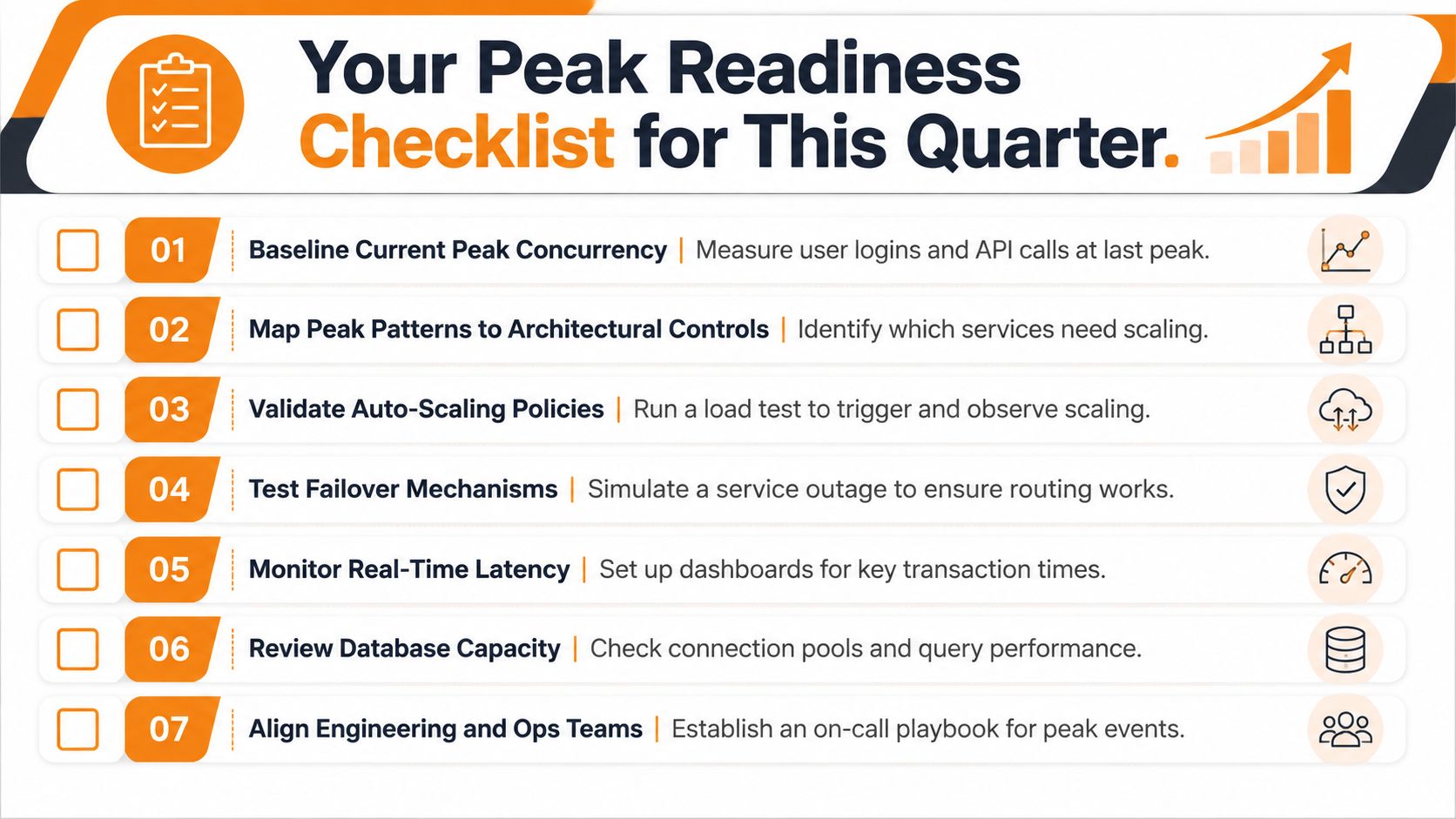
Review the checklist after every major event, not only after an incident. A unified casino and sportsbook backend, managed auto-scaling, shared wallet controls, and built-in queueing can give your team a clearer foundation for that recurring review.
NexGrate provides a turnkey white-label platform that unifies casino, sportsbook, wallets, payments, compliance, hosting, monitoring, and operational controls in one environment. If you're planning a launch or replacing fragmented infrastructure, visit NexGrate to assess a platform built for stable player experiences during peak demand.