At 8:47 PM, a regulated casino's Champions League promotion is driving a sharp rise in traffic. Visa deposits above €50 begin declining, the e-wallet queue grows, and a withdrawal batch stops because the acquiring bank wants updated traffic-quality evidence. None of these failures has the same cause, yet players experience them as one broken cashier.
That's iGaming payment processing. A cashier isn't finished when the API goes live. Operators must keep acquirers comfortable, route transactions around degraded rails, explain traffic changes, control fraud, reconcile every ledger movement, and protect payout speed while regulators and banking partners continue to scrutinize the business.
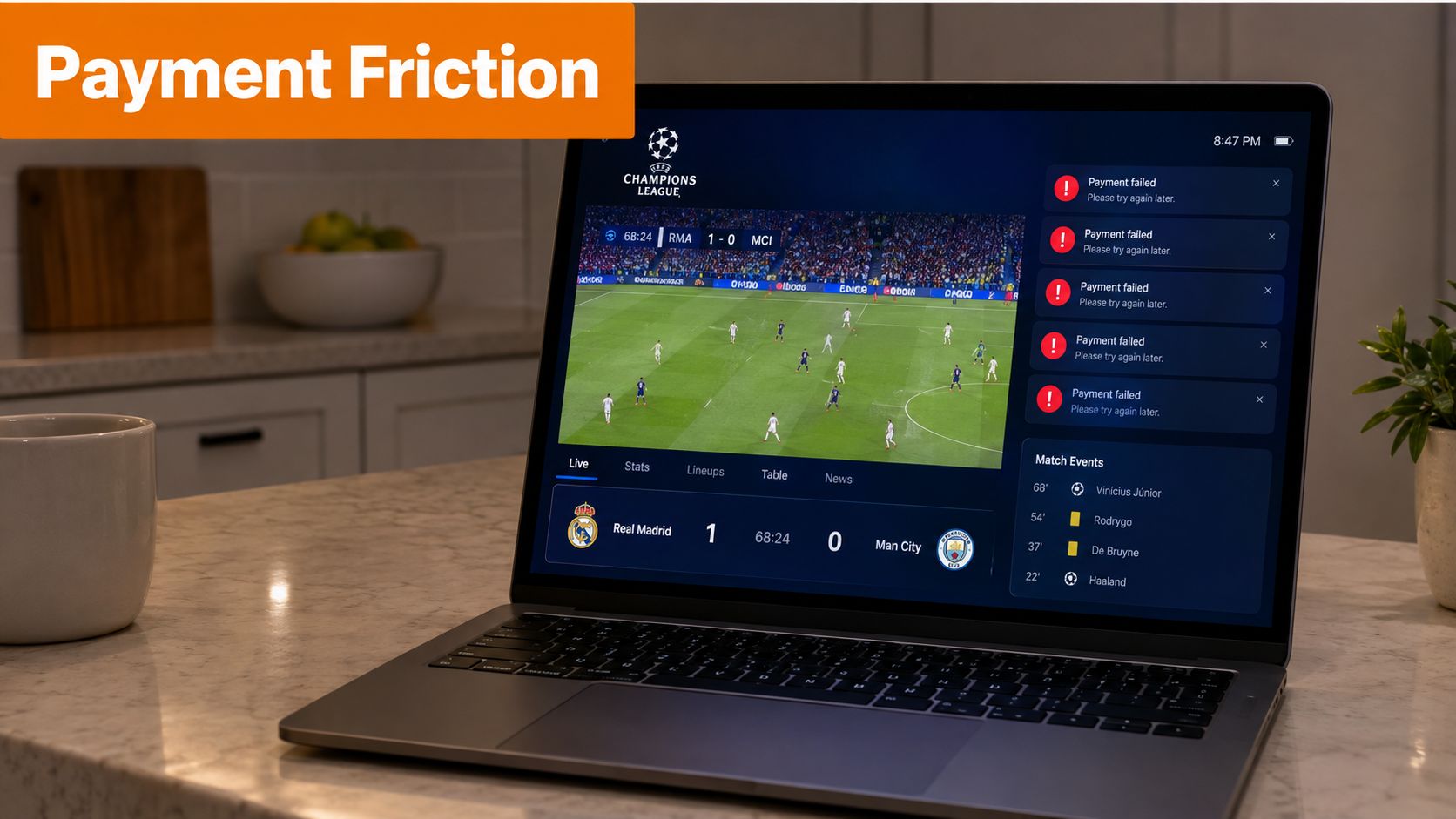
Table of Contents
- The Operator Scenario Behind This Guide
- What iGaming Payment Processing Actually Covers
- Comparing the Main Payment Rails
- Risk, Fraud, and Authentication Controls
- Reconciliation, Settlement, and Payout Mechanics
- Selecting and Onboarding Payment Providers
- Keeping Payment Rails Healthy After Launch
The Operator Scenario Behind This Guide
The first response shouldn't be to switch every transaction to another provider. Start by separating the incident into authorization, routing, settlement, and payout questions.
If Visa deposits above €50 are declining, inspect the affected BINs, currencies, issuer countries, risk scores, 3DS outcomes, and acquirer response codes. A threshold-specific decline can indicate a risk rule, issuer behavior, a merchant configuration issue, or a provider policy that has tightened during the event. A broad decline across all card traffic points to a different problem, such as an acquirer outage or routing failure.
The e-wallet queue needs its own diagnosis. Check whether the provider accepted payout instructions, whether the operator ledger marked them as approved, and whether the wallet has placed transactions into compliance review. A payout can be financially approved but operationally pending. Those are different states and should appear separately in the cashier and finance dashboards.
The acquiring bank's request for fresh traffic data is also part of the incident, not an administrative distraction. Acquirers increasingly assess traffic quality, affiliate compliance, KYB depth, sanctions screening, and dispute ratios before approving or maintaining iGaming accounts, as described in industry coverage of payment stability for iGaming operators. A campaign that changes GEO mix or affiliate traffic can alter the risk profile even when the product and license haven't changed.
The first operational checks
Use a live incident checklist:
- Slice the declines: Compare payment method, issuer country, currency, BIN, amount band, 3DS result, and response code.
- Protect the ledger: Never credit a player wallet solely because the front end received a timeout or redirect.
- Separate payout states: Track approved, queued, under review, submitted, rejected, and settled as distinct statuses.
- Preserve evidence: Keep campaign details, affiliate sources, traffic composition, and dispute data ready for the acquirer.
- Activate fallback routing: Move only the affected method, market, or transaction segment to a tested secondary route.
Practical rule: A provider relationship is part of the payment product. If the acquirer learns about traffic changes from an unexplained spike in declines, the operator has already lost valuable context.
The durable fix is a layered cashier stack with multiple PSP and acquiring paths, clear routing rules, a unified ledger, and operational ownership. Peak-event resilience comes from knowing which rail failed, why it failed, and how to move the smallest safe portion of traffic while the primary relationship is repaired.
What iGaming Payment Processing Actually Covers
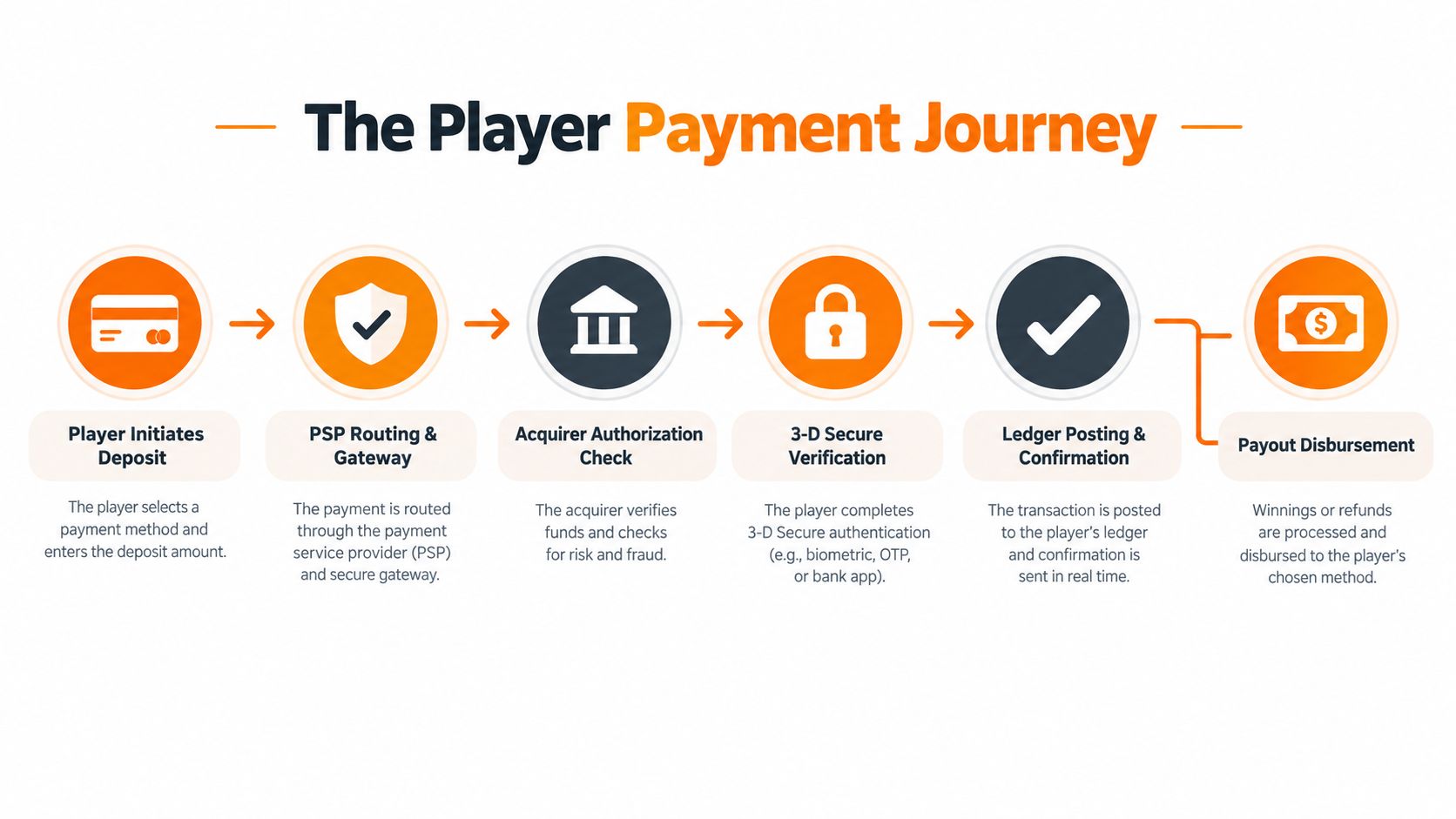
Payment processing begins before authorization and ends after settlement, reconciliation, and payout. A player chooses a method, the cashier creates a transaction, the PSP applies routing and risk logic, the gateway passes payment data, the acquirer requests authorization, and the operator posts the result to the player wallet and accounting ledger.
A gateway generally handles the secure transmission of payment information and the connection between the checkout and payment services. A PSP can orchestrate several methods, providers, risk tools, and operational services through one integration. An acquirer provides merchant acquiring access and submits transactions into the relevant payment network or bank rail. In practice, providers can combine these roles, so the contract and operating model matter more than the label.
Why the vertical receives different treatment
Online gambling is commonly treated as a high-risk merchant category because providers associate it with elevated fraud, chargeback, and regulatory exposure. Industry guidance identifies gambling merchants with MCC 7995, a classification linked to higher fees, tighter monitoring, limited processor availability, and reserve requirements, as outlined in this overview of iGaming payment processing.
That classification affects more than pricing. An acquirer may require enhanced underwriting, a rolling reserve, transaction monitoring, additional evidence about traffic sources, or limits on particular markets and payment methods. If the operator's dispute profile changes, the provider can revisit terms or restrict processing.
The cashier is a compliance system
A good cashier doesn't treat compliance as a separate screen that appears only when a withdrawal is requested. KYC status, jurisdiction, payment-method ownership, source-of-funds requirements, responsible-gaming controls, and transaction limits all influence whether a deposit or payout can proceed.
The ledger must also distinguish authorization from final settlement. A successful redirect isn't proof that funds have settled, and an approved withdrawal isn't proof that the beneficiary has received money. Those distinctions support accurate player balances, finance reporting, customer support, and audit trails.
The practical test is simple. Can the operations team explain every transaction from player intent to final settlement, including the provider, risk decision, ledger entry, and payout result? If not, the integration may work technically while the payment operation remains fragile.
Comparing the Main Payment Rails
No payment method wins every market. Cards can provide familiar checkout behavior and broad reach, while open banking can reduce card-dispute exposure and support faster account-to-account movement. E-wallets often convert well among players who already hold balances, and crypto can support particular withdrawal preferences where the operator can meet the jurisdiction's compliance requirements.
The right comparison uses four questions: what the transaction costs, how quickly funds settle, who carries dispute exposure, and whether the method fits the target market and license. Country-level preferences vary sharply across Europe. One industry report lists the UK at 45% cards, 25% e-wallets, and 15% open banking, while Sweden is listed at 50% open banking and Finland at 45% open banking, according to the iGaming payments orchestration market report.
| Rail | Typical Cost | Settlement Speed | Chargeback Risk | Regional Fit |
|---|---|---|---|---|
| Cards | Often higher for high-risk acquiring | Depends on authorization and funding cycle | Material card dispute exposure | Broad reach, but country and issuer acceptance vary |
| Open banking and bank transfers | Often lower than card acceptance | Can be fast, subject to bank and PSP support | Lower card-chargeback exposure | Strong fit in markets with mature account-to-account adoption |
| E-wallets | Provider and payout fees can vary | Usually convenient for players, queue depth matters | Dispute model depends on wallet provider | Useful where wallets are established player habits |
| Crypto | Network, conversion, custody, and compliance costs apply | Can support rapid movement, but conversion and review add steps | No conventional card chargeback, but AML and source-of-funds risk remain | Appropriate only where licensing, controls, and local rules support it |
Cards still account for the largest share of the payment orchestration value described in the cited market report, at $1.52 billion or 40.0%, while bank transfers and account-to-account methods reached $0.62 billion or 16.3%. The same report values the 2025 market at $3.8 billion and notes operational complexity across 47 currencies and 120+ payment methods. These figures reinforce a practical point: the card rail remains important, but a single global card strategy is insufficient.
Route by player context
Cards suit players who prioritize familiarity and immediate deposit confirmation, but acquirer scrutiny and card-not-present disputes make risk controls essential. Open banking suits markets where players trust bank authentication and want direct account movement. E-wallets can be effective for repeat users, although a provider queue can become a visible service problem during promotional peaks.
Crypto should be treated as a controlled rail, not a shortcut around compliance. Operators need jurisdiction-specific decisions about whether it supports deposits, withdrawals, or both, alongside wallet screening, source-of-funds checks, conversion controls, and transaction monitoring. A payment method that settles quickly can still create operational delay if compliance teams can't explain the funds.
For operators evaluating account-based experiences, the Pay N Play payment model is relevant because it shows how payment identity and registration design can affect the cashier journey. The implementation still has to satisfy licensing, KYC, responsible-gaming, and acquirer requirements in each market.
Risk, Fraud, and Authentication Controls
A payment stack should make risk decisions in layers. One control rarely separates a legitimate player from a stolen card, a bonus abuser, or a coordinated multi-accounting operation. The goal is to reduce avoidable losses without turning every genuine deposit and payout into a manual review.
Start with authentication, then add context
3D Secure 2 and Strong Customer Authentication help authenticate card payments and can shift liability for fraud-based chargebacks away from the merchant. They don't eliminate non-fraud disputes, so operators still need KYC, device and IP analysis, payment-method matching, and transaction monitoring, as explained in this guide to 3D Secure and SCA in iGaming.
Use the controls for distinct purposes:
- 3DS and SCA: Authenticate higher-risk card transactions and record the result for dispute evidence.
- Velocity rules: Detect repeated attempts across cards, accounts, devices, or beneficiaries.
- Device fingerprinting: Link accounts that appear separate but share a suspicious device profile.
- IP and geolocation checks: Identify mismatches between declared jurisdiction, login location, and payment activity.
- BIN validation: Block or review cards whose issuing country, product type, or risk profile conflicts with the licensed market.
- KYC triggers: Request verification when account behavior or risk thresholds require it, rather than applying identical friction to every player.
- Third-party scoring: Combine internal history with external signals, then monitor false positives instead of accepting the score blindly.
The useful metric isn't the number of blocked transactions. Review approval rate, decline reason, chargeback ratio, manual-review volume, payout delay, and confirmed fraud together. A stricter rule can reduce fraud while also rejecting profitable legitimate players. Tune rules by market, method, and player history, and test changes against a defined baseline.
Keep payment risk connected to player risk
Bonus abuse and affiliate fraud often appear first in payment data. Shared devices, recycled cards, repeated beneficiary accounts, synchronized deposits, and unusual withdrawal timing can expose patterns that a CRM view misses. Connect payment events to account, campaign, affiliate, and gameplay data so the risk team can distinguish a genuine high-value player from a coordinated network.
Control design matters more than control count. A dozen overlapping rules can create opaque declines that neither the operator nor the acquirer can explain.
Operators should also document why a transaction was challenged, approved, held, or rejected. That record supports customer communication, dispute handling, provider reviews, and regulatory audits. For a broader operational framework, the risk management best-practices guide offers a useful reference point, but each rule still needs calibration against the operator's license and traffic profile.
Reconciliation, Settlement, and Payout Mechanics
A deposit has several financial identities during its life. The player sees a balance update, the cashier records a transaction, the PSP records an instruction, the acquirer reports an authorization and settlement event, and finance expects funds in a settlement account. Reconciliation fails when teams treat those events as one record instead of matching them through stable transaction identifiers.
Consider a card deposit. The cashier creates a pending transaction, the PSP sends it through the selected acquirer, and the acquirer returns an authorization result. Only after the operator's ledger applies the approved state should the player wallet receive the appropriate credit. Later, the PSP's settlement file must match the original transaction, fees, refunds, reversals, and any reserve movement before finance closes the day.
A daily matching process
A practical reconciliation run should:
- Extract cashier records: Include transaction ID, player account, method, currency, amount, status, and timestamps.
- Match PSP events: Tie authorization, capture, refund, reversal, payout, and failure events to the cashier ID.
- Compare settlement files: Confirm gross movement, provider fees, currency conversion, and net funding.
- Post exceptions: Create separate queues for missing events, duplicates, partial settlements, and unmatched funds.
- Close the ledger: Require finance sign-off on unresolved balances instead of forcing totals to agree.
Settlement terms affect working capital. T+1, T+2, and T+7 describe different funding timelines, but the practical outcome depends on the provider contract, reserve policy, weekends, currency, and whether the transaction is card-based, account-to-account, or crypto. A reserve can be rolling, fixed, or adjusted after dispute behavior changes. If chargebacks rise, an acquirer may increase the holdback or delay funding.
| Rail | Funding Timeline | Reserve Model | Chargeback Window | Notes |
|---|---|---|---|---|
| Cards | Contract-dependent, often delayed by settlement cycles | Rolling or fixed reserve may apply | Card-scheme dispute processes apply | Match authorization, capture, refund, and settlement records |
| Bank transfers and open banking | Can be faster, but bank and PSP status must be confirmed | May rely more on operational and compliance controls | Lower card-chargeback exposure | Don't treat an initiated transfer as irrevocably settled |
| E-wallets | Provider-dependent | May include balance, reserve, or payout controls | Wallet-specific dispute process | Monitor queue depth and provider status |
| Crypto | Depends on blockchain confirmation, custody, conversion, and review | Compliance and custody controls are central | No conventional card window | Track asset, network, conversion rate, and destination wallet |
Payouts need the same discipline. Approval queues should distinguish automated approval from manual review, and larger or unusual withdrawals may require renewed source-of-funds checks. Regulated operators also need segregated player-fund handling and an auditable ledger trail appropriate to the relevant framework, including MGA or UK requirements where applicable.
For multi-currency operations, the wallet architecture must preserve both player-facing balances and finance-facing currency movements. A multi-currency wallet design can help clarify that separation, but it doesn't replace provider-level reconciliation or regulatory controls.
Selecting and Onboarding Payment Providers
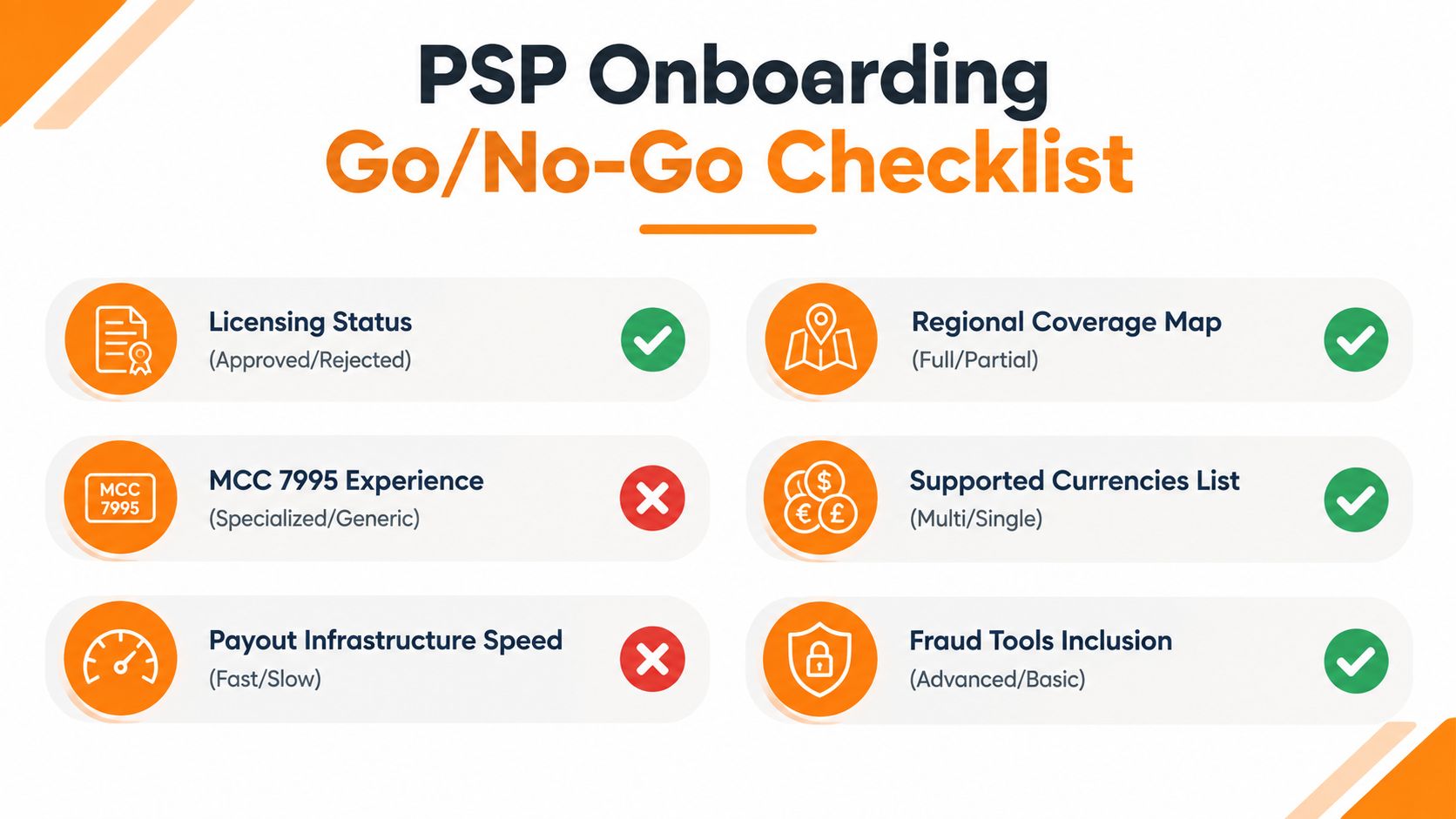
Provider selection should begin with the operator's licensing map and traffic plan, not a generic payment-method list. Ask whether the PSP and acquirer have genuine MCC 7995 experience, which markets they underwrite, which currencies they support, how they handle payouts, and whether their fraud tooling exposes usable decision data.
The go or no-go screen
Require written answers to these questions:
- Licensing and underwriting: Will the provider support every intended brand, license, domain, GEO, and product vertical?
- Rail coverage: Can it process the methods players use in each target market, including deposits and withdrawals?
- Operational transparency: Will it share decline reason codes, settlement files, reserve calculations, and incident procedures?
- Dispute capacity: Does it support evidence collection, representment, refund controls, and dispute reporting?
- Payout resilience: Can it process withdrawals through a route that remains available when card deposits or a primary PSP degrade?
- Commercial clarity: Are fees, reserve triggers, minimums, conversion costs, and termination rights documented?
Red flags deserve more weight than a polished demo. Undisclosed rolling reserves, mid-cycle repricing, refusal to share decline codes, and one-size-fits-all underwriting make it difficult to manage the relationship after launch. A provider that won't explain how it evaluates traffic quality is unlikely to become more transparent during an incident.
Prepare the evidence before submission
KYB onboarding commonly requires corporate ownership details, licensing documents, business plans, projected markets, traffic sources, affiliate arrangements, sanctions controls, KYC procedures, responsible-gaming policies, chargeback history, and technical payment-flow documentation. Organize these materials around the provider's underwriting questions. Incomplete or contradictory information creates more delay than a difficult but well-supported application.
Negotiate the operating model before production traffic arrives. Cover reserve caps, release conditions, repricing notice, termination clauses, data portability, transaction-level reporting, service levels, and volume-based fee tiers. Confirm who owns customer communications during payout delays and who can authorize routing changes.
A redundant design doesn't mean connecting every method to every provider. Use a primary route, a tested secondary route, and explicit rules for failover by market, currency, method, and risk tier. Test the fallback with controlled traffic before a major sporting event. The objective is to preserve safe transaction flow, not to shift blindly when a provider reports a temporary decline spike.
Keeping Payment Rails Healthy After Launch
Launch performance is only the opening measurement. Acquirers continue to judge the operator through changing traffic, dispute behavior, payout activity, affiliate quality, and compliance evidence. A stable payment program gives the provider context before a pattern looks like unexplained risk.
The dashboard should connect commercial and risk signals. Monitor declines by BIN, issuer country, currency, method, amount band, and response code. Track fraud-score movement, 3DS outcomes, chargeback queues, payout age, reserve balance, and settlement exceptions. A rising payout queue can indicate provider congestion, compliance review, missing beneficiary data, or a ledger problem, so the alert should identify the responsible workflow rather than report delay.
Keep the relationship evidence-ready
Refresh KYB and license information whenever ownership, domain, brand, product, market, or traffic sources change. Maintain an accessible record of affiliate compliance, campaign dates, GEO distribution, sanctions screening, dispute investigations, and payment-method performance. When an acquirer asks for traffic data, the operator should be able to provide a coherent explanation without assembling files from several teams under pressure.
Traffic shaping also matters. Avoid sending an unexplained burst through one route when a promotion or live event changes demand. Use pre-agreed capacity and routing plans, then tell the PSP what has changed. Providers can manage unusual traffic more effectively when the operator explains the campaign, expected player mix, markets, and safeguards.
Dispute management shouldn't start after the chargeback arrives. Capture authentication results, delivery or account-use evidence, player communications, refund decisions, and responsible-gaming records at transaction time. Apply representment selectively. A weak case costs operational time and can damage the relationship further.
A workable operating cadence
- Daily: Review authorization, decline causes, fraud alerts, payout queues, settlement exceptions, and reserve movements.
- Weekly: Examine method and BIN trends, false-positive decisions, affiliate traffic, and unresolved player complaints.
- Monthly: Hold a PSP business review covering volume, disputes, reserves, incidents, routing, and upcoming campaigns.
- Quarterly: Run a controlled redundant-routing drill and confirm that fallback credentials, limits, and compliance rules still work.
- Annually: Revalidate licenses, processor approvals, KYB records, payment contracts, and data-export procedures.
The benchmark evidence shows why this discipline belongs at the center of retention, not only finance. A 2026 summary reports that 72% of players rank payout speed among their top three reasons for platform loyalty, while 71% have left a platform because payouts were slow, and abandonment rises 25–30% when delays exceed 24 hours, according to the 2026 iGaming benchmark summary. The same source reports that operators lose over $100 billion annually to fees and chargebacks. Separately, it records an iGaming fraud rate of 1.53% in Q1 2026, an 18% year-over-year increase, and 82.9% of operators reporting increased fraud.
Those figures describe the cost of treating payments as a completed integration. The healthier model is continuous: monitor the rails, explain the traffic, tune controls, preserve evidence, and maintain more than one safe path to authorization and payout.
NexGrate provides a white-label iGaming platform with integrated cashier capabilities for cards, bank transfers, e-wallets, crypto, wallet management, compliance workflows, and ledger-based payment handling. If you're planning a launch or replacing fragmented casino and sportsbook infrastructure, visit NexGrate to discuss how its payment and operational components can fit your routing, reconciliation, and regulatory requirements.