You've got the dashboard open, the fraud queue is fuller than it was yesterday, and the same problem keeps showing up in a different place. KYC passed, the account looked clean at signup, and then the losses arrived later, through withdrawals, chargebacks, bonus abuse, or a cluster of suspicious logins that didn't look dangerous in isolation.
That's the shape of iGaming fraud detection now. The job isn't to catch one bad registration and call it done, it's to keep score across the full player journey, from login to wallet movement to withdrawal, and to do it in a way your platform team can operate.
Table of Contents
- Why iGaming Fraud Detection Is No Longer a Signup Problem
- What iGaming Fraud Detection Means
- The Main Fraud Types Operators Face Today
- Building a Layered Detection Architecture
- Mapping Controls to Platform Components
- Running the Daily Fraud Operations Playbook
- Implementation Roadmap and Common Pitfalls
- Frequently Asked Questions for Operators
Why iGaming Fraud Detection Is No Longer a Signup Problem
A lot of operators still behave as if fraud is something you solve at the door. They harden registration, add KYC checks, and assume the rest of the journey will behave itself. That model breaks down the moment a player account starts looking legitimate at signup and only turns toxic later, after deposits, bonus consumption, payment changes, or withdrawal requests.
The industry data makes that shift hard to ignore. Observed fraud rates in one 2024 to 2026 benchmark rose from about 1.10% in 2024 to 1.53% in Q1 2026, which is nearly 40% growth in two years, and suspicious transaction volumes rose 4.5× between Q1 2025 and Q1 2026, with average suspicious transaction value climbing from €3,664 to €6,002 according to 2026 reporting of industry monitoring data (industry benchmark summary). That doesn't describe a signup problem. It describes a cost problem, a review problem, and a monetization problem.
The operational mistake is stopping at identity
If you only look at onboarding, you'll miss the attack chain. Fraudsters can pass identity checks, then reuse devices, cluster payment methods, and move between accounts until the platform finally sees a withdrawal or a chargeback.
Practical rule: treat signup as the first checkpoint, not the finish line.
The better mental model is continuous exposure management. Registration matters, but so do login behavior, deposit velocity, withdrawal timing, account changes, and the links between accounts that look separate on paper but shared in practice. That's why the question has shifted from “Did this player pass KYC?” to “What is this player doing across the entire session and across related accounts?”
Multi-step abuse is now the normal threat shape
In 2025, multi-step attacks represented 28% of all identity-fraud cases, up from 10% in 2024, a 180% year-over-year increase, and suspected fraud in attempted iGaming transactions was reported at 8.3% globally in 2025, with the U.S. described as having nearly 1 in 10 transactions flagged for suspected fraud (industry benchmark summary). Those figures matter because they show the modern attacker doesn't need a single big win. They can string together smaller steps, each one plausible enough to slip through siloed controls.
That's why legacy registration-only controls bleed margin. They catch some obvious abuse, but they leave a lot of higher-value activity to manual review after the operator has already taken exposure. A modern fraud stack has to behave like a connected system, not a gate.
What iGaming Fraud Detection Means
iGaming fraud detection is the continuous practice of assigning and updating risk across every meaningful player interaction. That includes onboarding, yes, but also login, payment creation, bet placement, withdrawal attempts, and account edits. The goal is to identify when a player's behavior diverges from the trust level your platform has assigned.
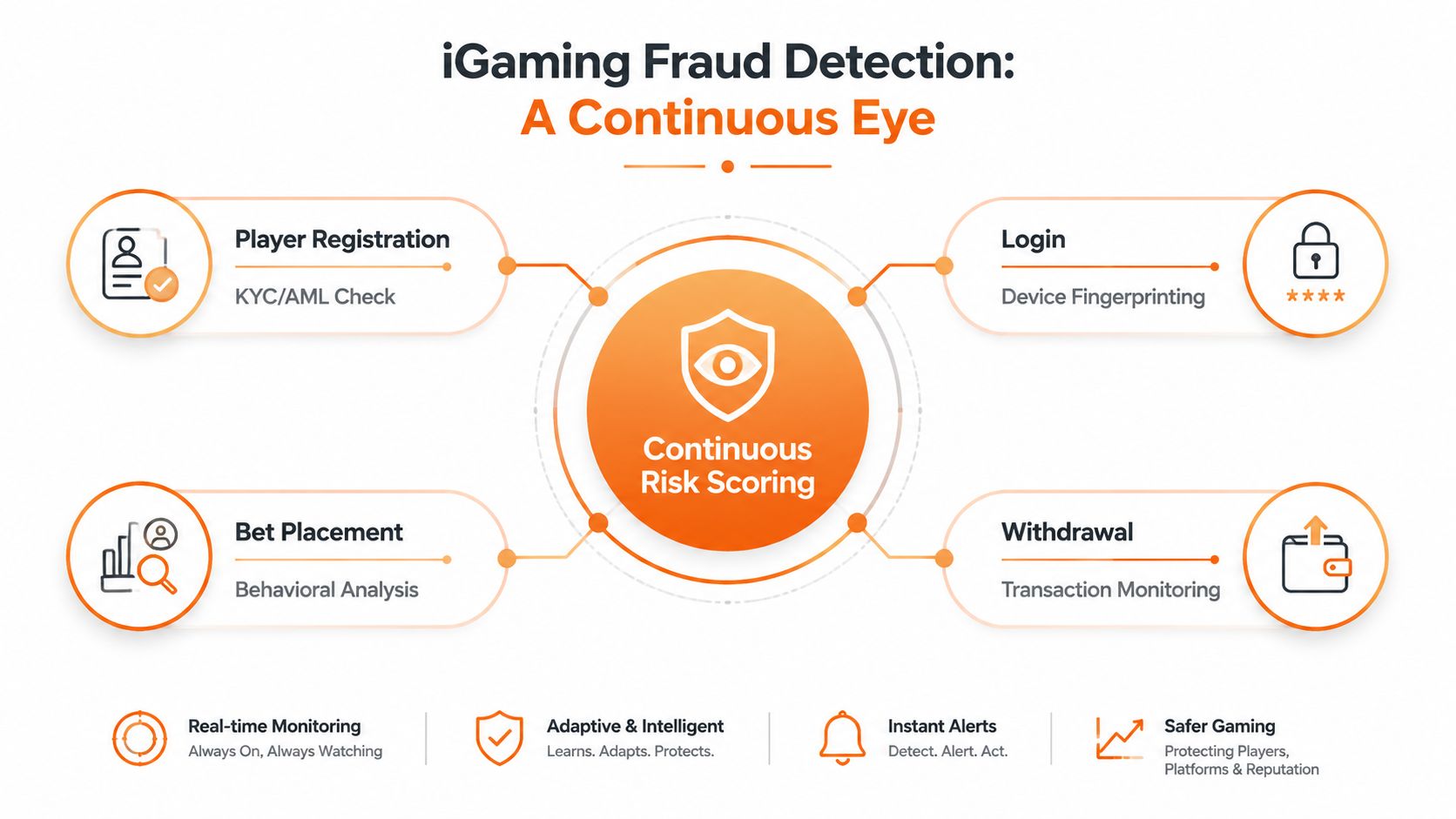
The most useful way to think about it is as a risk engine with multiple inputs, not isolated checks. KYC, device intelligence, payment telemetry, velocity rules, and behavioral signals should all feed the same decision layer, because a safe-looking identity can still behave like a bad actor once it enters the wallet and gameplay environment.
Detection and prevention are different jobs
Detection finds risk. Prevention decides what to do about it. Too many stacks blur the two and end up with rigid rules that are either too soft to matter or too harsh to use.
A better setup separates the concerns. The detection layer scores and clusters signals. The response layer applies friction, review, hold, or denial based on the risk level and the action being attempted. That matters because a login from a new device and a withdrawal to a new destination do not deserve the same response, even if they come from the same account.
The player risk graph is the core object
A practical fraud program needs a single player risk graph. That graph should connect KYC records, device fingerprints, payment methods, session behavior, and linked accounts so the system can see whether a “new” player is really part of an existing abuse pattern.
A clean KYC result doesn't prove a clean account, it only proves the first layer didn't fail.
Many operators overestimate their protection. Stronger identity checks help, but they do not replace post-onboarding telemetry. Fraudsters adapt through device reuse, emulator use, payment clustering, and relationship patterns that only appear after the account has started moving money. If your stack stops watching after signup, your confidence is inflated.
The right definition of fraud detection is operational, not academic. It means updating trust in real time across the full journey, with one view of the player instead of four isolated ones. For operators that run referrals and partner traffic, the same logic should extend into affiliate quality controls, since abuse often enters through acquisition paths before it shows up in gameplay. See the practical side of that in this affiliate program guide.
The Main Fraud Types Operators Face Today
The fraud types are familiar, but the important part is how they behave inside a live platform. Operators don't lose money because they misnamed the threat. They lose money because the threat showed up in a channel the controls weren't watching closely enough.

Bonus abuse and multi-accounting
This is the classic “one actor, many identities” problem. A fraud ring creates multiple accounts, reuses devices or payment methods, and extracts promotional value before the system notices the accounts are linked. The signal to watch is not just a single suspicious signup, it's repeated relationships across accounts that should have been independent.
Payment fraud and card testing
Payment fraud usually starts with small, messy deposits that don't look important in isolation. Then the pattern turns into stolen credential use, rapid deposits, and attempted cash-out or laundering behavior through the platform. Card testing leaves a particular operational footprint, lots of low-value attempts and abnormal payment velocity that can burn support time even when the direct loss is small.
Account takeover
ATO is expensive because the account already has history, balances, and sometimes saved payout methods. A session that begins from an unfamiliar device and quickly moves toward withdrawal, password change, or payment edits deserves immediate attention. The business impact is often sharper than with fake accounts because the attacker is monetizing an already trusted profile.
Affiliate fraud, collusion, chip dumping, and chargebacks
Affiliate fraud shows up when acquisition channels are gamed rather than customers. Collusion and chip dumping, especially in poker or peer-to-peer formats, show up as coordinated play patterns and abnormal value transfer between accounts. Chargebacks from first-party misuse are different again, because the player may have been genuine at the start and then disputes the transaction later.
For affiliate teams, this affiliate program guide is useful as a reference point for how abuse can hide inside acquisition and attribution flows.
The operational point is simple. Each fraud type leaves a different footprint. Your queue design should reflect that, because a chargeback dispute, a collusion cluster, and a takeover event need different evidence, different owners, and different escalation paths.
Building a Layered Detection Architecture
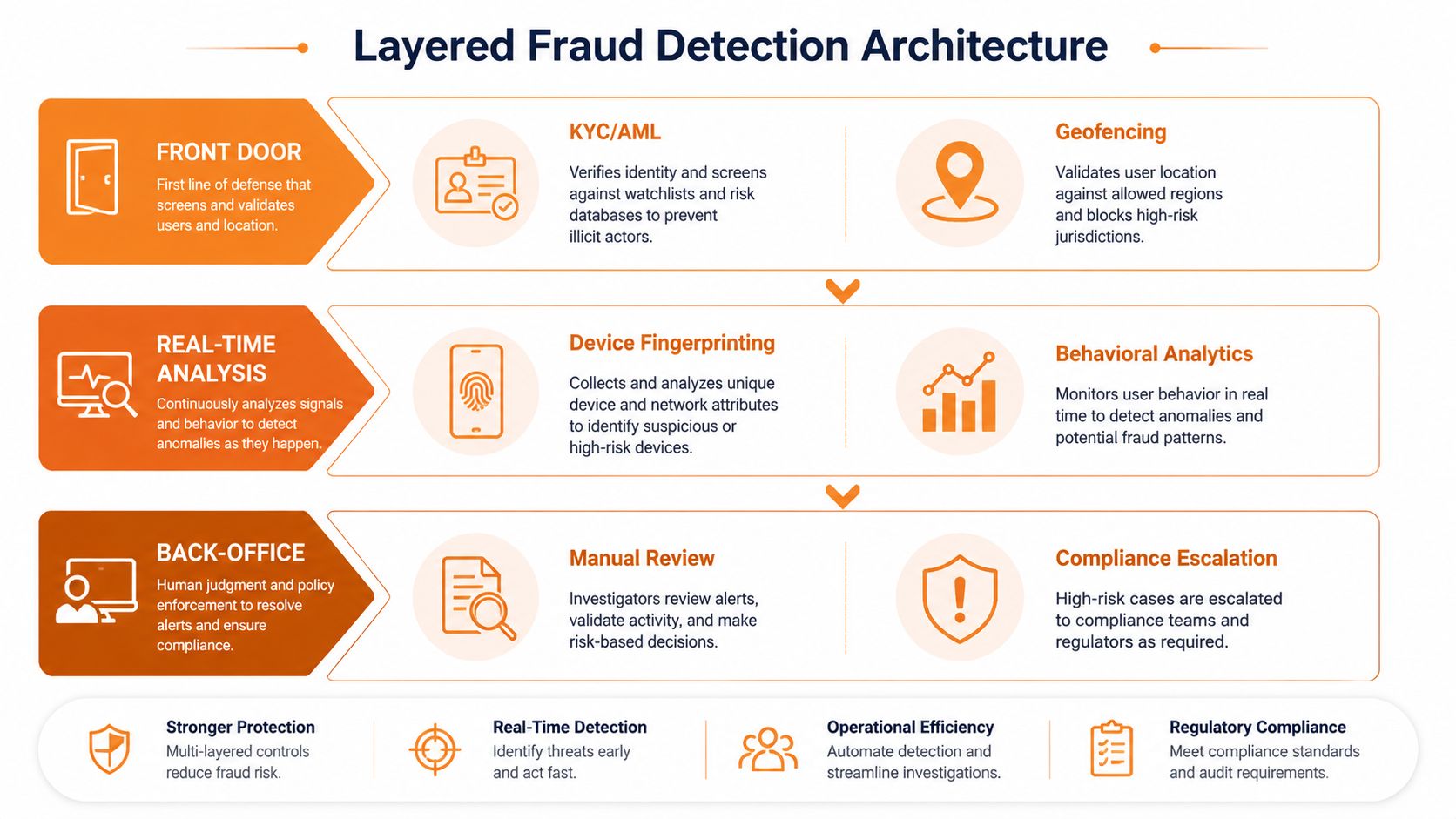
A workable fraud stack looks more like airport security than a single locked door. One checkpoint won't catch everything, and one false belief about “strong verification” won't keep the platform safe. The architecture has to layer controls so the system can make progressively better decisions as the player moves through the product.
Front door controls stop obvious abuse early
Start with KYC/AML and geofencing at the front door. That doesn't mean you rely on those checks alone, it means you use them to establish the first layer of trust and regulatory eligibility. If the front door is weak, the rest of the stack spends its time cleaning up preventable noise.
Session-level analysis catches behavior that identity can't
Once the player is active, device fingerprinting and behavioral analytics do the heavy lifting. A device that keeps appearing across different accounts, or a session that shows rapid login-logout cycles, is a better signal than a static registration record.
Wallet and cashier logic protect the monetization point
The wallet is where the risk becomes financial. Deposit and withdrawal monitoring should apply velocity checks, linked-account correlation, and timing analysis so the platform can see suspicious movement before funds leave. A lot of fraudulent activity stops being theoretical and becomes a balance-sheet issue at this stage.
Back-office review closes the loop
Manual review, escalation, and case management belong in the back office, not in ad hoc email threads. A good review system preserves the evidence trail, pushes suspicious cases to compliance when needed, and feeds outcomes back into the scoring layer so the next decision is better.
The stack should not answer the same question five times. It should answer one question better at each layer.
That layered flow matters because signals should converge into one risk engine. The front door should inform session risk, session behavior should inform wallet risk, and the review outcome should inform future thresholds. If each tool lives in its own silo, the platform becomes slower, noisier, and easier to game.
Mapping Controls to Platform Components
Operators don't need a prettier theory. They need to know which platform component should own which control, and what that control should produce. That's the practical audit step most white-label reviews skip.
The table below is the fastest way to pressure-test a stack.
| Fraud Control | Platform Component | What It Produces |
|---|---|---|
| KYC workflow | Compliance toolkit and player onboarding | Identity verification outcome, document status, account eligibility |
| Geofencing | Compliance toolkit and session policy layer | Location eligibility, blocked jurisdiction events |
| Velocity rules | Payments and cashier, plus risk console | Deposit bursts, withdrawal timing flags, escalation triggers |
| Device fingerprinting | Risk console and session analytics | Linked-device clusters, device novelty alerts |
| Withdrawal screening | Payments and cashier | Hold, approve, or escalate decision before payout |
| ML scoring | Risk console and back-office review | Risk score, priority queue, case enrichment |
| Case management | Back office and compliance workflow | Investigation notes, outcomes, audit trail |
| Linked-account analysis | Risk engine and fraud tooling | Player cluster view, shared identity relationships |
The point of the table is not to overload every module. It's to stop teams from pretending the cashier, compliance stack, and fraud console can work independently. They can't. A withdrawal screen that doesn't know about device links will approve bad behavior faster than a manual reviewer can react.
The platform-level design also matters for wallet complexity. If your system supports multiple currencies, including crypto and fiat, then wallet controls need to reflect the movement rules of each payment path, not just the visible balance. A multi-currency wallet changes how funds can flow, which means risk logic needs to sit close to the cashier, not only in the KYC layer. For operators thinking about the architecture around this, multi-currency wallet design is a useful reference point for how wallet structure affects control placement.
A good white-label audit asks three questions. Where is the signal created, where is the decision made, and where is the evidence stored? If those answers are split across different systems with no shared queue or trail, the operator will spend more time reconciling than preventing.
Running the Daily Fraud Operations Playbook
Fraud detection only matters if the team can operate it every day. That means triage, queue management, review, escalation, and tuning, all inside a console that doesn't force analysts to stitch together the story by hand.
Start with alert triage, not deep investigation
The first job each morning is to sort overnight alerts by risk and likely impact. Some cases need immediate holds, some need quick evidence collection, and some can wait for batch review. If your team starts by investigating the most interesting case instead of the most risky one, your queue discipline is broken.
Use KPIs that measure both protection and friction
A healthy operation watches detection rate, false positive rate, manual review load, chargeback rate, and time-to-decision on withdrawals. Those metrics tell you whether the system is catching abuse without turning the whole platform into a bottleneck.
Operational rule: if reviewers are drowning, the rules are too broad or the queue is too noisy.
The console should also show a first responder the basics without forcing them to click through six tools. They need risk score, linked accounts, device history, payment method history, recent session behavior, prior case outcomes, and a clear decision path. Anything less slows the team down and makes decisions harder to defend.
Tune weekly, not whenever someone complains
Model and rule tuning should happen on a regular cadence, with compliance and operations in the room together. Bad rules drift, and good rules can still create false positives if the player mix changes. That's why tuning is part of operations, not a side project.
If you want a fuller operational framework, this risk management playbook is a helpful companion reference.
The best fraud teams don't just react faster. They close the loop faster. They turn reviews into queue priorities, queue priorities into threshold changes, and threshold changes into fewer bad approvals next week.
Implementation Roadmap and Common Pitfalls
The cleanest rollout starts with instrumentation. Before you tune models or build complex workflows, you need reliable event capture across registration, login, payment, withdrawal, and account change activity. Without that baseline, every later decision is built on partial visibility.
Next comes rules, not because rules are perfect, but because they give you immediate control while the data model matures. Build a focused library around high-signal events, then layer linkage and behavior on top so the system can move from single-event flags to cluster-level judgment. After that, bring in model scoring and start tuning it against review outcomes and real operational losses.
Common mistakes that waste months
- Over-relying on KYC: identity verification is necessary, but it won't catch device reuse, payment clustering, or post-onboarding behavior.
- Treating fraud as payments-only: the same abuse often starts in registration, login, or bonus logic and only ends in the cashier.
- Ignoring shared-device intelligence: if multiple accounts keep touching the same infrastructure, the platform should see it as a cluster, not random noise.
- Failing to tune by region: player behavior differs by market, so one global threshold can create a flood of false positives in one jurisdiction and misses in another.
Don't start by asking how many tools you need. Start by asking which journey events you can prove, and which decisions they should drive.
For regulated markets, audit readiness needs to be designed in from the start. That means reporting hooks, immutable audit trails, and a clear explanation of why a case was held, escalated, or cleared. If an auditor or regulator asks how the decision was made, the operator should be able to show the evidence chain without rebuilding it from scratch.
The right sequence is simple. Instrument first. Apply rules second. Add scoring third. Tune continuously after that. Operators who reverse those steps usually end up with a stack that looks complex but is hard to trust under pressure.
Frequently Asked Questions for Operators
How do I know if fraud detection is working?
Look for a stable or improving balance between detection rate, false positive rate, and review load. If abuse is still leaking through while analysts are overloaded, the system is too blunt or too shallow.
Should we optimize for fewer false positives or stronger blocking?
Neither in isolation. The right answer is risk-based friction, where low-risk players move cleanly and high-risk activity gets step-up checks or holds. That protects conversion without giving fraudsters a free pass.
How often should rules and models be retuned?
Regularly, and with evidence from recent cases. If the fraud pattern changes, your thresholds need to move with it, especially after launch campaigns, major payment changes, or market expansion.
What do auditors usually care about most?
Traceability. They want to see why a decision was made, who reviewed it, what evidence was used, and whether the decision followed policy. A clean audit trail matters as much as the decision itself.
Where should a white-label operator start if the current stack is weak?
Start with event capture and queue design. If you can't see the full player journey in one place, you can't score it well, and you certainly can't defend the decisions later.
If you're evaluating your fraud stack or planning a new brand launch, NexGrate can help you think through the platform, wallet, compliance, and risk pieces as one operating system. Visit NexGrate to see how a turnkey white-label environment can support fraud controls, review workflows, and regulated-market operations without stitching everything together from scratch.