Saturday night, just before a major football fixture, the login endpoint starts absorbing a credential-stuffing wave. At the same time, bots are creating casino accounts, claiming introductory bonuses, and calling the registration and wallet APIs faster than an operations team can inspect the logs. The sportsbook still looks available to customers, but the operator is losing control of authentication, promotions, and potentially player funds.
That's the operating reality for B2B iGaming teams managing several brands, tenants, jurisdictions, payment providers, game studios, and affiliate integrations. APIs connect the front end to wallets, odds, settlement, KYC, bonuses, responsible-gaming controls, and reporting. A weakness in any one of those paths can become a margin, compliance, or player-protection incident, not just a technical defect.
The scale explains why an API security platform has become an enterprise category. OWASP's 2023 API Security Top 10 used issues reported between 2019 and 2022, drawing on bug bounty platforms and publicly available reports, while independent reporting identified 12 publicly reported API data breaches in 2022 and associated those incidents with more than 4,100 total known breaches across all categories in the same period. The report also stated that API data-breach exposure averaged over 10 million records per incident. Fortune Business Insights' API security market overview links those figures to the need for continuous discovery, authentication and authorization testing, schema validation, and runtime monitoring.
Table of Contents
- Why API Security Matters for B2B iGaming Operators
- Core Capabilities Every API Security Platform Provides
- OWASP API Risks Mapped to iGaming Attack Scenarios
- Deployment Patterns for Multi-Tenant Casino and Sportsbook Stacks
- Integrating Security Controls with Payments, KYC, and Game Aggregators
- Bot Defense and Fraud Economics at the API Layer
- Evaluation Criteria for Choosing an API Security Platform
Why API Security Matters for B2B iGaming Operators
A sportsbook or casino platform rarely has one API boundary. It has many. Aggregators send game and odds data, payment service providers exchange transaction instructions, KYC vendors return verification decisions, affiliates pass acquisition data, and bonus engines update eligibility and balances. Each integration introduces credentials, callbacks, payloads, retry behavior, and assumptions about who may call which operation.
That complexity becomes dangerous during high-pressure events. A login storm can hide account takeover activity inside otherwise valid authentication requests. A registration bot can create accounts that pass superficial input checks, then claim a bonus through a separate endpoint. A scraper can collect pre-match prices without trying to compromise infrastructure, while still damaging commercial advantage and increasing load on the odds service.
Practical rule: Treat every endpoint that changes money, eligibility, identity, odds, or settlement as a security control point, not merely an integration route.
The regulatory context raises the cost of weak enforcement. MGA, UKGC, and state-level licensing obligations place strong emphasis on player-fund protection, fraud controls, responsible gaming, auditability, and jurisdictional restrictions. The exact implementation varies by market, but the engineering requirement is consistent. An operator needs to demonstrate who accessed a sensitive function, what policy applied, and whether the platform stopped or contained suspicious behavior.
Where gaming losses actually appear
API abuse often produces operational losses before it produces a headline breach:
- Bonus abuse: Automated registrations consume free spins, deposit matches, or campaign rewards through coordinated identities.
- Payment abuse: Attackers probe cashier flows, replay callbacks, or generate excessive authorization attempts.
- Settlement manipulation: A caller changes a bet, payout, or settlement state without the correct object and function permissions.
- Account takeover: Reused credentials reach wallets and withdrawal endpoints through valid-looking sessions.
- Data scraping: Bots collect player, game, or market data through endpoints that were never designed for automated access.
A perimeter firewall won't distinguish every legitimate player action from an automated sequence that uses valid credentials. The request path needs layered decisions: authenticate the caller, authorize the specific object and action, validate the payload, apply a quota, and score the behavior against the endpoint's normal use.
OWASP's API guidance is useful because it's based on observed failure modes rather than hypothetical categories. Its methodology draws on public incident data, bug bounty reports, and issues reported between 2019 and 2022, with Broken Object Level Authorization, Broken Authentication, and Broken Object Property Level Authorization among the leading concerns. OWASP's API Security project gives operators a practical starting point, but the list only becomes useful after it's mapped to wallet changes, bonus flags, player profiles, and settlement actions.
Core Capabilities Every API Security Platform Provides
Start vendor evaluation by grouping controls into four capability areas. The labels matter less than the enforcement behavior. A platform that advertises dozens of features but can't apply them consistently to a tenant, route, player, and service identity won't protect a live gaming stack.
Identity and permission enforcement
Authentication establishes who or what is calling. The platform should validate OAuth 2.0 access tokens, verify JWT signatures and claims, support mutual TLS for service-to-service traffic, and perform token introspection through a central identity provider where the architecture requires it.
Authorization must go further than checking whether a token exists. A player token should permit access to that player's wallet and bets, not another player's resources. An aggregator credential should reach only its assigned game, callback, or session functions. Administrative operations need separate scopes and stronger controls than a standard partner token.
Quotas that understand gaming traffic
A single global rate limit is easy to deploy and easy to evade. Operators need separate buckets by IP, token, player, tenant, route, and integration. A login endpoint may need credential-stuffing controls, while a jackpot endpoint needs protection against expensive polling and bursty automation.
Limits should adapt to context. Settlement cutovers, bonus launches, and live betting windows create different risk profiles from ordinary account activity. The platform should tighten controls, require additional verification, or route suspicious traffic for review without throttling every legitimate customer.
Payload and schema controls
Schema enforcement rejects malformed, unexpected, or oversized input before it reaches wallet, payment, or game logic. It should understand the API contract, content type, required fields, allowed values, and relevant object relationships.
This is especially important for partial updates. A player-facing request might legitimately change a display preference, but it shouldn't be able to submit a hidden bonus eligibility flag or internal risk status. Schema validation won't replace authorization, but it removes a class of accidental and malicious input from downstream services.
Behavioral protection at the edge
WAF rules remain useful for common attack patterns, but iGaming abuse often uses syntactically correct requests. An API security platform should combine OWASP rules, bot detection, anomaly scoring, device or transport signals, and geo-velocity checks.
These capabilities need to share one policy plane. A disconnected WAF may see a request, an identity service may validate a token, and an application may record a balance change, but no component alone understands the complete sequence. The strongest design correlates identity, object, endpoint, payload, rate, and outcome before allowing a high-impact action.
| Capability | Typical Controls | iGaming Example |
|---|---|---|
| Authentication and authorization | OAuth 2.0, JWT validation, mTLS, token introspection, scoped permissions | A partner token can submit game callbacks but cannot access player wallets |
| Rate limiting and quotas | Per-IP, per-token, per-player, per-tenant, adaptive route limits | A jackpot polling burst is slowed without blocking ordinary game sessions |
| Schema enforcement | Contract validation, field allowlists, payload limits, content-type checks | A profile update cannot alter internal bonus or risk fields |
| Behavioral protection | WAF rules, bot scoring, anomaly detection, geo-velocity | A withdrawal request receives step-up verification after an unusual session sequence |
OWASP API Risks Mapped to iGaming Attack Scenarios
An OWASP category becomes actionable when an operator can name the endpoint, the asset, the expected caller, and the control that should stop misuse. For gaming platforms, object and function permissions deserve particular attention because the most damaging requests may be valid in form.
Authorization failures
Broken Object Level Authorization appears when a player can manipulate an identifier and retrieve or change another player's wallet, bet slip, or transaction. The defense is an object-level permission check performed against the authenticated subject, not a simple test that the resource exists. Per-endpoint anomaly scoring can add context when one session probes unrelated player objects.
Broken Object Property Level Authorization is relevant to bonus and account models. A client may be allowed to update a profile field but not a bonus eligibility flag, risk marker, or withdrawal state. Use explicit field allowlists and separate write models rather than passing the full database object into a generic update handler.
Broken Function Level Authorization can expose administrative or operational functions through a partner credential. Scoped tokens, distinct service identities, and route-level policy should prevent an aggregator callback from reaching settlement overrides or reporting administration.
Authentication and workflow abuse
A stolen JWT replayed against an aggregator callback can create duplicate game events or misleading status updates. Signed webhooks, short-lived credentials, issuer validation, audience checks, and replay detection reduce that exposure. Idempotency keys are essential where a retry could create a duplicate payment, bet, or wallet event.
Unrestricted Resource Consumption has a direct operational and financial dimension. OWASP explains that every request consumes CPU, memory, bandwidth, and sometimes billable downstream resources such as SMS, email, biometrics, or third-party APIs. OWASP's Unrestricted Resource Consumption guidance supports controls such as per-route quotas, depth and complexity limits, timeouts, and adaptive throttling. In iGaming, those controls apply to jackpot polling, odds queries, KYC checks, and any endpoint that triggers a paid provider call.
Misconfiguration and server-side requests
A misconfigured API may expose internal player data, verbose errors, outdated routes, or test functions. Automated discovery helps identify shadow and undocumented endpoints, while schema validation and environment-specific policy reduce the chance that an old route remains reachable.
Server-side request forgery can enter through KYC document fetch URLs or other user-influenced callback fields. Permit only approved destinations, validate schemes and redirects, isolate fetch services, and record every outbound request. The OWASP checklist is valuable only when each item maps to a tested gaming scenario and a control that executes in the request path.
Deployment Patterns for Multi-Tenant Casino and Sportsbook Stacks
The deployment model determines where policy runs, how much context it sees, and how much operational work your team owns. A multi-brand operator shouldn't choose based on architecture diagrams alone. Test the model against tenant isolation, live odds traffic, settlement bursts, and jurisdiction-specific rules.
Sidecars, gateways, and managed edges
An Envoy or Istio sidecar sits close to each microservice. That gives teams strong service-to-service mTLS, per-route policy, and local enforcement for wallet, sportsbook, and casino services. The cost is operational sprawl. Every service, mesh policy, certificate, and telemetry path becomes part of the production system, and inconsistent configuration can create gaps between brands or environments.
An inline gateway such as Kong, Apigee, or AWS API Gateway centralizes visibility and policy. That's attractive for shared authentication, schema enforcement, partner controls, and tenant-aware routing. The risk is concentration. A gateway that becomes the choke point during settlement bursts needs carefully designed scaling, failure behavior, and isolation so one tenant's fixture-driven surge doesn't affect every brand.
A cloud-delivered reverse proxy from Cloudflare or Akamai is often the fastest way to add internet-facing protection. It can simplify rollout and absorb hostile traffic before it reaches the platform. Customization may be less flexible for rules such as jurisdiction-specific self-exclusion propagation, private connectivity, or unusual aggregator workflows.
Operators comparing these choices should also account for their white-label platform architecture, where tenant isolation and shared wallet behavior can create policy dependencies across brands. A multi-brand implementation may need both centralized edge controls and local service authorization rather than a single universal layer. See this overview of a white-label gaming solution for the type of multi-tenant operating model that makes those boundaries important.
| Criterion | Sidecar (Envoy/Istio) | Inline API Gateway (Kong/Apigee) | Cloud-Delivered Proxy (Cloudflare/Akamai) |
|---|---|---|---|
| Enforcement location | Beside each service | Central request path | Managed internet edge |
| Main strength | mTLS and local route policy | Unified visibility and policy | Fast rollout and traffic absorption |
| Main trade-off | Operational sprawl | Bottleneck and shared failure domain | Less customization for niche rules |
| Tenant isolation | Strong when policies are maintained per service | Centralized and easy to audit, if correctly modeled | Usually strongest at edge attributes and routing |
| Best fit | Mature platform engineering teams | Operators needing centralized control | Teams prioritizing rapid perimeter coverage |
A practical maturity match is straightforward. Use sidecars when service ownership and mesh operations are already strong. Choose a gateway when central policy and partner governance are the priority. Start with a managed proxy when internet-facing exposure needs immediate reduction, then add deeper application and service controls as the platform evolves.
Integrating Security Controls with Payments, KYC, and Game Aggregators
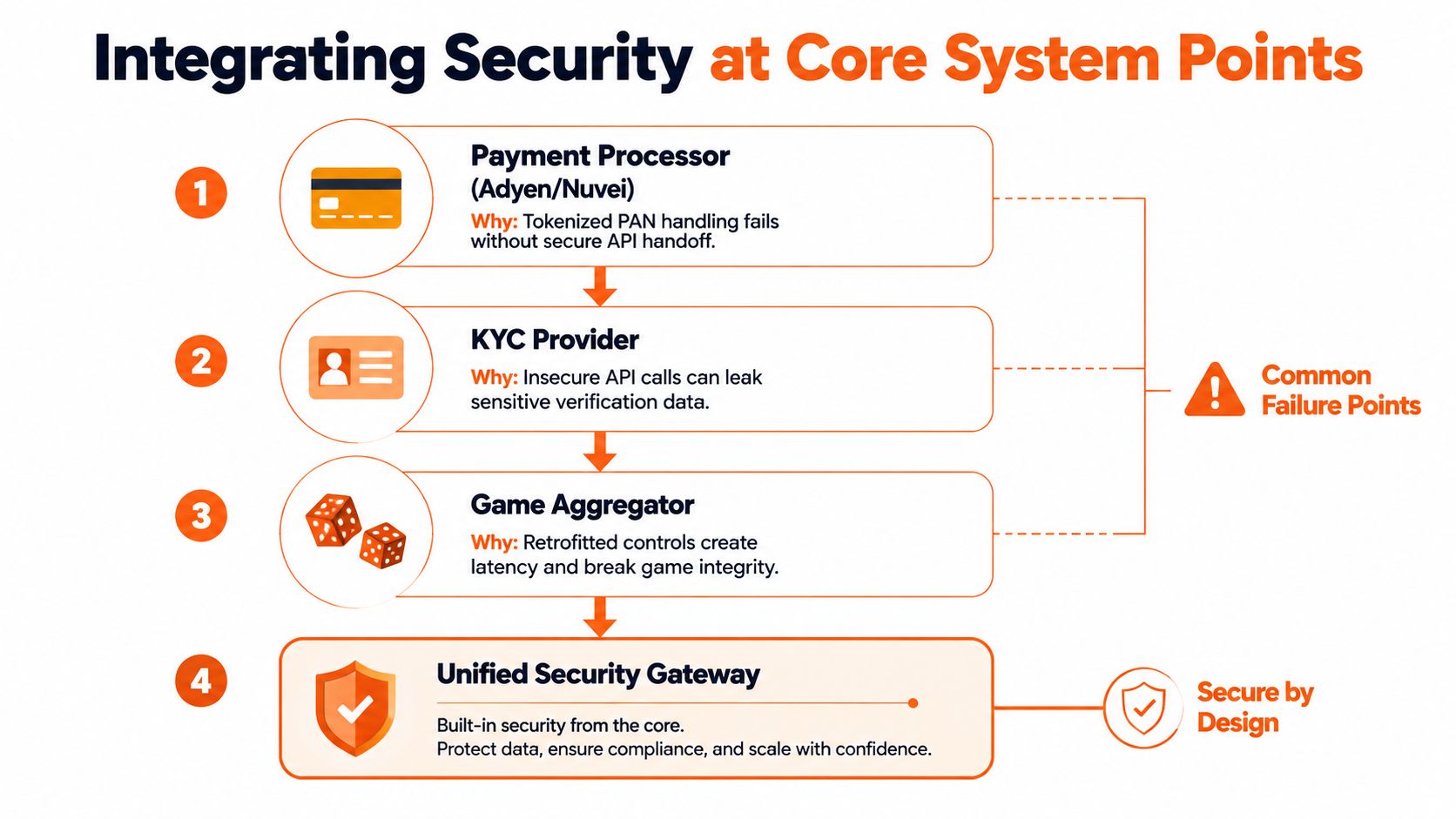
Retrofitting security after integrations are live usually reveals the same problem: business services own controls they weren't designed to enforce consistently. The gateway should handle the common validation and identity decisions, while domain services retain the final business authorization and ledger rules.
Payment processors
For Adyen, Nuvei, Trustly, and similar providers, keep tokenized payment data on the controlled integration path. The gateway should validate token format, enforce idempotency-key behavior, apply issuer or integration-specific rate limits, and strip sensitive card data before the request reaches the application tier. That design helps reduce unnecessary PCI exposure and prevents every payment service from implementing its own interpretation of a safe request.
The production failure usually starts with a retry that isn't treated as a duplicate. A timeout occurs, the client repeats the call, and the service creates a second authorization or wallet event because no trusted idempotency policy exists at the boundary.
KYC and age verification
Onfido, Jumio, and Sumsub callbacks should arrive through a narrowly controlled route. Validate the provider signature, issuer, timestamp, event type, and subject binding, then reject replayed events and store the event identifier before applying the state transition.
A common retrofit mistake is trusting the callback body because it came from an apparently known URL. Location-based allowlisting alone isn't enough. Attackers can exploit leaked credentials, compromised integration paths, or replayed valid messages unless the platform verifies the assertion and ensures that the event belongs to the expected player and verification request.
Game aggregators and sportsbook feeds
Pragmatic Play, Evolution, Relax Gaming, and sportsbook providers need strict callback policies. Allowlist the expected source path where feasible, bind session tokens to the game, tenant, player, and session context, and shape traffic on jackpot or game-state endpoints.
The failure mode is often subtle. An aggregator callback is accepted with a shared token, the route doesn't validate tenant ownership, and a legitimate retry updates the wrong session or applies an event twice. Separate credentials, signed messages, object binding, and idempotent state transitions provide more protection than a broad network allowlist.
Integration test: Replay a valid callback, alter its tenant and player identifiers, duplicate its event key, and send it through an unexpected route. The platform should reject each invalid variation before business state changes.
Security also has to account for the wallet model shared by casino, sportsbook, fiat, and crypto flows. A multi-currency wallet architecture needs consistent authorization, currency validation, ledger idempotency, and audit events across every balance-changing integration.
Bot Defense and Fraud Economics at the API Layer
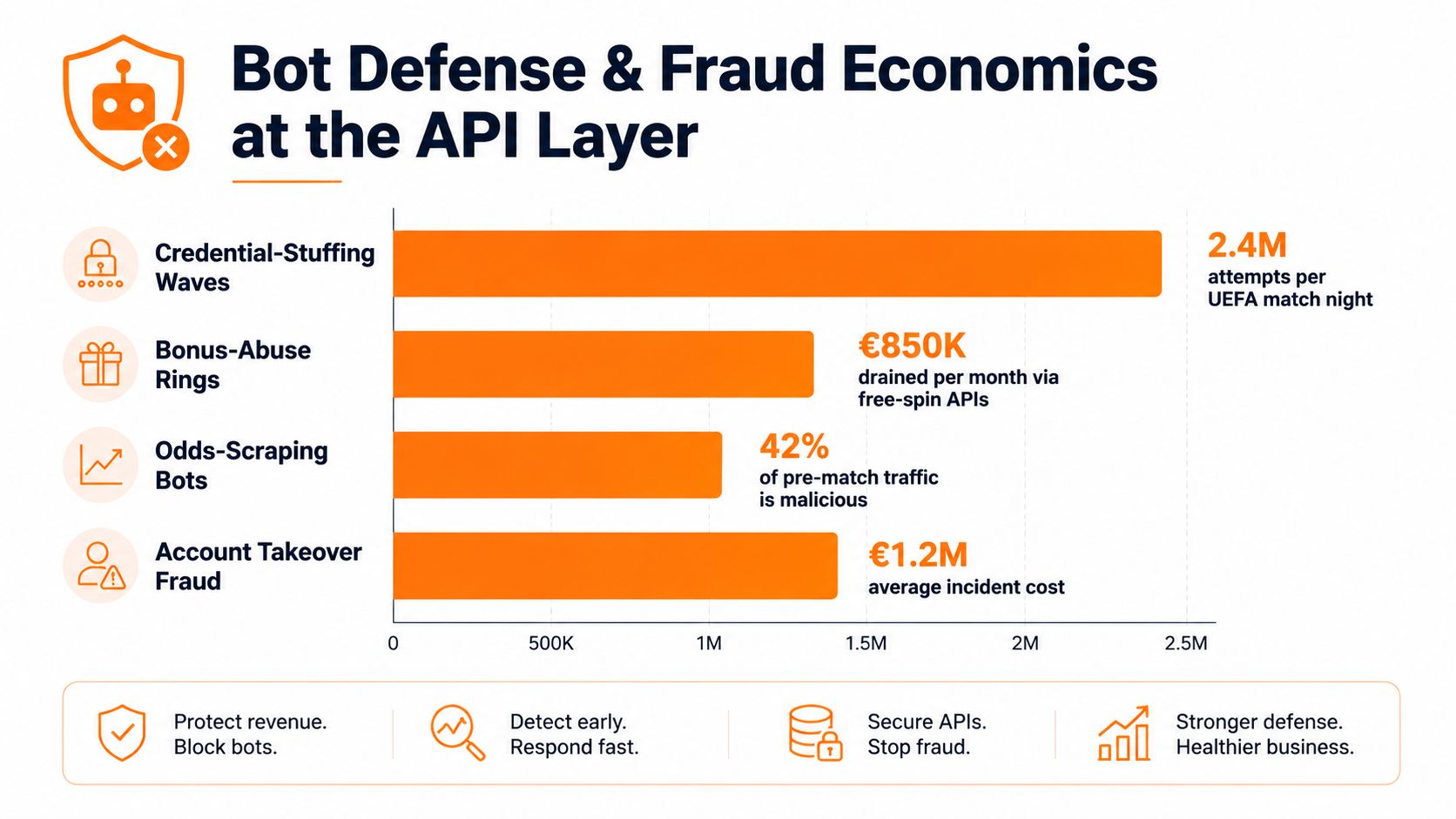
Generic WAF protection misses a large part of gaming abuse because the attacker often sends correctly formatted requests. A credential-stuffing ring can call the login API with valid fields, a bonus ring can follow the registration flow normally, and an odds scraper can request prices exactly as a browser client does. The distinction appears in sequence, velocity, identity consistency, and economic intent.
Independent reporting found that 53% of organizations experienced bot attacks involving APIs, 44% named bot mitigation a top challenge, and 53% said WAF or WAAP tools were ineffective at identifying or preventing fraud at the API layer. Traceable's 2025 State of API Security report also reported that API bot activity included 40% more credential-stuffing and account-takeover attempts, with payment fraud and scraping among the common attack patterns.
Match signals to the business action
For login protection, combine device fingerprinting, transport fingerprints, behavioral biometrics, failed-attempt velocity, and account history. A headless browser may present a valid user agent, but it often reveals automation through stable transport characteristics, repeated timing, impossible account rotation, or a device appearing across unrelated identities.
Bonus endpoints need different logic. Apply velocity rules by account, device, payment instrument, household or risk cluster, and promotion. Don't rely on IP address alone, because mobile networks, proxies, and shared connections make it a weak identity signal.
Payment and withdrawal flows deserve step-up authentication when the request follows a suspicious sequence, such as a new device, password reset, rapid deposit, and immediate withdrawal. Odds scraping calls for request shaping, token binding, and transport analysis rather than a browser challenge that an API client never renders.
Static rules versus behavioral models
Static rules are explainable and useful for hard boundaries. They work well for impossible values, unsupported countries, excessive request rates, and known bad credentials. Their weakness is adaptability. Attackers can distribute activity below a fixed threshold or rotate identities to stay inside the rule.
Behavioral models can identify relationships across calls, accounts, devices, and endpoints. They're better suited to detecting coordinated bonus abuse or a session that moves from login to cashier in an unusual way. They also require careful tuning, explainability, and a safe response strategy. Blocking every anomaly during a major fixture can harm legitimate customers, so graduated actions such as delay, step-up verification, reduced limits, and review are usually more resilient.
Use the operator's risk management practices as the business context for these signals. The platform should connect a bot score to a decision, not merely create another dashboard alert.
Evaluation Criteria for Choosing an API Security Platform
A proof of concept should test production behavior, not presentation slides. Give shortlisted vendors representative traffic from login, registration, bonus, wallet, payment, KYC, odds, and settlement flows. Include multiple brands and tenants, because policy isolation is where attractive demos often become difficult implementations.
Must-haves
The platform should support OAuth 2.0, JWT validation, mTLS, scoped permissions, per-endpoint rate limiting, and OWASP API Top 10 coverage. Ask for limits that operate at sub-second granularity, because a broad minute-level quota won't adequately control login storms, jackpot polling, or withdrawal probing.
Audit logs must support the reporting and investigation needs associated with MGA and UKGC operations. Test whether each event records the caller, tenant, player or object context, policy decision, route, response, and correlation identifier. Performance also needs a measurable acceptance test. Require demonstrated latency overhead of under 5ms at p99 as part of the proposed evaluation criteria, rather than accepting an unqualified “low latency” statement.
Useful extensions
Schema-aware inspection reduces the amount of custom validation code in individual services. Behavioral bot scoring helps with coordinated abuse, while pre-built connectors for major game aggregators can shorten integration work. These features are valuable only if the vendor exposes tuning, testing, and rollback controls that your operations team can use during live events.
Deal-breakers
Some gaps should end the evaluation:
- No self-hosted key management: The operator can't meet its control requirements for secrets, signing keys, or jurisdictional boundaries.
- No per-tenant policy isolation: One white-label brand can inherit another brand's access or traffic policy.
- No responsible-gaming extension point: The security layer can't participate in self-exclusion propagation, account restrictions, or related enforcement workflows.
- No explainable enforcement: Fraud or bot decisions can't be tied to an event, policy, and operator action.
- No failure-mode controls: The vendor can't show what happens when the platform is unavailable, overloaded, or disconnected from an identity provider.
| Criterion Category | Weight (%) | Must-Have Example | Deal-Breaker Example |
|---|---|---|---|
| Compliance | 40% | MGA and UKGC-compatible audit trails, jurisdiction-aware policy, responsible-gaming integration | No self-hosted key management or reporting evidence |
| Performance | 25% | Demonstrated under 5ms p99 overhead and controlled degradation | Unmeasured latency or shared bottleneck during bursts |
| Integration | 20% | OAuth 2.0, mTLS, schemas, signed webhooks, aggregator connectors | No tenant isolation or weak callback controls |
| Commercial | 15% | Clear pricing, support model, rollout plan, and exit terms | Contract locks the operator into untestable capabilities |
Use the weighting to keep the decision disciplined. A vendor with an impressive bot dashboard shouldn't outrank a platform that protects settlement authorization, preserves tenant isolation, and produces usable compliance evidence. The best API security platform is the one that enforces the controls your gaming flows need, under the traffic and failure conditions your teams must handle.
NexGrate gives B2B iGaming operators a unified white-label platform for casino, sportsbook, payments, wallets, KYC, game aggregation, and compliance workflows, with the integration surface needed to apply API security controls consistently. Review the platform at NexGrate and discuss how its architecture can support your next brand launch or migration.