
A football match reaches its decisive minutes. Player betting traffic climbs, the odds service pushes refreshes, and a settlement job starts processing completed bets. At the edge, one blanket quota sees only requests. It doesn't know which calls move money, which calls refresh prices, and which calls can wait.
The settlement worker consumes the shared allowance. Valid bets remain unsettled while wallet checks and session requests continue competing for capacity. Operators then face a failure created by their own protection rule: the control meant to preserve stability has delayed financial processing and damaged player trust.
That scenario is common on mixed-traffic iGaming platforms. API rate limiting isn't a single security switch. It's a resource-allocation policy for wallets, odds, KYC, payments, sessions, reporting, and internal jobs that all share infrastructure but carry different operational risks.
Table of Contents
- Why Rate Limits Can Save or Sink an iGaming Brand
- What API Rate Limiting Actually Does
- The Four Algorithms Every Operator Should Understand
- Where Rate Limiting Matters Most on a White-Label Platform
- Configuring Limits That Match Real Traffic
- Error Handling, Retries, and Customer Trust
- Observability and Tuning Over Time
- A Practical Rate Limiting Checklist for Operators
Why Rate Limits Can Save or Sink an iGaming Brand
A sportsbook backend has several types of traffic moving through the same platform. Player requests are interactive and latency-sensitive. Odds ingestion may arrive in bursts. Settlement and reconciliation jobs are deadline-driven. KYC checks depend on an external provider, while marketing and reporting workloads can expand suddenly without being part of the live betting path.
A global limit treats those workloads as interchangeable. They aren't.
If the platform assigns one shared allowance to a brand or gateway, a high-volume odds consumer can crowd out wallet operations. A settlement worker can consume capacity needed for bet placement. A shared enterprise network can also make unrelated players appear to be one noisy client when enforcement relies only on the source IP.
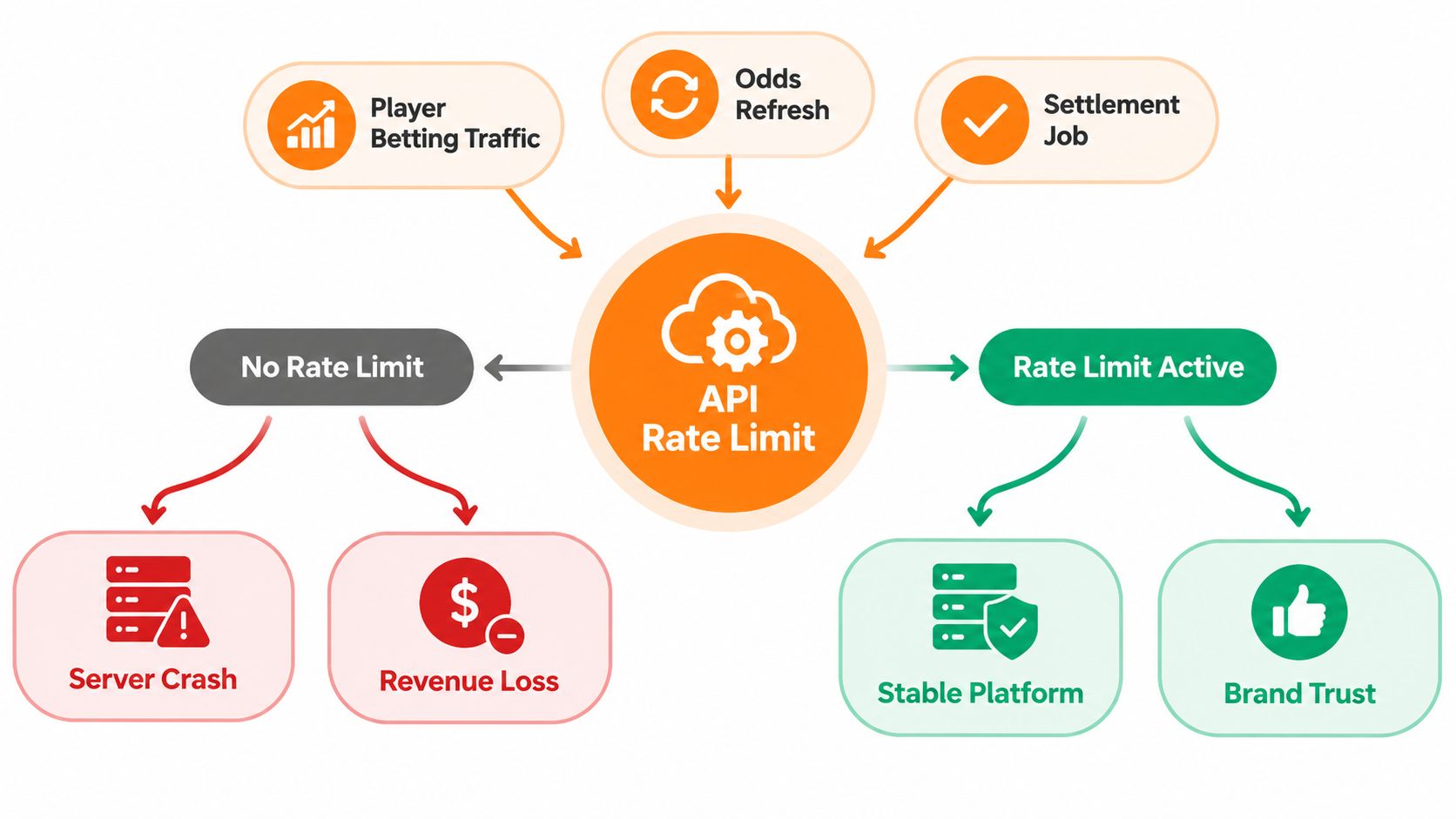
Operational rule: Rate limiting should produce controlled degradation. It shouldn't make critical money movement compete directly with optional traffic.
The practical job is to protect finite resources while preserving the workflows that matter most. Those resources include application workers, database connections, wallet-provider quotas, KYC capacity, payment-provider capacity, and downstream odds infrastructure. A limit can contain a bad integration, absorb an expected burst, or stop an abusive workflow before it becomes an outage. It can also create retry storms if clients receive unclear responses and immediately resend rejected requests.
This is why API protection belongs alongside broader DDoS protection for hosting environments, not in an isolated gateway configuration. Edge controls can reject obvious excess traffic, but application and database layers still need policies for expensive business operations.
Before setting thresholds, map every route and consumer. Identify which operations must remain available during a peak match, which jobs can queue, and which traffic can be shed first. Keep an emergency override that has been tested before production pressure arrives. A good design preserves the settlement path, isolates noisy neighbors, and gives each white-label brand a defensible share of capacity.
What API Rate Limiting Actually Does
API rate limiting controls how many requests an identified consumer can send within a defined period. The identity might be an API key, user, tenant, brand, device, service account, source IP, or a combination of those signals. The limiter checks the request against a policy, then accepts it, delays it, queues it, or rejects it.
The formal HTTP behavior is clear. RFC 6585 guidance on HTTP 429 introduced the 429 Too Many Requests status code in April 2012 for clients sending too many requests in a given time window. The same guidance pairs 429 with Retry-After, turning throttling into a client-server contract rather than an undocumented backend decision.
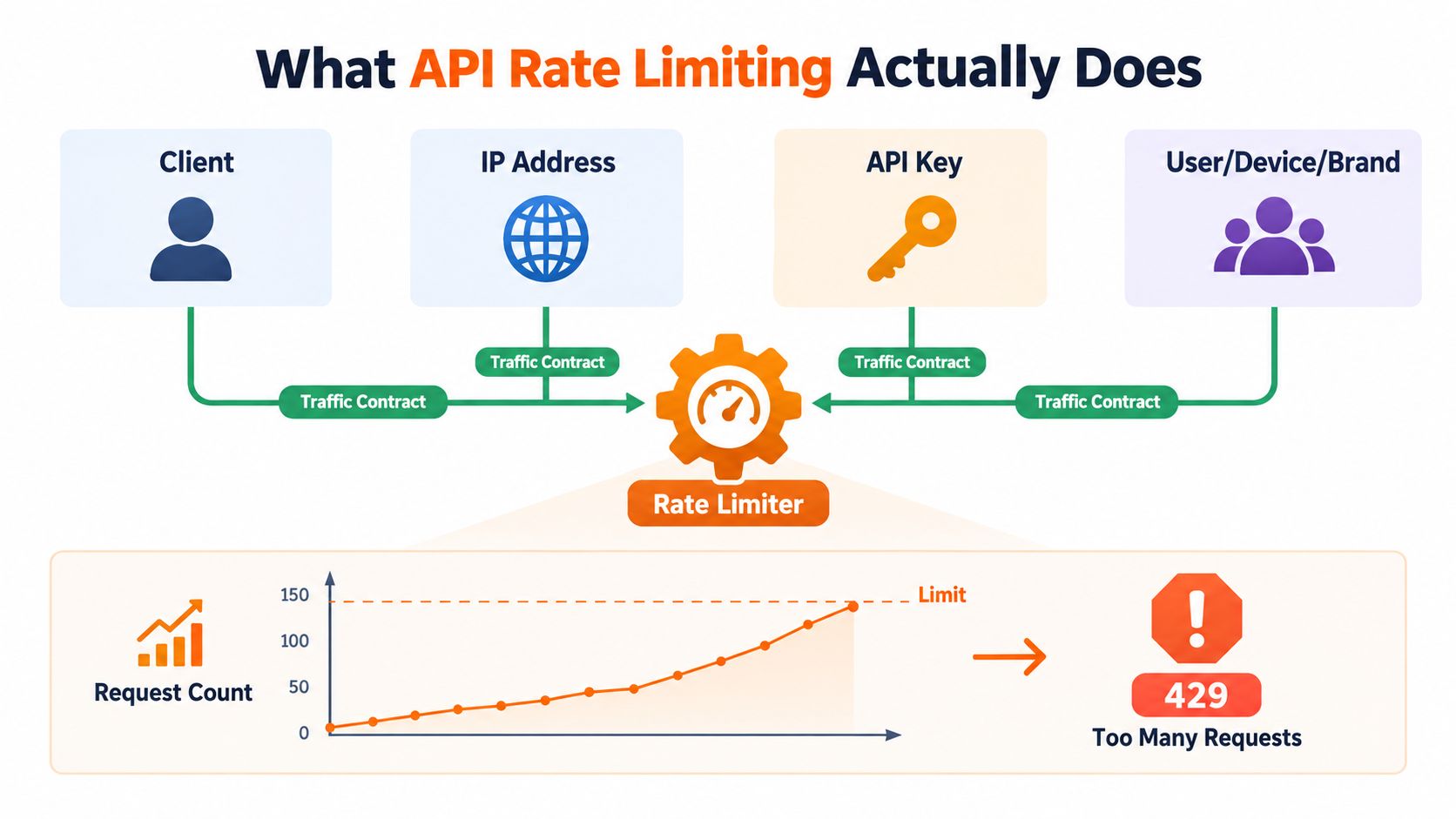
A venue analogy helps. The entrance counter admits people at a sustainable pace and may allow a short rush when several guests arrive together. Once safe capacity is reached, new arrivals wait or turn back instead of crowding the venue and disrupting the people already inside. A rate limiter performs the same function for application instances, databases, wallet providers, KYC vendors, and odds suppliers.
The response contract should be predictable:
- Status: Return 429 when the policy rejects a request because the consumer has exceeded its allowance.
- Timing: Include
Retry-Afterso the client knows when it can try again. - Identity: Make the policy key understandable to the owning integration, without revealing another tenant's usage.
- Cost: Avoid counting every request equally when one route is cheap and another triggers expensive risk or database work.
A distributed gateway can enforce shared state across application instances, while local service limits provide protection when the central limiter or dependency is unavailable. The important distinction is between request rate, concurrency, and request cost. A balance lookup, a KYC decision, and a complex risk evaluation shouldn't automatically consume the same unit of capacity.
For operators, the key question isn't how many requests the system receives. It's which identity sent them, which route they hit, what work each request triggered, and whether the downstream service could safely absorb the load.
The Four Algorithms Every Operator Should Understand
The algorithm determines the shape of traffic that reaches your services. Choosing one because it's familiar can create boundary bursts, unfair rejection, or unnecessary queue latency.
Fixed window
A fixed window counts requests inside a defined interval and resets the counter at the boundary. A policy such as 1,000 requests per minute is easy to explain and inexpensive to implement, but clients that send requests at the end of one window and the beginning of the next can create a synchronized spike. That behavior is especially awkward around live odds updates, where many consumers refresh on the same schedule.
Fixed windows work well for coarse quotas and low-risk routes. They aren't a strong default for a sensitive endpoint that needs smooth enforcement across time boundaries.
Sliding window
A sliding window evaluates recent traffic continuously instead of waiting for a calendar boundary. It gives a more faithful view of sustained demand and tends to be fairer for player-facing APIs, but accurate tracking needs more state and coordination.
Use it when a route's recent history matters more than burst flexibility. Authentication, account access, and interactive player APIs often benefit from this behavior because a client shouldn't gain a fresh allowance merely because a clock boundary passed.
Token bucket
A token bucket replenishes tokens at a defined rate and stores them up to a capacity. A configuration such as 100 requests per second with a bucket capacity of 250 allows routine traffic while permitting a controlled burst of 250 requests, provided the bucket has accumulated enough tokens.
That shape suits odds updates and similar workloads where short bursts are legitimate but sustained excess must stop. The capacity still needs careful tuning. A bucket that is generous at the edge can send a burst directly into a database or provider that has no equivalent burst tolerance.
Cloudflare's published API limits show how large platforms combine policies by identity and workload. Its client API allows 1,200 requests per 5 minutes per user or account token and 200 requests per second per IP, while GraphQL access uses query cost with a maximum of 320 requests per 5 minutes. These policies demonstrate why raw request count isn't always enough.
Leaky bucket
A leaky bucket places work into a bounded queue and drains it at a controlled rate. It smooths traffic effectively, which can protect payment providers and mutation-heavy databases, but queueing adds latency and creates a hard requirement for timeout behavior.
If a queued request can no longer complete before its business deadline, rejecting it is safer than allowing an indefinite wait. For settlement, that decision may differ from marketing ingestion, so the queue policy belongs to the workload rather than the shared gateway.
| Algorithm | Traffic behavior | Best fit | Main trade-off |
|---|---|---|---|
| Fixed window | Counts within discrete intervals | Coarse quotas and low-risk routes | Boundary bursts can occur |
| Sliding window | Evaluates a rolling recent period | Fair, sustained user traffic | Requires more state and coordination |
| Token bucket | Enforces an average rate with controlled bursts | Odds updates and bursty integrations | Bucket size can overload downstream systems |
| Leaky bucket | Queues and drains at a steady rate | Smooth database or provider load | Adds latency and queue-management complexity |
Where Rate Limiting Matters Most on a White-Label Platform
A white-label platform needs a policy map, not one number shared by every brand and endpoint. The same backend may serve casino browsing, sportsbook pricing, player sessions, wallet mutations, KYC checks, payment callbacks, bonus campaigns, and administrative exports.
Wallet debit, credit, and reversal routes deserve strict controls at the player, account, tenant, and route levels. Throttling reduces duplicate pressure, but it doesn't make a financial mutation safe by itself. Use idempotency keys, transaction guards, and ordering rules so a retry or race can't create a duplicate adjustment.
Odds ingestion needs sustained throughput with an explicit burst allowance. Outgoing odds delivery has a different shape because fan-out can multiply one upstream update into work for many players or tenants. A platform should limit that delivery path independently instead of allowing one consumer's refresh behavior to consume the same capacity reserved for wallet or settlement operations.
KYC requests may need provider-aware limits because an external verification call can be slow or costly. Payment callbacks should move through a reliable intake path with deduplication and bounded processing. Bonus engines need isolation during campaigns, when an otherwise modest player action can trigger many eligibility, ledger, and notification operations.
Practical observation: A route that looks small at the HTTP layer can be expensive after authorization, database writes, provider calls, and event publication.
Admin and reporting APIs also need separate budgets. An export launched during a live event shouldn't compete with bet placement or settlement. Internal jobs should use distinct service identities, with reserved capacity for reconciliation and incident response.
The platform model described in a white-label gaming solution combines casino, sportsbook, payments, wallets, and compliance concerns. That combination makes route-level ownership essential. Enforce cheap broad checks at the edge, application policies around business cost, and database controls around transaction integrity.
| Workload | Primary risk | Recommended policy shape | Enforcement focus |
|---|---|---|---|
| Wallet mutations | Duplicate or conflicting financial operations | Strict per-player and per-account controls | Application and database |
| Odds ingestion | Bursts and supplier overload | Sustained rate plus controlled burst | Gateway and ingestion service |
| Odds delivery | Expensive tenant or player fan-out | Per-consumer and per-tenant budgets | Delivery layer |
| KYC verification | Slow or constrained external provider | Provider-aware concurrency and queue limits | Application and dependency client |
| Payment callbacks | Delayed or duplicated financial events | Reliable intake, deduplication, bounded processing | Webhook and ledger services |
| Bonus engine | Campaign-driven amplification | Isolated campaign budget and queue | Application workers |
| Admin reporting | Heavy reads during live traffic | Separate quota and concurrency pool | Gateway and reporting service |
Configuring Limits That Match Real Traffic
Start with observation, not an arbitrary requests-per-second value. Measure request volume by route and identity, response latency, downstream quotas, concurrency, error behavior, and the actual cost of each operation. The limit should reflect what the service and its dependencies can sustain while leaving room for critical work.
Choose identity keys carefully. Cloudflare's rate-limit guidance recommends stable identifiers such as API keys, user IDs, or tenant IDs instead of relying on IP address or location alone. Mobile networks, carrier NAT, shared offices, and enterprise egress can put many legitimate users behind one address, while distributed abuse can spread across many addresses.
A useful policy usually combines several dimensions:
- Tenant and brand: Prevent one white-label operation from consuming another's allocation.
- Consumer and API key: Contain a faulty integration or service account.
- User or player: Protect sensitive account and financial workflows.
- Route: Match the policy to the operation's risk and cost.
- Source IP: Use as one signal for edge abuse, not as the sole identity for legitimate traffic.
Express sustained capacity and burst capacity separately. A token bucket with 20 requests per second and a burst of 40 communicates expected speed and short-term tolerance more clearly than a large aggregate quota. That policy still needs validation against provider behavior, database headroom, and the number of concurrent application workers.
Put each control where it belongs
The edge should handle inexpensive checks such as malformed traffic, obvious abuse, and broad source controls. The application should evaluate identity, authorization, eligibility, risk, and request cost. The database should protect mutation integrity with transaction guards, uniqueness rules, and safe concurrency behavior.
Don't make a gateway limit responsible for every failure mode. A request may pass the edge and still need to wait for a wallet lock, a KYC provider, or an odds dependency. Use queues for work that can safely wait, and use bounded concurrency for work that must not overwhelm a downstream system.
Internal settlement and reconciliation jobs need separate identities and reserved capacity. Retry capacity needs explicit treatment too. If every client retries at the same time after a provider slowdown, the limiter may see a second wave larger than the first.
Test with production-like conditions before rollout. Include synchronized bursts, uneven brand distribution, cold starts, failover, dependency delays, and a saturated database. Review policies after provider changes, major game launches, new regulated markets, and meaningful shifts in player or integration behavior.
Error Handling, Retries, and Customer Trust
A rejected request must leave the client with an unambiguous outcome. For a read, that usually means the client can wait and try again. For a bet, withdrawal, bonus grant, or wallet adjustment, the client must know whether the server accepted the operation before deciding to retry.
Return 429 Too Many Requests for throttling, a stable machine-readable error code, a clear message, and Retry-After. The header can express a delay or an absolute retry time. Include correlation details for support and operations, but don't expose another tenant's counters or internal capacity.
The client should stop sending requests as soon as it receives 429. It should honor Retry-After, apply exponential backoff with jitter, and attach an idempotency key to every retryable mutation. Without idempotency, a timeout followed by a retry can create duplicate bets, withdrawals, bonus grants, or wallet entries.
A 429 is useful only when the client can act on it safely.
Server-side queueing is appropriate when delayed processing is safer than rejection. Queues must have bounded size, deadlines, and cancellation behavior. A queue that accepts unlimited work moves overload from the gateway into worker memory and makes recovery harder.
Circuit breakers provide another layer around a saturated payment, KYC, or odds provider. They can fail away from an unhealthy dependency, but they don't replace quotas. The breaker needs a controlled recovery probe, otherwise clients will either keep hammering the dependency or remain blocked after it recovers.
Separate overload from business rejection. Insufficient funds, a KYC failure, an invalid bet state, and a rate limit are different outcomes with different support procedures. Log each throttled request with its policy, route, consumer, retry time, and correlation ID, while redacting player and financial data.
During an incident, operators should identify the exhausted key and route, check dependency health, protect critical workflows, shed optional traffic, and communicate status to affected brands. Raising a limit can be correct, but only after confirming that the limiting resource can absorb the additional work.
Observability and Tuning Over Time
A rate-limit policy is only as defensible as the evidence behind it. Connect metrics, structured logs, traces, dashboards, and incident records so the team can distinguish a correct rejection from a misconfigured quota.
Four signals deserve a permanent place on the operator dashboard:
- 429 rate by consumer and route: Reveals which integration or endpoint is exhausting capacity.
- p95 latency for throttled traffic: Shows whether rejected clients are also creating queue or retry pressure.
- Retry amplification after a burst: Indicates whether client behavior is turning one overload event into repeated demand.
- Business completion counters: Track settled bets, completed deposits, withdrawals, and verification outcomes during a limit event.
Slice every signal by brand, tenant, vertical, route, dependency, and consumer type. A noisy casino integration shouldn't look like a sportsbook settlement outage. A shared source IP shouldn't hide the fact that several authenticated users are being throttled together.
Cloudflare's rate-limiting best practices recommend response-aware rules that can count error responses such as 401 and 403 and match the exact attacked URI path. The guidance also describes windows ranging from 60 seconds to 1 day, reinforcing that enforcement should reflect attack duration and endpoint sensitivity rather than one universal interval.
Set alerts around impact, not just counter activity. For example, an operator may alert when a consumer's 429 rate stays above 2% for 5 minutes, using that threshold as a deliberate operational trigger rather than a universal industry standard. Review the resulting incidents, compare them with customer impact, and adjust token-bucket refill rates, burst capacity, route policies, or client behavior.
| Metric | Why it matters | Example threshold |
|---|---|---|
| 429 rate by consumer-route pair | Identifies targeted exhaustion and false positives | Above 2% for 5 minutes |
| p95 latency during throttling | Exposes queueing and dependency pressure | Compare with the route's established baseline |
| Retry amplification | Shows whether clients multiply the original burst | Alert when retries materially exceed accepted traffic |
| Settled bets during limit events | Connects enforcement to sportsbook continuity | Investigate any unexplained interruption |
| Completed deposits and withdrawals | Protects payment and wallet visibility | Compare limit events with normal completion behavior |
Keep a runbook for each policy: owner, identity key, route, algorithm, capacity rationale, dependencies, emergency override, rollback method, and last review. Revisit the configuration on a regular operating cadence and after every significant incident. The next engineer should inherit measured reasoning, not folklore embedded in a gateway file.
A Practical Rate Limiting Checklist for Operators
Before the next peak match, review the platform in three passes. The opening settlement scenario should be the test case: can the system absorb player activity and odds refreshes without starving settlement, wallet calls, or session traffic?
Enforce
- Separate workloads: Create distinct policies for wallet mutations, odds ingestion, odds delivery, KYC, payments, bonuses, reporting, and internal settlement.
- Use stable identities: Key limits by tenant, brand, API key, user, or service account, with IP as a supporting edge signal rather than the only identity.
- Match the route: Give expensive risk and mutation endpoints different treatment from lightweight reads.
- Allow deliberate bursts: Define burst capacity separately from sustained throughput and test it against downstream limits.
- Protect transactions: Pair throttling with idempotency keys, database guards, and safe ordering for financial operations.
Observe
- Own the dashboard: Assign an operator to monitor 429 rates, p95 latency, retry amplification, and completed business workflows.
- Slice the data: Break results down by brand, tenant, route, dependency, and consumer so shared infrastructure doesn't hide the source.
- Review offenders: Examine the integrations generating repeated throttles and determine whether the issue is abuse, a client bug, or an undersized policy.
- Verify the path: For security rules, confirm the exact URI and response pattern before enforcement. Cloudflare's rule guidance specifically emphasizes analytics validation and response-aware matching.
Recover
- Honor the contract: Ensure every client handles 429 and
Retry-Afterwithout immediate retry loops. - Queue selectively: Use bounded queues and deadlines only for work that can safely wait.
- Open the circuit carefully: Fail away from unhealthy dependencies and recover with controlled probes.
- Keep a rollback: Document how to disable or reduce a new limit without removing protection from every route.
- Communicate impact: Tell affected brands whether the event involves throttling, provider failure, business rejection, or maintenance.
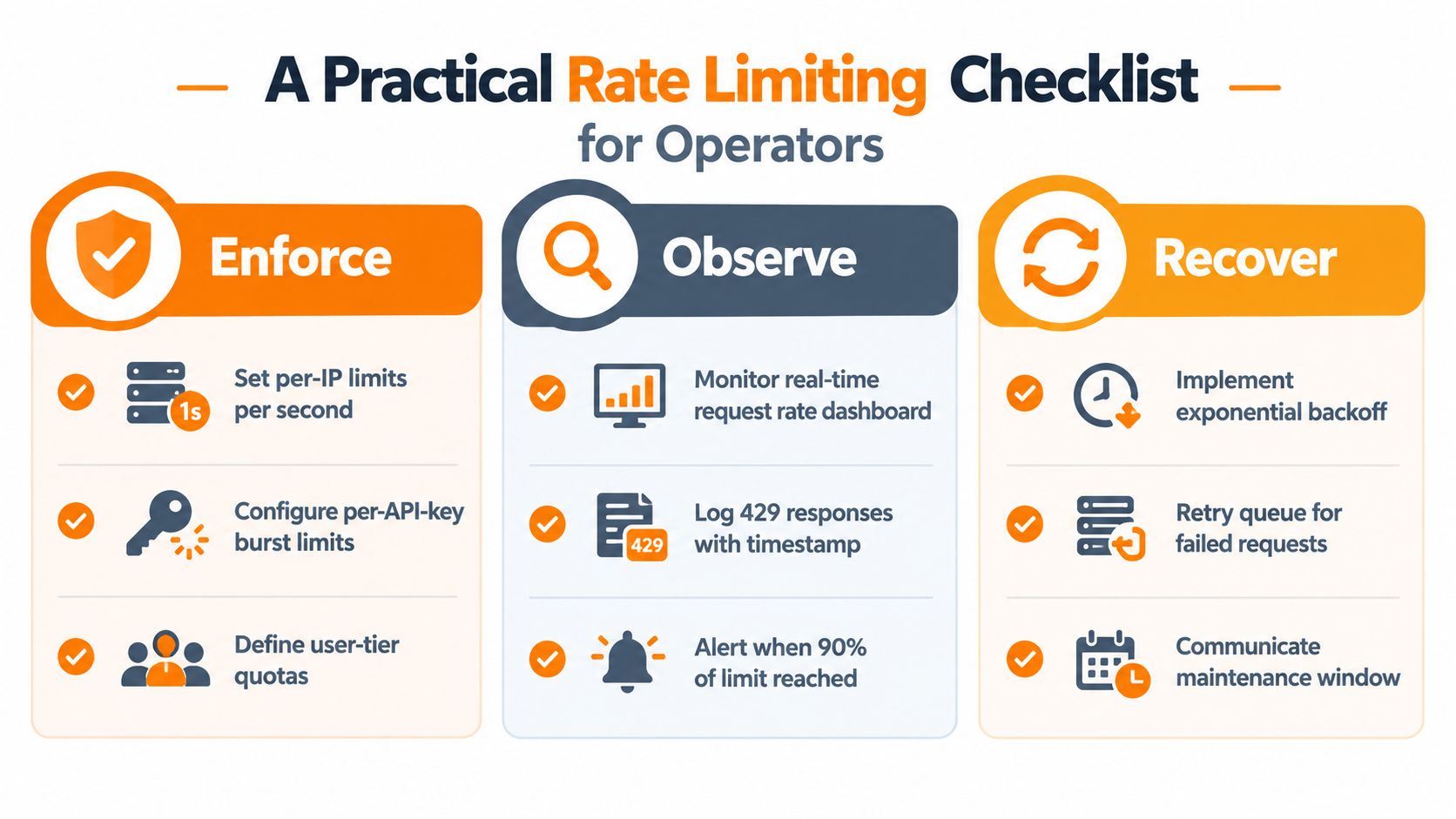
The central principle is simple: limit per consumer, per route, and per risk profile. A single blanket quota would have allowed the settlement job to compete with odds refreshes in the opening scenario. A workload-aware design reserves the capacity that keeps bets settled, balances accurate, and player sessions available.
For broader operational controls, connect this work with risk management best practices for iGaming platforms. Then run the checklist against a simulated peak, not just a quiet staging environment.
NexGrate provides a white-label casino and sportsbook platform with integrated wallets, betting engines, payments, KYC and compliance workflows, monitoring, hosting operations, and rate limiting within its layered DDoS mitigation approach. Visit NexGrate to discuss how its unified backend can support workload-aware API protection across sportsbook, casino, wallet, and compliance traffic.