
A sportsbook settles a same-game parlay incorrectly during peak hours. The promo engine was changed, but nobody tested that change against the live-shaped odds feed, the wallet rules, and the settlement path together. By the time operations identifies the fault, the refund queue has already become a multi-team incident that takes days to unwind.
That's the practical reason sandbox environment testing matters in iGaming. A regulated operator needs to know whether a release can move through casino, sportsbook, payments, KYC, fraud controls, and responsible gambling logic without affecting real balances or real players. A sandbox isn't just a spare staging URL. It's a controlled operating model for exercising integrations, replaying difficult conditions, and producing evidence that release paths were tested before production exposure.
The trade-off is unavoidable. Strong isolation protects production but can drift away from reality. A sandbox that imitates everything perfectly may be expensive and difficult to refresh, while a lightweight test setup can miss the exact callback, latency, rounding, or settlement interaction that fails after launch. The useful target is reproducibility, realistic behavior, fast feedback, and audit-ready evidence.
Table of Contents
- What Sandbox Environment Testing Actually Solves for iGaming Operators
- Core Layers Every Sandbox Needs Before You Touch a Bet
- Building Realistic Test Data Without Touching Player Records
- Validating Casino, Sportsbook, and Payment Integrations
- Automating Pipelines and Staging-to-Production Gates
- Compliance, KYC, and Regression Scenarios to Lock In
- Common Sandbox Failures and a Pre-Release Audit Checklist
What Sandbox Environment Testing Actually Solves for iGaming Operators
A release can pass every component test and still fail once casino, sportsbook, payments, KYC, and promotions interact. The sportsbook may accept a wager, the wallet may record the transaction, and the odds provider may respond correctly in isolation. The production defect often appears at the boundary, such as a delayed callback, an unexpected settlement state, or a bonus decision based on stale account data.
A sandbox gives engineers a controlled place to test that boundary. The practical question is: can the entire regulated stack absorb this change without affecting real money or player records? A useful environment separates casino sessions, sportsbook bets, payment callbacks, KYC responses, bonus decisions, fraud checks, and operational jobs from live systems. Teams can then replay unusual combinations without creating genuine deposits, withdrawals, player liabilities, or regulatory reporting events.
The approach has a clear technical foundation. A 2006 reference definition of a software sandbox describes a sandbox as a testing environment that isolates untested code changes from production. Current security practice extends that idea by checking whether the boundary holds. Security teams have reported both generated test suites for untrusted code and incidents involving supposedly isolated environments reaching the live internet. Those findings support a practical rule for iGaming: isolation must be tested, not assumed.
Isolation is protection, not realism
Blocking every external dependency can make a sandbox safe but misleading. Gaming providers may behave differently in test mode, PSP callbacks may arrive on different schedules, and KYC vendors may expose only a narrow set of document outcomes. Tests built entirely on idealized mocks confirm application assumptions, not provider behavior.
The opposite failure creates direct operational risk. Shared credentials, production webhooks, or copied player records can turn staging into an uncontrolled extension of production. The sandbox security analysis identifies poorly secured test environments as a recurring breach risk and describes the financial and containment benefits of stronger controls. The exact figures matter less than the engineering consequence: a sandbox needs its own credentials, endpoints, data, and network permissions.
A practical standard is:
A release should be repeatable without being dangerous, and realistic without depending on live player data.
Every run should identify the build, control its inputs, isolate its credentials, capture provider outputs, and retain logs. Those records let an engineer reproduce a failure, let compliance review the tested path, and let an auditor verify what reached each system. The goal is controlled realism, not a perfect copy of production.
Core Layers Every Sandbox Needs Before You Touch a Bet
A useful iGaming sandbox starts below the betting interface. If infrastructure, secrets, data, integrations, and observability aren't reset together, a successful bet test can still conceal a broken release.
Start with infrastructure and identity
Use the same service boundaries and deployment artifacts that production uses wherever practical. Containerized casino services, sportsbook workers, wallet APIs, promotion jobs, KYC adapters, and reporting processes should start from versioned images rather than manually adjusted servers. Feature flags must point to non-production identifiers, and every secret should be scoped to the sandbox environment.
The key distinction is not whether a value looks authentic. It's whether the value can cause a real-world side effect. A payment credential that happens to be stored in a staging vault is still dangerous if it can authorize a live transaction. Sandbox credentials, test merchant accounts, non-production callback URLs, and deny-by-default network policies should be provisioned automatically.
Build a controlled data plane
Casino games need deterministic configurations and known outcomes. Sportsbooks need odds fixtures, event states, market suspensions, price changes, voids, and settlements that testers can replay. Wallets need balances and transaction histories that reset predictably. An RNG seed or simulated odds sequence should be tied to the test run, not pulled from a live provider.
The integration layer then translates those controlled inputs into provider-like behavior. Use virtual payment processors, fake PSP webhooks, and KYC vendors in test mode with deterministic responses. Capture every callback, including retries, duplicates, malformed signatures, delayed settlement messages, and provider errors.
Make every result observable
Structured logs should carry a shared trace ID from bet placement through odds acceptance, wallet reservation, settlement, promotion evaluation, and ledger posting. Dashboards should expose rejected callbacks, unmatched transactions, balance changes, queue delays, and KYC state transitions. Without that trail, a failed test tells you only that something broke, not where money or compliance state diverged.
The practical guidance on iGaming sandbox testing recommends ephemeral CI environments, teardown after execution, captured-and-replayed traffic, and programmatically generated synthetic data. That combination addresses two common problems at once, stale shared state and dependence on unrealistic mocks.
| Sandbox Layer | Must Mirror Production | Must Stay Isolated |
|---|---|---|
| Infrastructure | Service boundaries, deployment images, worker behavior, configuration shape | Hosts, networks, credentials, and operational access |
| Data plane | Game rules, odds states, wallet transitions, reporting fields | Player identities, balances, PII, and live event data |
| Integrations | Request schemas, callback formats, signing logic, error states | Merchant accounts, provider tenants, callback destinations |
| Observability | Trace propagation, alert conditions, audit fields, dashboards | Production logs, personal data, and live alert channels |
| Lifecycle | Provisioning, migrations, resets, teardown, recovery | Persistent access, unmanaged resources, and shared state |
Building Realistic Test Data Without Touching Player Records
A production database snapshot feels like the quickest route to realism. In regulated iGaming, it's usually a liability disguised as convenience. Player identity, payment history, KYC documents, location information, self-exclusion status, and responsible gambling records can remain sensitive even inside a controlled corporate network, particularly where GDPR obligations overlap with jurisdiction-specific licensing and data-handling rules.
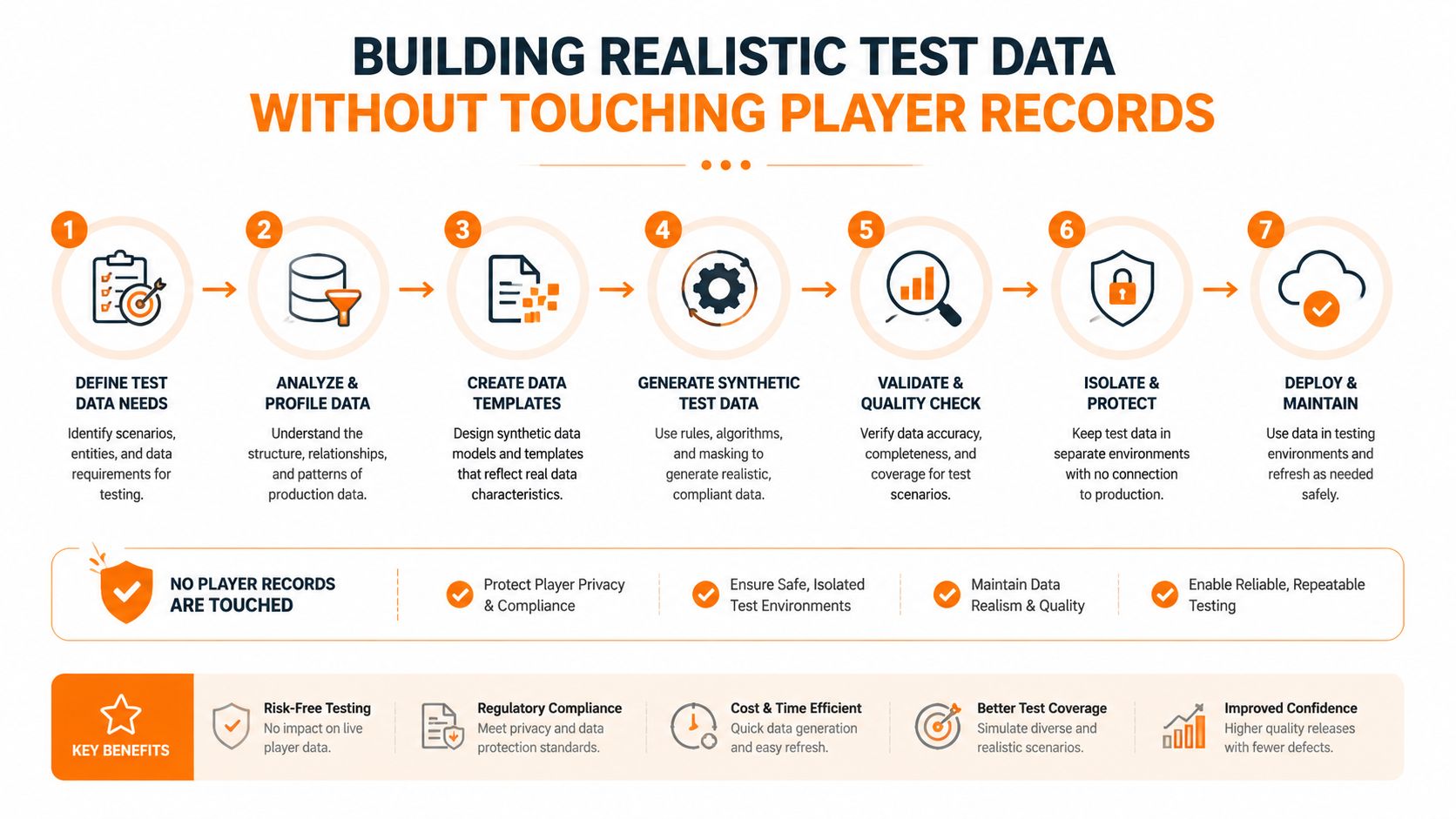
The safer approach is to model behavior, not copy people.
Generate identities and risk patterns
Create synthetic player records with deterministic identifiers so a test can refer to the same player across casino, sportsbook, wallet, KYC, CRM, and reporting systems. Names, addresses, dates, and contact details should be plausible but fabricated. Deterministic generation matters because a retry must reproduce the same account state, while a new test run must be able to start clean.
A useful generator creates behavioral classes rather than random rows. Include ordinary casino play, an account moving from deposit to withdrawal, a multi-leg parlay, a player approaching a deposit cap, a self-excluded identity, a suspected multi-account cluster, and a bonus-abuse pattern. KYC fixtures should cover successful verification, unreadable documents, age failure, sanctions matches, PEP review, provider timeout, soft decline, and retry.
Replay events instead of copying records
Realistic traffic comes from event shape and ordering as much as from values. Anonymize representative wallet events and odds ticks, then replay them at controlled rates inside the sandbox. A sportsbook test should be able to reproduce an odds change between selection and confirmation, a market suspension during bet placement, and a settlement correction after the original result.
For payments, replay deposits, withdrawals, duplicate webhooks, chargebacks, partial failures, and PSP failover. For casino, replay game-session creation, stake authorization, result delivery, round completion, and a delayed provider response. The malware sandbox workflow described by ANY.RUN uses the sequence of submission, execution, observation, and reporting. The same discipline works for iGaming event testing, submit a known fixture, execute the flow, observe every side effect, and retain the report.
Treat freshness as an operating contract
Synthetic data becomes stale when production rules change faster than the test catalogue. Version fixtures alongside game configurations, campaign rules, KYC policies, and wallet schemas. Regenerate scheduled datasets and require data and QA teams to agree on how a new campaign, market rule, or compliance scenario enters the suite.
A good test-data request should describe the behavior required, not ask for a database export. “Create a player who deposits, triggers a bonus, places a pending parlay, reaches a limit, and withdraws while KYC is under review” is actionable. It can be generated safely, reset reliably, and reused in CI without exposing a single player record.
Validating Casino, Sportsbook, and Payment Integrations
Sandbox validation matters most at the seams. Casino, sportsbook, and payments should be tested as one wallet-bearing surface because a player doesn't experience them as separate systems. A casino round can affect balance availability, a sportsbook settlement can release or reverse funds, and a PSP callback can change the same ledger that both products read.
Start by documenting each provider's test and live contract side by side. Record endpoints, supported currencies, wallet operations, settlement cadence, callback URLs, authentication behavior, signing rules, retry semantics, and error responses. Don't assume a provider sandbox mirrors production because the request schema looks familiar.
Where provider sandboxes commonly diverge
Currency rounding can differ between test and live accounts. A provider may simplify void policies, return callbacks immediately, omit realistic latency, or accept a signing configuration that production rejects. Some test environments support only a subset of wallets, game types, markets, or KYC outcomes. These differences aren't reasons to abandon provider sandboxes. They're reasons to supplement them with contract tests and captured traffic.
| Integration area | Sandbox behavior | Production behavior | Parity risk |
|---|---|---|---|
| Odds feed | Controlled fixtures and replayed price changes | Continuous provider updates, suspensions, and corrections | Timing and state transitions may be under-tested |
| Bet placement | Test markets with predictable acceptance | Live market availability and operational cutoffs | Confirmation can differ after an odds change |
| Settlement | Simulated results and provider callbacks | Results, voids, corrections, and delayed messages | Ledger reversal paths may remain unexercised |
| Casino rounds | Selected games and deterministic outcomes | Multiple studios, session rules, and game callbacks | Round completion and wallet reservations can diverge |
| Payments | Test merchant accounts and known responses | PSP risk decisions, fees, chargebacks, and failover | Amounts, signatures, and callback timing may change |
| KYC | Curated pass and fail cases | Jurisdiction-specific documents and vendor decisions | Soft declines and retry states can be missed |
Run the important journey end to end. Place a bet against a replayed odds update, reserve the wallet amount, trigger a promotion decision, settle the result, and reconcile the ledger. Then run a deposit, a withdrawal, a chargeback, and a PSP failover through the same wallet. Assert not only the API response, but also the final balance, transaction status, provider reference, audit record, and reporting output.
For game integrity, keep game configuration and outcome verification visible in the test evidence. Teams working with provably fair mechanics can also review provably fair games as part of their wider integration model.
A contract test should fail when a provider changes a field type, omits a required callback value, alters an error code, or changes signature validation. Traffic replay then covers the messy behavior that a clean contract cannot, including duplicates, delays, retries, and out-of-order events.
Automating Pipelines and Staging-to-Production Gates
Automation determines whether sandbox environment testing survives a busy release calendar. A shared staging environment looks efficient until several branches mutate the same wallet, payment endpoint, or KYC state. Tests then pass or fail according to execution order, and nobody can confidently reproduce the result.
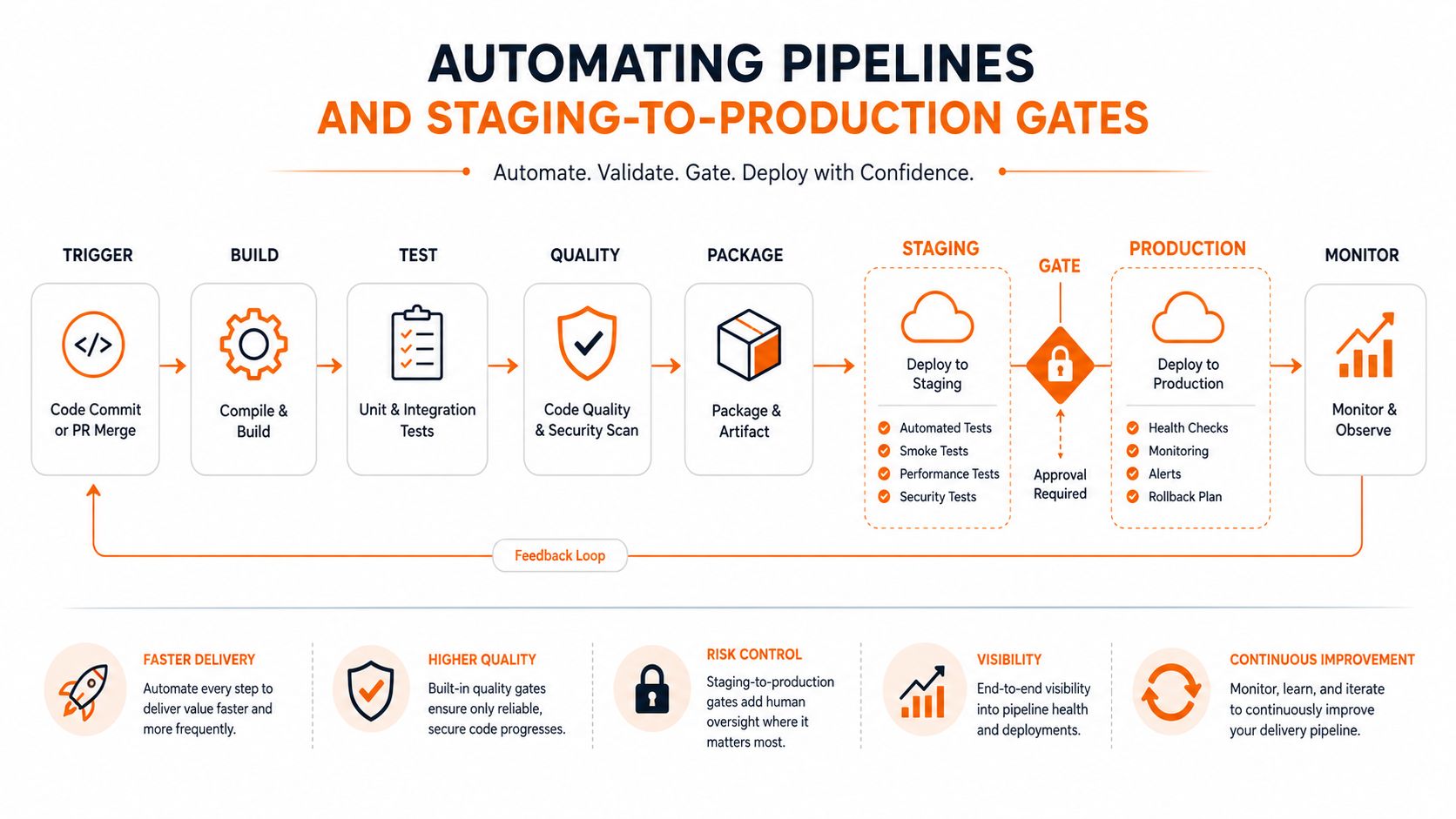
Create an ephemeral environment for each pull request or integration run. It should provision the casino, sportsbook, wallet, payment stubs, KYC fixtures, queues, databases, and observability configuration from versioned definitions. After the run, the environment should be destroyed automatically, including temporary storage, credentials, callbacks, and test data. The guidance on sandbox refresh and parity highlights automation, regular refresh cycles, and reproducible seeded data as practical responses to environment drift.
Use a deliberate test order
Run fast checks before expensive workflows. Unit tests should validate local business rules, contract tests should verify provider schemas and callbacks, and integration tests should exercise service boundaries. Full end-to-end flows belong after those checks, using the staging stack and realistic event replay.
The pipeline should test business outcomes rather than celebrate code coverage. A release candidate needs assertions for wallet reconciliation, failed and retried KYC, sportsbook settlement, casino round completion, promotion eligibility, responsible gambling controls, and reporting records. A green build that never checks the ledger is not a safe build.
Make release gates enforceable
A staging-to-production gate should block deployment when a critical assertion fails. Warnings are useful for exploratory checks, but they're a poor control for money movement or regulatory logic. Record the build identifier, fixture versions, provider responses, reconciliation results, and approval trail with each release.
A canary deployment can provide an additional safety boundary by routing a controlled portion of traffic before a full cutover. Monitor balance errors, rejected callbacks, settlement mismatches, KYC failures, payment declines, and queue growth during that period. The gate should have an explicit rollback condition, not rely on an operator noticing a dashboard after the incident has spread.
Ephemeral environments need resource limits and automatic cleanup. Without lifecycle controls, abandoned environments retain state, consume capacity, and create confusing test results. Vendor dependencies also need ownership, documented escalation paths, and reviewable service expectations, which is why teams should align their test process with vendor management best practices.
Compliance, KYC, and Regression Scenarios to Lock In
Regulated testing is not complete when a player can log in, place a bet, and see a result. The sandbox must demonstrate that the operator enforces the rules attached to the player, jurisdiction, product, payment method, and risk state. Those rules often fail at transitions, especially after a provider change or a wallet refactor.
Test the rule as a state machine
Deposit caps should be tested across successful deposits, pending transactions, reversals, and attempts made through different products. Session controls need coverage for expiry, reality checks, interrupted sessions, and a player continuing after an acknowledgement requirement. Self-exclusion must prevent the relevant activity across casino, sportsbook, promotions, and account access according to the applicable market rules.
Responsible gambling controls should be tied to observable events. Test the trigger, the message, the block or restriction, the audit entry, and the operator workflow that follows. A rule that works in the front end but fails to propagate to the wallet or back office isn't implemented reliably.
KYC needs the same treatment. Test document upload, age verification, sanctions screening, PEP checks, address review, provider timeout, soft decline, retry, manual escalation, and approval after additional evidence. Make sure the player's status remains consistent across account management, cashier, betting, promotions, and reporting.
Compliance evidence should answer three questions: which rule was tested, with which input, and what state did every connected system record?
Turn incidents into permanent fixtures
Every historical production incident deserves a versioned regression case. If a bonus was awarded after self-exclusion, create that sequence. If a multi-account pattern bypassed a control, generate the same behavioral shape with synthetic identities. If an AML velocity check missed rapid deposits or withdrawals, replay the event order and confirm the alert, hold, review queue, and audit record.
Keep legal and compliance owners close to the test catalogue. Market rules change, and a test can become wrong even when the code remains unchanged. The suite should identify the jurisdiction, rule version, expected player treatment, evidence fields, and approval owner. Guidance on risk management best practices can support the wider operating model, but the executable test case must remain specific to the operator's licensed markets and actual integrations.
Run these scenarios against the environment that most closely matches production traffic shape and configuration. A tiny happy-path suite can confirm that the application is reachable. It can't establish that a regulatory restriction survives a wallet update, a delayed provider callback, or a cross-product session.
Common Sandbox Failures and a Pre-Release Audit Checklist
Sandbox programmes usually fail through ordinary operational shortcuts. The schema in staging drifts from production, a supposedly test credential points to a live tenant, or an ephemeral environment survives after the pull request closes. Parallel tests may collide on shared payment endpoints, while a KYC fixture validates one market and ignores another jurisdiction's document rules.
Those failures share one root problem: teams treat the sandbox as a place rather than as a controlled lifecycle. The environment needs an owner, a reset mechanism, a parity record, and evidence that its dependencies behaved as expected.
Audit the release before approval
Use a concise sign-off record that covers:
- Environment parity: Confirm service versions, schemas, feature flags, queues, workers, callback routes, and configuration match the intended production release.
- Isolation: Verify that secrets, networks, payment tenants, logs, alerts, and data stores cannot reach live systems.
- Data freshness: Record fixture versions, synthetic-data generation time, odds and wallet replay sources, and the scenarios added since the previous release.
- Integration health: Check contract results, callback signatures, retry handling, settlement behavior, PSP failover, KYC responses, and provider reference reconciliation.
- Automation gates: Confirm unit, contract, integration, end-to-end, reconciliation, and canary checks completed for the exact build being deployed.
- Compliance evidence: Attach results for limits, reality checks, self-exclusion, responsible gambling triggers, KYC outcomes, AML rules, audit logs, and jurisdiction-specific controls.
- Lifecycle cleanup: Confirm temporary environments, credentials, storage, callbacks, and test accounts were removed or expired.
The final approval should be based on evidence, not confidence. If a provider sandbox cannot reproduce production behavior, document the gap and cover it with replayed traffic, contract tests, or a controlled production canary. That's how an operator turns sandbox environment testing from a ceremonial QA step into a defensible release control.
NexGrate provides a turnkey white-label iGaming platform that brings casino, sportsbook, payments, wallets, KYC, compliance controls, monitoring, and third-party integrations into one operating stack. Visit NexGrate to discuss how a more unified platform can make sandbox testing, release gates, and regulated brand operations easier to manage.